
Life, 1918-07-04 · page 17 of 36
Life — July 4, 1918 — page 17: what you’re looking at
What you’re looking at
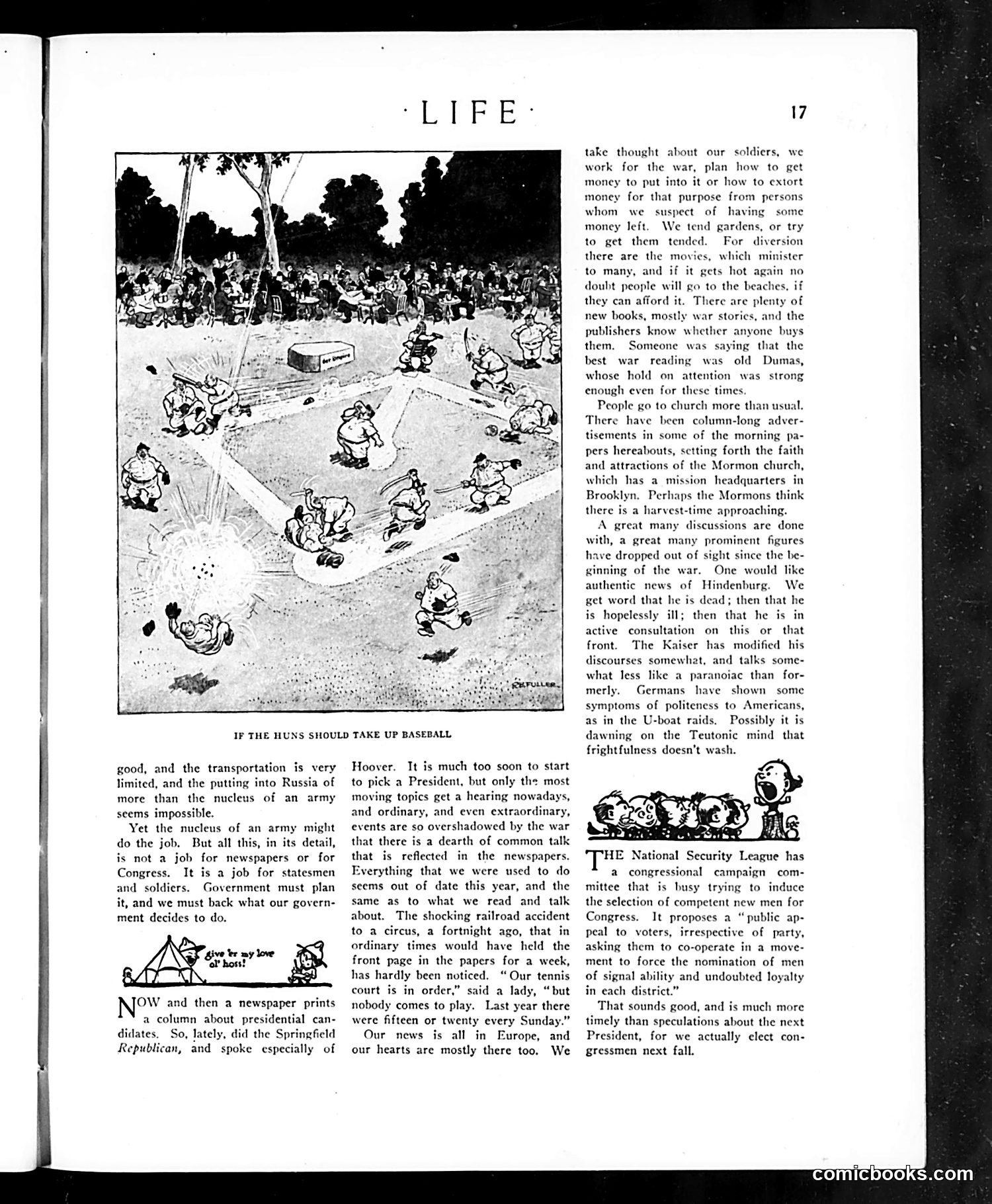
This cartoon satirizes the German military ("the Huns"—a dehumanizing WWI-era term for Germans) by imagining them attempting to play baseball, an quintessentially American sport. The crowded, chaotic scene shows cartoonish German soldiers bungling the game while spectators watch from bleachers. The satire works on two levels: it mocks German militarism as fundamentally incompatible with American recreational culture, and it suggests that Germans, despite their military prowess, cannot master American civilian life or values. Published during American involvement in WWI (the text discusses war efforts and defense), the cartoon reinforces nationalist sentiment by positioning baseball—and by extension American identity itself—as alien to and superior to German culture. The accompanying essay discusses how wartime preoccupations have displaced normal American civic life, making this cartoon's juxtaposition of German soldiers with American leisure particularly pointed.
📄 Transcribed text from this page (OCR, searchable)
Machine-transcribed from the original scan — historical spelling and the odd misread are preserved.
IF THE HUNS SHOULD TAKE UP BASEBALL good, and the transportation is very limited, and the putting into Russia of more than the nucleus of an army seems impossible. Yet the nucleus of an army might do the job. But all this, in its detail, is not a job for newspapers or for Congress. It is a job for statesmen and soldiers. Government must plan it, and we must back what our govern- ment decides to do. OW and then a newspaper prints a column about presidential can- didates, So, lately, did the Springfield Republican, and spoke especially of Hoover. It is much too soon to start to pick a President, but only the most moving topics get a hearing nowadays, and ordinary, and even extraordinary, events are so overshadowed by the war that there is a dearth of common talk that is reflected in the newspapers. Everything that we were used to do seems out of date this year, and the same as to what we read and talk about. The shocking railroad accident to a circus, a fortnight ago, that in ordinary times would have held the front page in the papers for a week, has hardly been noticed. “Our tennis court is in order,” said a lady, “but nobody comes to play. Last year there were fifteen or twenty every Sunday.” Our news is all in Europe, and our hearts are mostly there too. We 17 take thought about our soldiers, we work for the war, plan how to get money to put into it or how to extort money for that purpose from persons whom we suspect of having some money left. We tend gardens, or try to get them tended. For diversion there are the movies, which minister to many, and if it gets hot again no doubt people will go to the beaches, if they can afford it. There are plenty of new books, mostly war stories, and the publishers know whether anyone buys them. Someone was saying that the best. war reading was old Dumas, whose hold on attention was strong enough even for these times. People go to church more than usual. There have been column-long adver- tisements in some of the morning pa- pers hereabouts, setting forth the faith and attractions of the Mormon church, which has a mission headquarters in Brooklyn, Perhaps the Mormons think there is a harvest-time approaching. A great many discussions are done with, a great many prominent figures have dropped out of sight since the be- ginning of the war. One would like authentic news of Hindenburg. We get word that he is dead; then that he is hopelessly ill; then that he is in active consultation on this or that front. The Kaiser has modified his discourses somewhat, and talks some- what less like a paranoiac than for- merly. Germans have shown some symptoms of politeness to Americans, as in the U-boat raids. Possibly it is dawning on the Teutonic mind that frightfulness doesn’t wash. TH National Security League has a congressior campaign com- mittee that is busy trying to induce the selection of competent new men for Congress. It proposes a “public ap- peal to voters, irrespective of party, asking them to co-operate in a move- ment to force the nomination of men of signal ability and undoubted loyalty in each district.” That sounds good, and is much more timely than speculations about the next President, for we actually elect con- gressmen next fall.