
A complete issue · 35 pages · 1917
Life — May 17, 1917
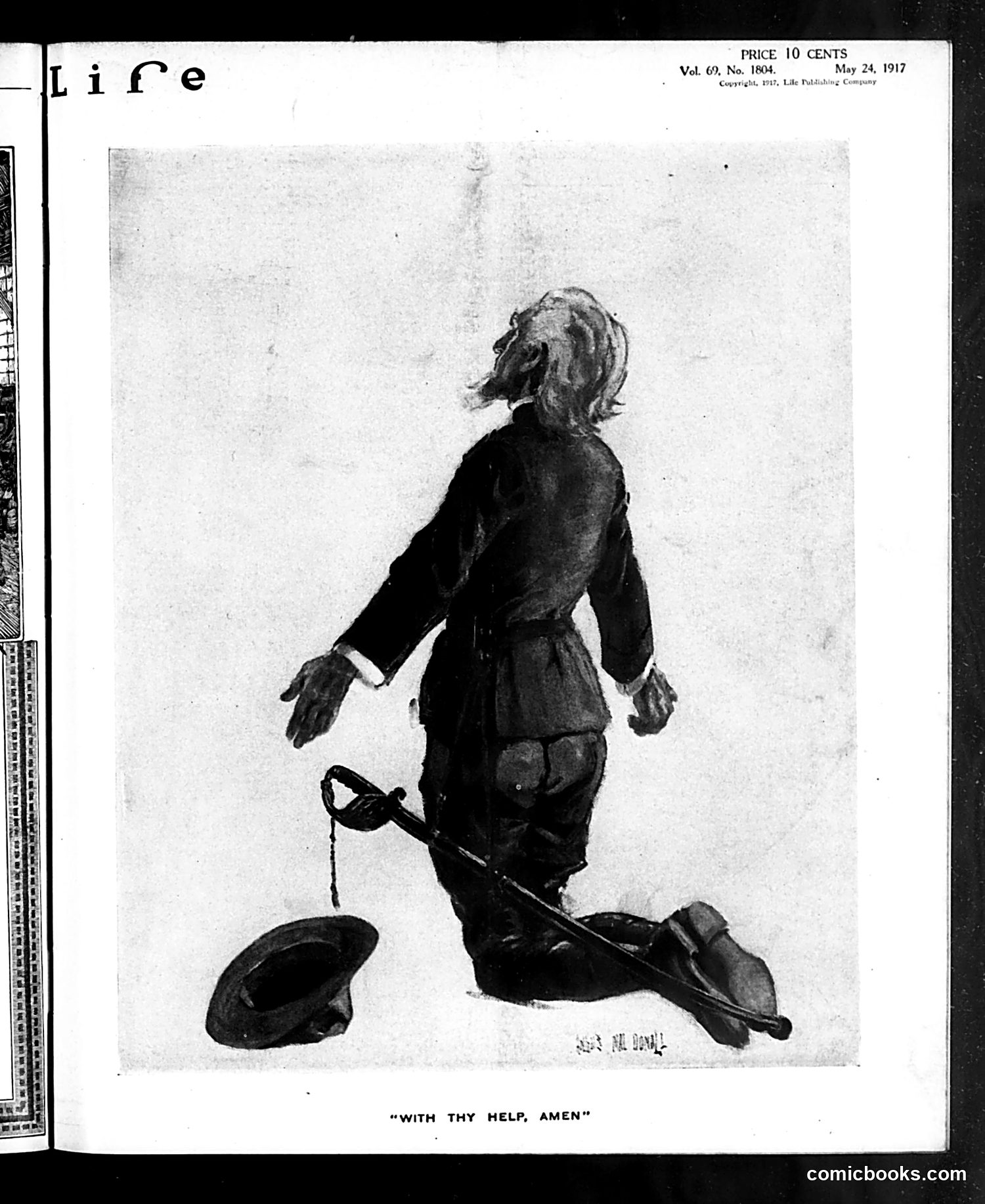
This is a Life magazine cover from May 24, 1917, depicting a figure in military uniform kneeling in prayer, with a sword and hat beside them. The caption reads "WITH THY HELP, AMEN." The image appears to be religious/patriotic propaganda from America's entry into World War I (April 1917). The kneeling soldier represents American servicemen appealing to divine assistance for the war effort. The composition—prayer posture, military regalia, abandoned weapons—suggests faith as essential to military success. This reflects the widespread mobilization rhetoric of 1917, where religious sentiment was invoked to support wartime sacrifice and recruitment. The satire may be gentle, affirming the spiritual dimension soldiers would need, or potentially critical of framing warfare as divinely sanctioned—though the tone is ambiguous without additional context.
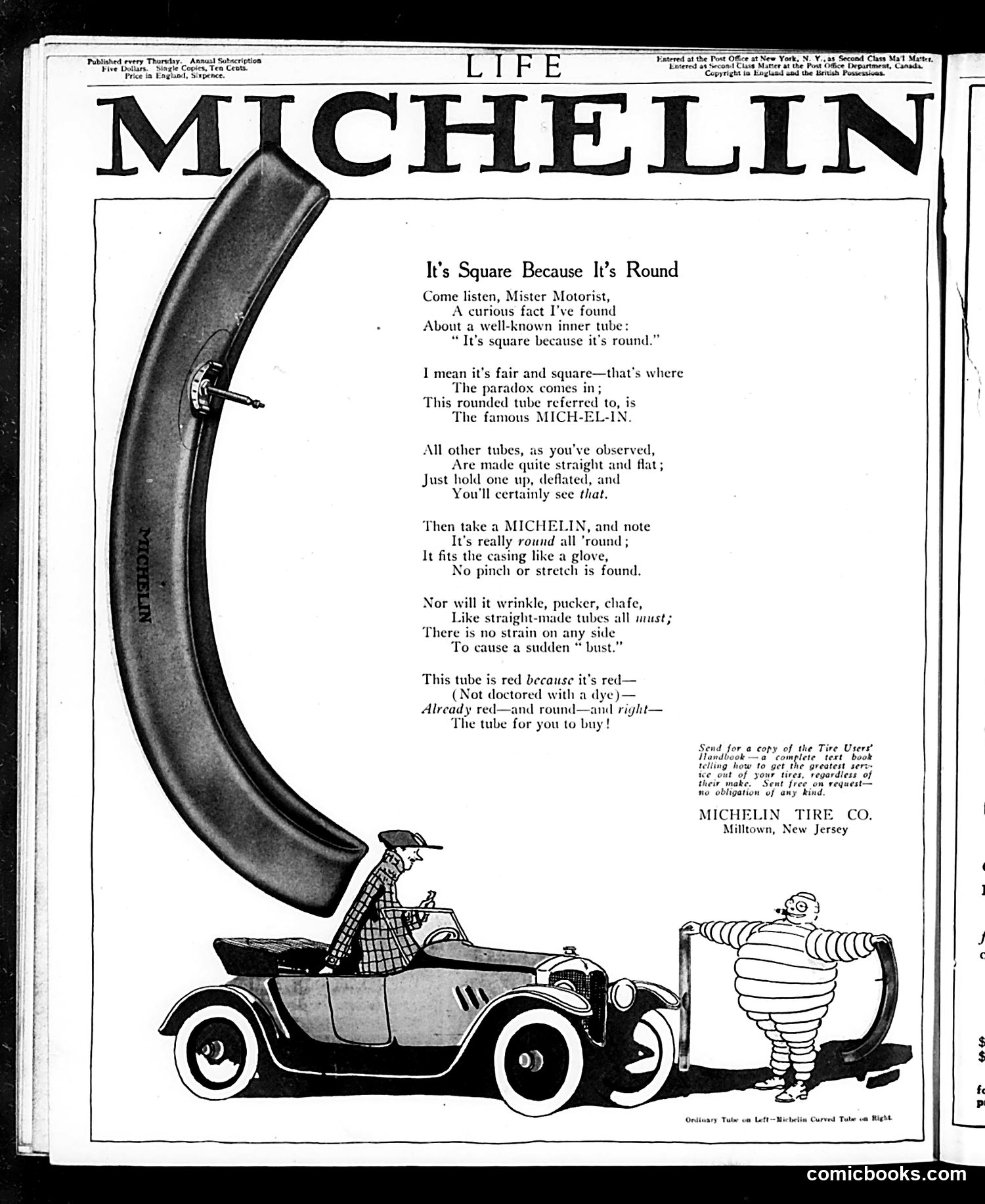
This is a Michelin tire advertisement, not political satire. It promotes Michelin's inner tubes through humorous verse and illustration. The ad's joke: Michelin tubes are "square because [they're] round"—a paradox explained by the tube's superior roundness and flexibility. The copy contrasts Michelin's rounded design with competitors' flat tubes that wrinkle and pinch when deflated. The illustration shows a motorist struggling with an oversized curved tube above his car, while the Michelin Man (the company's mascot, visible on the right) appears amused. The exaggerated size humorously demonstrates the tube's superior design. The verse playfully explains why Michelin's red-colored tube is superior: it maintains its round shape, prevents pinching, and resists damage—key selling points for early automotive tire tubes.
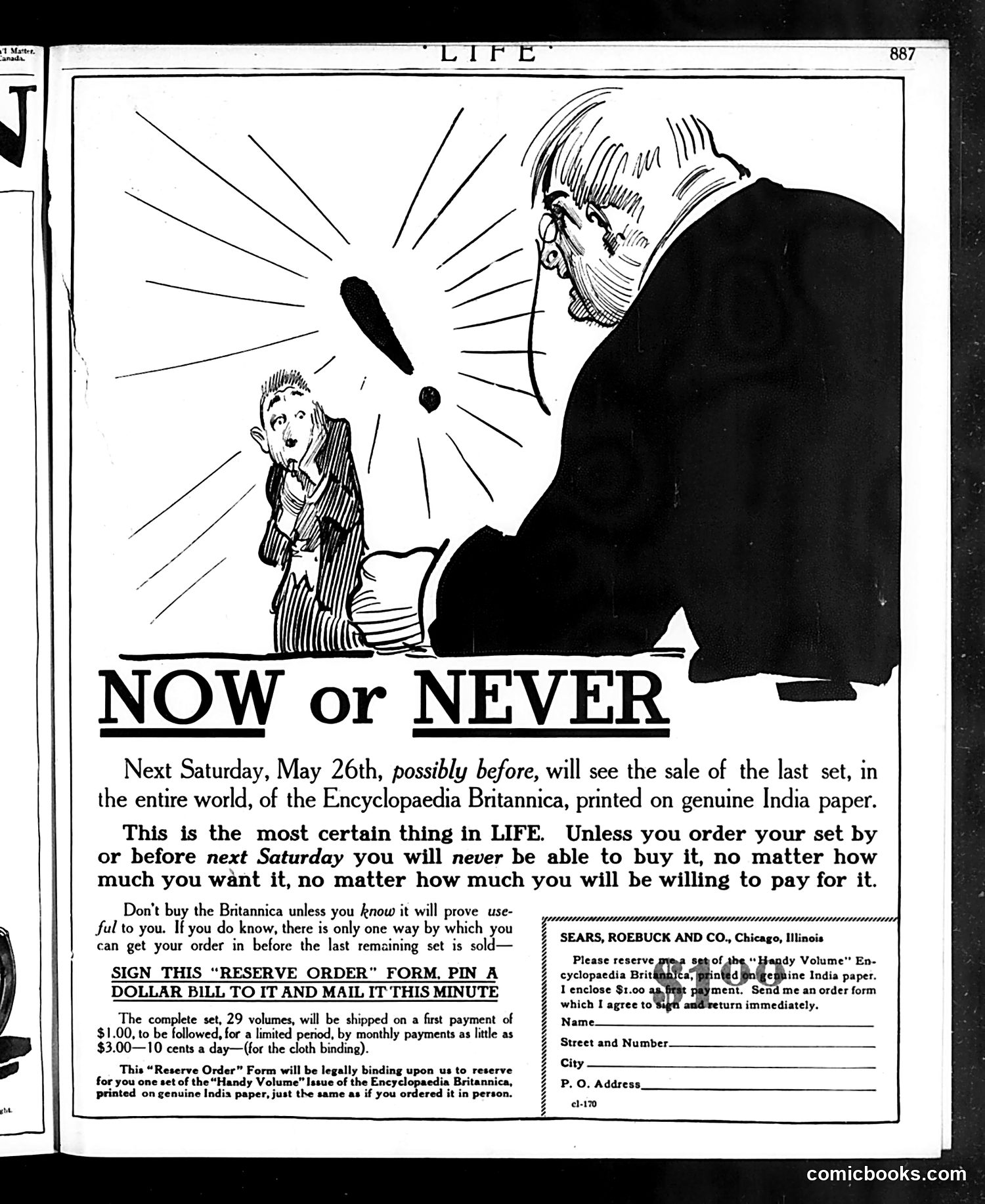
This page is primarily an advertisement for the Encyclopedia Britannica, not political satire. The cartoon illustrates a sales pitch using urgency and emotional appeal. **The Image:** A large, stern figure (likely representing a salesman or authority figure) leans over a small, frightened man, with an exclamation point between them. The visual metaphor emphasizes pressure and alarm. **The Message:** The ad uses fear-based marketing, claiming that the "last set" of Encyclopedia Britannica printed on genuine India paper will be sold May 26th. It warns customers they must order immediately or "never be able to buy it, no matter how much you want it." **The Satire:** The exaggerated urgency and melodramatic tone parody high-pressure sales tactics. The cartoon mocks how salesmen manufacture artificial scarcity and panic to drive purchases—a critique of manipulative advertising itself.
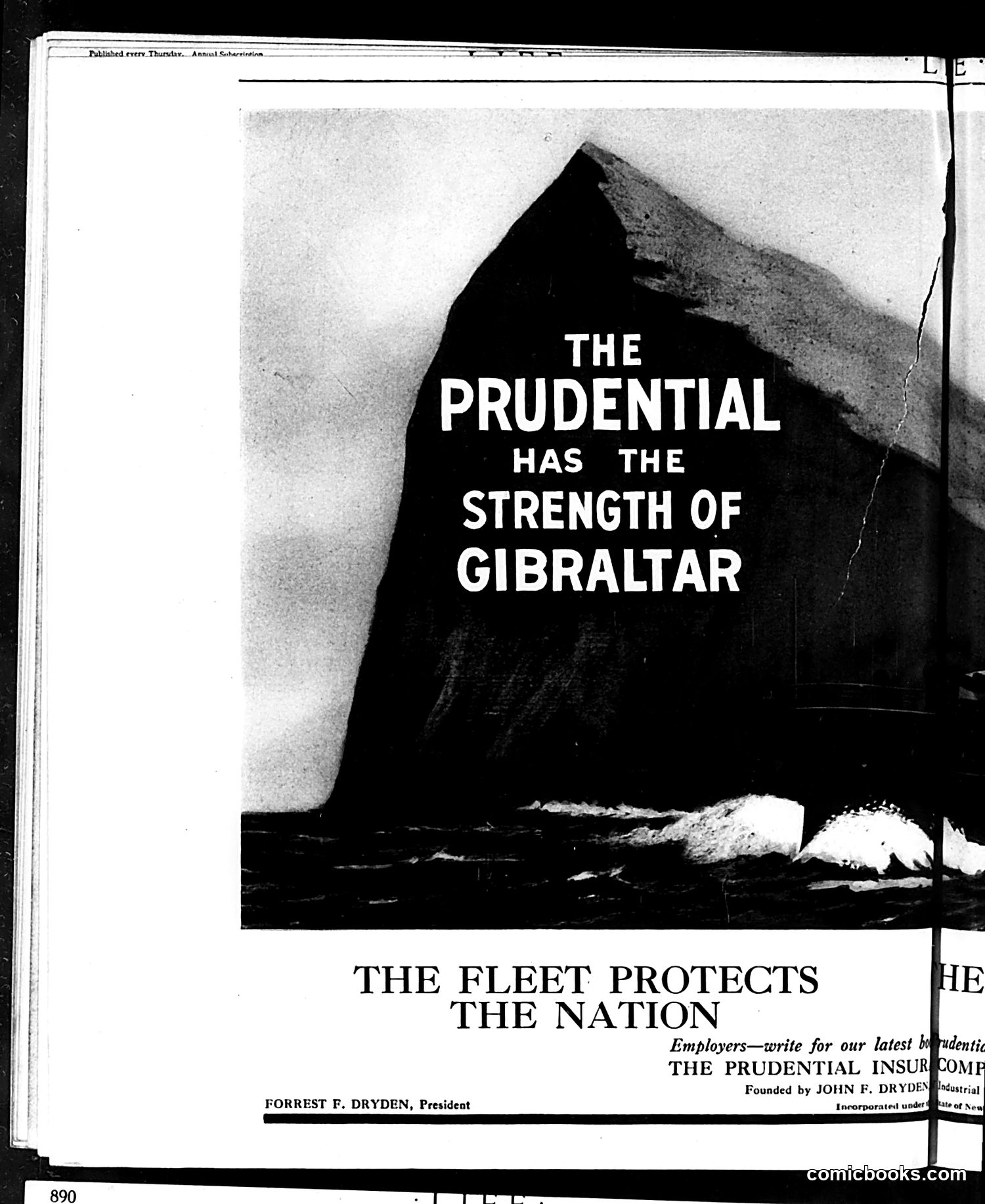
This page is primarily an **advertisement**, not satire or political commentary. The Prudential Insurance Company uses dramatic imagery of the Rock of Gibraltar to promote their financial services. The **visual metaphor** compares Prudential's stability to Gibraltar's legendary strength and permanence—Gibraltar being a famous, nearly impregnable fortification. The slogan "THE PRUDENTIAL HAS THE STRENGTH OF GIBRALTAR" positions the insurance company as an unshakeable protector of national security and personal finances. The tagline "THE FLEET PROTECTS THE NATION" reinforces patriotic messaging while implicitly linking Prudential to national defense and economic security. The ad targets employers, offering "prudential" (cautious, wise) insurance solutions. This reflects early 20th-century advertising strategy: associating commercial products with national strength and stability during economically uncertain times.
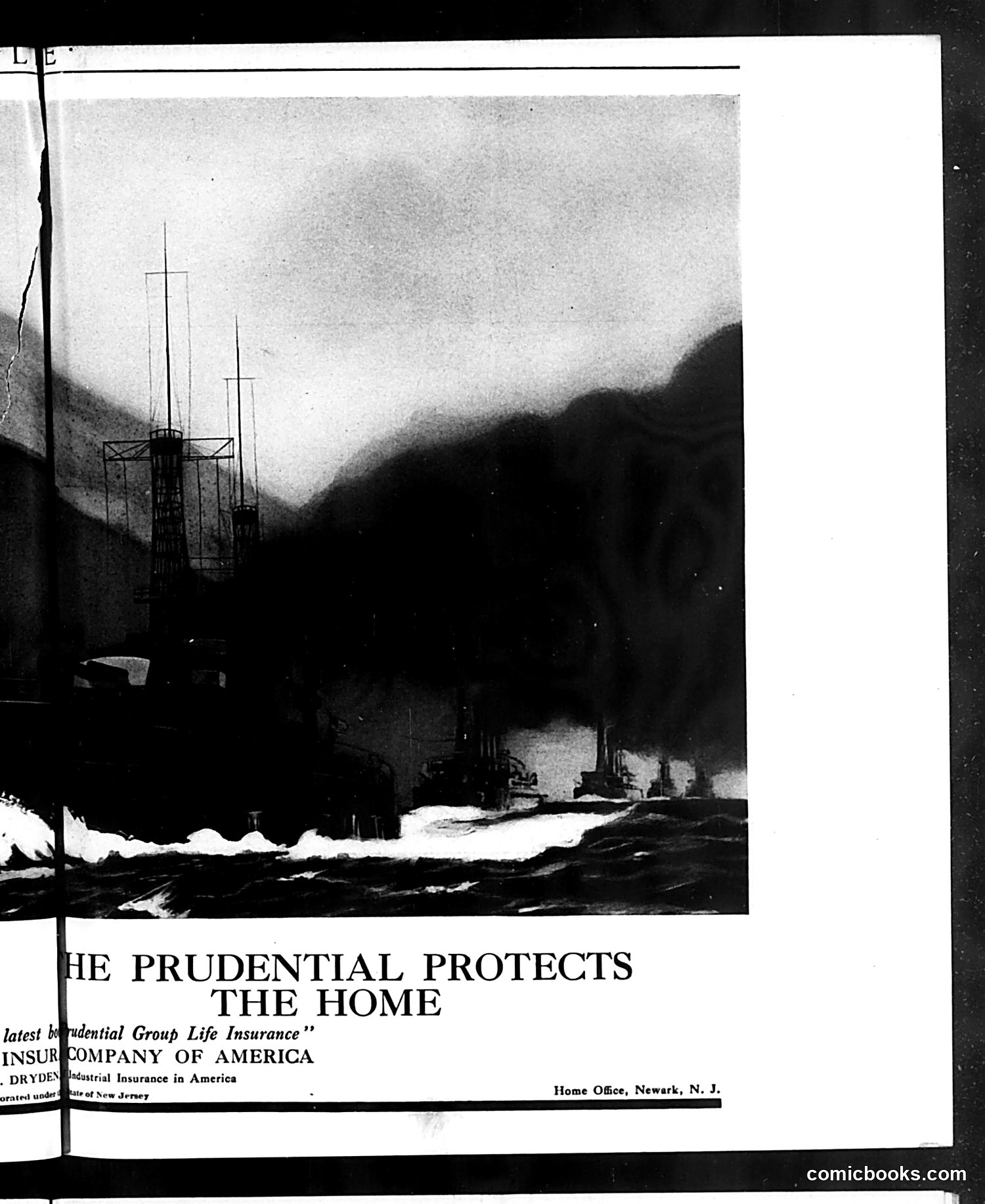
This appears to be an insurance advertisement rather than political satire. The image shows an industrial waterfront scene with tall smokestacks, ships, and factories silhouetted against a dramatic sky—likely depicting a port or manufacturing district. The headline "HE PRUDENTIAL PROTECTS THE HOME" promotes the Prudential Group Life Insurance Company of America, based in Newark, New Jersey. The advertisement uses the industrial landscape to suggest economic productivity and security; the implicit message is that Prudential insurance protects families from financial hardship caused by the death of a wage-earner working in such industrial settings. This reflects early-20th-century advertising strategy: associating insurance with industrial progress and masculine economic responsibility.
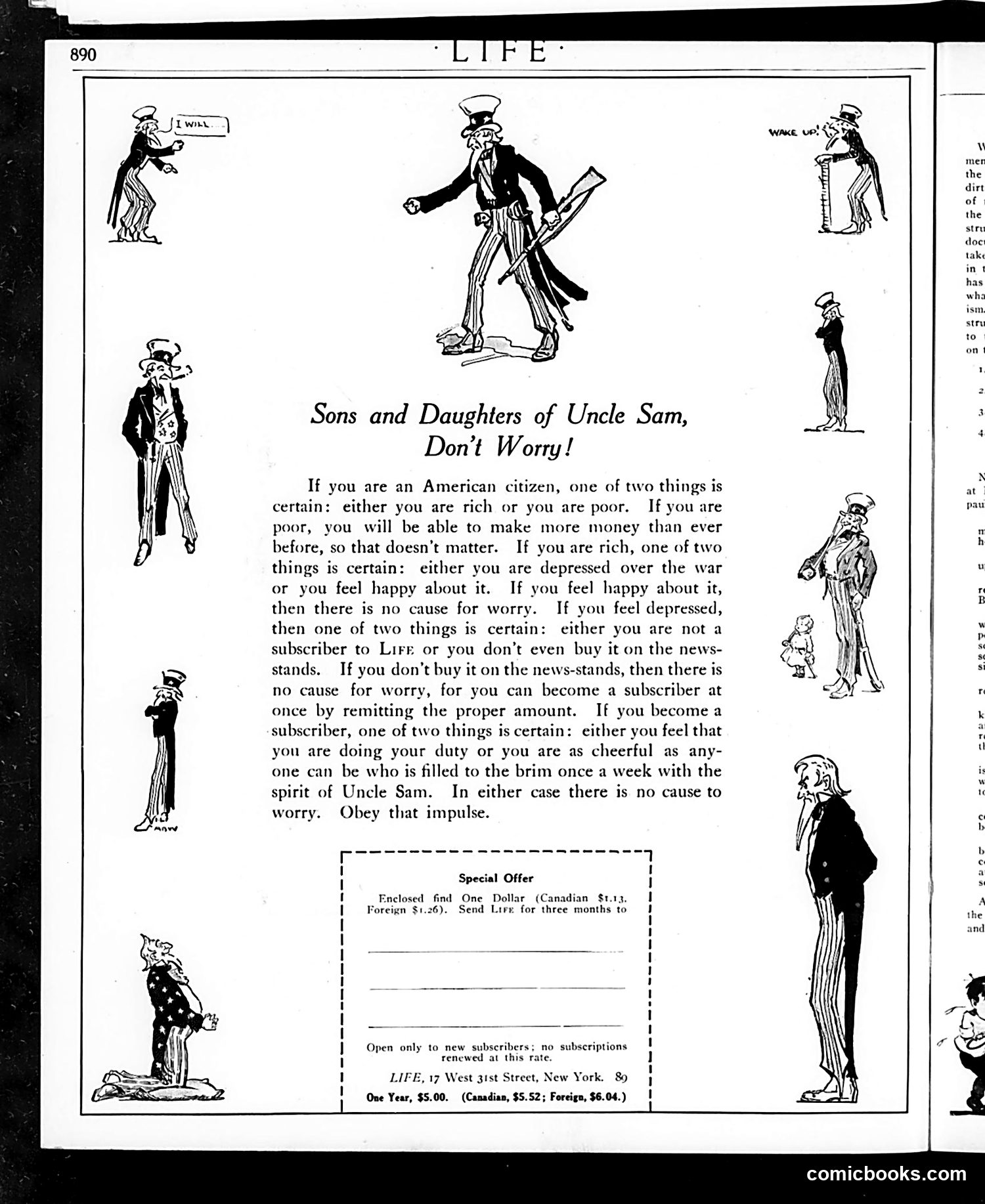
This is a subscription advertisement for *Life* magazine featuring Uncle Sam as the central figure, surrounded by smaller illustrations of him in various poses and moods. The headline "Sons and Daughters of Uncle Sam, Don't Worry!" uses a logical-fallacy argument structure: it claims that regardless of whether readers are rich or poor, happy or depressed about "the war" (likely World War I, given the historical period), they have "no cause for worry" if they subscribe to *Life*. The satire targets the magazine's own promotional claims—suggesting that reading *Life* provides such reliable comfort and entertainment that it's a guaranteed antidote to any anxiety. The surrounding caricatures of Uncle Sam emphasize this theme through repetition and exaggeration, implying that subscription offers an almost magical solution to wartime concerns.
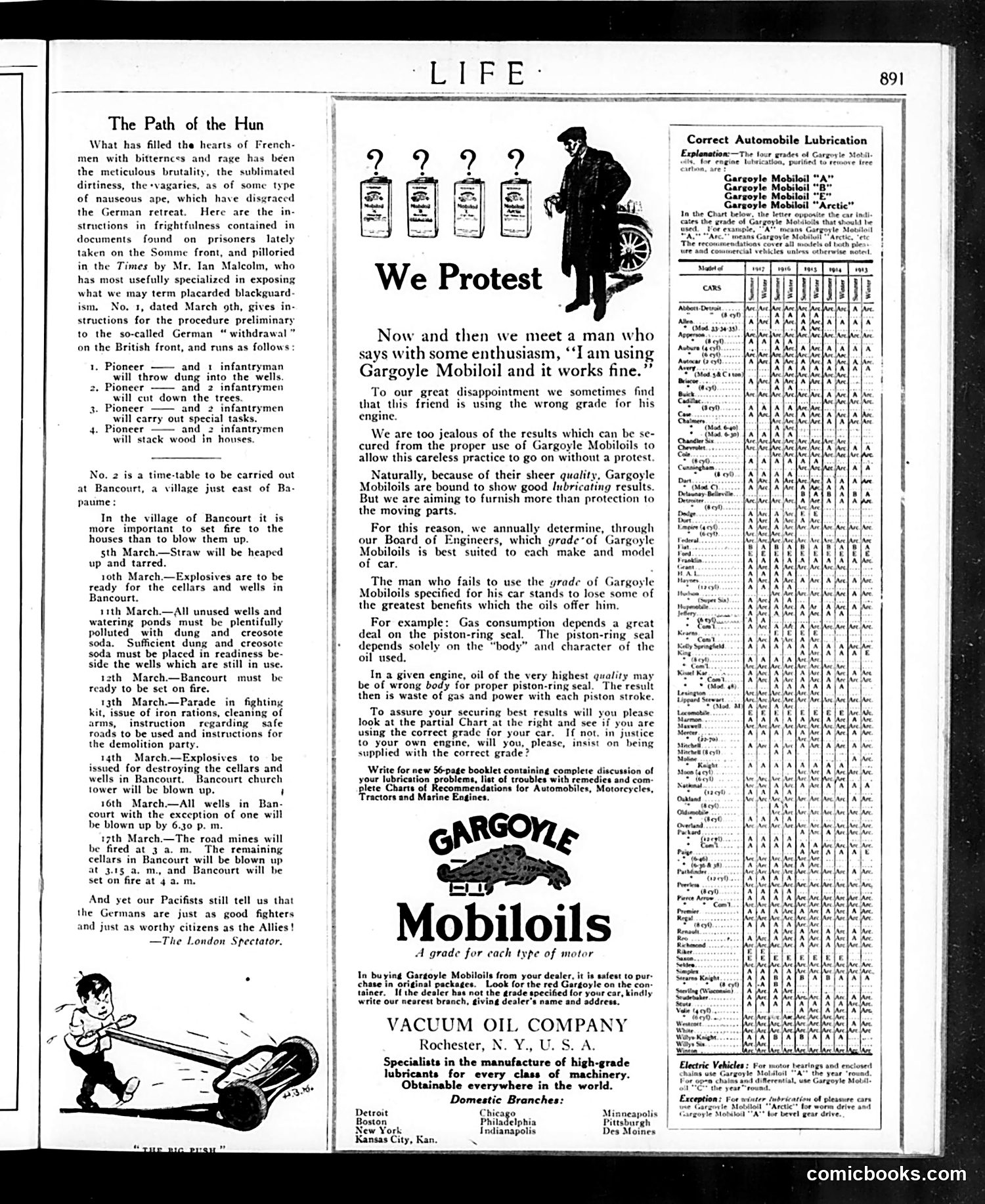
This page is primarily **advertising for Gargoyle Mobiloils** (automobile lubricants), though it includes unrelated content. The left column contains "The Path of the Hun"—an article about German military brutality during WWI, citing specific atrocities documented in the Somme campaign. The text references the *Times* by Max Macholm, appearing to be a historical account of German wartime conduct. The main advertisement features a man "protesting" that he uses Gargoyle Mobiloil despite sometimes meeting users of competing brands. The ad humorously frames proper oil selection as a point of pride and technical importance for engine performance. The bottom includes a small cartoon of a figure straining with effort, likely reinforcing the advertisement's message. The extensive chart on the right specifies Gargoyle Mobiloil grades for different vehicle types and engines.
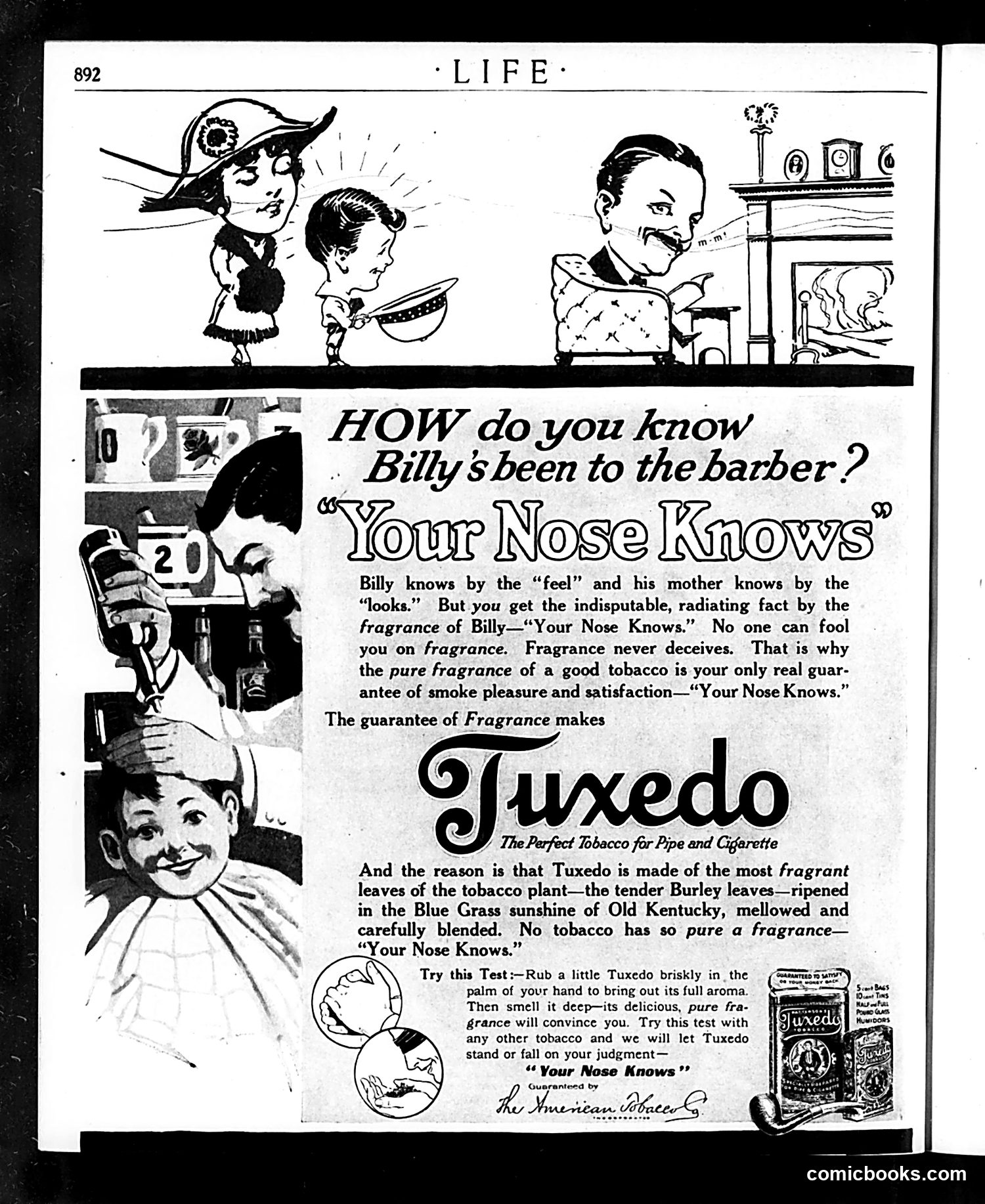
This is primarily a **tobacco advertisement**, not political satire. The page shows a humorous ad for "Tuxedo" pipe and cigarette tobacco, using the slogan "Your Nose Knows." The cartoons at top depict a child ("Billy") visiting a barber—the joke being that you can tell he's been there by the "feel" and "looks," but the ad claims fragrance is the true indicator of quality. The ad then pivots to tobacco: just as you recognize a barber visit, "your nose knows" good tobacco by its pure fragrance. The barber-chair illustrations on the left reinforce this through visual repetition. The ad emphasizes Tuxedo's "pure fragrance" from Kentucky Burley leaves as a quality guarantee, encouraging readers to test it themselves. This reflects early 20th-century advertising that directly targeted consumers' sensory experience and trust.
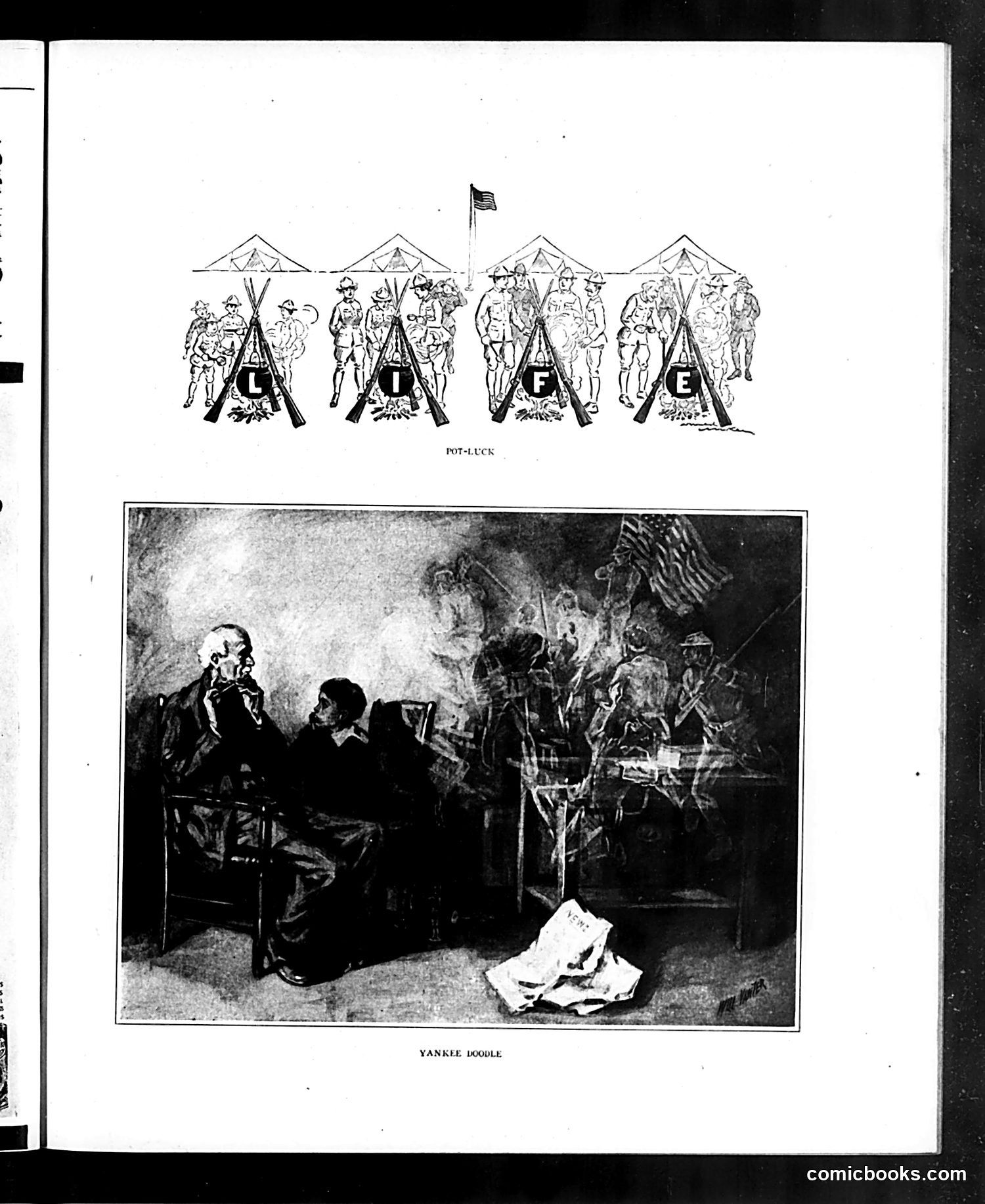
This page contains two illustrations satirizing American military culture during what appears to be the early 20th century. The top illustration, labeled "POT-LUCK," depicts four military camp tents with soldiers gathered around campfires marked with letters C, A, M, P—spelling the word vertically. The American flag flies above, suggesting a patriotic military setting. The bottom illustration, "YANKEE DOODLE," shows officers in what appears to be a tent interior with an American flag visible. The scene depicts a military gathering or entertainment, possibly referencing the famous patriotic song "Yankee Doodle." Both images employ wordplay and visual puns typical of Life magazine's satirical style, humorously depicting military life and American patriotism. The exact historical context or specific events referenced remain unclear without additional dating or documentation.
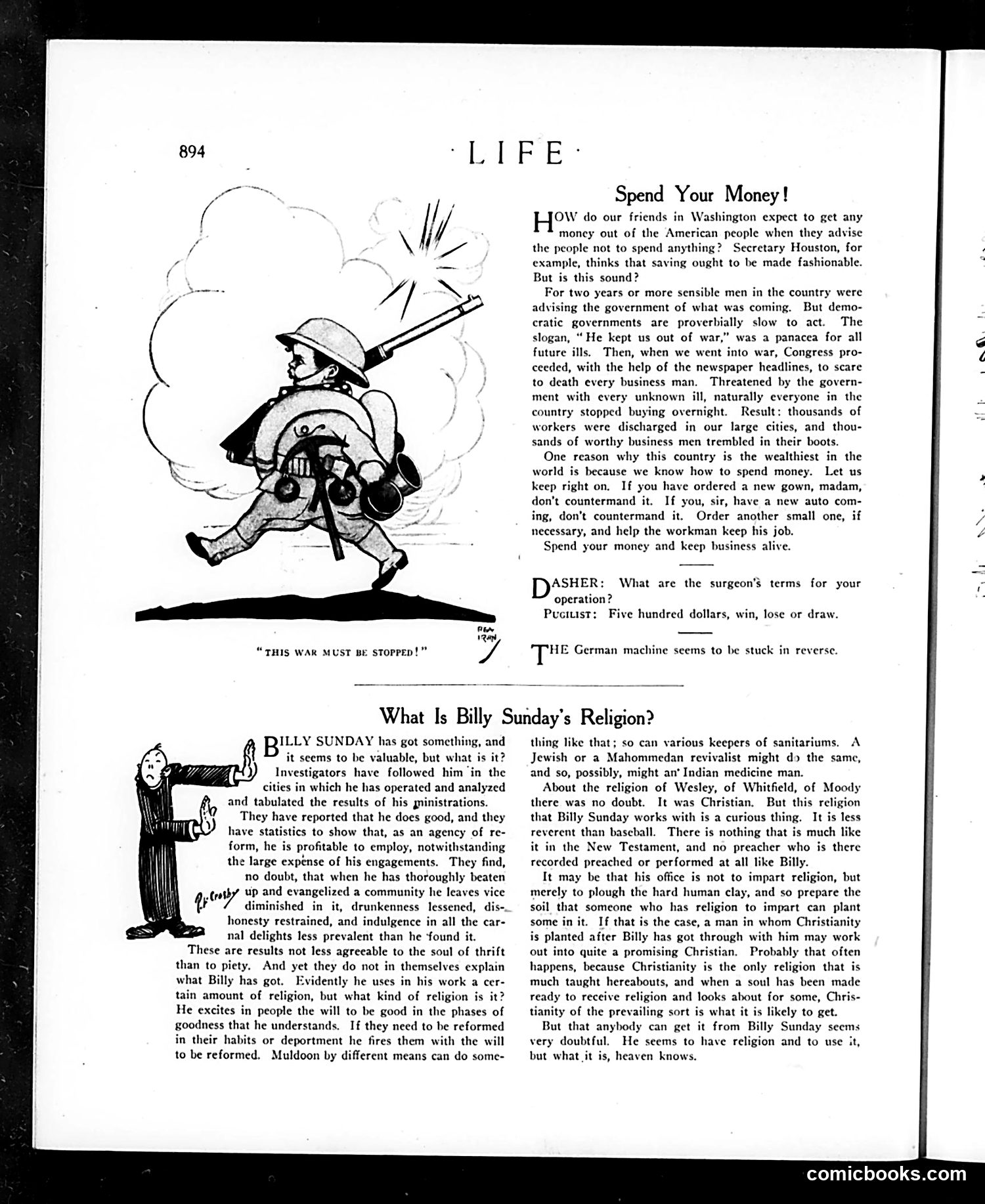
**Main Cartoon:** The illustration shows a soldier being blown backward by an explosion, captioned "THIS WAR MUST BE STOPPED!" The cartoon satirizes anti-war sentiment during what appears to be World War I. The irony is that those advocating to "stop the war" are being literally blown apart by it—suggesting the absurdity or futility of pacifist rhetoric in the face of actual warfare. **"Spend Your Money" Article:** This piece criticizes Secretary of Houston and those who advised Americans not to spend money before the war, warning it would lead to economic collapse. The author argues that spending actually maintains employment and business health—a proto-Keynesian economic argument. The surgeon/pugilist dialogue jokes about the costs of war itself. **Billy Sunday Section:** Discusses the evangelist Billy Sunday's charitable work and questions his actual religious commitment, suggesting his religion serves practical rather than spiritual purposes.
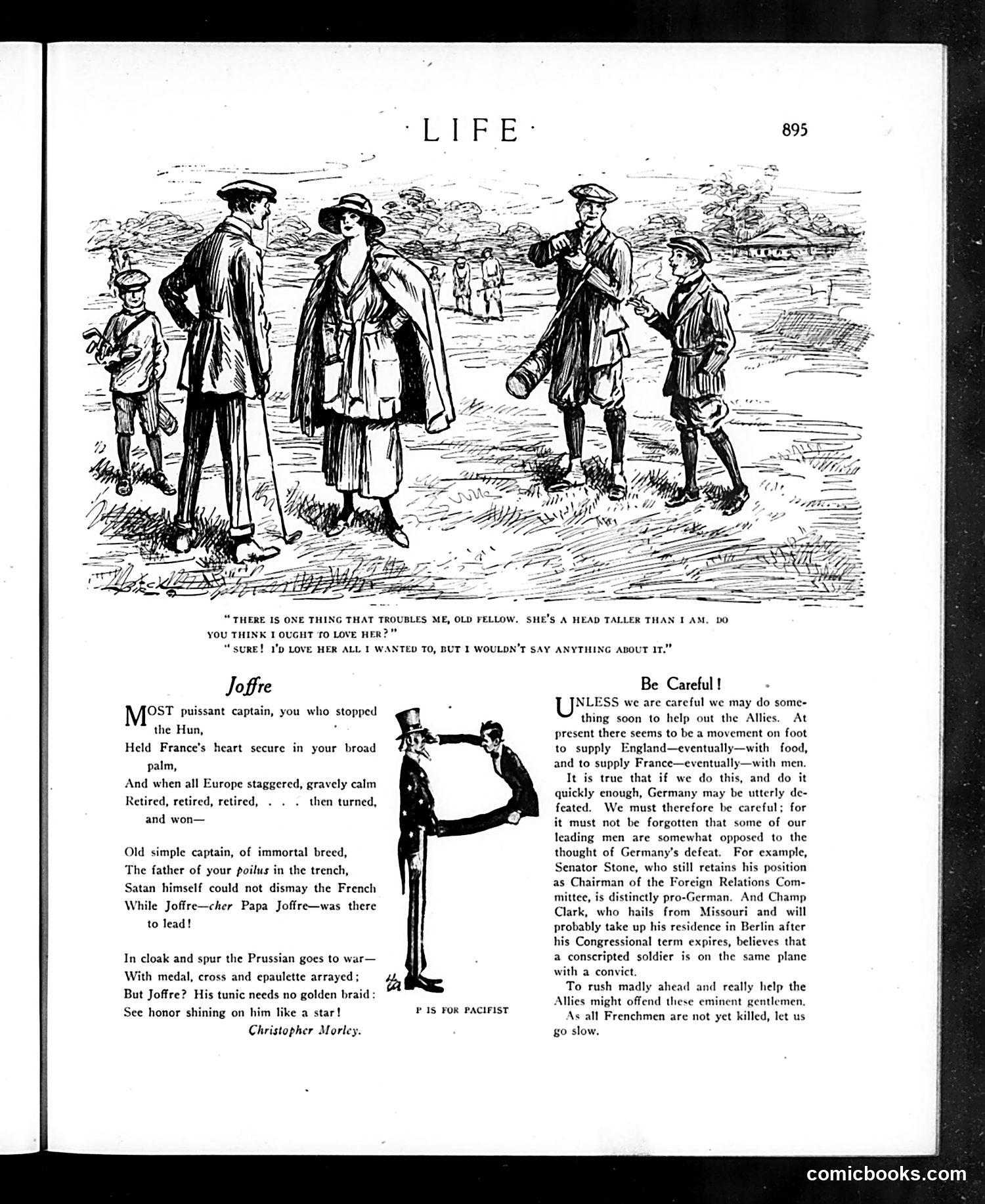
This page contains two pieces of WWI-era political commentary: **The illustration** depicts what appears to be a military scene with officers and civilians discussing a woman's height, with dialogue about her being "a head taller than I am." **"Joffre"** (left) is a poem by Christopher Morley praising French General Joseph Joffre, who commanded French forces during WWI. It celebrates him as a heroic leader ("immortal breed") who held back the German advance ("stopped the Hun"). **"Be Careful!"** (right) is a cautionary editorial warning American leaders against rushing into military involvement. It references specific pro-German senators (Stone and Clark) and expresses concern that hasty American intervention might offend French allies still fighting. The piece advocates slow, measured support rather than dramatic military commitment. The overall page reflects American debate over involvement in the ongoing European war.
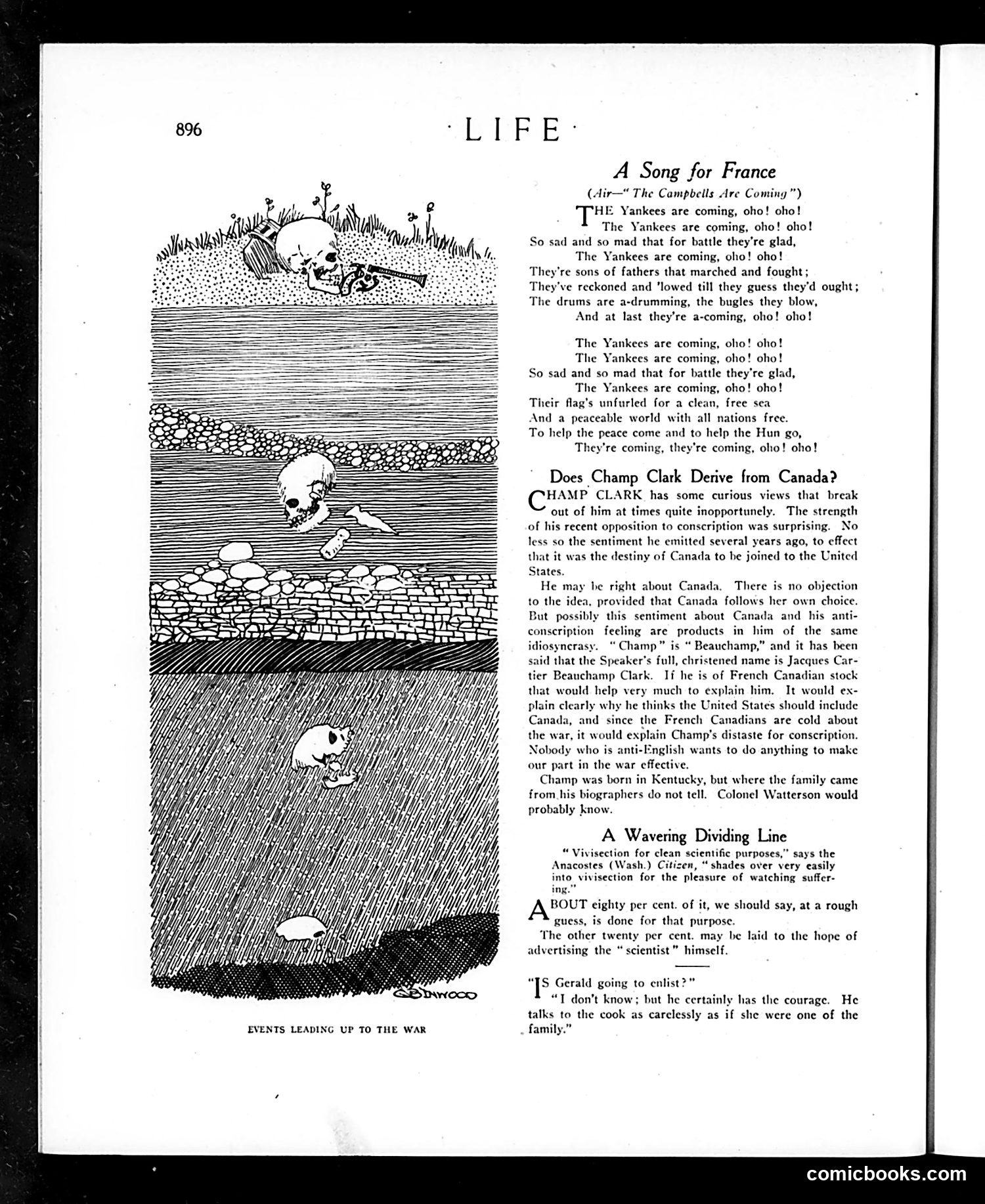
This *Life* magazine page contains WWI-era satirical content. The illustration labeled "Events Leading Up to the War" depicts skeletal figures in successive underground layers, suggesting the accumulation of death and destruction preceding the conflict. The article "A Song for France" celebrates American military support for France, with lyrics about "Yankees coming" to aid the war effort—reflecting American intervention sentiment. "Does Champ Clark Derive from Canada?" discusses a political figure's controversial views on Canada's relationship to the United States. The piece suggests his anti-war or isolationist positions reflect suspicious sympathies, while implying that French-Canadian heritage might explain his stance. "A Wavering Dividing Line" discusses medical standards for military service, humorously noting that "eighty percent" serve for genuine purposes while "twenty percent" may seek to advertise themselves as scientists.
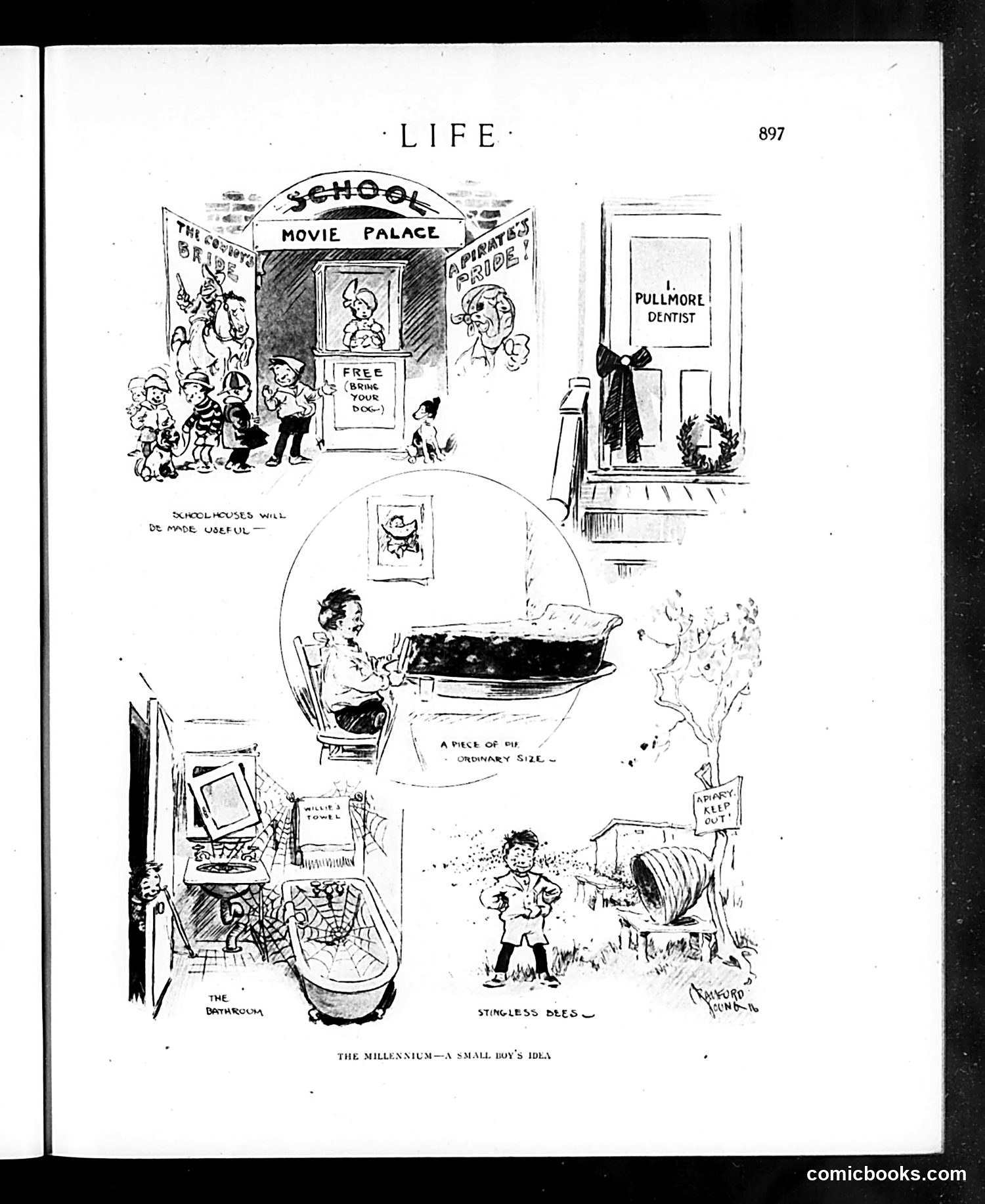
This satirical cartoon series depicts a child's utopian vision of the future, contrasting idealistic hopes with practical realities: 1. **Movie Palace with free admission** - suggests entertainment democratized for all 2. **Pullmore Dentist** - implies dental care becomes accessible/normalized 3. **A pie of ordinary size** - humor about abundance, though still modest 4. **The bathroom** - shows plumbing as luxury amenity, suggesting indoor sanitation becomes universal 5. **Stingless bees** - represents nature perfected, removing life's annoyances The caption "SCHOOLHOUSES WILL BE MORE USEFUL" (top left) suggests even education transforms. The satire gently mocks both childish naiveté about progress and early-20th-century optimism about technological solutions solving human problems. It's humorous commentary on what this era imagined "the millennium" (future utopia) would entail—revealing period preoccupations with comfort, entertainment, and removing minor inconveniences.
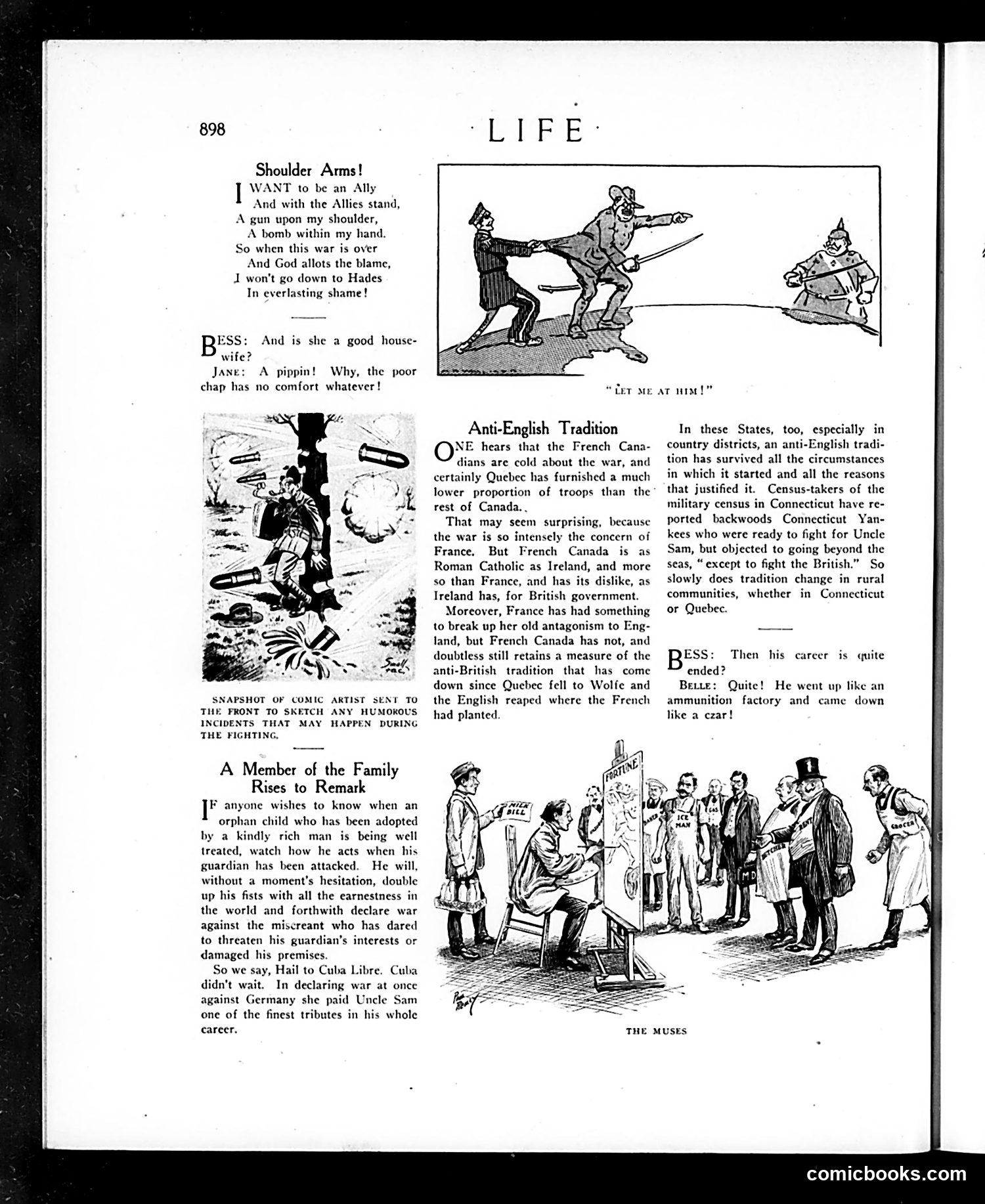
This page contains WWI-era American satirical content. The top cartoon "Shoulder Arms!" depicts a soldier enlisting to fight alongside the Allies, with jingoistic language about bombs and warfare. The "Anti-English Tradition" article discusses French-Canadian reluctance to support the war effort, contrasting this with America's commitment. It notes historical anti-British sentiment in Quebec persists despite the conflict. "A Member of the Family Rises to Remark" celebrates Cuba's declaration of war against Germany, calling it "one of the finest tributes" to Uncle Sam's leadership. The bottom illustration "The Muses" appears to depict various figures, possibly representing different aspects of war support or public opinion. The overall page promotes American and Allied patriotism while addressing public resistance to the war effort in certain communities.
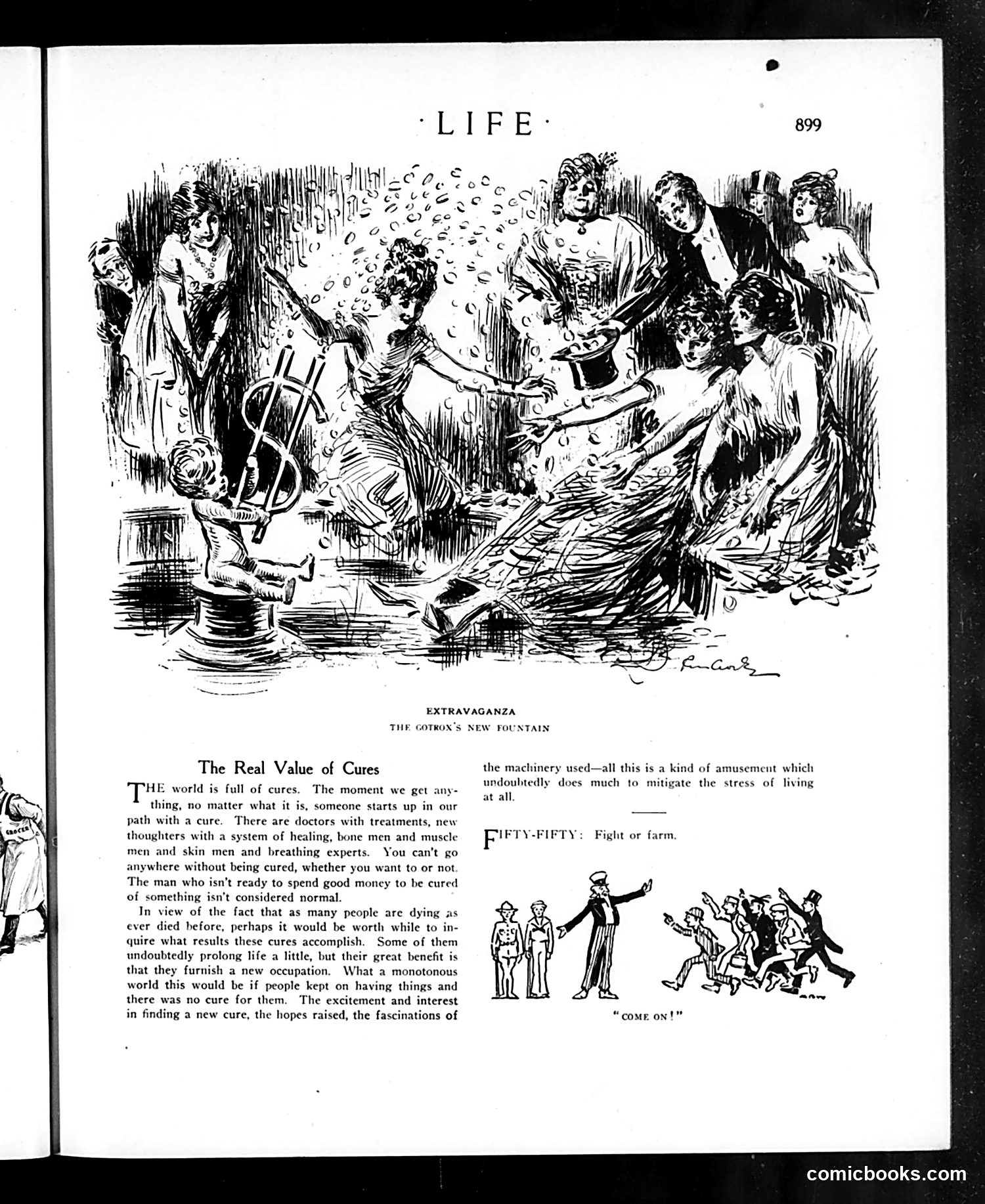
The top illustration titled "Extravaganza: The Gorgon's New Fountain" depicts a chaotic scene of elaborately dressed women around a central figure playing a harp, with money (indicated by dollar signs) flowing like water from a fountain. The article "The Real Value of Cures" satirizes society's obsession with medical treatments and remedies. It argues that the proliferation of cures—for ailments both serious and trivial—has created an entire industry of "doctors with treatments" and "breathing experts." The satire suggests people are unnecessarily spending money on questionable remedies simply because cures exist, and that this endless cycle of seeking cures provides artificial employment and entertainment rather than genuine health benefits. The lower cartoon "Fifty-Fifty: Fight or Farm" appears to humorously depict occupational choices.
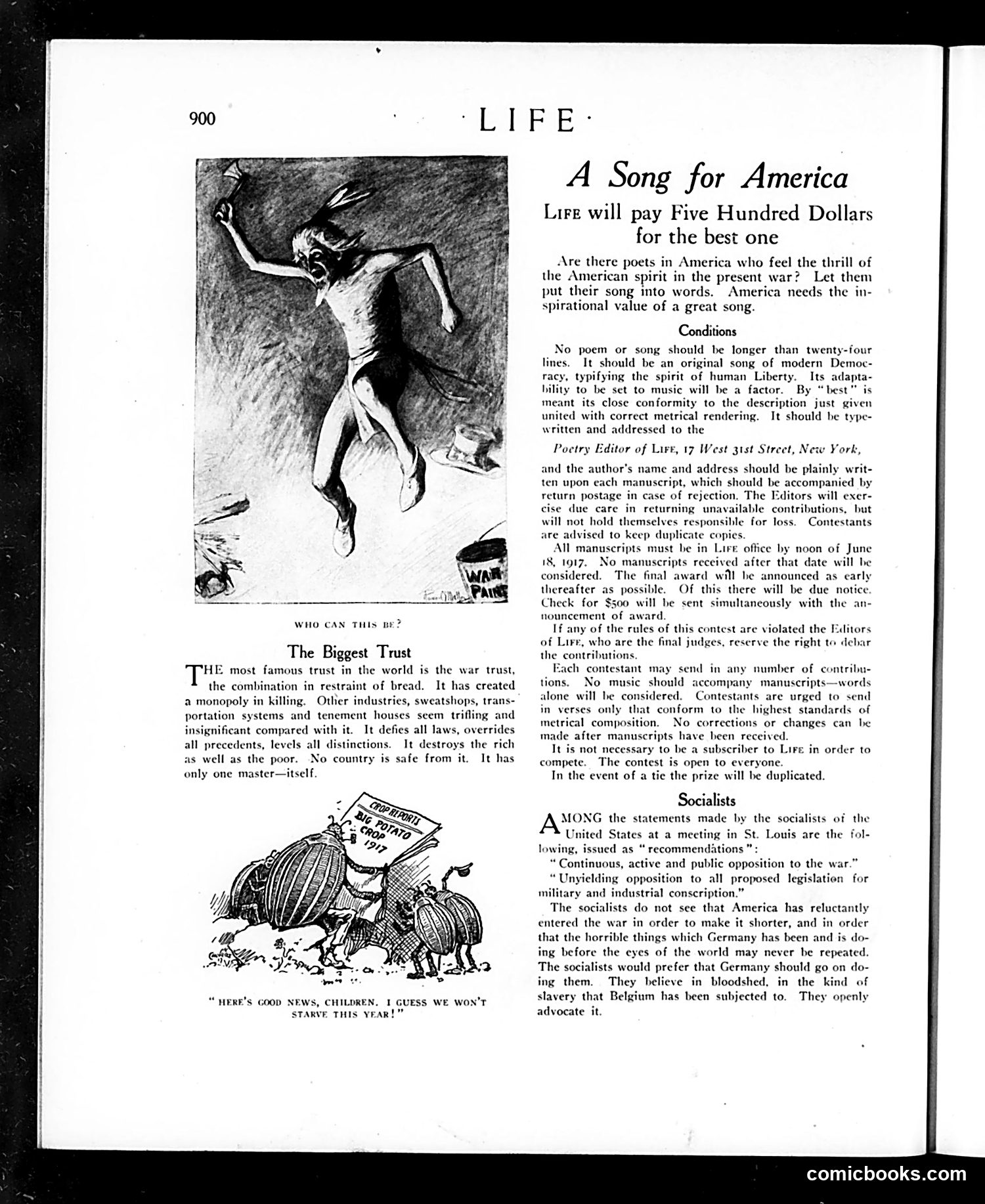
This page reflects American WWI-era propaganda and patriotic fervor. **"The Biggest Trust" cartoon**: Shows a skeletal, bloated figure labeled "War" crushing people beneath it. The caption's dark joke—a parent telling starving children "good news, we won't starve this year"—sarcastically critiques how war monopolizes resources and kills, destroying rich and poor alike. It personifies war as an uncontrollable force serving only itself. **"A Song for America" contest**: Life magazine solicits patriotic poetry celebrating American democracy and liberty, offering $500—substantial money at the time. The deadline (June 18, 1917) places this shortly after U.S. entry into WWI. **"Socialists" section**: Attacks American socialists' anti-war position, accusing them of preferring German atrocities (referencing Belgium's occupation) over military intervention. This represents the intense wartime pressure against pacifist opposition. Together, the page showcases how American media weaponized culture and morality to build support for the war effort while demonizing dissent.
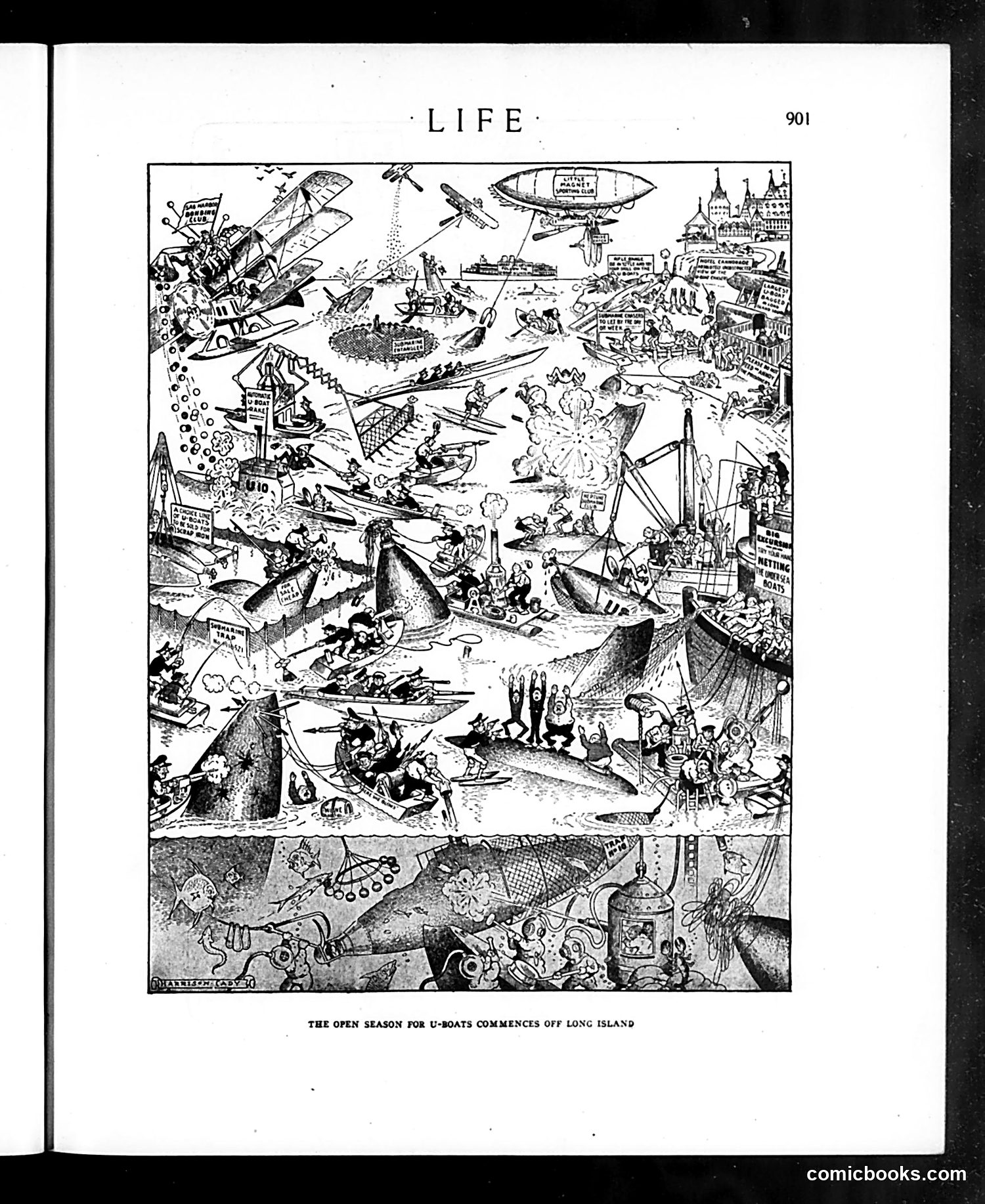
This is a satirical cartoon from *Life* magazine (page 901) depicting "The Open Season for U-Boats Commences Off Long Island." The illustration is a chaotic, densely-packed scene showing submarine warfare activity near the American coast. The cartoon satirizes German U-boat (submarine) attacks on shipping off Long Island during World War I. The upper portion shows a beach resort scene with civilians enjoying leisure activities—swimming, boating, flying—seemingly oblivious to military danger. The lower half depicts underwater U-boat activity, suggesting the hidden threat beneath the surface. The satire critiques the contrast between American complacency about the war and the actual danger posed by German submarines attacking vessels near American shores. This likely dates to the period when U-boat attacks on merchant and passenger ships were escalating, creating public anxiety about home-front vulnerability.
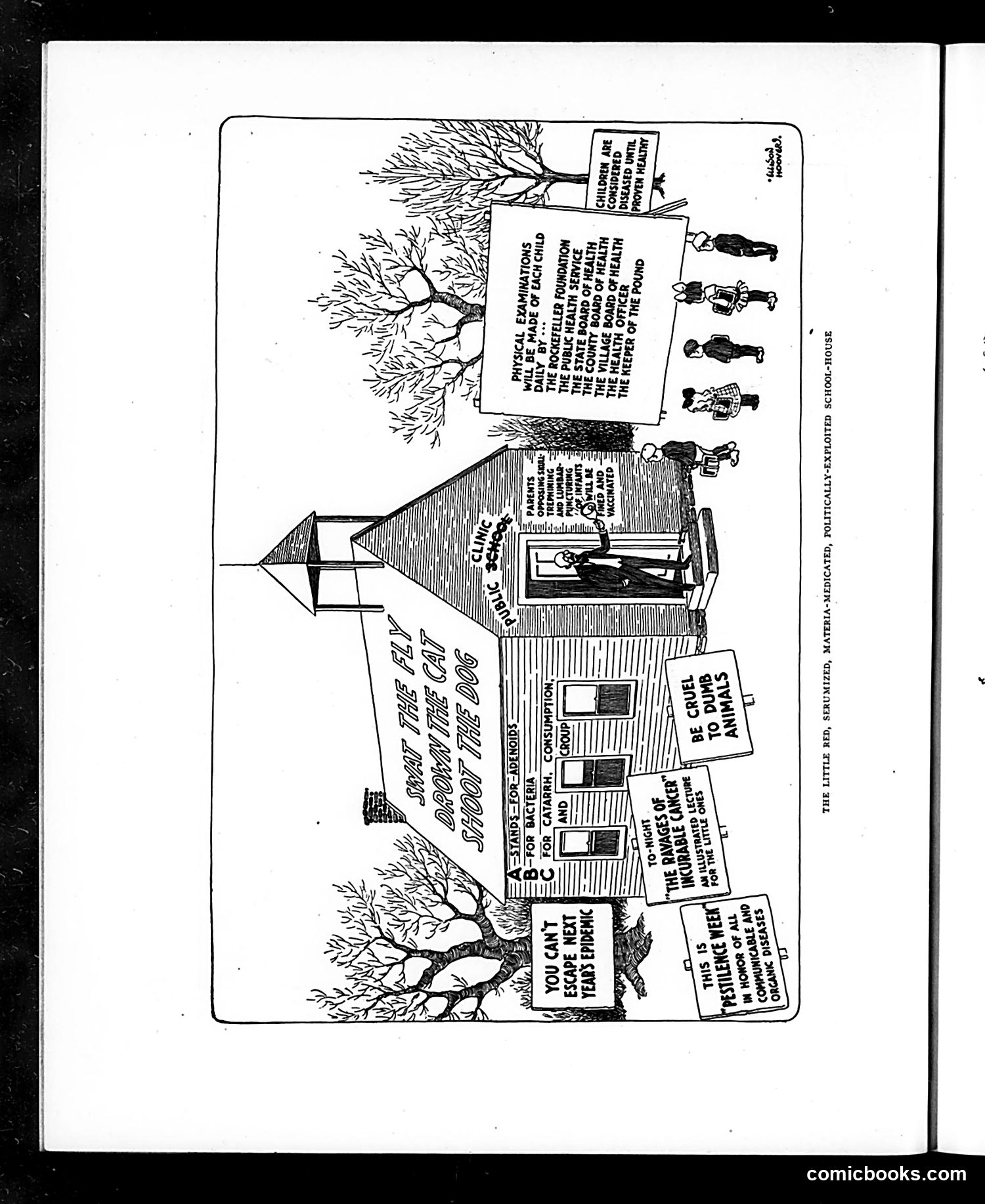
This page presents a satirical illustration of American suburban life and materialism. The central image shows a house with multiple signs advertising consumer goods and services—automobiles, appliances, and various commercial offerings. The cartoon critiques post-war American consumerism and suburban expansion, suggesting that homeownership and the "American Dream" have become primarily defined by purchasing products and accumulating possessions. The prominent display of commercial advertisements on and around the dwelling implies that suburban identity is constructed through consumption. The family figures shown and the tree imagery frame this as commentary on how traditional values (symbolized by nature/family) are being overshadowed by commercial materialism. This reflects mid-20th-century anxieties about conformity, consumption culture, and the standardization of American life during the suburban boom era. The satire targets the equation of homeownership with endless consumer spending as the measure of success and happiness.
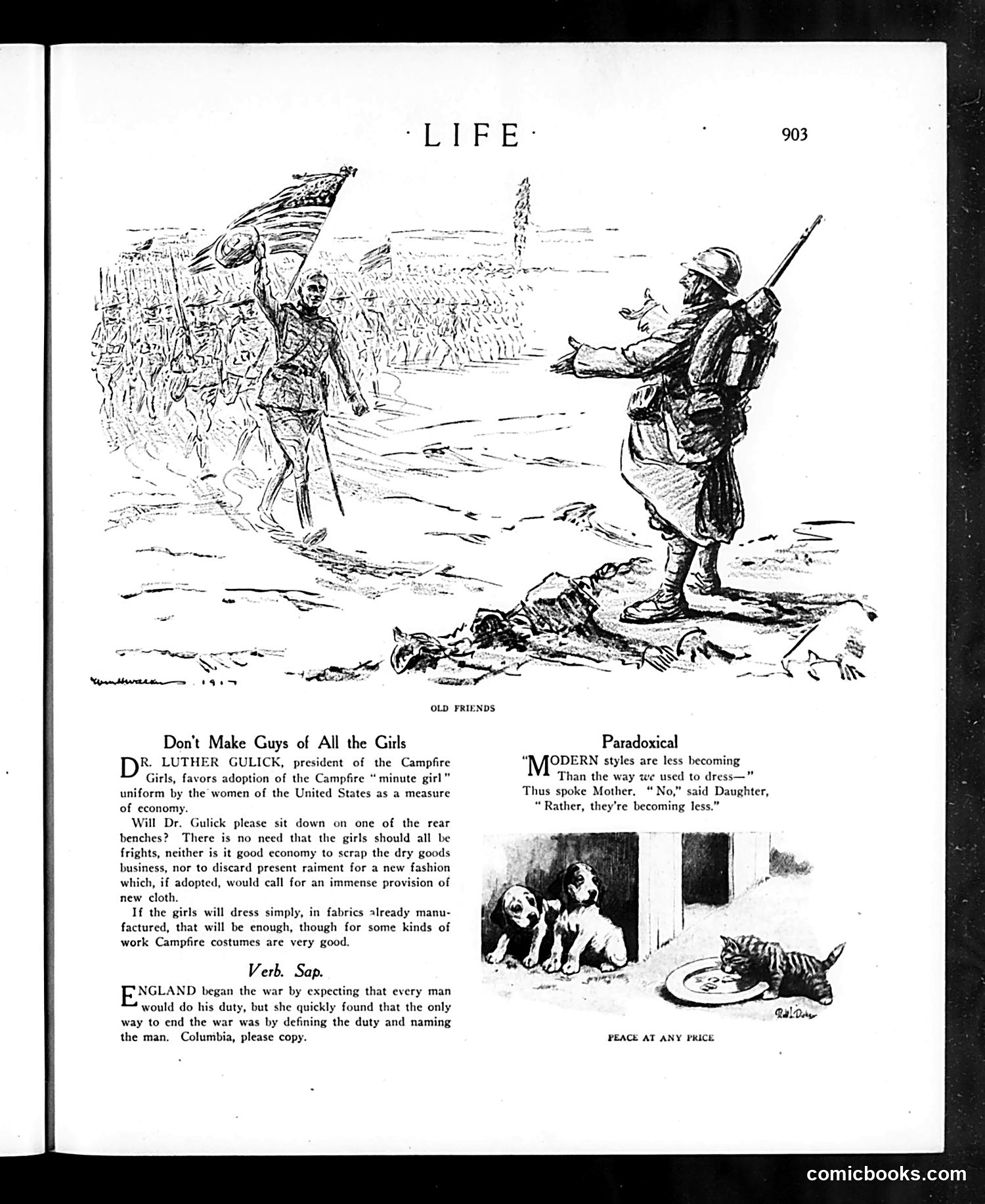
**Top Cartoon ("Old Friends"):** A soldier encounters a skeleton soldier, likely representing death or fallen comrades. The satire appears to comment on WWI's devastating human cost. **"Don't Make Guys of All the Girls":** This article criticizes Dr. Luther Gulick's proposal that American women adopt Campfire Girls' uniforms as wartime economy measures. The author argues this would harm the textile industry and isn't necessary—women can simply dress plainly in existing fabrics. The satire mocks the impracticality of the suggestion. **"Verb. Sap.":** A brief commentary on England's WWI strategy, suggesting England initially expected individual duty but learned it must explicitly assign responsibilities and name specific people for tasks to accomplish war objectives. **"Paradoxical":** A wordplay joke about modern fashion. Mother says modern styles are "less becoming," while the daughter quips they're "becoming less"—punning on "becoming" as both "flattering" and "appearing." **"Peace at Any Price":** Shows animals seemingly accepting conflict (dogs and tiger coexisting). The caption suggests prioritizing peace regardless of the cost.
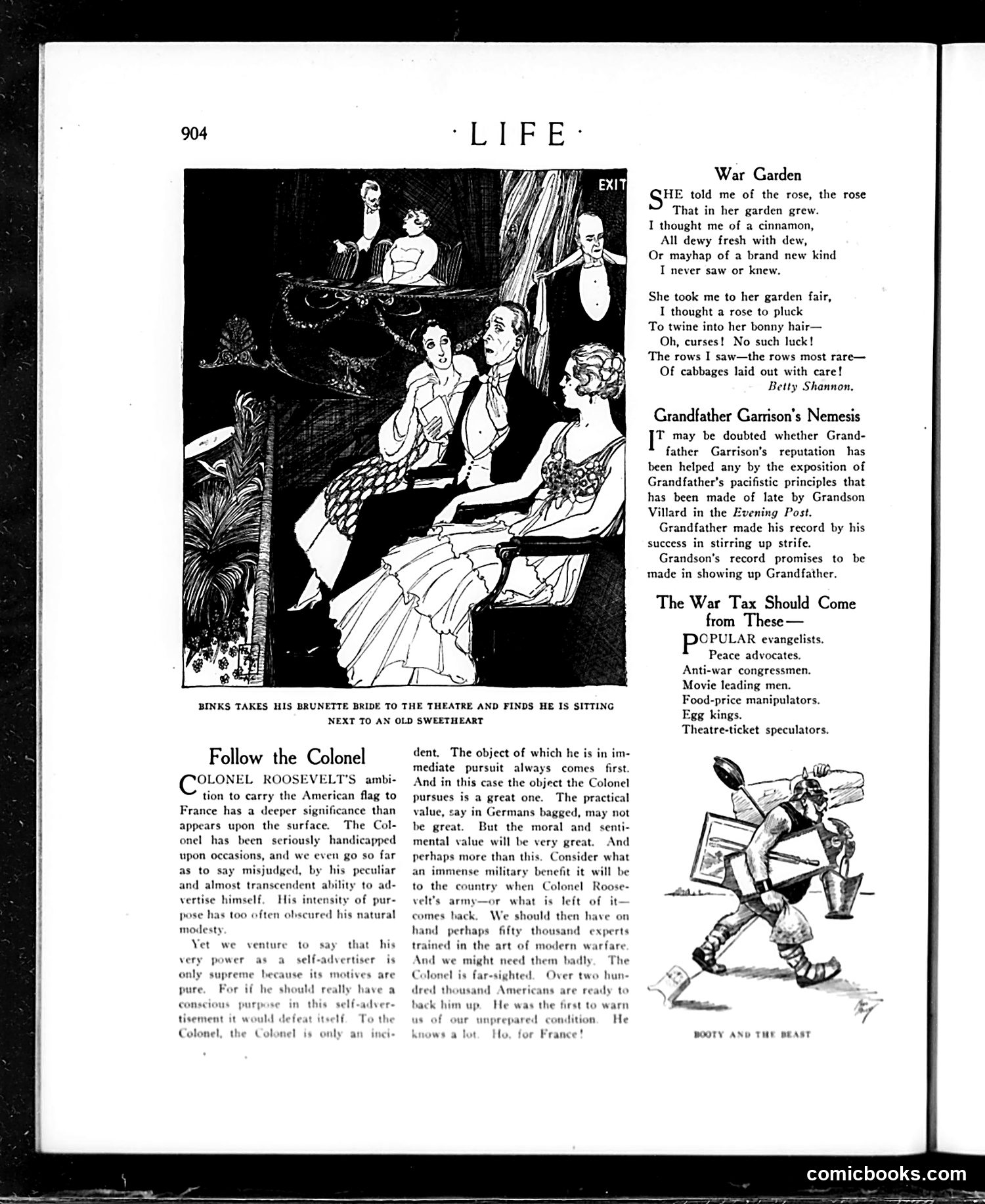
This page contains several satirical pieces from WWI-era America: **"Follow the Colonel"** critiques Theodore Roosevelt's ambition to lead troops to France. It acknowledges Roosevelt's self-promotional tendencies ("intensity of purpose") while arguing his military venture would provide valuable training for American soldiers—suggesting Roosevelt's vanity serves a practical purpose despite itself. **"War Garden"** is a humorous poem mocking romantic expectations. A suitor expects to find roses in a woman's garden but discovers only practical vegetables (cabbages), reflecting wartime necessity replacing peacetime romance. **"Grandfather Garrison's Nemesis"** references a dispute between pacifist William Lloyd Garrison and his grandson Oswald Garrison Villard (editor of the *Evening Post*), whose anti-war stance contradicts his grandfather's legacy of stirring conflict. **"The War Tax Should Come from These"** sarcastically lists groups who should fund the war effort—including pacifists, anti-war politicians, and profiteers—suggesting hypocrisy among those opposing or exploiting the conflict.
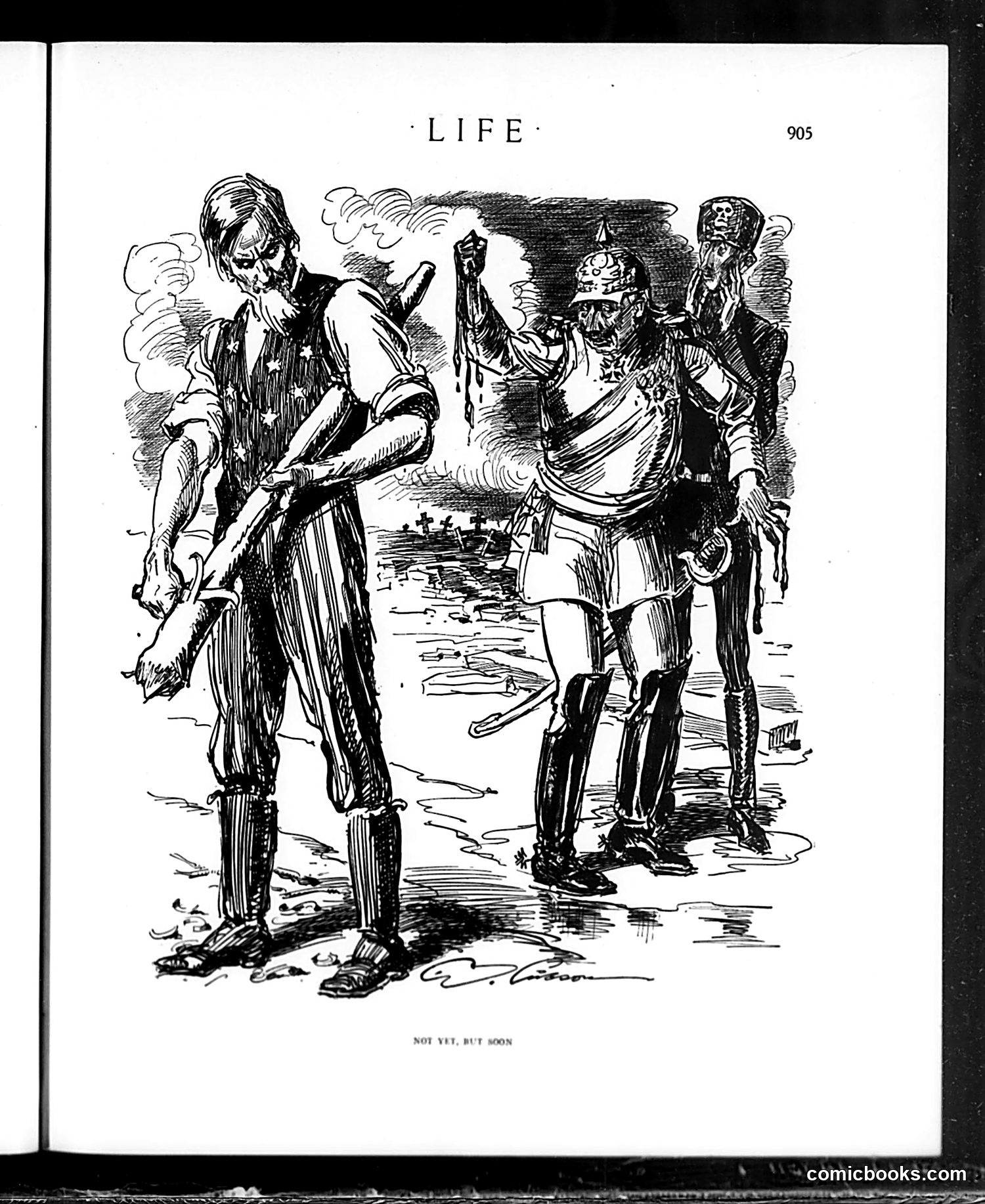
This political cartoon depicts military figures in what appears to be a wartime or post-war scenario. The central figure on the left, dressed as a soldier or military officer, holds a rifle and appears gaunt or exhausted. He confronts uniformed military leaders on the right, who are adorned with medals and decorative insignia, suggesting high rank. The caption "NOT YET, BUT SOON" suggests a threat or warning—likely implying the common soldier's resentment toward military leadership. The contrast between the worn enlisted man and the decorated officers reflects satirical commentary on class divisions, military hierarchy, or potentially post-war labor unrest. Without additional context about Life magazine's publication date, the specific historical moment remains unclear, though the style suggests early-to-mid 20th century.
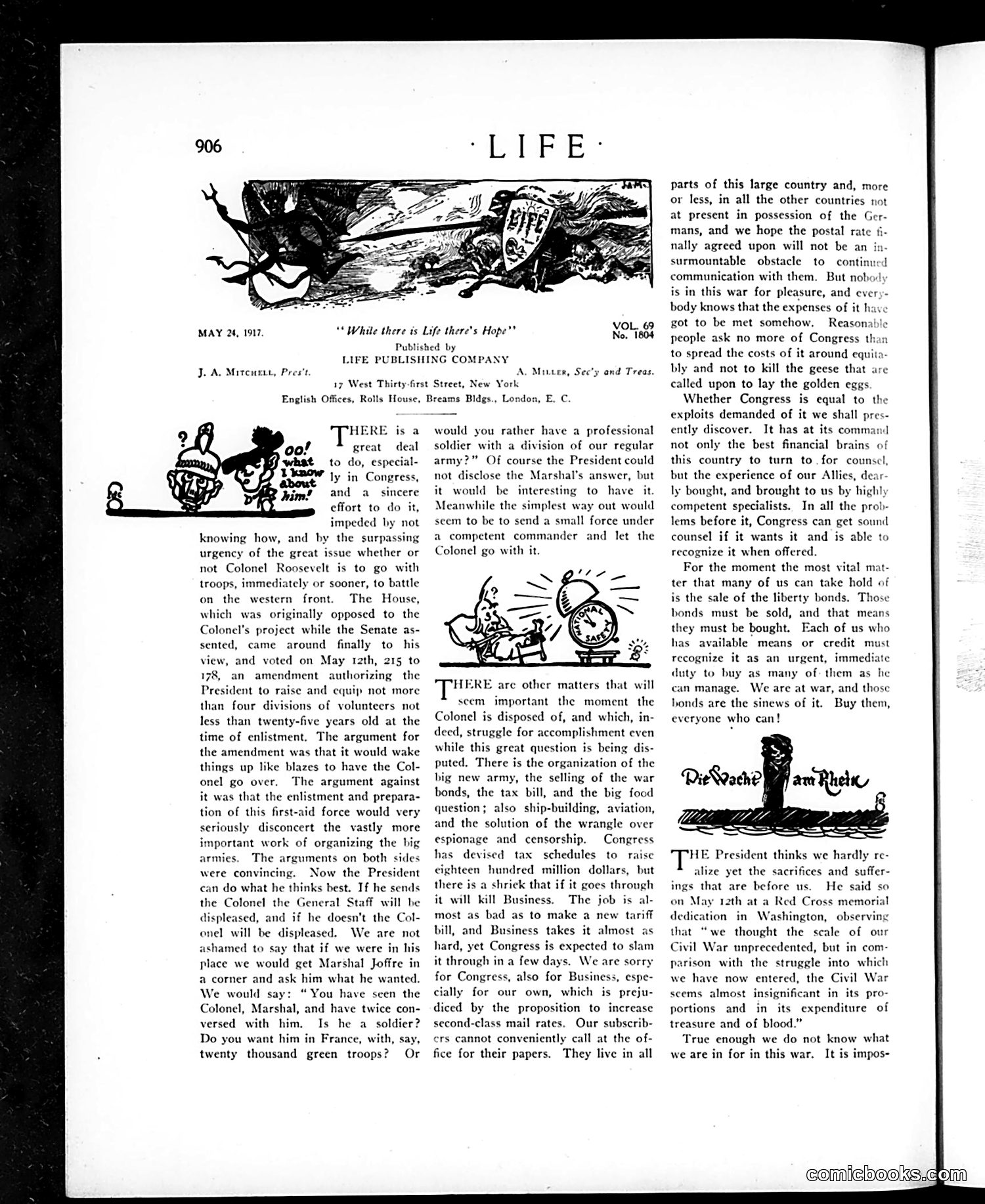
This page addresses the heated debate over whether **Colonel Theodore Roosevelt** should lead troops to France during World War I. Congress had voted to authorize the President to raise volunteer divisions, creating a political dilemma: deploy Roosevelt (which would please him but disrupt military organization) or refuse him (disappointing the popular former president). The editorial sardonically notes the President could ask French Marshal Joffre for advice but instead must choose between an angry Colonel or an angry General Staff. The page also discusses concurrent wartime challenges: organizing the new army, selling war bonds, passing a tax bill, and food production—all urgent matters competing for Congressional attention. The cartoons (partially visible) appear to satirize the competing pressures and confusion surrounding these decisions. The underlying point: wartime governance requires navigating impossible political choices while managing multiple crises simultaneously.
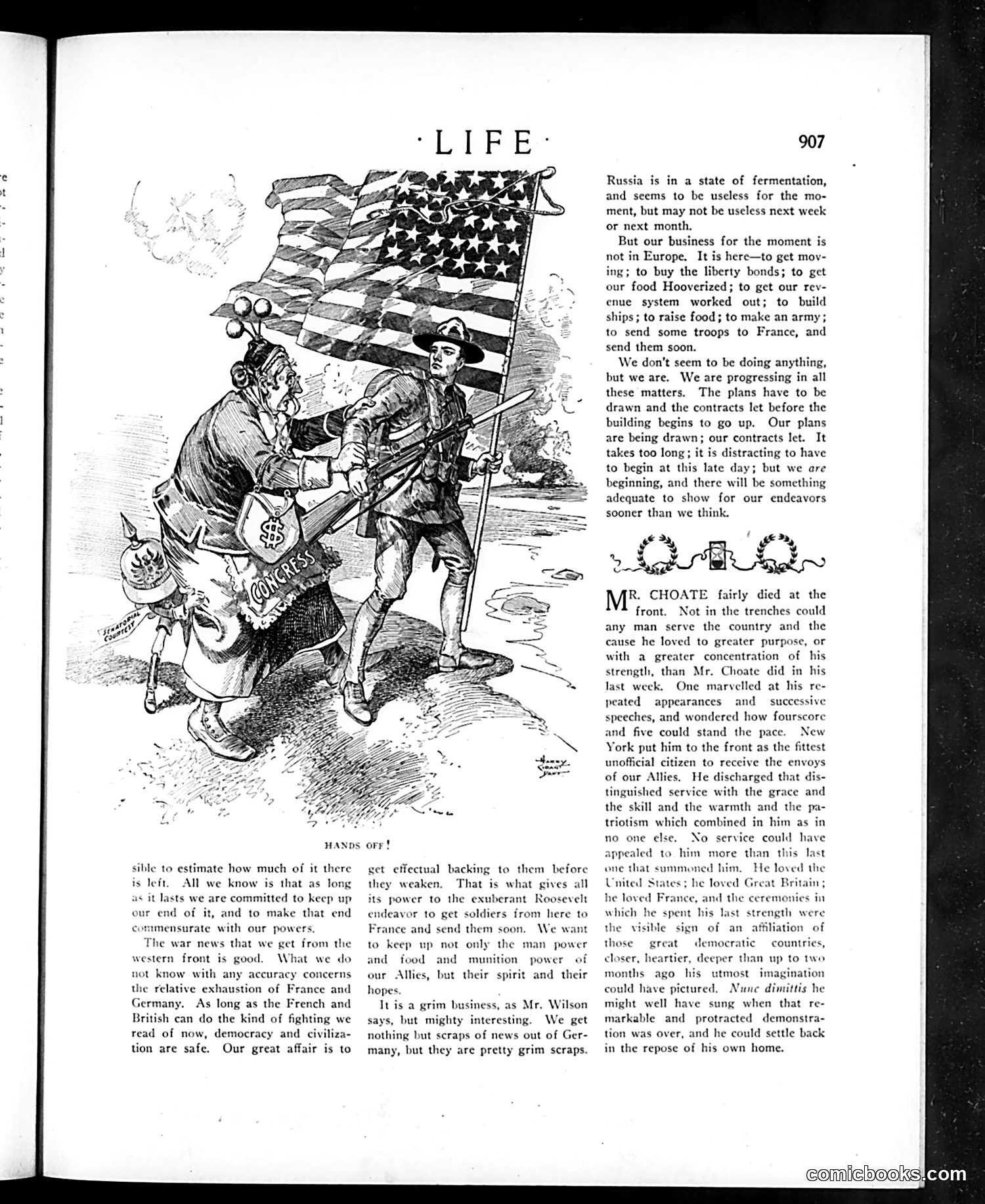
**Main Cartoon ("Hands Off!"):** The illustration depicts Uncle Sam (American flag personified) with Lady Liberty, appearing to block or restrain aggressive figures—likely representing Germany and/or Kaiser Wilhelm. The "hands off" message warns against interference with American support for the Allied cause during World War I. **Historical Context:** This page dates to WWI, when America was debating intervention. The text discusses mobilizing American resources—buying liberty bonds, food rationing ("Hooverized"), shipbuilding, and troop deployment to France. Theodore Roosevelt is mentioned as advocating rapid military support. **The Choate Tribute:** The article commemorates Joseph H. Choate (identified as "fourscore and five"—85+ years old), a prominent diplomat who died after serving as an unofficial ambassador receiving Allied envoys. His death represented sacrifice for the democratic cause linking America, Britain, and France. **Overall Message:** The page urges Americans to fully commit to supporting the Allies through material resources and military participation, positioning this as a moral imperative for democracy and civilization.
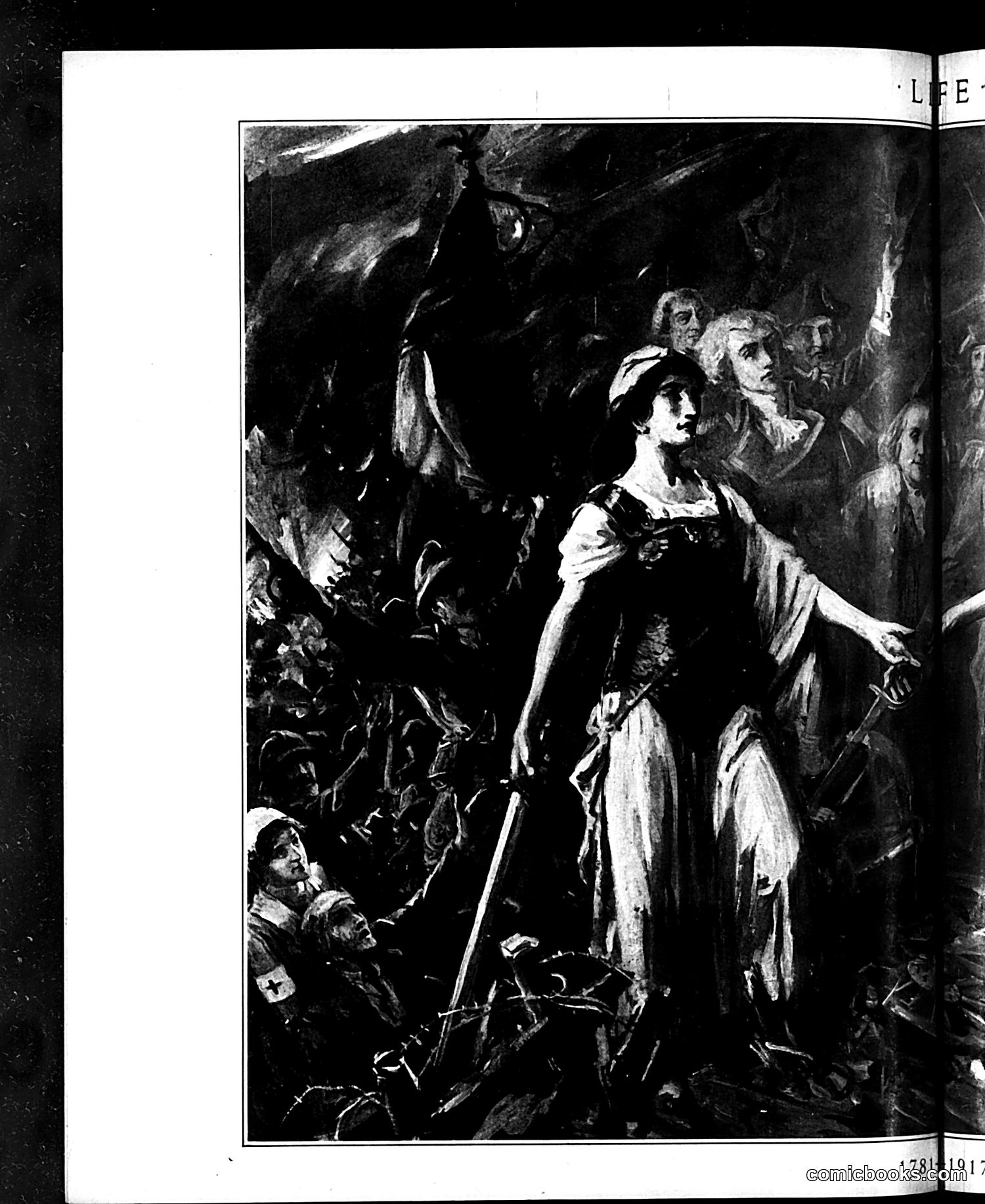
I can see this is a dramatic black and white illustration from Life magazine showing a woman in classical or medieval dress standing centrally, surrounded by armored soldiers or warriors. The artistic style suggests this is likely a historical or theatrical scene rather than political satire. However, without the OCR text being legible or additional context visible on the page, I cannot definitively identify: - Which historical or literary work this depicts - Who the central figure represents - What specific political or social commentary (if any) is intended - The date of publication The page appears to be from an early 20th-century issue based on the formatting and reproduction quality, but I cannot make specific claims about its satirical meaning without clearer textual information.
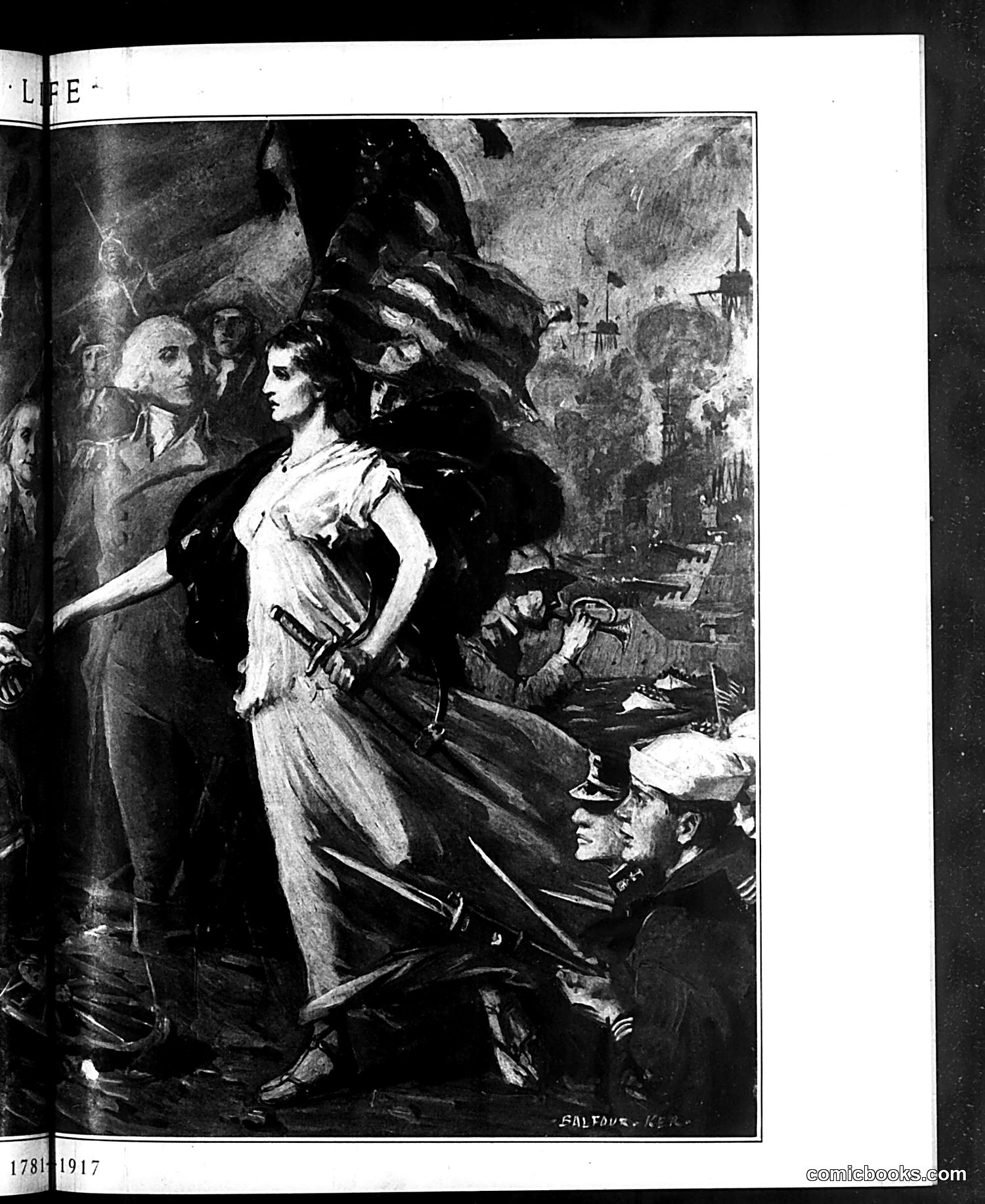
This appears to be a historical illustration from *Life* magazine (dated 1781-1917 based on the page marker). The image depicts an allegorical or patriotic scene featuring a woman in classical dress—likely representing Liberty or a national ideal—positioned prominently among military figures and soldiers. A older gentleman in period dress appears in the background left. The signature reads "BALFOUR SKE" (possibly the artist's name). The dramatic composition, with the female figure elevated above uniformed men and an industrialized cityscape visible in the background, suggests this relates to military or patriotic themes, possibly WWI-era propaganda or morale-building imagery. Without clearer text or additional context, the specific political message remains unclear, though the symbolism emphasizes national unity and sacrifice.
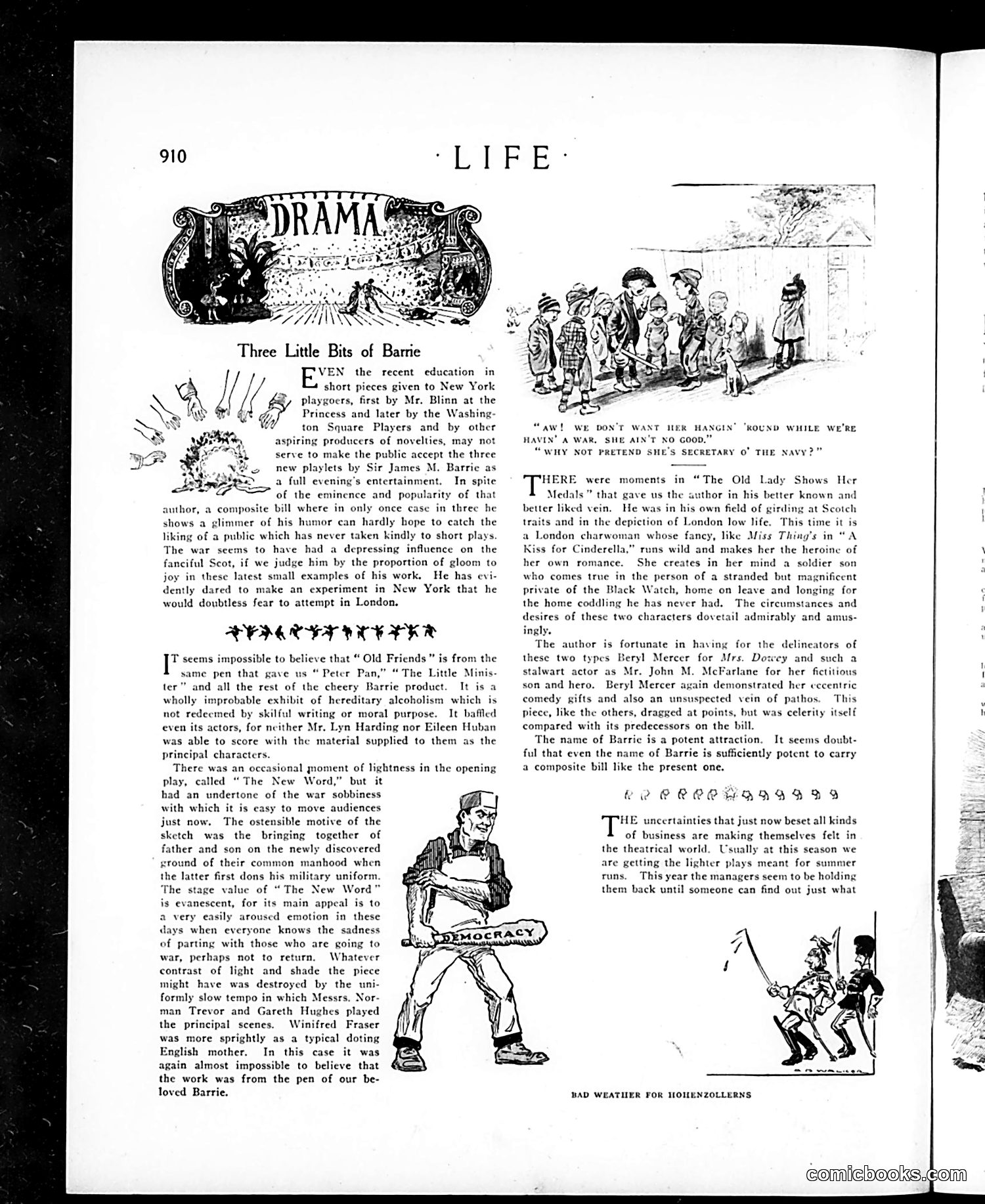
This page reviews three short plays by Sir James M. Barrie presented in New York. The critic argues that even Barrie's fame cannot save a composite bill of one-act plays, which audiences have never favored. The review examines three works: "Old Friends" (criticized as uncharacteristically dark, depicting alcoholism), "The New Word" (exploiting wartime emotions about fathers and sons, performed too slowly), and "The Old Lady Shows Her Medals" (more successful, praising actress Beryl Mercer's performance). The cartoons illustrate audience complaints: one shows children rejecting a woman ("Why not pretend she's secretary of the navy?"), while another titled "Bad Weather for Hollenzollerns" appears to reference wartime politics (likely mocking German leadership during WWI, though unclear without full context). The critic concludes Barrie's reputation alone cannot sustain this theatrical experiment.
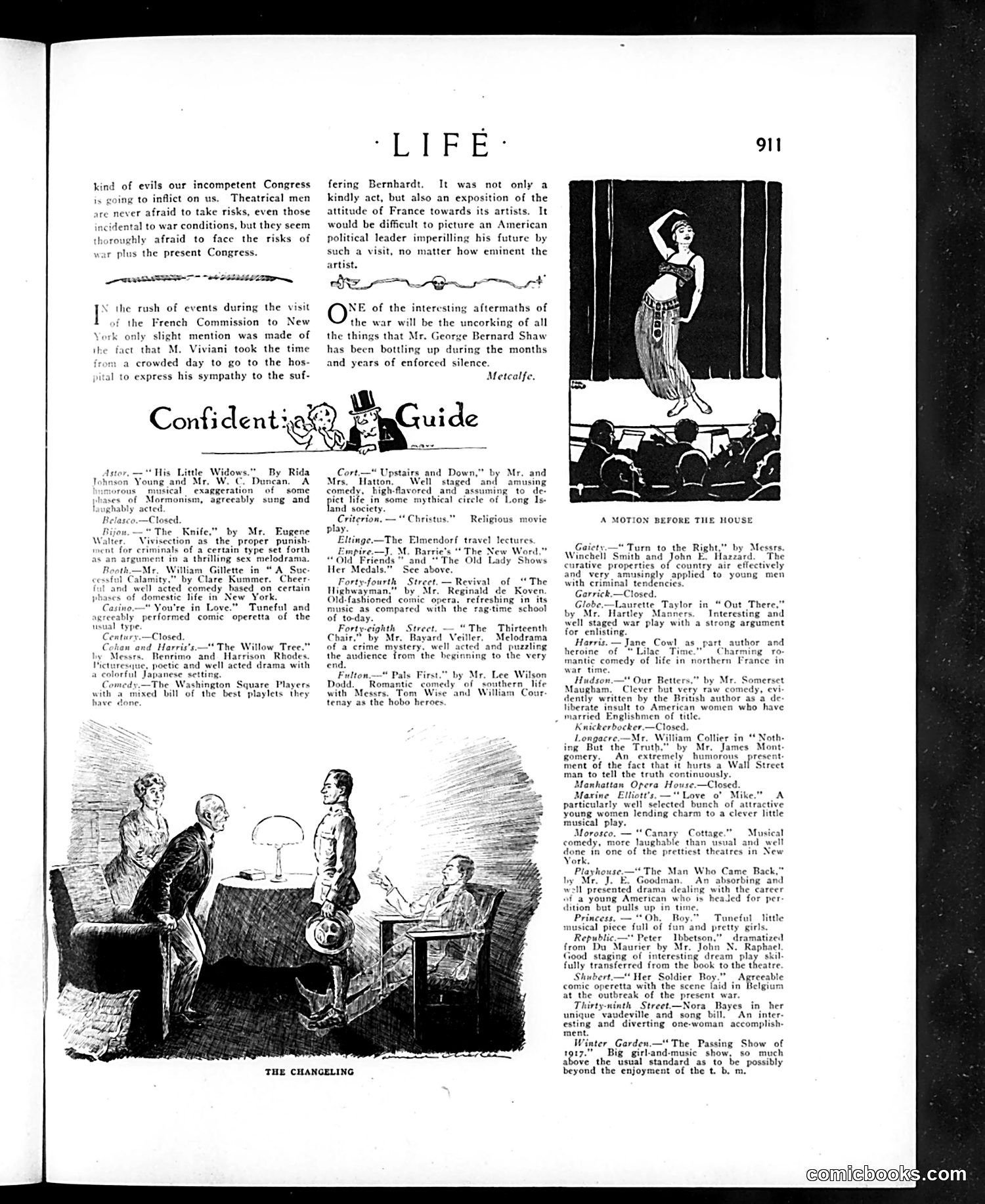
This page presents a "Confidential Guide" to Broadway theaters—essentially theater reviews with satirical commentary. The two illustrations depict theatrical scenes: "The Changeling" shows an interior domestic scene, while "A Motion Before the House" depicts an audience watching a performer on stage. The text critiques both theatrical productions and contemporary politics. A key passage mocks American political leaders' timidity compared to French culture: French leader M. Viviani visited a hospital despite his busy schedule, while "an American political leader [would be] imperilling his future" by such an act "no matter how eminent the artist." The reviews also reference George Bernard Shaw being "enforced silence" during wartime—suggesting censorship of his controversial views. Several reviews mention war-related plays and their patriotic messages about enlisting. The "guide" format allows Life to blend entertainment criticism with social and political commentary about American attitudes toward art, leadership, and wartime conformity.
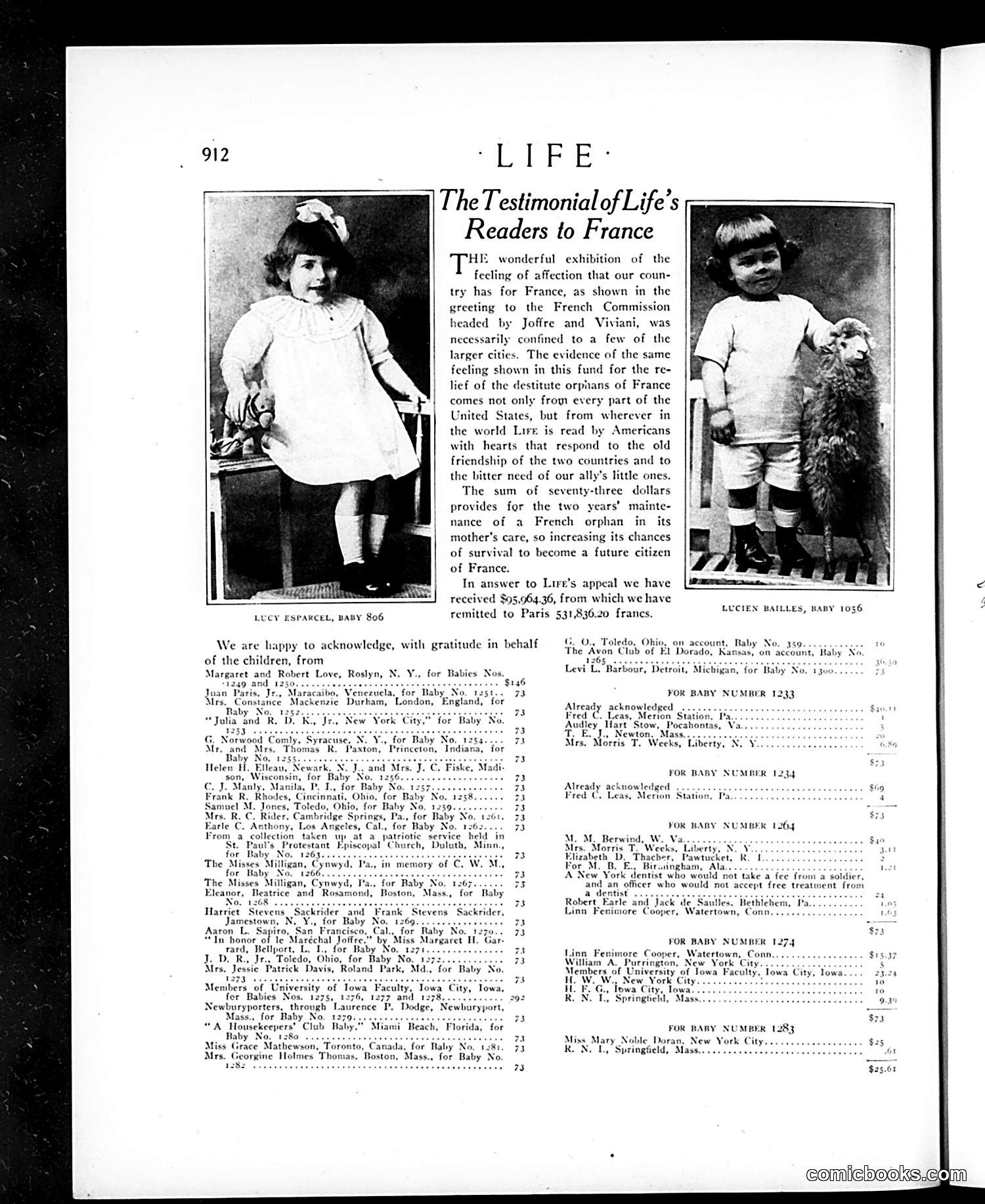
This page documents **Life magazine's fundraising campaign for French orphans during World War I**. The context: France was America's ally, and the magazine appeals to readers' sympathy for war-displaced children. The two photographs show babies (Lucy Esparcel, Baby 806, and Lucien Bailles, Baby 1056) representing beneficiaries of the relief effort. The article explains that $73 supports a French orphan's two-year care with a foster mother, increasing survival chances. The bulk of the page lists **donors and their contributions**—individuals, church groups, and university faculty from across America sending money. This demonstrates widespread American support for France and French civilians suffering war's effects. The text references a French Commission visit "headed by Joffre and Viviani" (French military and political leaders), indicating this campaign capitalized on pro-French sentiment during WWI. The appeal emphasizes "old friendship" between nations and "our ally's little ones"—emotional language designed to motivate donations.
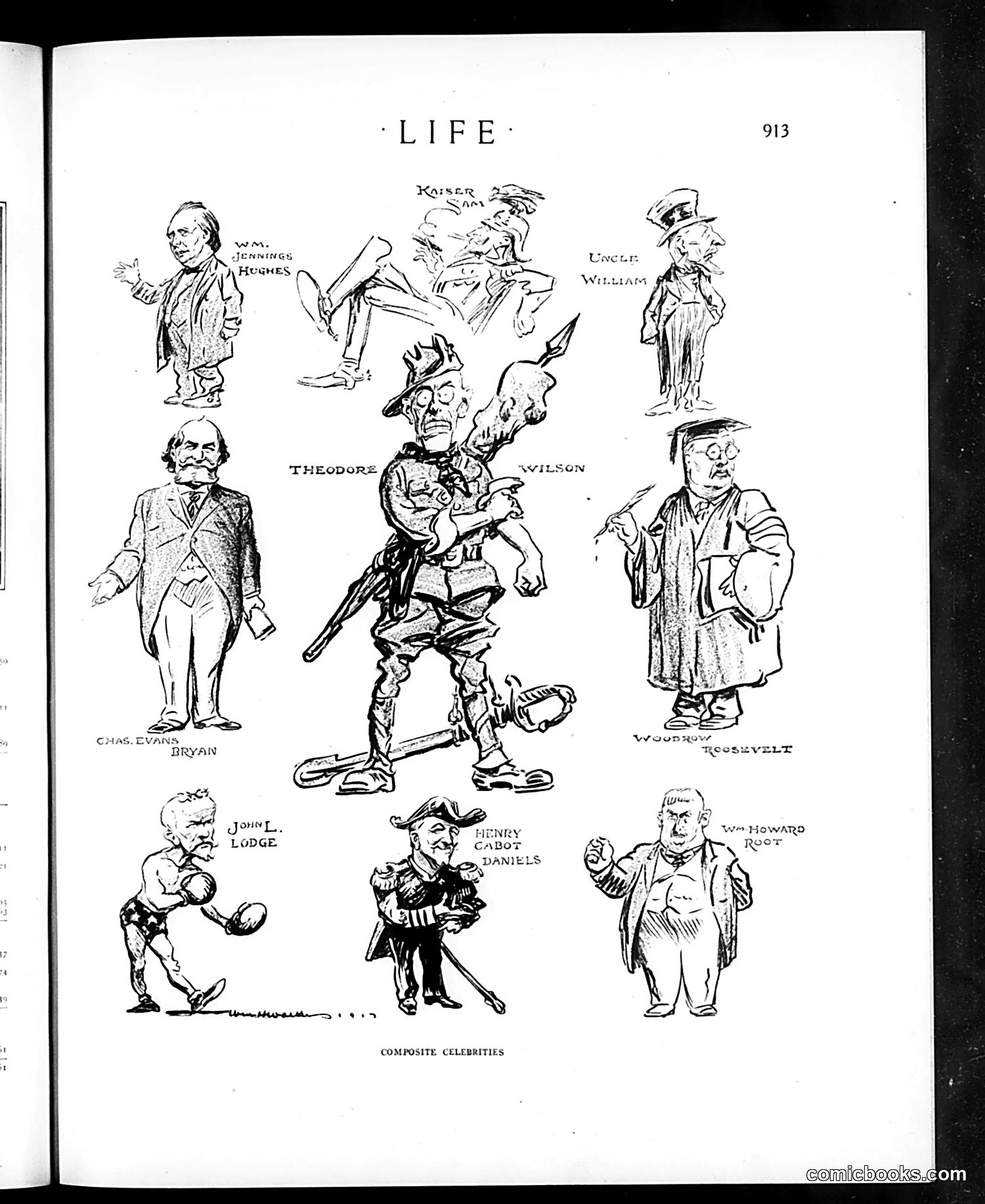
This page presents exaggerated caricatures of prominent American figures from the early 20th century. The title "Composite Celebrities" suggests these are composite or blended representations meant to satirize public figures. Identifiable figures include Theodore Roosevelt (center, depicted as a militant/aggressive caricature), William Jennings Bryan (appears to reference the political figure), and what seems to be references to business and political leaders of the era like Henry Cabot Daniels and William Howard Taft. The satirical style uses physical exaggeration—distorted features, poses suggesting pomposity or aggression—to mock these public figures' perceived characteristics or political stances. This was typical of Life magazine's editorial cartooning, which employed visual humor to comment on politics, celebrities, and social issues of the period. Without specific publication date context, the exact political references remain somewhat unclear, though the style suggests the Progressive Era.
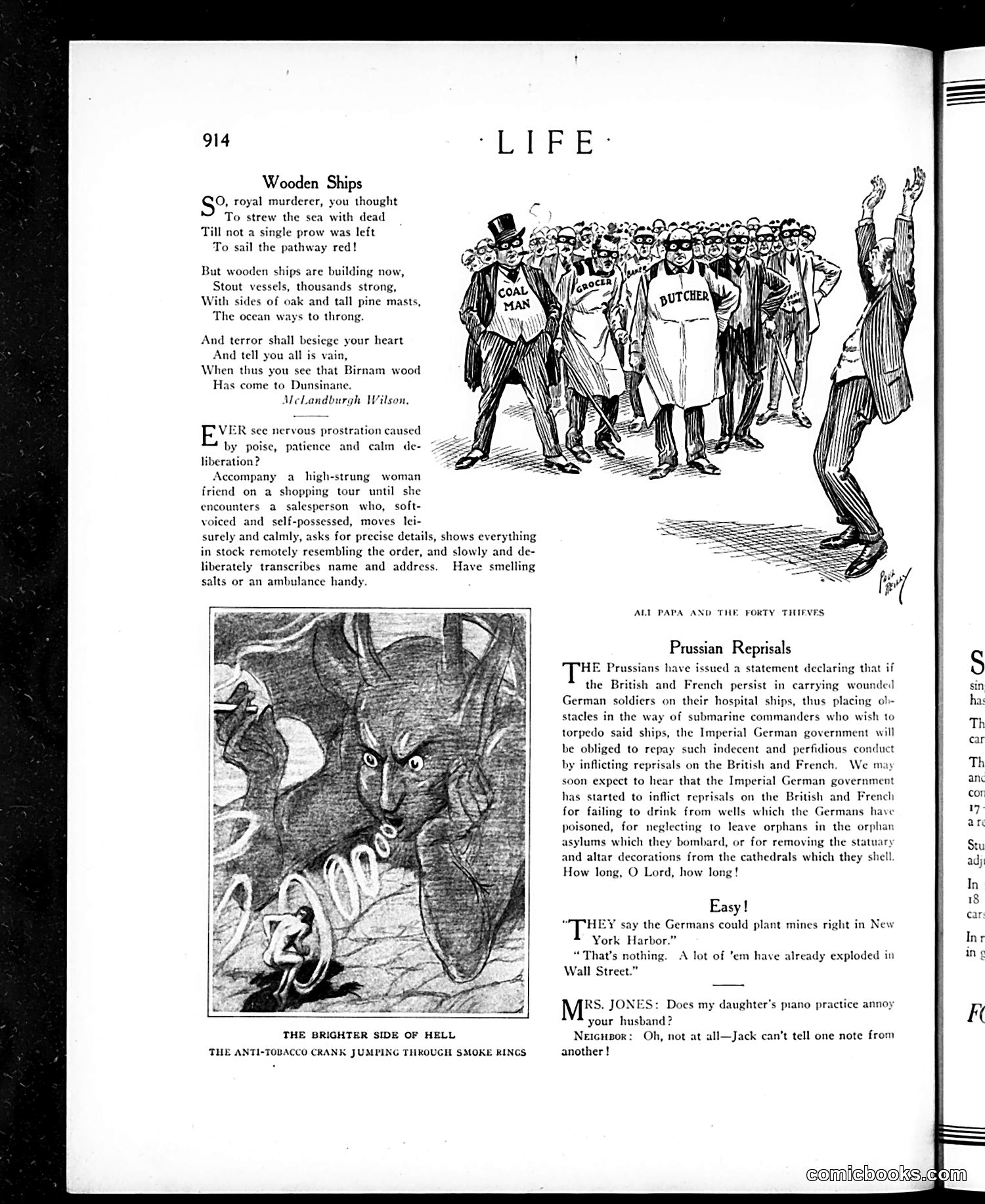
This WWI-era satirical page attacks Germany's conduct and American anxieties through multiple pieces: **"Wooden Ships"** (poem): References Shakespeare's *Macbeth*'s "Birnam Wood" prophecy to suggest America will build countless wooden vessels to counter German U-boats, inevitably defeating them. It's propaganda-as-poetry, addressing the Kaiser as "royal murderer." **"Prussian Reprisals"** (article): Mockingly describes Germany's threat to retaliate against Britain/France for transporting wounded soldiers on hospital ships. The satire exposes this as absurd—sarcastically suggesting Germany will next punish them for not drinking poisoned wells or leaving orphans in bombed asylums. It's bitter commentary on German military brutality. **Cartoons**: "The Brighter Side of Hell" depicts an anti-tobacco activist comically tormented by smoke rings. The bottom exchanges are contemporary humor about piano practice and Wall Street's financial collapse. The page reflects American wartime sentiment: confidence in industrial capacity, moral outrage at German tactics, and dark humor about civilian anxieties.
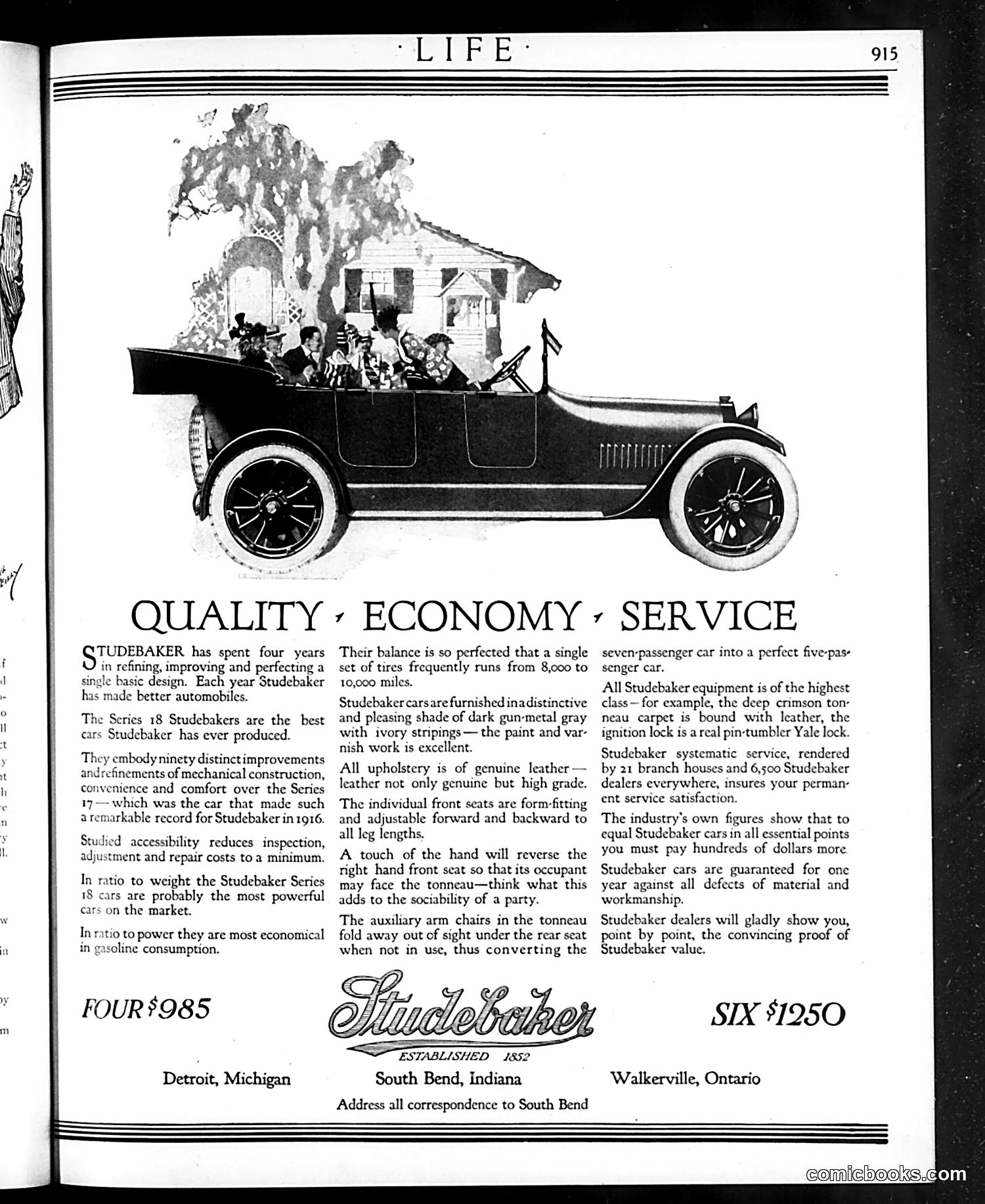
This is a **full-page automobile advertisement**, not political satire or a cartoon. It promotes the Studebaker Series 18 car from the early 1920s era. The illustration shows a stylized open-air touring car loaded with well-dressed passengers and their belongings (including what appears to be a house), emphasizing the vehicle's spaciousness and social appeal for leisure travel. The ad's messaging targets middle-class buyers by highlighting: - **Quality**: "ninety distinct improvements" over previous models - **Economy**: fuel efficiency and tire durability - **Service**: extensive dealer network (6,500 dealers, 21 branch houses) Notable period details include the tonneau (rear passenger area) with folding auxiliary seats, emphasizing the car's social function for entertaining. The prices ($985 for the Four, $1,250 for the Six) and manufacturing locations (Detroit, South Bend, Walkerville) reflect Studebaker's prominence as a major American automaker before its eventual decline.
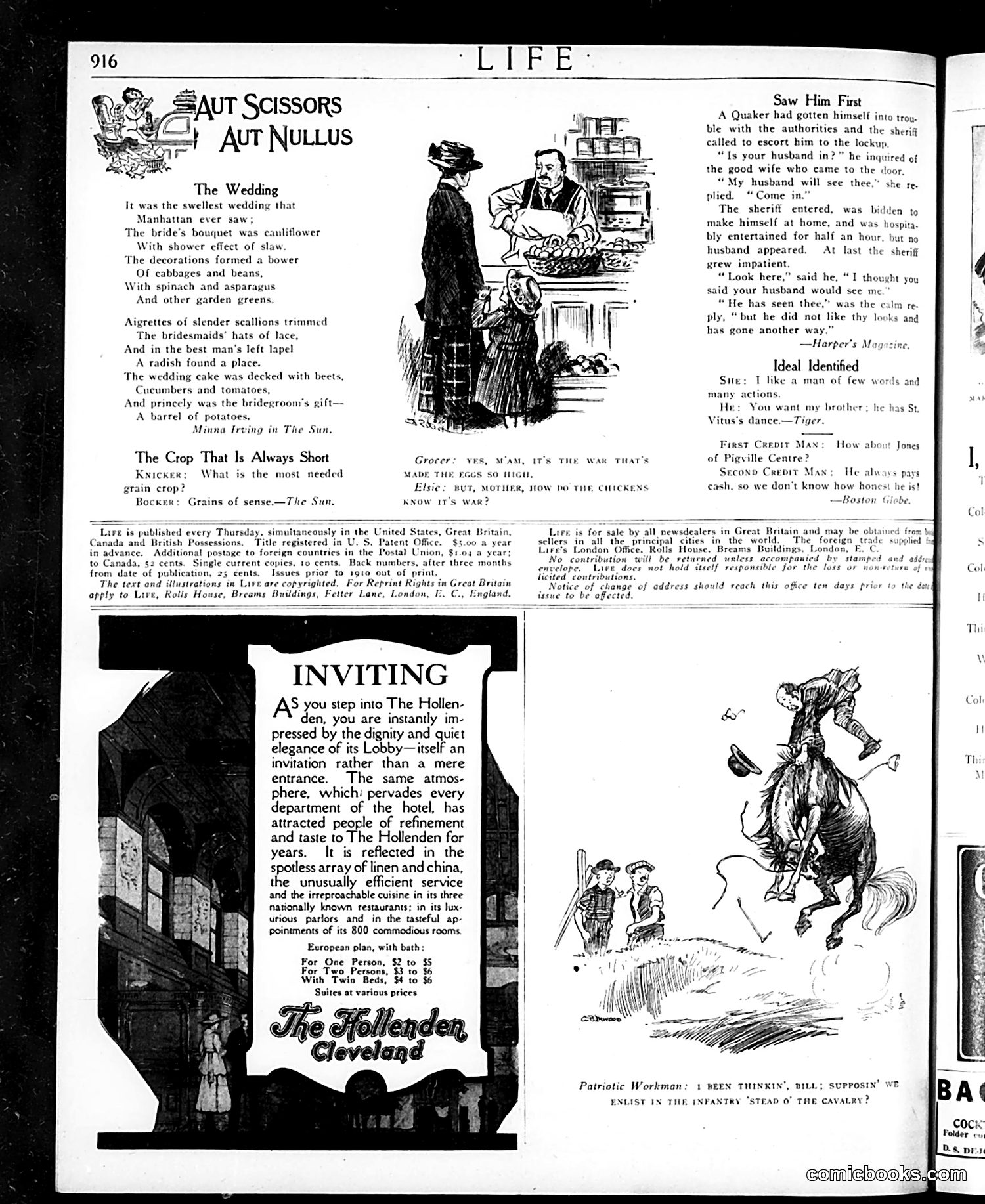
This page from *Life* magazine contains several satirical pieces typical of early 20th-century American humor: **"The Wedding"** and **"The Crop That Is Always Short"** are light verse jokes: the first depicts a vegetable-themed wedding (satirizing perhaps wartime rationing or agricultural abundance), while the second is a simple pun—the "most needed grain crop" is "grains of sense" (common sense). **"Patriotic Workman"** cartoon (bottom) references WWI military service, with two workers debating whether to enlist in infantry or cavalry—likely satirizing working-class attitudes toward military duty during the war effort. The remaining anecdotes ("Saw Him First," "Ideal Identified," etc.) are brief joke-exchanges typical of *Life*'s humor section, playing on wordplay and social situations. **The Hollenden hotel advertisement** is a major commercial feature, not editorial content. Overall, this is a typical *Life* page mixing light satire, wordplay, and advertising—no single dominant political cartoon, but rather scattered wartime-era humor reflecting American domestic and military concerns.
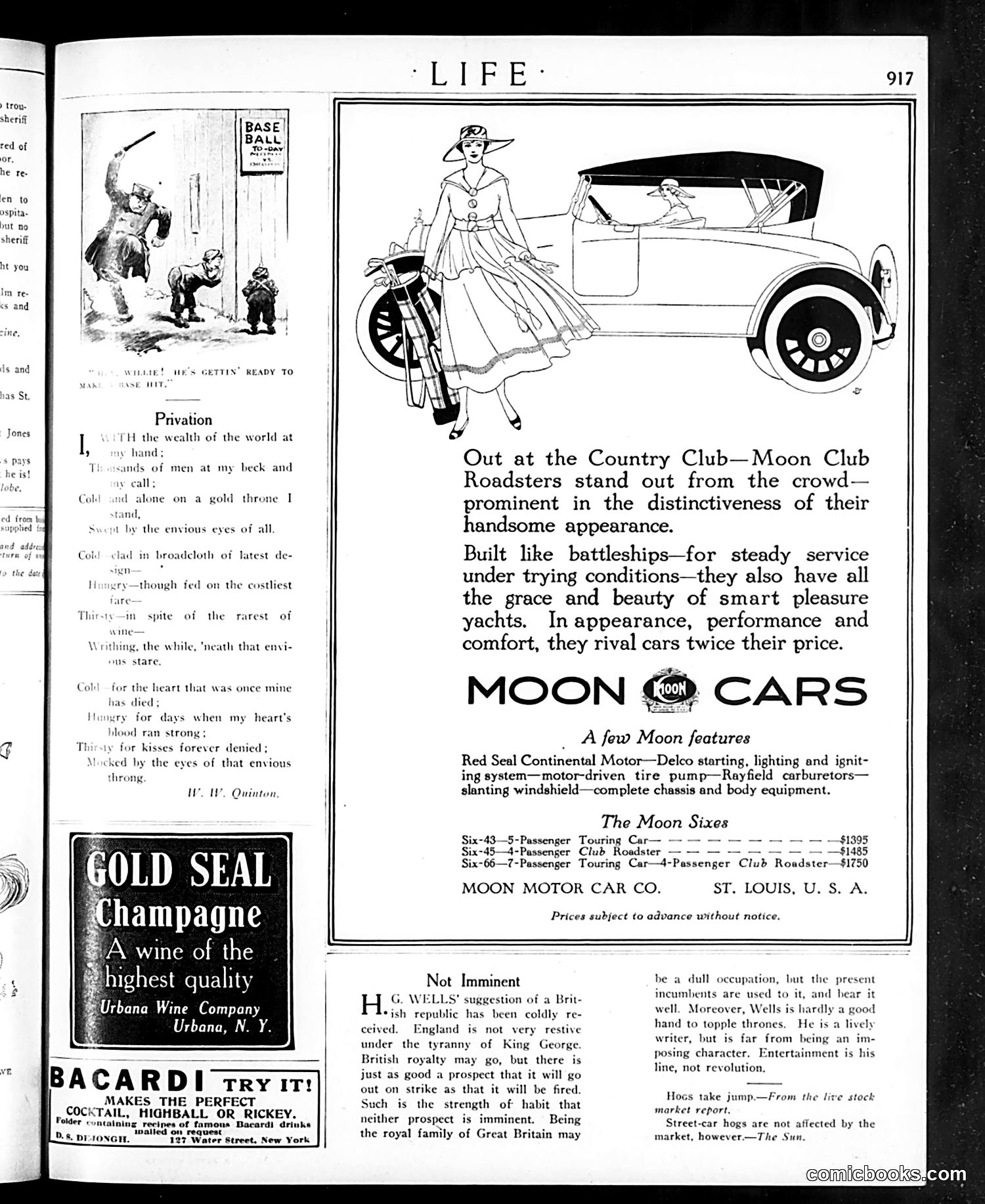
**The Main Cartoon ("Willie! He's Gettin' Ready to Use Her"):** This small sketch appears to show a baseball scene—a child about to bat while an adult and another figure watch. The humor likely plays on double meaning: "using" someone in sports versus romantic/social contexts, typical of Life's early 20th-century humor style. **The Poem "Privation" by W.W. Quinton:** A melancholic verse about wealth without love—a rich man surrounded by material abundance and envious admirers, yet emotionally hollow because his heart "has died" and he's estranged from genuine affection. **Page Content:** The page is primarily advertising (Moon Cars, Gold Seal Champagne, Bacardi rum) with a brief satirical note mocking H.G. Wells's suggestion of a British republic. The joke: England won't overthrow its monarchy because habit is too strong, and Wells—a mere entertainer—lacks revolutionary credibility anyway. The "hogs" quips are simple puns about stock-market language applied to literal hogs and streetcar passengers.
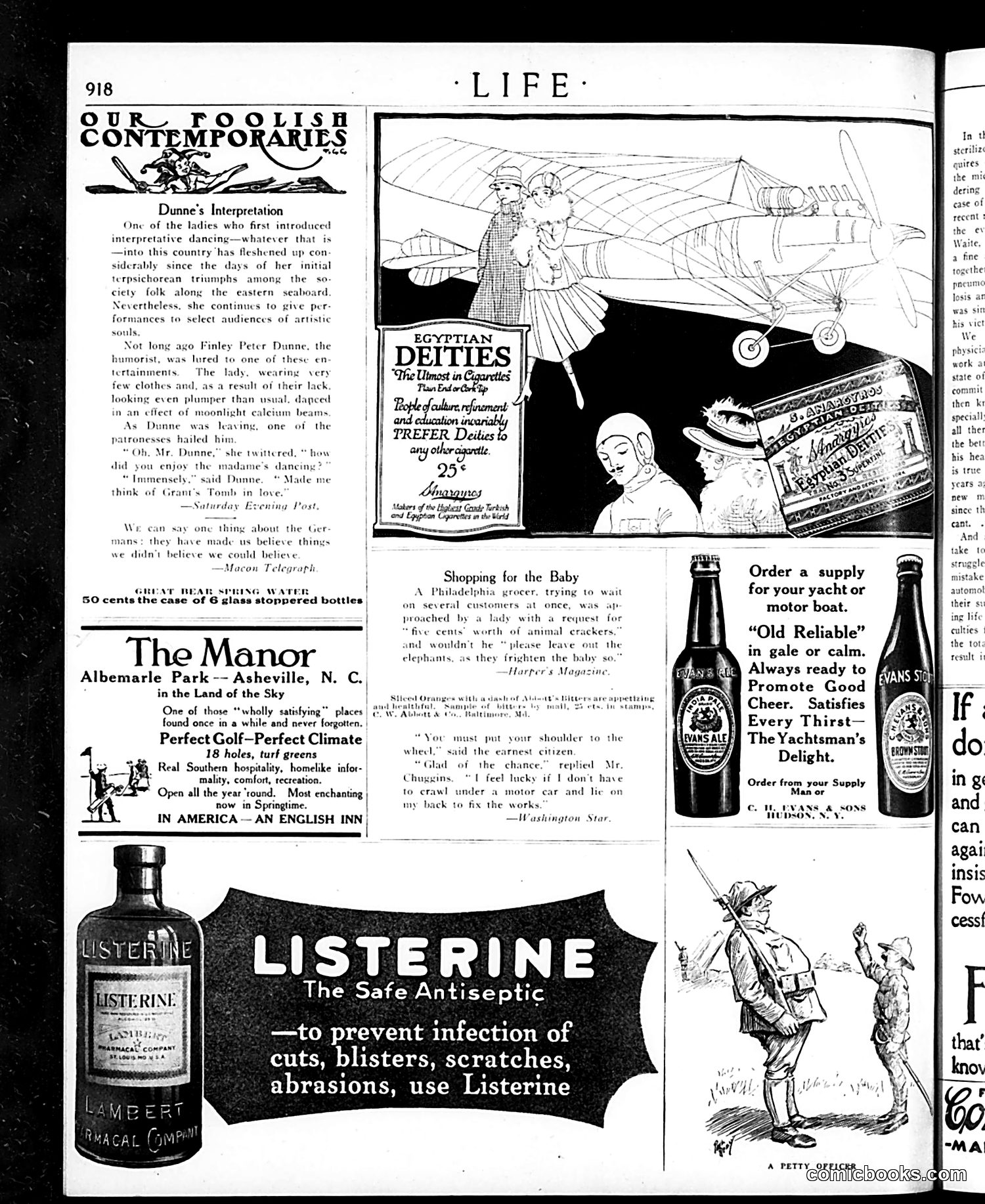
This page is primarily **advertising mixed with light satirical content**, typical of Life's era. The main humor piece features **Finley Peter Dunne**, a famous Irish-American humorist and satirist. The cartoon mocks an "interpretative dancer" (early modern dance) who has aged and gained weight but continues performing for society audiences. When Dunne attends her show, he's asked if he enjoyed it. His reply—that it made him think of Grant's Tomb—is a cutting joke: the dancer, like the monument, is large, heavy, immobile, and a public landmark. The page also contains a joke about a shopkeeper and customer, and advertisements for Listerine antiseptic, Egyptian Deities cigars, "Old Reliable" beer, and The Manor resort. The satire reflects early-1900s attitudes mocking both pretentious artistic movements and aging performers attempting to maintain relevance in fashionable society circles.
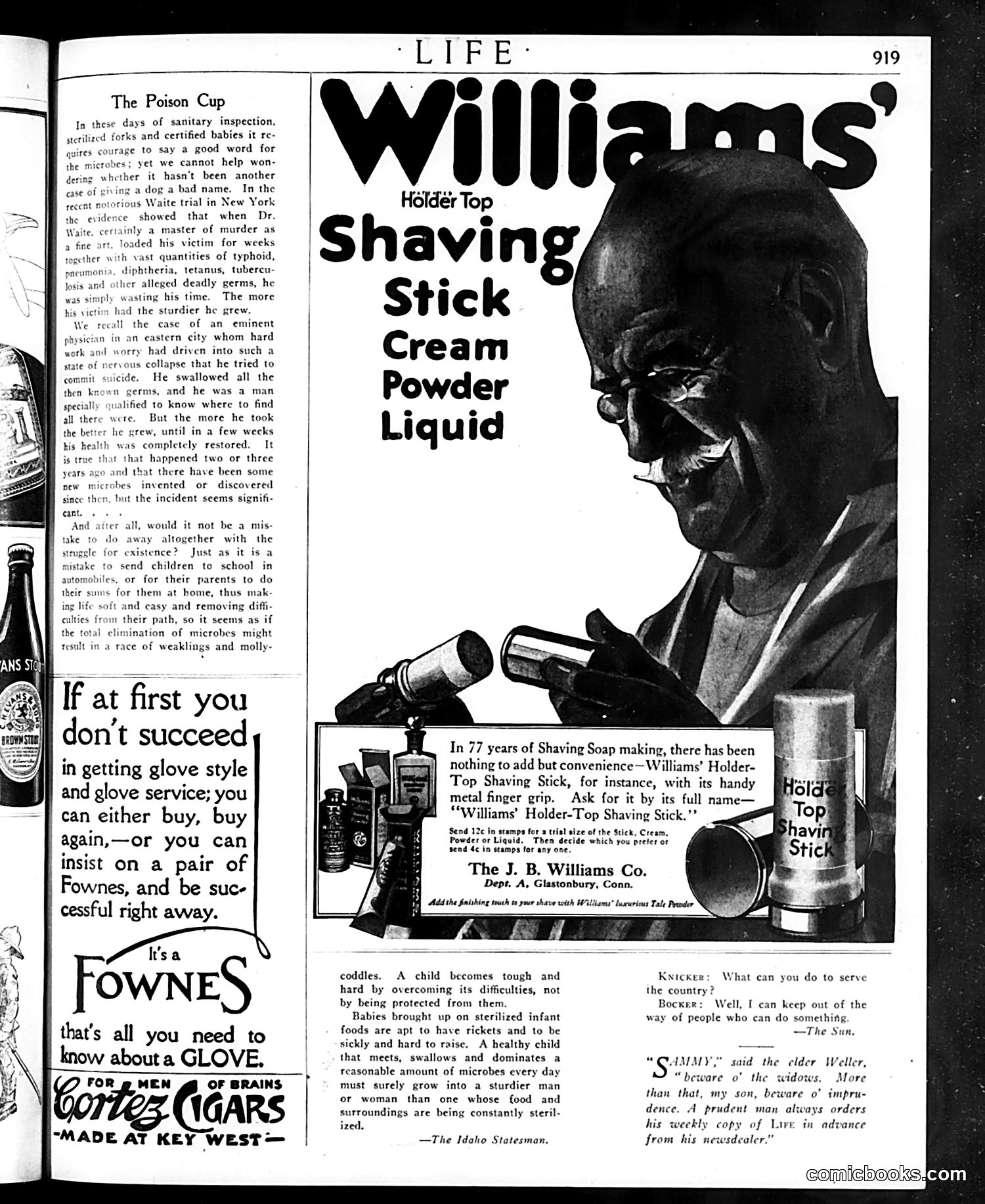
This page contains three distinct elements: **"The Poison Cup" Editorial Essay** (left): A satirical argument against over-sanitization. Referencing the notorious Dr. Hawley Harvey Waite trial (a real 1916 poisoning case in New York), the author argues that germs aren't actually dangerous—claiming a poisoner's victim grew healthier despite ingesting typhoid and other diseases. The piece concludes that eliminating all microbes would create "weaklings," advocating instead that children need exposure to germs to build strength. This reflects early 20th-century anti-sanitation pseudoscience that contradicted emerging germ theory. **Advertisements**: Williams' Shaving Stick, Fownes Gloves, and Cortez Cigars dominate the page—typical period marketing. **Brief Jokes** (bottom right): Generic humor about glove-buying and avoiding widows. The satire's point is unclear without knowing whether Life magazine endorsed or mocked this anti-sanitization viewpoint. The absurd claims suggest mockery of dangerous health pseudoscience, though the tone is ambiguous.