
Life, 1917-05-17 · page 16 of 35
Life — May 17, 1917 — page 16: what you’re looking at
What you’re looking at
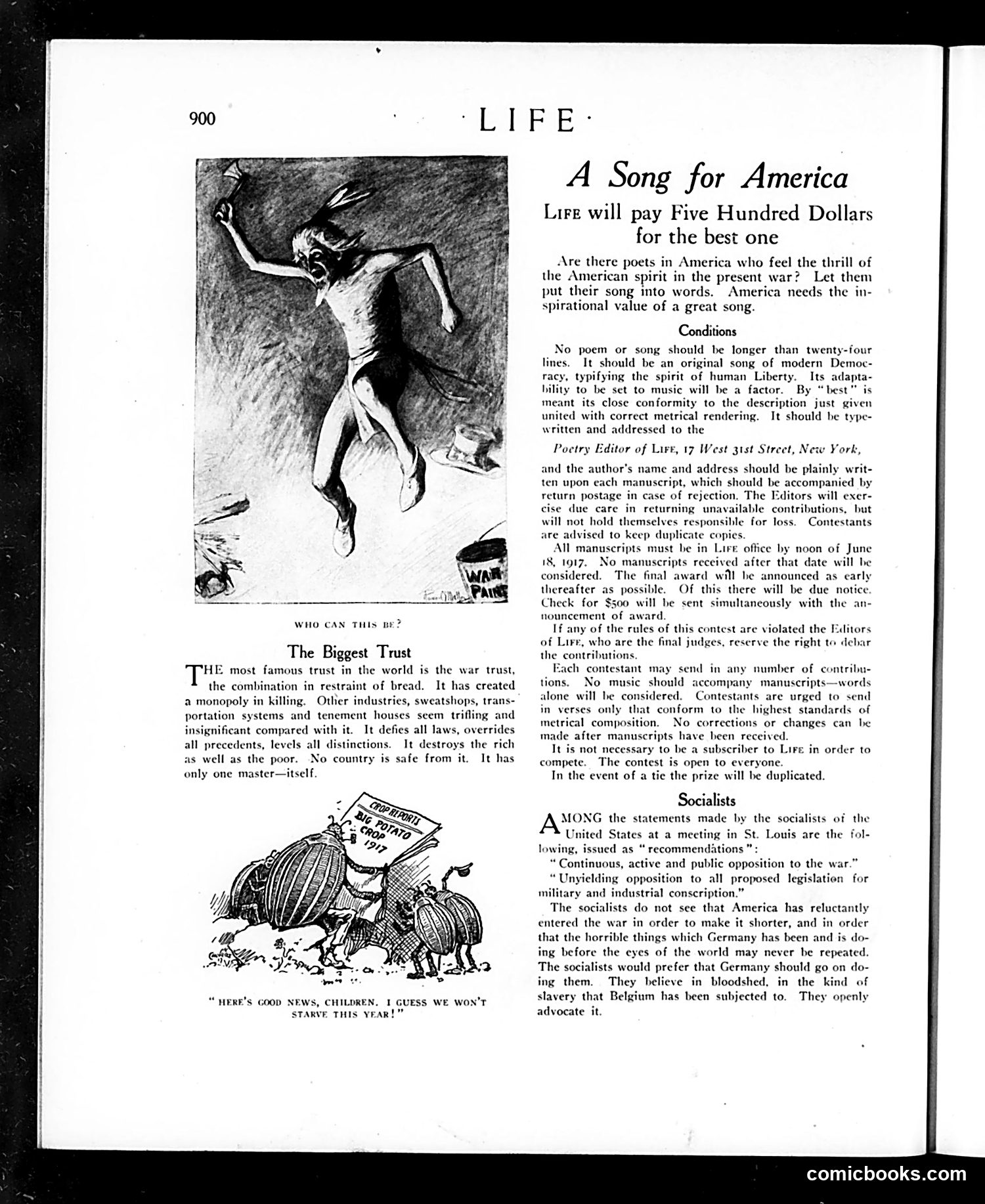
This page reflects American WWI-era propaganda and patriotic fervor. **"The Biggest Trust" cartoon**: Shows a skeletal, bloated figure labeled "War" crushing people beneath it. The caption's dark joke—a parent telling starving children "good news, we won't starve this year"—sarcastically critiques how war monopolizes resources and kills, destroying rich and poor alike. It personifies war as an uncontrollable force serving only itself. **"A Song for America" contest**: Life magazine solicits patriotic poetry celebrating American democracy and liberty, offering $500—substantial money at the time. The deadline (June 18, 1917) places this shortly after U.S. entry into WWI. **"Socialists" section**: Attacks American socialists' anti-war position, accusing them of preferring German atrocities (referencing Belgium's occupation) over military intervention. This represents the intense wartime pressure against pacifist opposition. Together, the page showcases how American media weaponized culture and morality to build support for the war effort while demonizing dissent.
📄 Transcribed text from this page (OCR, searchable)
Machine-transcribed from the original scan — historical spelling and the odd misread are preserved.
WHO CAN THIS BE? The Biggest Trust HE most famous trust in the world is the war trust, the combination in restraint of bread. It created a monopoly in killing. Other industries, sweatshops, trans- portation systems and tenement houses seem trifling and insignificant compared with it. It defies all laws, overrides all precedents, levels all distinctions. It destroys the rich as well as the poor. No country is safe from it. It has only one master—itself. “HERE'S GOOD NEWS, CHILDREN. I GUESS WE WON'T STARVE THIS YEAR! A Song for America Lire will pay Five Hundred Dollars for the best one «Are there poets in America who feel the thrill of the American spirit in the present war? Let them put their song into words. America needs the in- spirational value of a great song. Conditions No poem or song should be longer than twenty-four lines. It should be an original song of modern Democ- racy, typifying the spirit of human Liberty. It pta to be set to music will be a factor. By “best” meant its close conformity to the description just given united with correct metrical rendering. It should be type- written and addressed to the Poetry Editor of Lire, 17 West 31st Street, New York, and the author's name and address should be plainly writ- ten upon each manuscript, which should be accompanied by return postage in case of rejection. The Editors will exer- cise due care in returning unavailable contributions, but will not hold themselves responsible for loss. Contestants are advised to keep duplicate copies: All manuscripts must be in Lire office by noon of June 18, 1917. No manuscripts received after that date will be considered. The final award will he announced as early thereafter as possible. Of this there will be due notic Check for $5300 will be sent simultaneously with the an- nouncement of award. If any of the rules of this contest are violated the Editors of Lire, who are the final judges, reserve the right to debar the contributions. cach contestant may send in any number of contribu- tions. No music should accompany manuscripts—words alone will be considered. Contestants are urged to send in verses only that conform to the highest standards of metrical composition. No corrections or changes can be made after manuscripts have been received. It is not necessary to be a subscriber to Lire in order to compete. The contest is open to everyone. In the event of a tie the prize will be duplicated. Socialists MONG the statements made by the socialists of the United States at a meeting in St. Louis are the fol- lowing, issued as “ recommendations “Continuous, active and public opposition to the war.” “Unyielding opposition to all proposed legislation for military and industrial conscription.” The socialists do not see that America has reluctantly entered the war in order to make it shorter, and in order that the horrible things which Germany has been and is do- ing before the eyes of the world may never be repeated. The socialists would prefer that Germany should go on do- ing them. They believe in bloodshed, in the kind of slavery that Belgium has been subjected to. They openly advocate it. comicbooks.com