
Life, 1917-05-17 · page 20 of 35
Life — May 17, 1917 — page 20: what you’re looking at
What you’re looking at
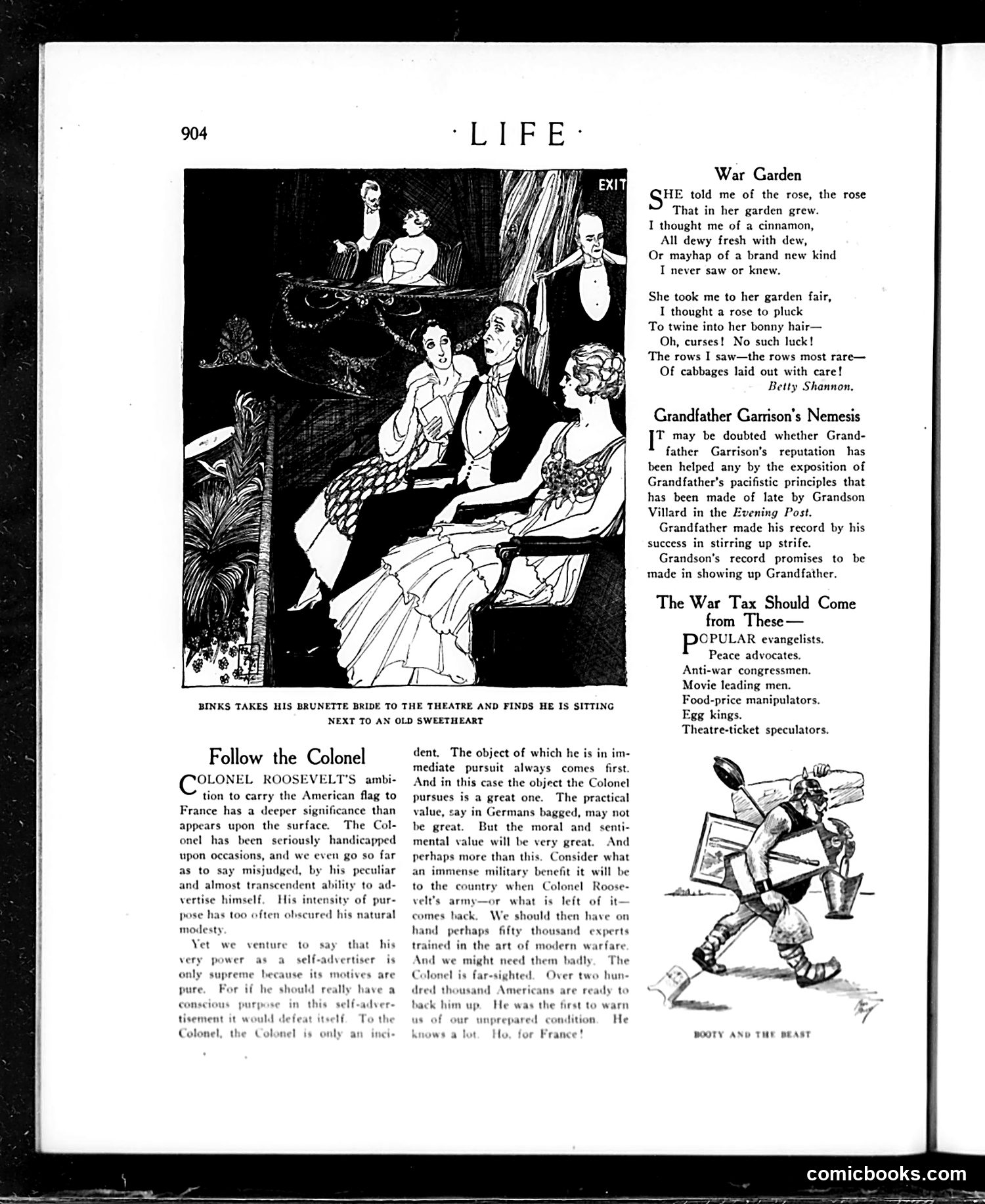
This page contains several satirical pieces from WWI-era America: **"Follow the Colonel"** critiques Theodore Roosevelt's ambition to lead troops to France. It acknowledges Roosevelt's self-promotional tendencies ("intensity of purpose") while arguing his military venture would provide valuable training for American soldiers—suggesting Roosevelt's vanity serves a practical purpose despite itself. **"War Garden"** is a humorous poem mocking romantic expectations. A suitor expects to find roses in a woman's garden but discovers only practical vegetables (cabbages), reflecting wartime necessity replacing peacetime romance. **"Grandfather Garrison's Nemesis"** references a dispute between pacifist William Lloyd Garrison and his grandson Oswald Garrison Villard (editor of the *Evening Post*), whose anti-war stance contradicts his grandfather's legacy of stirring conflict. **"The War Tax Should Come from These"** sarcastically lists groups who should fund the war effort—including pacifists, anti-war politicians, and profiteers—suggesting hypocrisy among those opposing or exploiting the conflict.
📄 Transcribed text from this page (OCR, searchable)
Machine-transcribed from the original scan — historical spelling and the odd misread are preserved.
BINKS TAKES HIS BRUNETTE BRIDE TO THE THEATRE AND FINDS HE IS SITTING NEXT TO AN OLD SWEETHEART Follow the Colonel OLONEL ROOSE T'S ambi- tion to carry the American flag to France has a deeper significance than appears upon the surface. The Col- onel has been seriously handicapped upon occasions, and we even go so far dent, The object of which he is in im- mediate pursuit always comes first. And in this case the object the Colonel pursues is a great one. The practical value, say in Germans bagged, may not be great. But the moral and. senti- mental value will be very great. And perhaps more than this. Consider what an immense military benefit it will be to the country when Colonel Roose- velt's army—or what is left of it- We should then have on hand perhaps fifty trained in the art of modern warfare as to say misjudged, by his peculiar and almost transcendent ability to ad- vertise himself. His intensity of pur- pose has too often obscured his natural comes hack modesty thousand. experts that his advertiser is Yet we venture to say And we might need them badly, The tives are Col dred self-adver- hy nt it would defeat itself. To the very power as a. se only supreme because its nel is far-sighted. Over two hun- or if he should really have a vusand Americans are ready to pury in thi k him up. He was the first to warn pared condition. He for France! Colonel, the Colonel is only ar War Garden HE told me of the rose, the rose That in her garden grew. I thought me of a cinnamon, All dewy fresh with dew, Or mayhap of a brand new kind I never saw or knew, She took me to her garden fair, I thought a rose to pluck To twine into her bonny hair— Oh, curses! No such luck! The rows I saw—the rows most rare— Of cabbages laid out with care! Betty Shannon, Grandfather Garrison’s Nemesis a may be doubted whether Grand- father Garrison’s reputation has been helped any by the exposition of Grandfather's pacifistic principles that has been made of late by Grandson Villard in the Evening Post. Grandfather made his record by his success in stirring up strife. Grandson’s record promises to be made in showing up Grandfather. The War Tax Should Come from These — PoEstar evangelists. Peace advocates. Anti-war congressmen. Movie leading men. Food-price manipulators. Egg kings. Theatre-ticket speculators. BOOTY AND THE BEAST