
Life, 1917-05-17 · page 26 of 35
Life — May 17, 1917 — page 26: what you’re looking at
What you’re looking at
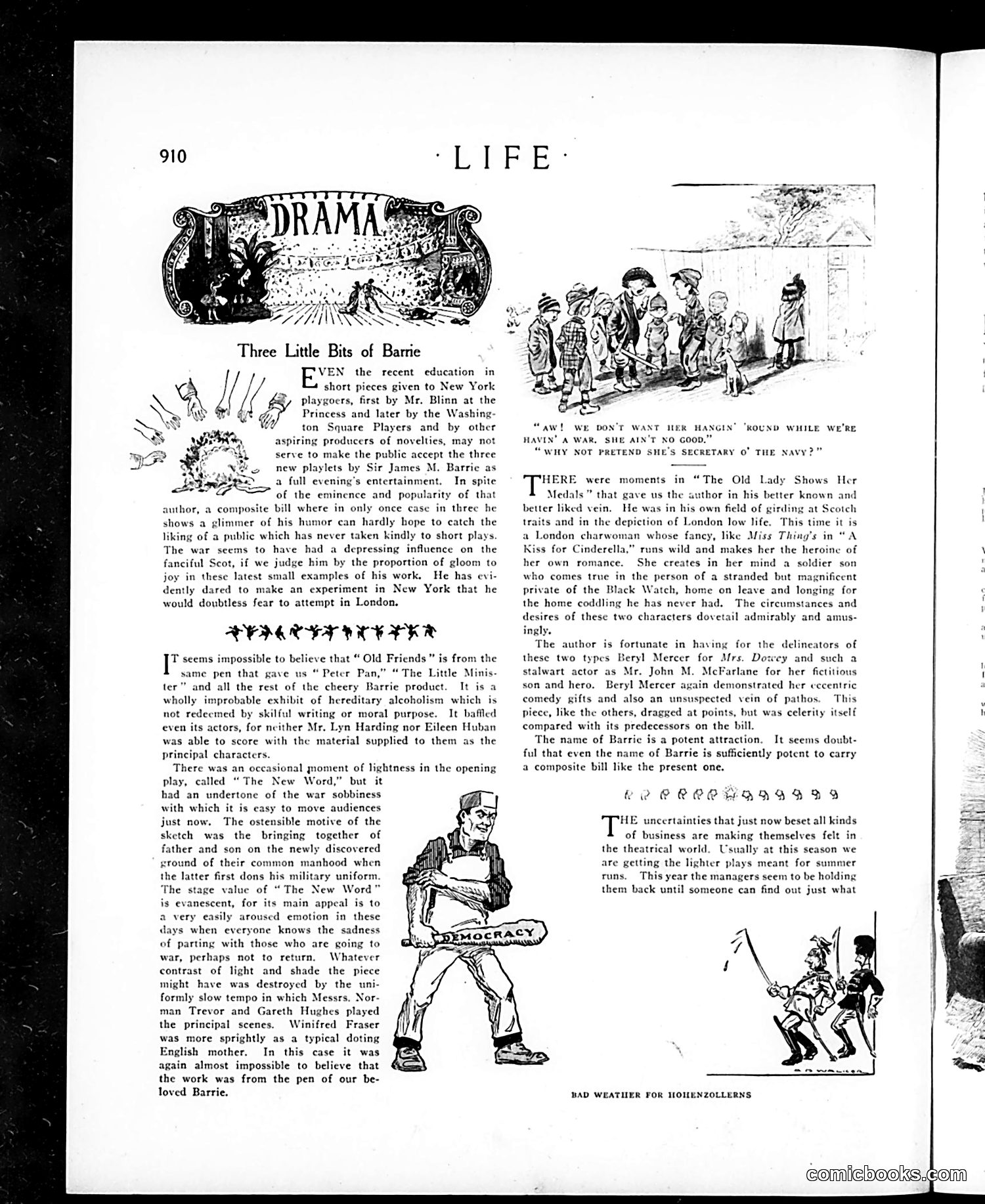
This page reviews three short plays by Sir James M. Barrie presented in New York. The critic argues that even Barrie's fame cannot save a composite bill of one-act plays, which audiences have never favored. The review examines three works: "Old Friends" (criticized as uncharacteristically dark, depicting alcoholism), "The New Word" (exploiting wartime emotions about fathers and sons, performed too slowly), and "The Old Lady Shows Her Medals" (more successful, praising actress Beryl Mercer's performance). The cartoons illustrate audience complaints: one shows children rejecting a woman ("Why not pretend she's secretary of the navy?"), while another titled "Bad Weather for Hollenzollerns" appears to reference wartime politics (likely mocking German leadership during WWI, though unclear without full context). The critic concludes Barrie's reputation alone cannot sustain this theatrical experiment.
📄 Transcribed text from this page (OCR, searchable)
Machine-transcribed from the original scan — historical spelling and the odd misread are preserved.
Three Little Bits of Barrie VEN the recent education in short pieces given to New York goers, first by Mr. Blinn at the Princess and later by the Washing- ton Square Players and by other aspiring producers of novelties, may not serve to make the public accept the three new playlets by Sir James M. Barrie as a full evening’s entertainment. In spite of the eminence and popularity of that author, a composite bill where in only once case in three he shows a glimmer of his humor can hardly bope to catch the liking of a public which has never taken kindly to short plays. The war seems to have had a depressing influence on the fanciful Scot, if we judge him by the proportion of gloom to joy in these latest small examples of his work, He has evi- dently dared to make an experiment in New York that he would doubtless fear to attempt in London. PEIRCE EER T seems impossible to believe that “ Old Friends” is from the same pen that gave us “Peter Pan,” “The Little Minis- ter” and all the rest of the cheery Barrie product. It wholly improbable exhibit of hereditary alcoholism which is not redeemed by skilful writing or moral purpose. It bafiled even its actors, for ncither Mr. Lyn Harding nor Eileen Huban was able to score with the material supplied to them as the principal characters. There was an occasional moment of lightness in the opening play, called “The New Word,” but it had an undertone of the war sobbiness with which it is easy to move audiences just now, The ostensible motive of the sketch was the bringing together of father and son on the newly discovered ground of their common manhood when the latter first dons his military uniform. The stage value of “The New Word” is evanescent, for its main appeal is to a very easily aroused emotion in these days when everyone knows the sadness of parting with those who are going to war, perhaps not to return, Whatever contrast of light and s\ might have was destroyed by the uni- formly slow tempo in which Messrs. Nor- man Trevor and Gareth Hughes played the principal scenes. Winifred Fraser was more sprightly as a typical doting English mother. In this case it was again almost impossible to believe that the work was from the pen of our be- loved Barrie. le the piece “AW! WE DON'T WANT IER HANGIN’ "ROUND WHILE WE'RE HAVIN’ A WAR, SHE AIN'T NO GOOD,” WHY NOT PRETEND SHE'S SECRETARY 0° THE vy HERE were moments in “The Old Lady Shows Her Medals” that gave us the better liked vein. He was in his own field of girding at and in the depiction of London low life. This time it is n whose fancy, like Miss Thing’s in “A Kiss for Cinderella,” runs wild and makes her the heroine of her own romance. She creates in her mind a soldier son who comes true in the person of a stranded but magnificent private of the Bla ch, home on leave and longing for the home coddling he has never had, The circumstances and desires of these two characters dovetail admirably and amus- ingly The author is fortunate in having for the delineators of these two types Beryl Mercer for Mrs. Dowey and such a stalwart actor as Mr. John M. McF son and hero. Beryl Mercer comedy gifts and also an unsuspected vein of pathos. Th piece, like the others, dragged at points, but was celerity itself compared with its predecessors on the bill. The name of Barric is a potent attraction. It seems doubt- ful that even the name of Barrie is sufficiently potent to carry a composite bill like the present one. & Oe RPRCCHHAABADBD sthor in his better known and Scotch trait: a London charwow lane for her fictitious demonstrated her eccentric HE, uncertainties that just now beset all kinds of business are making themselves felt in the theatrical world. Usually at this season we are getting the lighter plays meant for summer runs. This year the managers seem to be holding them back until someone can find out just what BAD WEATHER FOR HOMENZOLLERNS