
Life, 1917-05-17 · page 27 of 35
Life — May 17, 1917 — page 27: what you’re looking at
What you’re looking at
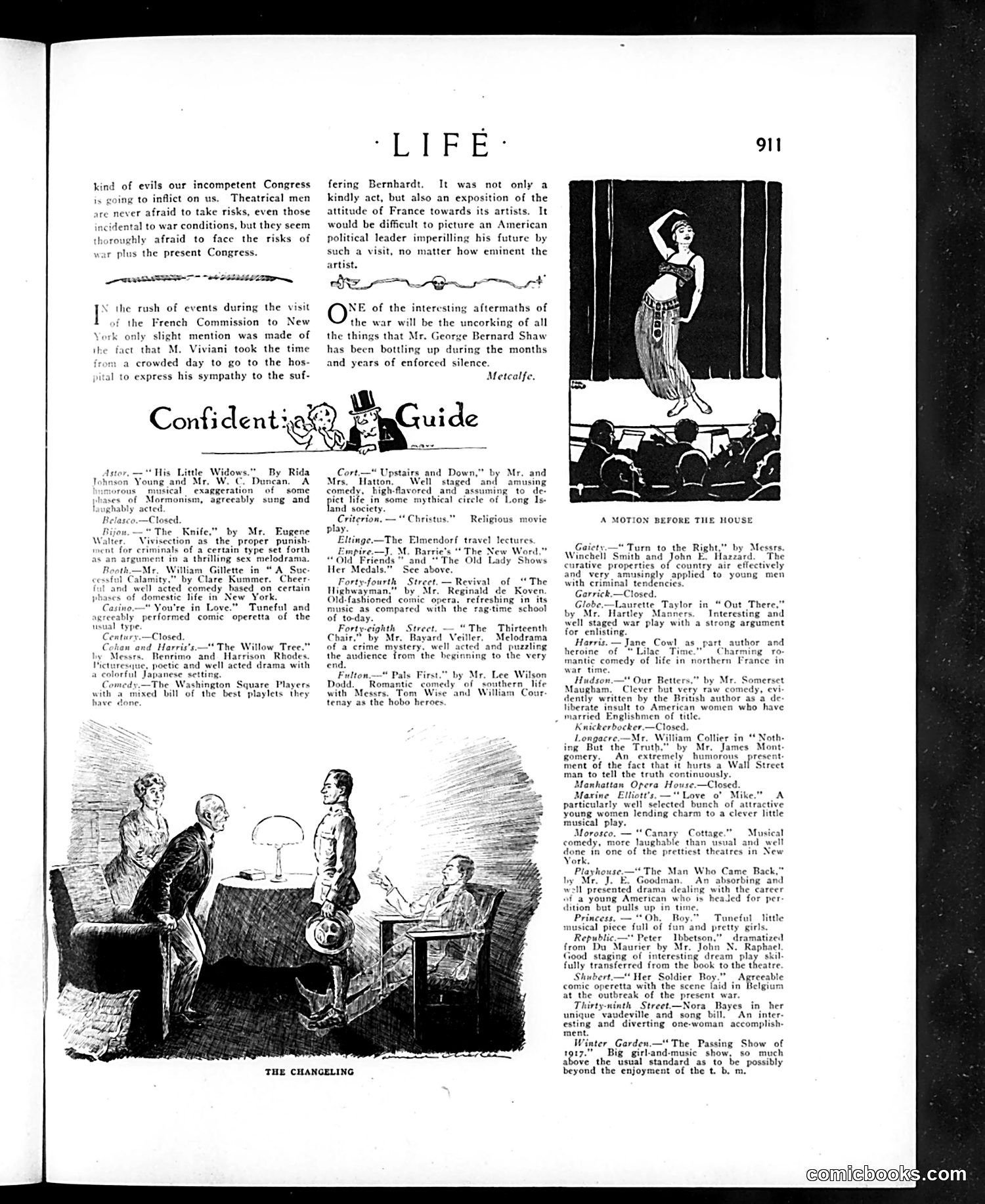
This page presents a "Confidential Guide" to Broadway theaters—essentially theater reviews with satirical commentary. The two illustrations depict theatrical scenes: "The Changeling" shows an interior domestic scene, while "A Motion Before the House" depicts an audience watching a performer on stage. The text critiques both theatrical productions and contemporary politics. A key passage mocks American political leaders' timidity compared to French culture: French leader M. Viviani visited a hospital despite his busy schedule, while "an American political leader [would be] imperilling his future" by such an act "no matter how eminent the artist." The reviews also reference George Bernard Shaw being "enforced silence" during wartime—suggesting censorship of his controversial views. Several reviews mention war-related plays and their patriotic messages about enlisting. The "guide" format allows Life to blend entertainment criticism with social and political commentary about American attitudes toward art, leadership, and wartime conformity.
📄 Transcribed text from this page (OCR, searchable)
Machine-transcribed from the original scan — historical spelling and the odd misread are preserved.
kind of evils our incompetent Congress ing to inflict on us. Theatrical men vre never afraid to take risks, even those cidental to war conditions, but they seem thoroughly afraid to face the risks of war plus the present Congress. nev yi DSO “e oataseee [ste rush of events during the visit the French Commission to New York only slight mention was made of the fact that M. Viviani took the time from a crowded day to go to the hos- ital to express his sympathy to the suf- Confidentiat, Istor, = His Little Widows Johnson Young and Mr, WC. I merous musical exaggeration asses. of Mormonism, agreeably ghably acted. Relasco.—Closed i The Knife.” by Mr. Eugene Walter isection as’ the proper punish: vient for eriminals of a certain type set forth tin a thrilling sex melodrama. William, Gillette in “ A, Sv lare Kummer. Cheer acted comedy hased on certain sof domestic life in. New York. You're in Love.” Tuneful and performed comic operetta of the agreeably usual type. Century. —Closed. re 4 Harris's." The Willow Tree.” Renrimo and Harrison Rhodes. c, poetic and well acted drama with —The Washington Square Players ed Dill of the best playlets they Comed. with am LIFE fering Bernhardt. It was not only a kindly act, but also an exposition of the attitude of France towards its artists. It would be difficult to picture an American political leader imperilling his future by such a visit, no matter how eminent the artist. Na BI hes NE of the interesting aftermaths of the war will be the uncorking of all the things that Mr. George Bernard Shaw has been bottling up during the months and years of enforced silence. Metcalfe, ~~ Cort— Upstairs and Down,” by Mr. and Mrs. Hatton. Well staged and. amusing comedy, bigh-Mavored and assuming to. de- ict life in some mythical circle of Long Is- land society. Criterion. —“ Christus.” play. Eltinge—The Elmendorf travel lectures Empire—J. M. Barrie's “The New Word.” “Old Friends” and “The Old Lady Shows Her Medals.” See above. Forty-fourth Street. — Revival of |“ The Highwayman.” by Id de Koven. Old-fashioned cra. refreshing in its music as compared with the rag-time school of today. Forty-cighth Street. —“ The Chair.” by Mr. Bayard. Veiller of a crime mystery, well act the, audience fror Fulton. Lee Wilson Dodd. in c ds f hern life with Messrs, Tom Wise and William Cour tenay as the hobo heroes. Religious movie Thirteenth Melodrama and puzzling ping to the very THE CHANGELING A MOTION BEFORE THE MOUSE Turn to the Right,” by Messrs. Smith and John E. Hazzard. The © properties 0} ry air eflectively nd very amusingly applied to young men with criminal tendencies —Closed. aurette Taylor “Out There, ley Manners. Interesting well staged war play with a strong argument for enlisting. Harris. — Jane Cow! as t author and heroine of “Lilac Time." Charming ro: mantic comedy of life in northern France in wart Hudson.—* Our Betters,” by Mr. Somerset Maugham. Clever but very raw comedy, evi dently written by the British author as a de liberate insult to American won who have married Englishmen of title. ‘herbocker.—Cl losed. iam Collier in * Noth- "by Mr. James Mont- mely humorous _prese frent of the fact that it hurts a Wall Strect man to tell the truth continuously Manhattan Opera House.—Closed. Maxine Elliott's, —‘* Love o° Mike.” A particularly well selected bunch of attractive young women lending charm to a clever little musical play. Morosco. — ‘Canary Cottage.” Musical comedy, ¢ laughable than usual and well done in one of the prettiest theatres in New York. Playhouse-—“ The Man Who Came Back,” hy Mr. J. E, Goodman. An absorbing well presented dra @ with the c: of a young American who is headed f dition but pulls up in time, Princess. — “Oh, Roy.” Tuneful tittle ical piece full of fun and pretty girls. Republic.—* Peter Ibbets dramatized from Da Maurier by Mr. J . Raphael. Good stagi of interesting dream play skil- fully transferred from the book to the theatre Shwbert.—" Her Soldier Roy.” Agreeable comic operetta with the scene laid in Belgium at the outbreak of the present war. Thirty-ninth Street—Nora, Bayes in her unique vaudeville and song bill, An inter- esting and diverting one-woman accomplish: ment. Winter Garden.—* The. Passing Show of p17. Big girl-and-music show, so much above the usual standard as to be possibly beyond the enjoyment of the t. b, m. gomery comichoo!