
Life, 1917-05-17 · page 22 of 35
Life — May 17, 1917 — page 22: what you’re looking at
What you’re looking at
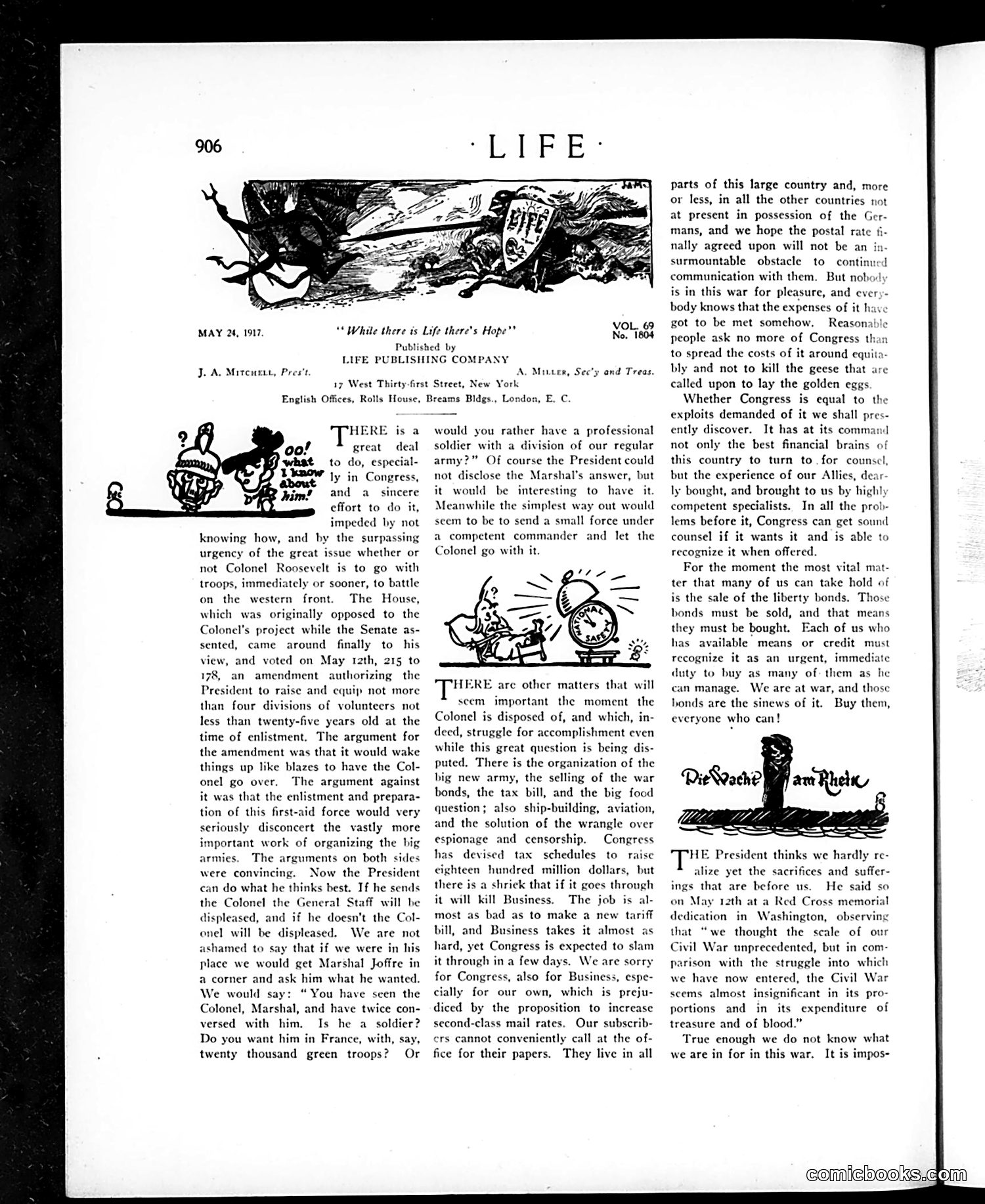
This page addresses the heated debate over whether **Colonel Theodore Roosevelt** should lead troops to France during World War I. Congress had voted to authorize the President to raise volunteer divisions, creating a political dilemma: deploy Roosevelt (which would please him but disrupt military organization) or refuse him (disappointing the popular former president). The editorial sardonically notes the President could ask French Marshal Joffre for advice but instead must choose between an angry Colonel or an angry General Staff. The page also discusses concurrent wartime challenges: organizing the new army, selling war bonds, passing a tax bill, and food production—all urgent matters competing for Congressional attention. The cartoons (partially visible) appear to satirize the competing pressures and confusion surrounding these decisions. The underlying point: wartime governance requires navigating impossible political choices while managing multiple crises simultaneously.
📄 Transcribed text from this page (OCR, searchable)
Machine-transcribed from the original scan — historical spelling and the odd misread are preserved.
MAY 24, 1917. PUBLISHING COMPANY J. A. Mircumtt, Pres’t. A. Minter, Sec’y and Treas, 17 West Thirty-first Street, New York English Offices, Rolls House, Breams Bldgs., THER Lis oo! great de what to do, especial- }enow iy in Congress, dims and a. sincere effort to do it, impeded by not knowing how, and by the surpassing urgency of the great issue whether or not Colonel Roosevelt is to go with troops, immediately or sooner, to battle on the western front. The House, which was originally opposed to the Colonel's project while the Senate as- sented, came around finally to his view, and voted on May 12th, 215 to 178, an ing the President to raise and equip not more than four divisions of volunteers not less than twenty-five years old at the time of enlistment. The argument for the amendment was that it would wake things up like blazes to have the Col- onel go over. The argument against it was that the enlistment and prepara- tion of this first-aid force would very seriously disconcert the vastly more important work of organizing the big armies. The arguments on both sides were convincing. Now the President can do what he thinks best. If he sends the Colonel the General Staff will bh displeased, and if he doesn't the Col- onel will be displeased. We are not ashamed to say that if we were in his place we would get Marshal Joffre in a corner and ask him what he wanted. We would say: “You have seen the Colonel, Marshal, and have twice con- versed with him. Is he a soldier? Do you want him in France, with, say, twenty thousand green troops? Or amendment authori London, E. C. would you rather have a professional soldier with a division of our regular army?” Of course the President could not disclose the Marshal's answer, but to have it. Meanwhile the simplest way out would m to be to send a small force under a competent commander and let the Colonel go with it. it would be interesting are other matters that will important the moment. the Colonel is disposed of, and which, in- deed, struggle for accomplishment even while this great question is being dis- puted. There is the organization of the big new army, the selling of the war bonds, the tax bill, and the big food question; also ship-building, aviation, and the solution of the wrangle over espionage and censorship. Congress has devised tax schedules to raise eighteen hundred million dollars, but there is a shriek that if it goes through it will kill Business. The job is al- most as bad as to make a new tariff bill, and Business takes it almost as hard, yet Congress is expected to slam it through in a few days. We are sorry for Congress, also for Business, espe- cially for our own, which is preju- diced by the proposition to increase second-class mail rates. Our subscrib- crs cannot conveniently call at the of- fice for their papers. They live in all THERE seem parts of this large country and, more or less, in all the other countries not at present in possession of the Ger- mans, and we hope the postal rate fi- nally agreed upon will not be an surmountable obstacle to continued communication with them. But nobod is in this war for pleasure, and every- body knows that the expenses of it have got to be met somehow. Reasonable people ask no more of Congress th to spread the costs of it around equi bly and not to kill the geese that are called upon to lay the golden eggs Whether Congress is equal to the exploits demanded of it we shall pres- ently discover. It has at its command not only the best financial brains of this country to turn to. for counsel, but the experience of our Allies, dear ly bought, and brought to us by highly competent specialists. In all the prob- lems before it, Congress can get sound counsel if it wants it and is able to recognize it when offered. For the moment the most vital mat- ter that many of us can take hold of is the sale of the liberty bonds. Those bonds must be sold, and that means they must be bought. Each of us who has available means or credit must recognize it as an urgent, imme duty to buy as many of: them as he can manage. We are at war, and those bonds are the sinews of it. Buy them, everyone who can! : President thinks we hardly re- alize yet the sacrifices and suffer- ings that are before us. He said so on May 12th at a Red Cross memorial dedication in V that “we thought the scale of our Civil War unprecedented, but in com- parison with the struggle into which we have now entered, the Civil War scems almost insignificant in its pro- portions and in its expenditure of treasure and of blood.” True enough we do not know what we are in for in this war. It is impos- ashington, observing comichooks.qom