
A complete issue · 48 pages · 1914
Life — October 1, 1914
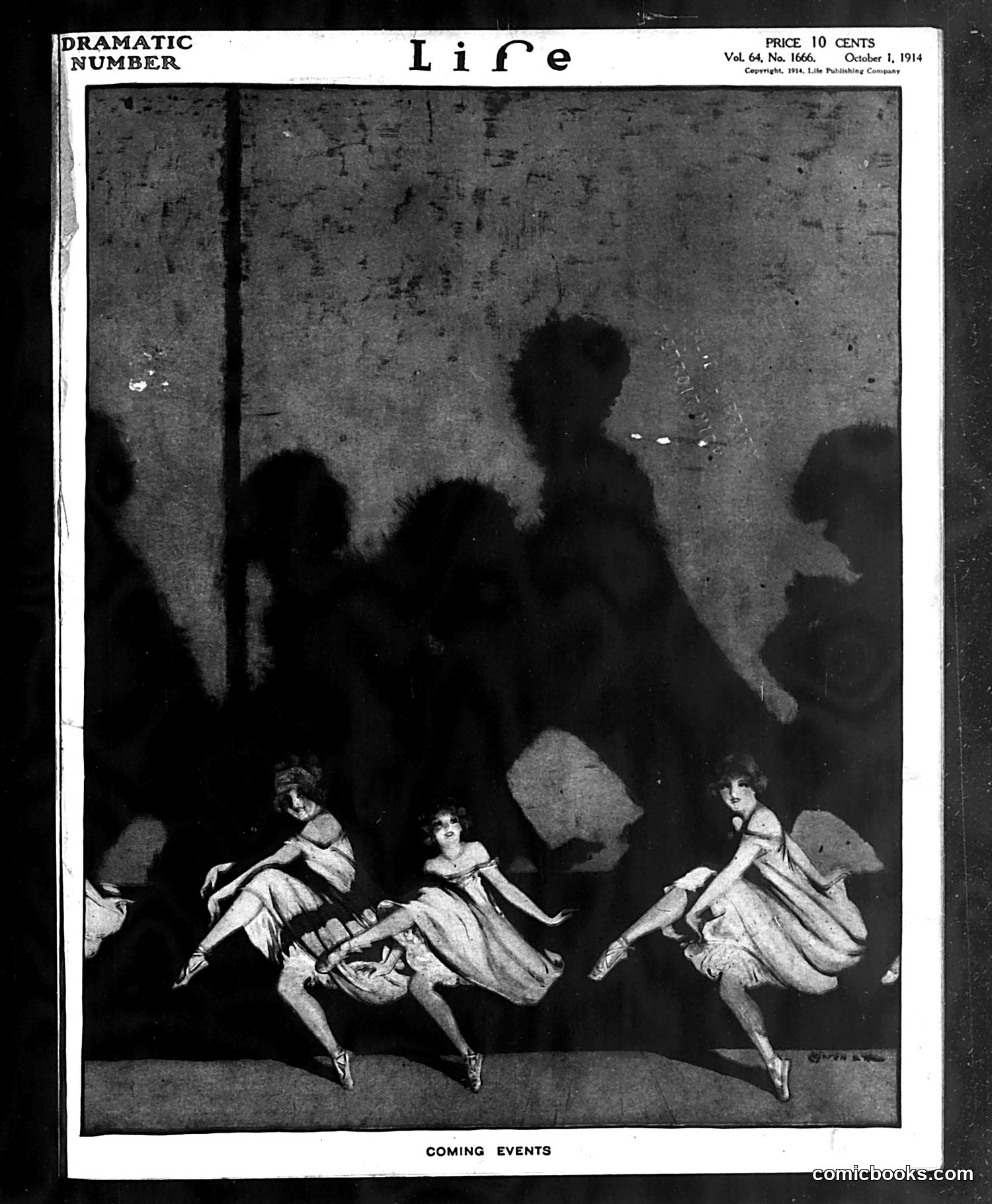
This is the cover of *Life* magazine from October 1, 1914, labeled "Dramatic Number." The image shows three female figures in classical Greek/Roman style dress and poses, apparently representing allegorical concepts, with large dark shadows of male figures looming behind them against a wall. The timing—October 1914—is crucial: World War I had begun just weeks earlier (August 1914). The composition appears to satirize how women and civilian concerns are overshadowed by male military power and the massive specter of war. The classical styling suggests civilization itself is being threatened. The "Coming Events" caption implies the shadows represent impending catastrophes or the dominance of military concerns over domestic life. This reflects contemporary anxieties about the Great War's expansion and impact.
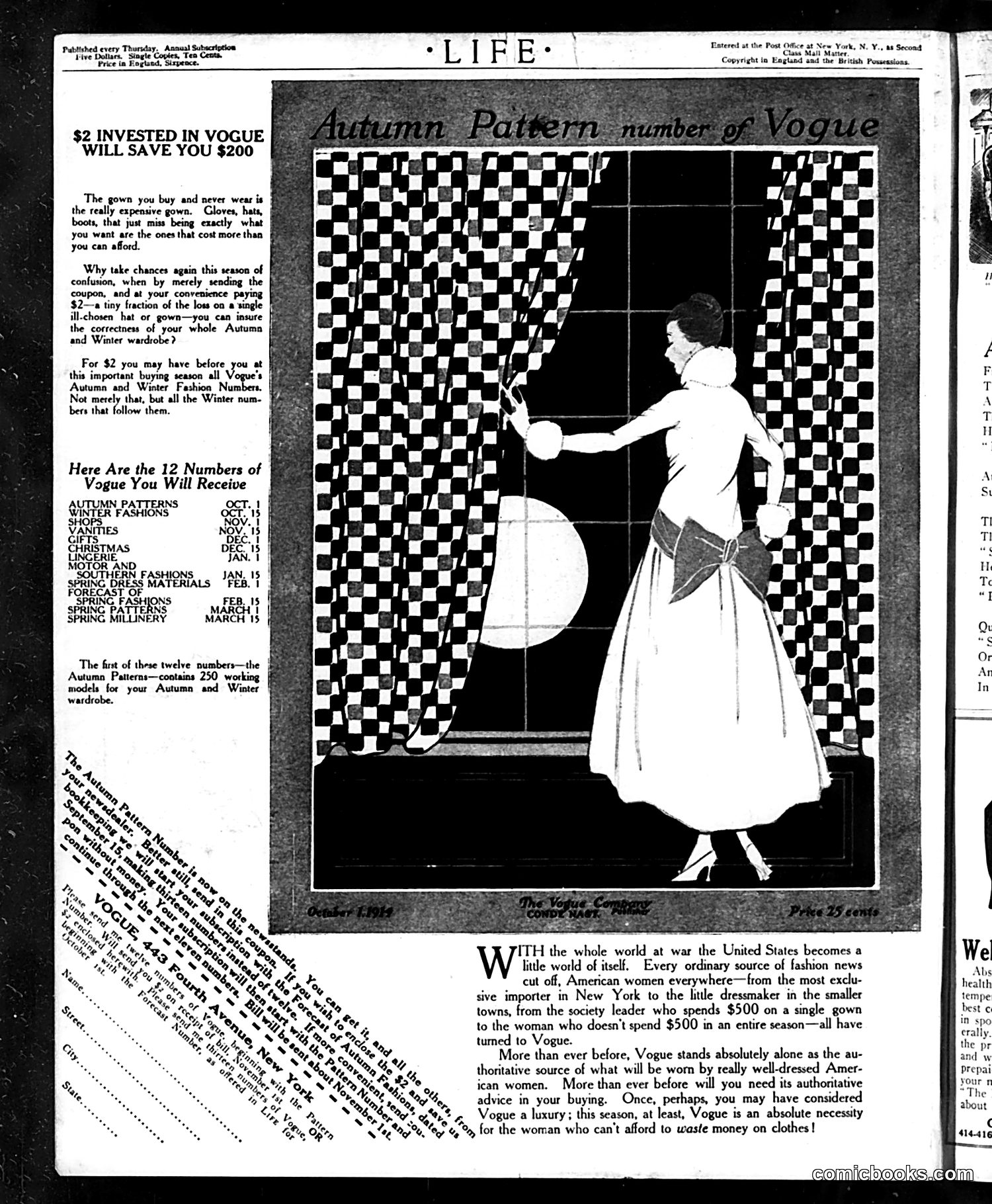
This page is primarily **advertising**, not satire or political commentary. It promotes Vogue magazine subscriptions with the headline "$2 Invested in Vogue Will Save You $200." The central illustration shows a woman in 1920s fashion examining a checkered pattern—likely representing fabric swatches or design options. The accompanying text emphasizes Vogue's authority on fashion for "well-dressed American women," positioning it as an essential guide for purchasing clothes wisely. The advertisement lists twelve upcoming Vogue issues covering seasonal fashion topics (autumn patterns, winter fashions, gifts, Christmas). The pitch argues that Vogue's authoritative fashion guidance justifies the subscription cost by helping readers avoid poor clothing purchases. This reflects early 20th-century consumer culture and the emerging importance of fashion magazines in shaping women's purchasing decisions.
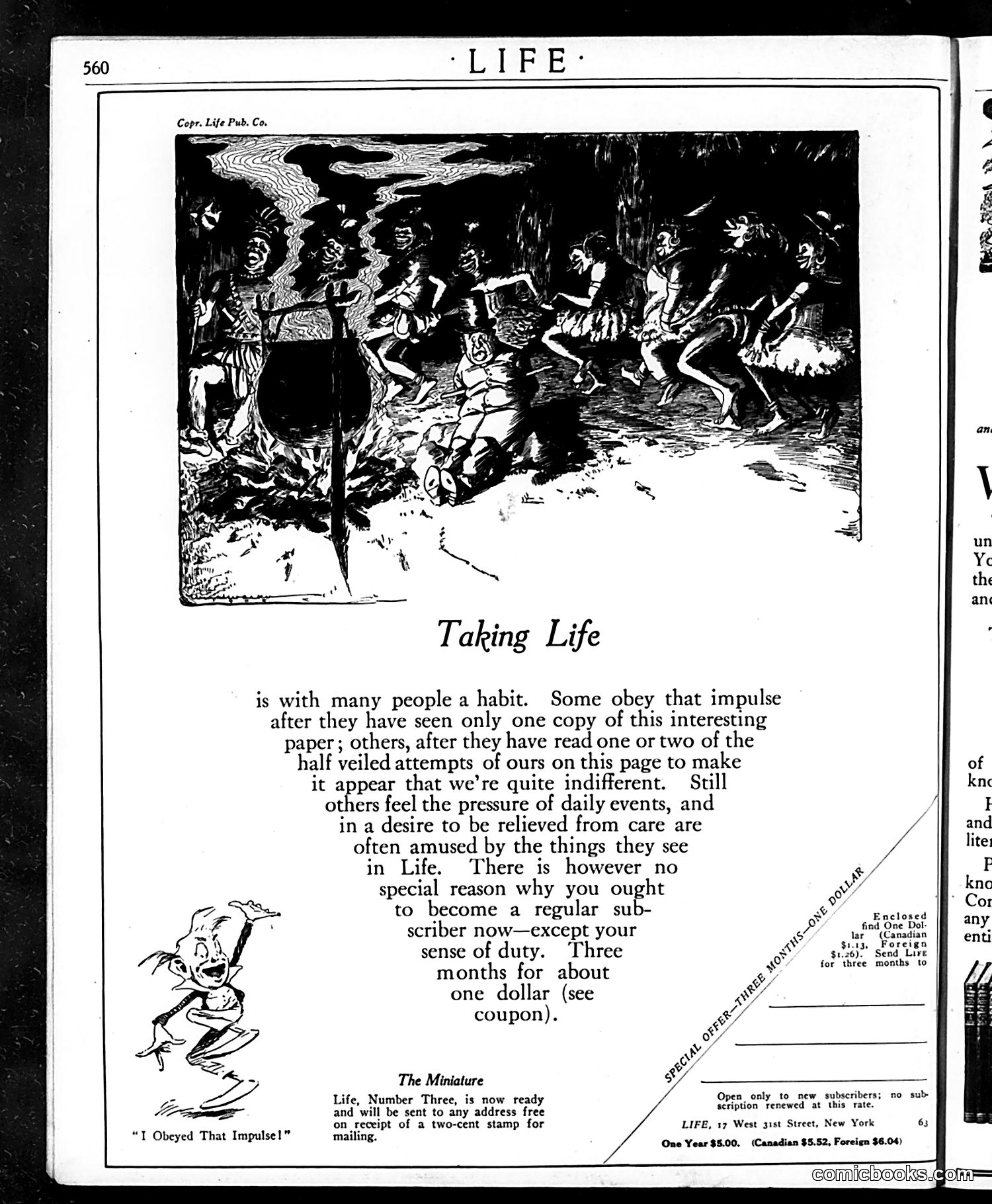
The main illustration depicts skeletal figures dancing around a cauldron in a witches' sabbath-like scene, likely representing death or morbid fate. The accompanying text is a subscription pitch for *Life* magazine itself, humorously suggesting that reading about grim current events is a "habit" for many people. The smaller cartoon below shows a figure skiing, captioned "I Obeyed That Impulse!" — appearing to satirize impulsive decision-making, though the specific reference is unclear. This page functions primarily as **advertising disguised as editorial content**. Rather than political satire, it's a self-promotional piece encouraging subscriptions by acknowledging readers' morbid interest in news while presenting *Life*'s humor as relief from dark events. The tone suggests post-WWI disillusionment common to 1920s satirical magazines.
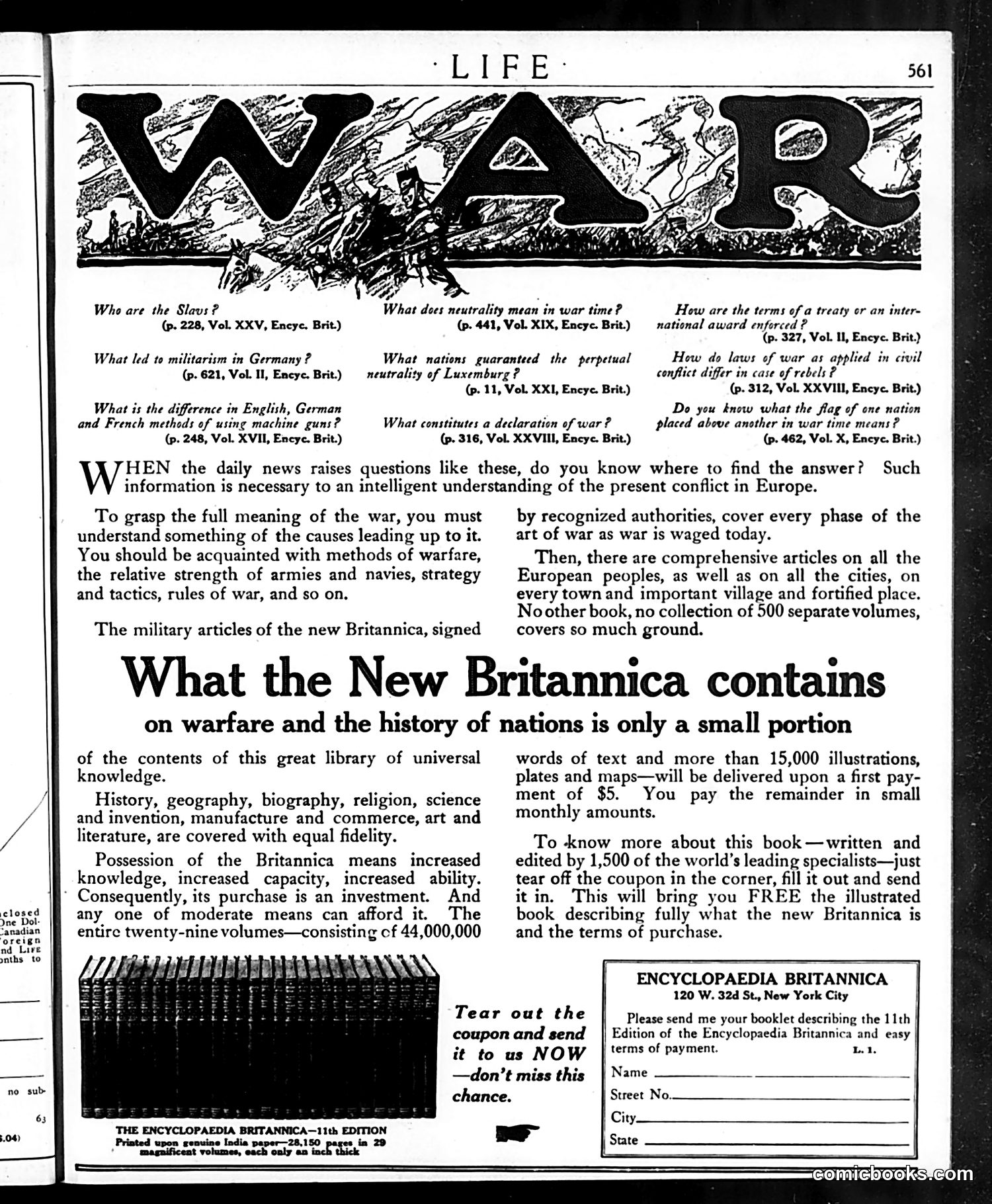
This page is primarily an **advertisement for Encyclopedia Britannica** (11th Edition), not political satire. The "WAR" header with decorative artwork frames war-related educational questions ("Who are the Slavs?" "What led to militarism in Germany?"). The ad's pitch exploits **World War I anxieties**: readers need the encyclopedia to understand the ongoing European conflict intelligently. It emphasizes the Britannica's comprehensive coverage—44 million words, 15,000 illustrations—as essential knowledge for informed citizens during wartime. The promotional strategy is direct: tear out the coupon and request a free illustrated booklet about purchasing terms. This represents typical WWI-era marketing that connected educational products to patriotic duty and civic understanding.
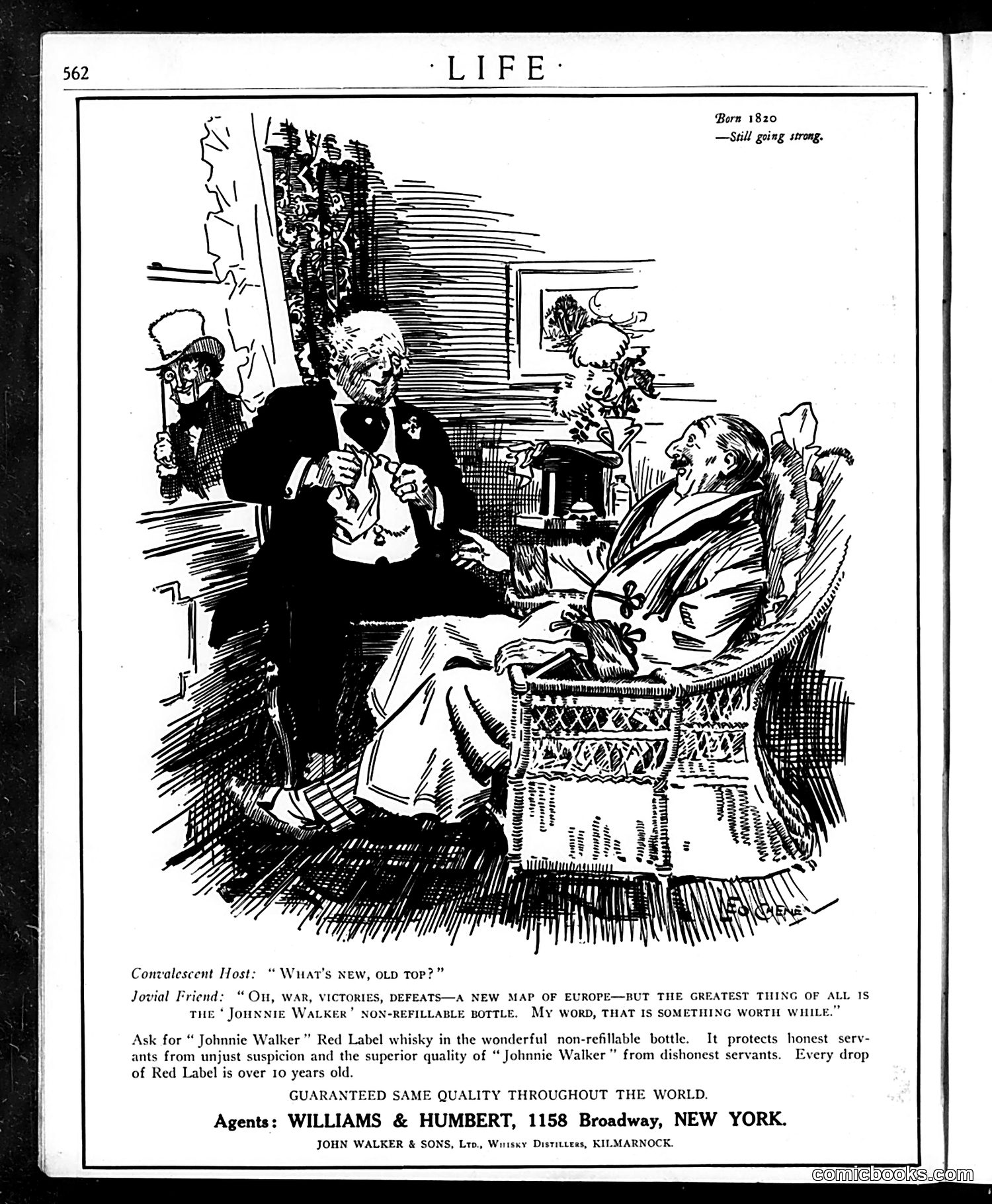
This page is primarily a **Johnnie Walker whisky advertisement** disguised as satirical content. The illustration shows two men in conversation—a "Convalescent Host" and "Jovial Friend"—in what appears to be a post-WWI setting (born 1820, "still going strong"). The satire is thin: the friend boasts about war victories, defeats, and "a new map of Europe," but pivots to praising Johnnie Walker whisky's non-refillable bottle as "the greatest thing of all." The joke suggests that amid serious geopolitical upheaval, the advertisement's subject is trivially promoted as the real achievement. The ad copy emphasizes the bottle's anti-tampering design, positioning the product as reliably "honest" compared to dishonest servants. Agents are listed as Williams & Humbert in New York.
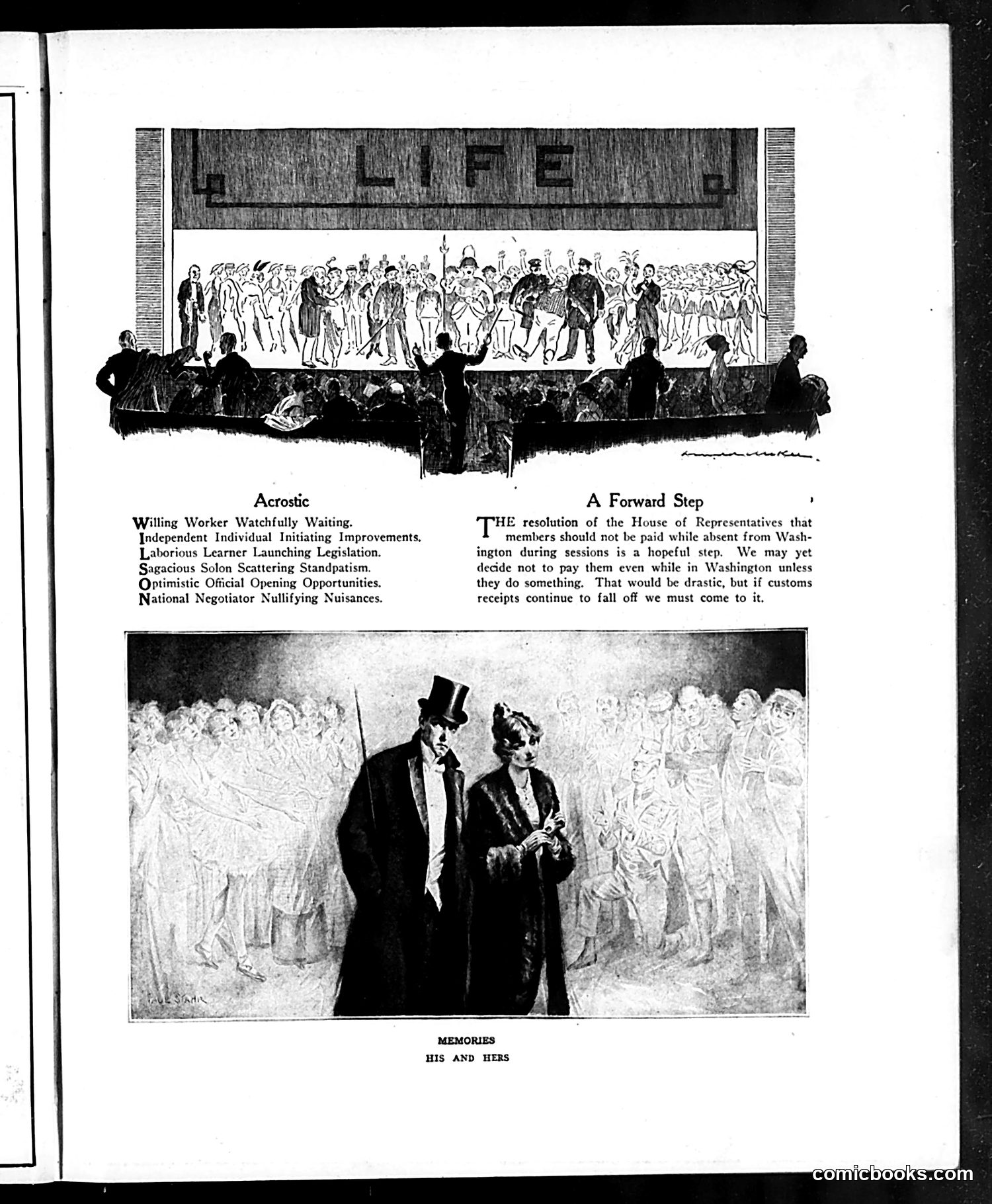
This page contains two political cartoons satirizing Congressional conduct around 1910-1920. **Top cartoon ("Acrostic"):** Lists complaints about Congressional behavior using acrostic format—including "Willing Worker Wasting Waiting," "Laborious Loafer Launching Legislation," and similar criticisms. The stage scene shows legislators in disarray, mocking their ineffectiveness. **Bottom cartoon ("A Forward Step"):** References a House resolution proposing members shouldn't be paid while absent from Washington sessions. The accompanying text sarcastically suggests this won't work unless "customs receipts continue to fall off." The cartoon depicts an elegantly dressed couple amid crowds, apparently representing the self-interested political class indifferent to fiscal concerns. Both pieces mock Congressional laziness, corruption, and fiscal irresponsibility during the Progressive Era.
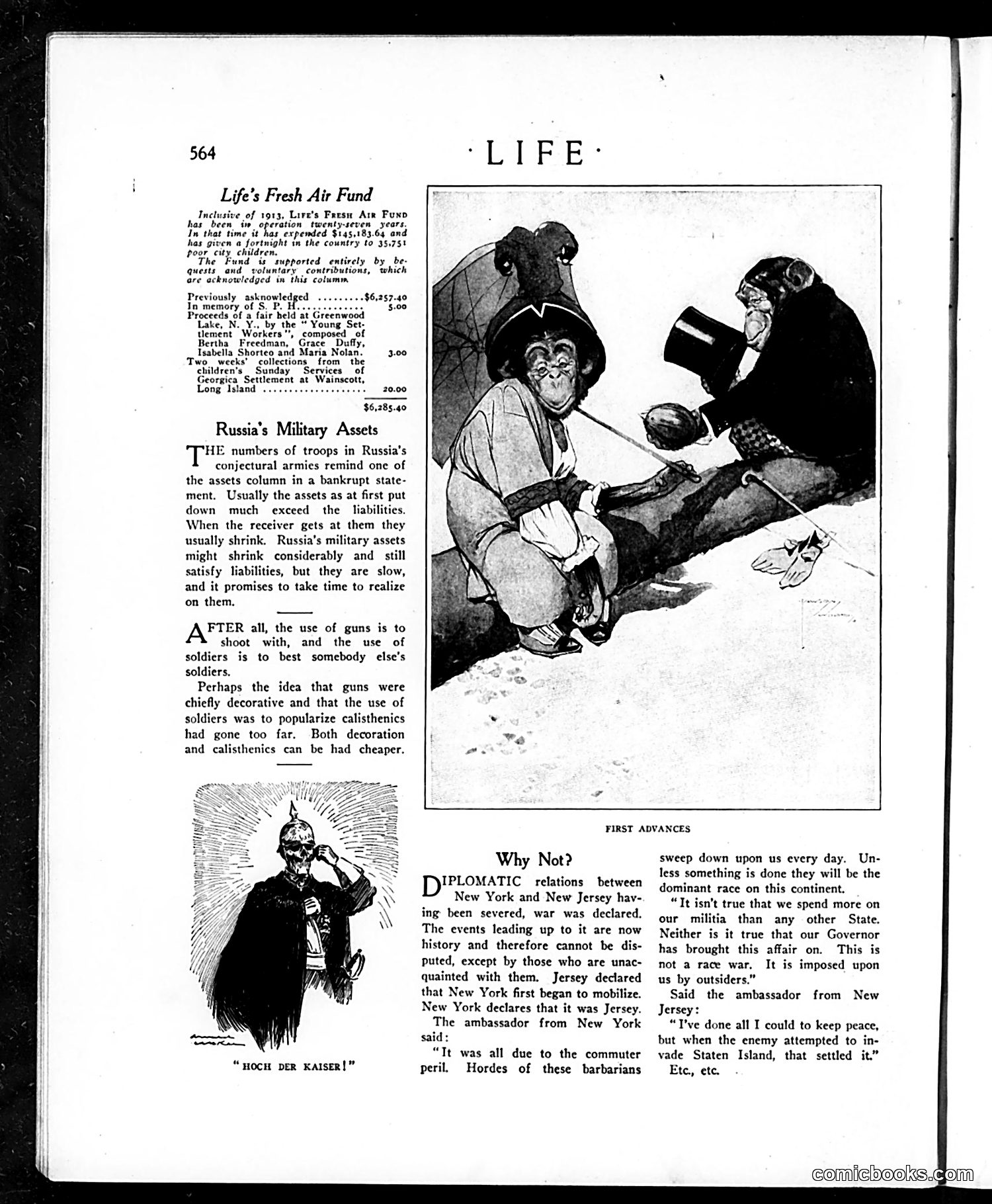
The main cartoon depicts two chimpanzees in a domestic scene—one sitting with a gun while the other appears to be a woman in a dress applying makeup or grooming. This is satirizing American militarism and gender roles during wartime (likely WWI era, given references to Russia's military). The accompanying article "Why Not?" discusses diplomatic tensions between New York and New Jersey over war mobilization, with accusations flying about who declared war first and responsibility for invasion threats. The "Hoch der Kaiser!" illustration shows a caricatured German military figure, reflecting anti-German sentiment of the period. The cartoon's ape imagery—comparing soldiers and domestic life to animals—suggests satire of how militarization affects civilization and normalcy.
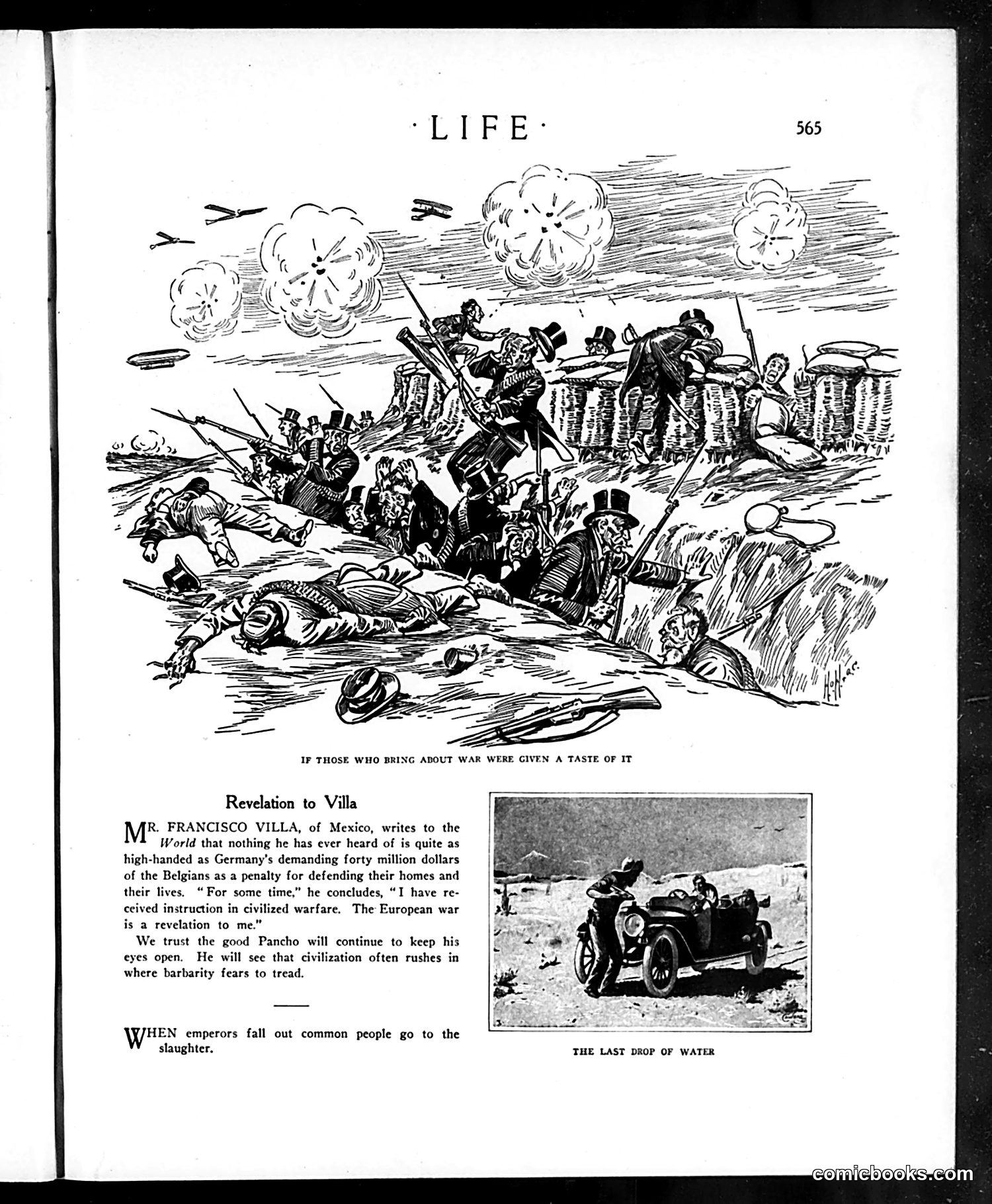
This page contains anti-war satire from World War I. The large illustration at top depicts a gruesome battlefield scene with explosions, casualties, and soldiers, captioned "IF THOSE WHO BRING ABOUT WAR WERE GIVEN A TASTE OF IT"—suggesting that war-promoting politicians should experience combat's horrors themselves. Below, a piece titled "Revelation to Villa" quotes Mexican revolutionary leader Francisco Villa criticizing Germany's $40 million penalty demanded from Belgium for defending itself. Villa calls the European war "a revelation" showing that "civilization often rushes in where barbarity fears to tread"—arguing that supposedly civilized nations wage war as brutally as any "savage." The accompanying photograph shows Villa in a vehicle, labeled "THE LAST DROP OF WATER," likely referencing wartime deprivation.
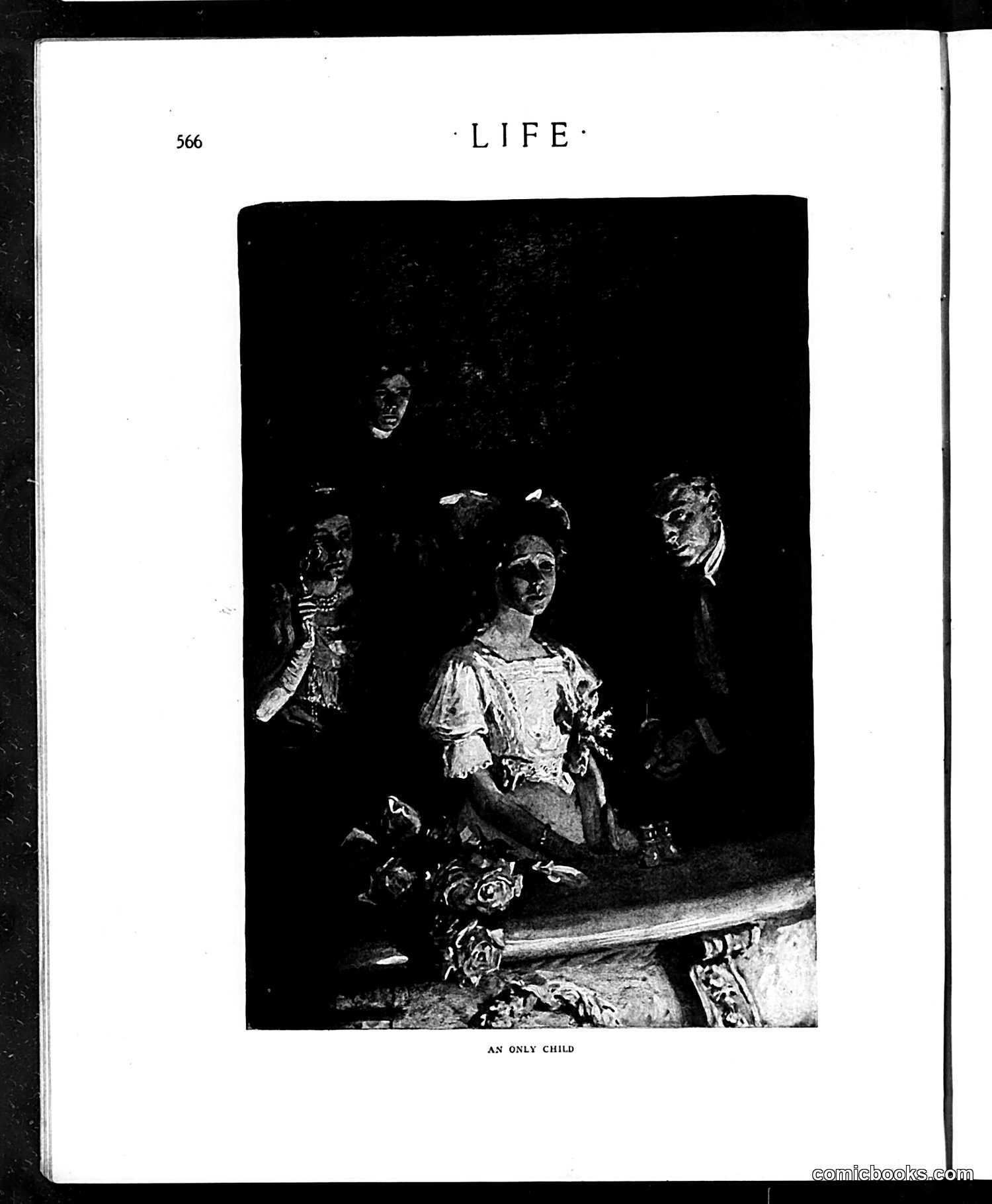
This page from *Life* magazine shows a dramatic theatrical or artistic scene depicting a young girl surrounded by ghostly or shadowy figures in the darkness. The caption reads "AN ONLY CHILD." The image appears to be a satirical commentary on the social anxieties surrounding only children—a cultural concern that was prominent in early-to-mid 20th century America. The piece likely satirizes beliefs that only children were spoiled, lonely, or psychologically troubled due to lack of siblings. The ghostly figures surrounding the solitary child may represent these perceived psychological burdens or societal judgment. The theatrical, dramatic lighting emphasizes the emotional isolation and overwrought concern placed on children without siblings. This reflects period anxieties about child development and family structure.
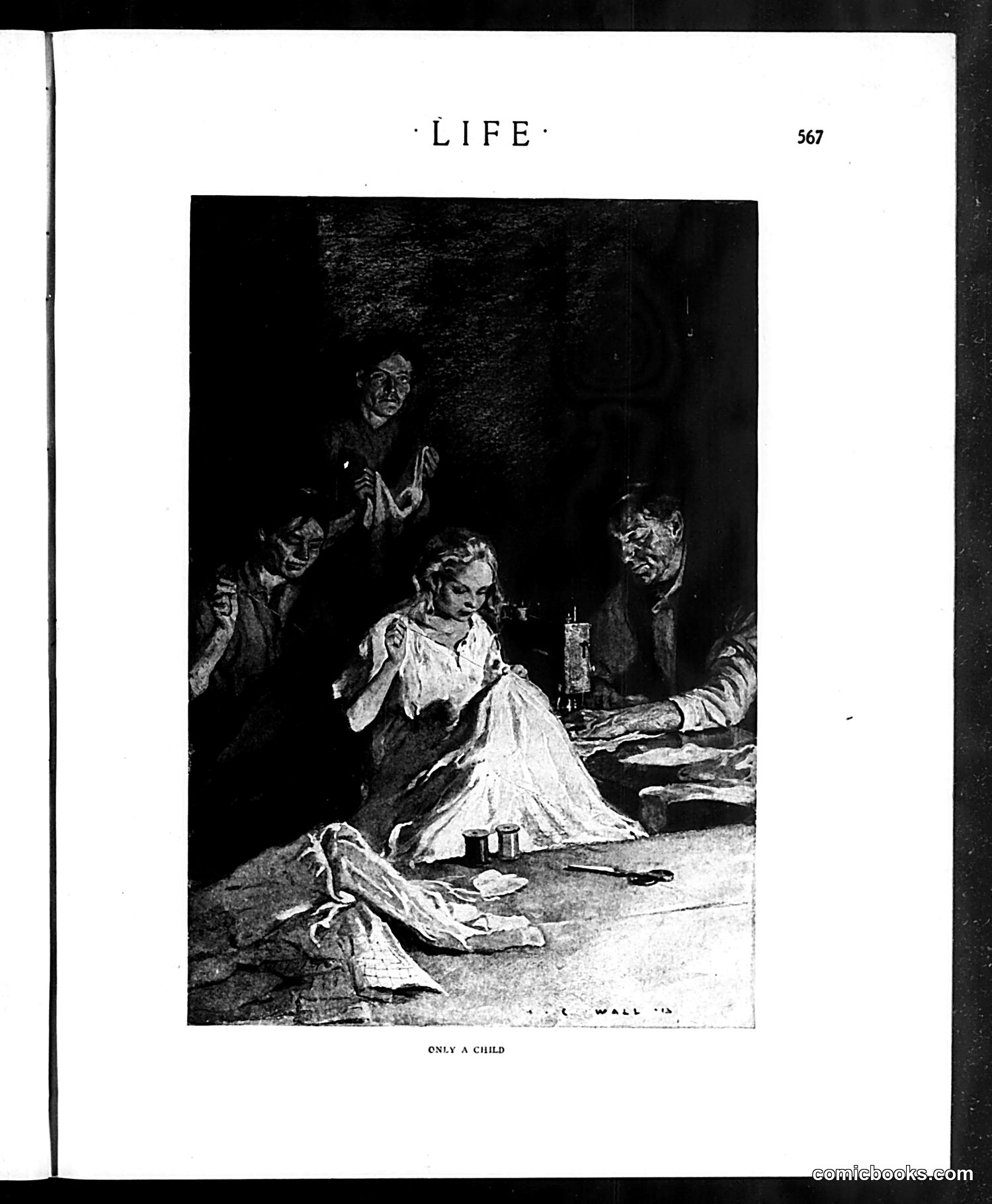
This appears to be a dramatic illustration rather than political satire. The image shows a young girl in a light dress seated on the ground, surrounded by several menacing adult figures in dark clothing looming over her in shadow. The composition and title suggest a commentary on child vulnerability or exploitation. The stark black-and-white artwork uses dramatic lighting and positioning to create an unsettling atmosphere. Without additional context from the magazine issue's date or surrounding articles, the specific social issue being critiqued remains unclear—though the visceral depiction of a child threatened by multiple adults suggests commentary on child welfare, abuse, or predatory behavior. The artwork's style is characteristic of early-to-mid 20th century *Life* magazine illustration.
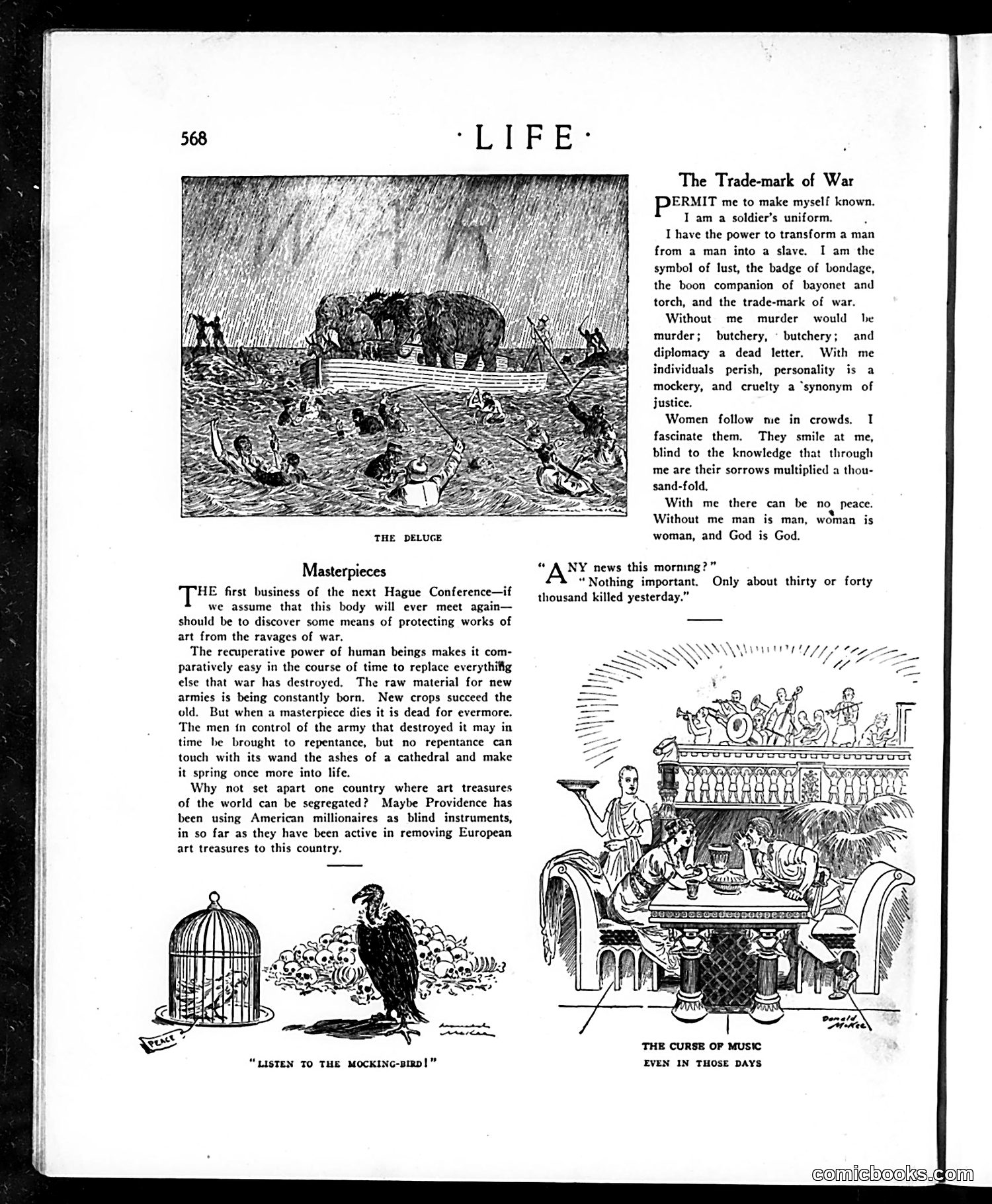
This page contains satirical commentary on World War I's devastation. **"The Trade-mark of War"** (right column) is a personified monologue where War itself boasts of its destructive power—transforming men into slaves, multiplying sorrows, destroying peace and humanity. It's dark irony: War speaks as an agent of pure destruction. **"Masterpieces"** discusses protecting artworks from war damage, referencing the Hague Conference's concern about preserving cultural treasures amid destruction. The cartoons illustrate war's absurdity: - **"The Deluge"** shows chaos and death - **"Listen to the Mocking-Bird"** depicts a caged bird amid destruction—nature muted - **"The Curse of Music"** contrasts indulgent feasting with war's horrors The dialogue ("Only about thirty or forty thousand killed yesterday") emphasizes casual acceptance of mass death.
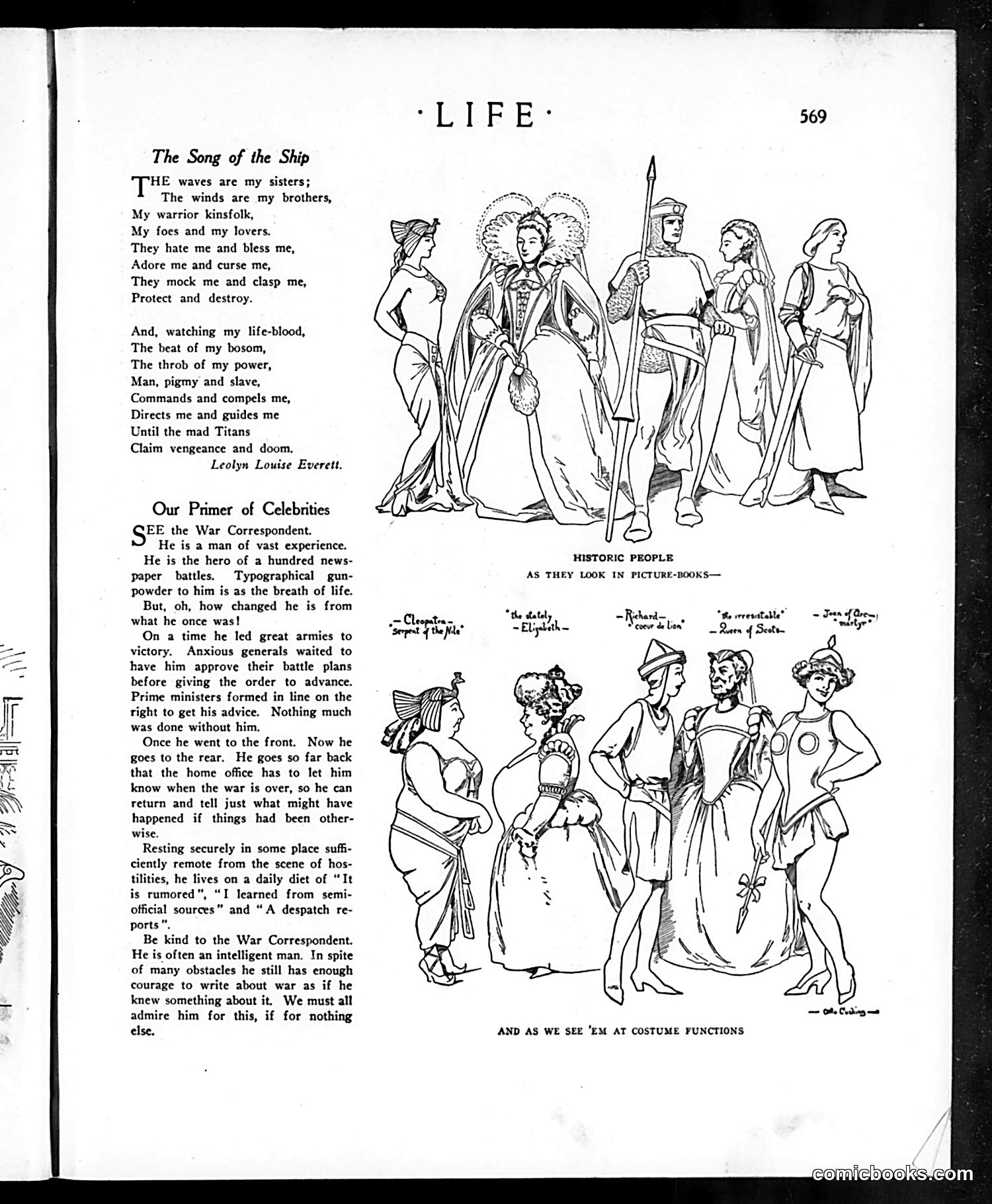
This page contains two distinct sections: **"The Song of the Ship"** is a romantic poem by Evelyn Louisa Everett personifying a ship as a female entity struggling between natural forces (waves, winds) and human masters who "command and compel" her. **"Our Primer of Celebrities"** satirizes a War Correspondent—a journalist covering military conflicts. The text mocks how such correspondents operate far from actual fighting, relying on rumors and secondhand reports ("It is rumored," "I learned from semi-official sources"). The satire suggests these journalists lack direct knowledge yet claim authority, highlighting the gap between their distant position and their authoritative war reporting. The accompanying illustrations show "historic people" in picture-book style and figures "at costume functions"—apparently contrasting dignified historical figures with contemporary people in formal dress, though the exact satirical point remains unclear without additional context.
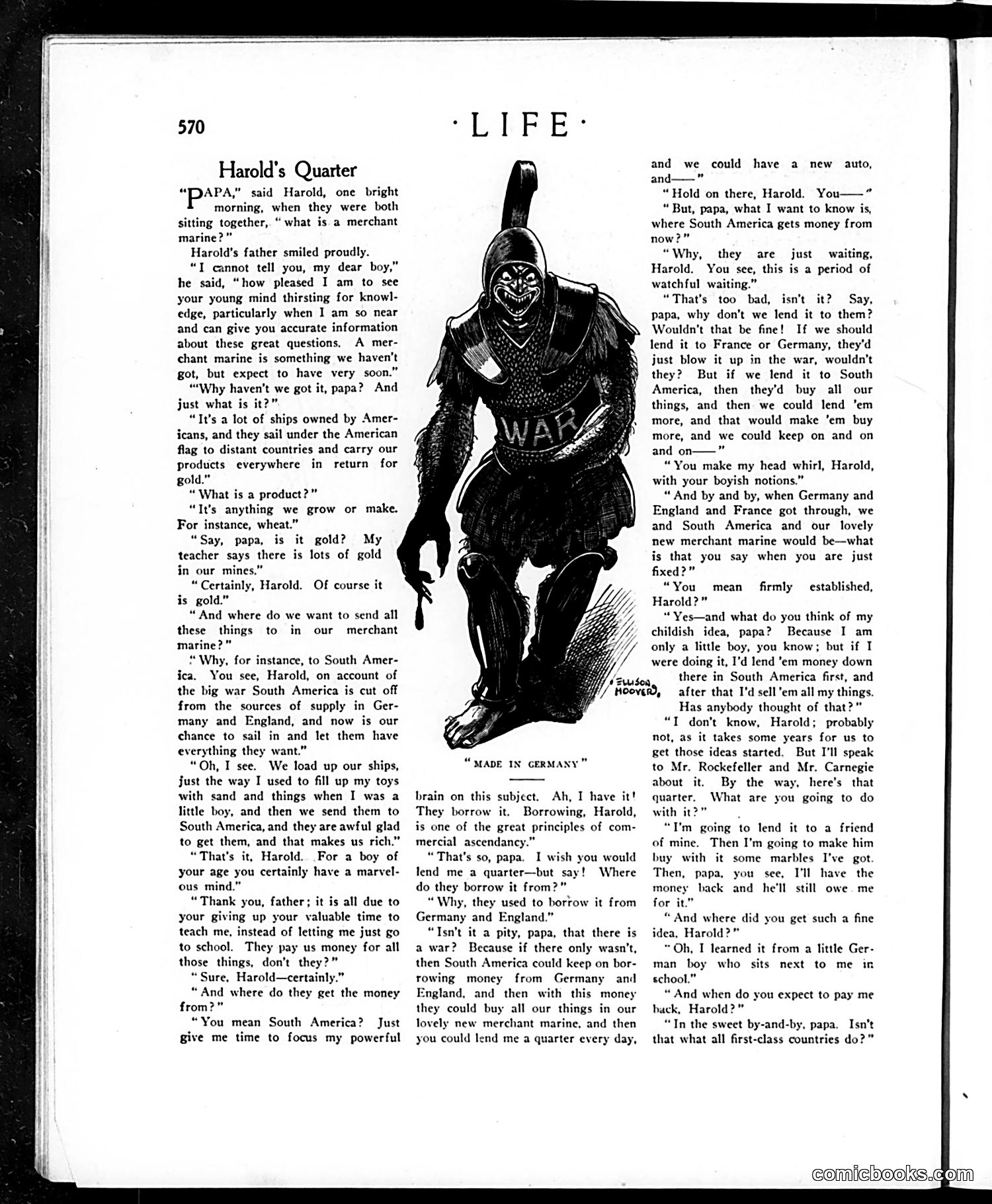
This page presents a dialogue between a father and son named Harold about international commerce and merchant marines. The central illustration shows a menacing German soldier labeled "MADE IN GERMANY," depicting Germany as a military/industrial threat. The satire critiques Harold's naive proposal to lend American money to South America, arguing this would help Germany and England monopolize trade through their merchant marines. The father warns that lending money internationally is economically foolish—a country should keep its wealth domestic. The "German soldier" image reinforces the satirical point: Germany represented industrial competition and military threat to American interests. This reflects pre-WWI American anxieties about German economic and military dominance, using a child's innocent financial proposal to mock those who might support such foreign lending schemes.
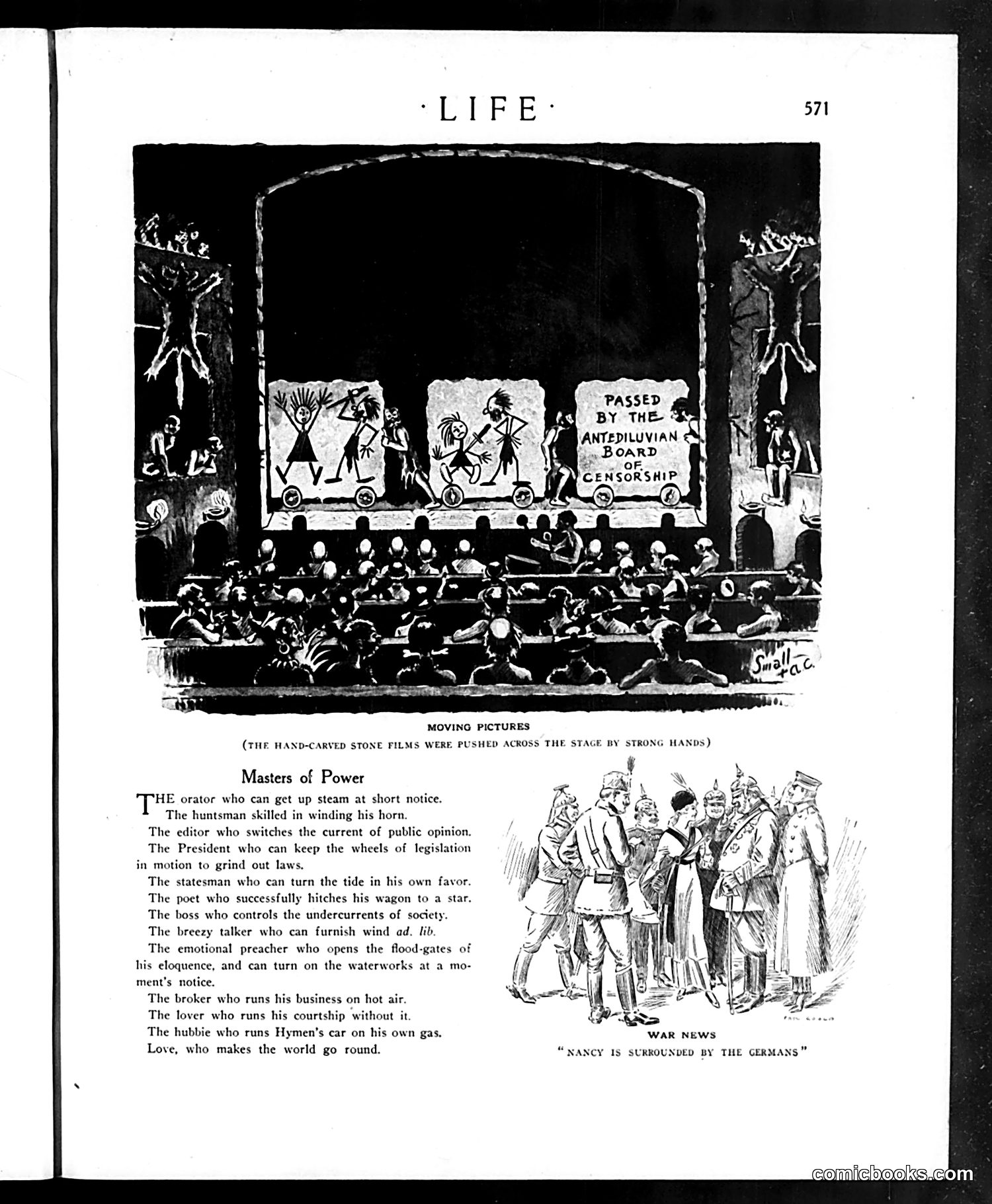
This page satirizes film censorship and powerful social influencers. The top cartoon depicts a theater audience watching primitive "stone films" (a joke about ancient, crude entertainment) being pushed across a stage. Notably, one film panel reads "Passed by the Antediluvian Board of Censorship"—mocking overly restrictive film boards as hopelessly outdated and primitive. The accompanying poem, "Masters of Power," lists various influential figures (orators, editors, presidents, preachers, brokers) who manipulate public opinion through rhetoric and "hot air." The satirical point: these so-called masters actually wield less real power than they claim. The bottom illustration, captioned "Nancy is Surrounded by the Germans," appears to reference World War I, likely depicting wartime political maneuvering. Overall, the page critiques both film censorship as antiquated and the inflated influence of public figures who rely on persuasion rather than substance.
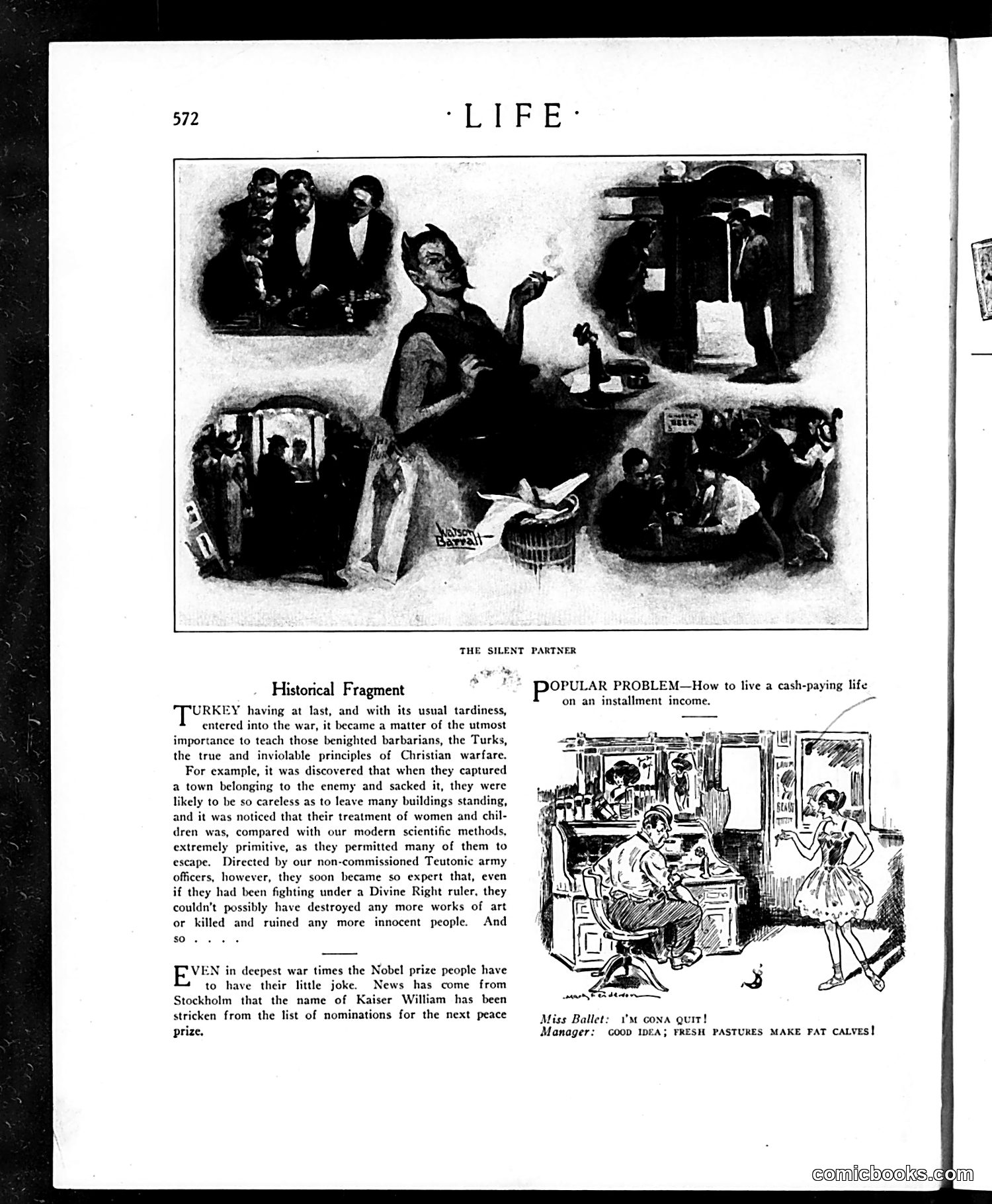
**"The Silent Partner" (top image):** This appears to be a film still or dramatic scene, likely unrelated to the text below. **"Historical Fragment" (main text):** This is biting satire about World War I. The text sarcastically "praises" how German military officers taught the Ottoman Turks (who joined the Central Powers in 1914) to wage "proper Christian warfare"—meaning the destruction of civilian populations and cultural artifacts. The satire inverts moral values: it mocks Western powers' claims to civilization while describing their own atrocities as "scientific methods." The passage culminates in mocking the Nobel Peace Prize committee for removing Kaiser Wilhelm's name from peace prize nominations despite his destructive conduct. **"Popular Problem" (lower right cartoon):** A lighter, domestic satire showing a manager convincing an employee ("Miss Ballet") to stay in her low-paying job rather than quit, using the logic that financial hardship (fresh pastures) will keep her desperate and compliant (fat calves)—critiquing exploitative labor practices during wartime.
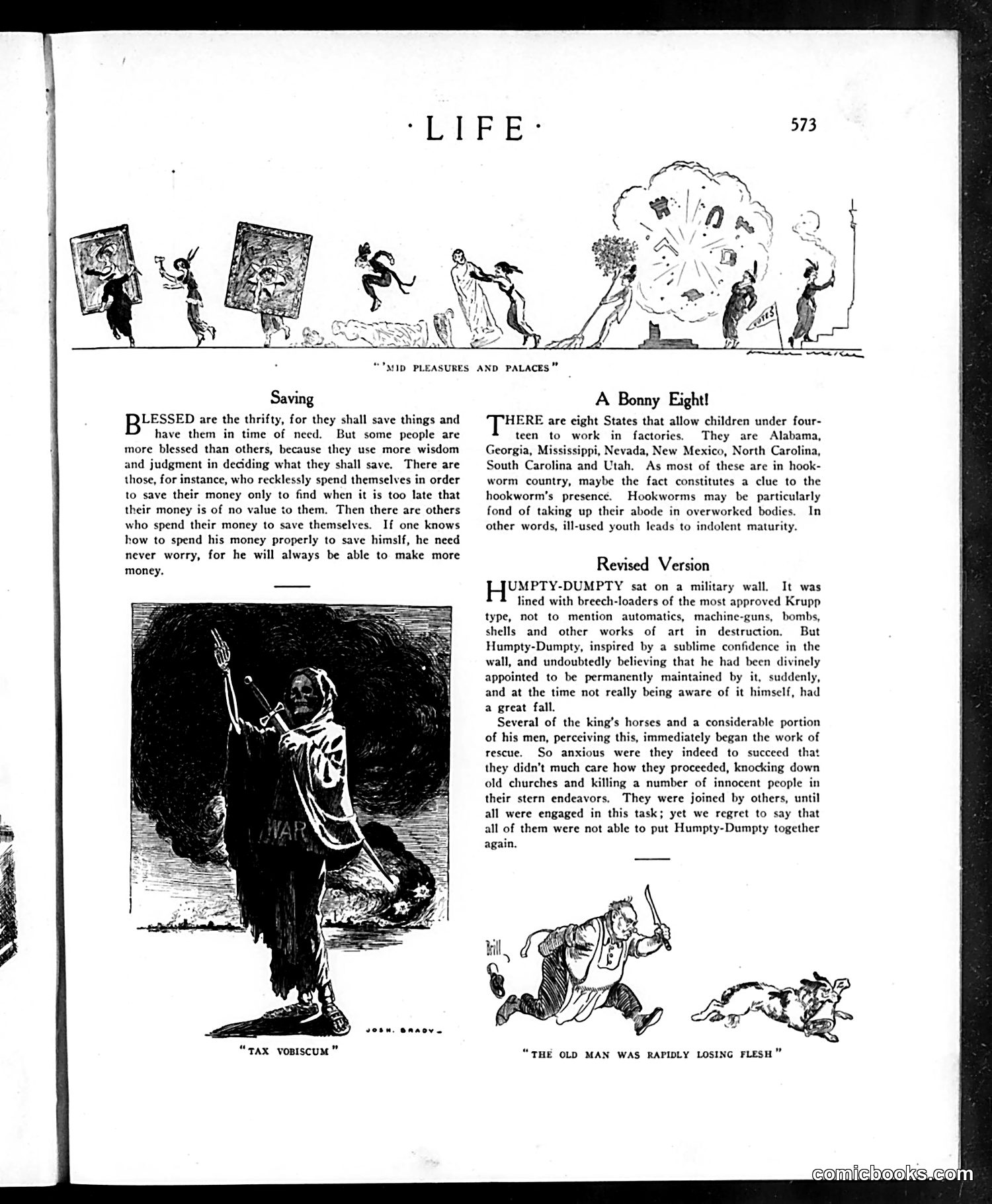
This page contains three distinct satirical pieces: **"Tax Vobiscum"** (left): A dark cartoon depicting a skeletal figure labeled as taxation, suggesting that excessive taxes drain citizens of resources and vitality—a common anti-tax critique. **"A Bonny Eight!"** (top right): Critiques eight U.S. states (Alabama, Georgia, Mississippi, Nevada, New Mexico, North Carolina, South Carolina, Utah) that permitted children under fourteen to work in factories. The satire links child labor to hookworm disease prevalent in those regions, arguing that exploiting children's bodies creates enfeebled adults. **"Humpty-Dumpty: Revised Version"** (bottom right): A political allegory reimagining the nursery rhyme. Humpty-Dumpty (likely representing a leader or institution) falls from a military wall lined with weapons. The "rescue" efforts by the king's forces cause collateral destruction—killing innocent people and demolishing churches—yet ultimately fail to restore him. This appears to satirize destructive military intervention or warfare's futility and civilian cost. All three pieces critique economic exploitation, child welfare neglect, and militarism.
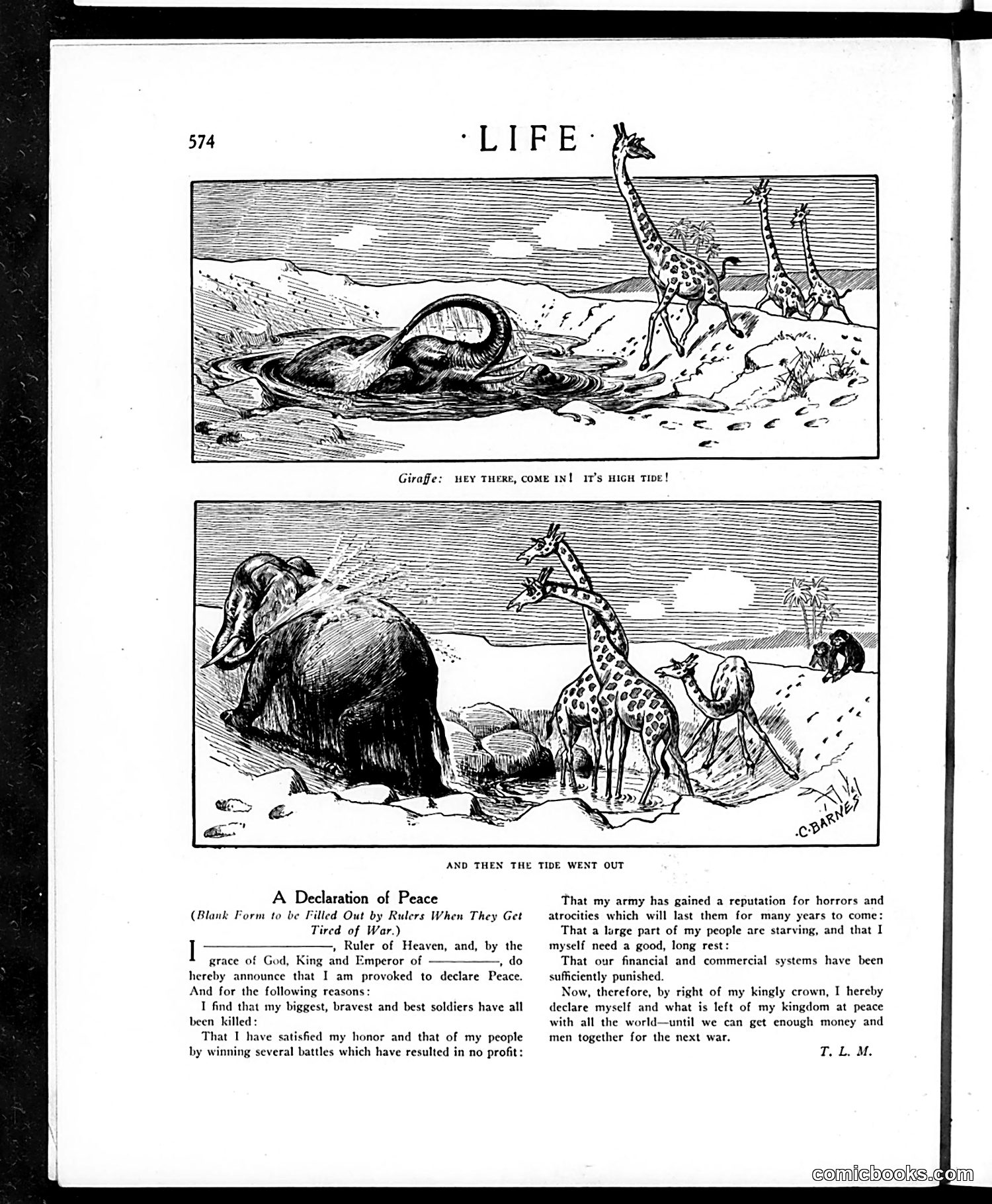
This page contains two satirical cartoons and a mock declaration of peace, likely from World War I era. **The Cartoons:** The top two panels show giraffes inviting an elephant into water at "high tide," then departing when the tide recedes—a visual metaphor for temporary alliance or cooperation that dissolves when circumstances change. **"A Declaration of Peace":** The text is a cynical template rulers could fill in, mocking post-war peace declarations. It satirizes how nations declare peace not from genuine desire but from exhaustion: soldiers killed, honor "satisfied," armies infamous for atrocities, populations starving, finances ruined. The final line—"until we can get enough money and men together for the next war"—is the punchline, exposing that peace is merely an intermission before inevitable future conflict. **The Satire:** Life magazine critiques how political leaders frame warfare's devastation as honorable while actually being driven by practical depletion, not principle. The message: don't believe rhetoric about peace—it's temporary funding and rest before resuming war.
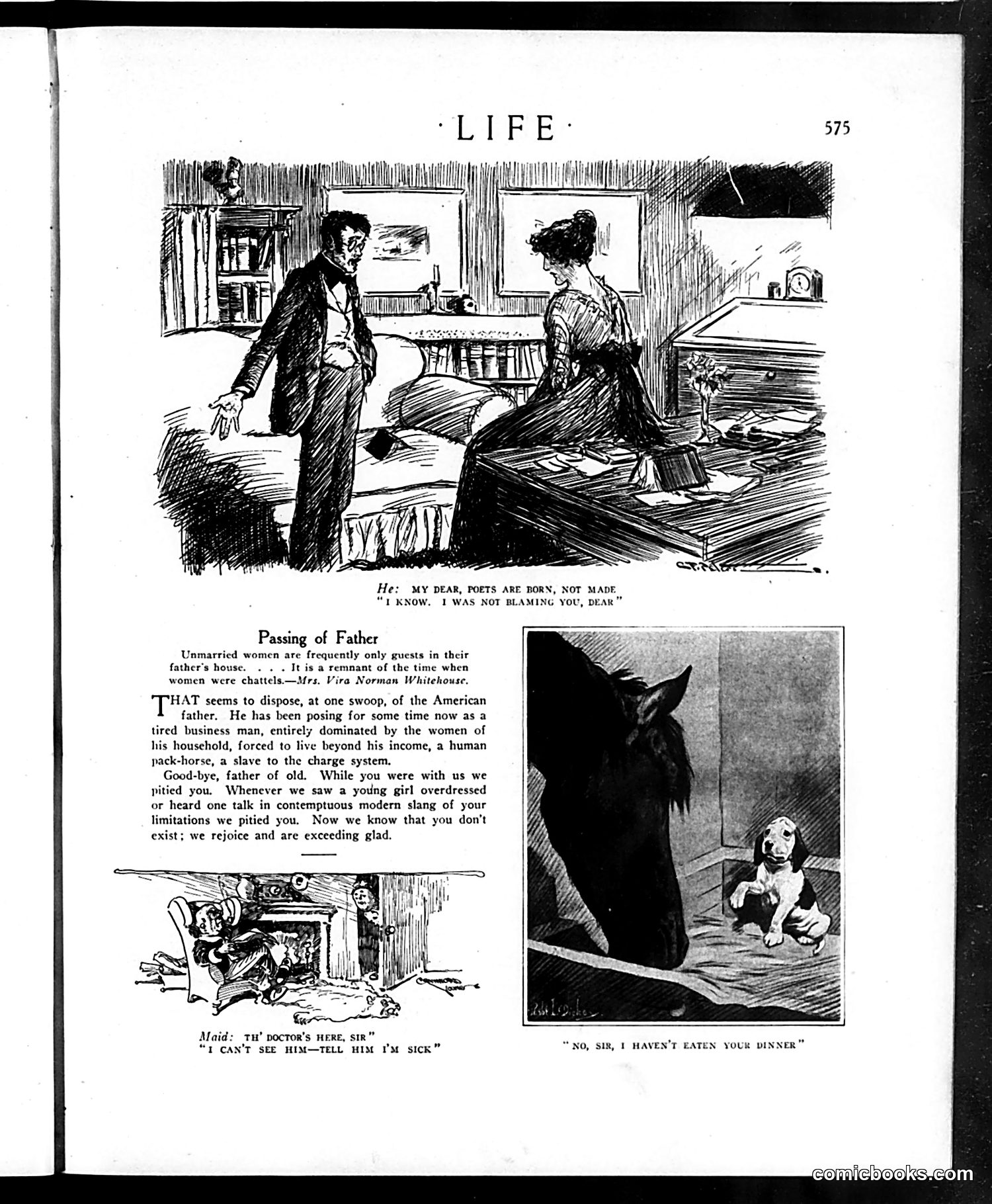
This page satirizes the decline of paternal authority in early 20th-century American households. The article, citing feminist Mrs. Vira Norman Whitehouse, declares the traditional father figure obsolete—portrayed as a "tired business man" enslaved by household women and financial demands. The top cartoon jokes about marital dynamics: a husband insists poets are born, not made; his wife agrees, implying he wasn't "made" into a poet (a dig at his mediocrity). The lower cartoons mock the father's powerlessness: he's too ill to see a doctor but well enough to avoid his wife's dinner. The maid's concern for his health contrasts sharply with his actual incapacity to assert authority. The satire targets the shifting power dynamics where women (wives, daughters, servants) control household decisions while men surrender economic and domestic control, becoming figuratively "non-existent" as authority figures.
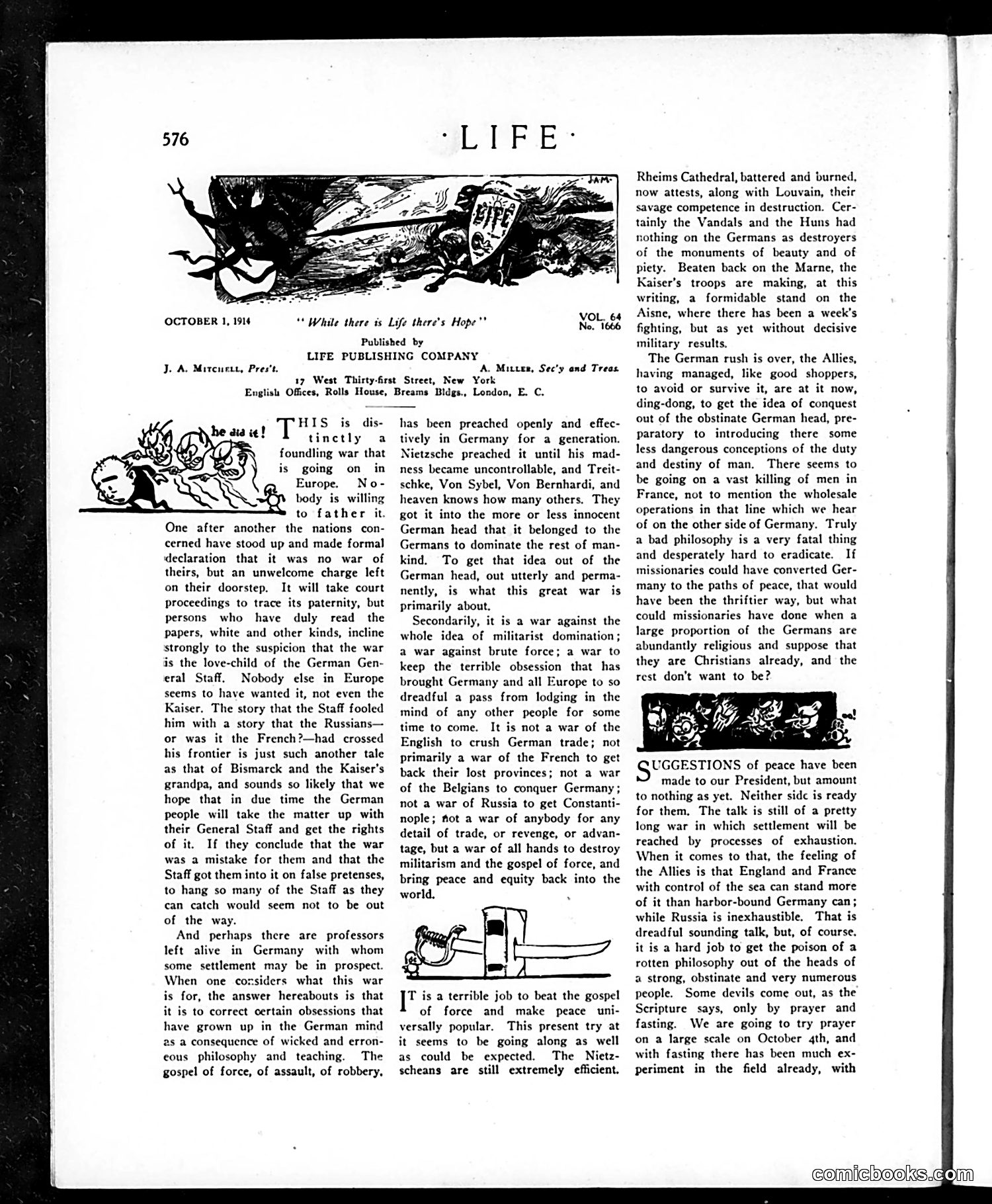
This editorial addresses World War I's origins and purpose. The opening cartoon (showing a foundling baby labeled with German imperial symbols) satirizes Germany's denial of responsibility for the war—each nation claims it "didn't want it," but Life attributes paternity to the German General Staff, suggesting they deliberately provoked the conflict. The text argues the war's true purpose is ideological: destroying "the gospel of force" preached by German philosophers like Nietzsche, Treitschke, and Von Bernhardi—thinkers who convinced Germans they should dominate other peoples. Life dismisses narrower explanations (trade wars, territorial disputes) and frames the conflict as a civilizational struggle against militarism itself. The editorial criticizes German destruction of cultural monuments (Rheims Cathedral, Louvain) and references recent military stalemate on the Aisne River, written during the war's ongoing brutal attrition phase.
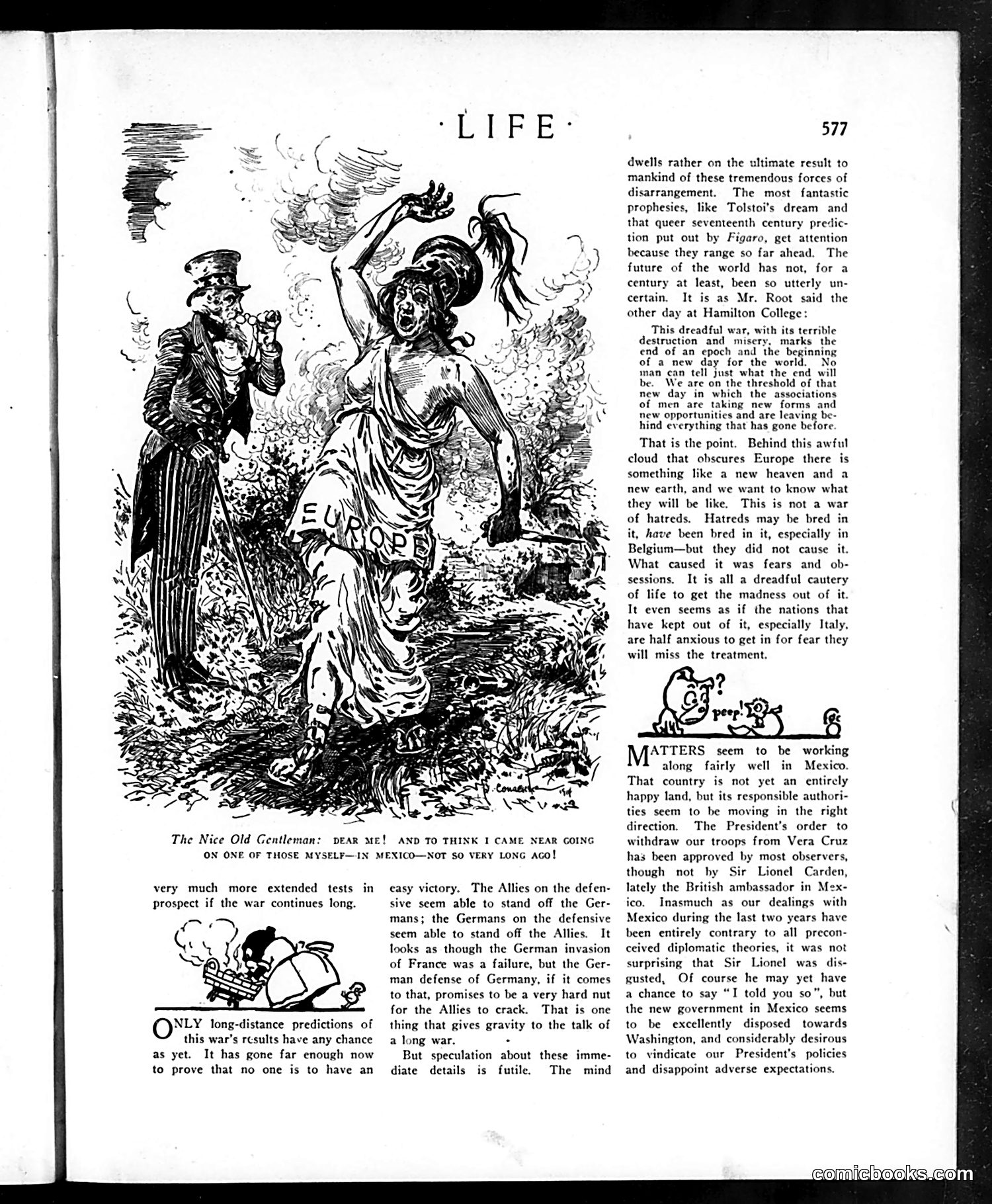
**Main Cartoon:** "The Nice Old Gentleman" depicts an elderly gentleman startled by a vision of Europe (allegorized as a woman) engulfed in flames and chaos. A military figure stands nearby. The gentleman remarks he nearly went to Mexico himself—referencing U.S. military intervention in Mexico. **Context:** This appears from World War I era (references to France's invasion, German defense). The cartoon contrasts Mexico's relative stability—where the U.S. recently withdrew troops from Vera Cruz per presidential order—with Europe's catastrophic war. **Satire:** The joke is ironic: the gentleman feared Mexico dangerous enough to nearly visit, yet Europe has become far more destructive. The "dreadful cautery" (surgical burning) metaphor suggests war might purge nations of madness. **Political Reference:** The text praises President Wilson's Mexico policy despite British ambassador Sir Lionel Carden's disapproval, presenting withdrawal as wise and vindicating American diplomacy. **Point:** Contrasts American restraint and progressive policy against European destruction.
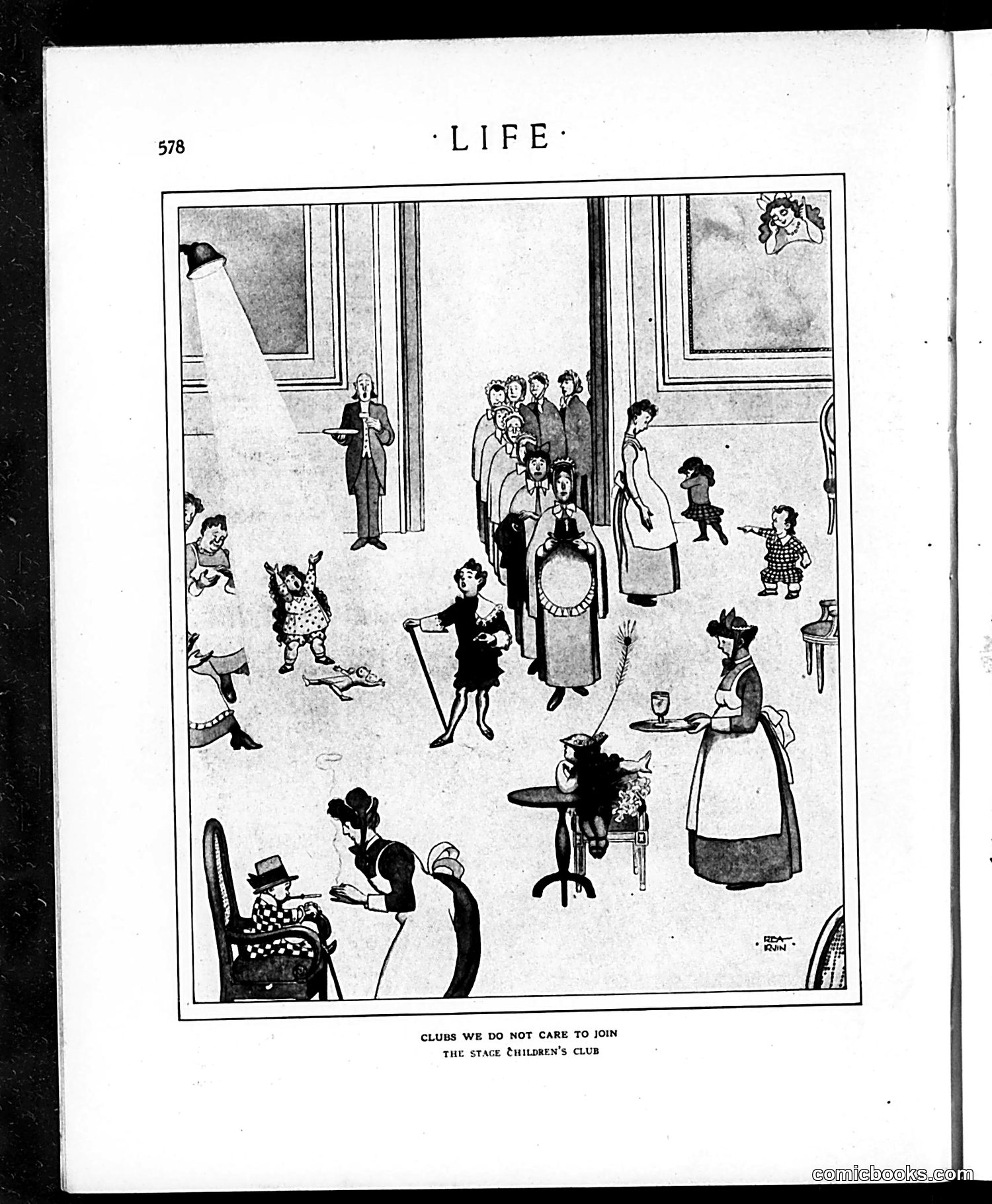
This satirical cartoon critiques child labor in theater during the early 20th century. The illustration depicts a chaotic backstage scene with numerous children of various ages working amid adults—some carrying props, others in costume or makeup, creating an environment portrayed as disorganized and exploitative. The "Stage Children's Club" is presented ironically as something respectable institutions would deliberately avoid joining, mocking the normalization of children performing in theatrical productions. The cartoon exposes the practice as hazardous and unsuitable for child welfare, showing them mingling with theater personnel in crowded, potentially dangerous conditions. This reflects progressive-era concerns about child labor laws and children's rights in entertainment—a significant social reform issue of that period.
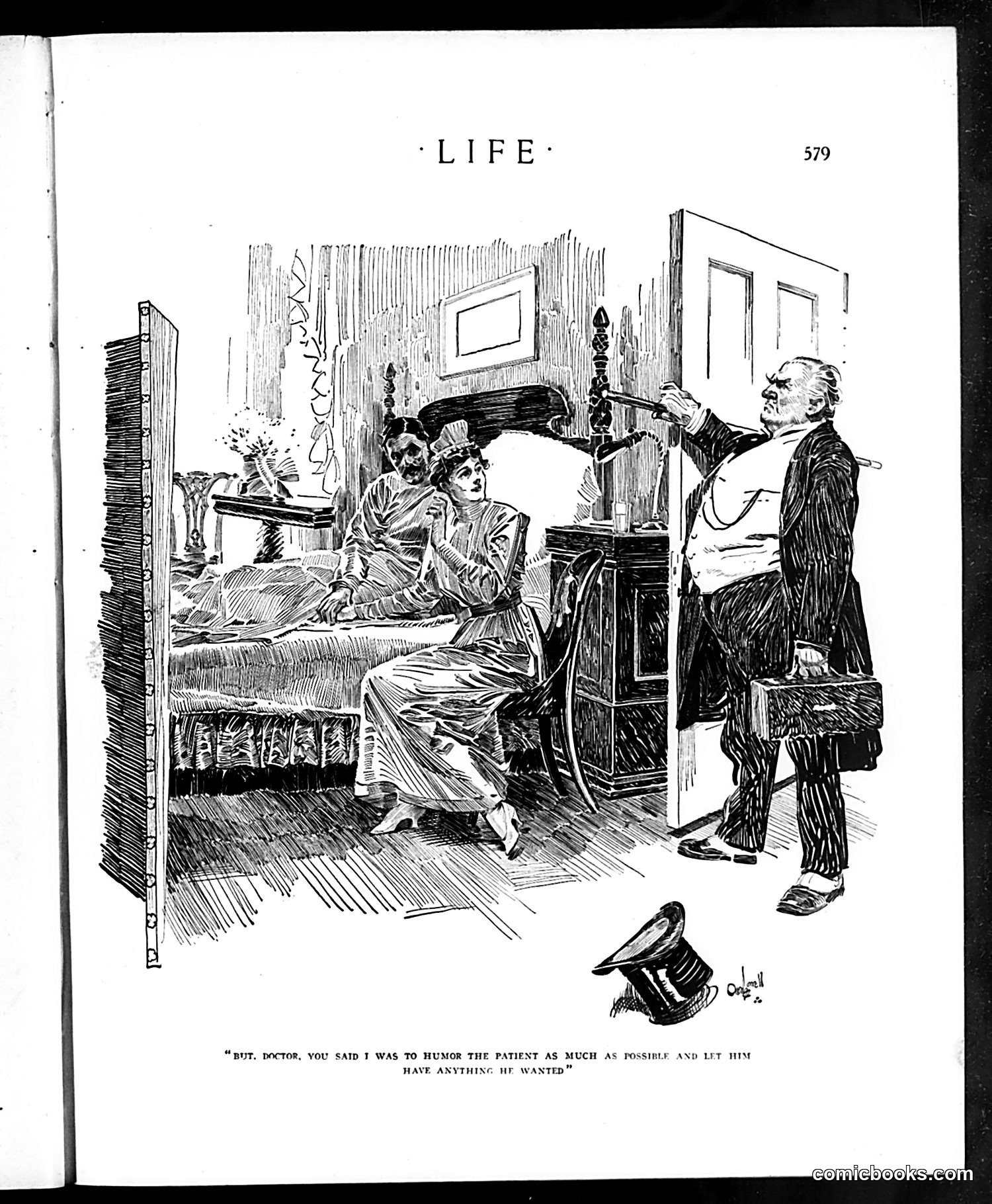
This single-panel cartoon depicts a bedroom scene where a doctor appears to be leaving while two women (likely a nurse and visitor) remain with a patient in bed. The caption quotes the patient's companion reminding the doctor of his own instructions to indulge the patient's wishes. The satire likely concerns a doctor's advice being taken too literally or inconveniently. The humor suggests the patient has requested something the doctor now regrets permitting—perhaps excessive food, entertainment, or comfort that contradicts medical treatment. The cartoon satirizes the gap between theoretical medical advice (humor patients) and its practical consequences when patients exploit such permission. Without identifying specific historical context, the joke reflects common early 20th-century tensions between medical authority and patient demands.
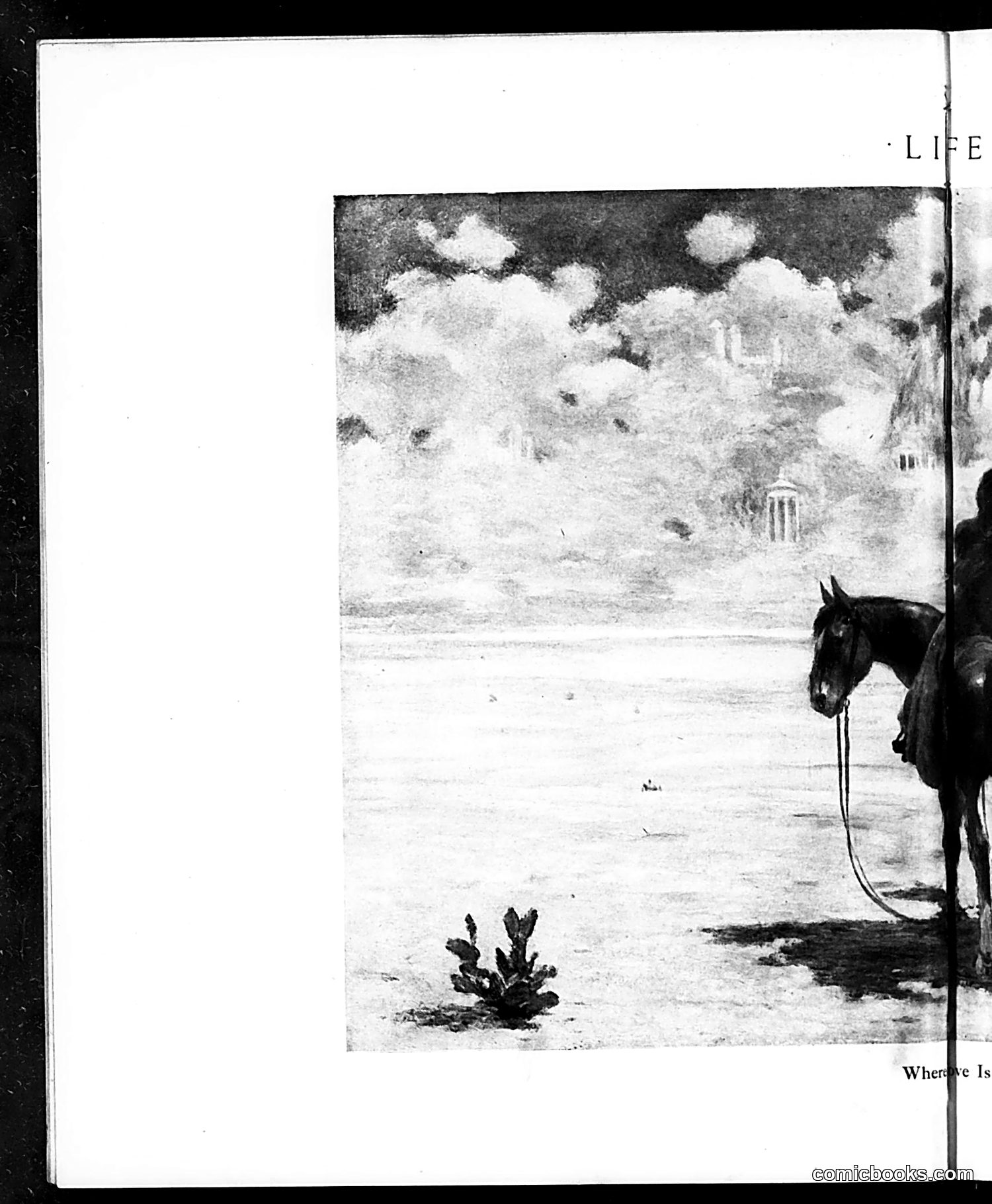
This page from *Life* magazine shows a black and white photograph rather than a traditional cartoon. The image depicts a saddled horse tied to a post in what appears to be a desert or arid landscape, with sparse vegetation visible and cloudy skies above. A building structure is visible in the distant background. The page header reads "LIFE" and the bottom text reads "Where we Is" (likely "Where we is" as dialect/slang). Without additional context or visible captions explaining the photograph's satirical intent, the exact political or social commentary remains unclear. The seemingly intentional grammatical error in the caption ("where we is") suggests satirical commentary on American speech or society, but the specific target or meaning cannot be determined from the visible elements alone.
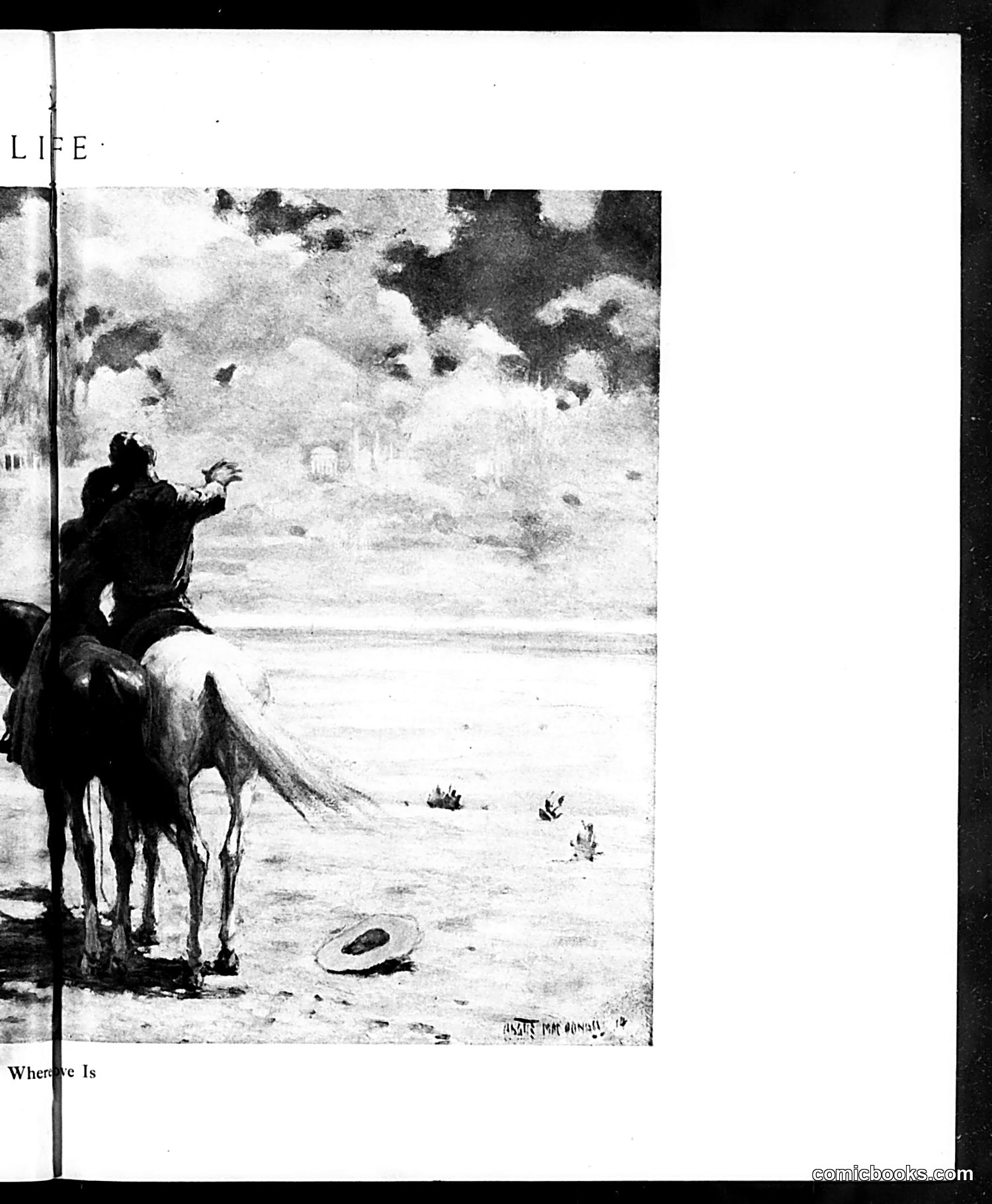
This appears to be a page from *Life* magazine titled "Where've Is" (likely "Where've We Been" or similar, partially cut off). The illustration shows a figure on horseback in the foreground, gesturing toward a vast landscape dotted with small figures and smoke or dust clouds—suggesting a battlefield or scene of widespread conflict. The satirical point seems to be questioning the location or direction of American involvement, possibly referencing military campaigns or foreign interventions. The mounted figure's gesturing pose suggests bewilderment or complaint about being sent somewhere unclear. Without the complete text or clear dating, the specific historical reference remains uncertain—this could reference various early 20th-century American military actions.
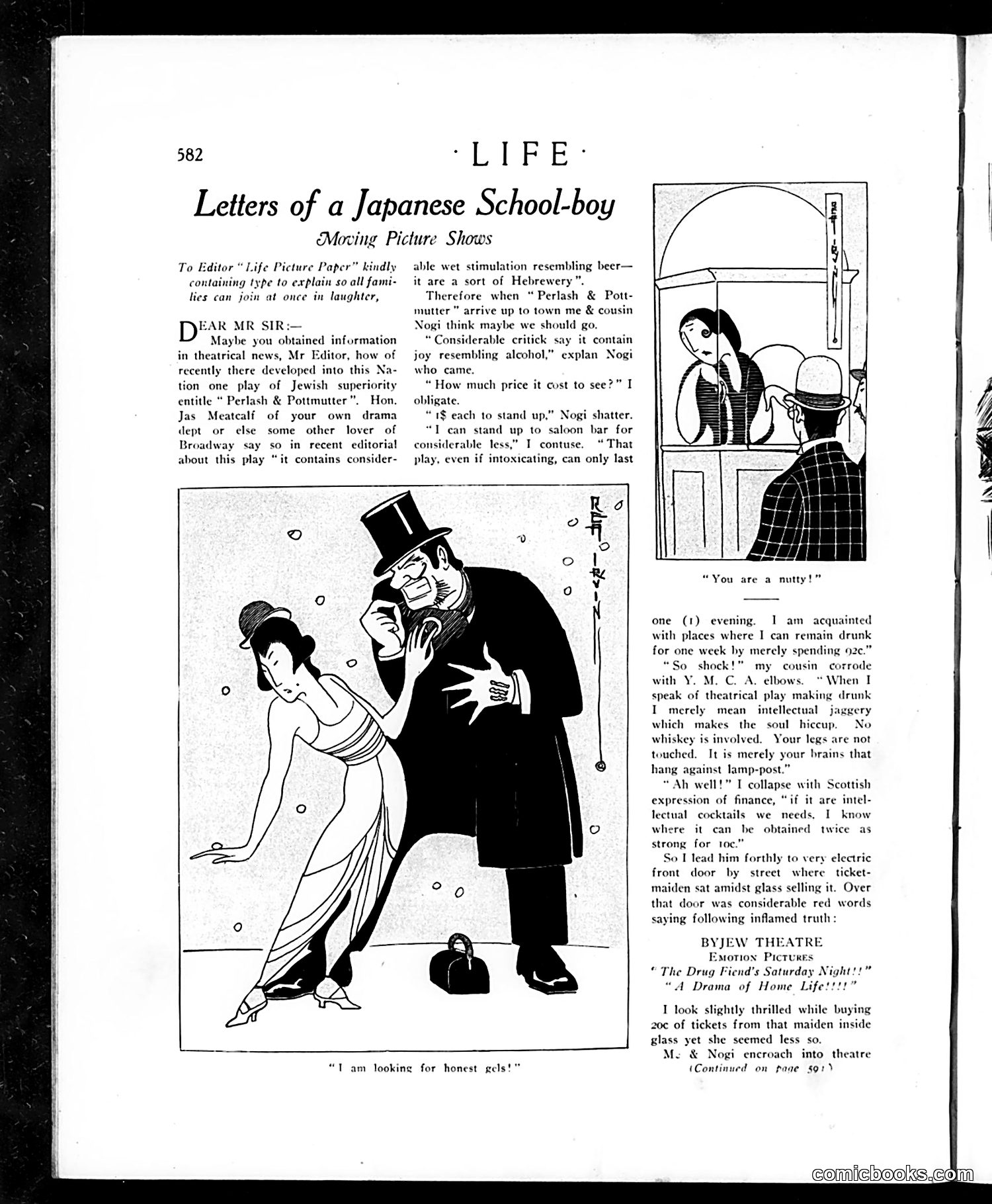
This is a satirical "Letters" column featuring a Japanese schoolboy's observations of American life. The humor relies on broken English and cultural misunderstandings common to early 20th-century American comedy. The main joke concerns a Broadway play called "Perlash & Pottmutter"—appearing to reference Jewish characters (the OCR mentions "Jewish superiority"). The schoolboy and his cousin Nogi debate whether attending is worthwhile, comparing theatrical "intoxication" to actual drunkenness at cheaper saloons. The left cartoon shows a man in top hat (likely representing a Western seducer) with a woman, captioned "I am looking for honest gals!"—playing on stereotypes about Western moral corruption. The satire mocks both the Japanese visitors' literal-minded confusion about theatrical metaphor AND American theatrical pretensions. The continued reference to a movie theater's sensational advertising ("The Drug Fiend's Saturday Night") underscores the irony: high-minded intellectual claims mask commercial exploitation. This reflects early 1900s attitudes: ethnic humor, theatrical criticism, and fascination with "exotic" foreign perspectives.
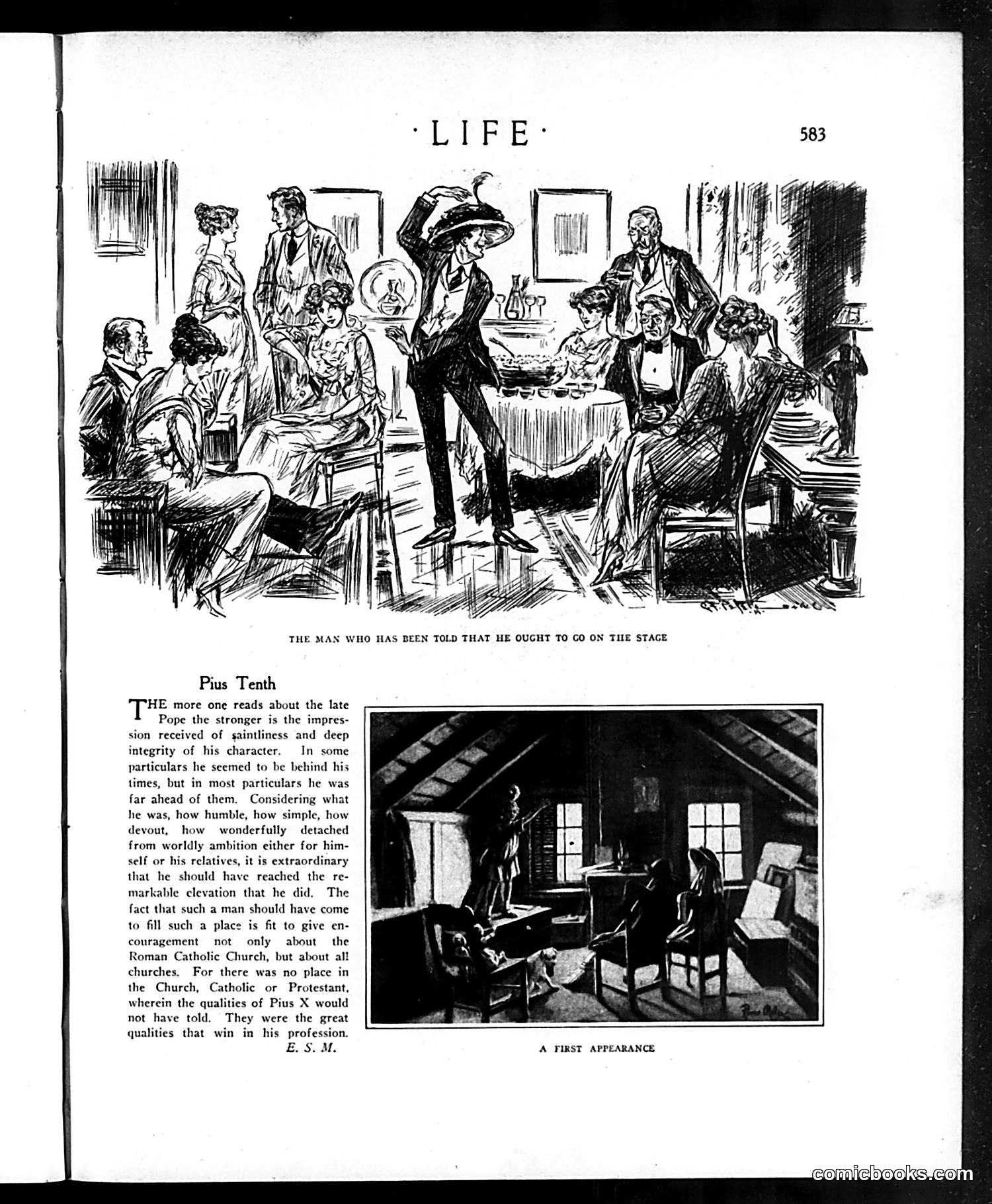
The top cartoon depicts a social gathering where a man stands center-stage gesticulating dramatically—"the man who has been told that he ought to go on the stage." This is satirizing someone at a party who performs theatrically, seeking attention, apparently believing he possesses theatrical talent because others have suggested it (likely sarcastically). The accompanying article praises Pope Pius X (who died recently when this was published), emphasizing his humility, simplicity, and spiritual integrity. The ironic juxtaposition—pairing vain theatrical posturing with an essay celebrating genuine humility—creates the satirical point: a contrast between false pretense and authentic virtue. The bottom illustration, "A First Appearance," likely depicts Pius X's early life, supporting the article's theme of humble origins leading to greatness. The satire mocks people who mistake casual comments for genuine encouragement and adopt grandiose personas accordingly.
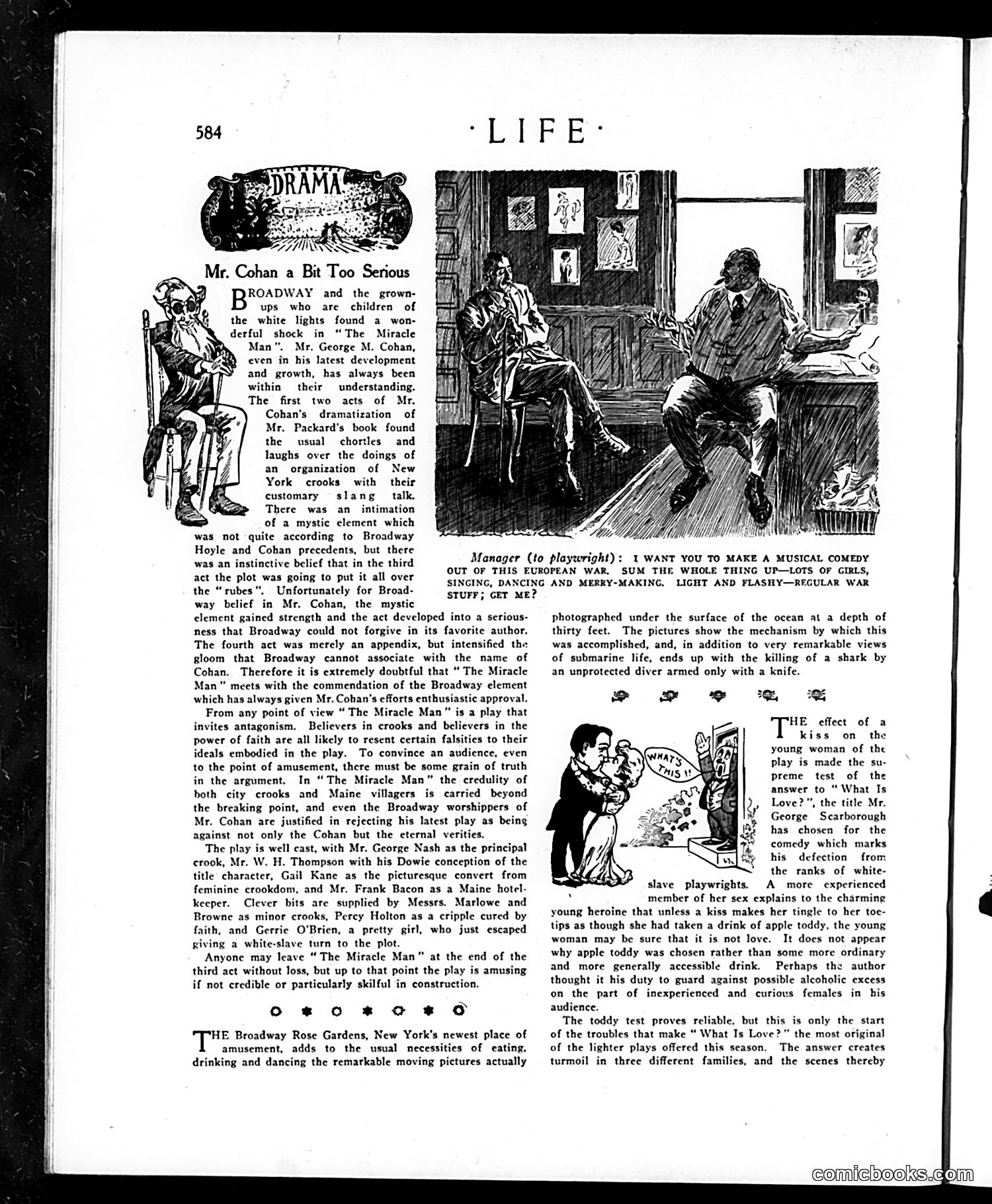
This page reviews Broadway productions with two distinct satirical elements: **Main Review**: Critiques George M. Cohan's play "The Miracle Man," adapted from a novel about New York crooks. The reviewer notes that while Cohan's audiences expect light entertainment and comic "crook" characters with slang dialogue, this production unexpectedly turns serious and moralistic in later acts—disappointing his typical Broadway followers who consider themselves "rubes" (unsophisticated theatergoers). The satire targets both Cohan's typical audience and Broadway's preference for escapism over genuine drama. **Cartoon Satire** (bottom): A theater manager demands a playwright turn the European War into a musical comedy—"lots of girls, singing, dancing and merry-making...regular war stuff." This mocks both the entertainment industry's trivialization of serious events and the period's apparent appetite for turning global conflict into light spectacle during what appears to be World War I. The page reflects contemporary tensions between commercial theater demands and artistic substance.
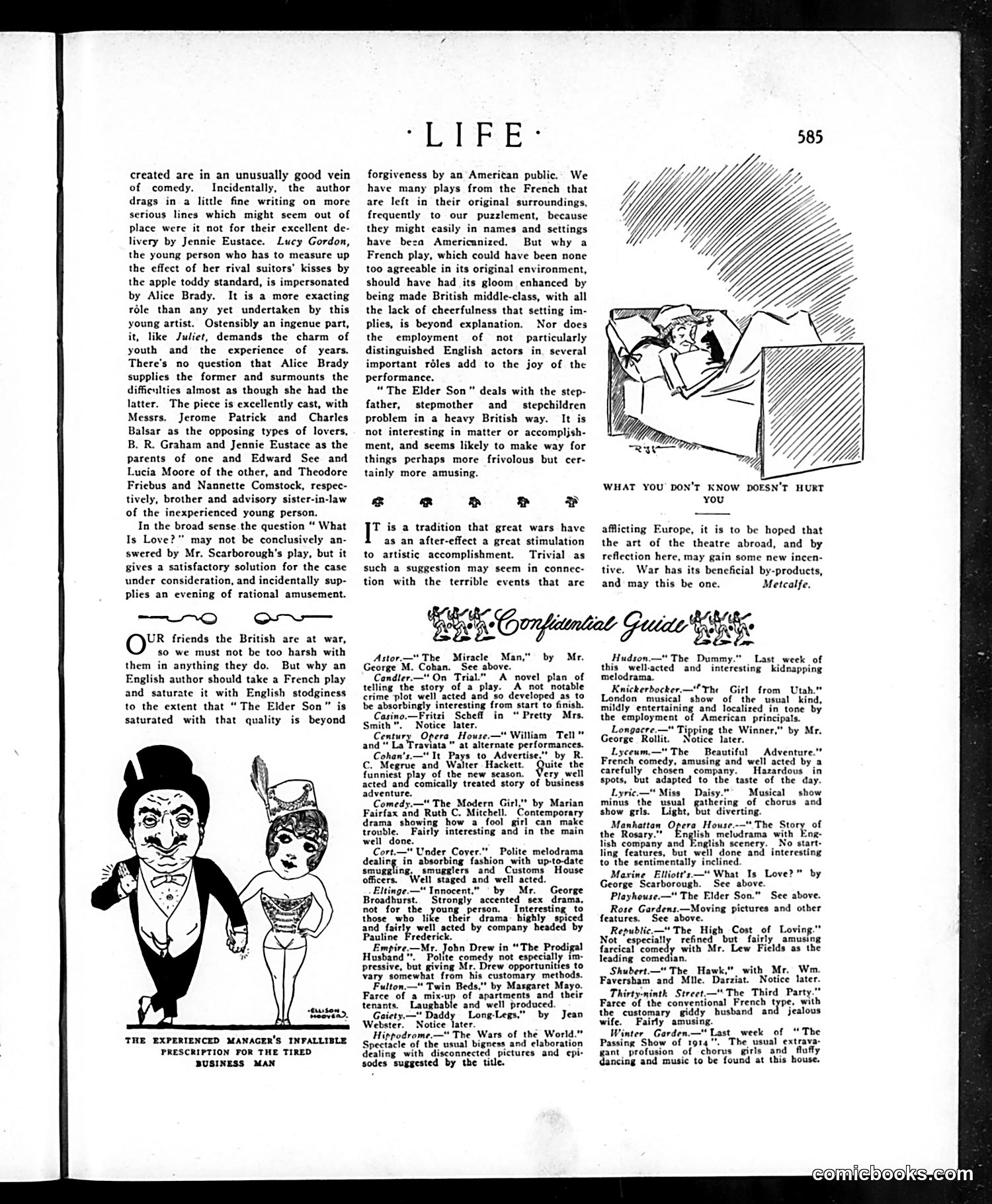
This is a theater review page from *Life* magazine featuring critique of contemporary Broadway productions. The main cartoon depicts a tired businessman being prescribed theatrical entertainment as a cure—a visual metaphor for theater's role as escapist entertainment. The text reviews several plays, notably criticizing "The Elder Son," a French play adapted into English with "British stodginess" that allegedly ruins its appeal. The critic argues the play's heavy, gloomy British middle-class setting undermines what might have worked better in its original French context. The page also includes optimistic commentary suggesting that despite World War I's horrors afflicting Europe, great conflicts historically stimulate artistic achievement. The critic hopes theater abroad—and by extension, American theater—will benefit creatively from wartime circumstances. The cartoon's caption—"The Experienced Manager's Infallible Prescription for the Tired Business Man"—humorously suggests theater as therapeutic medicine for urban professionals.
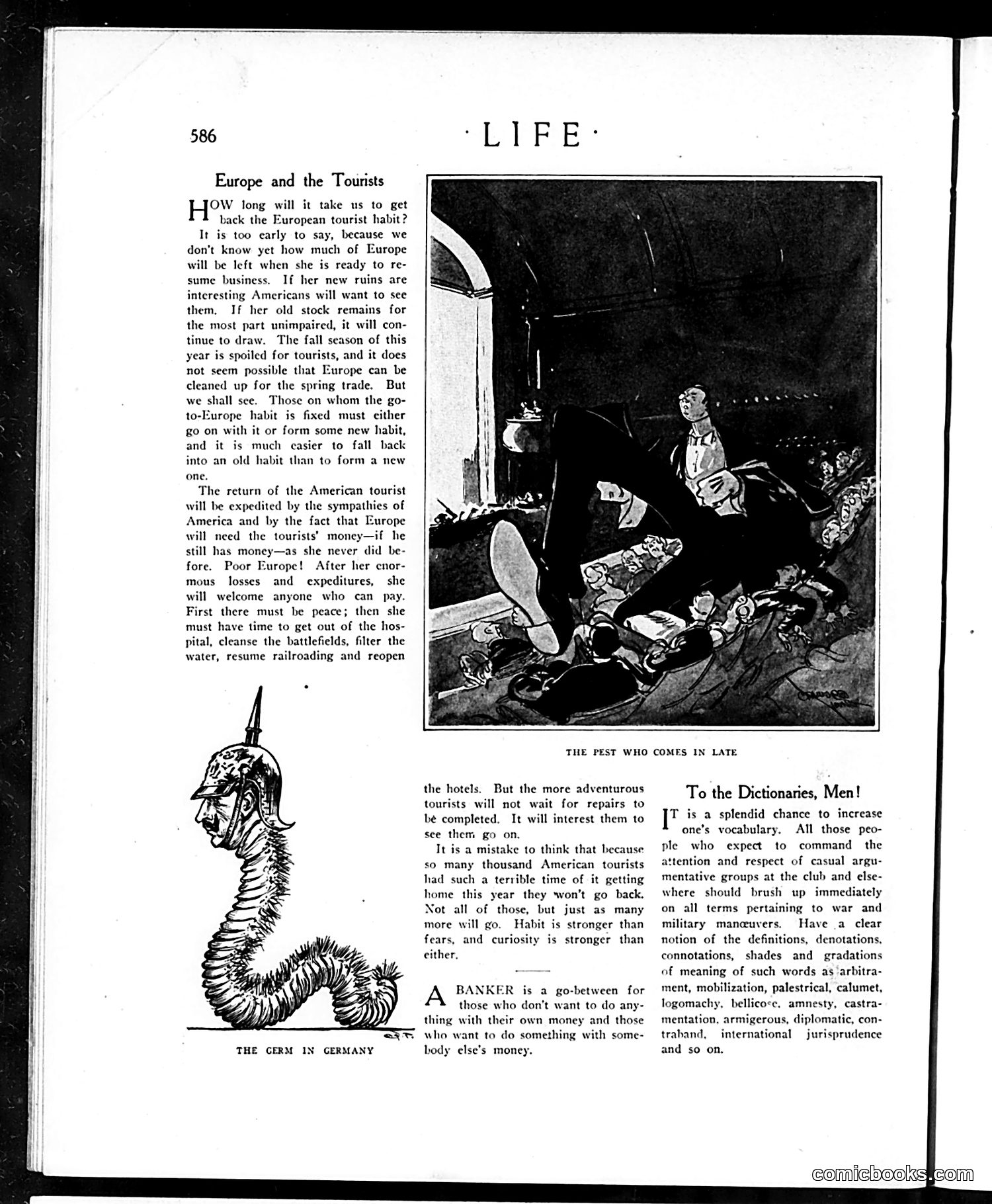
This page addresses post-World War I Europe's recovery and its appeal to American tourists. The main article anticipates Americans' eventual return to European travel, acknowledging that Europe needs tourist money desperately after wartime devastation. However, adventurous tourists won't wait for full reconstruction—they'll visit while ruins and repairs are still underway. The cartoon "The Germ in Germany" (bottom left) depicts Germany as a diseased, parasitic creature—a harsh caricature reflecting anti-German sentiment common in post-war American satire. It suggests Germany itself is a threat or infection to Europe. The illustration "The Pest Who Comes in Late" shows a skeleton, likely representing death or war's aftermath, among wreckage—evoking the battlefields and casualties Europeans must clean up. The sidebar "To the Dictionaries, Men!" humorously advises readers to learn military terminology to appear knowledgeable in social settings, satirizing how wartime vocabulary had permeated everyday discourse.
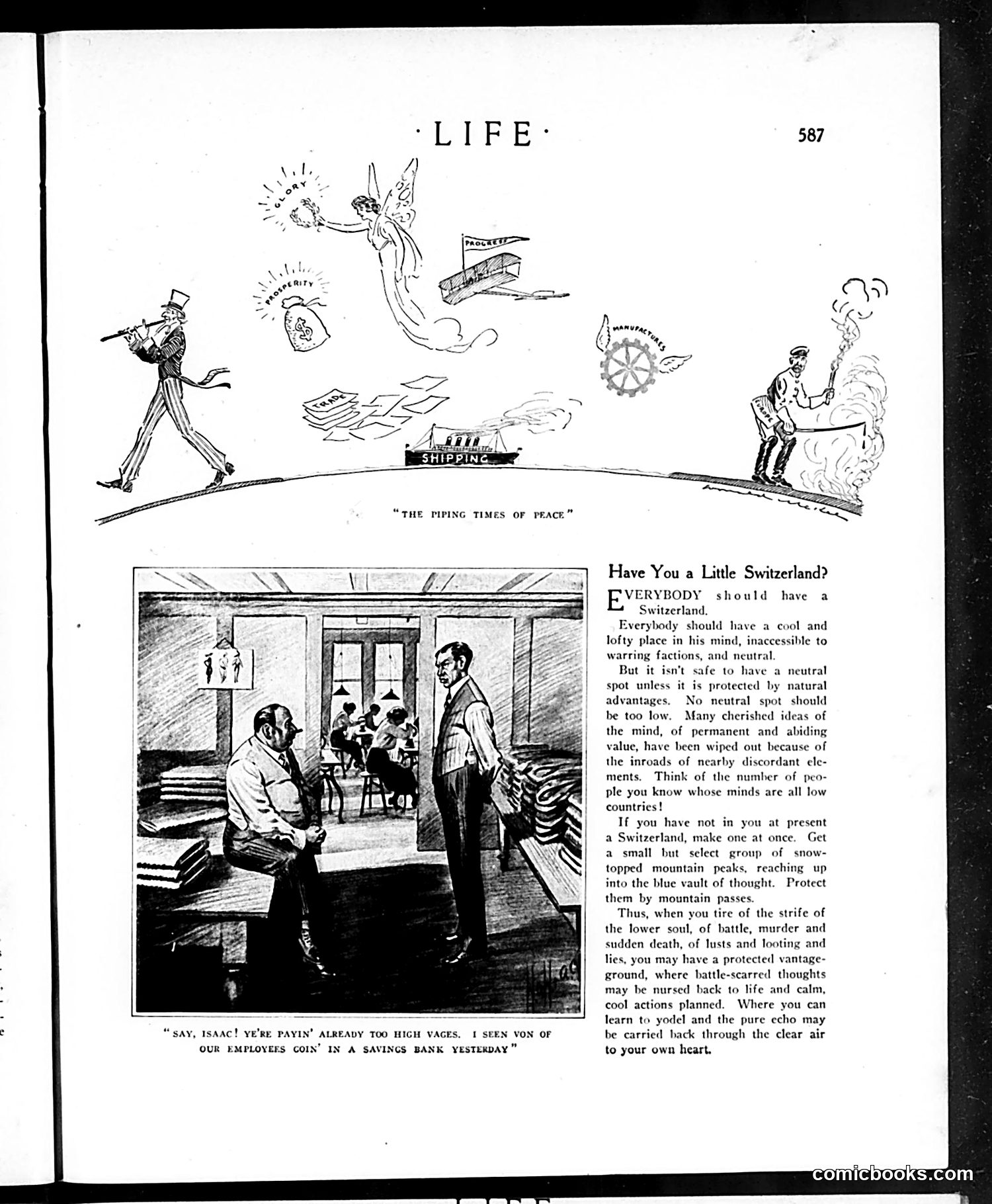
**Top Cartoon ("The Piping Times of Peace"):** This satirizes post-WWI economic conditions. The figures appear to represent labor and capital: a man on the left (likely a worker or union representative) gestures at various symbols of prosperity—a fairy, ship, factory wheel, and businessman—suggesting wealth and stability supposedly available during peacetime. The right figure tends a fire, implying unrest or instability. The irony is that despite "peace," economic benefits aren't reaching workers. **Bottom Comic Strip:** Shows two workers discussing wages. One complains their employer is "payin' already too high vages" while simultaneously depositing money in a savings bank—exposing the hypocrisy of wealthy employers claiming poverty while accumulating personal wealth. This critiques labor exploitation and wage suppression in the 1920s. **Essay ("Have You a Little Switzerland?"):** Metaphorically encourages readers to cultivate mental refuge—intellectual/spiritual peaks protected from worldly turmoil—using Switzerland's neutrality as an extended metaphor for mental peace amid social conflict.
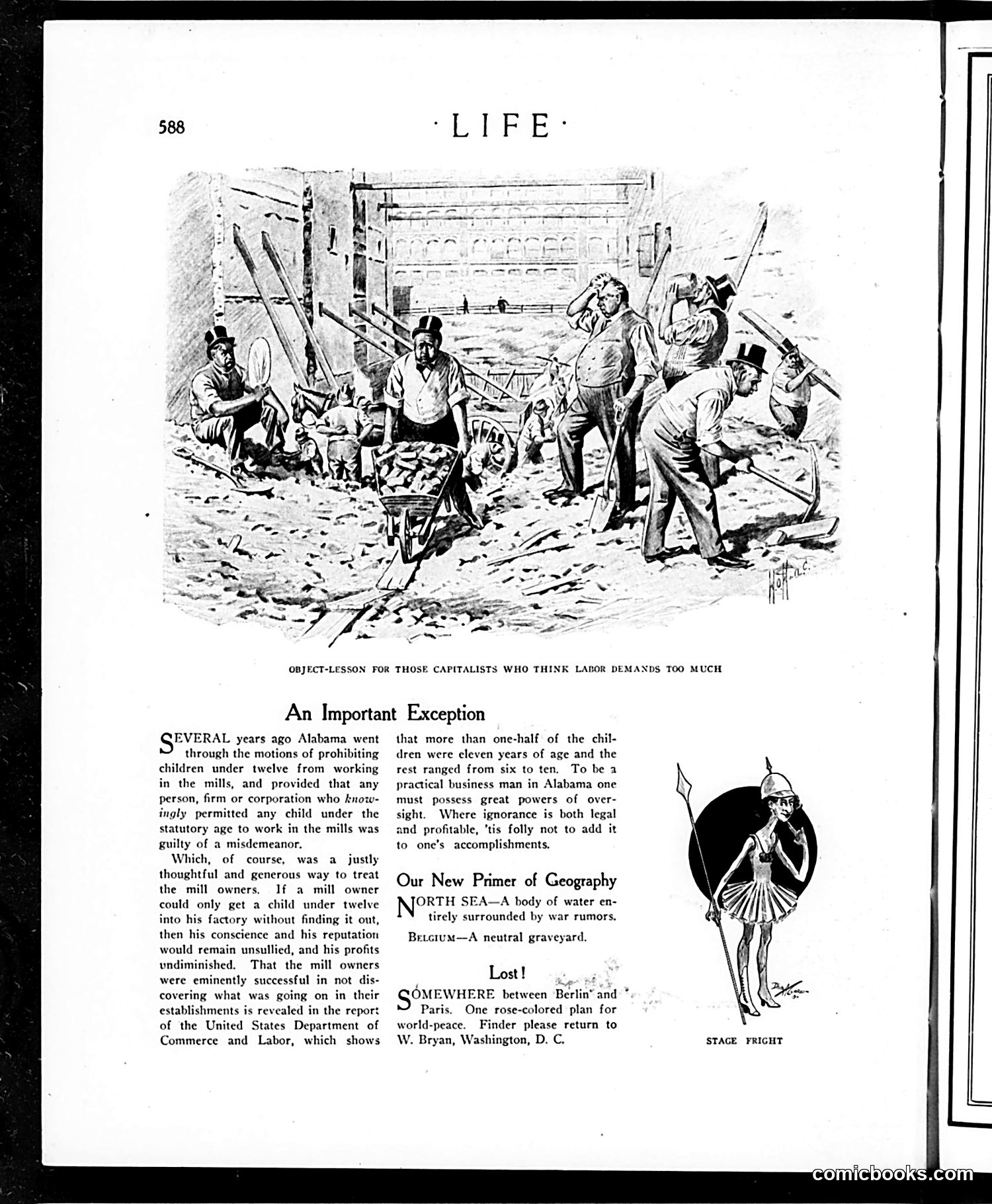
The main cartoon depicts child laborers in a mill yard—an "object-lesson" mocking capitalists who claim labor demands are excessive. The satire targets Alabama's 1907 child labor law, which prohibited employing children under twelve but included a loophole: violations were only punishable if the employer *knowingly* permitted it. The article's bitter irony is that mill owners exploited this by simply ignoring what happened in their factories. The cartoon shows the reality: over half the child workers were eleven, others as young as six. The secondary "Geography" section uses sarcastic definitions (the North Sea as "war rumors," Belgium as a "graveyard") to comment on World War I's devastation in Europe. The "Lost!" item mockingly addresses William Jennings Bryan—a peace advocate then serving as Secretary of State—suggesting his peace plans for post-war Europe have vanished between Berlin and Paris. Together, these pieces critique both industrial exploitation at home and international conflict abroad.
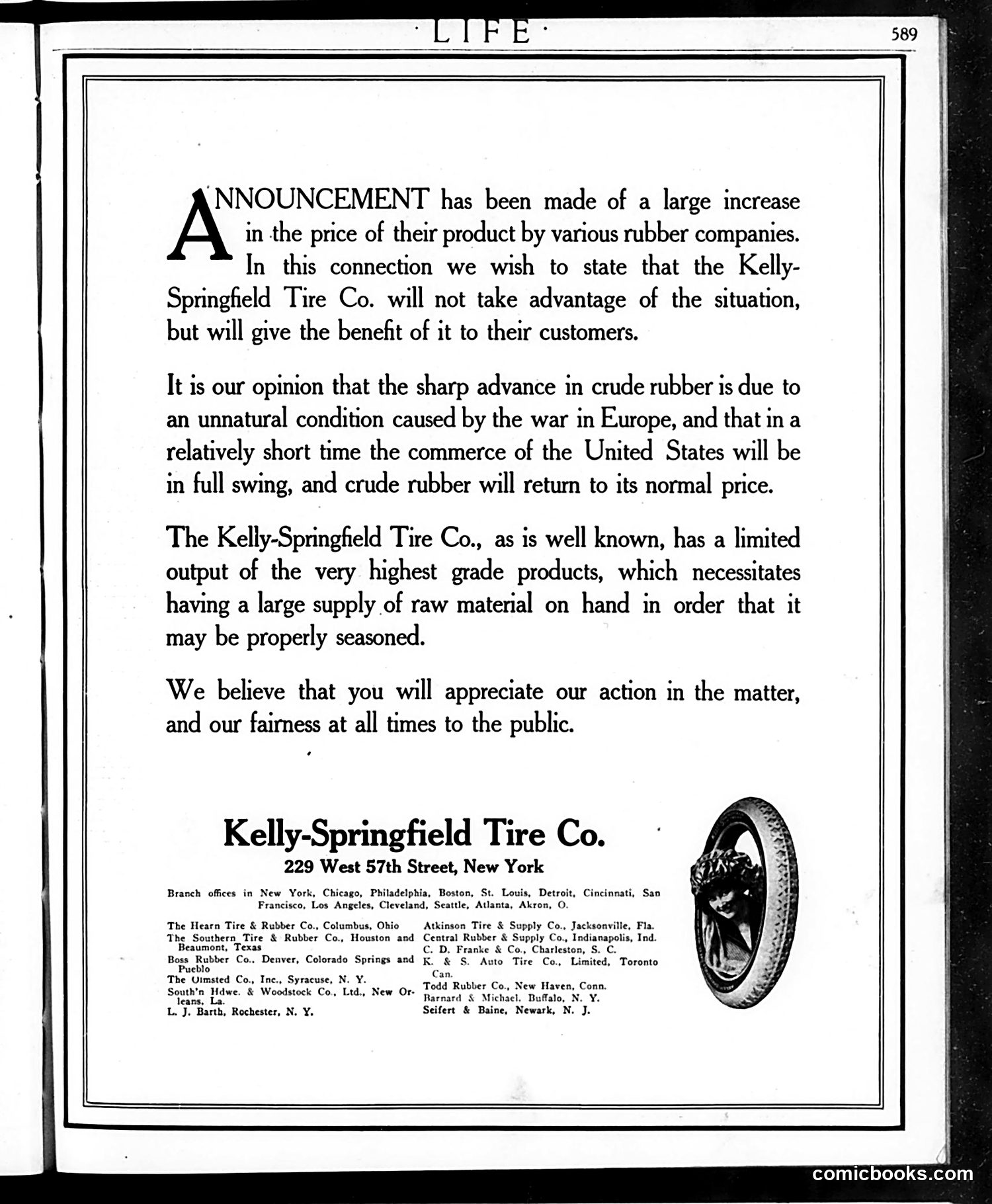
This is a **corporate advertisement**, not a satirical cartoon. It announces that while other rubber companies are raising prices due to war-disrupted crude rubber supplies from Europe, Kelly-Springfield will keep prices stable for customers. The company positions itself as ethical and fair-minded, attributing price spikes to temporary wartime conditions rather than permanent market changes. They claim their limited high-quality output and stockpiled raw materials allow them this principled stance. For modern readers: This reflects **WWI-era economic disruption** (likely 1914-1917). The advertisement uses corporate virtue-signaling—a marketing tactic where companies advertise their restraint or fairness as a competitive advantage. The "war in Europe" justification and promise of eventual normalcy show wartime uncertainty about global trade and supply chains. No satire or caricature is present; this is straightforward business messaging.
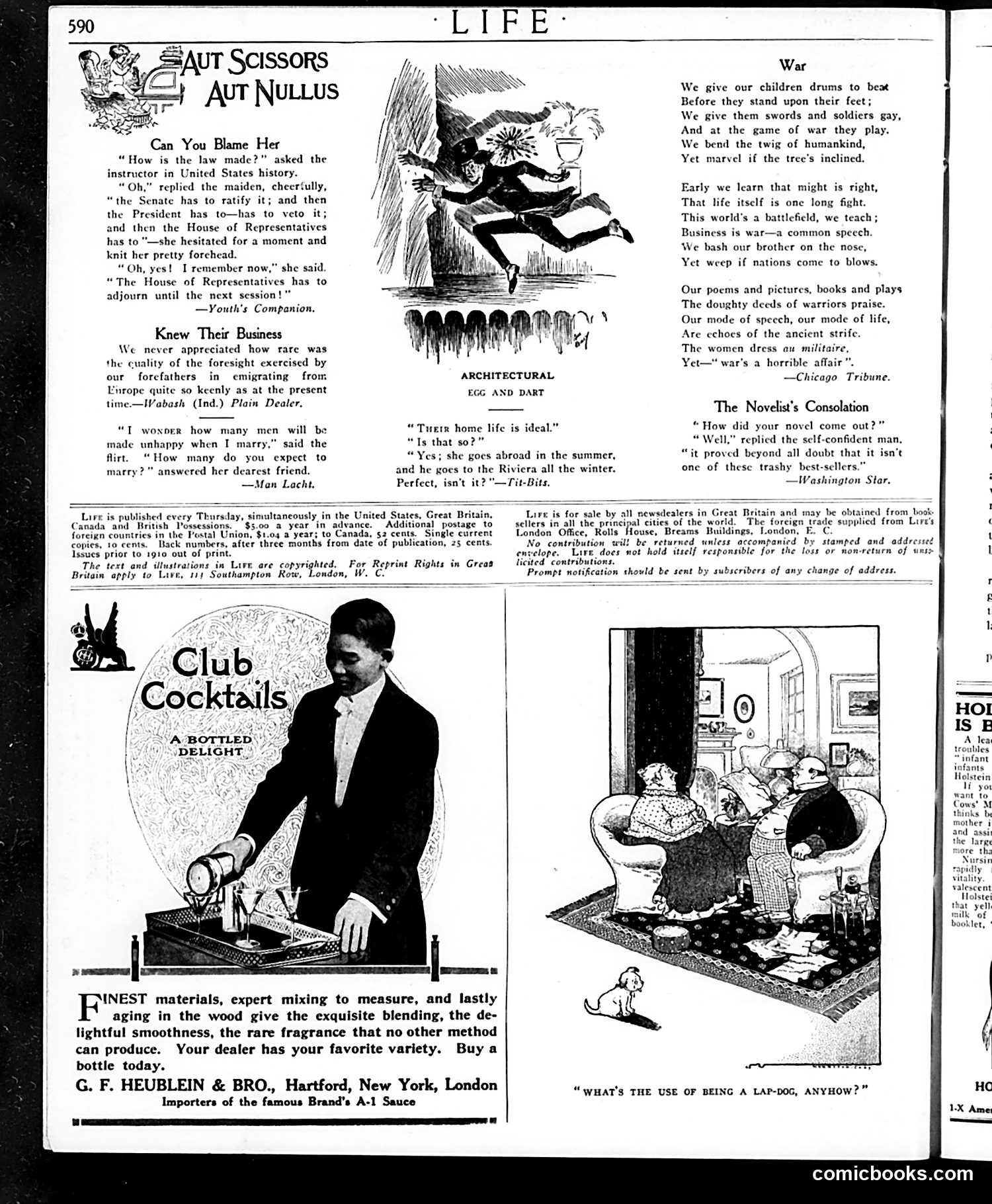
This page contains several short jokes and satirical pieces typical of Life magazine's format: **"Can You Blame Her"** mocks American legislative process—a schoolgirl humorously describes how laws are made: Senate ratifies, President vetoes, House of Representatives adjourns. The joke suggests the process is circular and accomplishes nothing. **"War"** (Chicago Tribune) is serious social commentary, not satire. It criticizes how society teaches children militarism and violence ("drums to beat," "swords and soldiers"), then hypocritically claims war is "horrible." It condemns the culture's glorification of combat while mourning its consequences. **"The Novelist's Consolation"** jokes that an author, failing to write a bestseller, consoles himself that his book at least *isn't* trashy—inverted logic suggesting mediocrity is preferable to popular success. **"Architectural Egg and Dart"** appears to be a brief humorous dialogue about ideal married life involving seasonal travel. The cartoons include a cocktail advertisement and a domestic scene with a lap-dog, captioned with the dog questioning its usefulness.
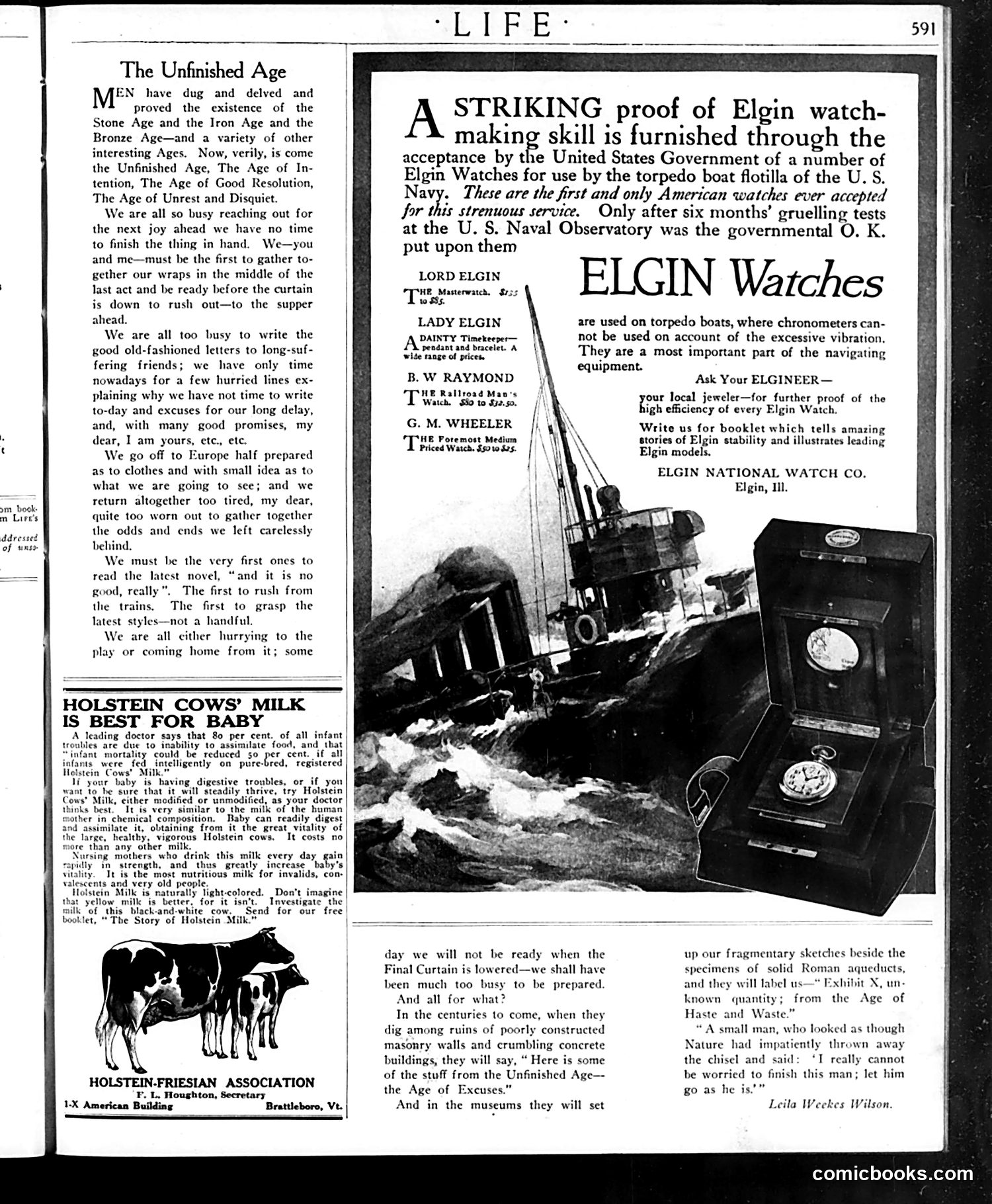
This page presents a satirical essay titled "The Unfinished Age," criticizing modern American culture's frenetic pace and lack of follow-through. The author argues that contemporary society has become obsessed with rushing toward the next experience rather than completing present tasks—whether writing letters to friends, preparing for travel, or finishing books. The piece characterizes this era as one of "Intention" and "Good Resolution" where people are perpetually hurrying to or from entertainment, never gathering their scattered "odds and ends." The satire suggests that future archaeologists will find evidence of this incomplete civilization amid "poorly constructed masonry walls and crumbling concrete buildings." The accompanying advertisements (Holstein milk, Elgin watches) ironically underscore the consumerist culture the essay critiques—products marketed to busy modern people seeking shortcuts to quality (better infant health, precise timekeeping). The torpedo boat image reinforces themes of technological progress and national concerns of the era.
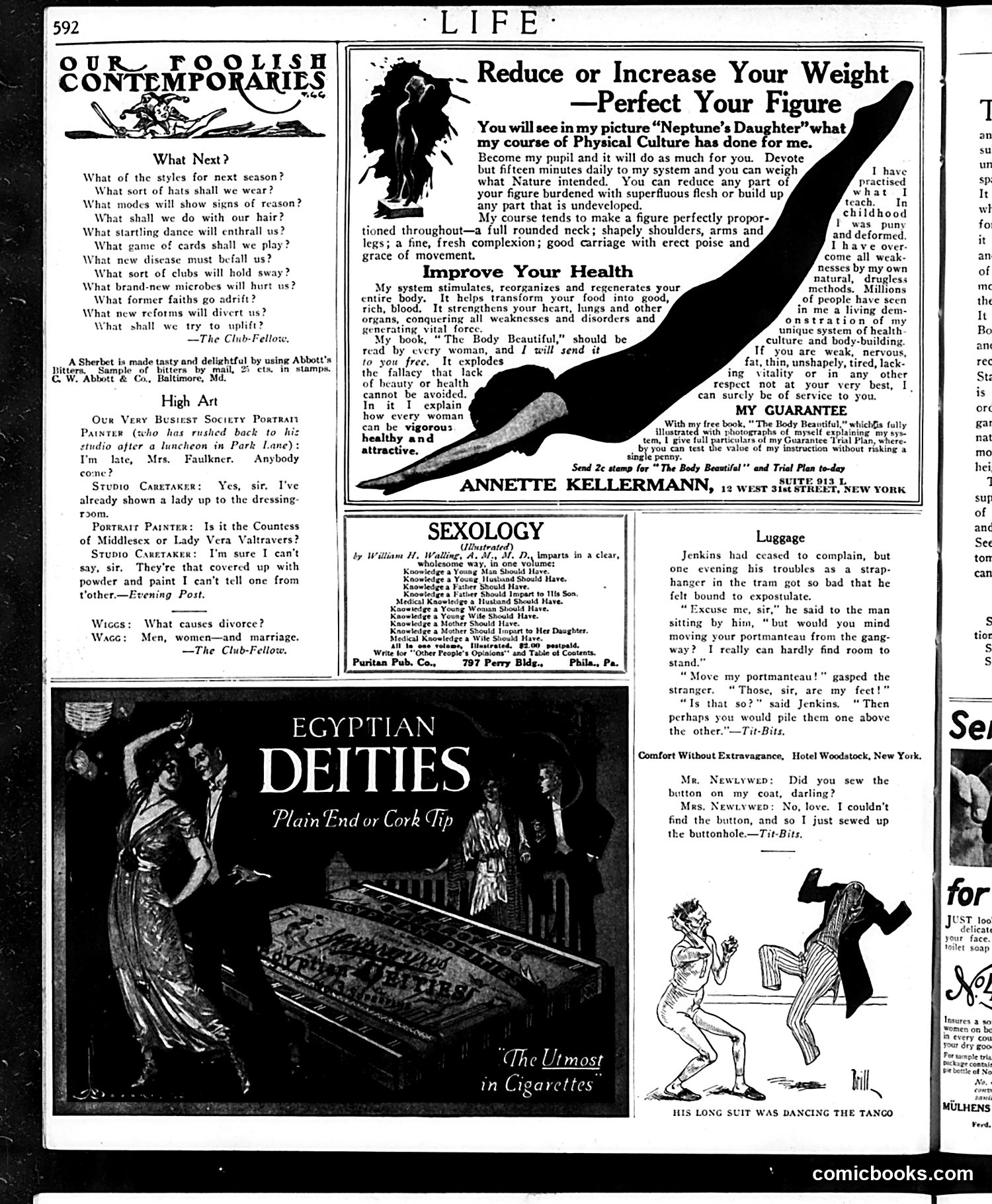
This page is primarily **advertising and humor content** rather than political satire. Key sections: **"Our Foolish Contemporaries"** column mocks society's obsessions with fleeting trends—fashions, dances, diseases, and reform movements—suggesting modern life chases novelties without substance. **"High Art"** sketch satirizes pretentious society portrait painters and their wealthy subjects, poking fun at the social climbing and superficiality of the upper classes. **Main Advertisement**: Annette Kellermann (a real figure—likely the famous swimmer/physical culture advocate) promotes her body-shaping system, claiming fifteen minutes daily achieves ideal weight and health through "natural, drugless methods." **"Sexology" Section**: Brief humorous anecdotes about marital/romantic misunderstandings—a man complaining about luggage on a tram, and a woman who sewed a lost button onto her dress instead of replacing it. **"Egyptian Deities"** and **"His Long Suit Was Dancing the Tango"**: Minor cartoons on unrelated topics. The page reflects 1920s preoccupations: physical culture fads, class anxieties, and domestic comedy.
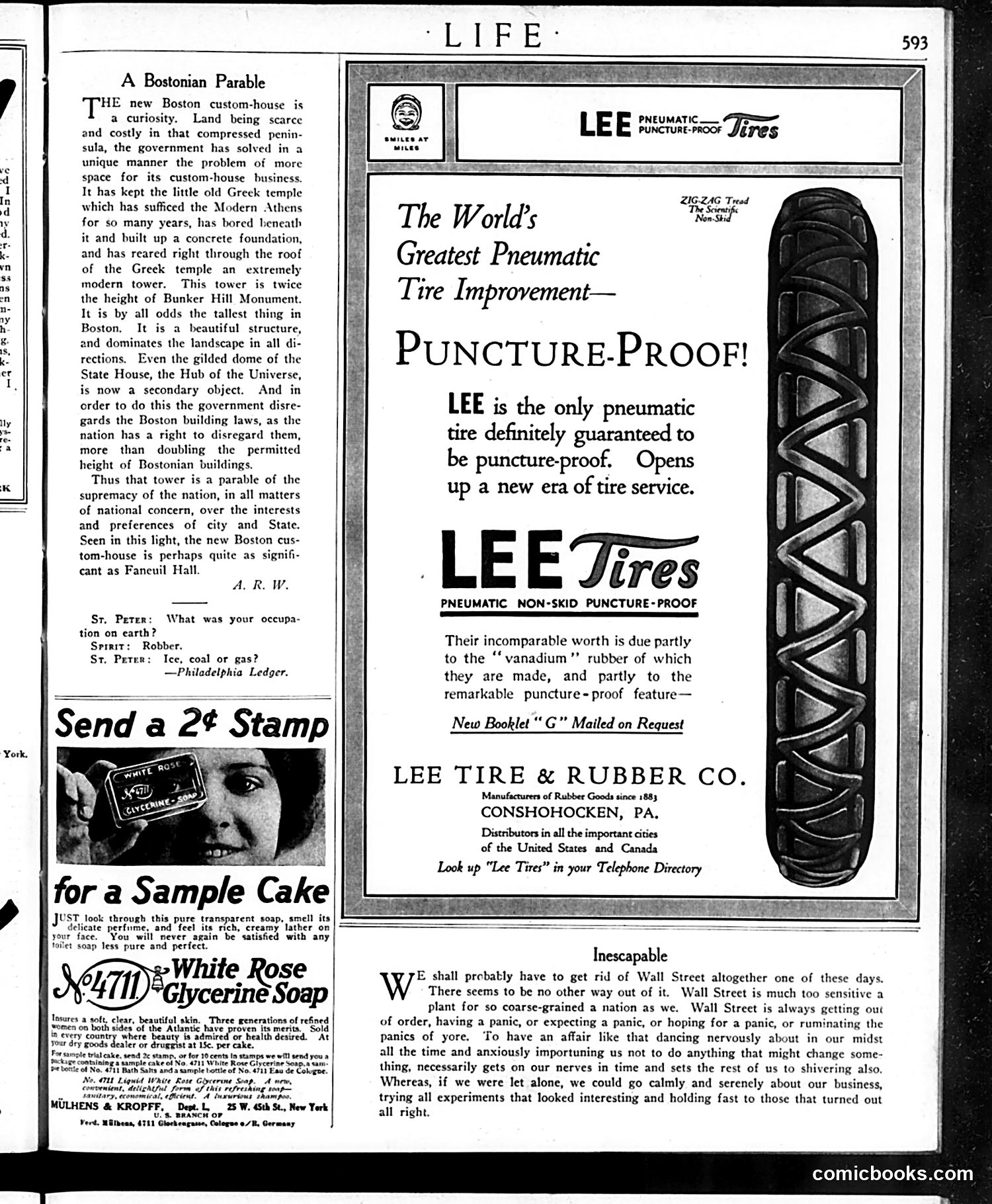
This short article satirizes federal overreach by describing Boston's new custom-house: a modern tower built through the roof of a historic Greek temple, twice the height of Bunker Hill Monument, violating local building laws. The author argues this structure symbolizes national government supremacy over city and state interests—the federal government disregards Boston's regulations because it has the constitutional authority to do so. The accompanying joke about St. Peter—where a spirit admits to being a "robber" who dealt in "ice, coal or gas"—appears to mock utility monopolies and price-gouging as a form of theft. The rest of the page consists of advertisements (Lee Tires, White Rose Glycerine Soap) and an unrelated essay on Wall Street's volatility causing national economic anxiety.
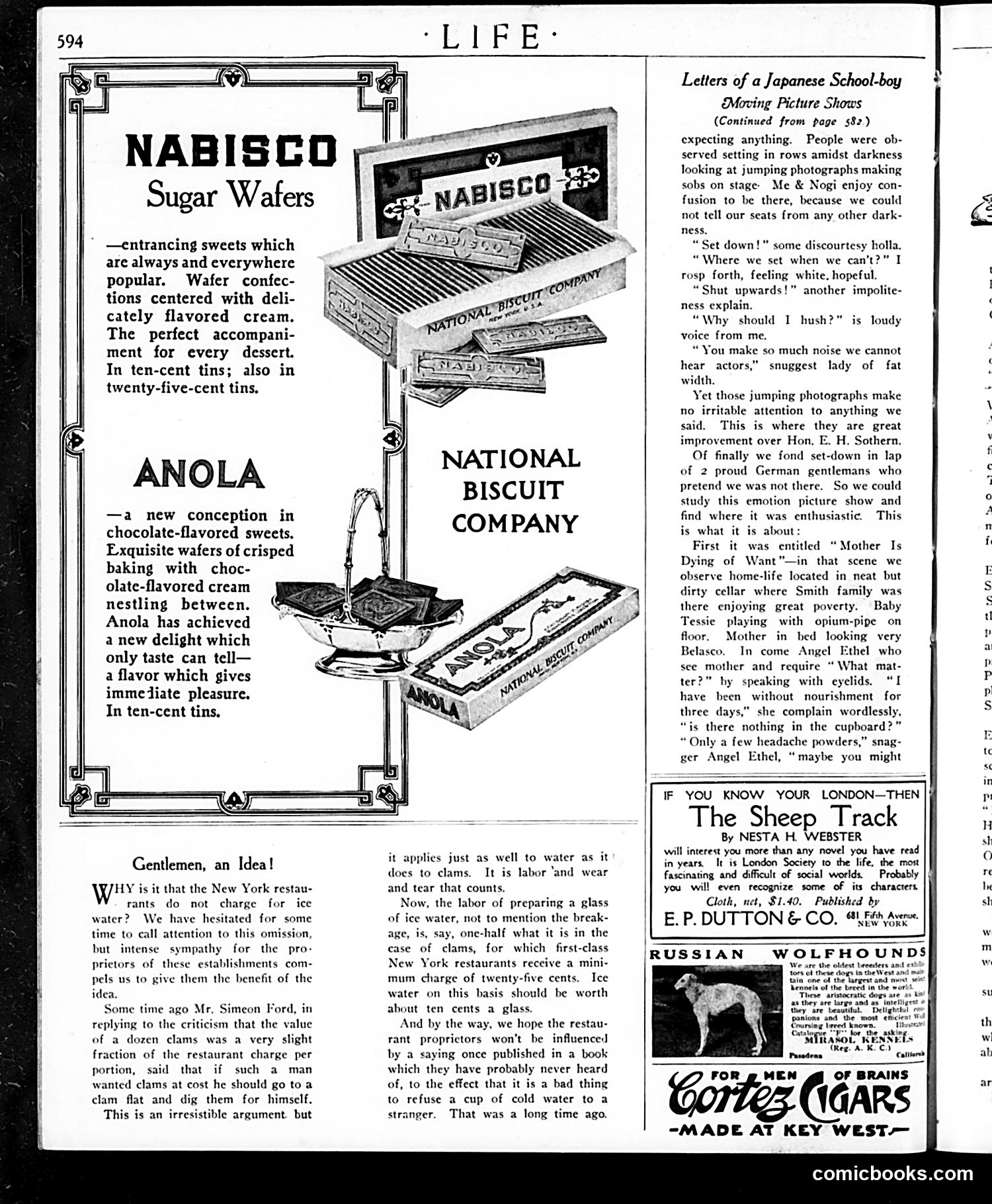
This page is primarily **advertising and serialized fiction**, not political satire. The main content features: 1. **Product advertisements** for Nabisco Sugar Wafers and Anola chocolates (left side), typical early 20th-century confectionery marketing. 2. **"Letters of a Japanese School-boy"** (continued serial)—a humorous piece written in deliberately broken English, depicting a Japanese visitor's confused observations of an American movie theater. The joke relies on the character's misunderstandings: loud audience behavior, confusion about seating, mistaking stage activity for screen action. The cinema scene described appears melodramatic (a play titled "Mother Is Dying of Want"). 3. **"Gentlemen, an Idea!"** essay about restaurant ice water charges—a minor consumer advocacy piece debating whether restaurants should charge for ice water. 4. **Additional advertisements** for *The Sheep Track* novel and Russian Wolfhounds. The page contains **no political cartoons**. The humor is gentle, focused on cultural misunderstanding and everyday consumer issues rather than satire of political figures or movements.
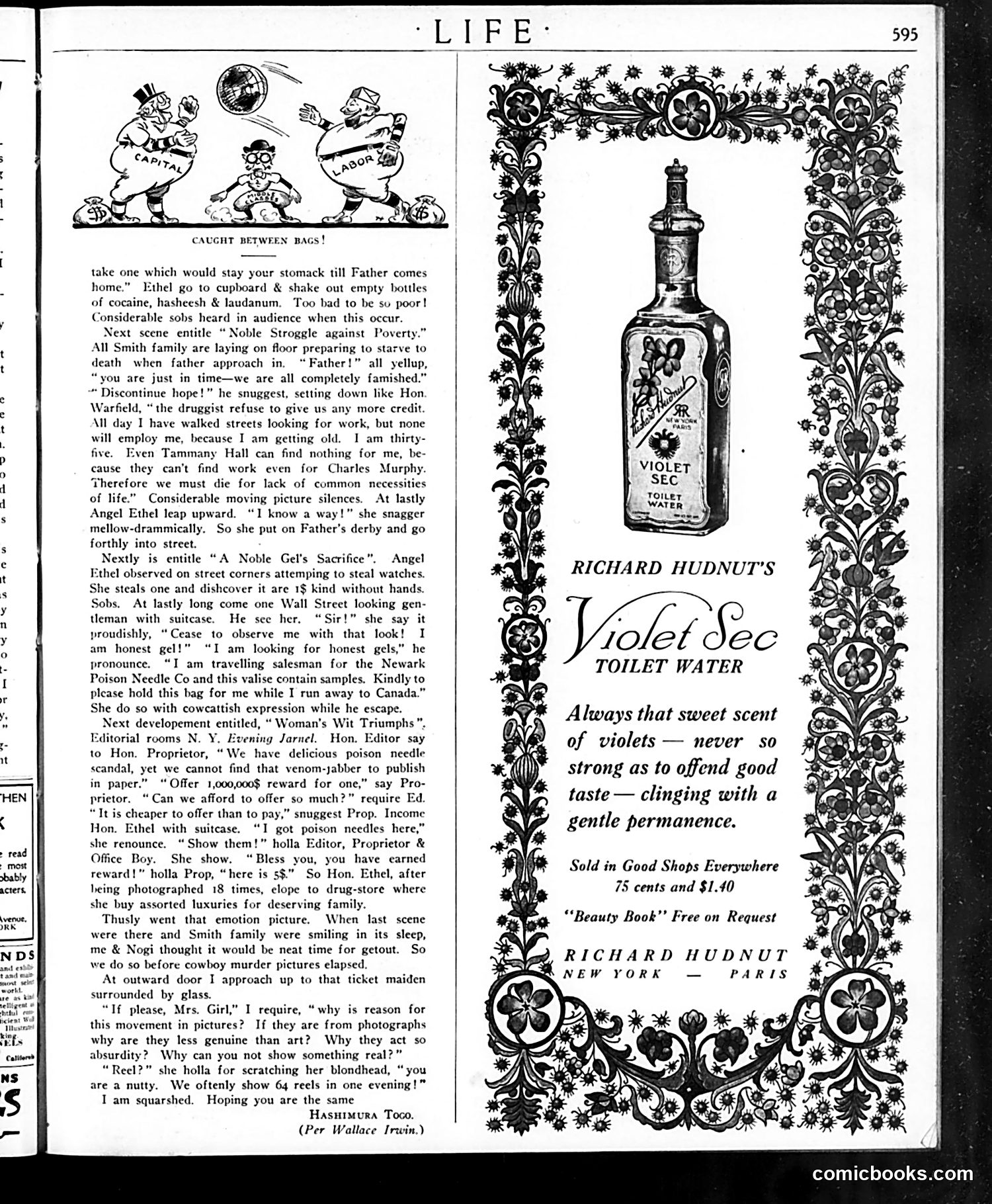
This page contains a satirical movie review (left) and a perfume advertisement (right). The review, written pseudonymously by "Hashimura Togo," mocks melodramatic silent films with exaggerated poverty narratives. It describes a plot where the Smith family, destitute and addicted to cocaine, hasheesh, and laudanum, are saved when their daughter "Angel Ethel" steals a watch, then inadvertently helps expose a poison needle scandal—earning a reward that rescues the family. The satire targets: - **Overwrought silent film tropes**: lurid plots about crime, addiction, and poverty - **Corrupt newspapers**: editors offering large rewards for sensational stories rather than truth - **Social commentary**: references to Tammany Hall (NYC political machine) and Charles Murphy suggest commentary on urban corruption and employment failures The review ridicules the absurdity and phoniness of these films while the ticket seller's "reel/real" pun provides a final joke about cinema's artificiality. The Violet Sec advertisement is unrelated luxury goods marketing.
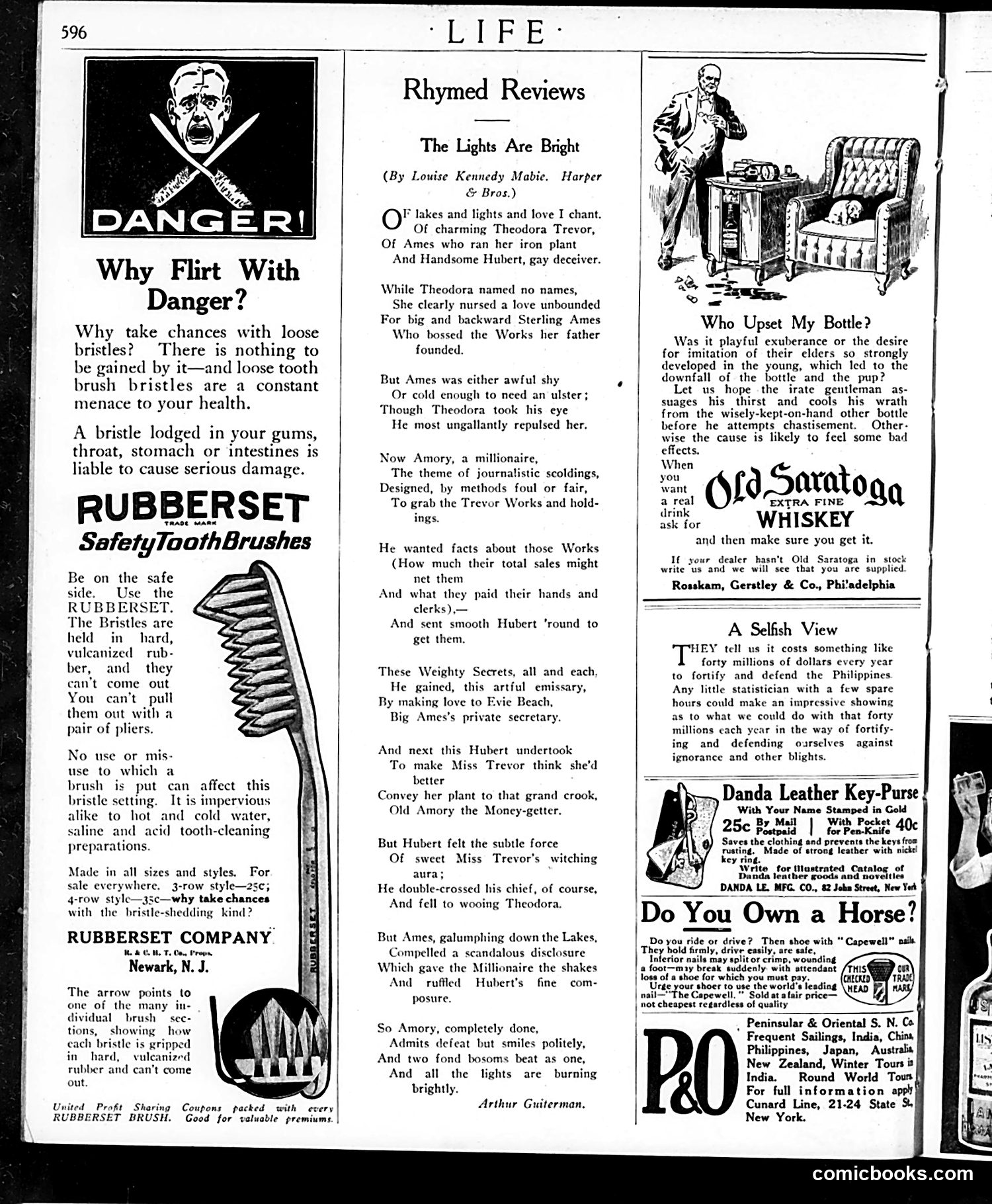
This page contains a book review in verse form of "The Lights Are Bright" by Louise Kennedy Mabie. The reviewer (Arthur Guiterman) satirizes what appears to be a melodramatic novel about romance and corporate intrigue among the wealthy. The plot summary mocks a formulaic tale: Theodora Trevor loves Sterling Ames (who runs her father's factory), but he rebuffs her. Amory, a millionaire, schemes to gain control of the Works through manipulation—sending the charming Hubert to seduce both Theodora and her father's secretary, Evie Beach, extracting business secrets. Ames exposes the plot, thwarting Amory. The satire targets overwrought romantic fiction of the era, with its predictable casts of wealthy schemers, virtuous heroines, and convenient plot revelations. The verse form itself—light rhyming couplets—underscores the mockery of taking such melodrama seriously. The surrounding advertisements (toothbrushes, whiskey, leather goods) are period commercial content, unrelated to the review's satirical content.
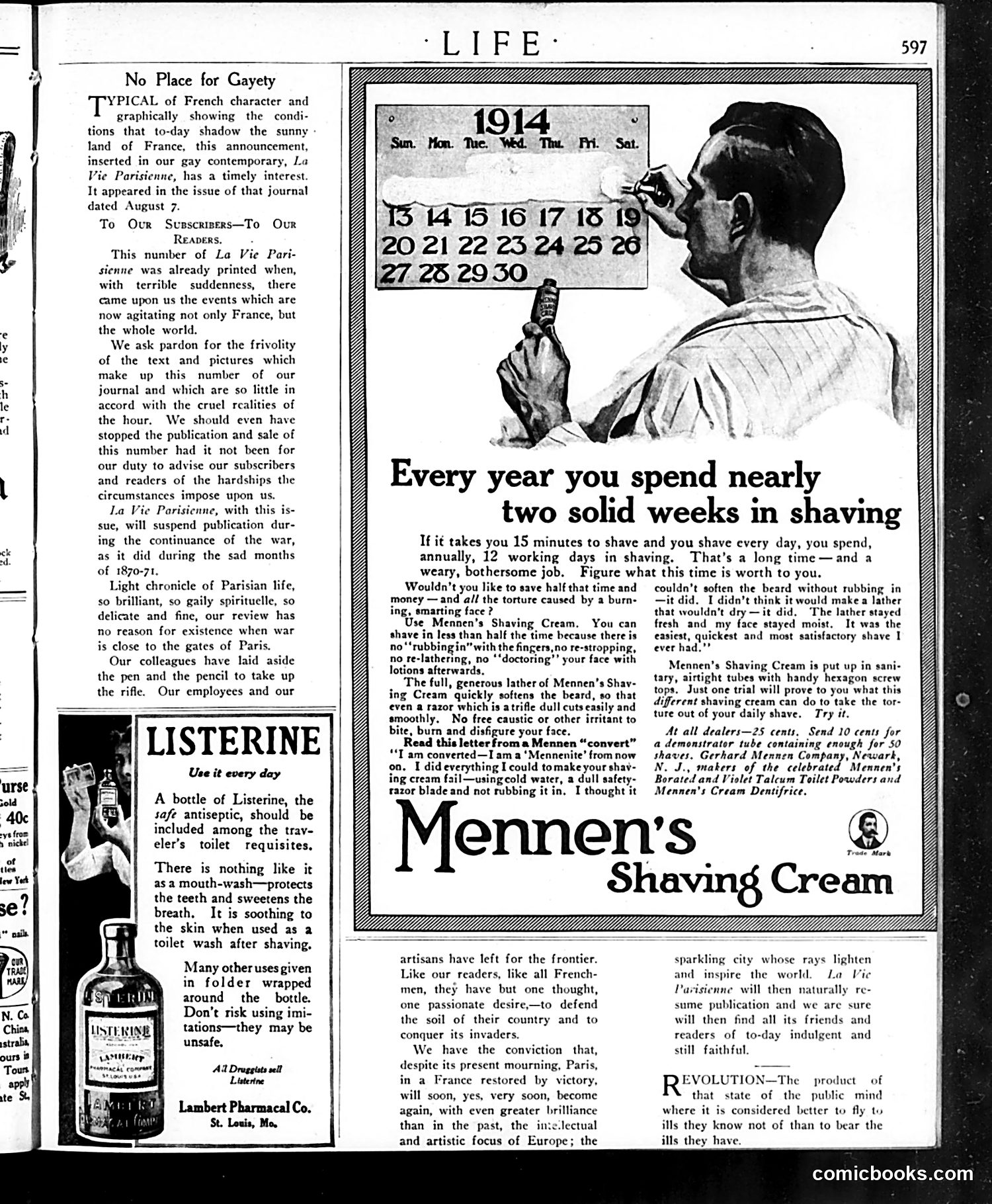
This page combines editorial content with advertisements, dated to August 1914—the outbreak of World War I. **The Main Editorial Content:** The left side reprints an announcement from *La Vie Parisienne*, a French satirical magazine. The announcement apologizes to subscribers for publishing frivolous, gay content when "terrible suddenness" brought war to France. The magazine suspends publication during the war, comparing the crisis to the 1870-71 Franco-Prussian War. Editors note their employees and colleagues have "laid aside the pen and the pencil to take up the rifle." **The Satire:** The irony is implicit: a humor magazine cannot exist during wartime. The juxtaposition with cheerful American advertisements (Listerine mouthwash, Mennen's Shaving Cream) underscores the stark contrast—while France mobilizes for existential conflict, American consumer life continues normally. **Historical Context:** This illustrates how WWI's outbreak shattered pre-war European culture and commerce, forcing even frivolous publications to acknowledge "cruel realities."
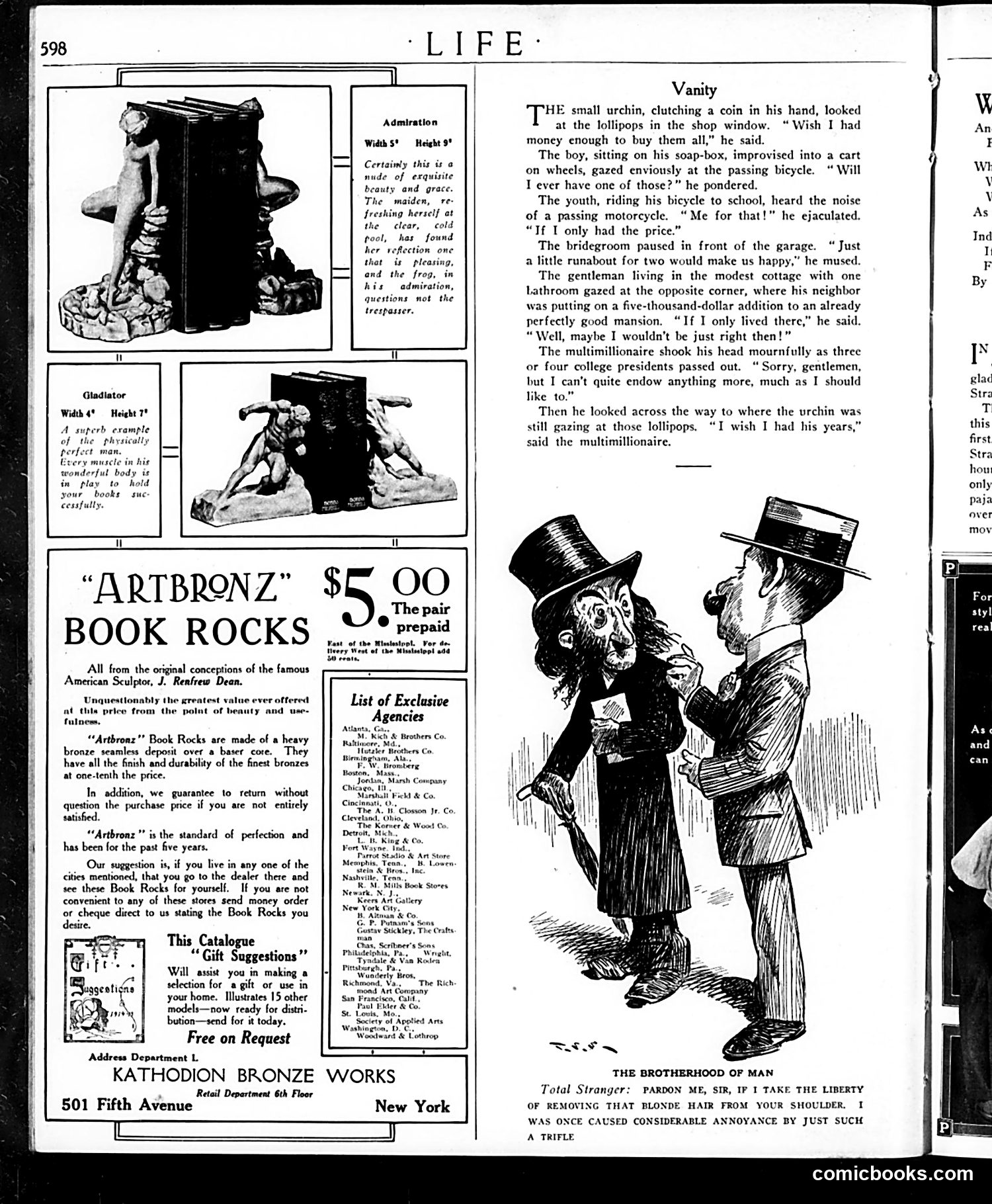
This page contains two distinct elements: **Main Content - "Vanity" (Satirical Story):** A narrative progression showing human dissatisfaction across social classes. An impoverished child wants lollipops; a boy wants a bicycle; a youth wants a motorcycle; a newlywed couple wants a car; a modest homeowner envies his wealthy neighbor's mansion expansion; a multimillionaire, despite his wealth, envies the poor child's youth and simple pleasures. The satire critiques perpetual desire and discontent—each person covets what the next person has, creating a cycle where even extreme wealth cannot buy contentment. **"The Brotherhood of Man" Cartoon (bottom right):** Two well-dressed gentlemen in top hats exchange pleasantries. One removes a blonde hair from the other's shoulder, joking that such trivial incidents once caused him "considerable annoyance." The humor is genteel social commentary about minor social embarrassments and the performative civility of upper-class interaction. **Advertisements:** The remaining space features "Artbronz" book rocks (decorative bronze items) and various retailers' contact information—typical magazine filler of the era.
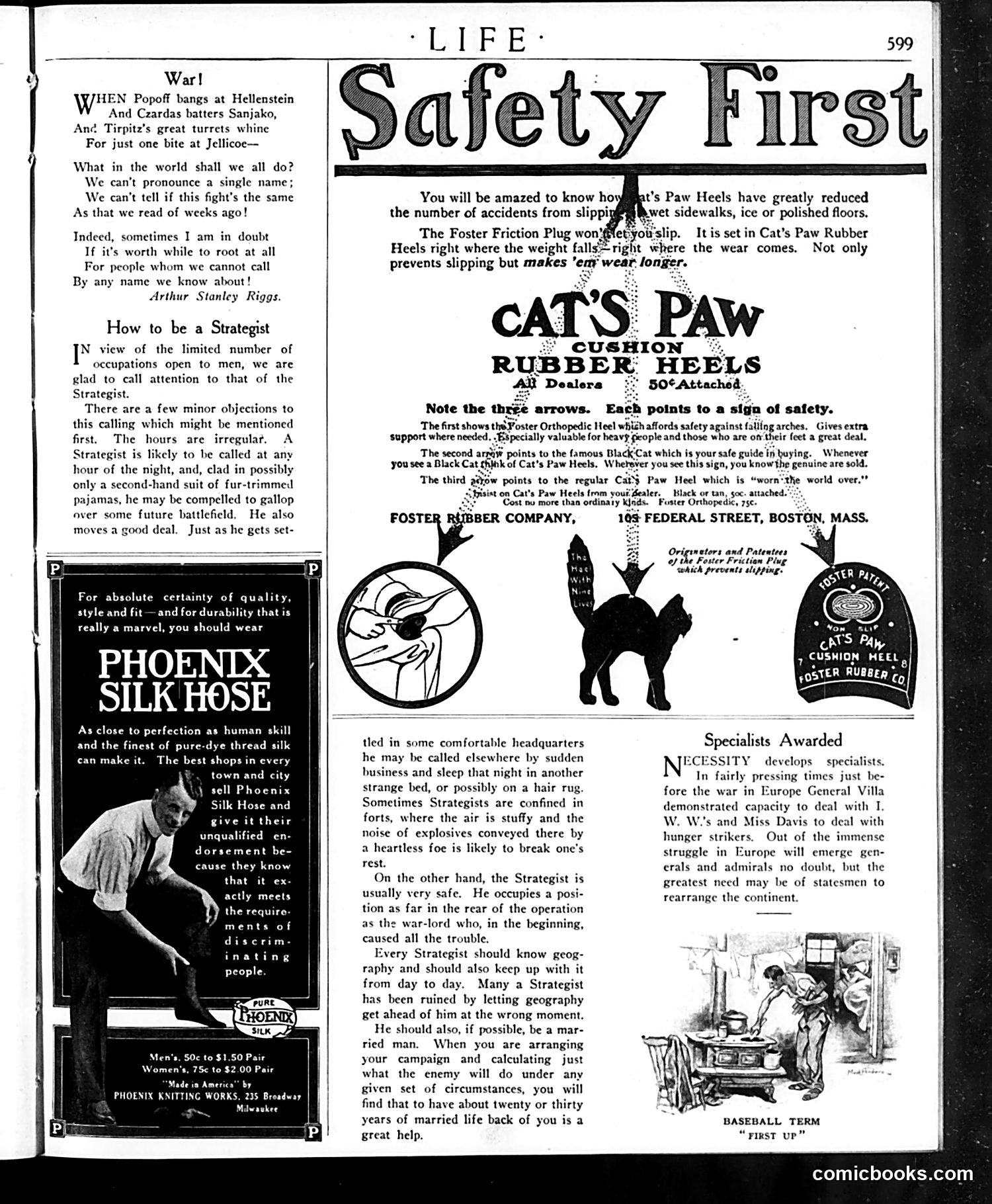
This page combines satire about World War I with period advertising. The opening poem by Arthur Stanley Riggs satirizes American confusion about the war—readers cannot pronounce foreign commanders' names (Popoff, Czardas, Tirpitz, Jellicoe) or distinguish between different battles, making it difficult to understand or care about the conflict. "How to be a Strategist" humorously describes military staff officers' irregular, uncomfortable lives—called away at night, sleeping in forts with explosions, constantly relocating—while noting they're actually safer than frontline troops. The advertisements (Phoenix Silk Hose, Cat's Paw Rubber Heels) are period marketing unrelated to the satire. A final section discusses how "necessity develops specialists," referencing General Villa and Miss Davis handling hunger strikers in pre-war Europe, suggesting wartime will produce military leaders needed to reorganize the continent afterward. The page reflects American attitudes toward distant European conflict—confusion, satirical distance, and focus on domestic life.
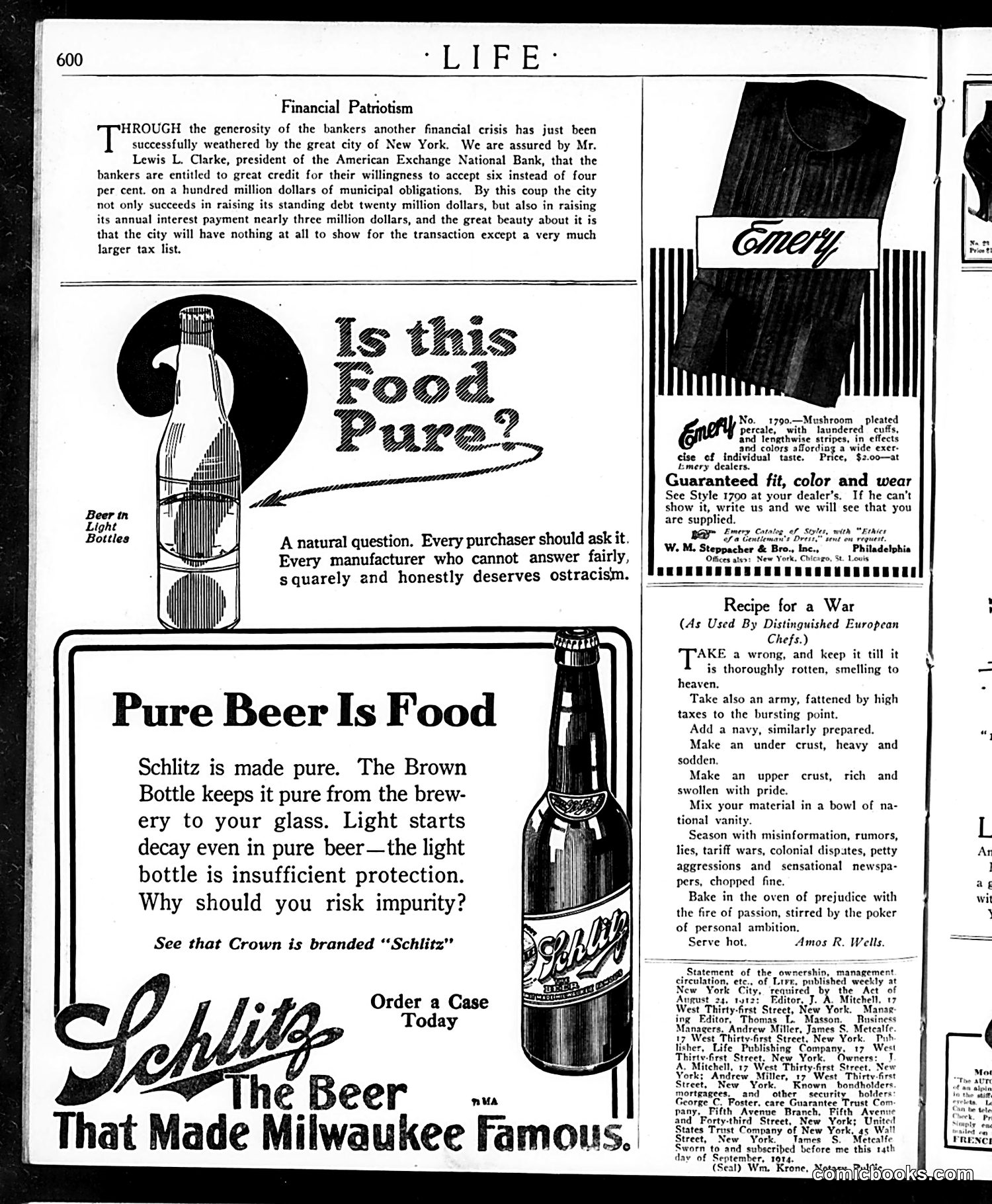
**"Financial Patriotism" Editorial Cartoon:** The top article satirizes New York bankers' self-congratulation during a financial crisis. The satire targets bank president Lewis L. Clarke's claim that bankers deserve "great credit" for accepting lower interest rates (6% instead of 4%) on municipal bonds. Life's point: the bankers actually benefited enormously—the city raised $20 million in debt while gaining nothing tangible except a larger tax burden on citizens. The "patriotism" is purely financial self-interest dressed in civic virtue. **"Recipe for a War" Feature:** This appears to be satirical commentary on European tensions (likely pre-WWI, given the 1914 publication date). It mocks how nations manufacture conflict through accumulated grievances, military buildup, nationalist pride, and propaganda—"chopped fine" and baked in prejudice. The recipe format makes absurd what was becoming tragically real in Europe. The page also contains period advertisements for Schlitz beer and Emery clothing—standard commercial content.
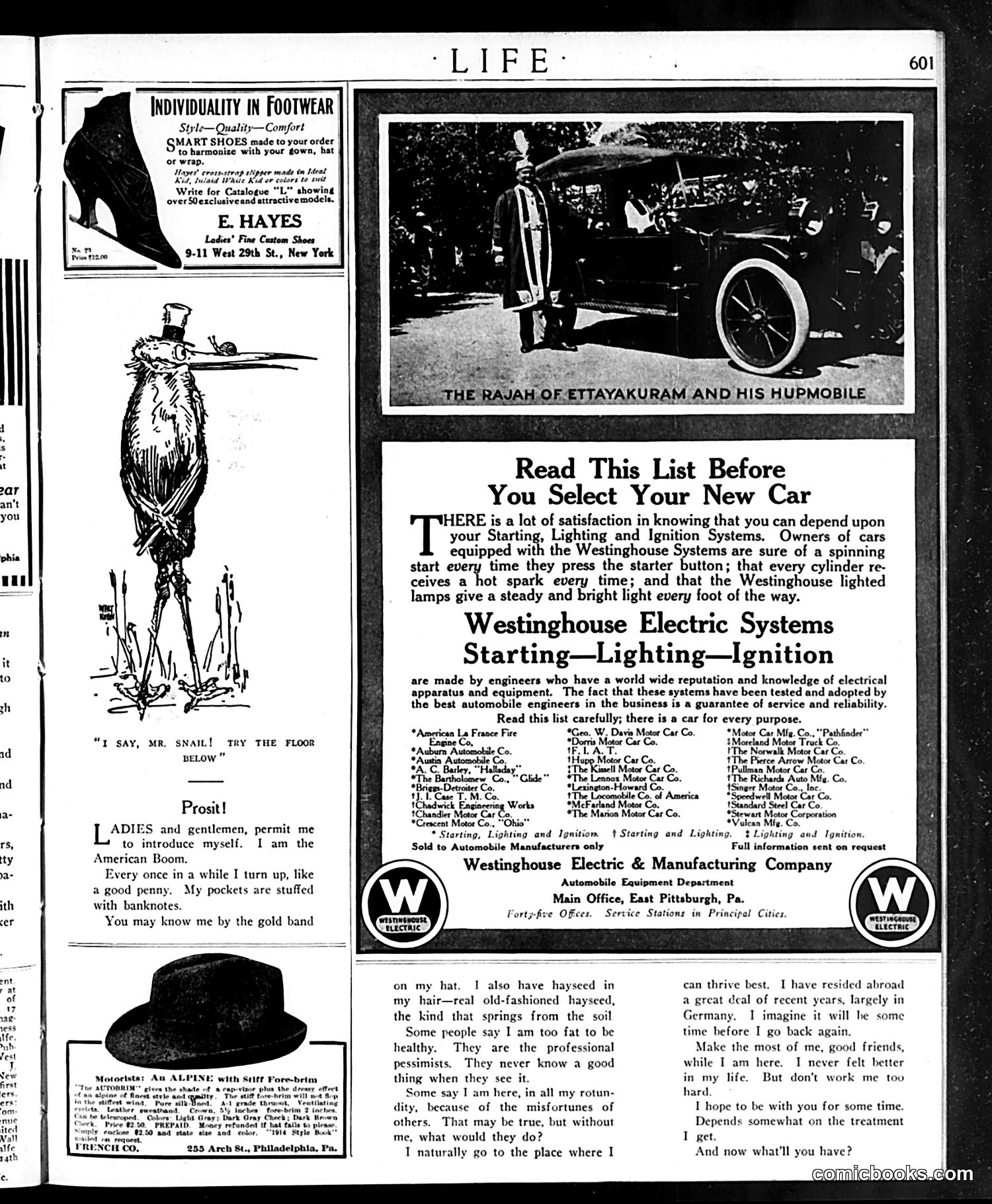
This page mixes advertisements with satirical content. The main cartoon features **the "American Boom"**—personified as a rotund, well-dressed figure representing post-WWI economic prosperity. Speaking directly to readers, this character boasts of carrying "banknotes" and promises good times, but with a knowing wink: he acknowledges he may owe his existence to "misfortunes of others" (likely wartime profits) and warns he won't stay forever. The humor targets both optimistic Americans and those skeptical of sudden wealth. The Boom is portrayed as vain, temporary, and dependent on being treated well—a satirical commentary on economic cycles and the fragility of the 1920s prosperity. The page also includes a snail cartoon and period advertisements for custom shoes and automobile electrical systems, typical of Life magazine's format blending editorial humor with commercial content.
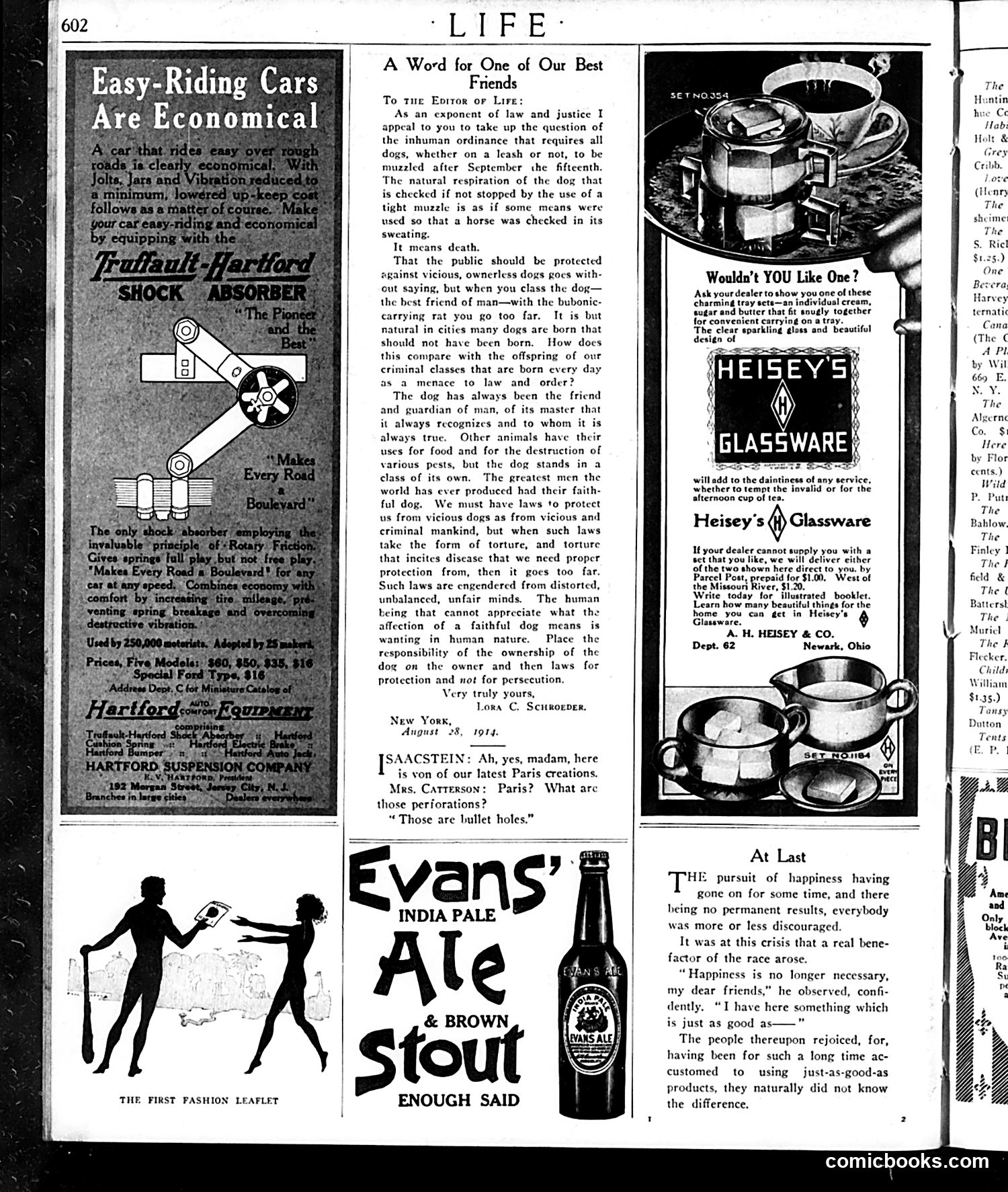
This page contains several distinct items: **Letter to the Editor** ("A Word for One of Our Best Friends"): A serious piece by Lora C. Schroeder arguing against a municipal ordinance requiring dogs to be muzzled after September 15th. She compares the muzzle requirement to torture, claiming it restricts natural respiration and causes death. The letter appeals to sentiment about dogs as faithful companions while criticizing the law as overly harsh compared to treatment of dangerous humans. **Fashion Cartoon**: A brief exchange satirizing post-WWI fashion. A Paris fashion designer shows a client a dress with perforations, explaining they are "bullet holes"—mocking how wartime damage became fashionable design elements, likely referencing the recent fighting in Europe. **Advertisements**: The remaining space features ads for shock absorbers, Heisey's glassware, and Evans' ale—typical period product marketing. The page reflects 1914 concerns: animal welfare debates, fashion responding to World War I, and consumer goods promotion.
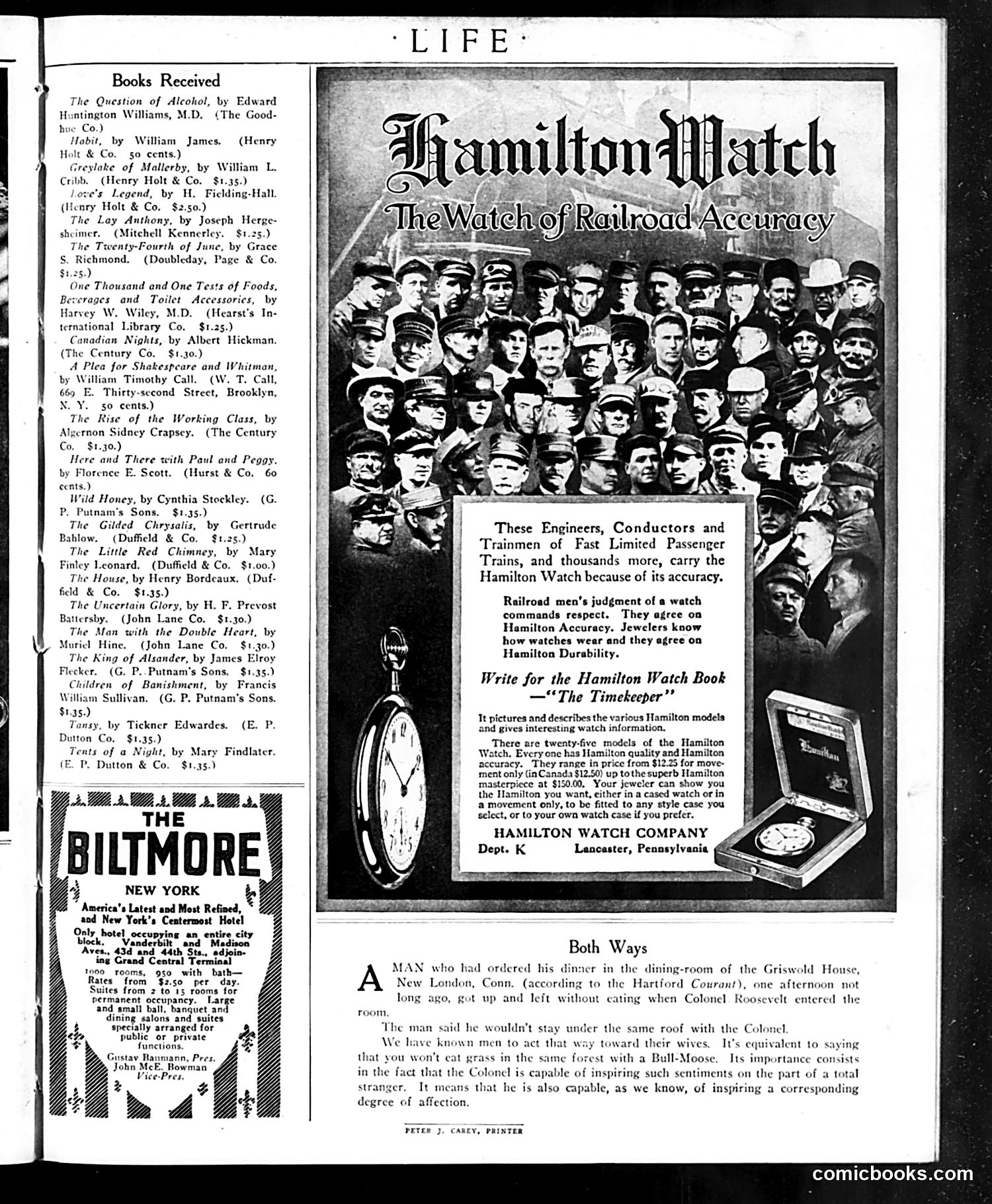
This page is primarily **advertising and book reviews**, not political satire. The dominant content is a Hamilton Watch advertisement featuring railroad workers, emphasizing accuracy and durability—a straightforward commercial appeal to a professional audience. The small narrative titled "Both Ways" at bottom references **Theodore Roosevelt's "Bull Moose" Progressive Party**. A man at the Griswold House dining room abandons his meal upon Colonel Roosevelt's arrival, unwilling to share space with him. The anecdote draws a contrast: just as men avoid eating near a bull-moose in the forest, some men similarly avoid Roosevelt—yet the author suggests Roosevelt, like the animal, inspires strong emotional reactions (both negative and positive). This appears to be gentle mockery of Roosevelt's divisive personality rather than hard political satire. The reference to "Bull-Moose" (Roosevelt's 1912 Progressive Party nickname) dates this clearly to that era's political tensions.
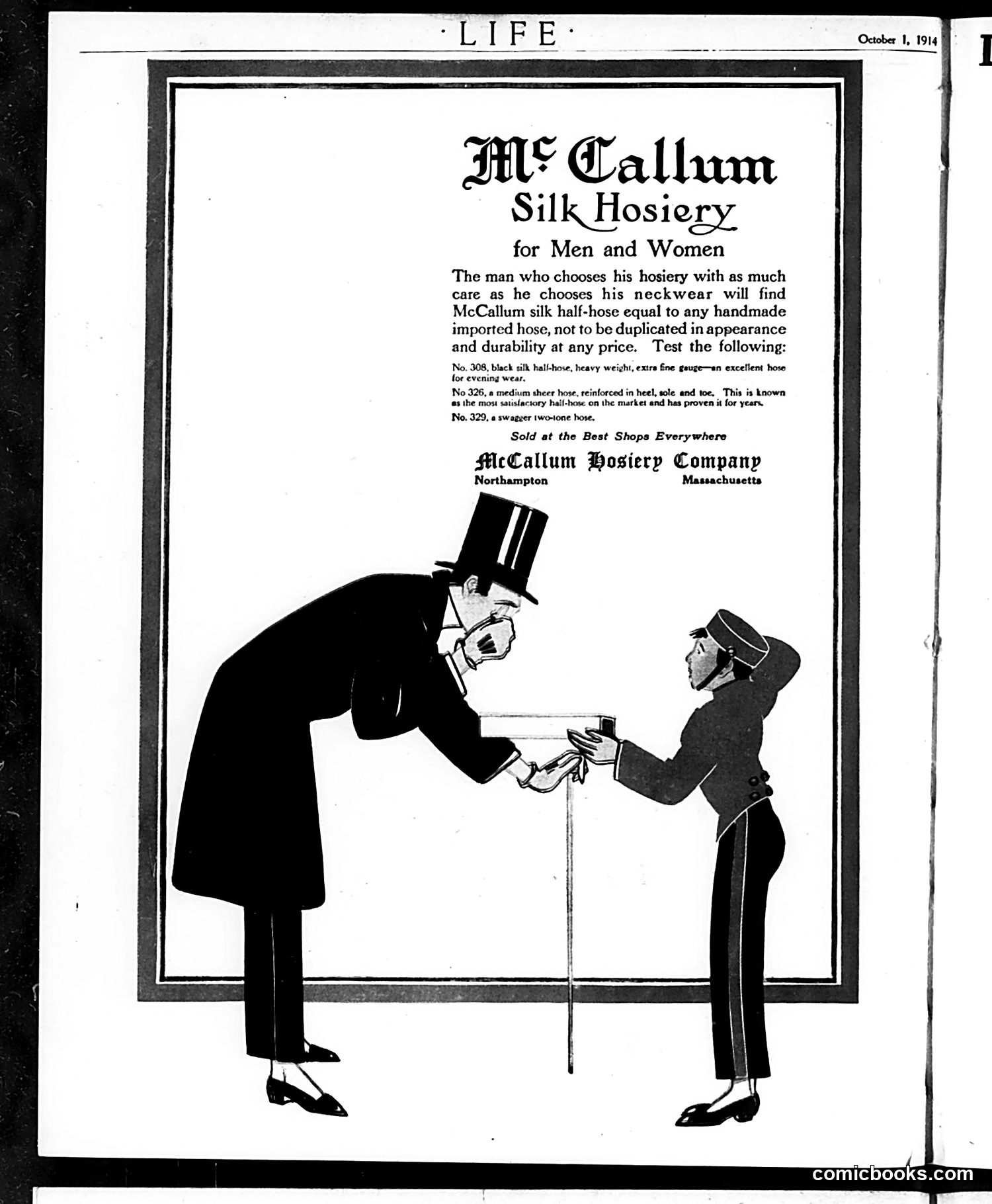
This is primarily a **product advertisement**, not political satire. It promotes McCallum brand silk hosiery from Northampton, Massachusetts, dated October 1, 1914. The illustration shows a tall, formally-dressed gentleman in top hat presenting hosiery samples to a shorter figure (likely a male customer or shop clerk), suggesting the product's quality and elegance. The ad emphasizes that quality hosiery deserves the same care as selecting neckwear—a notable concern for well-dressed early-20th-century men. Three specific hosiery styles are promoted: black silk for evening wear, reinforced medium sheer hose (described as the market's "most satisfactory"), and a "swagger two-tone" style. The page reflects period attitudes about masculine appearance and consumption while demonstrating how hosiery was marketed as a prestigious, carefully-chosen accessory in 1914.