
Life, 1914-10-01 · page 13 of 48
Life — October 1, 1914 — page 13: what you’re looking at
What you’re looking at
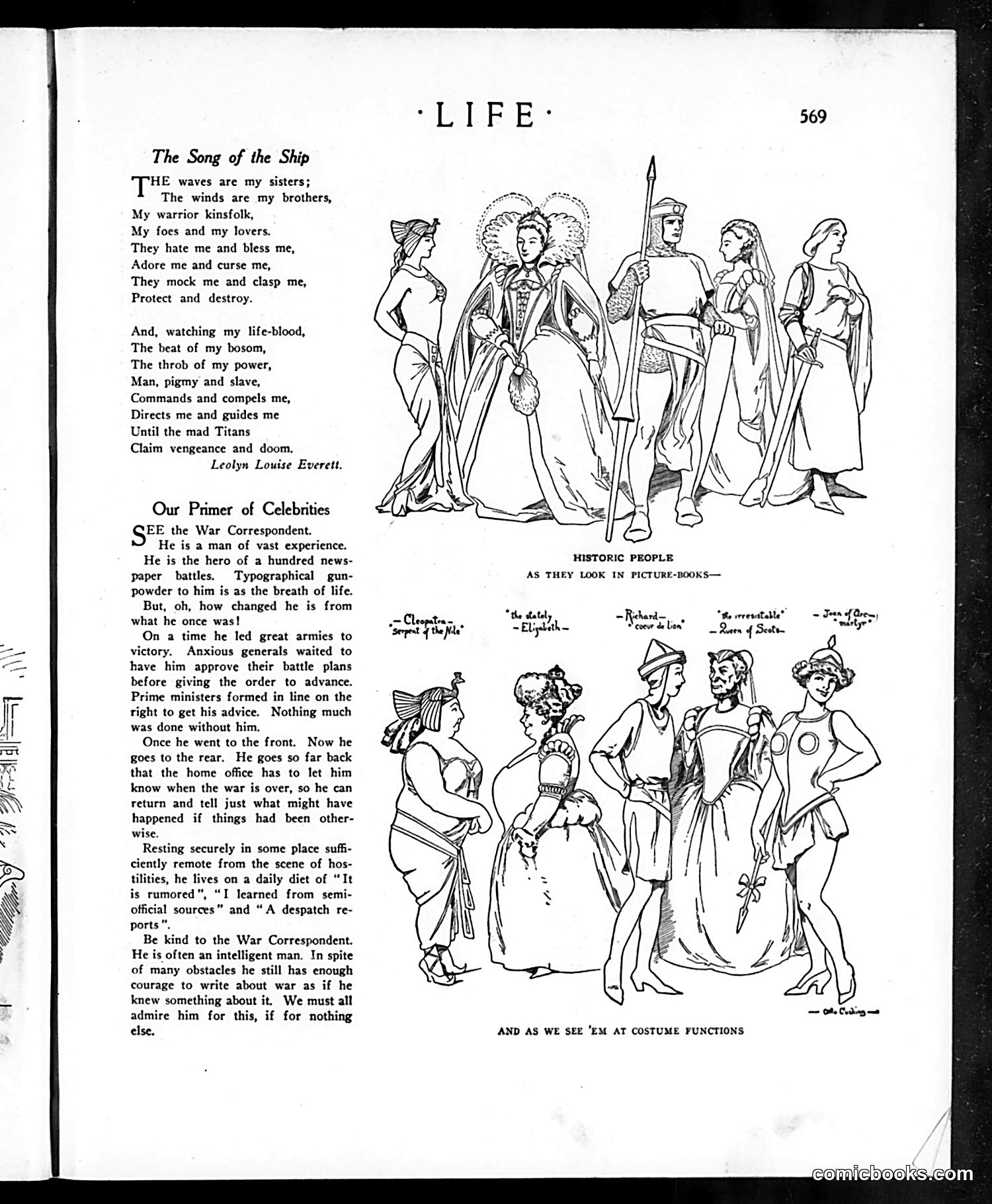
This page contains two distinct sections: **"The Song of the Ship"** is a romantic poem by Evelyn Louisa Everett personifying a ship as a female entity struggling between natural forces (waves, winds) and human masters who "command and compel" her. **"Our Primer of Celebrities"** satirizes a War Correspondent—a journalist covering military conflicts. The text mocks how such correspondents operate far from actual fighting, relying on rumors and secondhand reports ("It is rumored," "I learned from semi-official sources"). The satire suggests these journalists lack direct knowledge yet claim authority, highlighting the gap between their distant position and their authoritative war reporting. The accompanying illustrations show "historic people" in picture-book style and figures "at costume functions"—apparently contrasting dignified historical figures with contemporary people in formal dress, though the exact satirical point remains unclear without additional context.
📄 Transcribed text from this page (OCR, searchable)
Machine-transcribed from the original scan — historical spelling and the odd misread are preserved.
The Song of the Ship HE waves are my sisters; The winds are my brothers, My warrior kinsfolk, My foes and my lovers. They hate me and bless me, Adore me and curse me, They mock me and clasp me, Protect and destroy. And, watching my life-blood, The beat of my bosom, The throb of my power, Man, pigmy and slave, Commands and compels me, Directs me and guides me Until the mad Titans Claim vengeance and doom. Leolyn Louise Everett. Our Primer of Celebrities EE the War Correspondent. He is a man of vast experience. He is the hero of a hundred news- paper battles. Typographical gun- powder to him is as the breath of life. But, oh, how changed he is from what he once was! On a time he led great armies to victory. Anxious generals waited to have him approve their battle plans before giving the order to advance. Prime ministers formed in line on the right to get his advice. Nothing much was done without him. Once he went to the front. Now he goes to the rear, He goes so far back that the home office has to let him know when the war is over, so he can return and tell just what might have happened if things had been other- wise. Resting securely in some place suffi- ciently remote from the scene of hos- tilities, he lives on a daily diet of “It is rumored”, “I learned from semi- official sources” and “A despatch re- ports”. Be kind to the War Correspondent. He is often an intelligent man. In spite of many obstacles he still has enough courage to write about war as if he knew something about it. We must all admire him for this, if for nothing else. HISTORIC PEOPLE AS THEY LOOK IN PICTURE-BOOKS— * the stately ‘chard. "he wrresatable” ~ Elieth AND AS WE SEE 'EM AT COSTUME FUNCTIONS