
Life, 1914-10-01 · page 29 of 48
Life — October 1, 1914 — page 29: what you’re looking at
What you’re looking at
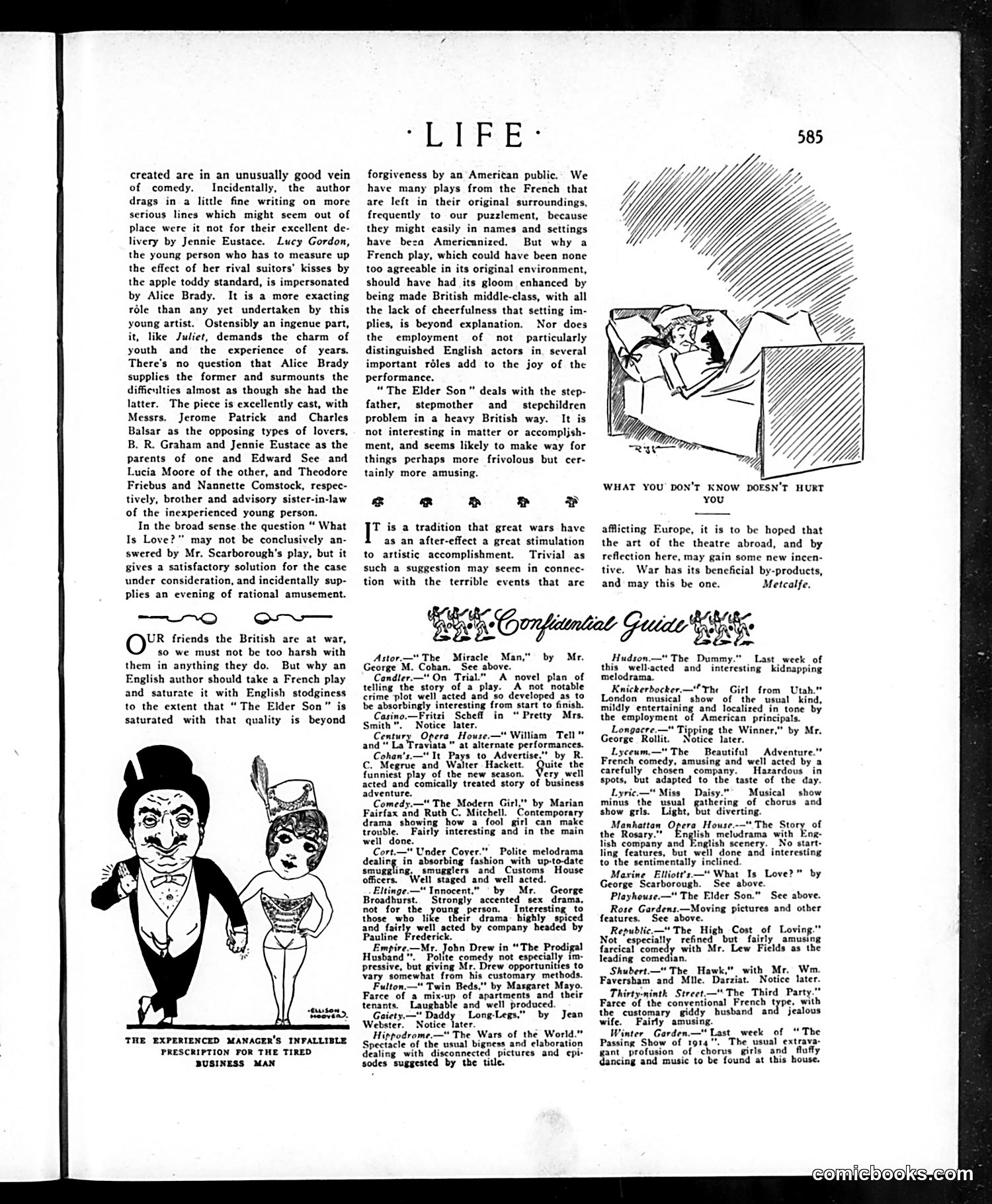
This is a theater review page from *Life* magazine featuring critique of contemporary Broadway productions. The main cartoon depicts a tired businessman being prescribed theatrical entertainment as a cure—a visual metaphor for theater's role as escapist entertainment. The text reviews several plays, notably criticizing "The Elder Son," a French play adapted into English with "British stodginess" that allegedly ruins its appeal. The critic argues the play's heavy, gloomy British middle-class setting undermines what might have worked better in its original French context. The page also includes optimistic commentary suggesting that despite World War I's horrors afflicting Europe, great conflicts historically stimulate artistic achievement. The critic hopes theater abroad—and by extension, American theater—will benefit creatively from wartime circumstances. The cartoon's caption—"The Experienced Manager's Infallible Prescription for the Tired Business Man"—humorously suggests theater as therapeutic medicine for urban professionals.
📄 Transcribed text from this page (OCR, searchable)
Machine-transcribed from the original scan — historical spelling and the odd misread are preserved.
created are in an unusually good vein of comedy. Incidentally, the author drags in a little fine writing on more serious lines which might seem out of place were it not for their excellent de- livery by Jennie Eustace. Lucy Gordon, the young person who has to measure up the effect of her rival suitors’ kisses by the apple toddy standard, is impersonated by Alice Brady. It is a more exacting role than any yet undertaken by this young artist. Ostensibly an ingenue part, it, like Juliet, demands the charm of youth and the experience of years. There's no question that Alice Brady supplies the former and surmounts the difficulties almost as though she had the latter. The piece is excellently cast, with Messrs. Jerome Patrick and Charles Balsar as the opposing types of lovers, B, R. Graham and Jennie Eustace as the parents of one and Edward See and Lucia Moore of the other, and Theodore Friebus and Nannette Comstock, respec- tively, brother and advisory sister-in-law of the inexperienced young person. In the broad sense.the question “ What Is Love?" may not be conclusively an- swered by Mr. Scarborough’s play, but it gives a satisfactory solution for the case under consideration, and incidentally sup- plies an evening of rational amusement. on UR friends the British are at war, so we must not be too harsh with them in anything they do. But why an English author should take a French play and saturate it with English stodginess to the extent that “ The Elder Son” is saturated that quality is beyond —_—O NO THE EXPERIENCED MANAGER'S INFALLIBLE PRESCRIPTION FOR THE TIRED BUSINESS MAN “EERE: forgiveness by an American public. We have many plays from the French that are left in their original surroundings, frequently to our puzzlement, because they might easily in names and settings have besa Americanized. But why a French play, which could have been none too agreeable in its original environment, should have had its gloom enhanced by being made British middle-class, with all the lack of cheerfulness that setting im- plies, is beyond explanation. Nor does the employment of not particularly distinguished English actors in. several important réles add to the joy of the performance. “ The Elder Son” deals with the step- father, stepmother and _ stepchildren problem in a heavy British way. It is not interesting in matter or accompli ment, and seems likely to make way for things perhaps more frivolous but cer- tainly more amusing. gs R & = y T is a tradition that great wars have as an after-effect a great stimulation to artistic accomplishment. Trivial as such a suggestion may seem in connec- tion with the terrible events that are WHAT YOU DON'T KNOW DOESN'T HURT you afflicting Europe, it is to be hoped that the art of the theatre abroad, and by reflection here, may gain some new incen- tive. War has its beneficial by-products, and may this be one. Metcalfe. Wi Comfinins Geter Miracle Man," by Mr. bove. A novel plan of 1 the story of a play. A not notable crime plot well acted and so developed as to be absorbingly interesting from start to finish. —Fritzi Scheff in “Pretty Mrs. Notice later. Century Opera, House.—" William Tell" and" La Traviata ” at alternate performances. Cohan’s.—"'It Pays to Advertise.” by R. C. Megrue and Walter Hackett. Quite the funniest play of the new season. Very well acted and comically treated story of business adventure. Comedy.—" The Modern Girl.” by Marian Fairfax and Ruth C. Mitchell. Contemporary drama showing how a fool girl can make trouble. Fairly interesting and in the main well done, Cort Under Cover.” Polite melodrama dealing in absorbing fashion ‘with up-to-date smuggling, smugglers and Customs House officers. Well staged and. well acted. Eltinge—" Innocent." by Mr. George Broadhurst. Strongly. accented sex drama, not for the young person. Interesting {0 those who like their drama. highly. spiced and fairly well acted by company headed by Pauline Frederick. Empire—Mr. John Drew in “The Prodi Husband", Polite comedy not especially im- pressive, but giving Mr. Drew opportunities to vary somewhat from his customary methods. Fulton.—" Twin Beds,” by Masgaret Mayo. Farce of a mix-up of apartments and their tenants. Laughable and well produced. Geiety.—" Daddy Long-Legs,” by Webster. jotice later. Hitpodrome—" The Wars of the World.” Spectacle of the usual bigness and elaboration dealing with disconnected pictures and. epi sodes “suggested by the title. Astor.—* The Jean Last _week of interesting kidnapping Hudson.—" The Dummy.” this well-acted and melodrama. Knickerbocke Girl from Utah. London musical show of the usual kind, mildly entertaining and localized in tone by the employment of American principals. Longacre.—" Tipping the Winner,” by Mr. George Roilit. Notice later. if Lyceum.—" The Beautiful Adventure. French comedy, amusing and well acted by carefully chosen company. Hazardous in spots, but adapted to the taste of the day. yric.—" Miss Daisy." Musical show minus the usual gathering of chorus and show gris. Light, but diverting. Manhattan Opera House.-—" The Story of the Rosary." English melodrama with Eng- lish company and English scenery. No start- ling features, but well done and interesting to the sentimentally inclined. Maxine Eltiott’s—"* What Is Love?" by George Scarborough. See above. Playhouse.—" The Elder Son.” See above. Moving pictures and other See abov. —"The High Cost of Loving.” Not ‘especially refined. but fairly amusing farcical comedy with Mr. Lew Fields as the leading comedian. Shubert-—" The Hawk,” with Mr, Wm. Faversham and Mlle. Darziat. Notice later. Thirty-ninth Street. The Third Party.” Farce of the conventional French type, with the customary giddy husband and jealous wife. Fairly amusing. Winter Garden.—" Last week of “The Passing Show of 1914". The usual extrava- gant profusion of chorus girls and fluffy dancing and music to be found at this house, features. Repub!