
Life, 1914-10-01 · page 28 of 48
Life — October 1, 1914 — page 28: what you’re looking at
What you’re looking at
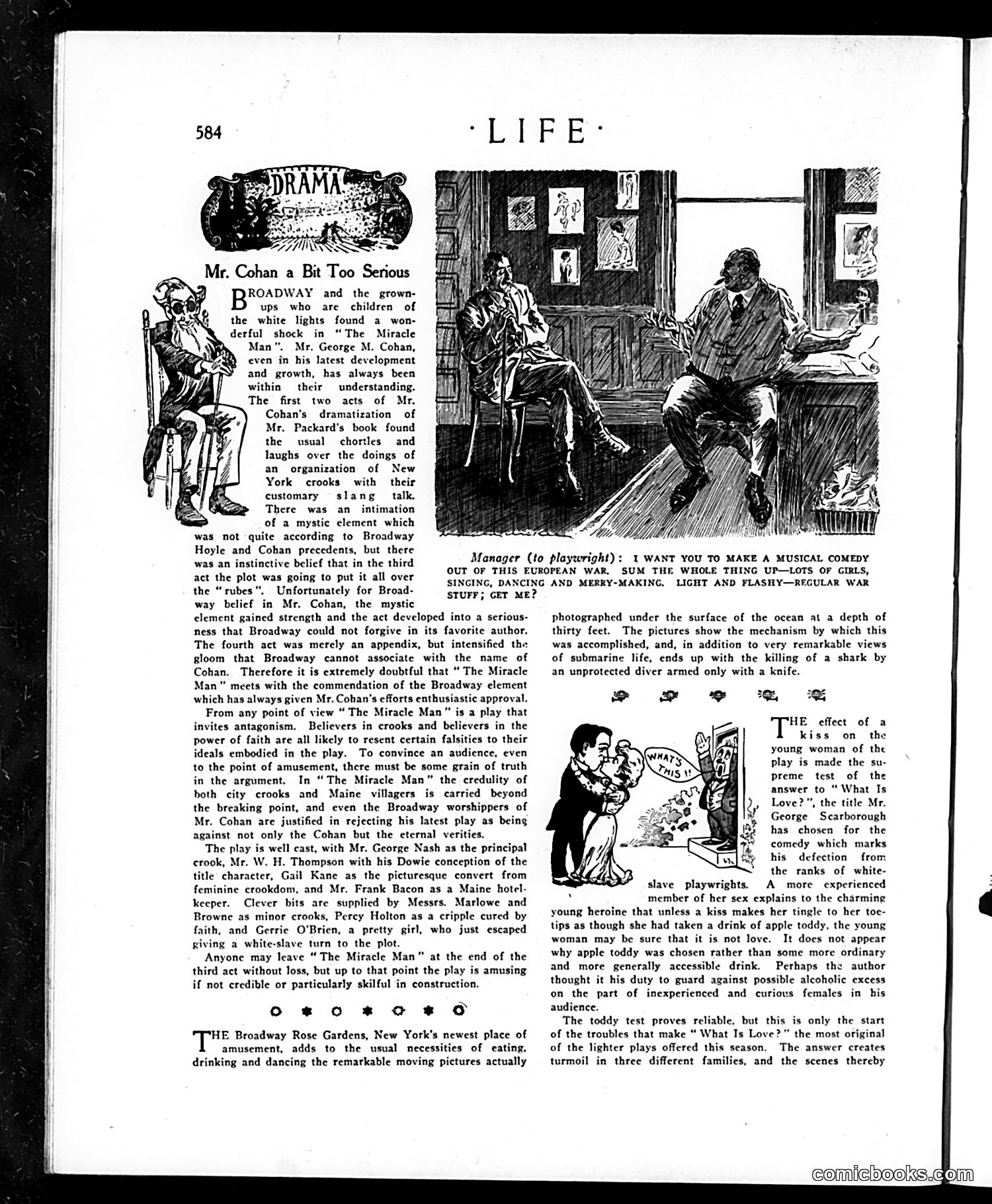
This page reviews Broadway productions with two distinct satirical elements: **Main Review**: Critiques George M. Cohan's play "The Miracle Man," adapted from a novel about New York crooks. The reviewer notes that while Cohan's audiences expect light entertainment and comic "crook" characters with slang dialogue, this production unexpectedly turns serious and moralistic in later acts—disappointing his typical Broadway followers who consider themselves "rubes" (unsophisticated theatergoers). The satire targets both Cohan's typical audience and Broadway's preference for escapism over genuine drama. **Cartoon Satire** (bottom): A theater manager demands a playwright turn the European War into a musical comedy—"lots of girls, singing, dancing and merry-making...regular war stuff." This mocks both the entertainment industry's trivialization of serious events and the period's apparent appetite for turning global conflict into light spectacle during what appears to be World War I. The page reflects contemporary tensions between commercial theater demands and artistic substance.
📄 Transcribed text from this page (OCR, searchable)
Machine-transcribed from the original scan — historical spelling and the odd misread are preserved.
ROADWAY and the grown- ups who are children of the white lights found a won- derful shock in “The Miracle Man”. Mr. George M. Cohan, even in his latest development and growth, has always been within their understanding. The first two acts of Mr. Cohan’s dramatization of Mr. Packard's book found the usual chortles and laughs over the doings of an organization of New York crooks with their customary slang talk. There was an intimation of a mystic clement which was not quite according to Broadway Hoyle and Cohan precedents, but there was an instinctive belief that in the third act the plot was going to put it all over the “rubes”. Unfortunately for Broad- way belief in Mr. Cohan, the mystic clement gained strength and the act developed into a serious- ness that Broadway could not forgive in its favorite author. The fourth act was merely an appendix, but intensified the gloom that Broadway cannot associate with the name of Cohan. Therefore it is extremely doubtful that “ The Miracle Man” meets with the commendation of the Broadway element which has always given Mr. Cohan’s efforts enthusiastic approval. From any point of view “The Miracle Man” is a play that invites antagonism. Believers in crooks and believers in the power of faith are all likely to resent certain falsities to their ideals embodied in the play. To convince an audience, even to the point of amusement, there must be some grain of truth in the argument. In “The Miracle Man” the credulity of both city crooks and Maine villagers is carried beyond the breaking point, and even the Broadway worshippers of Mr. Cohan are justified in rejecting his latest play as being against not only the Cohan but the eternal verities. The play is well cast, with Mr. George Nash as the principal crook, Mr. W. H. Thompson with his Dowie conception of the title character, Gail Kane as the picturesque convert from feminine crookdom, and Mr. Frank Bacon as a Maine hotel- keeper. Clever bits are supplied by Messrs. Marlowe and Browne as minor crooks, Percy Holton as a cripple cured by i and Gerrie O'Brien, a pretty girl, who just escaped giving a white-slave turn to the plot. Anyone may leave “ The Miracle Man” at the end of the third act without loss, but up to that point the play is amusing if not credible or particularly skilful in construction. ore o # GO # DO 'HE Broadway Rose Gardens, New York's newest place of amusement, adds to the usual necessities of eating, drinking and dancing the remarkable moving pictures actually STUFF; GET ME? «NU Manager (to playwright): 1 WANT YOU TO MAKE A MUSICAL COMEDY OUT OF THIS EUROPEAN WAR. SUM THE WHOLE THING UP—LOTS OF GIRLS, SINGING, DANCING AND MERRY-MAKING, LIGHT AND FLASHY—REGULAR WAR photographed under the surface of the ocean at a depth of thirty feet. The pictures show the mechanism by which this was accomplished, and, in addition to very remarkable views of submarine life, ends up with the killing of a shark by an unprotected diver armed only with a knife. HE effect of a kiss on the young woman of the play is made the su- Preme test of the answer to “ What Is Love?”, the title Mr. George Scarborough has chosen for the comedy which marks his defection from the ranks of white- slave playwrights. A more experienced member of her sex explains to the charming young heroine that unless a kiss makes her tingle to her toe- tips as though she had taken a drink of apple toddy, the young woman may be sure that it is not love. It docs not appear why apple toddy was chosen rather than some more ordinary and more generally accessible drink. Perhaps the author thought it his duty to guard against possible alcoholic excess on the part of inexperienced and curious females in his audience. The toddy test proves reliable, but this is only the start of the troubles that make “ What Is Love?" the most original of the lighter plays offered this season. The answer creates turmoil in three different families, and the scenes thereby comichooks.qom