
Life, 1914-10-01 · page 21 of 48
Life — October 1, 1914 — page 21: what you’re looking at
What you’re looking at
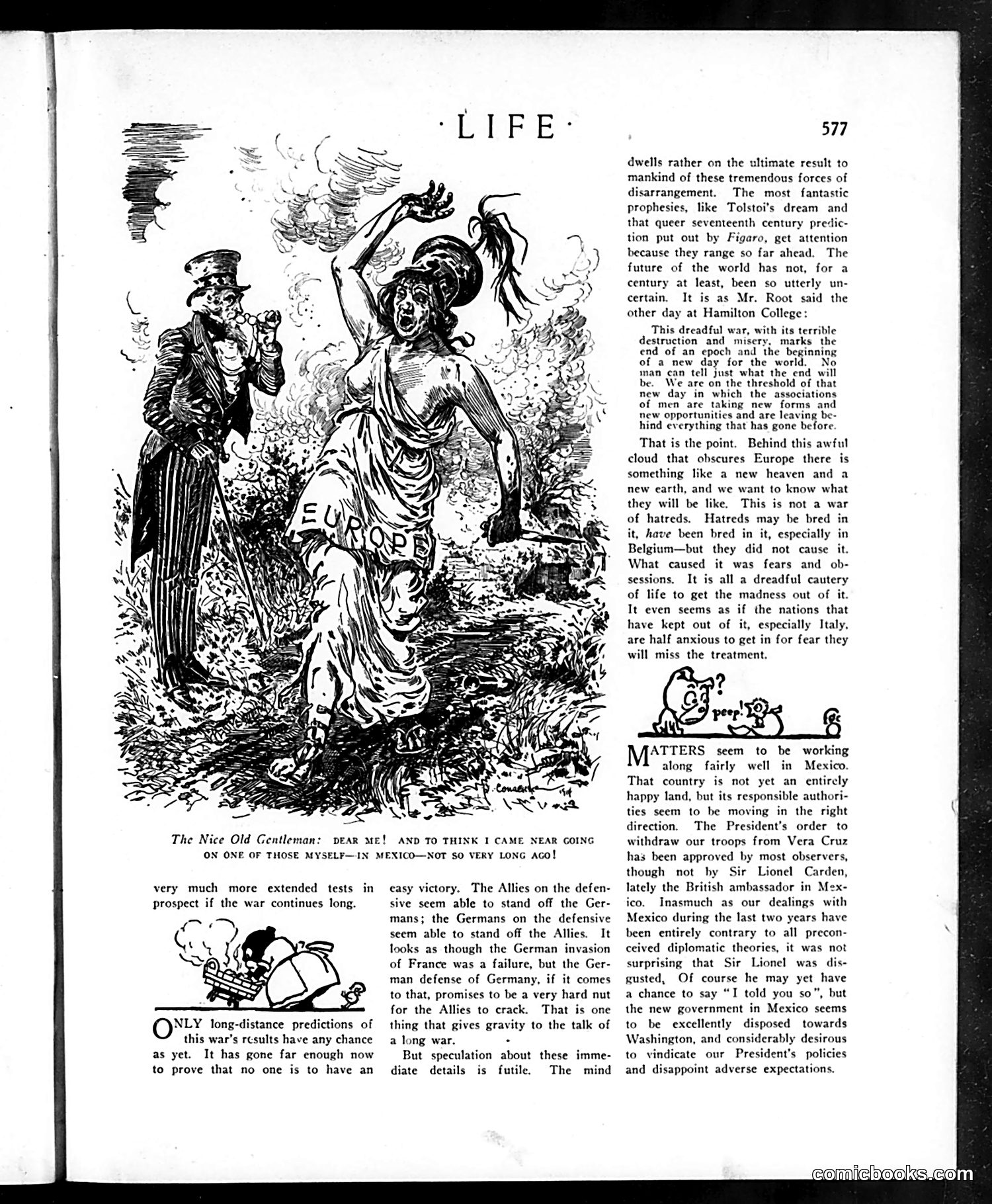
**Main Cartoon:** "The Nice Old Gentleman" depicts an elderly gentleman startled by a vision of Europe (allegorized as a woman) engulfed in flames and chaos. A military figure stands nearby. The gentleman remarks he nearly went to Mexico himself—referencing U.S. military intervention in Mexico. **Context:** This appears from World War I era (references to France's invasion, German defense). The cartoon contrasts Mexico's relative stability—where the U.S. recently withdrew troops from Vera Cruz per presidential order—with Europe's catastrophic war. **Satire:** The joke is ironic: the gentleman feared Mexico dangerous enough to nearly visit, yet Europe has become far more destructive. The "dreadful cautery" (surgical burning) metaphor suggests war might purge nations of madness. **Political Reference:** The text praises President Wilson's Mexico policy despite British ambassador Sir Lionel Carden's disapproval, presenting withdrawal as wise and vindicating American diplomacy. **Point:** Contrasts American restraint and progressive policy against European destruction.
📄 Transcribed text from this page (OCR, searchable)
Machine-transcribed from the original scan — historical spelling and the odd misread are preserved.
The Nice Old Gentleman: pear me! AND TO THINK I CAME NEAR GOING ON ONE OF THOSE MYSELF—IN MEXICO—NOT SO VERY LONG AGO! very much more extended tests in prospect if the war continues long. LPN ai LY long-distance predictions of this war’s rcsults have any chance as yet. It has gone far enough now to prove that no one is to have an easy victory. The Allies on the defen- sive seem able to stand off the Ger- mans; the Germans on the defensive seem able to stand off the Allies. It looks as though the German invasion of France was a failure, but the Ger- man defense of Germany, if it comes to that, promises to be a very hard nut for the Allies to crack. That is one thing that gives gravity to the talk of a long war. - But speculation about these imme- diate details is futile. The mind 577 dwells rather on the ultimate result to mankind of these tremendous forces of disarrangement. The most fantastic prophesies, like Tolstoi's dream and that queer seventeenth century predic- tion put out by Figaro, get attention because they range so far ahead. The future of the world has not, for a century at least, been so utterly un- certain. It is as Mr. Root said the other day at Hamilton College: This dreadful war, with its terrible destruction and misery, marks the end of an epoch and the beginning of a new day for the world. No man can tell just what the end will be. We are on the threshold of that new day in which the associations of men are taking new forms and new opportunities and are leaving be- hind everything that has gone before. That is the point. Behind this awful cloud that obscures Europe there is something like a new heaven and a new earth, and we want to know what they will be like, This is not a war of hatreds. Hatreds may be bred in it, have been bred in it, especially in Belgium—but they did not cause it. What caused it was fears and ob- sessions. It is all a dreadful cautery of life to get the madness out of it. It even seems as if the nations that have kept out of it, especially Italy. are half anxious to get in for fear they will miss the treatment. to be working in Mexico. MATTERS seem along fairly well That country is not yet an entircly happy land, but its responsible authori- ties seem to be moving in the right direction. The President’s order to withdraw our troops from Vera Cruz has been approved by most observers, though not by Sir Lionel Carden, lately the British ambassador in Mex- ico. Inasmuch as our dealings with Mexico during the last two years have been entirely contrary to all precon- ceived diplomatic theories, it was not surprising that Sir Lionel was dis- gusted, Of course he may yet have a chance to say “I told you so”, but the new government in Mexico seems to be excellently disposed towards Washington, and considerably desirous to vindicate our President's policies and disappoint adverse expectations.