
Life, 1914-10-01 · page 14 of 48
Life — October 1, 1914 — page 14: what you’re looking at
What you’re looking at
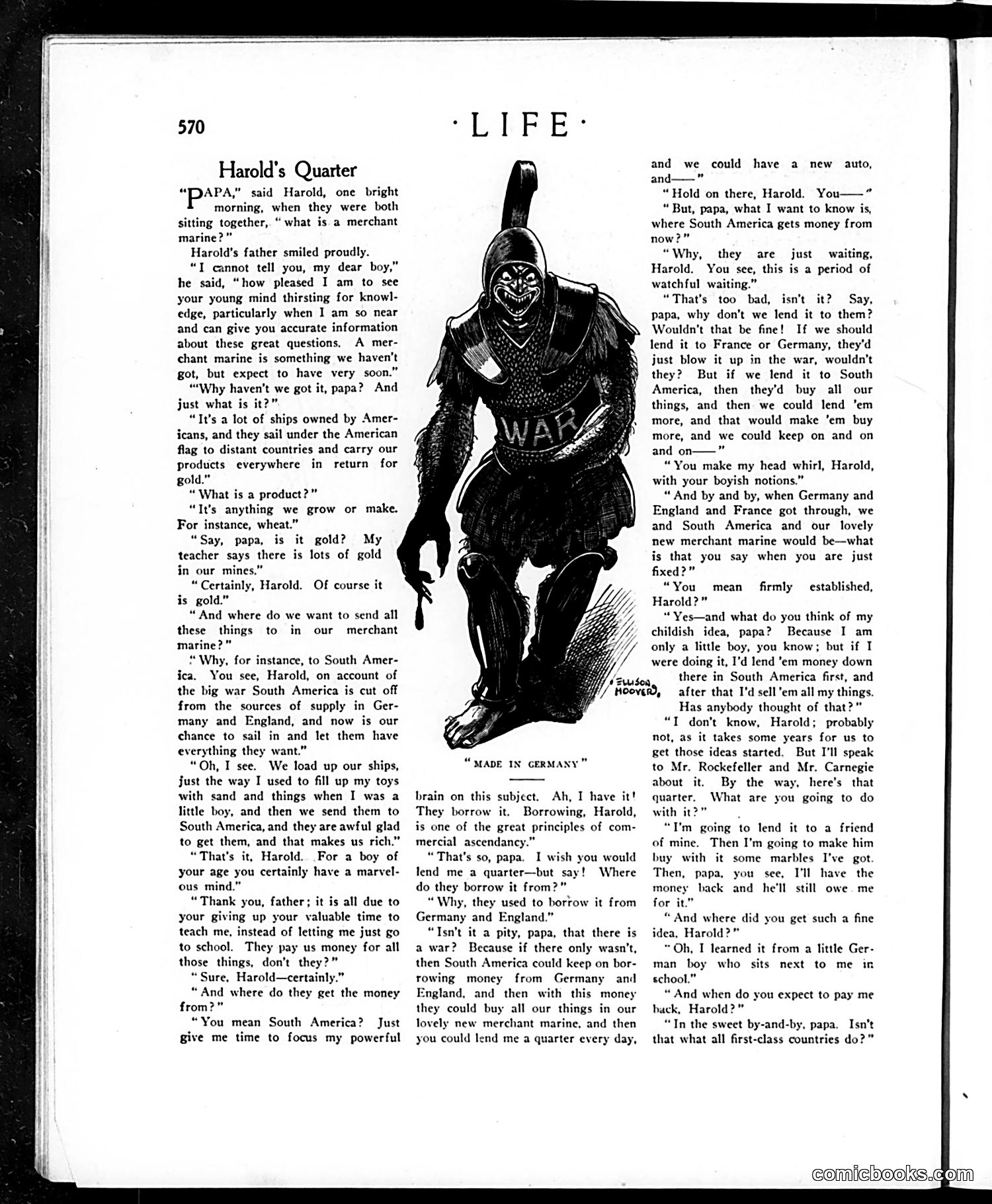
This page presents a dialogue between a father and son named Harold about international commerce and merchant marines. The central illustration shows a menacing German soldier labeled "MADE IN GERMANY," depicting Germany as a military/industrial threat. The satire critiques Harold's naive proposal to lend American money to South America, arguing this would help Germany and England monopolize trade through their merchant marines. The father warns that lending money internationally is economically foolish—a country should keep its wealth domestic. The "German soldier" image reinforces the satirical point: Germany represented industrial competition and military threat to American interests. This reflects pre-WWI American anxieties about German economic and military dominance, using a child's innocent financial proposal to mock those who might support such foreign lending schemes.
📄 Transcribed text from this page (OCR, searchable)
Machine-transcribed from the original scan — historical spelling and the odd misread are preserved.
Harold’s Quarter Pee: said Harold, one bright morning, when they were both sitting together, “ what is a merchant marine?” Harold's father smiled proudly. “I cannot tell you, my dear boy,” he said, “how pleased I am to see your young mind thirsting for knowl- edge, particularly when 1 am so near and can give you accurate information about these great questions, A mer- chant marine is something we haven't got, but expect to have very soon.” “Why haven't we got it, papa? And just what is it?” “It’s a lot of ships owned by Amer- icans, and they sail under the American flag to distant countries and carry our products everywhere in return for gold.” “What is a product?” “It's anything we grow or make. For instance, wheat.” “Say, papa, is it gold? My teacher says there is lots of gold in our mines.” “Certainly, Harold. Of course it is gold.” “And where do we want to send all these things to in our merchant marine?” “Why, for instance, to South Amer- ica. You see, Harold, on account of the big war South America is cut off from the sources of supply in Ger- many and England, and now is our chance to sail in and let them have everything they want.” “Oh, I see. We load up our ships, just the way I used to fill up my toys with sand and things when I was a little boy, and then we send them to South America, and they are awful glad to get them, and that makes us rich.” “That's it, Harold. For a boy of your age you certainly have a marvel- ous mind.” “Thank you, father; it is all due to your giving up your valuable time to teach me, instead of letting me just go to school. They pay us money for all those things, don’t they?” “Sure, Harold—certainly.” “And where do they get the money from?” “You mean South America? Just give me time to focus my powerful “MADE IN GERMANY” brain on this subject. Ah, I have it! They borrow it. Borrowing, Harold, is one of the great principles of com- mercial ascendancy.” “That's so, papa. lend me a quarter—but say! do they borrow it from?” “Why, they used to borrow it from Germany and England.” “Isn't it a pity, papa, that there is a war? Because if there only wasn't, then South America could keep on bor- rowing money from Germany and , and then with this money they could buy all our things in our lovely new merchant marine, and then you could lend me a quarter every day, I wish you would Where and we could have a new auto, and——” “Hold on there, Harold. You——” “ But, papa, what I want to know is, where South America gets money from now?” “Why, they are just waiting, Harold. You see, this is a period of watchful waiting.” “That's too bad, isn’t it? Say, papa, why don’t we lend it to them? Wouldn't that be fine! If we should lend it to France or Germany, they'd just blow it up in the war, wouldn’t they? But if we lend it to South America, then they'd buy all our things, and then we could lend 'em more, and that would make 'em buy more, and we could keep on and on and on——” “You make my head whirl, Harold, with your boyish notions.” “And by and by, when Germany and England and France got through, we and South America and our lovely new merchant marine would be—what is that you say when you are just fixed?” “You Harold?” “Yes—and what do you think of my childish idea, papa? Because I am only a little boy, you know; but if T were doing it, I'd lend ’em money down there in South America first, and after that I'd sell ’em all my things. Has anybody thought of that?” “T don’t know, Harold; probably not, as it takes some years for us to get those ideas started. But I'll speak to Mr. Rockefeller and Mr. Carnegie about it. By the way, here's that quarter. What are you going to do with it?” “I'm going to lend it to a friend of mine. Then I’m going to make him buy with it some marbles I've got Then, papa, you see, I'll have the back and he'll still owe me mean firmly _ established, And where did you get such a fine idea, Harold?” “Oh, I learned it from a little Ger- man boy who sits next to me in school.” “And when do you expect to pay me hack, Harold?” “In the sweet by-and-by, papa. Isn't that what all first-class countries do?” comichooks.qom