
A complete issue · 44 pages · 1911
Life — June 8, 1911
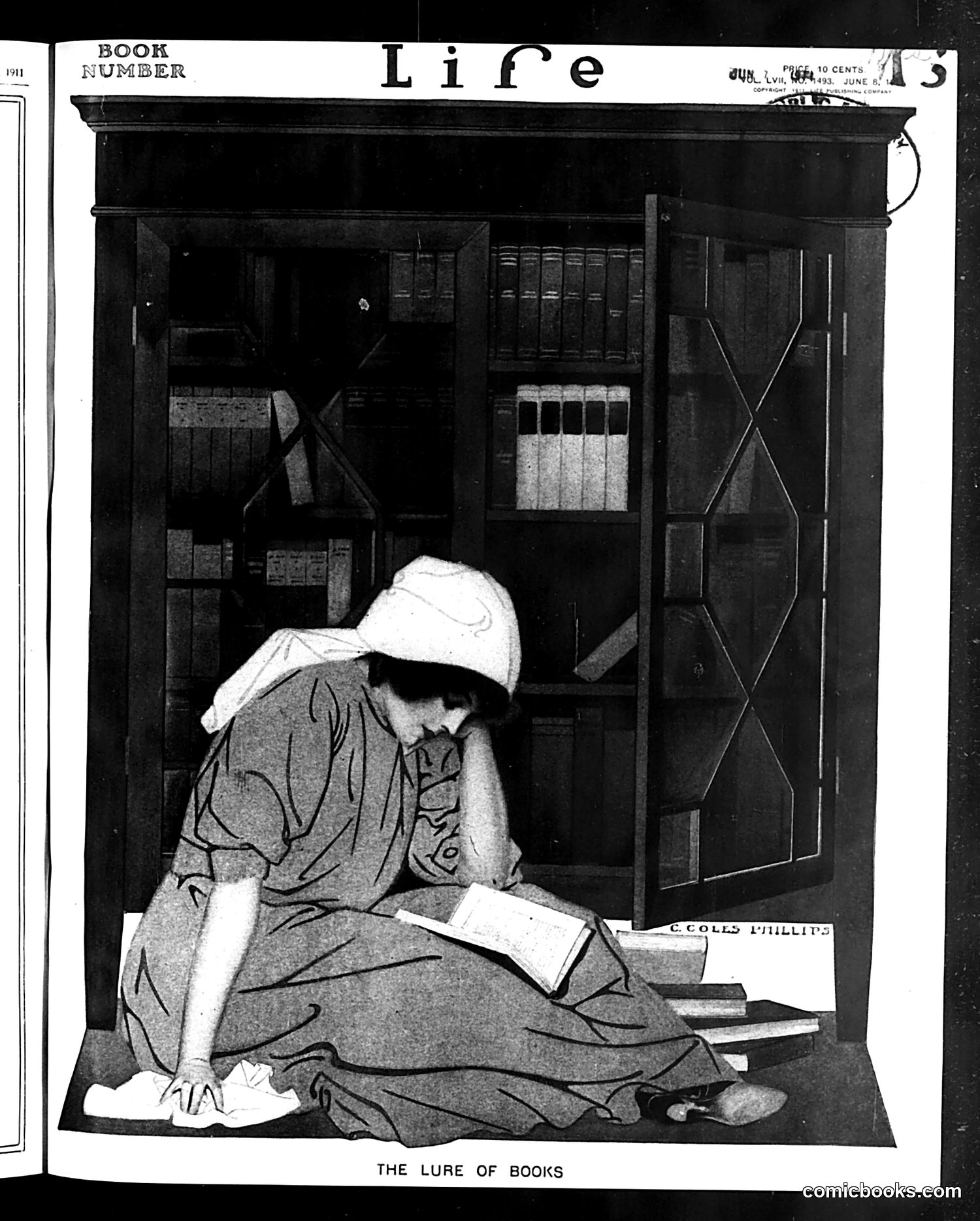
This is a satirical illustration titled "The Lure of Books," showing a young woman in a wide-brimmed hat sitting cross-legged outside a bookshop, completely absorbed in reading. The storefront displays bookshelves filled with volumes behind glass doors. The humor depicts the irresistible appeal of books—the woman has essentially camped out on the street, lost in her reading. Her posture and casual placement suggest she's so entranced by literature that she's abandoned propriety and comfort to remain immersed in the shop's collection. The satire likely mocks the obsessive nature of serious readers, or celebrates the cultural allure of reading in early 20th-century America. The illustration is credited to C. Colls Phillips (visible in the image).
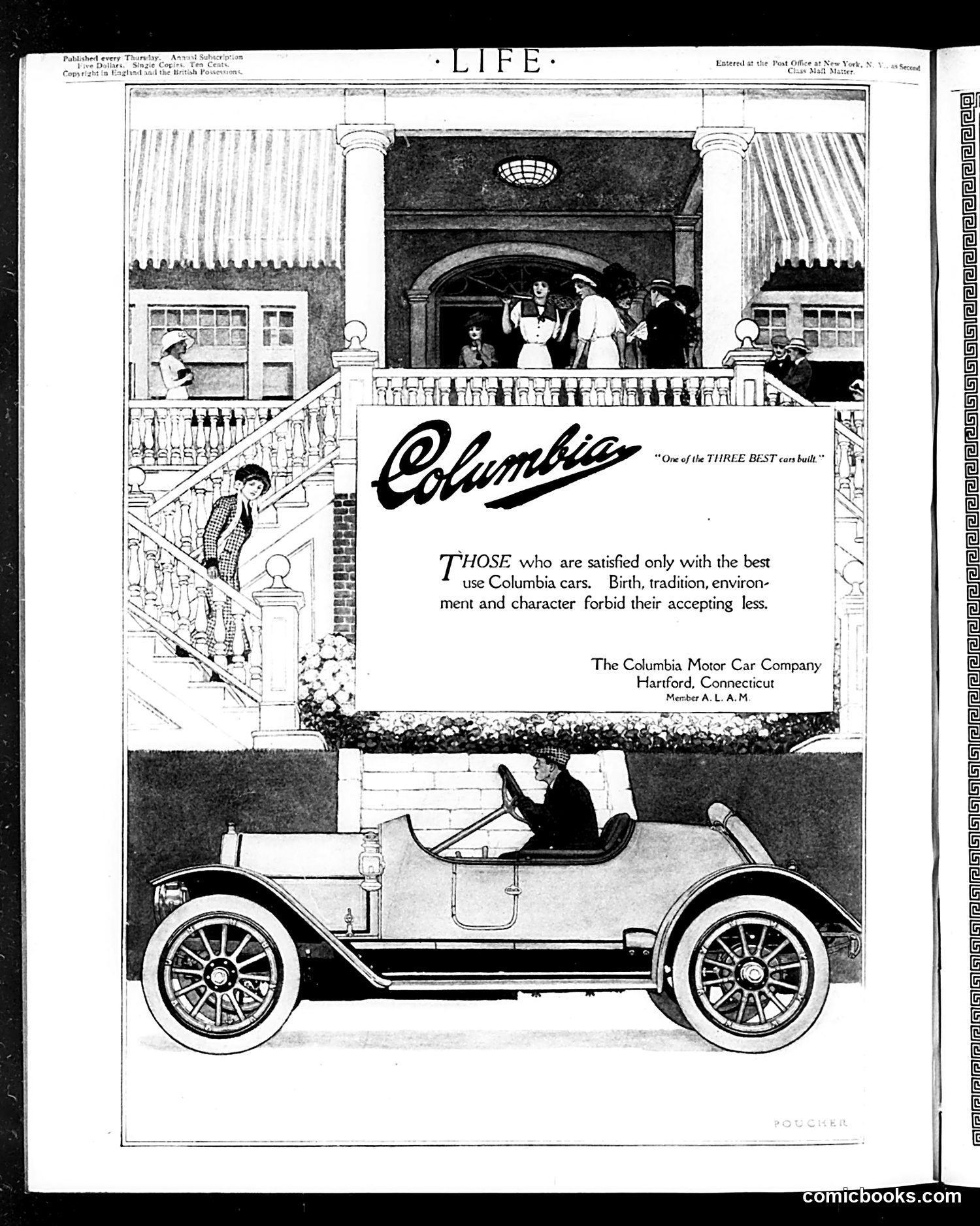
This page is primarily a **Columbia automobile advertisement**, not political satire. The ad appears in *Life* magazine and shows a luxury car with a wealthy couple arriving at an elegant estate. The advertisement's message emphasizes class and exclusivity: "Those who are satisfied only with the best use Columbia cars. Birth, tradition, environment and character forbid their accepting less." This appeals to upper-class readers by associating the vehicle with social status and refined taste. The illustration depicts the car arriving at a grand home with servants and well-dressed figures on the balcony, reinforcing themes of wealth and prestige. The Columbia Motor Car Company was based in Hartford, Connecticut. This represents typical early 20th-century automotive marketing targeting affluent consumers through aspirational lifestyle imagery.
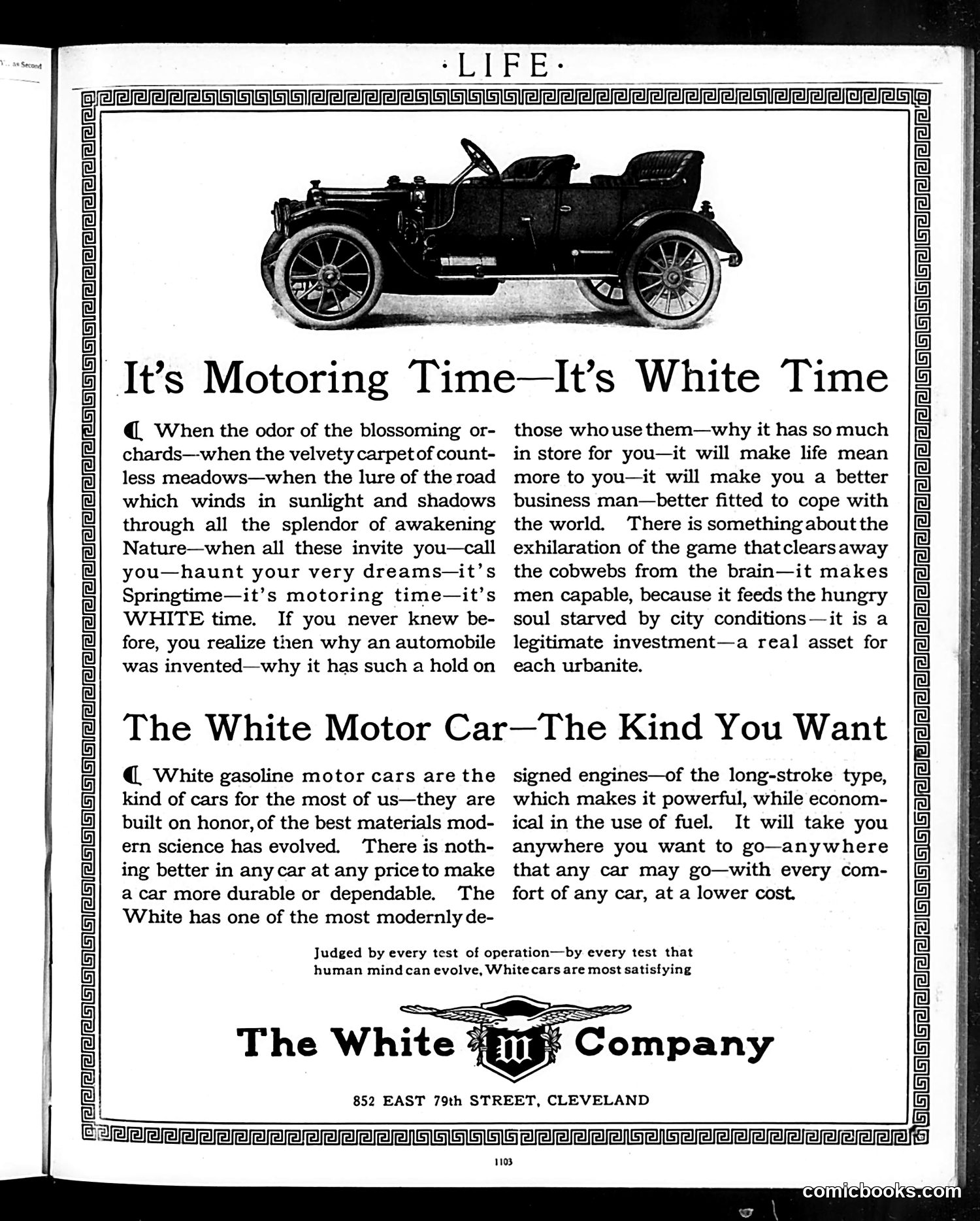
This is **not a cartoon or satire page**—it's a straightforward automobile advertisement for the White Motor Company of Cleveland, published in *Life* magazine. The ad promotes White brand gasoline motor cars, emphasizing their durability, reliability, and value. The imagery (a touring car illustration) and copy appeal to early automotive buyers by linking motoring to leisure, spring, and personal freedom ("motoring time—it's WHITE time"). The language targets middle-class businessmen, claiming the car will make them "better fitted to cope with the world" and describing motoring as a legitimate investment rather than luxury. This reflects early 20th-century attitudes toward automobiles as both practical tools and status symbols for urban professionals. There is no political satire or social commentary here—merely period advertising strategy.
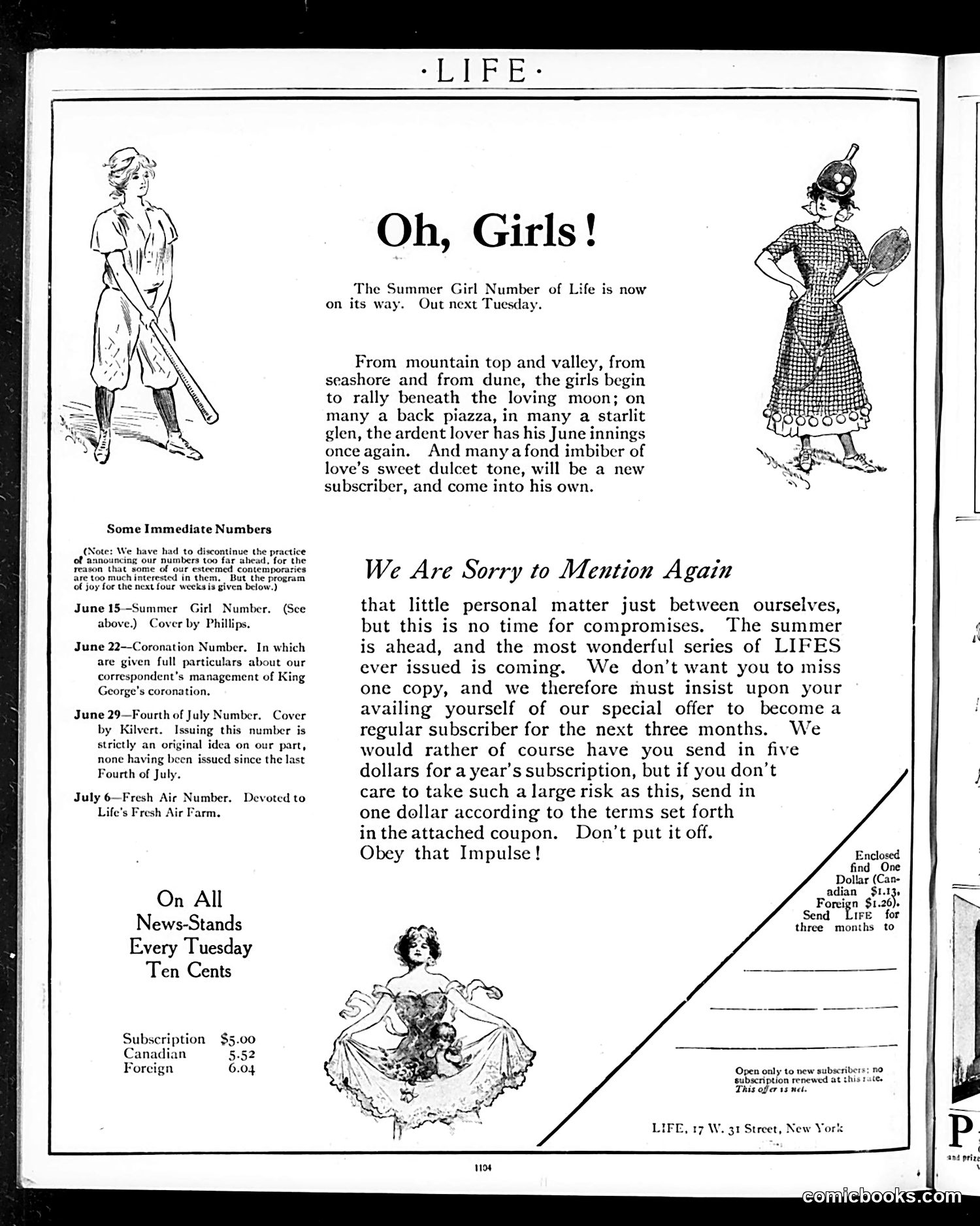
This page is primarily **advertising and promotional content** for Life magazine itself, not political satire. The "Oh, Girls!" headline announces the upcoming Summer Girl Number, appealing to female readers with illustrations of fashionable women engaged in summer activities (baseball, golf). The text romantically describes summer romance and outdoor pursuits. The main content is a **subscription pitch**: Life is offering a special deal—three months of subscription for one dollar (versus the regular annual rate of five dollars). The publishers explicitly state they want to convert casual newsstand readers into regular subscribers before the popular summer issues arrive. The decorative illustrations are generic period fashion drawings rather than caricatures. This is essentially **vintage magazine advertising** designed to boost circulation during peak reading season.
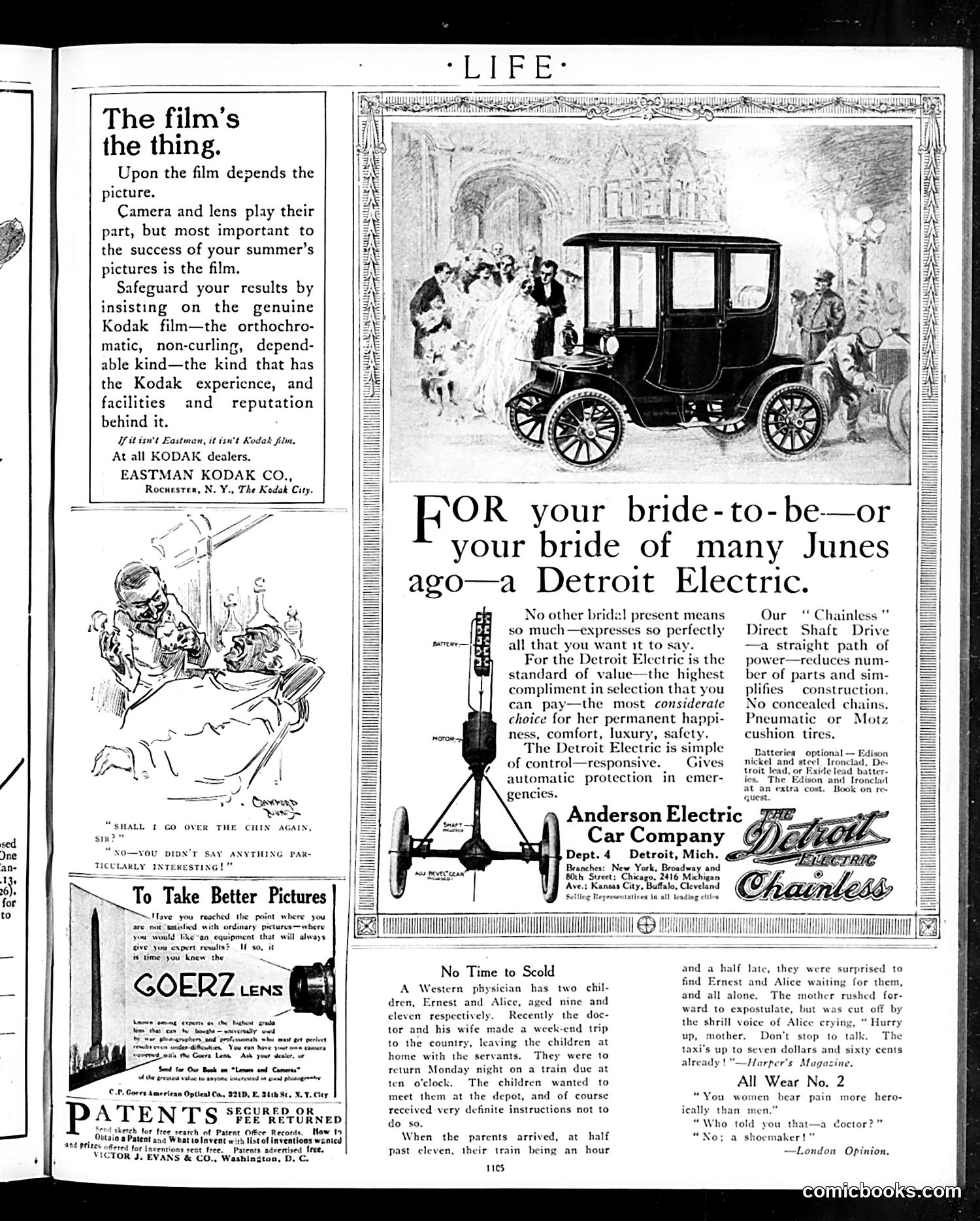
This page is primarily **advertising rather than satire**. It contains: 1. **Kodak film advertisement** (top left): Promotes Kodak film for summer photography, emphasizing reliability and quality. 2. **Detroit Electric automobile ad** (center-right): Markets the "Chainless" Detroit Electric as an ideal bridal gift, highlighting its safety features, simplicity, and comfort. The ad includes a sketch of an early electric car and technical diagram. 3. **Goerz Lens advertisement** (bottom left): Promotes camera lenses for better photography. 4. **Humorous anecdote** ("No Time to Scold"): A brief story about a Western physician and his two children, illustrating parental discipline challenges—unrelated to the ads. The page reflects early 20th-century consumer culture and automotive innovation, with electric vehicles positioned as luxury items suitable for women.
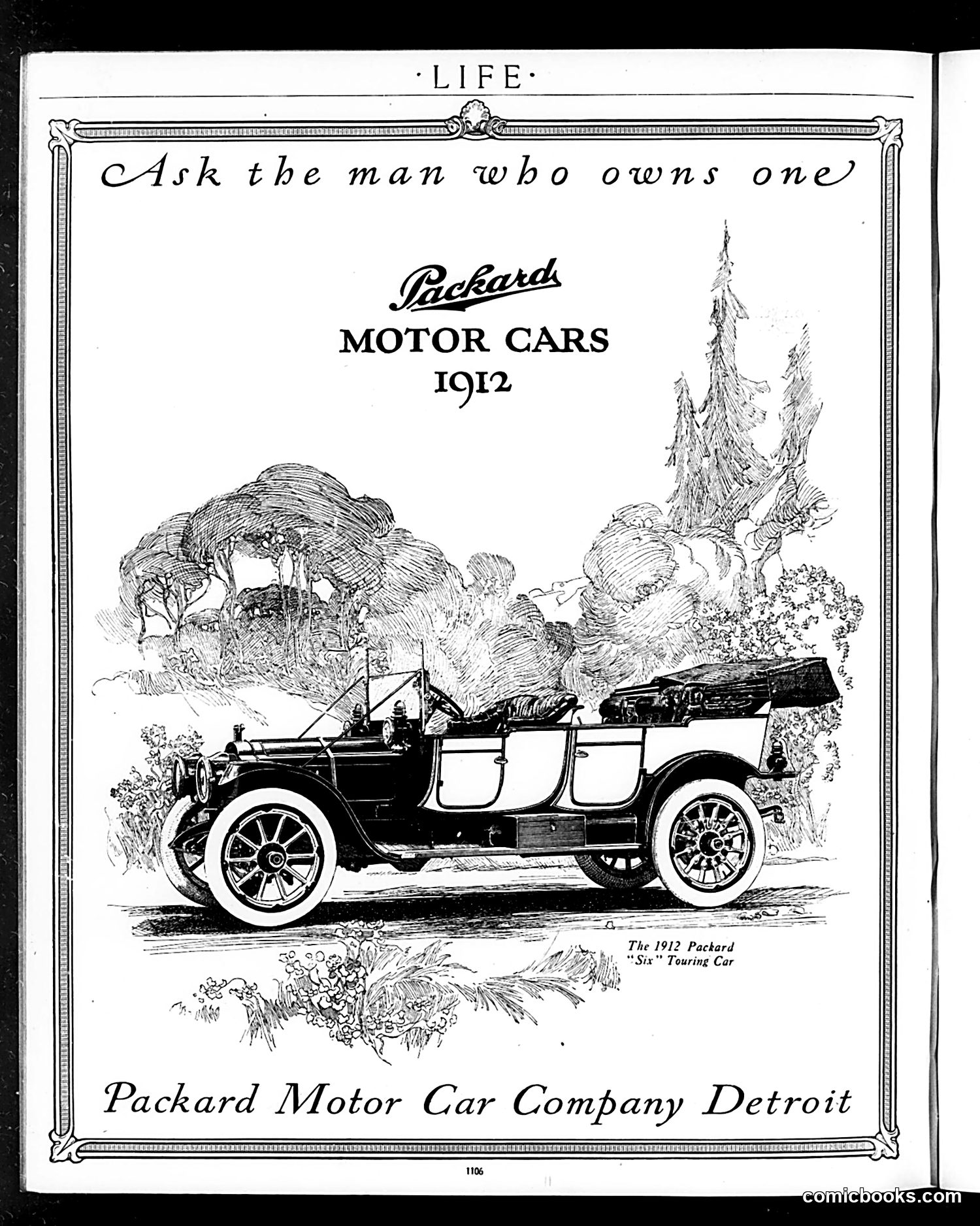
This is primarily **advertising**, not satire or political commentary. The page features a 1912 Packard "Six" Touring Car advertisement from the Packard Motor Car Company in Detroit. The tagline "Ask the man who owns one" was Packard's actual marketing slogan, positioning the car as a luxury vehicle endorsed by satisfied owners. The decorative illustration shows the automobile in an idyllic countryside setting with trees and vegetation, a common advertising technique to suggest freedom, leisure, and refined taste. The ornate Art Nouveau border and careful engraving reflect early 1900s advertising aesthetics. This represents commercial content placed in *Life* magazine rather than editorial satire or political cartooning.
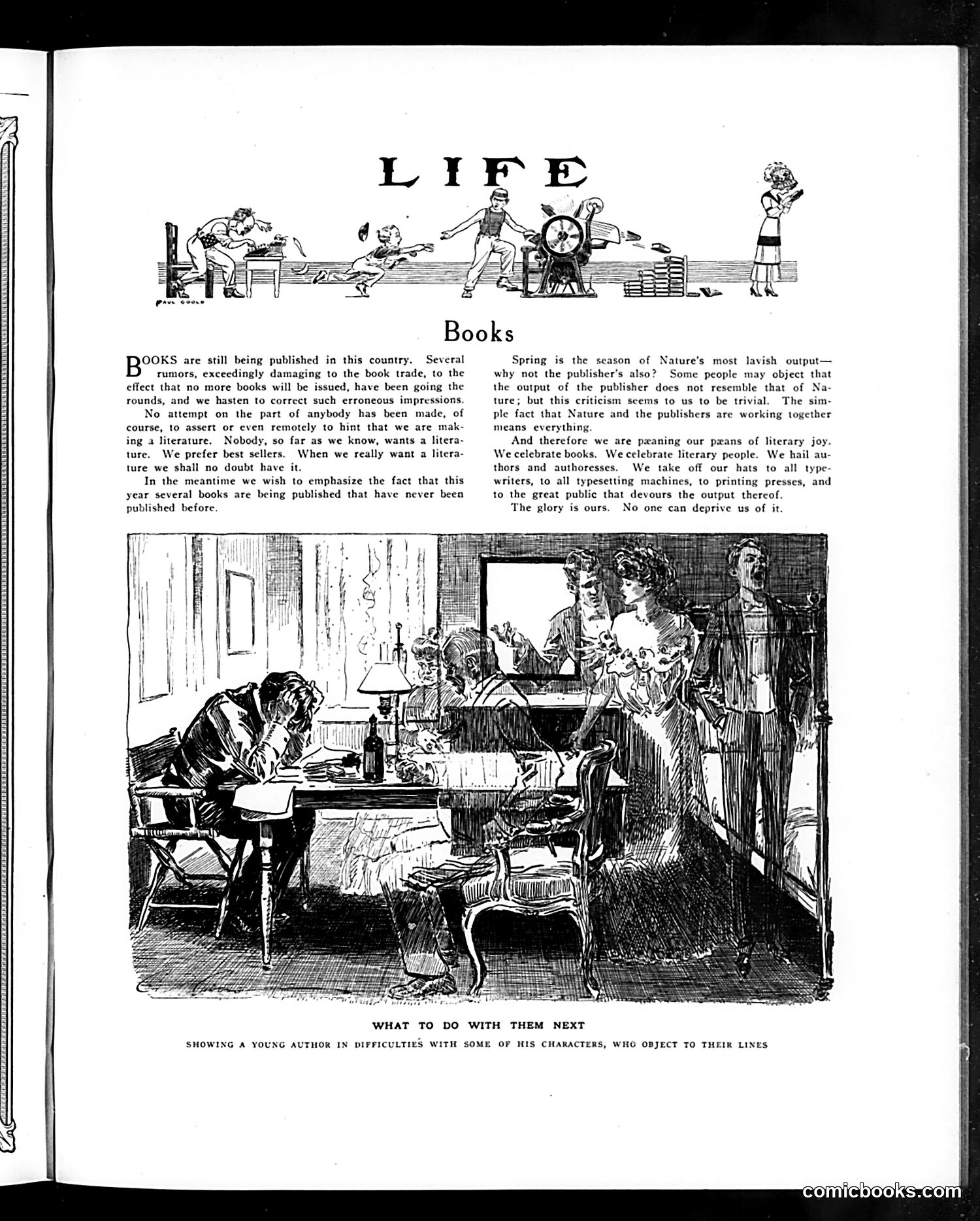
This page celebrates the publishing industry during spring. The text defends books against rumors that publishing is declining, asserting that several new books are being released and that publishers deserve celebration alongside authors. The illustration below depicts a young author (seated left, writing) surrounded by well-dressed visitors in a parlor setting. The caption "What to Do With Them Next" indicates the satire: the author faces difficulties with **characters who object to their fictional portrayal**—a common literary controversy where real people recognized themselves in fictional works and complained. The humor targets the social awkwardness authors faced when their characters' lines or actions offended people who suspected they were depicted.
This page contains editorial commentary on New York state politics rather than a cartoon. The text discusses several appointments and political figures, including: - **Mr. Cohalan**, nominated as a judge, praised as qualified despite political maneuvering - **Col. Joseph F. Scott**, appointed Superintendent of State Prisons, described as highly qualified - **Brother Bryan**, referenced regarding federal income tax legislation (likely William Jennings Bryan) - **Van Tuyl**, the new Superintendent of Banks The small illustration shows figures in apparent conflict or struggle—likely satirizing political infighting. The overall tone critiques the Legislature's handling of appointments and the income tax debate, while acknowledging some officials as genuinely competent despite political complications.
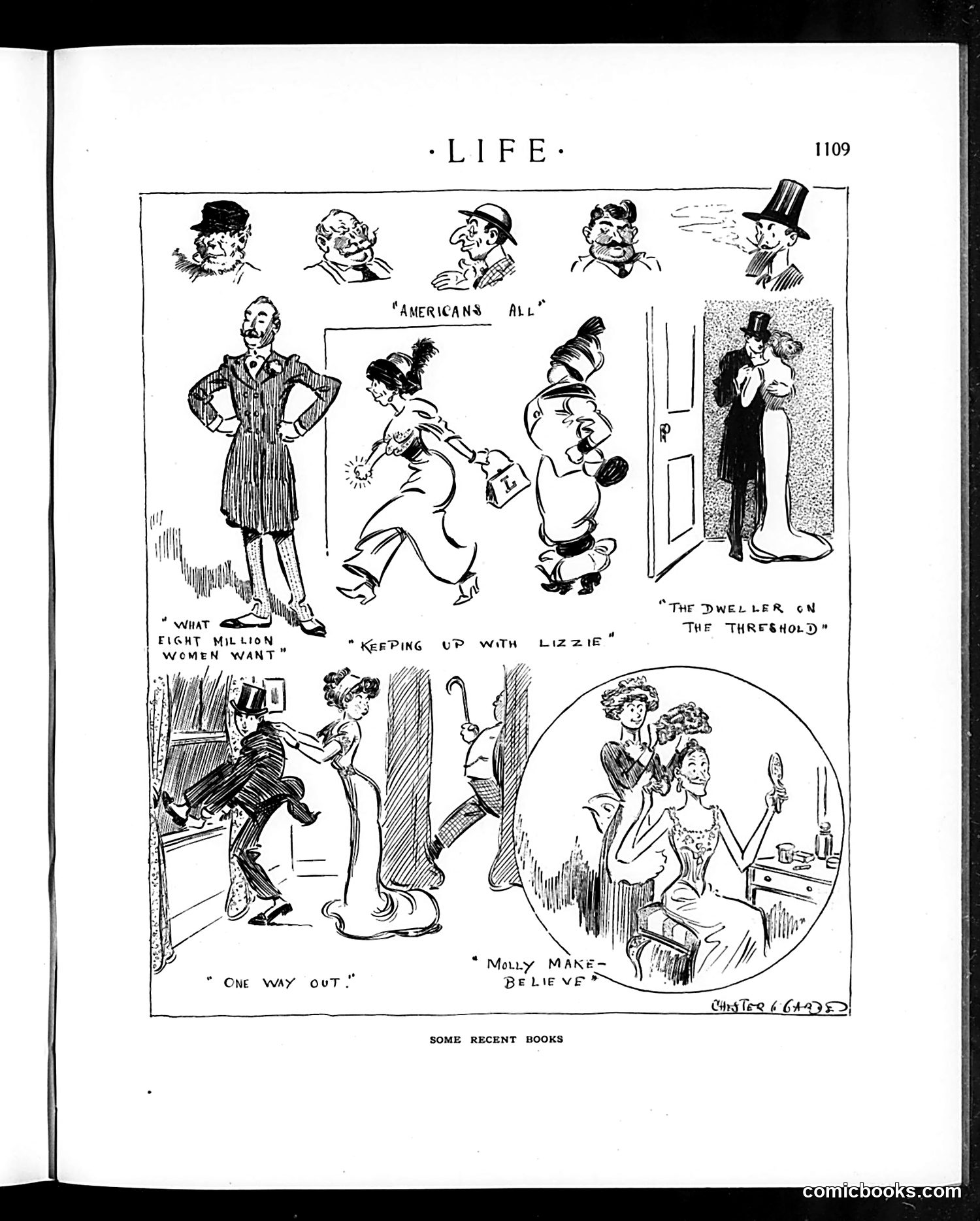
This page presents satirical cartoon sketches about recent books, labeled "Some Recent Books" at the bottom. The sketches mock contemporary literature through exaggerated character types: - "What Eight Million Women Want" depicts a man in a dress, satirizing women's suffrage or gender role debates - "Keeping Up with Lizzie" shows slapstick chaos, likely referencing the Lizzie Borden case (1892 murder trial) - "Americans All" presents ethnic caricatures across the top - "The Dweller on the Threshold" shows a well-dressed man at a doorway - "One Way Out" depicts physical comedy - "Molly Make-Believe" shows women at a vanity, satirizing romantic fiction The cartoons use exaggerated facial features and physical comedy typical of early 20th-century Life magazine humor, mocking both popular literature trends and social debates of the era.
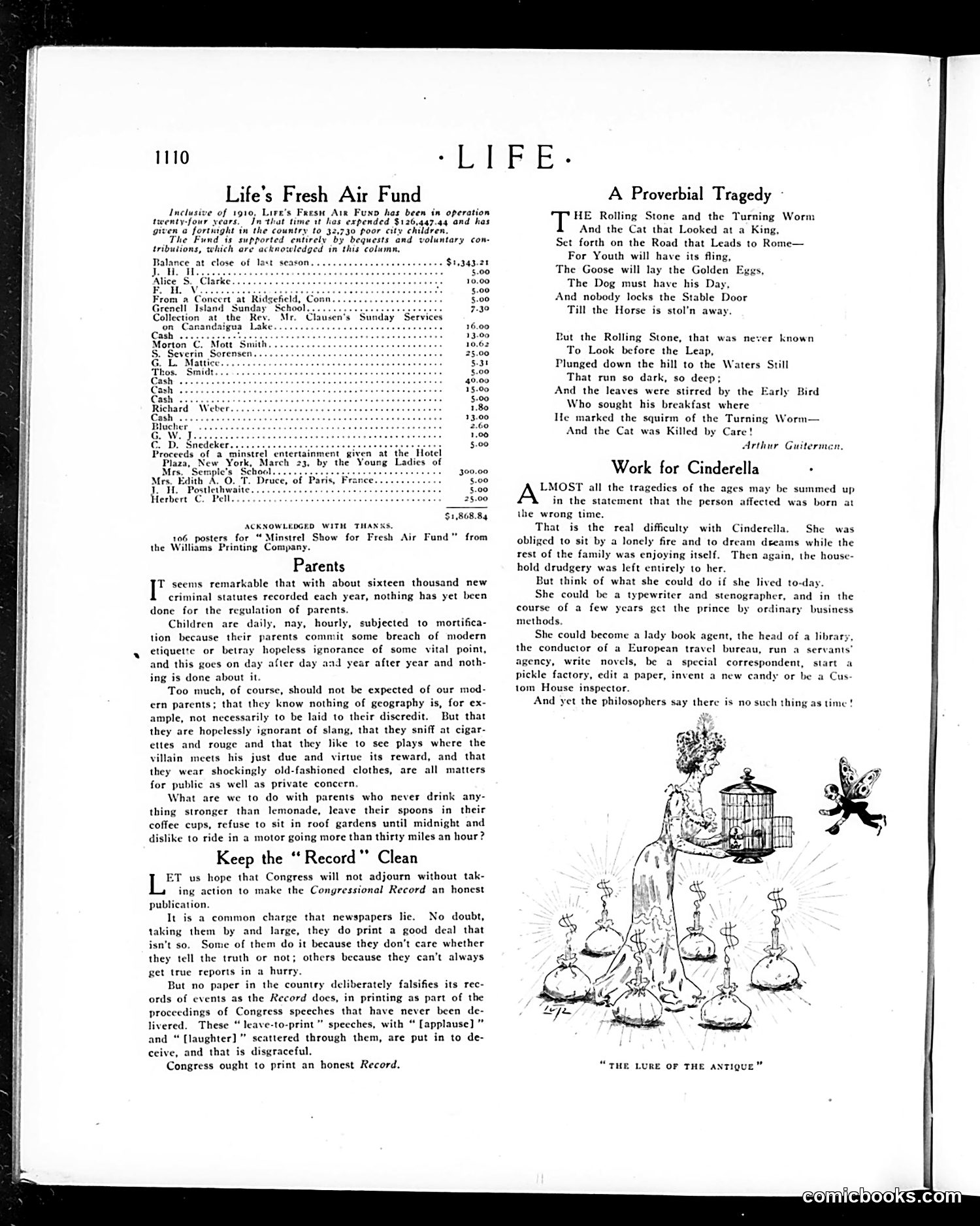
This page contains several satirical articles and one illustration. The cartoon titled "The Lure of the Antique" depicts a woman surrounded by glass domes containing money symbols, with a man juggling nearby. It appears to satirize the wealthy collecting antiques as speculative investments—suggesting the "lure" is financial rather than aesthetic appreciation. The articles address social issues: "Parents" criticizes parental ignorance and poor child-rearing; "Work for Cinderella" satirizes limited opportunities for women, listing professions they could pursue but are denied; and "Keep the 'Record' Clean" advocates for honest Congressional records rather than falsified speeches. The "Life's Fresh Air Fund" section lists donations to help poor city children access fresh air—a Progressive-era charitable concern.
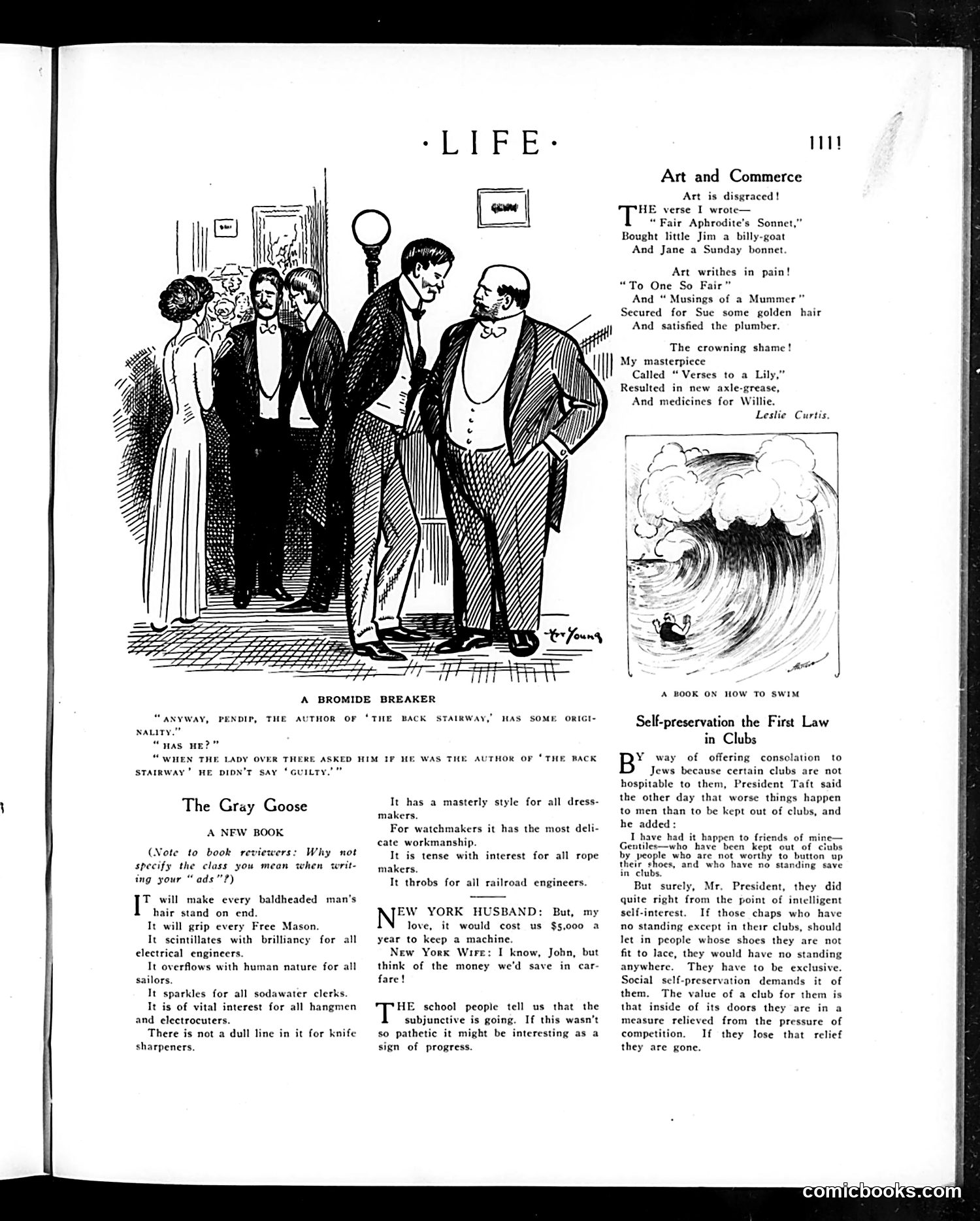
**Main Cartoon: "A Bromide Breaker"** The illustration shows a man in conversation with well-dressed figures in formal attire. The caption indicates he's the author of "The Back Stairway" who presents himself with "originality" when asked if he wrote another work titled "The Back Stairway." The joke mocks pretentious literary figures who use clichéd phrases ("bromides") while claiming originality—a common satire target in early 20th-century Life magazine. **Supporting Content:** The page includes book reviews and notices about "The Gray Goose" and articles on swimming and club membership. The satire targets intellectual vanity and the publishing world's self-important posturing, typical of Life's satirical approach to American cultural institutions and the artistic community's pretensions.
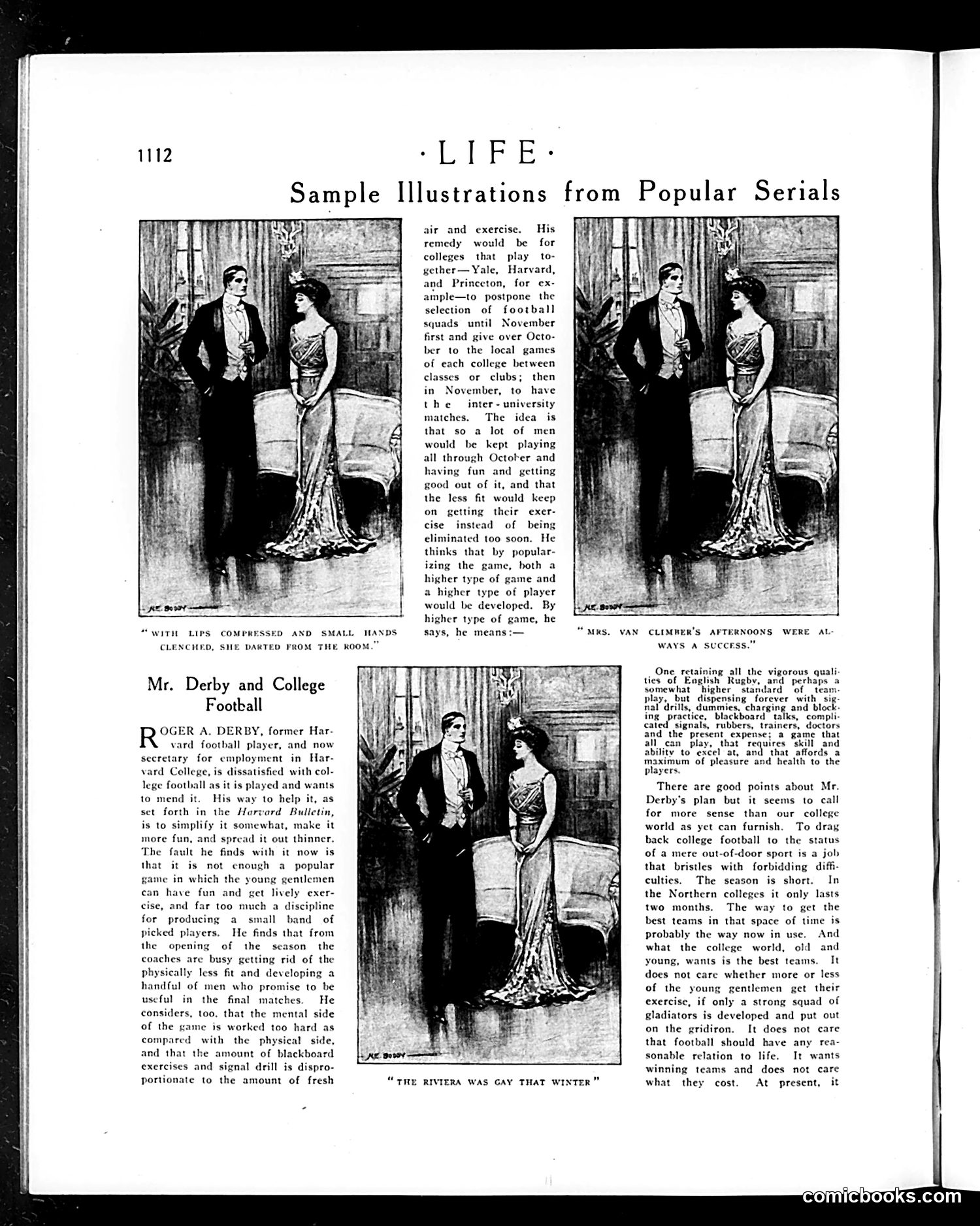
This page discusses Roger A. Derby's proposal to reform college football. The three illustrations show a well-dressed man and an elegant woman in what appears to be a domestic setting, likely depicting a narrative from a serialized story rather than political satire. The article argues that college football has become overly focused on winning and physical conditioning at the expense of broader educational value. Derby proposes postponing fall games until November and scheduling inter-university matches, suggesting this would keep students exercising throughout October while reducing the pressure to develop elite "fit" players too quickly. The satirical point critiques American college culture's obsession with competitive athletics over actual player health and education—a concern that remains relevant today.
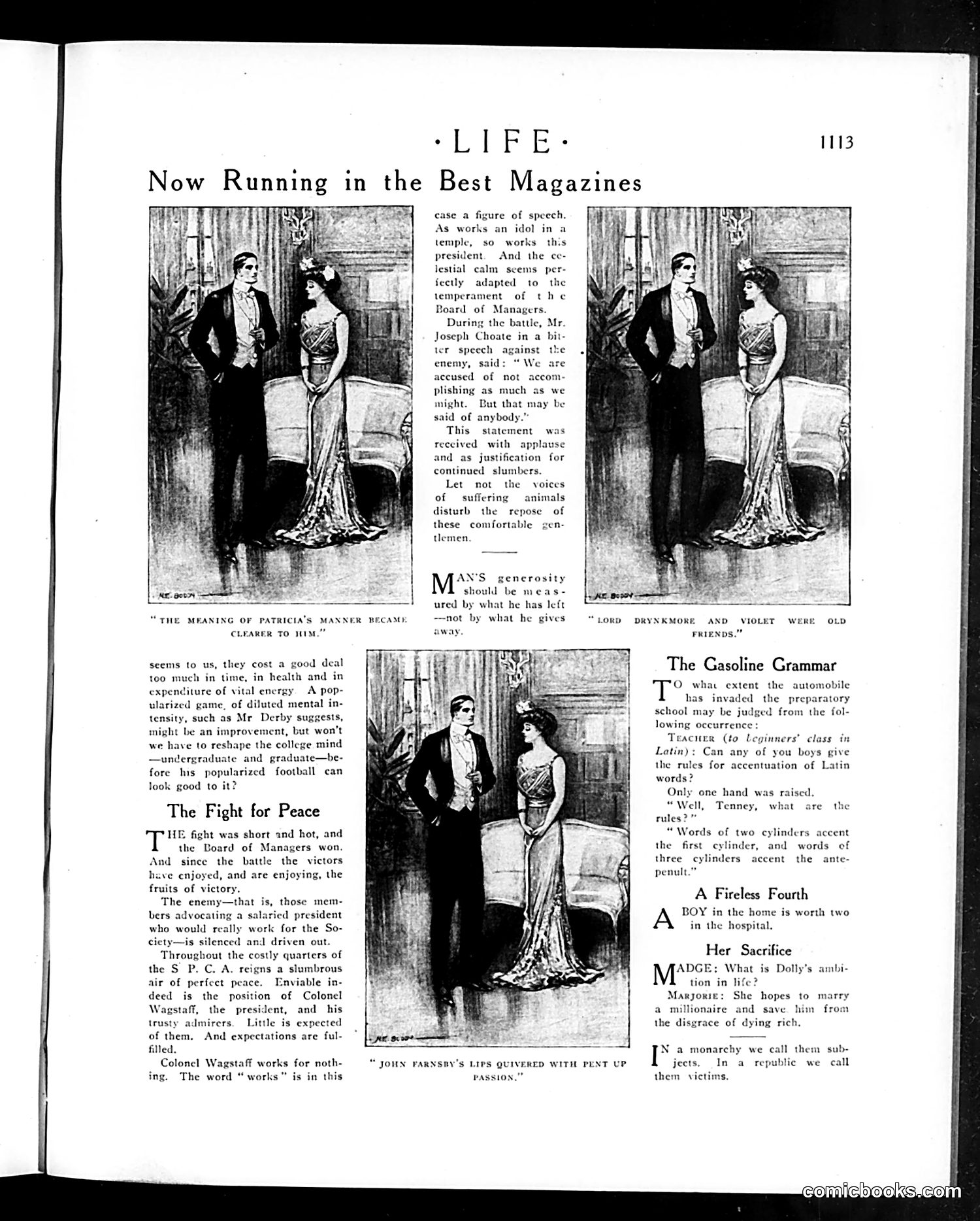
This page contains serialized fiction illustrations rather than political cartoons. The three images show scenes from "The Fight for Peace," depicting what appears to be a domestic drama involving a well-dressed man, a woman in an elegant gown, and references to an S.P.C.A. (Society for the Prevention of Cruelty to Animals) meeting. The satirical text criticizes the Board of Managers, mocking their self-congratulatory speeches about accomplishments while animal suffering continues. The joke suggests these "comfortable gentlemen" prioritize their own comfort over meaningful action—a commentary on organizational hypocrisy and performative concern for social causes. The page also includes unrelated brief humor pieces ("The Gasoline Grammar," "A Fireless Fourth," "Her Sacrifice") typical of Life's format.
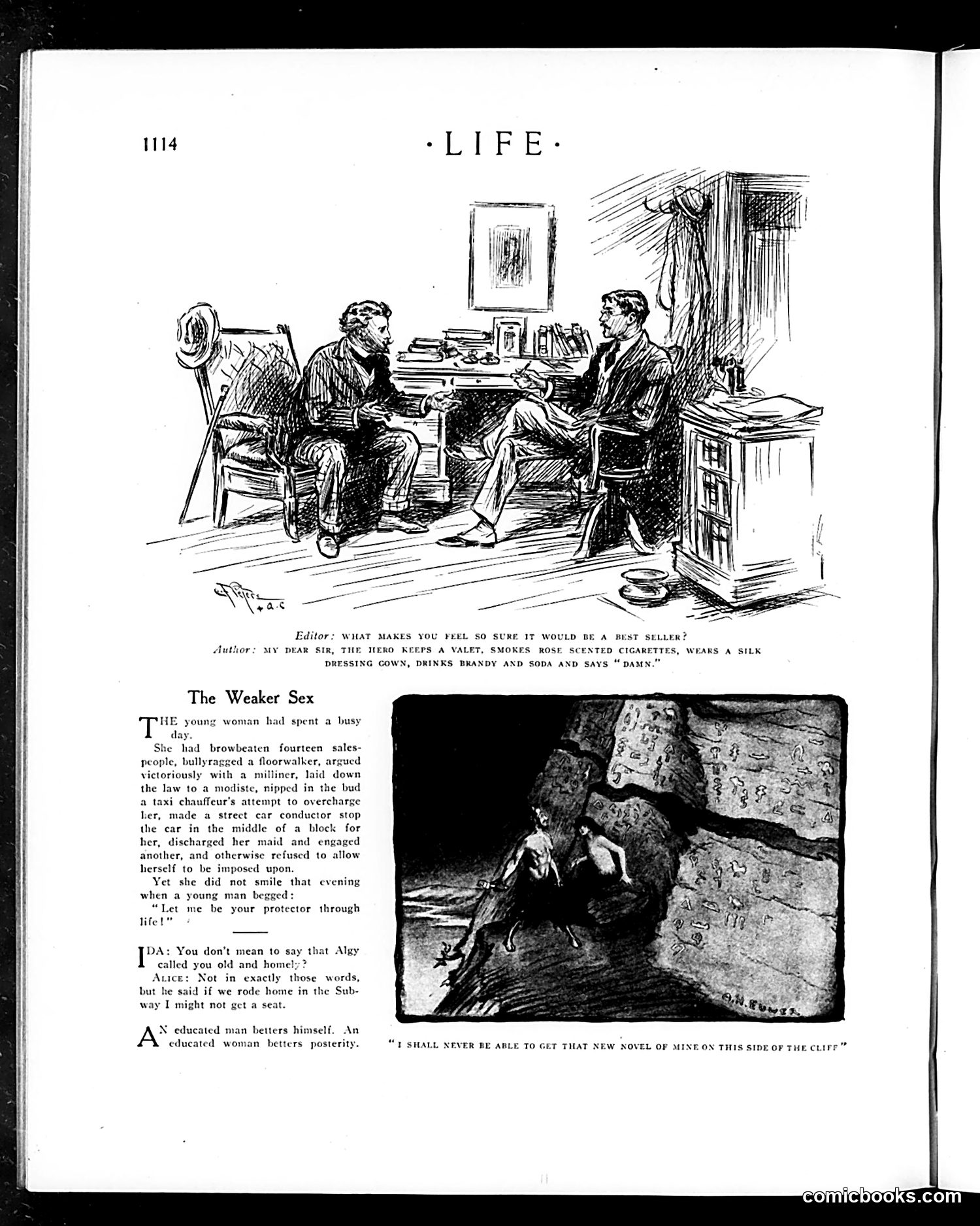
This page contains two satirical pieces mocking early-20th-century gender dynamics: **Top cartoon**: An editor and author discuss what makes a bestseller. The author lists clichéd "masculine" traits—a valet, rose-scented cigarettes, silk dressing gown, brandy, and saying "damn"—as guaranteed commercial appeal. The satire targets how popular literature relied on shallow stereotypes of sophistication and masculinity. **"The Weaker Sex" story**: The title ironically contradicts the narrative. A young woman spends her day aggressively dominating salespeople, workers, and service staff—yet still feels rejected when a suitor won't promise to "protect" her. The concluding anecdotes mock her simultaneous demands: she won't tolerate disrespect, yet her date's quip about not getting a subway seat wounds her. The satire targets contradictions in how women were viewed—simultaneously depicted as fragile beings needing protection while showing themselves forceful and capable. The closing aphorism suggests women's education benefits society generally, not just themselves—a dig at limited female ambitions.
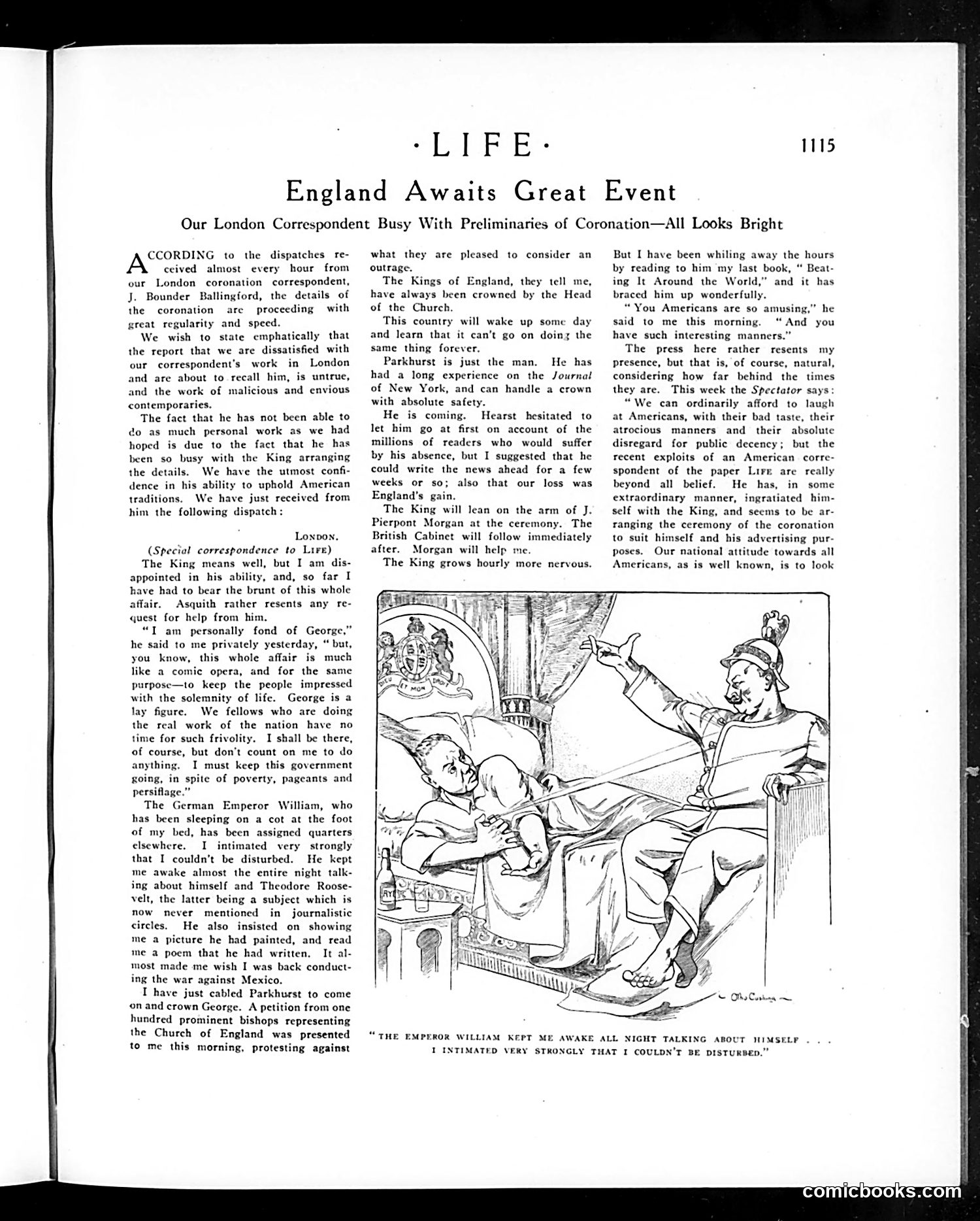
This is satirical commentary on an American newspaper correspondent's coverage of King George V's coronation (1911). The correspondent, "J. Bounder Ballingford," represents the stereotypical arrogant American journalist—inserting himself into major historical events and taking credit for their success. The humor operates on multiple levels: **The correspondent's delusion**: He claims to be "helping" arrange the coronation while British officials like Prime Minister Asquith resent his interference. He boasts of having arranged Kaiser Wilhelm's quarters and even plans to bring newspaper editor William Randolph Hearst's man Parkhurst to conduct the ceremony. **American presumption**: The piece mocks American confidence that they can "uphold American traditions" in England and improve British institutions through intervention. **The cartoon** shows the correspondent lounging while smaller figures (likely representing British officials) labor around him—visualizing his inflated sense of importance. The satire targets American journalistic arrogance and cultural chauvinism during the early 20th century.
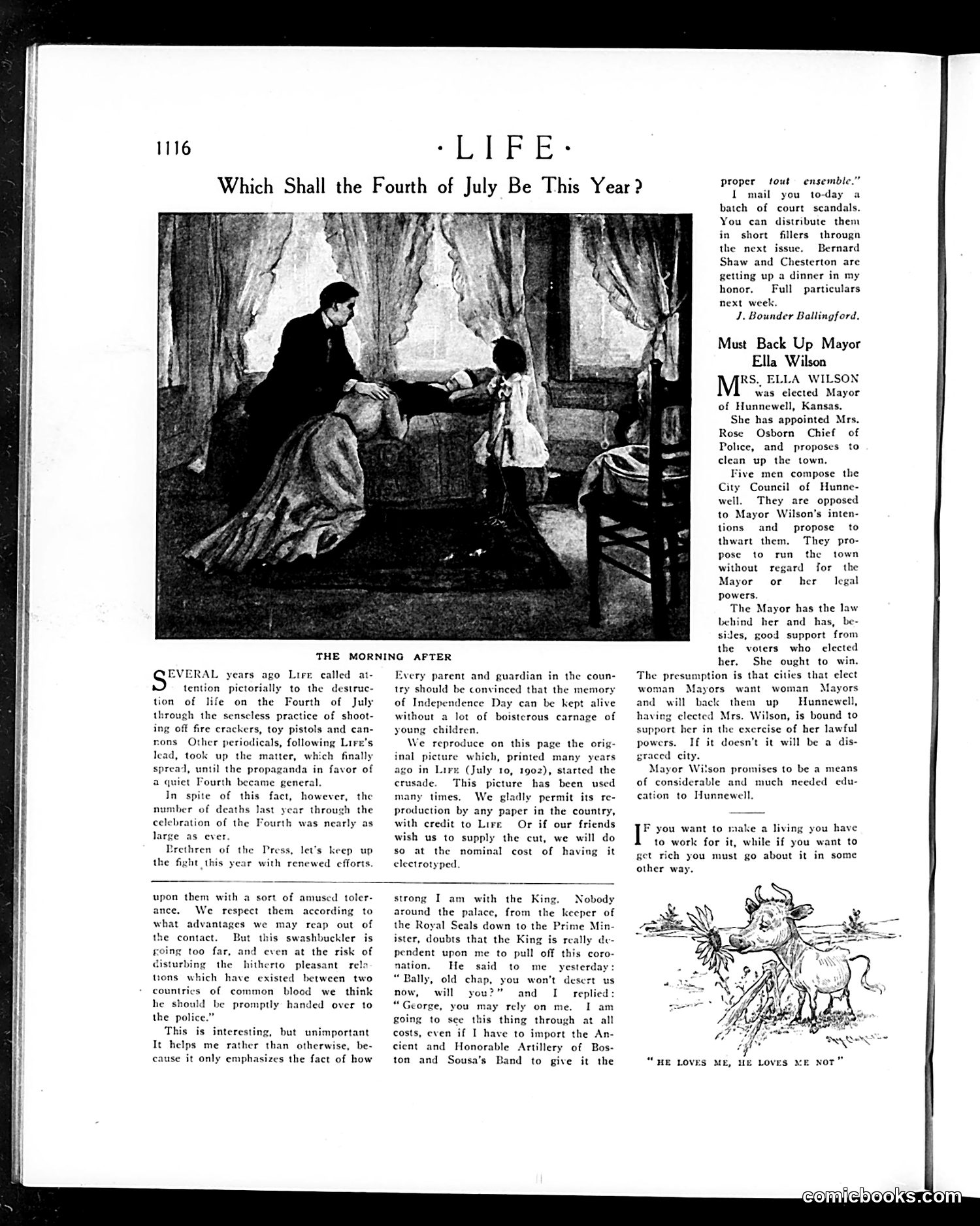
**Main Image ("The Morning After"):** This depicts the aftermath of Fourth of July celebrations—a child injured or killed by fireworks, attended by grieving adults. This visual supports Life's decade-long crusade against dangerous Independence Day practices like firecrackers and toy cannons that killed children annually. **Supporting Articles:** 1. **Court Scandal Notice:** A gossip item from "J. Bounder Ballingford" about distributing court scandals, mentioning dinner plans with Bernard Shaw and Chesterton—typical satirical content mocking high society. 2. **Mayor Ella Wilson:** Life endorses the female mayor of Hunnewell, Kansas, who appointed a female police chief and faces opposition from a five-man city council. Life argues citizens must support elected officials' lawful authority, particularly this woman reformer. The page champions both child safety advocacy and female political participation—progressive causes for the era.
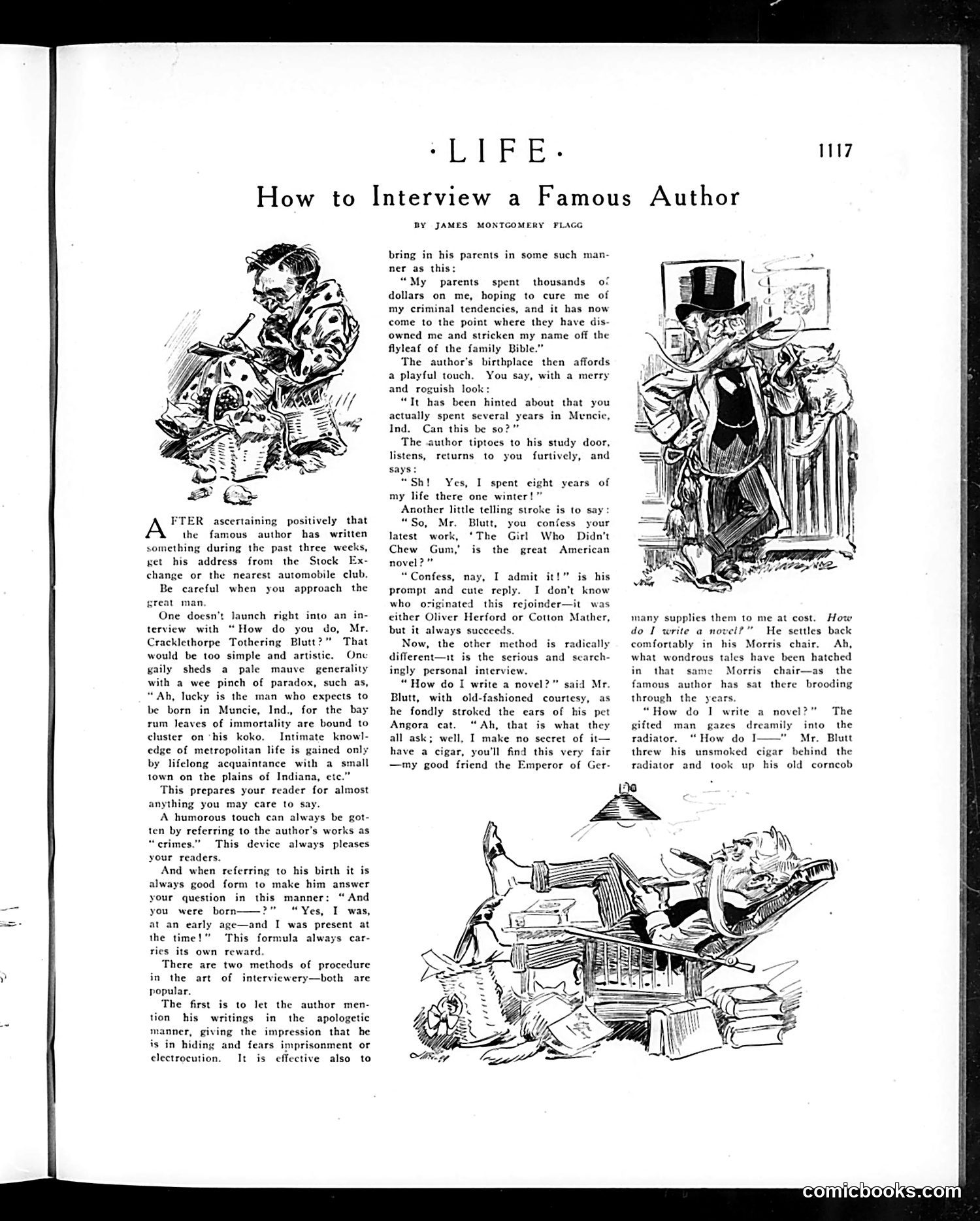
This humorous article by James Montgomery Flagg mocks the pretentious conventions of celebrity literary interviews. The piece satirizes both interviewer and author stereotypes popular in early 20th-century magazines. The satire targets: **Interview tactics**: Flagg ridicules formulaic questions—asking authors about their Indiana hometowns, referring to their books as "crimes," and using strained witticisms to seem clever. **Author affectations**: The fictional "Mr. Cracklethorpe Tothering Blutt" exemplifies the pretentious, evasive author who hides behind theatrical mannerisms (tiptoeing furtively, stroking Angora cats, gazing "dreamily into radiators") while discussing his craft in vague generalities. **The Morris chair**: A recurring comedic image—the author's supposedly profound creative process reduces to lounging furniture, suggesting empty pretension rather than genuine inspiration. The illustrations show interviewers fawning over affected authors in absurdly theatrical poses, emphasizing how both parties perform exaggerated roles rather than conducting genuine conversation.
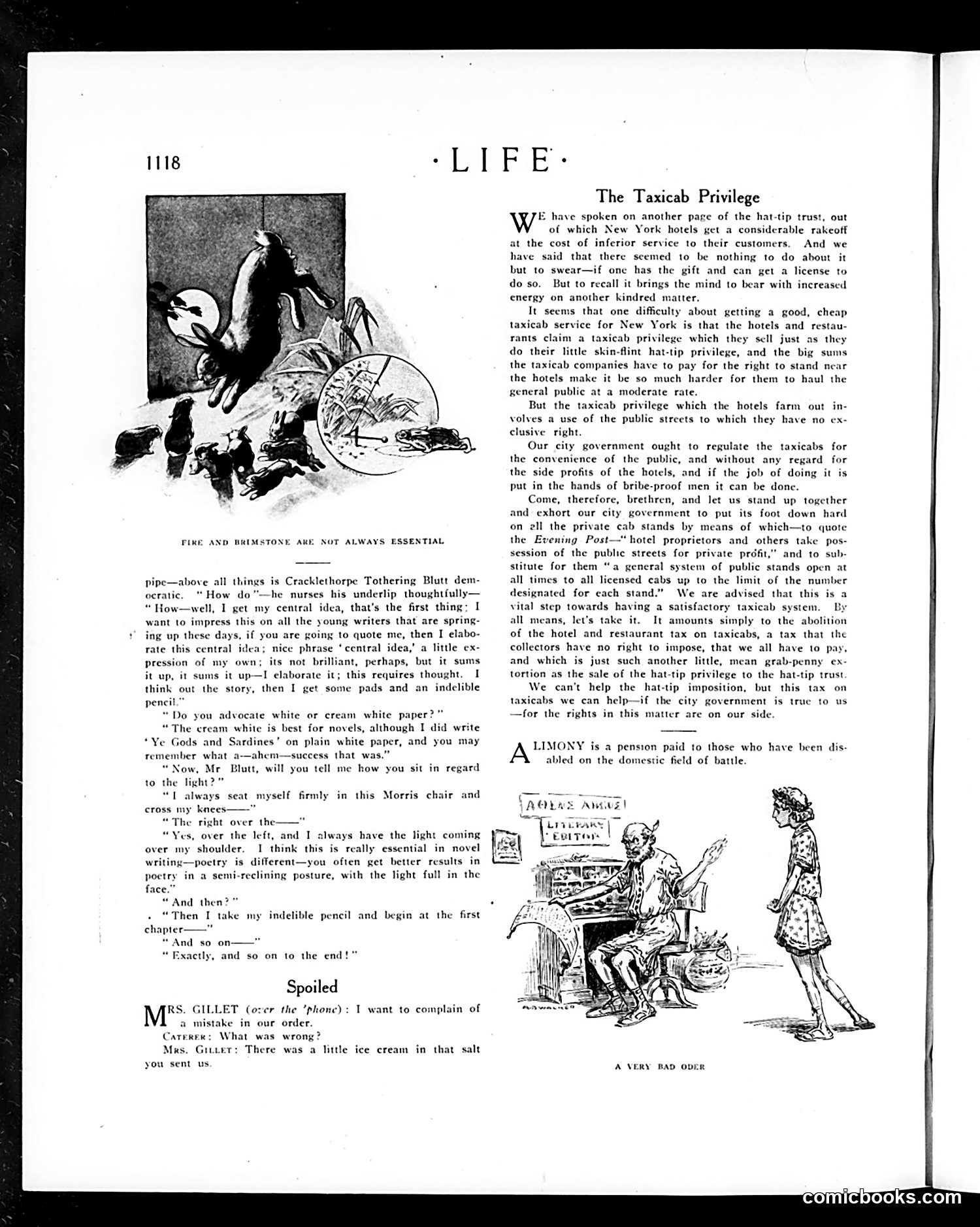
This page satirizes pretentious literary affectation through two main pieces: **"Fire and Brimstone Are Not Always Essential"** mocks a self-important writer named Cracklethorpe Tothering Blutt, who pontificates endlessly about his creative process—his "central idea," choice of paper color, seating position, and pencil type. The joke is that he makes trivial physical details sound profoundly important to writing, treating mundane habits as artistic necessity. The cartoon shows him pompously discussing craft. **"Spoiled"** is a brief joke about a customer (Mrs. Gillet) complaining to a caterer that her order of salt contained ice cream—reversing what should have been in each item. It's a simple play on mix-ups in service. **"The Taxicab Privilege"** is a serious editorial criticizing New York's hotel monopolies on taxi stands near their properties, which inflates fares for ordinary citizens. The piece advocates government regulation to break this corrupt system—what it calls an unfair "tax" like the hat-tip gratuity scam mentioned earlier.
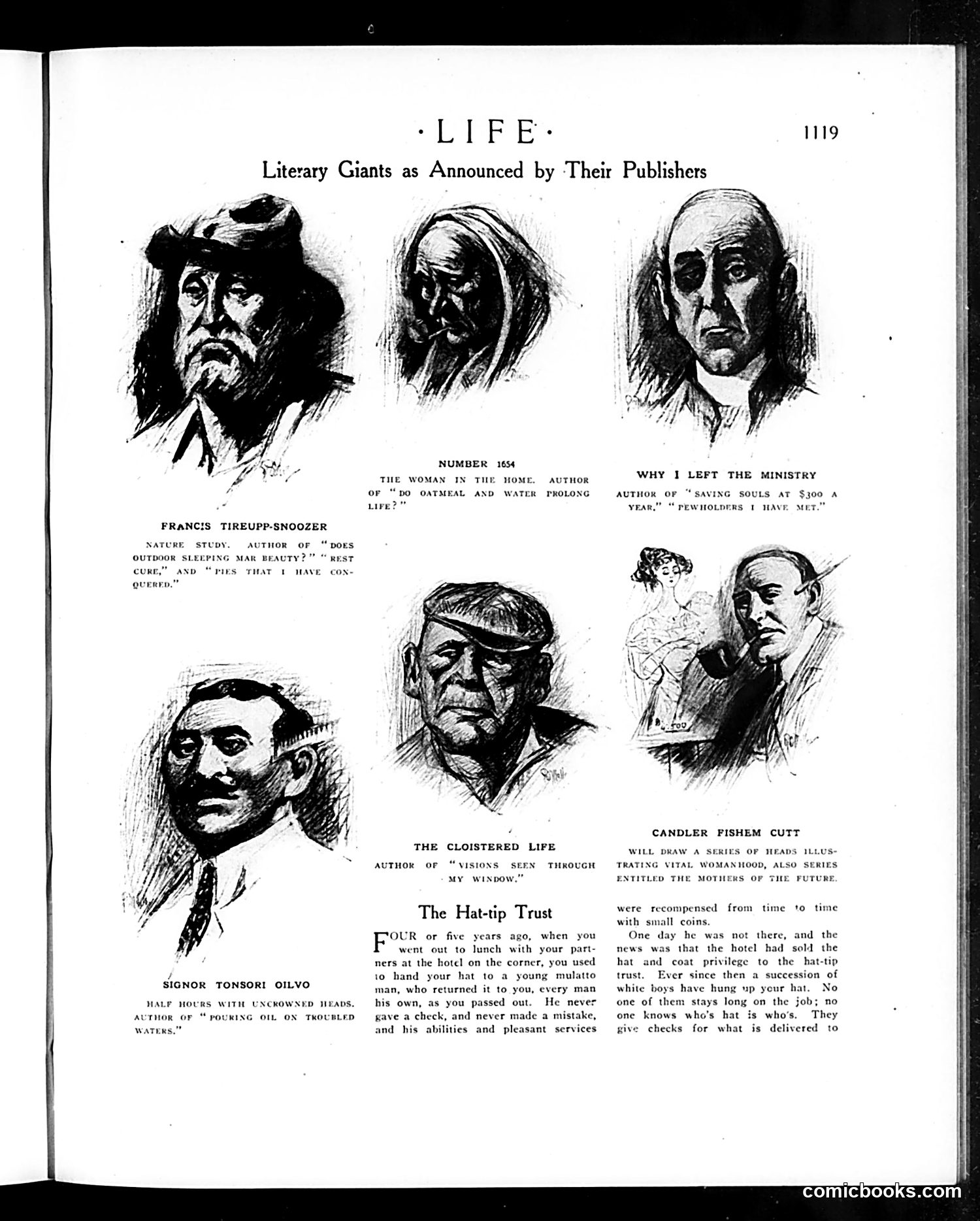
This page satirizes publisher hype about authors. The top section mocks five writers with absurdly pretentious titles—names like "Francis Tireupp-Snoozer" (clearly fabricated) with ridiculous book subjects ("Does Outdoor Sleeping Mar Beauty?"). The caricatures and descriptions suggest publishers exaggerate their authors' importance and obscure literary merit. The lower article, "The Hat-tip Trust," is a separate satirical piece. It describes how a hotel once employed a reliable Black attendant who checked hats for tips, but when a "hat-tip trust" (monopoly) took over, they replaced him with undependable white boys who don't know whose hat is whose and issue checks instead. This critiques corporate consolidation replacing personal service and hints at racial dynamics—the trustworthy Black worker displaced by an exploitative corporate system staffed with unreliable white labor.
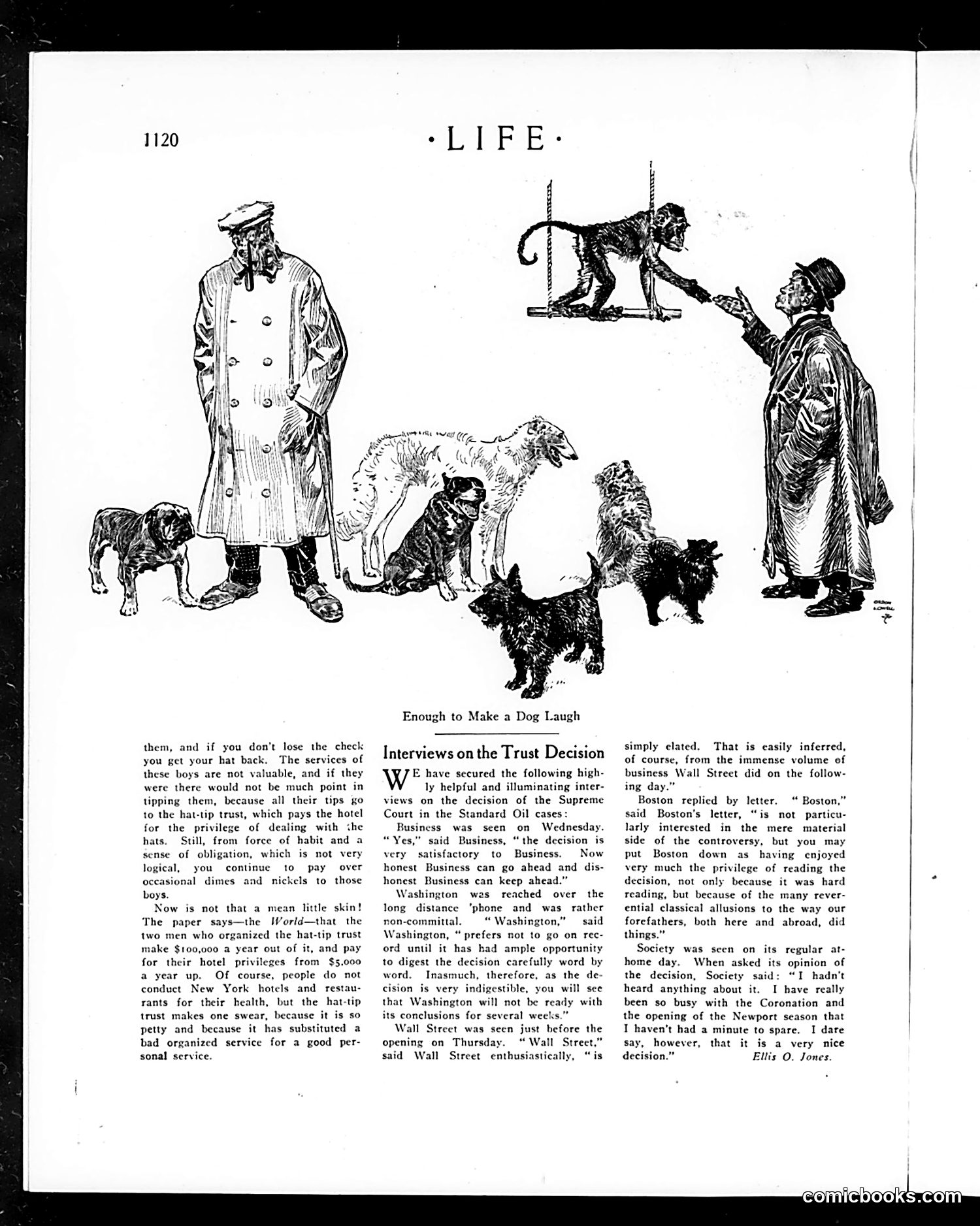
This page satirizes reactions to a major Supreme Court ruling against Standard Oil (the 1911 antitrust decision). The cartoon "Enough to Make a Dog Laugh" mocks how various American institutions responded to the decision with predictable hypocrisy or indifference. The satire targets: - **Business**: Claims to support the ruling while continuing dishonest practices - **Washington**: Refuses to commit, claiming the decision is too complex to understand - **Wall Street**: Celebrates while profiting anyway (volume increased) - **Boston**: Pretends moral interest but focuses on intellectual difficulty - **Society**: Admits complete ignorance, too preoccupied with elite social events (Coronation, Newport season) The joke is that each group gives self-serving, evasive responses rather than genuine reactions. The cartoon suggests the ruling will change nothing—institutions will continue as before while offering sanctimonious justifications. The "dog laughing" title implies the responses are laughably transparent.
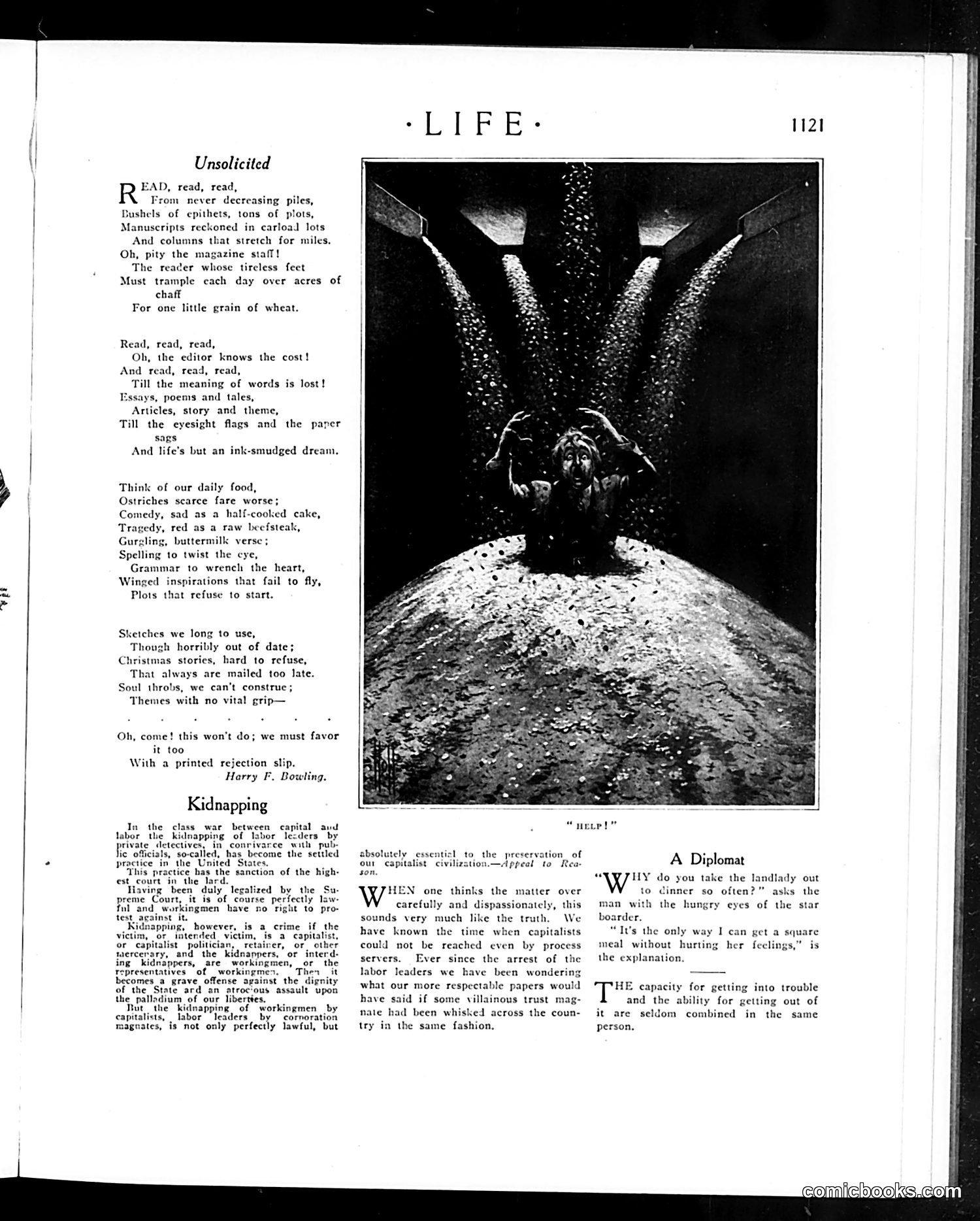
This page contains three distinct satirical pieces from *Life* magazine: **"Unsolicited"** (poem by Harry F. Bowling): Mocks the overwhelming volume of amateur manuscript submissions that magazine editors receive daily. The satire depicts editors drowning in mediocre work—poorly written essays, bad poetry, outdated sketches, late Christmas stories—forced to sift through "acres of chaff" for occasional quality material. The rejection slip is presented as a mercy. **"Kidnapping"** (editorial commentary): Critiques the hypocrisy of American justice regarding labor disputes. The piece argues that when capitalists or their hired detectives illegally kidnap labor leaders, courts sanction it as lawful and necessary for preserving civilization. However, if workers attempted similar kidnapping of capitalists, it would be prosecuted as grave crime. The satire exposes this double standard as absurd. **"A Diplomat"** (brief joke): A landlord takes his tenant's landlady to dinner frequently. When asked why, he explains it's the only way to get a square meal without her interrupting—a dig at her cooking and conversational habits. The cartoon image labeled "HELP!" appears to illustrate editorial distress, likely accompanying the "Unsolicited" piece.
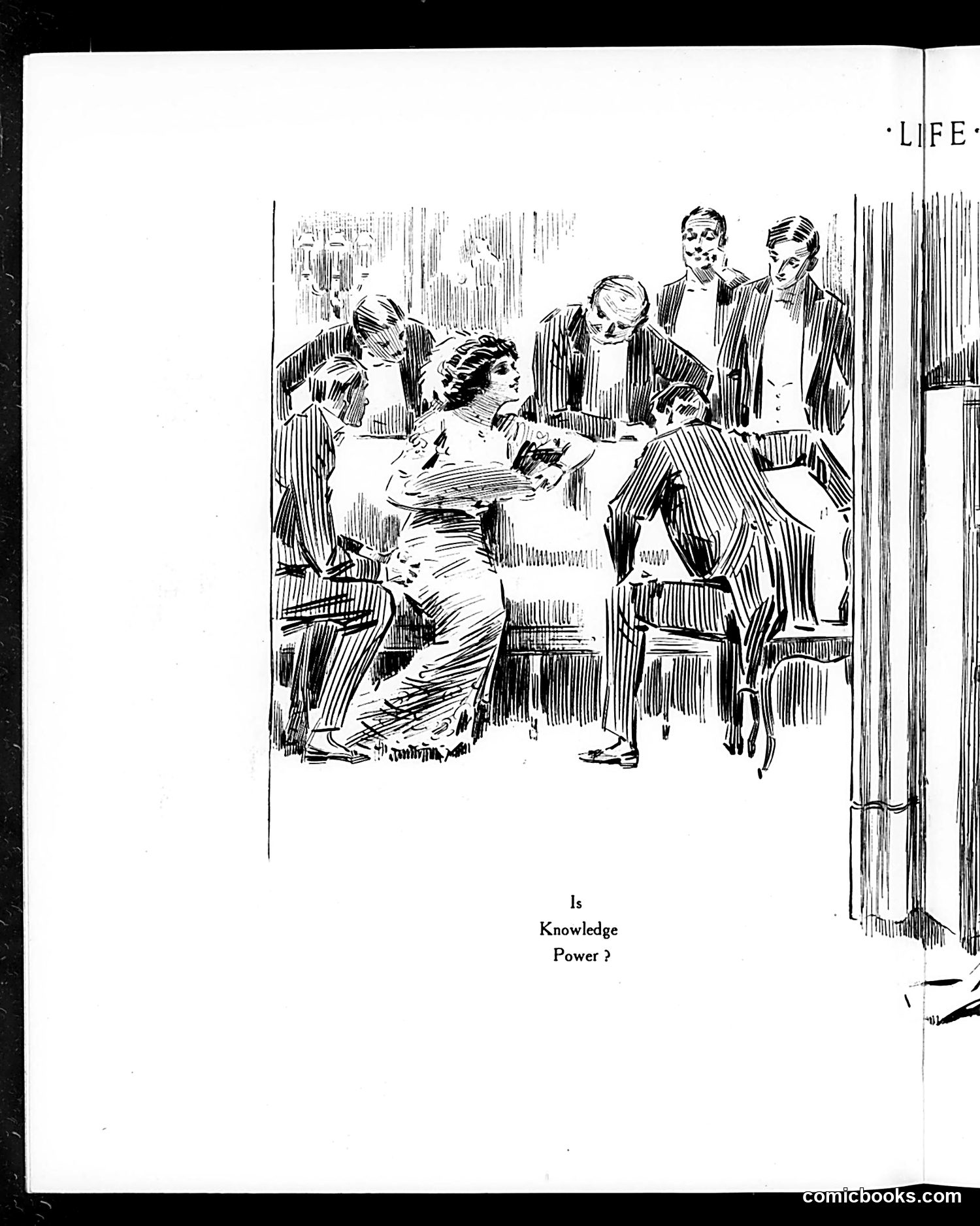
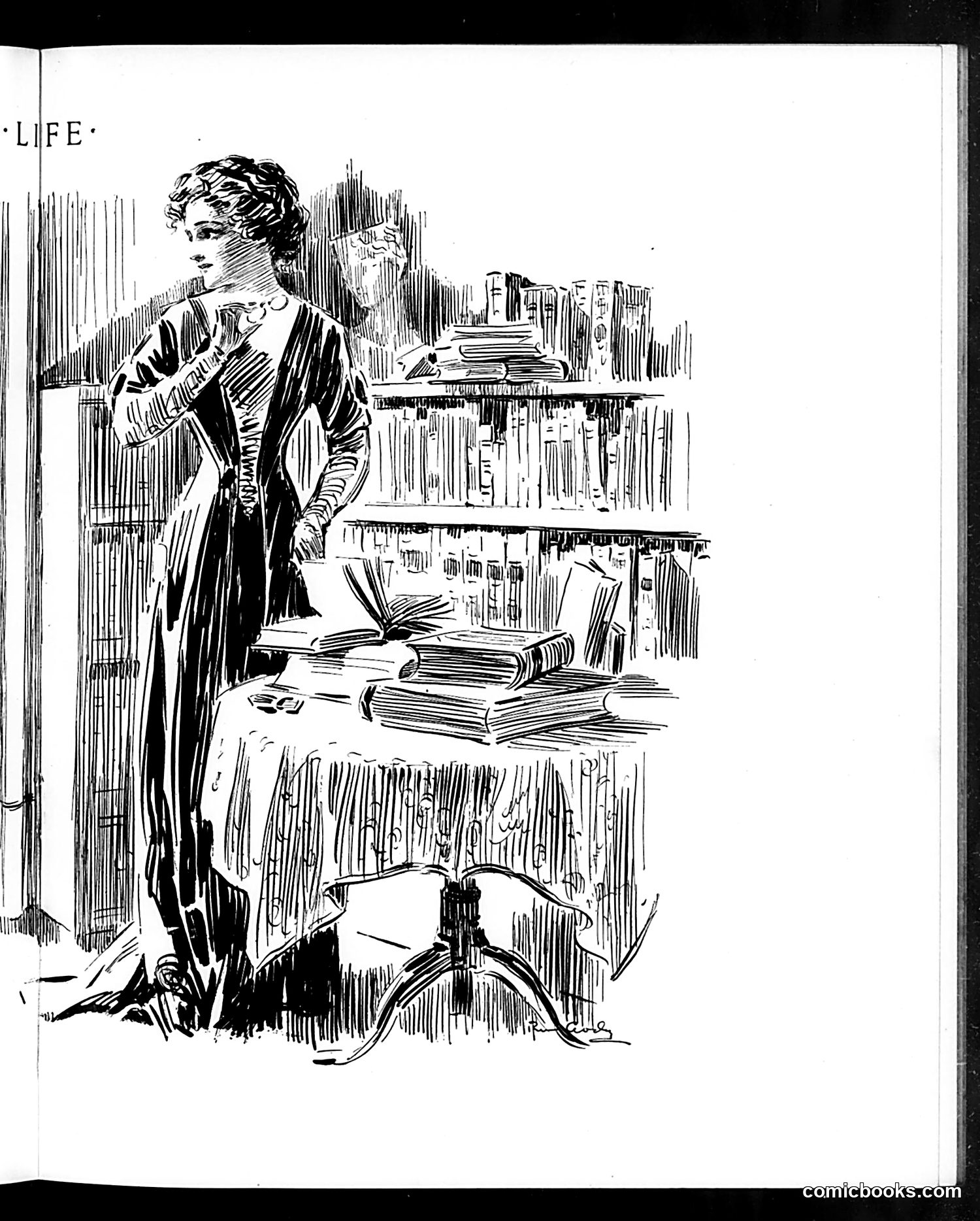
This page from *Life* magazine presents a satirical cartoon with the caption "Is Knowledge Power?" The image depicts a woman standing before a group of men in business attire who appear to be listening to or examining her. The satire likely comments on the relationship between education and influence, particularly regarding women's access to knowledge and professional spheres. Given the era's context, the cartoon probably questions whether women's education actually translates into real power in male-dominated institutions—suggesting ironic skepticism about claims of female empowerment through learning. The formal business setting and the woman's central position, surrounded by attentive men, create tension between the appearance of influence and actual authority or agency.
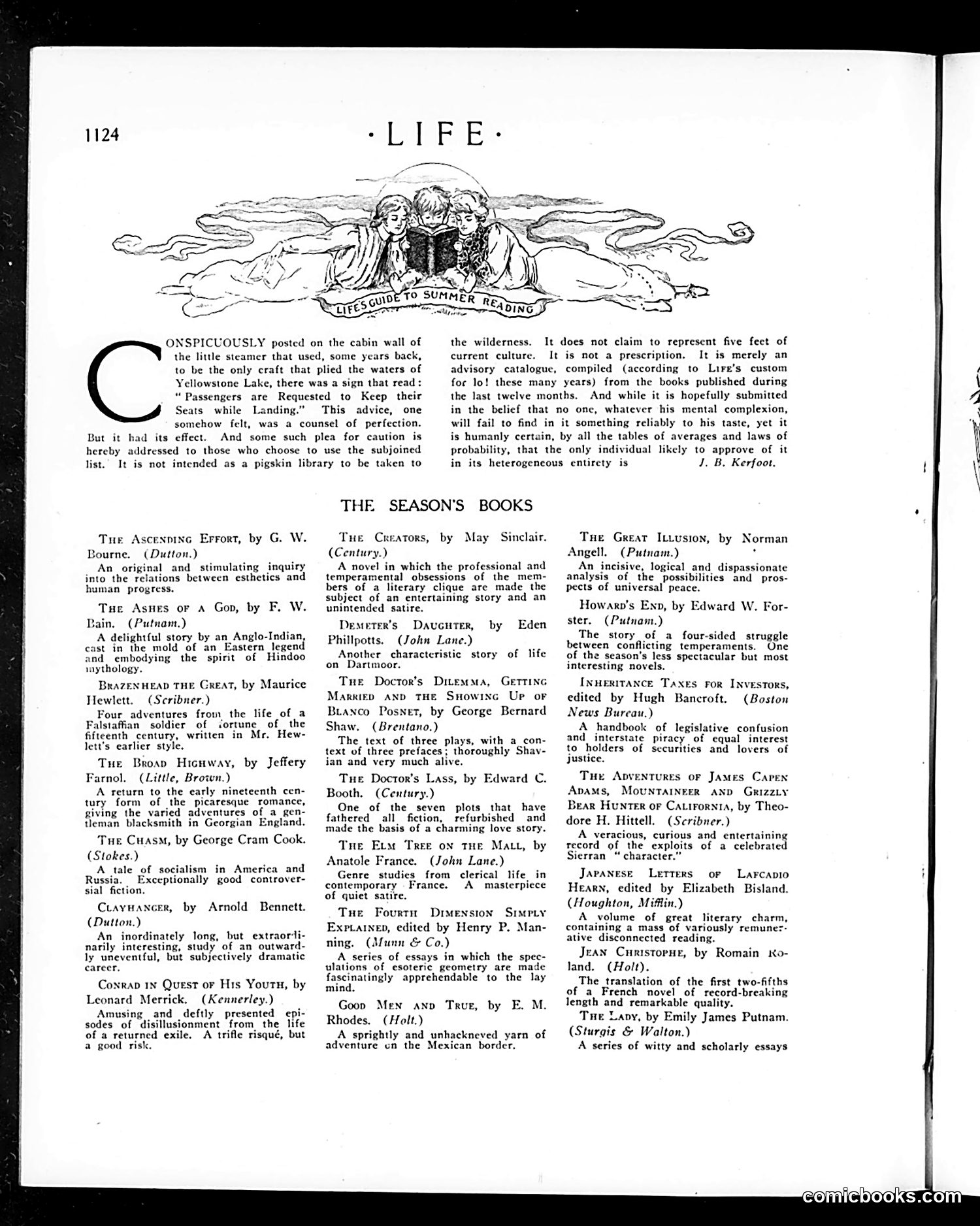
This page is primarily a **book review section** from Life magazine, not a political cartoon. The decorative header shows two figures reading together, illustrating "Life's Guide to Summer Reading." The introductory text by J.B. Kerfoot humorously acknowledges the subjectivity of literary taste. He notes that Life's curated book list—compiled from the previous twelve months' publications—won't please everyone, despite hoping it will. The opening anecdote about a Yellowstone Lake steamship sign ("Passengers are Requested to Keep their Seats while Landing") serves as a humorous analogy: just as that practical warning had limited effect, this book list is well-intentioned advice unlikely to satisfy all readers. The list itself features contemporary early-20th-century literary works by authors like George Bernard Shaw, Anatole France, and Arnold Bennett—representing fiction, philosophy, and social commentary popular during this period.
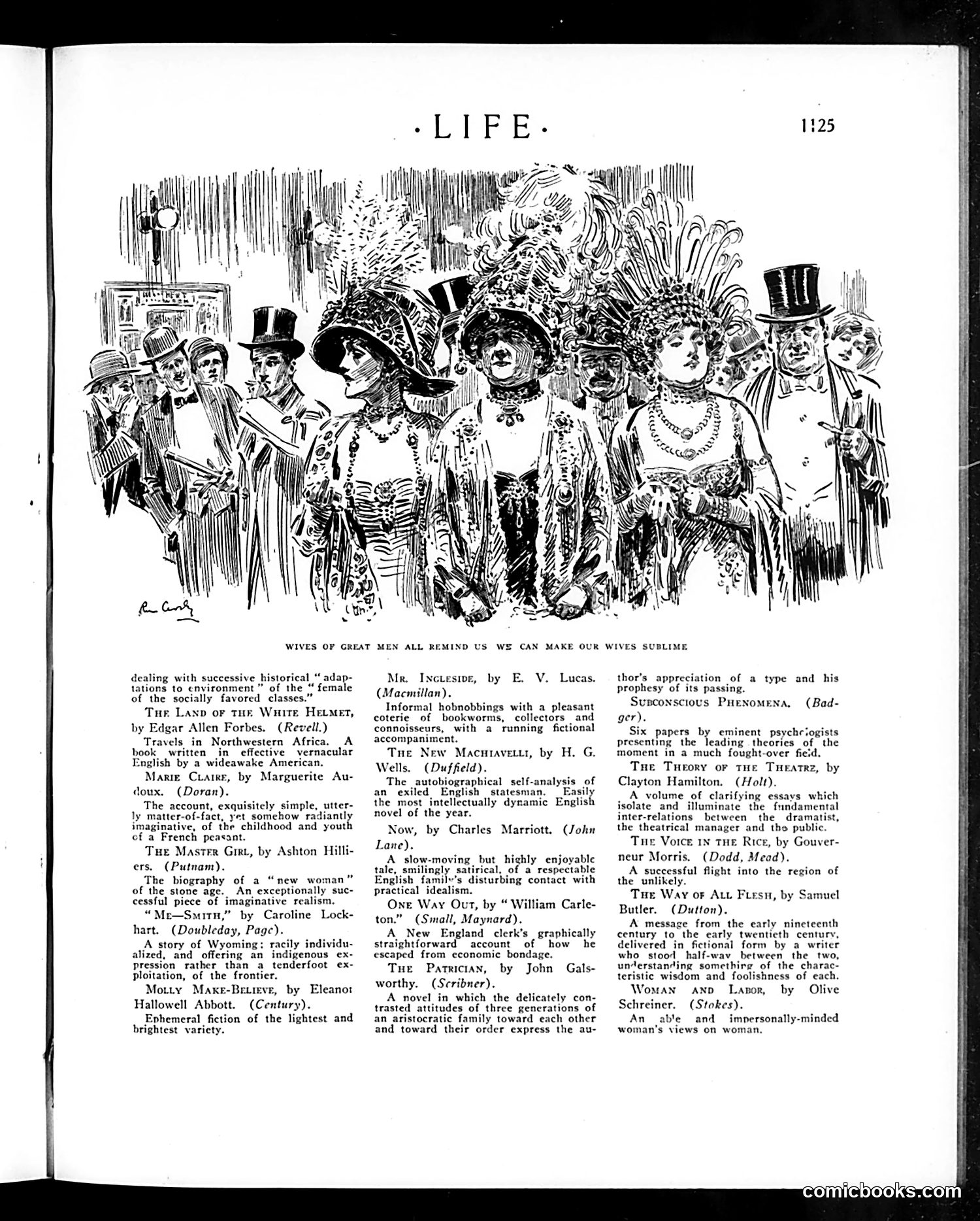
The cartoon depicts a fashionable procession of well-dressed society women and men in Edwardian-era formal attire, with the caption: "Wives of Great Men All Remind Us We Can Make Our Wives Sublime." This is satirical commentary on the "New Woman" movement and evolving gender roles. The caption—a play on Longfellow's poem "A Psalm of Life"—ironically suggests that wives of prominent men should aspire to be "sublime," yet the image shows them as ornately dressed, decorative figures in a social parade, seemingly reduced to fashionable accessories rather than intellectually developed individuals. The accompanying book reviews discuss novels featuring "new women" and female independence (like "The Master Girl," described as a "new woman" story), suggesting tension between emerging feminist ideas and traditional upper-class expectations that women remain decorative and subservient. The satire mocks both the pretensions of society and the gap between women's actual autonomy and their prescribed social roles.
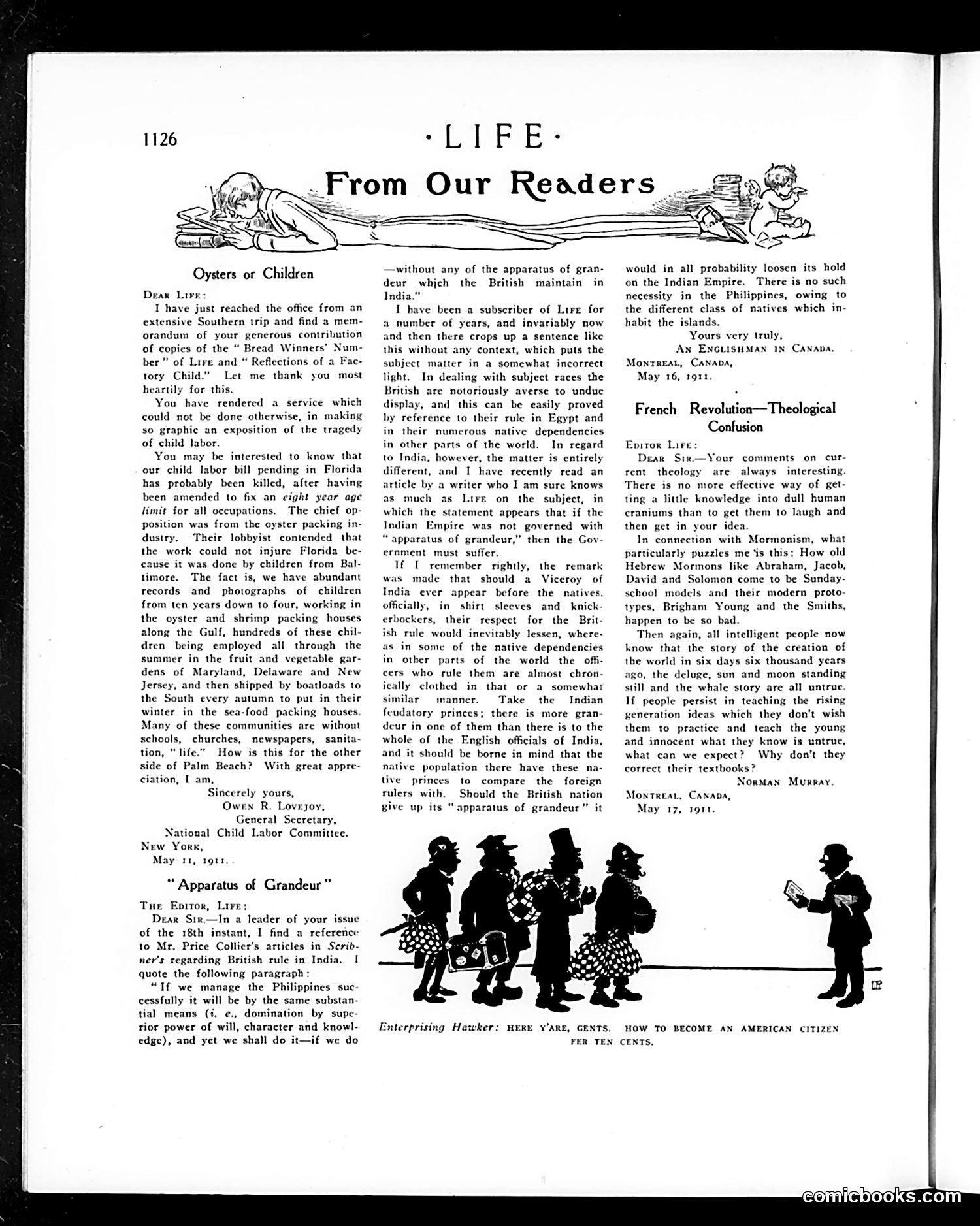
This page presents readers' letters debating American imperialism and child labor. The main cartoon, captioned "Here y'are, gents. How to become an American citizen per ten cents," depicts a street vendor hawking citizenship to caricatured immigrant figures—likely Eastern European or Irish based on their stereotyped appearances. The satire suggests citizenship is being sold cheaply or commodified, mocking both mass immigration and the ease of naturalization. The letters address serious policy matters: child labor in oyster-packing (children as young as four exploited seasonally), and British imperial governance in India versus American rule in the Philippines. Writers debate whether colonial authority requires ceremonial "apparatus of grandeur" or if American power can govern more efficiently and with less ostentation.
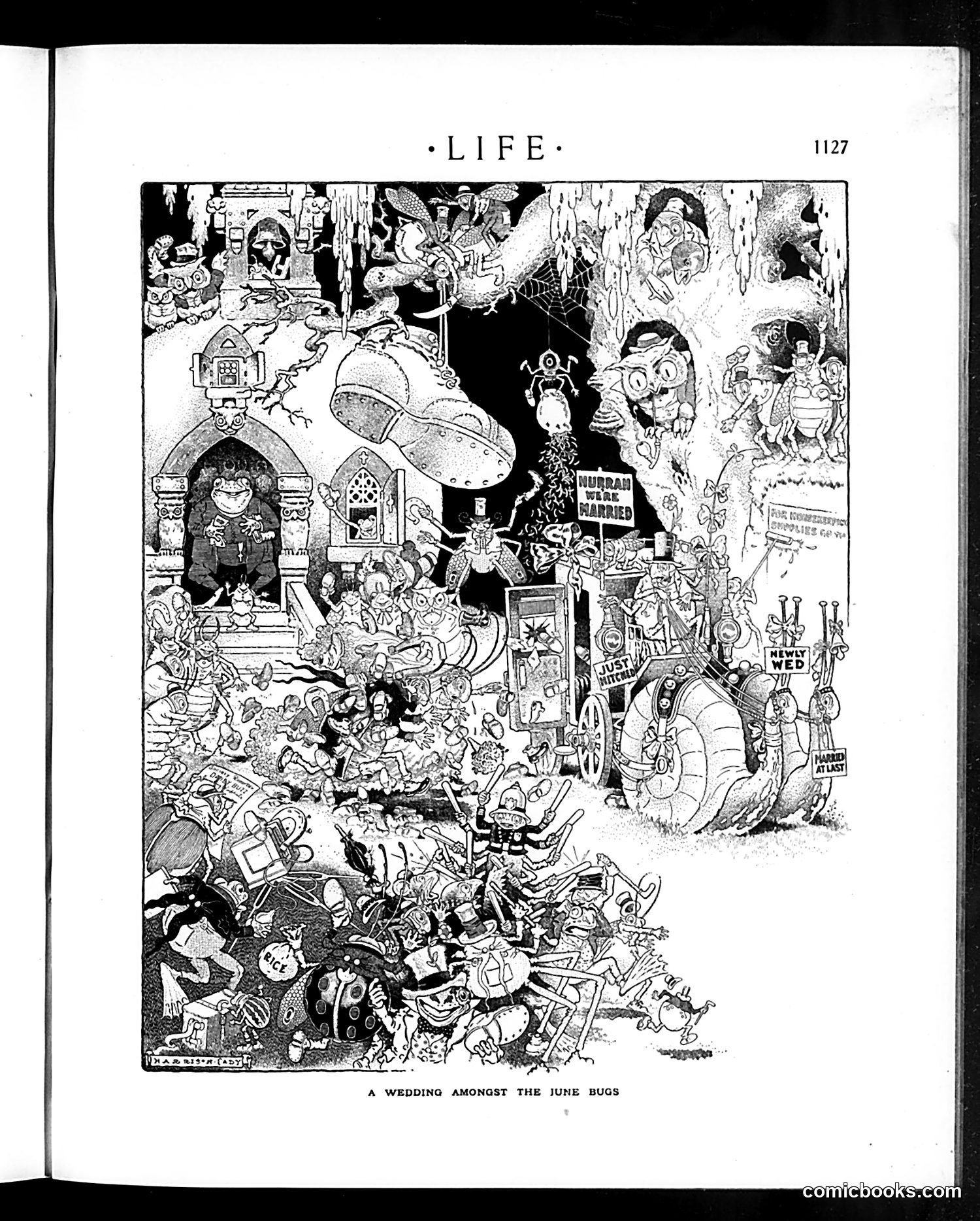
This is a densely packed satirical illustration titled "A Wedding Amongst the June Bugs," published in *Life* magazine (page 1127). The cartoon depicts an elaborate, chaotic insect wedding scene populated by anthropomorphized bugs and creatures. The joke plays on the term "June bugs"—likely a contemporary slang reference to foolish or ridiculous people—staging their absurd "wedding" with visible signs reading "DURRAH MARK MARRIED" and "NEWLY WED." The intricate, crowded composition filled with tiny detailed figures and elaborate architectural elements creates visual comedy through sheer overwhelming complexity. Without additional context, the specific political or social targets remain unclear, though the satire appears to mock either wedding extravagance, contemporary social figures, or cultural pretension through this insect-world allegory.
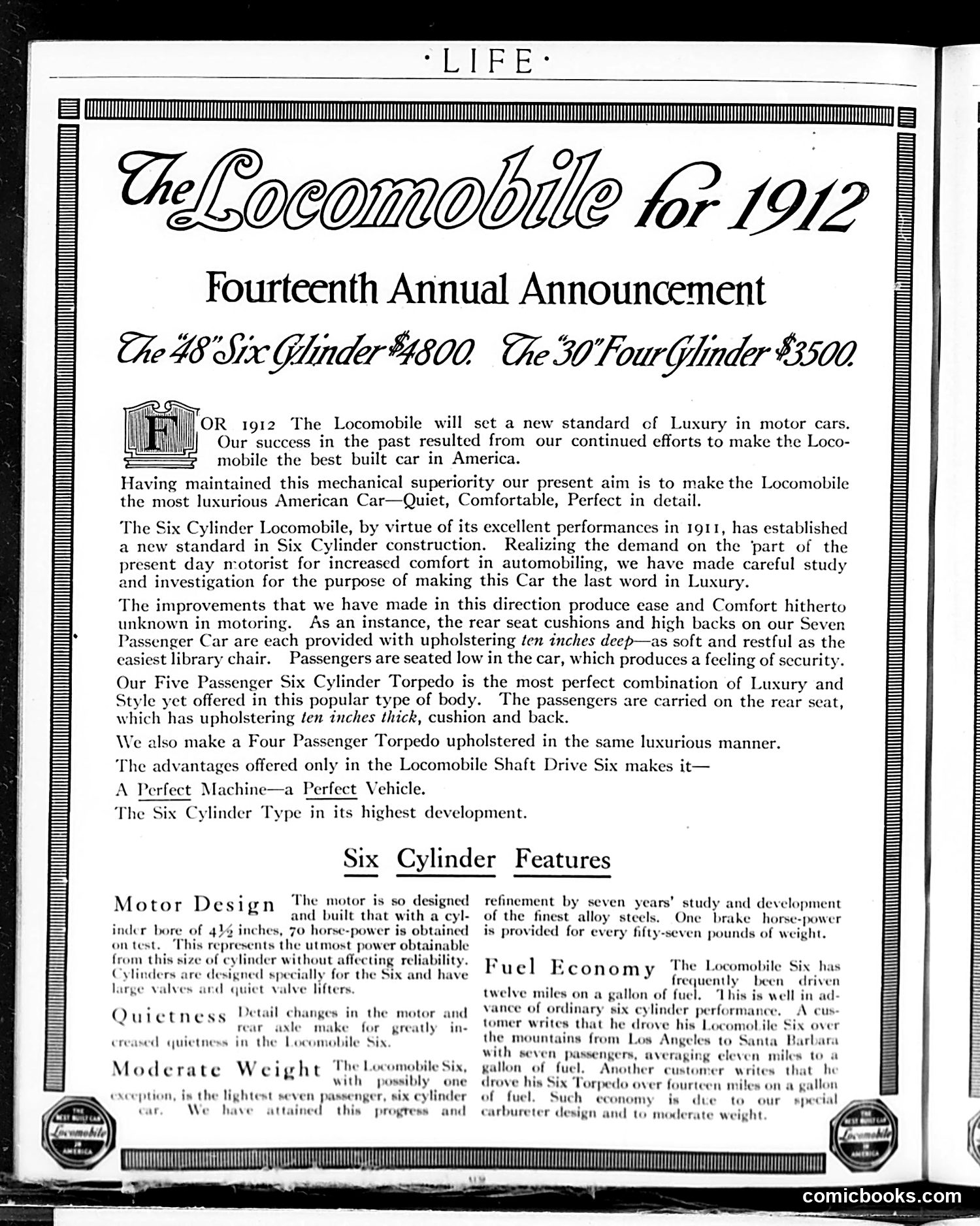
This is **not a political cartoon or satire**—it's a straightforward automobile advertisement from *Life* magazine's 1912 issue. The page announces the Locomobile's latest models: the 48 Six Cylinder ($4,800) and 30 Four Cylinder ($3,500). The ad emphasizes luxury features targeting wealthy motorists: deep upholstery (ten inches), lightweight construction, fuel economy (12 miles per gallon), and mechanical refinement from "seven years' study." It highlights the six-cylinder engine's superiority and claims the Locomobile offers "a new standard of Luxury in motor cars" and is "the best built car in America." This reflects early 1910s automotive culture when cars were luxury goods for the affluent, and manufacturers competed on comfort and engineering prestige rather than affordability or mass production—the opposite of Henry Ford's contemporaneous Model T strategy.
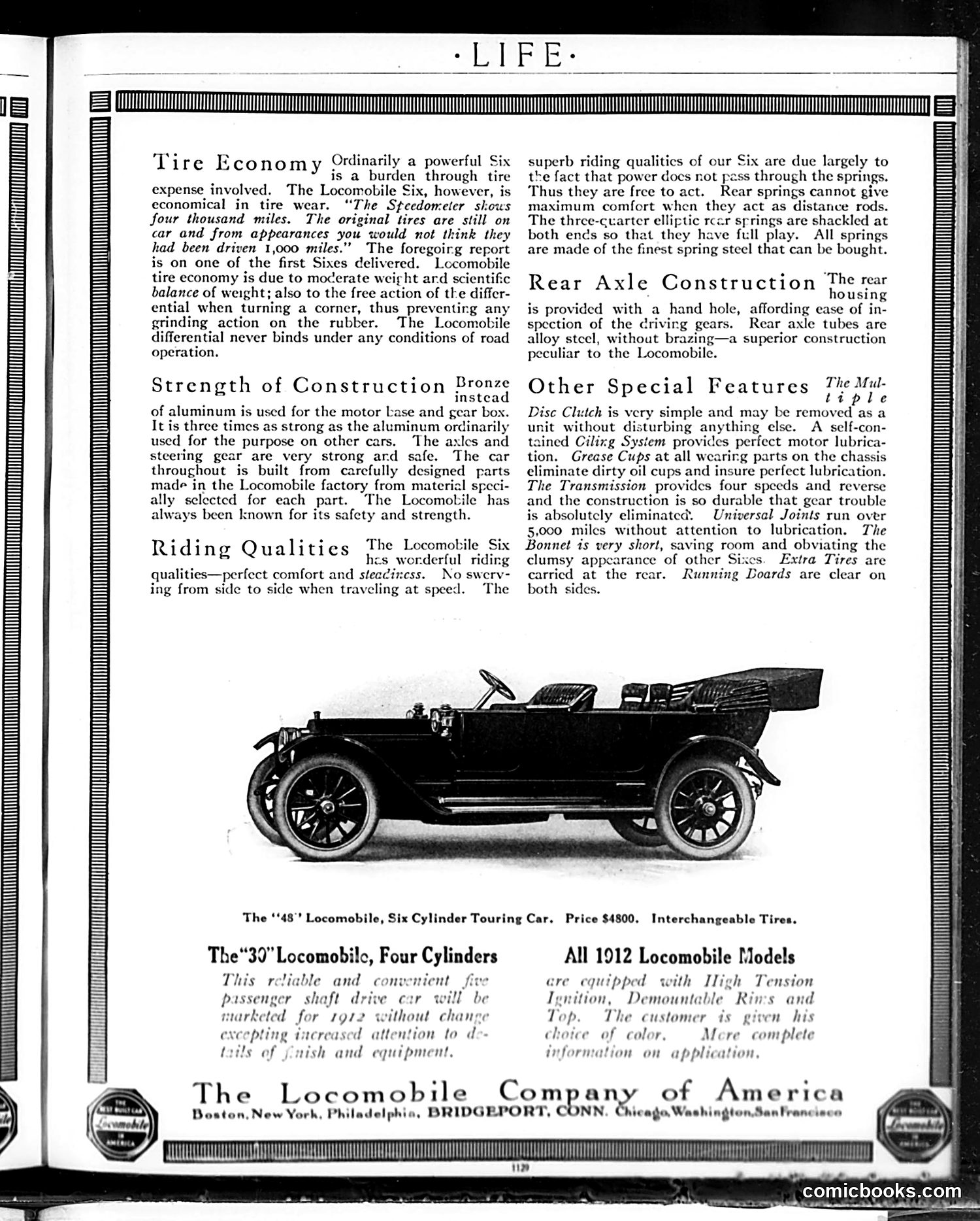
This is **not a cartoon or satire** — it's a straightforward automobile advertisement from *Life* magazine, circa 1912. The page promotes the Locomobile Company's luxury automobiles, specifically their six-cylinder touring car (priced at $4,800, substantial for the era). The copy emphasizes engineering superiority: bronze construction instead of aluminum, innovative spring suspension that isolates passengers from road shock, economical tire wear, and advanced features like demountable rims and self-contained lubrication systems. The accompanying photograph shows a touring car — an open-air vehicle typical of the period. **Historical context for modern readers:** This represents early automotive marketing focused on mechanical innovation and durability rather than speed or style. The detailed technical specifications reflect an era when automobile engineering was still novel and buyers needed reassurance about reliability. Interchangeable tires and demountable rims were genuine selling points, as tire failures were common.
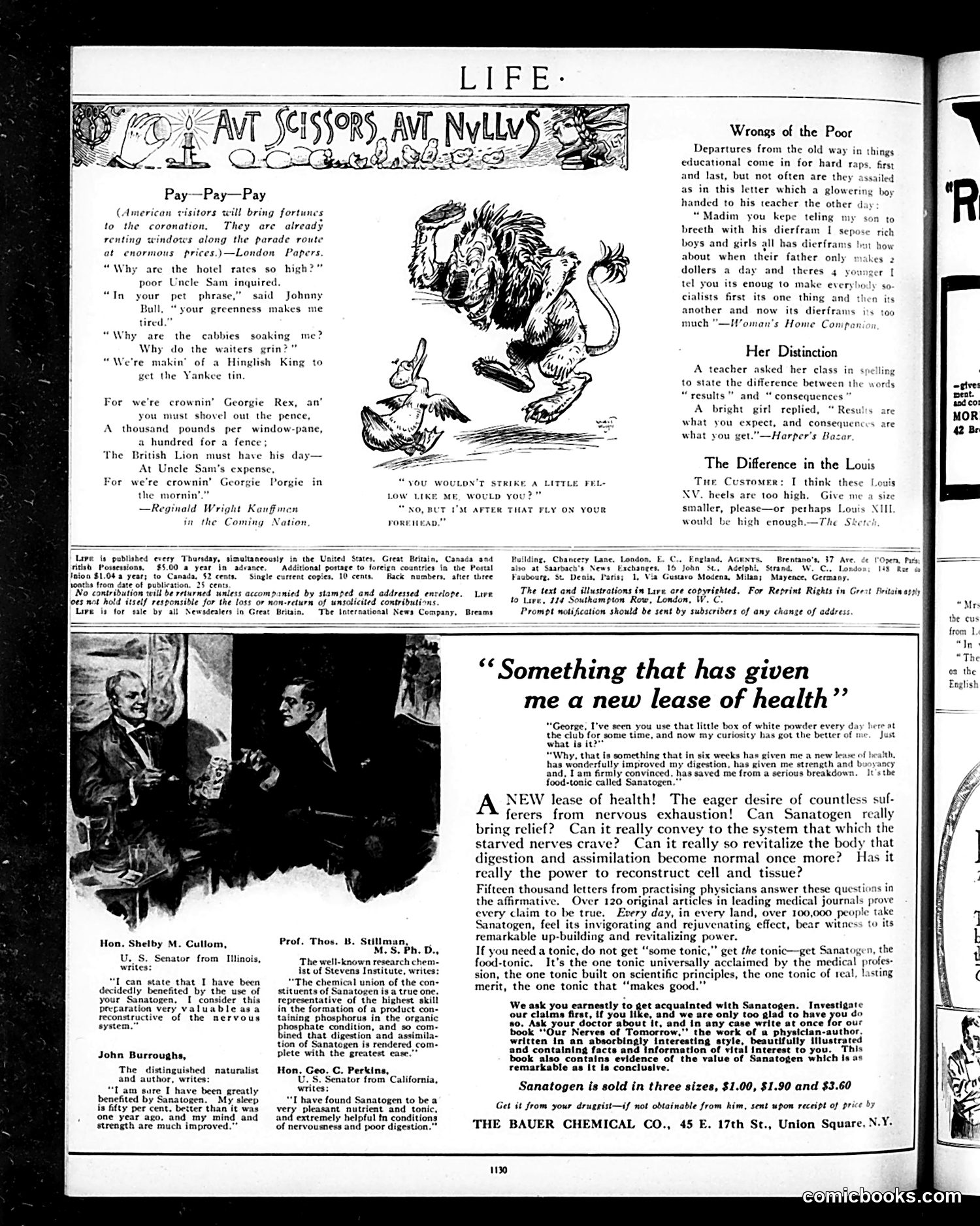
This page satirizes British financial exploitation of American tourists attending King Edward VII's coronation. The main cartoon depicts a lion (representing Britain) aggressively shearing a sheep (America) of its wool—a visual pun on "scissors" cutting fabric. The accompanying verses mock how British establishments—hotels, cabbies, waiters, and vendors—dramatically inflate prices for wealthy American visitors, under the cynical justification that Americans are so rich they won't notice. The dialogue references "crowning Georgie Rex" while extracting maximum payment from "Uncle Sam's expense." The cartoon's point: Britain treats American tourists as profit opportunities, fleecing them under the guise of hospitality during the royal coronation. It's economic satire targeting both British greed and American naïveté about being overcharged abroad. The page also includes unrelated educational humor about teaching children and a Sanatogen tonic advertisement.
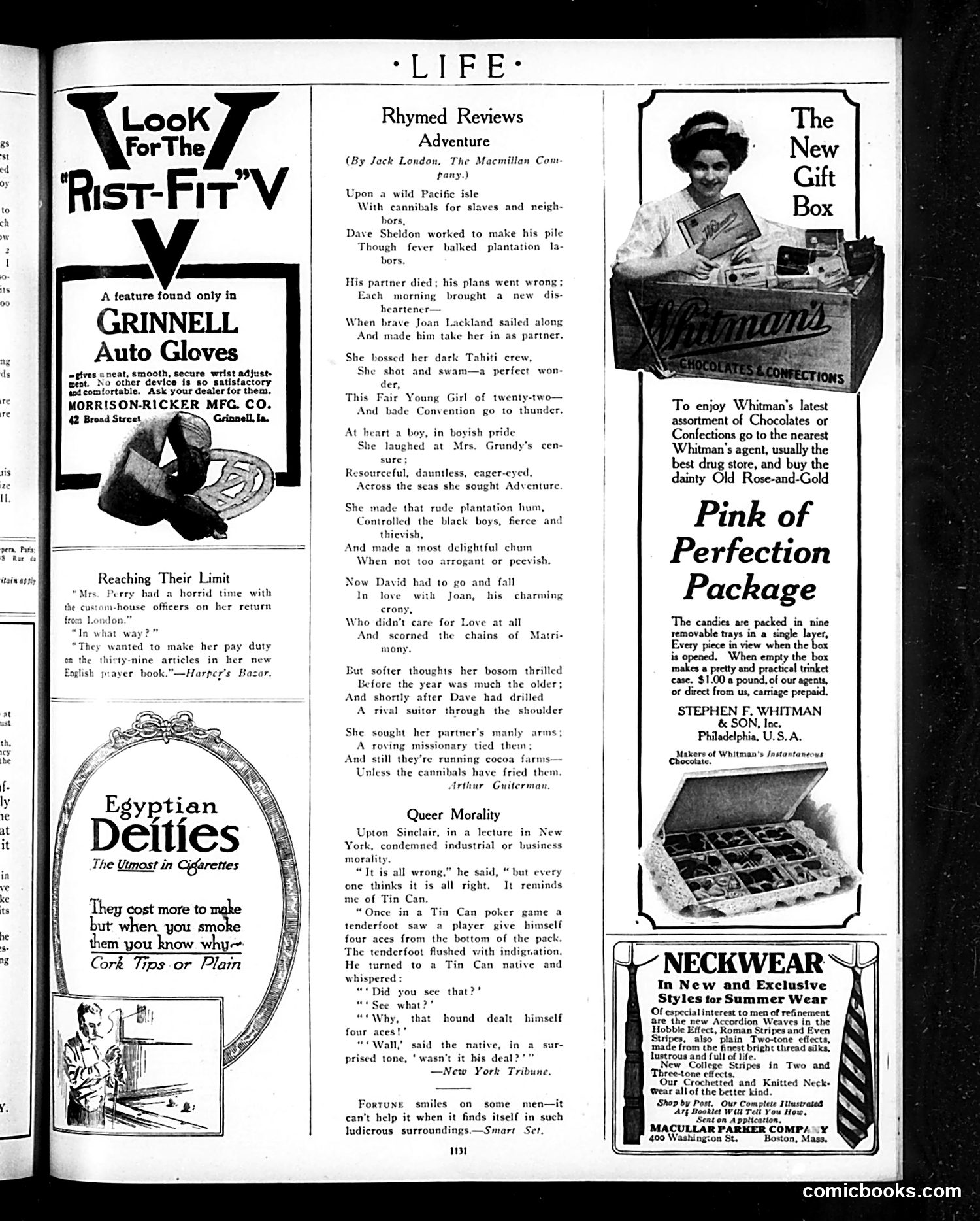
This page primarily contains **advertisements and light satirical content** rather than political commentary. The main satirical pieces are brief, genteel jokes: 1. **"Reaching Their Limit"**: A pun about customs duties on a prayer book—wordplay on "articles" (clothing items vs. religious content). 2. **"Queer Morality"**: A brief anecdote attributed to socialist lecturer Upton Sinclair criticizing business ethics. The humor derives from a Tin Can frontier poker player's amoral logic: when caught cheating by dealing himself four aces, he asks innocently "wasn't it his deal?"—exposing how people rationalize obviously wrong behavior as normal. The bulk of the page consists of **period advertisements** for auto gloves, cigarettes, chocolates, and neckwear—typical 1910s-era magazine filler. The **poetry review** of Jack London's *Adventure* is straightforward literary commentary, not satire. Overall, this is a standard Life magazine miscellany page: light humor, advertisements, and book reviews with minimal social critique.
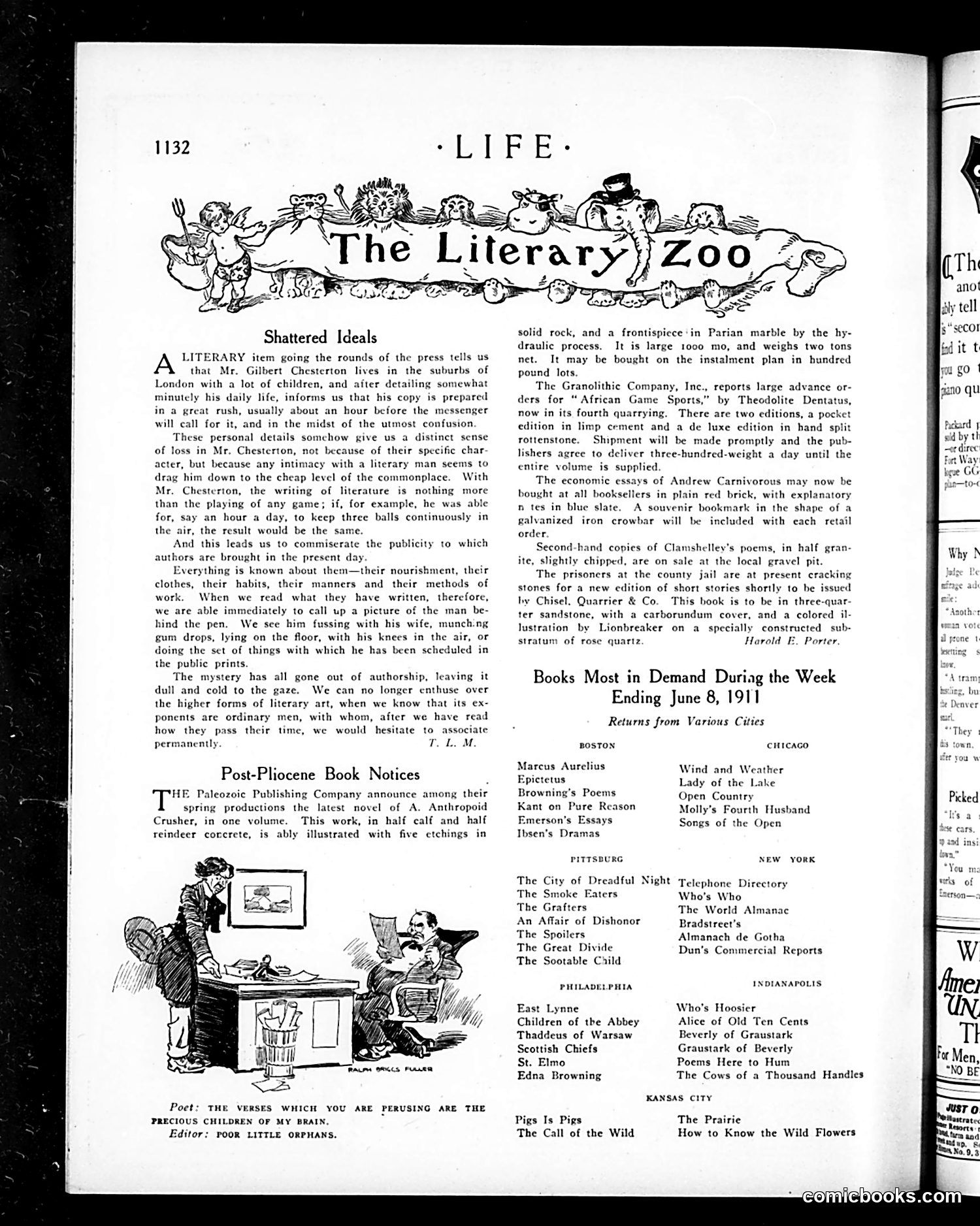
This page contains two satirical pieces mocking literary culture circa 1911. **"Shattered Ideals"** critiques the celebrity culture surrounding authors, specifically Gilbert Chesterton. The piece laments that excessive biographical publicity about writers—their daily habits, family life, quirks—destroys the mystique of literature. Knowing Chesterton "fusses with his wife, munching gum drops" diminishes appreciation for his work. The satire targets early 20th-century journalism's invasive interest in authors' personal lives, arguing that demystifying writers reduces literature to mere craft rather than art. **"Post-Pliocene Book Notices"** is absurdist satire using deliberately ridiculous fictional book titles and publishers. It mocks pretentious publishing through impossible descriptions: books bound in "half calf and half reindeer concrete," weighing "two tons," sold in "hundred pound lots." The fake author names (Anthropoid Crusher, Carnivorous, Clamshelley) parody literary culture. A final joke equates imprisoned laborers quarrying stones with prisoners "cracking stones for a new edition of short stories"—darkly suggesting mass-produced literature as literal hard labor.
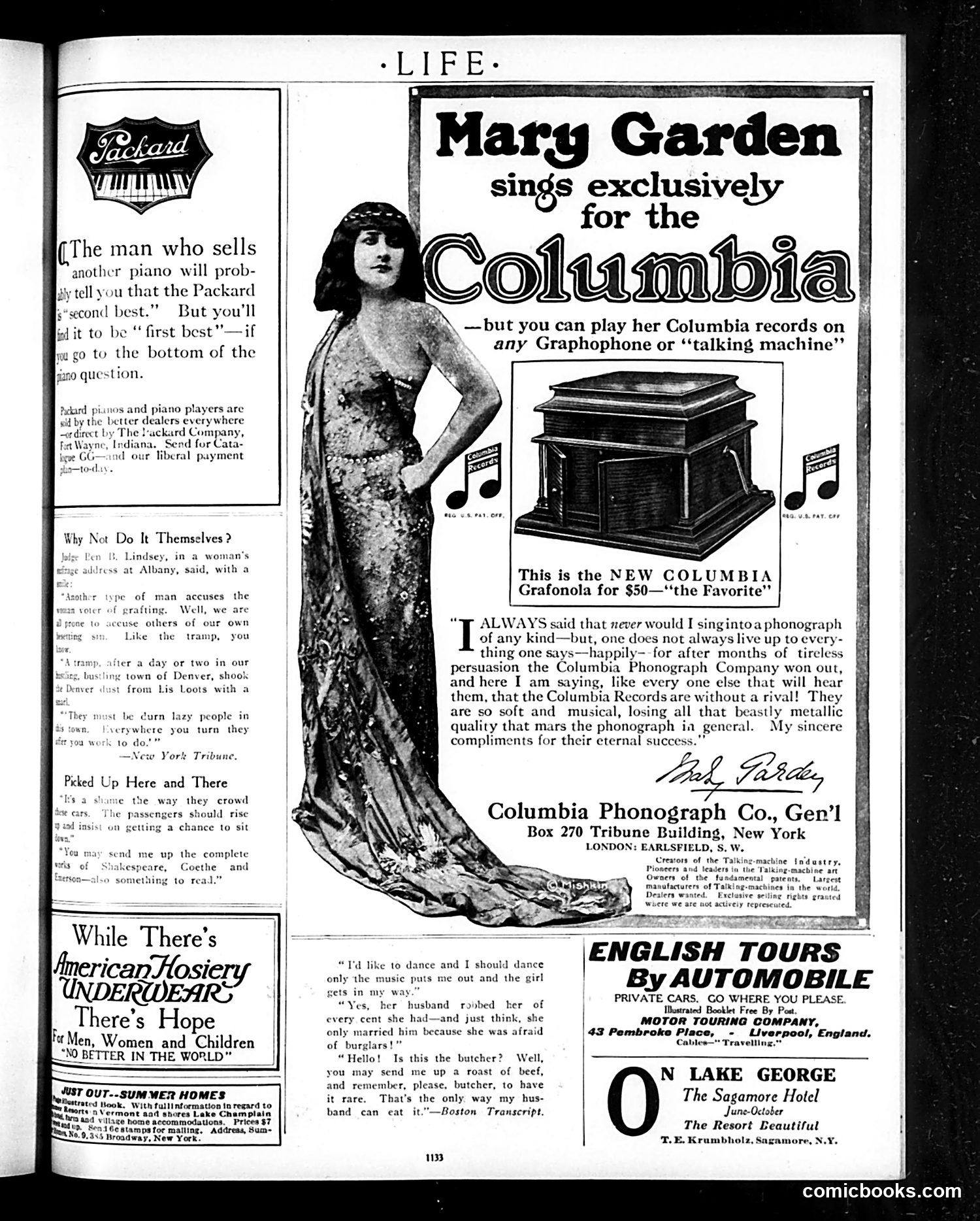
This page is primarily **advertising**, not satirical content. The dominant feature is a large advertisement for Columbia Phonograph Company, prominently featuring opera singer Mary Garden endorsing Columbia records and gramophones. The smaller left-column items are brief humorous anecdotes typical of Life's miscellaneous filler content—jokes about piano salesmen, lazy townspeople, and the absurdity of certain domestic situations. None constitute political satire. The Mary Garden advertisement is the page's significant content: it capitalizes on the famous soprano's exclusive recording contract with Columbia to market their new "$50 Grafonola" phonograph. Garden's quote emphasizes the superior sound quality of Columbia records compared to competitors, using her celebrity status as a sales tool—a common early 20th-century advertising strategy. The remaining ads promote American hosiery, English automobile tours, and a Lake George resort, typical of Life's commercial content from this era.
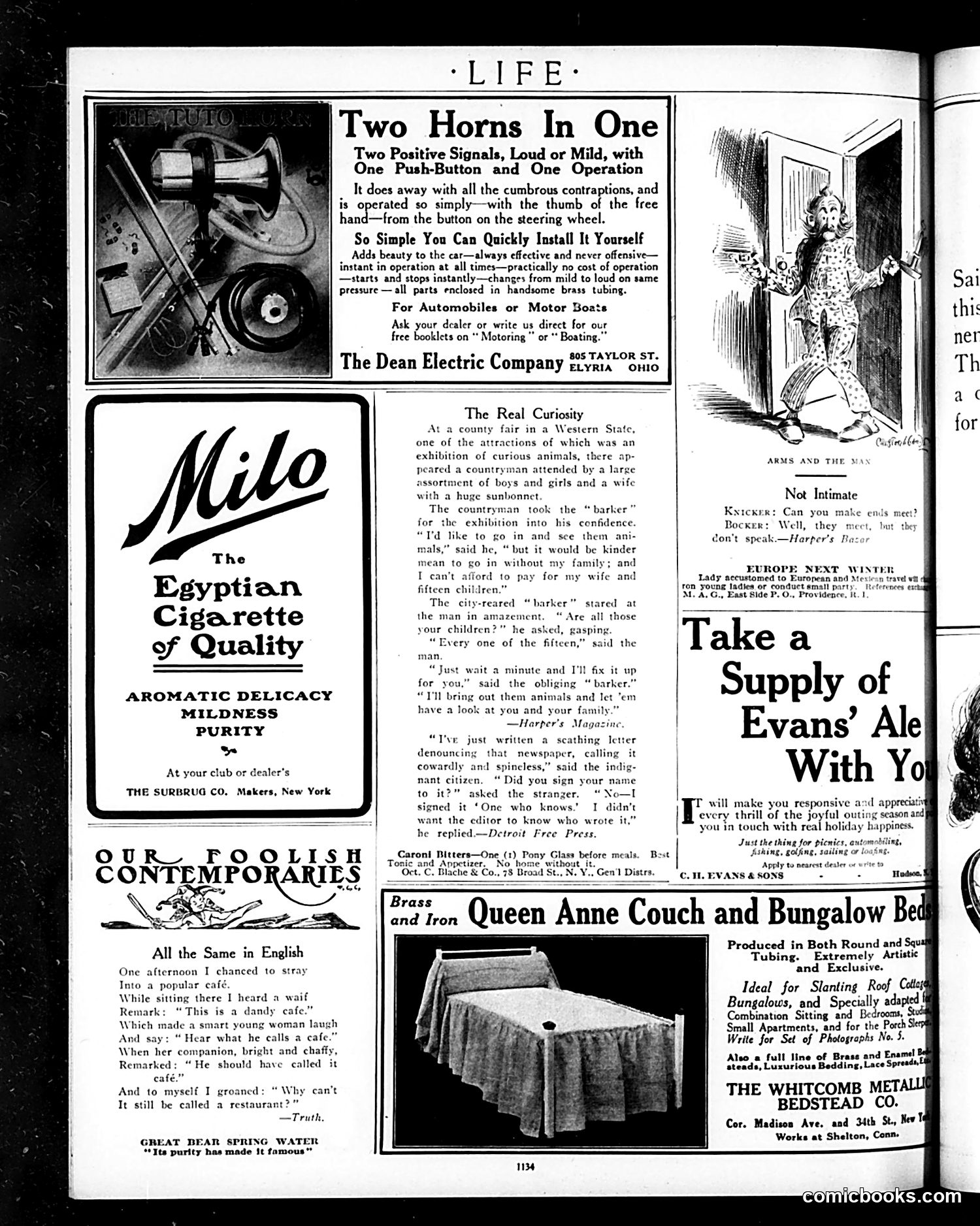
This page is primarily **advertising**, with brief satirical pieces inserted between ads. The main content includes: **"Two Horns In One"** (top): A car horn advertisement touting a dual-function device operable by thumb from the steering wheel—practical innovation marketed as simple and elegant. **"Our Foolish Contemporaries"** (middle left): A brief satire about linguistic affectation. A visitor praises a café using French pronunciation; companions mock him for pretension. The joke: English speakers affecting French words while speaking English appears absurd. **"The Real Curiosity"** (center): A humorous anecdote about a poor countryman with fifteen children seeking cheap admission to a traveling animal exhibition. The "barker" (carnival announcer) offers to display the family *as* curiosities instead—the joke being that large, poor families were considered oddities worthy of exhibition. Other pieces mock anonymous letter-writing and awkward social encounters. **The page contains no political cartoons**—it's a typical early-20th-century Life magazine mixture of advertising and light comedy sketches.
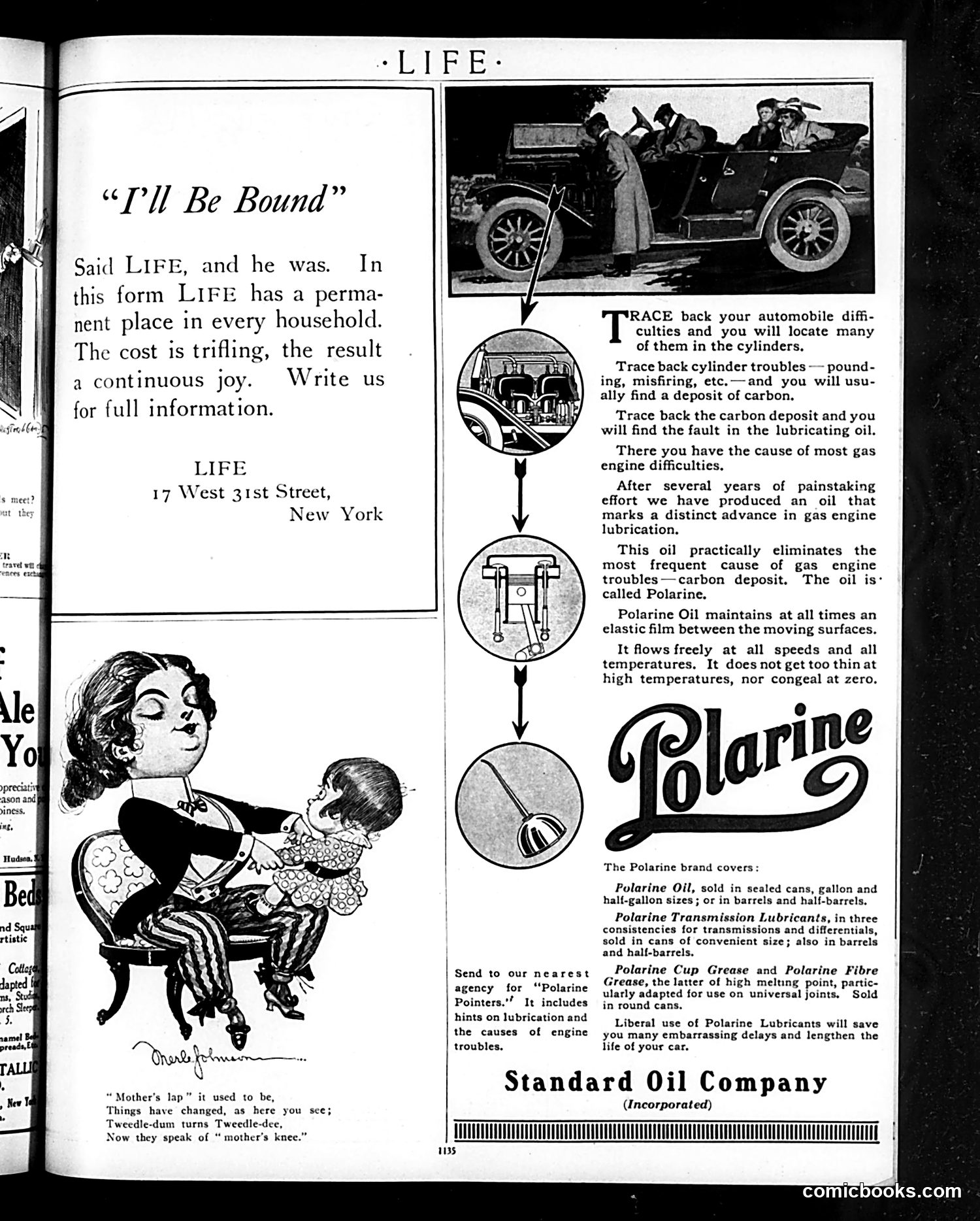
This page combines editorial content with advertising. The left side features a small satirical cartoon about changing childhood: a woman holds a child on her lap, with text joking that what was once called "mother's lap" is now called "mother's knee"—a gentle jab at how times and language have shifted. The main content is a Standard Oil Company advertisement for Polarine motor oil. The ad uses a diagnostic flowchart (top to bottom through engine cylinders) to explain engine problems, concluding that proper lubrication prevents carbon buildup. A photograph shows people in an early automobile. The "Life" nameplate advertisement on the left promotes the magazine itself as an inexpensive, permanent household item bringing "continuous joy." This reflects early 20th-century automotive culture when engine maintenance and proper oils were novel concerns, and when Life magazine positioned itself as essential reading for modern American households.
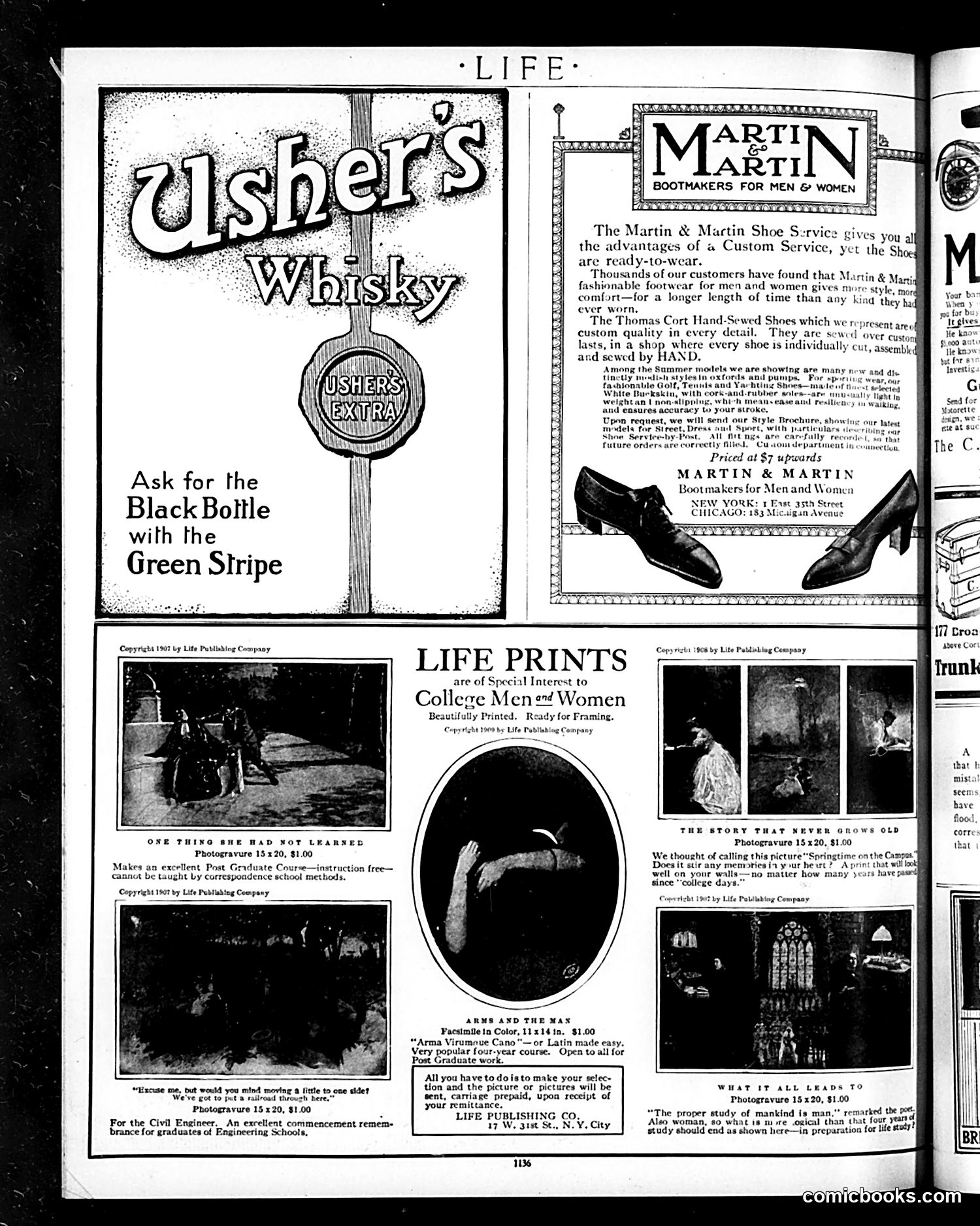
This page is primarily **advertising and product promotion**, not political satire. It contains: **Advertisements:** - Usher's Whisky (top left) - Martin & Martin Bootmakers (top right) — emphasizing handmade quality and custom service **"Life Prints" section (center):** Educational art reproductions for college students, including classical references like "Arms and the Man" (Virgil's Latin work) and sentimental college nostalgia imagery ("The Story That Never Grows Old"). **Small satirical cartoons** (left column) appear to mock educational limitations—one suggests a young woman learned everything *except* practical domestic skills; another jokes about engineering students needing real-world experience beyond coursework. The overall tone reflects early 1900s values: craftsmanship, higher education for the aspiring middle class, and romantic notions of college life. The page demonstrates how *Life* blended advertising with humor and cultural commentary for educated readers.
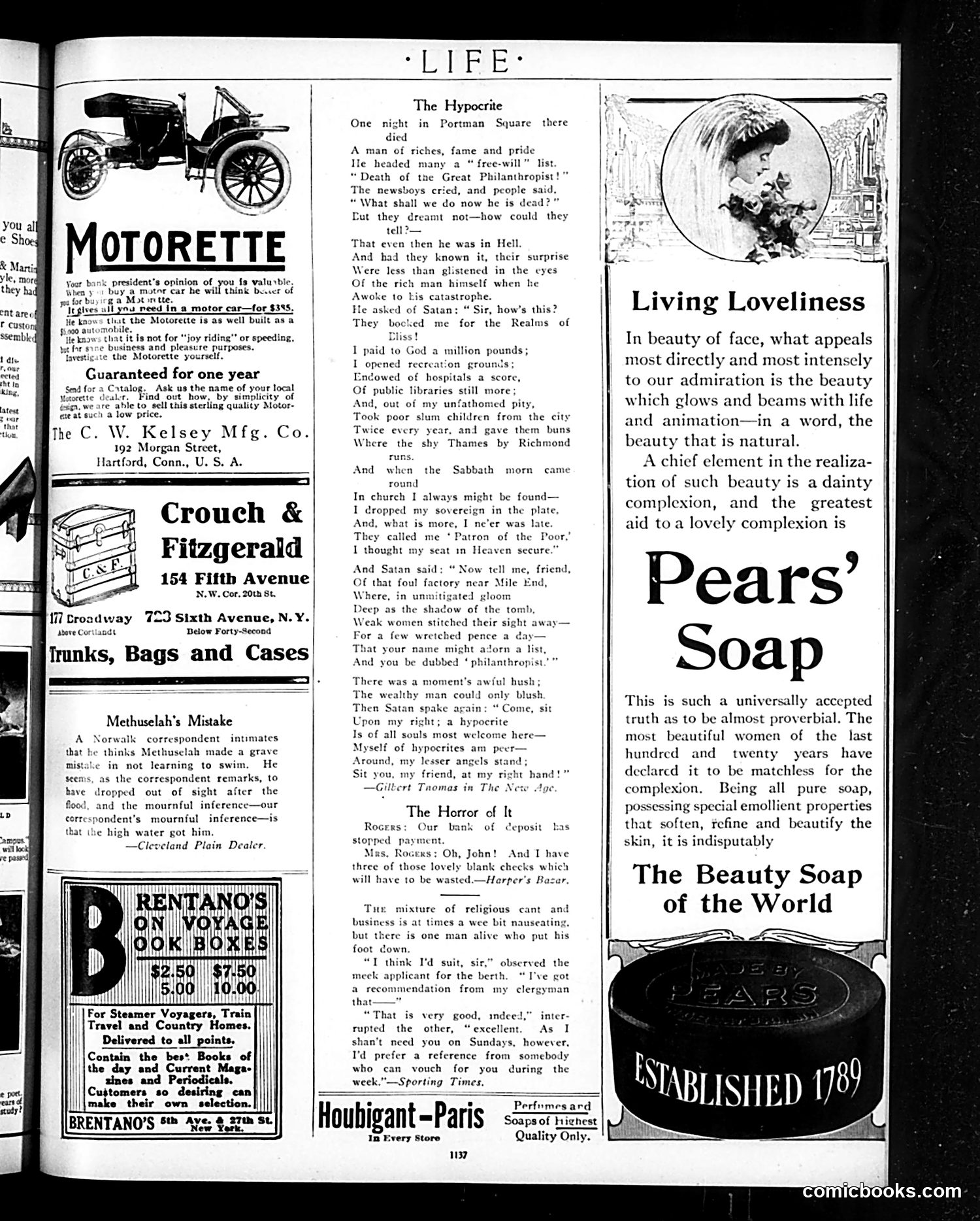
This page primarily contains a lengthy narrative poem titled "The Hypocrite," illustrated with a circular vignette image. The poem satirizes a wealthy philanthropist who dies and discovers his good works don't guarantee heavenly reward. **The satire's point:** A rich man boasts of his charitable donations—money to God, hospitals, libraries, and poor children—and believes he's secured a place in Heaven. However, Satan reveals the hypocrisy: while the man gave money, he ignored the brutal working conditions of factory women earning "a few wretched pence a day." His philanthropy was performative; he attended church regularly for social standing ("Patron of the Poor") but remained indifferent to actual human suffering. **The message for modern readers:** This critiques how wealthy individuals can maintain a public image of generosity while ignoring systemic exploitation. The "free-will" donations serve reputation rather than genuine moral commitment. It's a Victorian-era complaint about how charity can mask complicity in social injustice—particularly regarding working-class women's exploitation. The surrounding advertisements for automobiles and luggage are typical period filler.
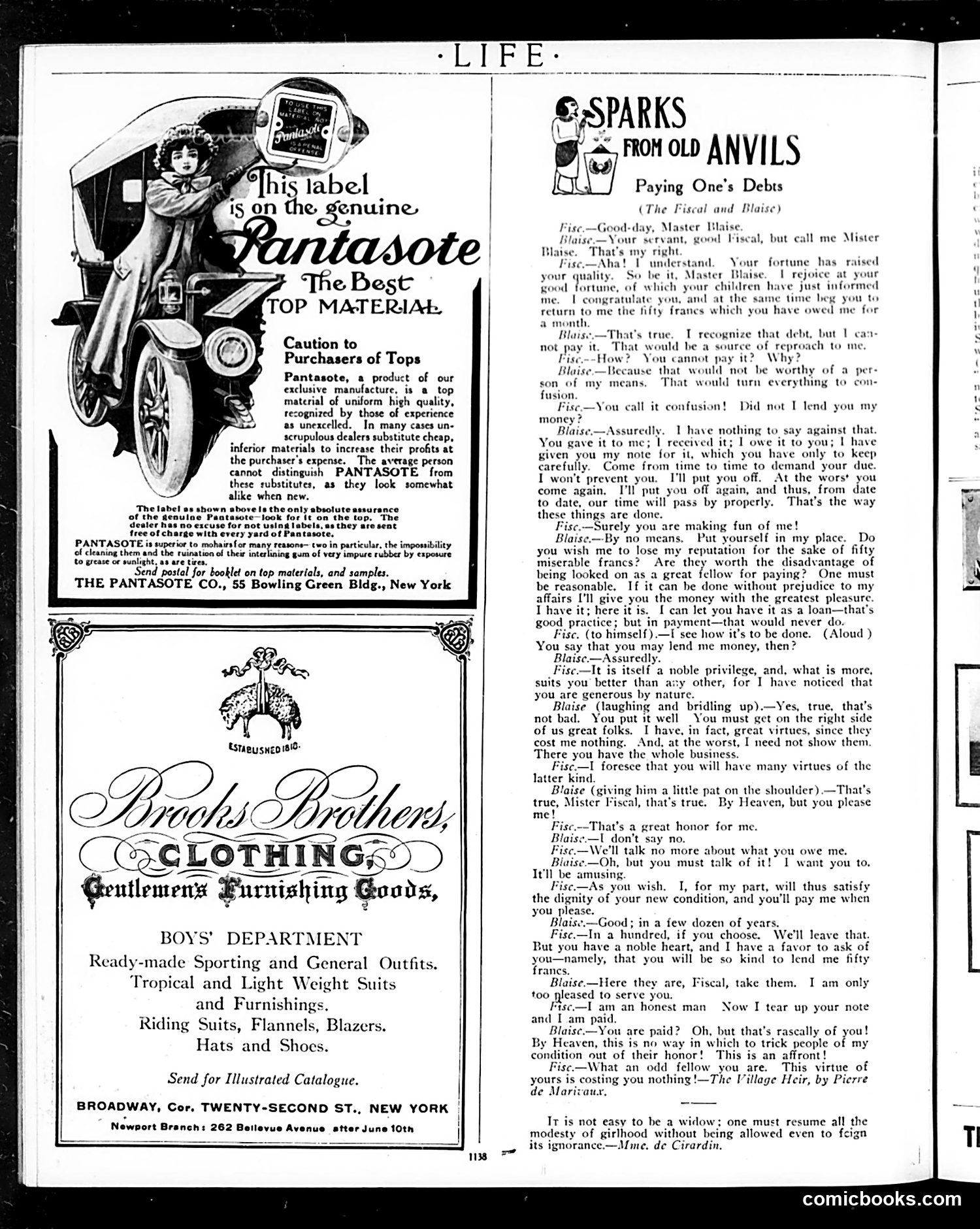
This page features a satirical dialogue titled "Paying One's Debts" between two characters: Fiscal (a creditor) and Blaise (a debtor). The humor lies in Blaise's elaborate rationalization for refusing to pay a fifty-franc debt he owes. Blaise employs absurd logic: paying the debt would damage his reputation as a "great fellow," so instead he offers to *lend* Fiscal money—a "noble privilege" that costs him nothing since he claims poverty. He argues that delaying payment indefinitely through excuses preserves his dignity better than honest repayment. The satire mocks wealthy or privileged individuals who rationalize financial dishonesty through twisted morality. Blaise represents the self-serving debtor who prioritizes social appearance over obligation, performing generosity (lending) while avoiding responsibility (paying). Fiscal's growing exasperation shows the absurdity of this logic. This reflects broader social commentary on honor, class pretense, and the elaborate excuses the privileged use to evade accountability—timeless themes that explain why *Life* magazine published this dialogue.
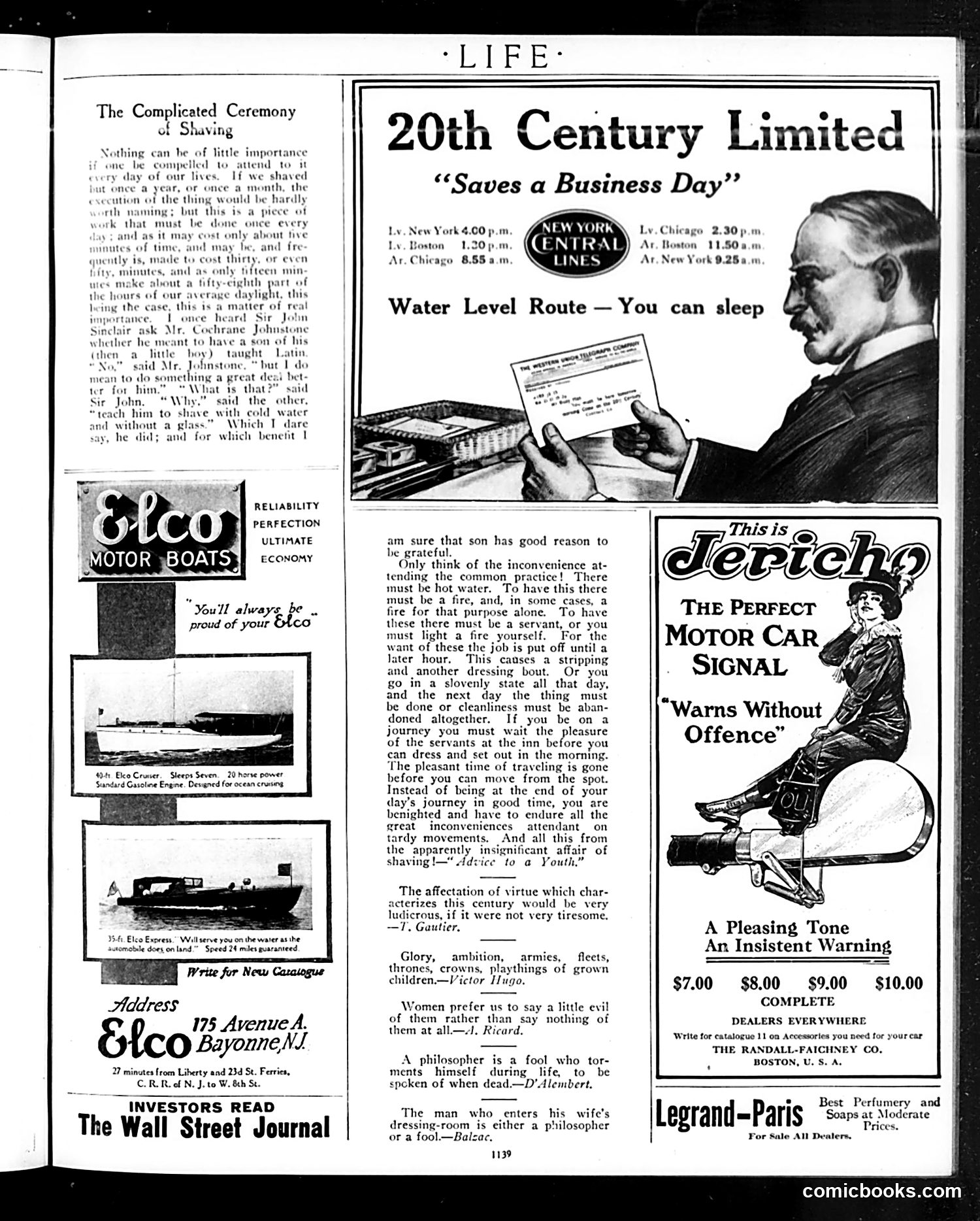
This page mixes editorial content with advertising typical of early 20th-century Life magazine. **Main Editorial Content:** "The Complicated Ceremony of Shaving" is a humorous essay arguing that daily shaving, though seemingly trivial, wastes enormous time and creates logistical burdens. It requires hot water, servants or fire-building, and delays travel. The author cites a anecdote about Sir John (unclear which historical figure) teaching his son to shave with cold water without a mirror—presenting this as virtuous efficiency. The piece is satirizing Victorian-era complaints about modern inconveniences and mock-praising austere self-discipline. **Advertisements:** The page features several product ads—Elco motor boats, the 20th Century Limited train (emphasizing speed and comfort), Jericho motor car signals, and Legrand-Paris perfume—typical of the magazine's upscale readership. **No political cartoon** is present on this page; it's primarily satirical prose with period advertisements.
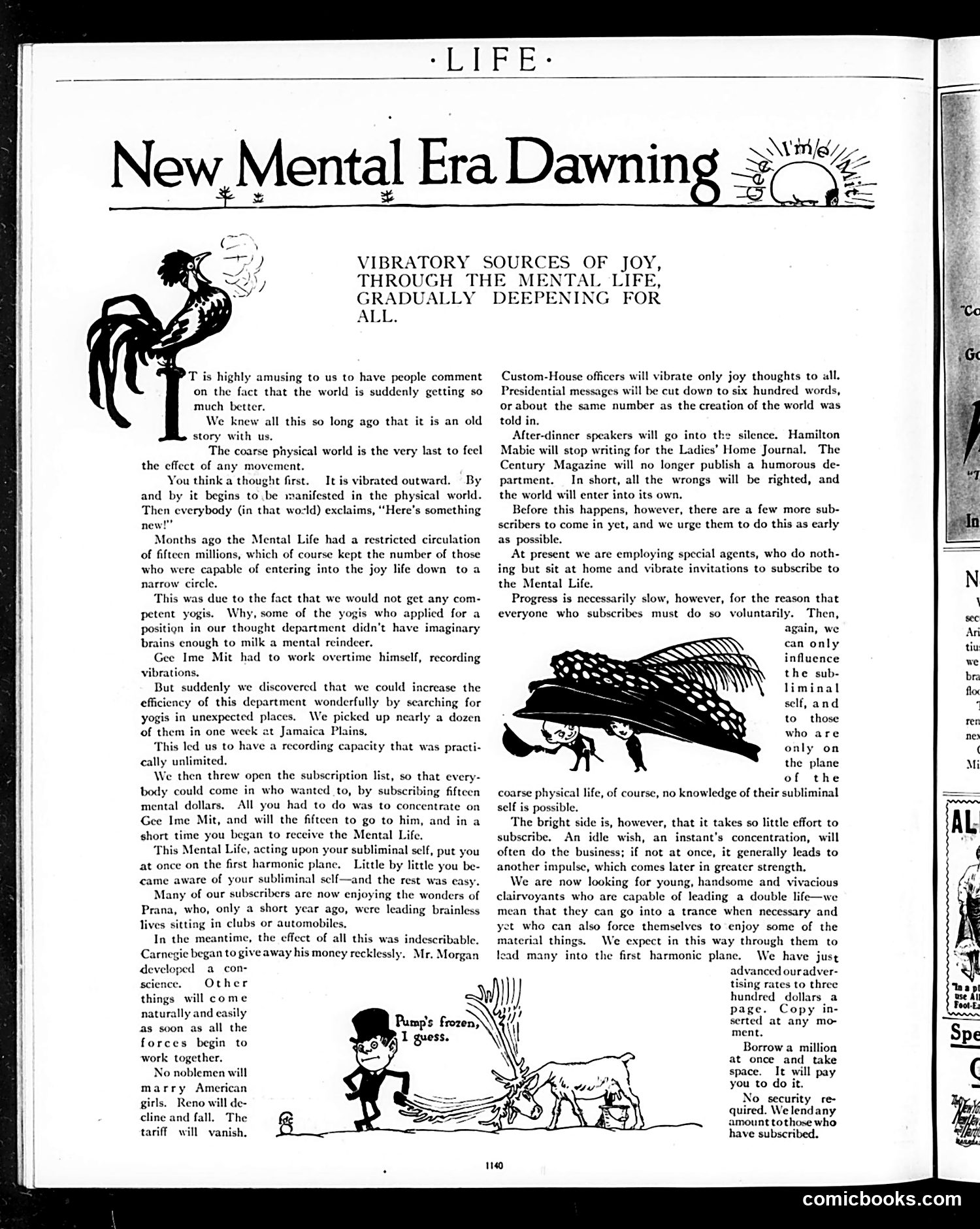
This is a satirical attack on the "New Thought" movement, a late 19th/early 20th-century pseudo-spiritual trend claiming thoughts could physically reshape reality through "vibrations" and mental concentration. The article mockingly describes a fictional "Mental Life" subscription service (15 "mental dollars") promising subscribers would reach higher spiritual planes by concentrating on a character named "Gee Ime Mit" (likely a satirical name). The joke is the absurdity: the service claims wealthy industrialists like Carnegie and Morgan will suddenly become generous, politicians will write shorter messages, and divorce rates will plummet—all through mere thought transmission. The cartoons illustrate the ridiculousness: one shows a figure with a rooster (representing dawn/new era), another depicts "Pump's frozen, I guess"—mocking the movement's grandiose but nebulous claims. **The satire targets**: credulous wealthy Americans embracing pseudo-science, the movement's vague jargon ("subliminal self," "harmonic planes"), and its promise of effortless transformation—just wish hard enough.
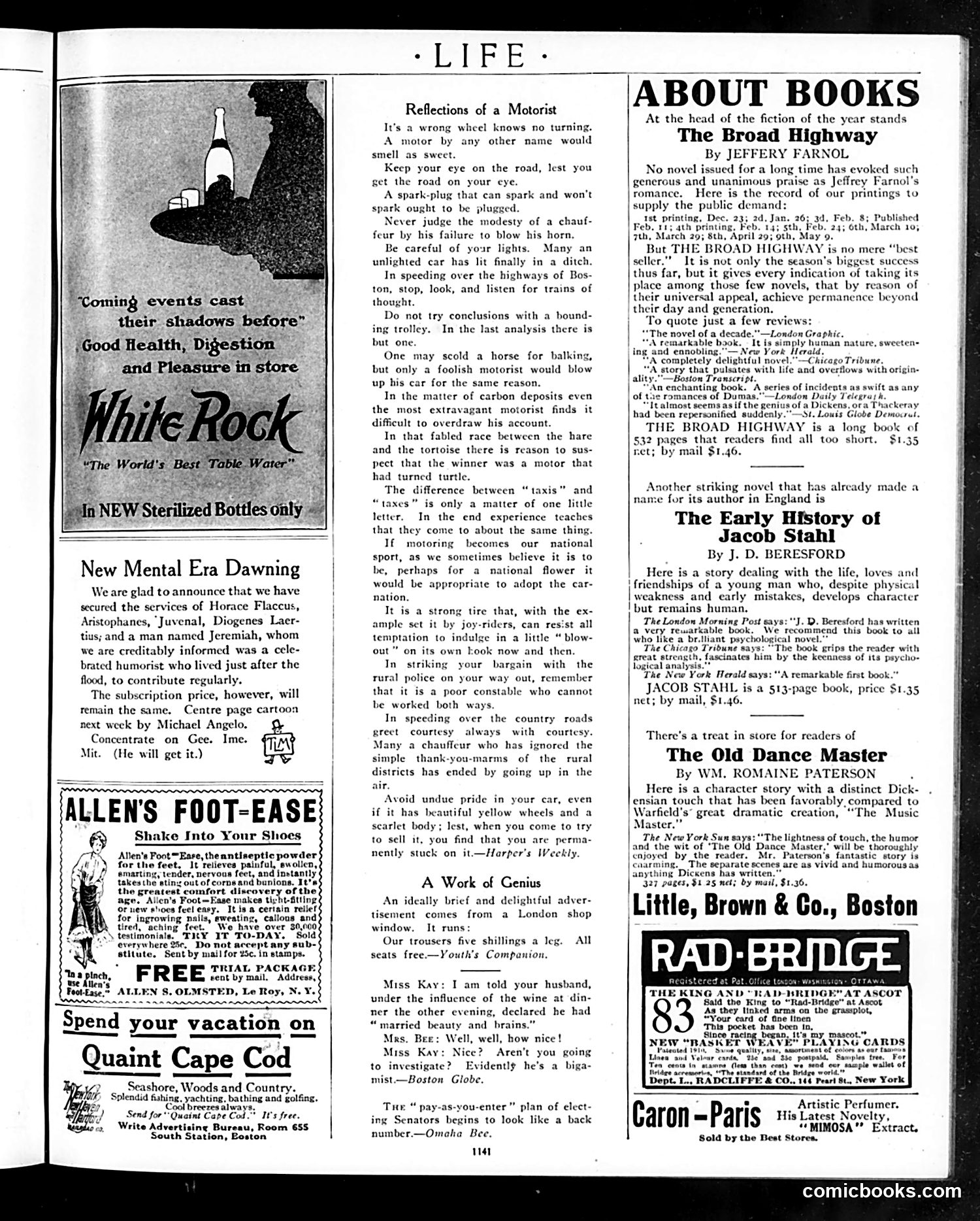
This is primarily a **advertisements and humor page** from Life magazine, not a political cartoon page. The main content consists of: **"Reflections of a Motorist"** — A humorous essay using motor-car culture as satire. Early 1900s automobiles were still novel and often unreliable. The jokes mock motorists' carelessness, arrogance, and mechanical ignorance (blown horns, reckless speeding, overheating engines that "blow out"). References to bribing "rural police" and hitting ditches reflect contemporary anxieties about this new technology. **Book advertisements** promote *The Broad Highway* as the year's bestselling novel, listing multiple printings as proof of its popularity. **Product ads** (Allen's Foot-Ease, White Rock Water, Rad-Bridge card game) use typical period advertising rhetoric. The page contains **no significant political satire** — it's primarily commercial content with light social humor about automobiles and consumerism targeting affluent readers who could afford cars and books.
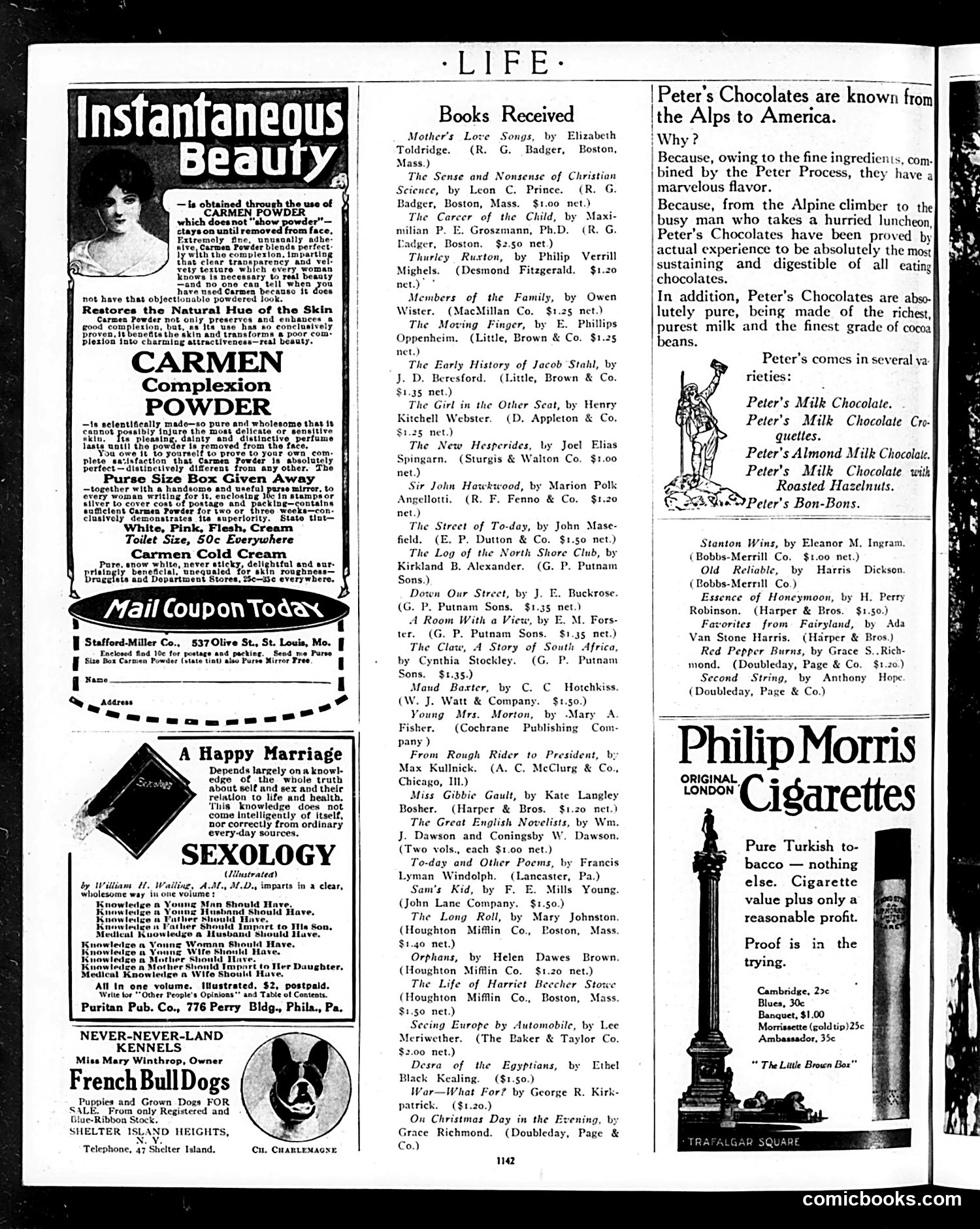
This is a **commercial advertisement and book review page** from *Life* magazine, **not a satirical political cartoon page**. The page contains: - **Multiple product advertisements**: Carmen Complexion Powder (using dated beauty claims about "natural hue"), a marriage/sex education book titled *Sexology*, and French Bulldog puppies for sale - **A books received section**: A straightforward list of contemporary fiction and non-fiction titles with publishers and prices **Why this matters for modern readers**: The ads reveal early 20th-century consumer culture—beauty products with dubious scientific claims, the commercialization of intimate education, and leisure pursuits like dog breeding. The book titles suggest *Life*'s educated, middle-class audience interested in literature, social criticism, and self-improvement. There are no caricatures, political references, or satire on this particular page.
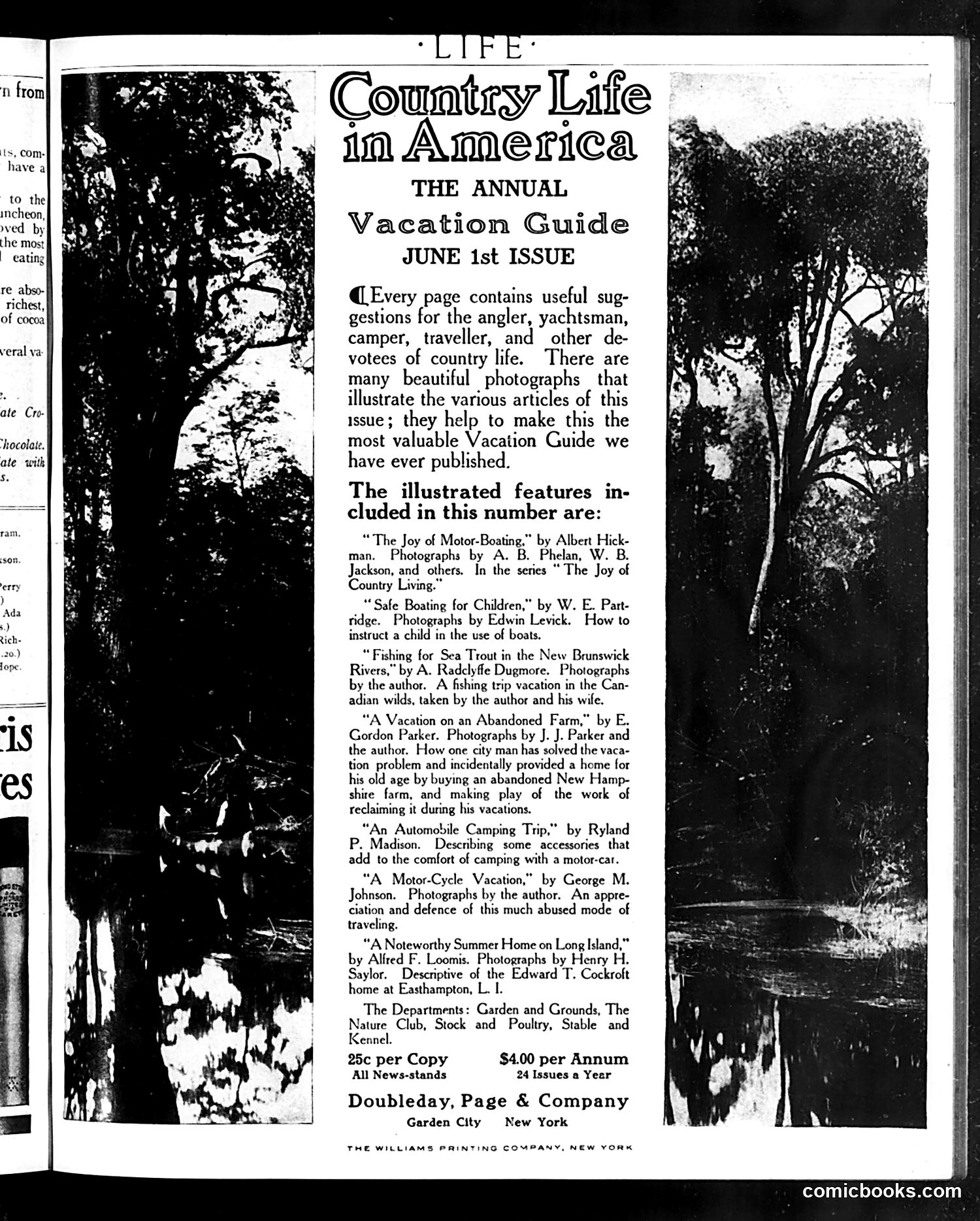
This is a **title page and advertisement**, not a cartoon or satirical content. It announces Life magazine's annual "Country Life in America" vacation guide for the June 1st issue. The page promotes articles about leisure activities for affluent Americans: motor-boating, safe boating for children, fishing trips in Canada, abandoned farm vacations, automobile camping, motorcycle touring, and a noteworthy Long Island summer home. The decorative photographs on either side show scenic natural settings—trees and water—establishing the aspirational "country life" aesthetic being marketed. **Context for modern readers**: This reflects early 20th-century American attitudes where "vacation" and "country life" were luxuries for the wealthy or middle-class urban professionals seeking escape. The emphasis on motor-boating, motorcycles, and automobiles shows these were still novel recreational technologies. The abandoned farm article notably pitches rural property as a retirement investment for city workers—reflecting period anxieties about aging and urbanization.
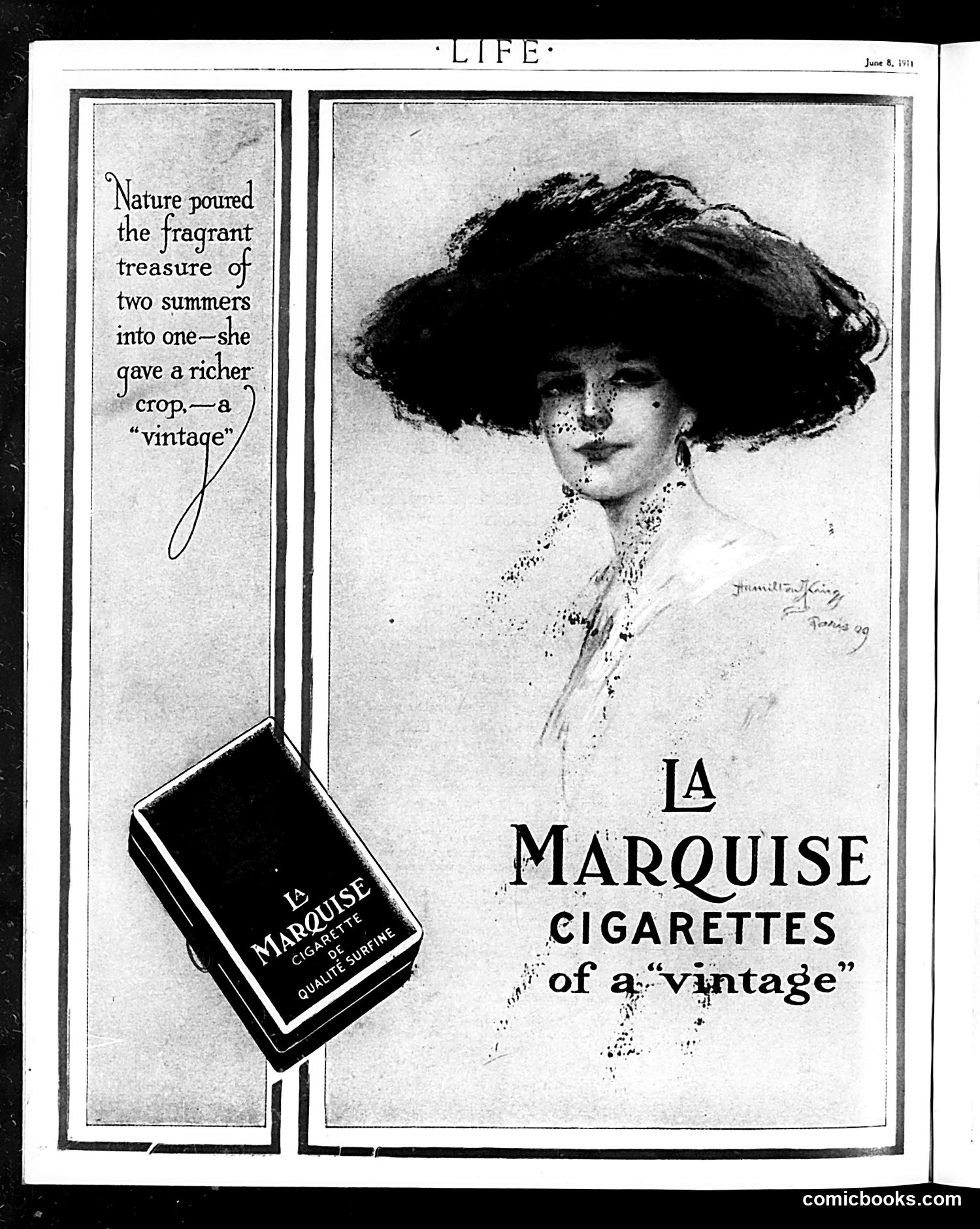
This is a cigarette advertisement rather than political satire. The page promotes "La Marquise" cigarettes, described as being of a "vintage" quality. The ad uses an extended metaphor comparing cigarettes to wine: just as a fine vintage wine concentrates the flavors of two summers into one bottle, these cigarettes supposedly offer concentrated quality. The elegant illustration of a fashionably dressed woman wearing a large, fashionable hat typical of 1911 (the publication date) emphasizes luxury and sophistication—marketing cigarettes as an upscale product for refined consumers. The advertisement targets the era's association of cigarette smoking with elegance and modernity, particularly among women, who were increasingly depicted as cigarette consumers in early 20th-century advertising.