
Life, 1911-06-08 · page 17 of 44
Life — June 8, 1911 — page 17: what you’re looking at
What you’re looking at
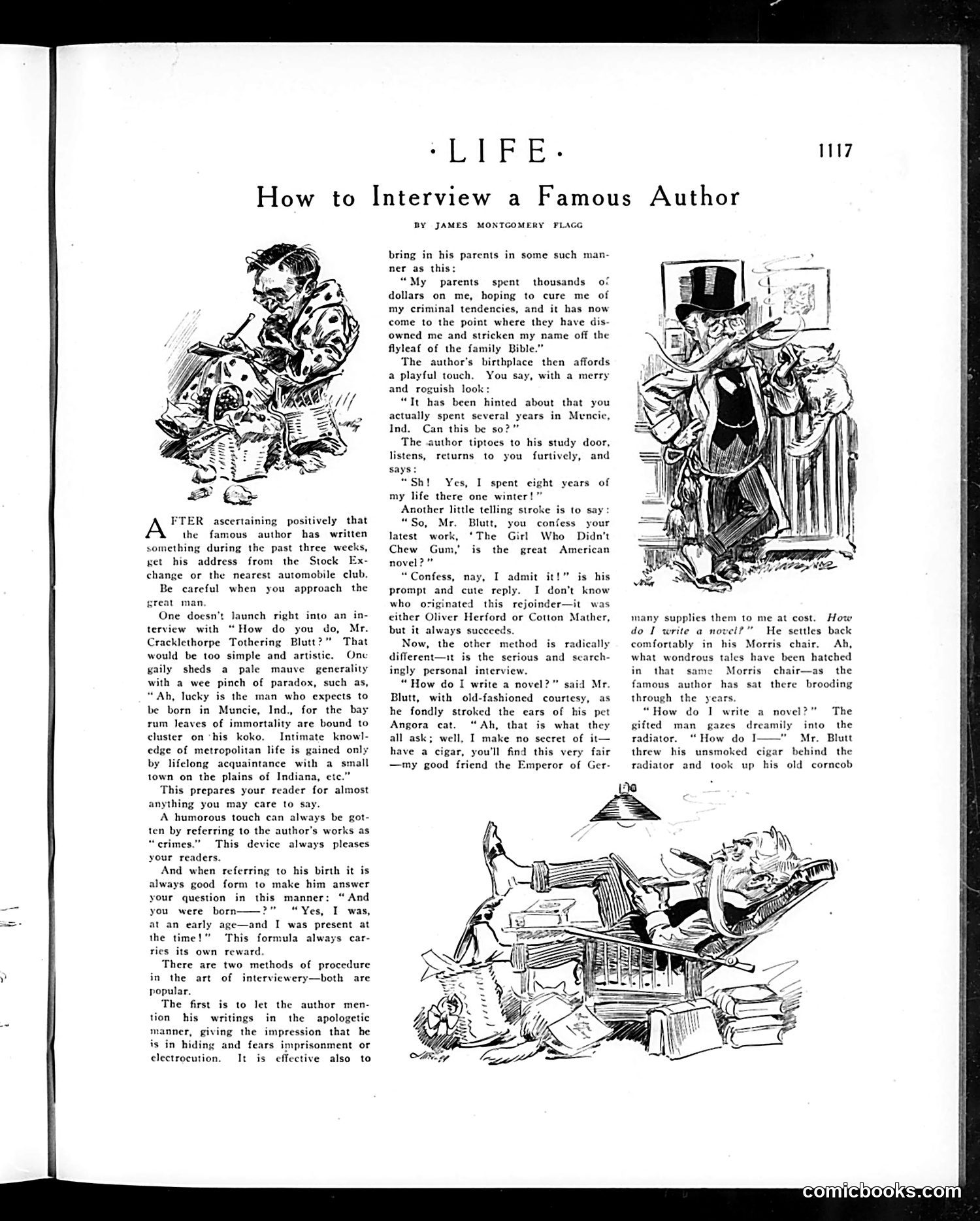
This humorous article by James Montgomery Flagg mocks the pretentious conventions of celebrity literary interviews. The piece satirizes both interviewer and author stereotypes popular in early 20th-century magazines. The satire targets: **Interview tactics**: Flagg ridicules formulaic questions—asking authors about their Indiana hometowns, referring to their books as "crimes," and using strained witticisms to seem clever. **Author affectations**: The fictional "Mr. Cracklethorpe Tothering Blutt" exemplifies the pretentious, evasive author who hides behind theatrical mannerisms (tiptoeing furtively, stroking Angora cats, gazing "dreamily into radiators") while discussing his craft in vague generalities. **The Morris chair**: A recurring comedic image—the author's supposedly profound creative process reduces to lounging furniture, suggesting empty pretension rather than genuine inspiration. The illustrations show interviewers fawning over affected authors in absurdly theatrical poses, emphasizing how both parties perform exaggerated roles rather than conducting genuine conversation.
📄 Transcribed text from this page (OCR, searchable)
Machine-transcribed from the original scan — historical spelling and the odd misread are preserved.
FTER ascertaining positively that the famous author has written something during the past three weeks, xet his address from the Stock change or the nearest automobile club. Be careful when you approach the great man. One doesn’t launch right into an in- terview with “How do you do, Mr. Cracklethorpe Tothering Blutt?” That would be too simple and artistic. Onc gaily sheds a pale mauve generality with a wee pinch of paradox, such as, “Ah, lucky is the man who expects to be born in Muncie, Ind., for the bay rum leaves of immortality are bound to cluster on ‘his koko, Intimate knowl- edge of metropolitan life is gained only by lifelong acquaintance with a small town on the plains of Indiana, e This prepares your reader for almost anything you may care to say. A humorous touch can always be got- ten by referring to the author's works as “crimes.” This device always pleases your readers. And when referring to his birth it is always good form to make him answer your question in this manner: “ And you were born——?" “Yes, I was, at an early age—and I was present at the time!” This formula always car- ries its own reward. There are two methods of procedure in the art of interviewery—both are popular. The first is to let the tion his author men- writings in the apologetic manner, giving the impression that he is in hiding and fears imprisonment or clectrocution. It is effective also to ‘LIFE BY JAMES MONTGOMERY PLAGG bring in his parents in some such man- ner as this: “My parents spent thousands of dollars on me, hoping to cure me of my criminal tendencies, and it has now come to the point where they have dis- owned me and stricken my name off the flyleaf of the family Bible.” The author's birthplace then affords a playful touch, You say, with a merry and roguish look: “Tt has been hinted about that you actually spent several years in Mencie, Ind. Can this be so?” The author tiptoes to his study door, returns to you furtively, and listens, says: “Sh! Yes, I spent eight years of my life there one winter!” Another little telling stroke is to say: “So, Mr. Blutt, you confess your latest. work, ‘The Girl Who Didn't Chew Gum,’ is the great American novel?” “Confess, nay, I admit it! prompt and cute reply. I don't know who originated this rejoinder—it was cither Oliver Herford or Cotton Mather, but it always succeeds. Now, the other method is radically different—1 is the serious and search- ingly personal interview. “How do I write a novel?” said Mr. Blutt, with old-fashioned courtesy, as he fondly stroked the ears of his pet Angora cat. “Ab, that is what they all ask; well, I make no secret of it— have a cigar, you'll find this very fair —my good friend the Emperor of Ger- is his Interview a Famous Author many supplies them to me at cost. How do I write a novel?” He settles back comfortably in his Morris chair. Ab, what wondrous tales have been hatched in that Morris chair—as the famous author has sat brooding through the years “How do I write a novel?” The gifted man gazes dreamily into the radiator. “How do I—" Mr. Blutt threw his unsmoked cigar behind the radiator and took up his old corncob same there