
Life, 1911-06-08 · page 25 of 44
Life — June 8, 1911 — page 25: what you’re looking at
What you’re looking at
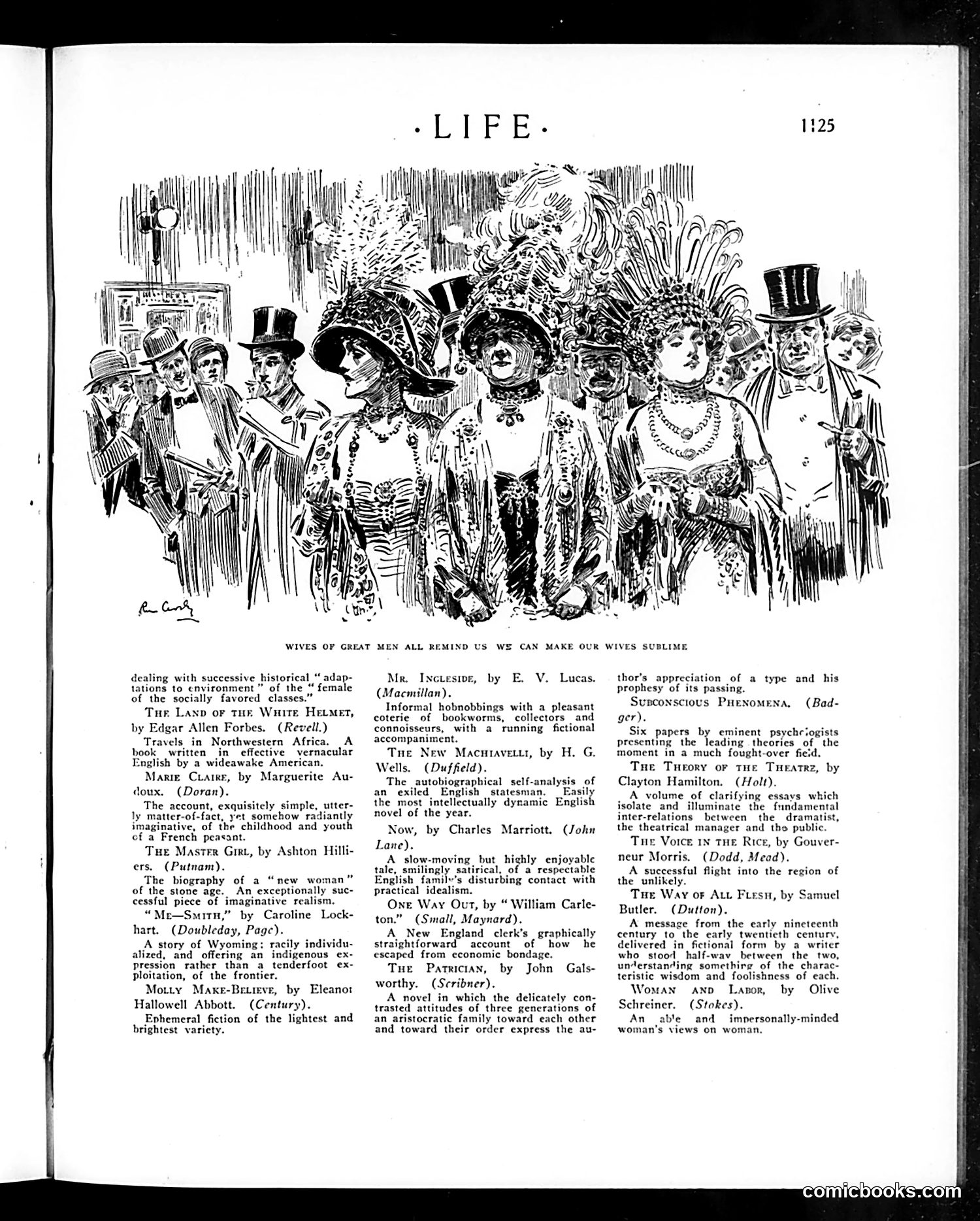
The cartoon depicts a fashionable procession of well-dressed society women and men in Edwardian-era formal attire, with the caption: "Wives of Great Men All Remind Us We Can Make Our Wives Sublime." This is satirical commentary on the "New Woman" movement and evolving gender roles. The caption—a play on Longfellow's poem "A Psalm of Life"—ironically suggests that wives of prominent men should aspire to be "sublime," yet the image shows them as ornately dressed, decorative figures in a social parade, seemingly reduced to fashionable accessories rather than intellectually developed individuals. The accompanying book reviews discuss novels featuring "new women" and female independence (like "The Master Girl," described as a "new woman" story), suggesting tension between emerging feminist ideas and traditional upper-class expectations that women remain decorative and subservient. The satire mocks both the pretensions of society and the gap between women's actual autonomy and their prescribed social roles.
📄 Transcribed text from this page (OCR, searchable)
Machine-transcribed from the original scan — historical spelling and the odd misread are preserved.
WIVES OP GREAT MEN ALL REMIND US WE CAN MAKE OUR WIVES SUBLIME dealing with successive historical “ adap- tations to environment” of the “ female of the socially favored classes.” Tur Lanp or tur Wire Hever, by Edgar Allen Forbes, (Revell.) Travels in Northwestern Africa. A book written in effective vernacular English by a wideawake America Mane Craire, by Marguerite Au- doux. (Doran). The account, exquisitely simple, utter- ly matter-of-fact, yet somehow patient? imaginative, of the childhood and yout! of a French peasant. Tue Master Girt, by Ashton Hilli- ers, (Putnam). The biography of a “new woman” of the stone age. An. exceptionally suc- cessful piece of imaginative realism. “Me—Smitn,” by Caroline Lock- hart. (Doubleday, Page). A story of Wyoming: racily individu- alized, and offering an indigenous ex- Pression rather than a tenderfoot ex- ploitation, of the frontier. Morty Maxe-Betieve, by Eleanor Hallowell Abbott. (Century). Ephemeral fiction of the lightest and brightest variety. Mr. In ive, by E. V. (Macmillan). Informal hobnobbings with a pleasant coterie of bookworms, collectors and connoisseurs, with a running fictional accompaniment. Tue New Macutavettr, by H. G. Wells, (Duffield). The autobiographical self-analysis of an exiled English statesman. aly the most intellectually dynamic English novel of the year. Now, by Charles Marriott. (John Lane). A slow-moving but highly enjoyable tale, smilingly satirical, of a respectable English familv’s disturbing contact with practical idealism. One Way Out, by “ William Carle- ton.” (Small, Maynard). A New England clerk’s graphically straightforward account of how he escaped from economic bondage. Tue Patrician, by John Gals- worthy. (Scribner). A novel in which the delicately con- trasted attitudes of three gencrations of an aristocratic family toward each other and toward their order express the au- Lucas. thor’s appreciation of a type and his prophesy of its passing. Supconscious Puenomena, (Bad- ger). Six papers by eminent psycheiogists presenting the leading theories of the moment in a much fought-over fie:d. Tue Tueory or tHe THEATR2, by Clayton Hamilton. (Holt). _ A volume of clarifying essays which isolate and illuminate the fundamental inter-relations between the dramatist, the theatrical manager and tho public. Tue Voice 1n THE Rice, by Gouver- neur Morris. (Dodd, Mead). A successful flight into the region of the unlikely. Tue Way oF Att Fiesu, by Samuel Butler. (Dutton). A message from the early nineteenth century to the early twentieth centu delivered in fictional form by a writer who stood half-wav between the two, understanding something of the charac- teristic wisdom and foolishness of each. Woman ann Lanor, by Olive Schreiner. (Stokes). An able and imnersonally-minded woman's views on woman.