
Life, 1911-06-08 · page 24 of 44
Life — June 8, 1911 — page 24: what you’re looking at
What you’re looking at
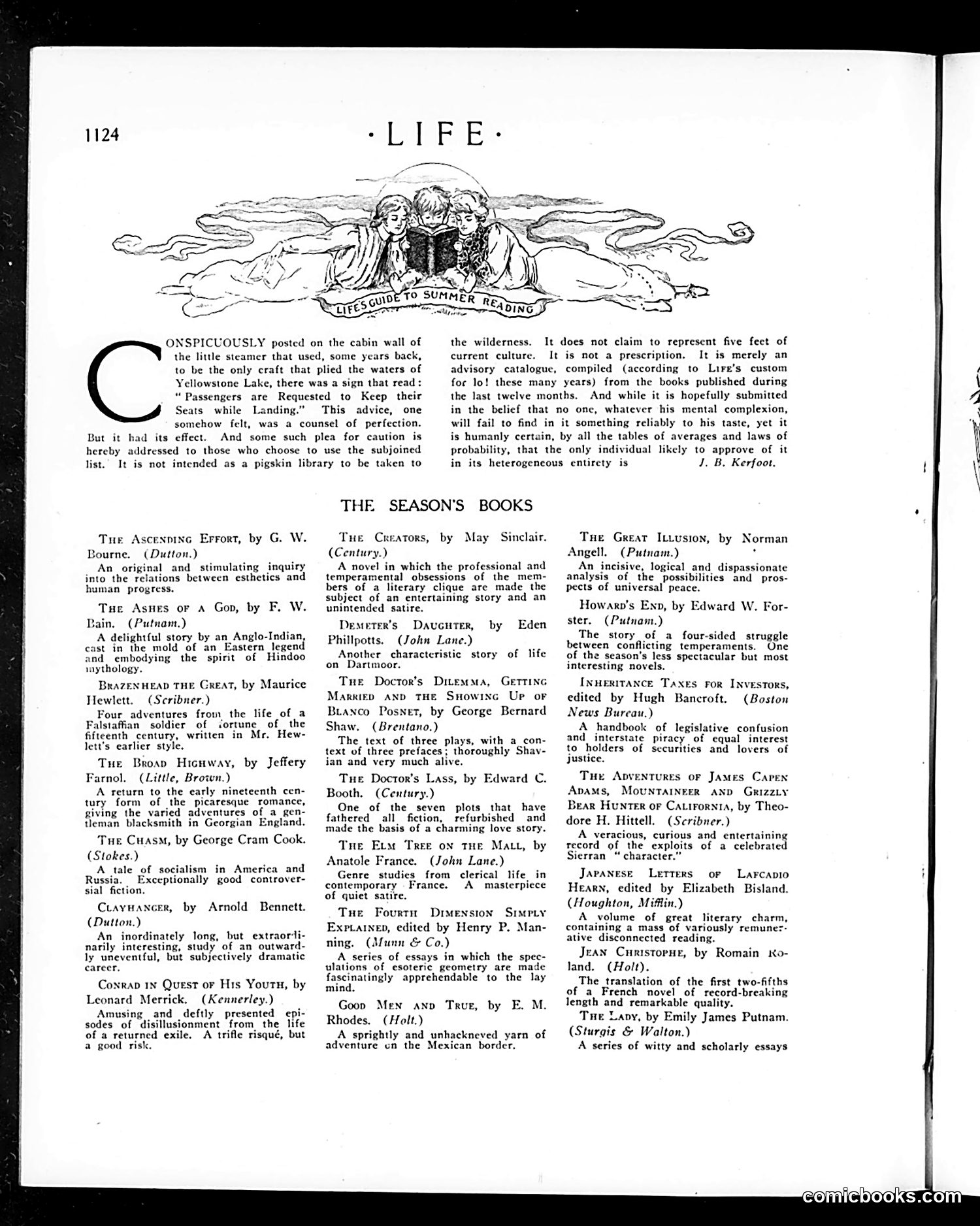
This page is primarily a **book review section** from Life magazine, not a political cartoon. The decorative header shows two figures reading together, illustrating "Life's Guide to Summer Reading." The introductory text by J.B. Kerfoot humorously acknowledges the subjectivity of literary taste. He notes that Life's curated book list—compiled from the previous twelve months' publications—won't please everyone, despite hoping it will. The opening anecdote about a Yellowstone Lake steamship sign ("Passengers are Requested to Keep their Seats while Landing") serves as a humorous analogy: just as that practical warning had limited effect, this book list is well-intentioned advice unlikely to satisfy all readers. The list itself features contemporary early-20th-century literary works by authors like George Bernard Shaw, Anatole France, and Arnold Bennett—representing fiction, philosophy, and social commentary popular during this period.
📄 Transcribed text from this page (OCR, searchable)
Machine-transcribed from the original scan — historical spelling and the odd misread are preserved.
ONSPICUOUSLY posted on the cabin wall of the little steamer that used, some years back, to be the only craft that plied the waters of Yellowstone Lake, there was a sign that read: Passengers are Requested This somehow felt, was a counsel of perfection. And some such plea for caution is hereby addressed to those who choose to use the subjoined list. It is not intended as a pigskin library to be taken to Seats while Landing.” But it had its effect. Tue Ascesnixc Errort, by G. W. Bourne. (Dutton.) An original and stimulating inquiry into the relations between esthetics and human progress. Tue Asnes or A Gop, by F. W. Bain. (Putnam.) A delightful story by an Anglo-Indian, cast in the mold of an Eastern legend and embodying the spirit of Hindoo iaythology. Brazen HEAD THE Great, by Maurice Hewlett. (Scribner.) Four adventures from the life of a Falstaffian soldier of sortune of the fifteenth century, written in Mr. Hew- lett's earlier style. Tue Broan Hicuway, by Jeffery Farnol. (Little, Brown.) A return to the early nineteenth cen- tury form of the picaresque romance, giving the varied adventures of a tleman blacksmith in Georgian England. Tue CuasM, by George Cram Cook. (Stokes.) A tale of socialism in America and Russia. Exceptionally good controver- sial fiction. CLAYHANGER, by (Dutton.) An inordinately long, but extraorti- narily interesting, study of an outward- ly uneventful, but subjectively dramatic career. Conrap IN Quest or Hts Youtu, by Leonard Merrick, (Kennerley.) Amusing and deftly presented epi- sodes of disillusionment from the life of a returned exile, A trifle risqué, but a good risk. Arnold Bennett. the wilderness. current culture. to Keep their advice, one THE SEASON'S BOOKS Tue Creators, by Sinclair. (Century.) A novel in which the professional and temperamental obsessions of the mem- bers of a literary clique are made the subject of an entertaining story and an unintended satire. Deseter’s Daucuter, Phillpotts. (John Lane.) Another characteristic story of life on Dartmoor. Tne Doctor's Ditesaaa, Gettinc Marktep and THE SHow1nc Up oF Bianco Posn by George Bernard Shaw. (Brentano.) The text of three plays, with a con- text of three prefaces; thoroughly Shav- ian and very much alive. Tue Doctor’s Lass, by Edward C. Booth. (Century.) One of the seven plots that have fathered all fiction, refurbished and made the basis of a charming love story. Tne Eth Tree on tHe Matt, by Anatole France. (John Lane.) Genre studies from clerical life in contemporary France. A masterpiece of quiet satire. Tue Fourth Dimension Srupiy Exptatnen, edited by Henry P. Man- ning. (Munn & Co.) A series of essays in which the spec- ulations of esoteric geometry are made fascinatingly apprehendable to the lay mind. Goon Men anv True, by E. M. Rhodes. (Holt.) A sprightly and unhackneved yarn of adventure cn the Mexican border. May by Eden It does not claim to represent five fect of It is not a prescription. advisory catalogue, compiled (according to Lire’s custom for lo! these many years) from the books published during the last twelve months. in the belief that no one, whatever his mental complexion, will fail to find in it something reliably to his taste, yet it is humanly certain, by all the tables of averages and laws of probability, that the only individual likely to approve of it in its heterogencous entirety is It is merely an And while it is hopefully submitted J. B. Kerfoot, Tue Great ItLusion, by Norman Angell. (Putnam.) i An incisive, logical and dispassionate analysis of the possibilities and pros- pects of universal peace. Howarv’s Env, by Edward W. For- ster. (Putnam.) The story of a four-sided struggle between conflicting temperaments. One of the season's less spectacular but most interesting novels. Innexitance Ta For In edited by Hugh Bancroft. News Bureau.) A handbook of legislative confusion and interstate piracy of equal interest to holders of securities and lovers of justice. TORS, (Boston Caren Apams, Mountaineer anp Grizziy Bear Hunter or Catirornia, by Theo- dore H. Hittell. (Scribner.) A veracious, curious and entertaining record of the exploits of a celebrated Sierran “ character.” Japanese Letters or Larcapio Hearn, edited by Elizabeth Bisland. (Houghton, Mifflin.) A_volume of great literary charm, containing a mass of variously remuner: ative disconnected reading. Jean Curistopue, by Romain Ko- land. (Holt). The translation of the first two-fifths of a French novel of record-breaking length and remarkable quality. Tre Lapy, by Emily James Putnam. (Sturgis & Walton.) A series of witty and scholarly essays Tue Apventures oF James