
Life, 1911-06-08 · page 26 of 44
Life — June 8, 1911 — page 26: what you’re looking at
What you’re looking at
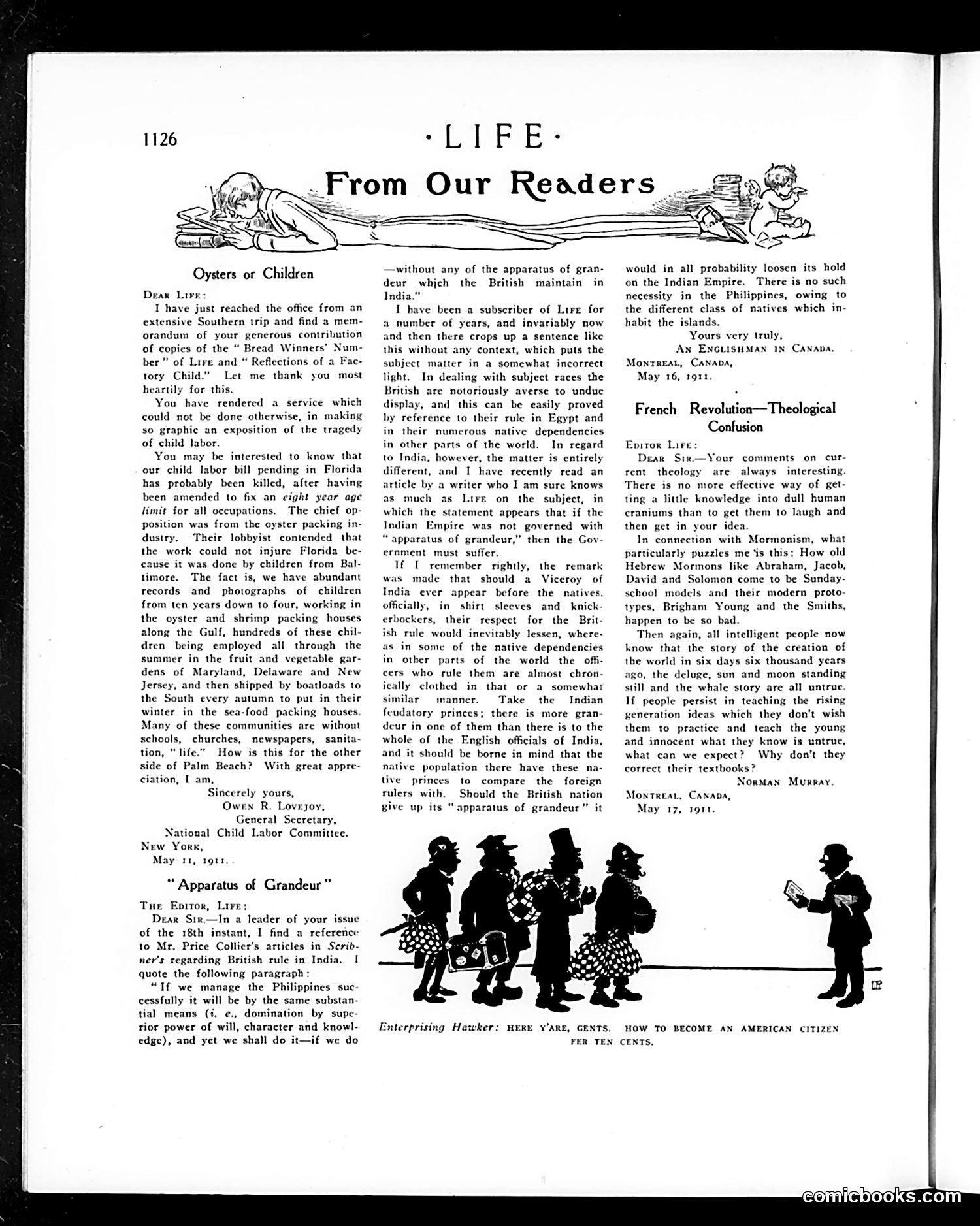
This page presents readers' letters debating American imperialism and child labor. The main cartoon, captioned "Here y'are, gents. How to become an American citizen per ten cents," depicts a street vendor hawking citizenship to caricatured immigrant figures—likely Eastern European or Irish based on their stereotyped appearances. The satire suggests citizenship is being sold cheaply or commodified, mocking both mass immigration and the ease of naturalization. The letters address serious policy matters: child labor in oyster-packing (children as young as four exploited seasonally), and British imperial governance in India versus American rule in the Philippines. Writers debate whether colonial authority requires ceremonial "apparatus of grandeur" or if American power can govern more efficiently and with less ostentation.
📄 Transcribed text from this page (OCR, searchable)
Machine-transcribed from the original scan — historical spelling and the odd misread are preserved.
Oysters or Children Dear Lire: I have just reached the office from an extensive Southern trip and find a mem- orandum of your generous contribution of copies of the “ Bread Winners’ Num- ber” of Lire and “ Reflections of a Fac- tory Child.” Let me thank most heartily for this. You have rendered a service which could not be done otherwise, in making so graphic an exposition of the tragedy of child labor. You may be interested to know that our child labor bill pending in Florida has probably been killed, after having been amended to fix an cight year age limit for all occupations. The chief op- position was from the oyster packing in- dustry. Their lobbyist contended that the work could not injure Florida be- cause it was done by children from Bal- timore. The fact is, we have abundant records and photographs of children from ten years down to four, working in the oyster and shrimp packing houses along the Gulf, hundreds of these chil- dren being employed all through the summer in the fruit and vegetable gar- dens of Maryland, Delaware and New Jersey, and then shipped by boatloads to the South every autumn to put in their winter in the sea-food packing houses. Many of these communities are without schools, churches, newspapers, sanita- tion, “life.” How is this for the other side of Palm Beach? With great appre- ciation, I am, Sincerely yours, Owen R. Lovejoy, General Secretary, National Child Labor Committee. New York, May 11, tot. you “* Apparatus of Grandeur” Tur Eprtor, Lire: Dear Sin.—In a leader of your issue of the 18th instant, I find a reference to Mr. Price Collier’s articles in Serib- ner’s regarding British rule in India. 1 quote the following paragraph : “If we manage the Philippines suc- cessfully it will be by the same substan- tial means (i, e., domination by supe- rior power of will, character and knowl- edge), and yet we shall do it—if we do ga Oo Fa lo —without any of the apparatus of gran- deur whjch the British maintain in India.” I have been a subscriber of Lire for a number of years, and invariably now and then there crops up a sentence like this without any context, which puts the subject matter in a somewhat incorrect light. In dealing with subject races the British are notoriously averse to undue display, and this can be easily proved by reference to their rule in Egypt and in their numerous native dependencies in other parts of the world. In regard to India, however, the matter is entircly different, and I have recently read an article by a writer who I am sure knows as much as Litre on the subject, in which the statement appears that if the Indian Empire was not governed with “apparatus of grandeur,” then the Gov- ernment must suffer. If I remember rightly, the remark was made that should a Viceroy of India ever appear before the natives. officially, in shirt sleeves and knick erbockers, their respect for the Brit- ish rule would inevitably lessen, where- as in some of the native dependencies in other parts of the world the offi- cers who rule them are almost chron ically clothed in that or a somewhat similar Take the Indian feudatory princes; there is more gran- deur in one of them than there is to the whole of the English officials of India, and it should be borne in mind that the native population there have these na- tive princes to compare the foreign rulers with. Should the British nation give up its “apparatus of grandeur” it manner. Enterprising Hawker: HERE Y'ARE, GENTS. would in all probability loosen its hold on the Indian Empire. There is no such necessity in the Philippines, owing to the different class of natives which in- habit the islands. Yours very truly, An ENGLISHMAN IN CANADA. Monreat, CaNapa, May 16, 1911. French Revolution—Theological Confusion Epitor Lire: Dear Stx.—Your comments on cur- rent theology are always interesting There is no more effective way of get- ting a little knowledge into dull human craniums than to get them to laugh and then get in your idea. In connection with Mormonism, what particularly puzzles me ‘is this: How old Hebrew Mormons like Abraham, Jacob, David and Solomon come to be Sunday- school models and their modern proto types, Brigham Young and the Smiths, happen to be so bad. Then again, all intelligent people now know that the story of the creation of the world in six days six thousand years ago, the deluge, sun and moon standing still and the whale story are all untrue. If people persist in teaching the rising generation ideas which they don't wish them to practice and teach the young and innocent what they know is untrue, what can we expect? Why don’t they correct their texthooks? Norwan Murray Montreat, Canava, May 17, 1918. HOW TO BECOME AN AMERICAN CITIZEN