
Life, 1911-06-08 · page 38 of 44
Life — June 8, 1911 — page 38: what you’re looking at
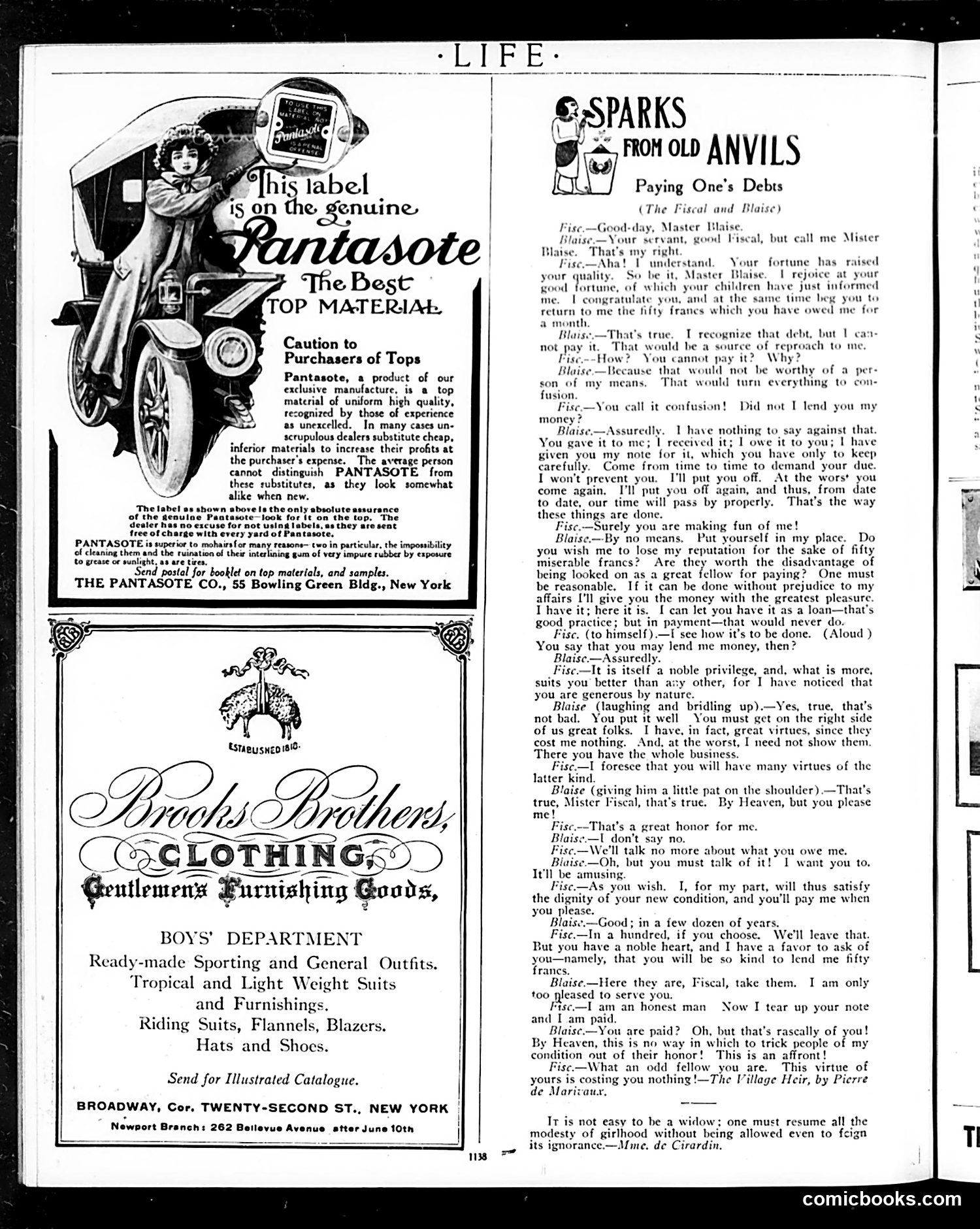
What you’re looking at
This page features a satirical dialogue titled "Paying One's Debts" between two characters: Fiscal (a creditor) and Blaise (a debtor). The humor lies in Blaise's elaborate rationalization for refusing to pay a fifty-franc debt he owes. Blaise employs absurd logic: paying the debt would damage his reputation as a "great fellow," so instead he offers to *lend* Fiscal money—a "noble privilege" that costs him nothing since he claims poverty. He argues that delaying payment indefinitely through excuses preserves his dignity better than honest repayment. The satire mocks wealthy or privileged individuals who rationalize financial dishonesty through twisted morality. Blaise represents the self-serving debtor who prioritizes social appearance over obligation, performing generosity (lending) while avoiding responsibility (paying). Fiscal's growing exasperation shows the absurdity of this logic. This reflects broader social commentary on honor, class pretense, and the elaborate excuses the privileged use to evade accountability—timeless themes that explain why *Life* magazine published this dialogue.
📄 Transcribed text from this page (OCR, searchable)
Machine-transcribed from the original scan — historical spelling and the odd misread are preserved.
his ri is on the genuine The Best i. ae Loe MATERIAL. x ) Caution to Purchasers of Tops Pantasote, a product of our exclusive manufacture, is a top material of uniform high quality, recognized by those of experience as unexcelled. In many cases un- scrupulous dealers substitute cheap, inferior materials to increase their profits at the purchaser's expense. The average person cannot distinguish PANTASOTE from these substitutes, as they look somewhat alike when new. 1n above is the on!: atasote ho excuse for not using fabels, as foe of charge with every yard of Pantasote, PANTASOTE is superior to mohairsfor many reasons— two in particular, the impossibility of cleaning them and the ruination of their interlining gum of very impure rubber by exposure to grease or sunlight, as are ties, Send postal for booklet on top materials, and samples. THE PANTASOTE CO., 55 Bowling Green Bldg., New York Sstaeusneo 8! Go Mriils Dirilhirds, C@GLOTHINGS ) Gentlemens Furnishing Goods, BOYS’ DEPARTMENT Ready-made Sporting and General Outfits. Tropical and Light Weight Suits and Furnishings. Riding Suits, Flannels, Blazers. Hats and Shoes. Send for Illustrated Catalogue. Newport Branch: 262 Bellevue Avenue stter June 10th BROADWAY, Cor. TWENTY-SECOND ST., NEW YORK Paying One's Debts (The Fiscal and Blaise) Fise.—Good-day, Master Blaise. Blaise.—Your servant, good Fiscal, but call me Mister Blaise. That's my right TV understand. Your fortune has raised So be it, Master Blaise. | rejoice at your Mf which your children have just informed alate you, and at the same time beg you to return to me the fifty franes which you have owed me for a month, Blaise. hat’s true. T re nize that debt, but 1 can- not pay it. That would be a source of reproach to me, How? Y not pay it? Why? Because thi Y be worthy of a per- That would turn everything to con- You call it confusion! Did not T lend you my I have nothing to. say against that. it to me; 1 received it; 1 owe it to you; I have my note for it, which you have only ‘to keey Come from time to time to demand your due. I won't prevent you, I'll put you off. At the worst you come again, I'll put you off again, and thus, from date to date, our time will pass by properly. That’s the way these things are done. Fisc.—Surely you are making fun of me! Blaise—By no means, Put yourself in my place. Do you wish me to lose my reputation for the sake of fifty miserable francs? Are they worth the ¢ advantage of being looked on as a great {cllow for paying? One must be reasonable. If it can be done without prejudice to my affairs I'll give you the money with the greatest pleasure. I have it; here it is. [ can let you have it as a loan—that's good practice; but in payment—that would never do. Fisc. (to himself).—I see how it’s to be done. (Aloud ) You say that you may lend me money, then? Blaise.—Assuredly. Fi It is itself a noble privilege, and, what is more, suits you better than any other, for I have noticed that you are generous by nature. Blaise (laughing and bridling up).—Yes, true, that’s not bad. You put it well You must get on the right side of us great folks. I have, in fact, great virtues, since they cost me nothing. And, at the worst, I need not show them. There you have the whole business. Fise.—I foresce that you will have many virtues of the latter kind. Blaise (giving him a little pat_on the shoulder).—That’s true, Mister Fiscal, that’s true, By Heaven, but you please That's a great honor for me. IU don’t say no. ell talk no more about what you owe me. —Oh, but you must talk of it! I want you to. It'll be amusing. Fis s you wish. I, for my part, will thus satisfy the dignity of your new condition, and you'll pay me when you please. Blaise.—Good ; in a few dozen of years. Fise.—In a hundred, if you choose. We'll leave that, But you have a noble heart, and I have a favor to ask of you—namely, that you will be so kind to lend me fifty francs. Blaise.—Here they are, Fiscal, take them, I am only too qleased to serve you, Fise—I am an honest man Now I tear up your note and I am paid Blaise-—You are paid? Oh, but that’s rascally of you! By Heaven, this is no way in which to trick people of my condition out of their honor! This is an affront! Fisc.—What an odd fellow you are. This virtue of yours is costing you nothing!—The Village Heir, by Pierre de Marivaux, It is not easy to be a widow; one must resume all the modes: f girlhood without being allowed even to fcign its ignorance-—Mme, de Cirardin, comicbooks.com