
Life, 1911-06-08 · page 12 of 44
Life — June 8, 1911 — page 12: what you’re looking at
What you’re looking at
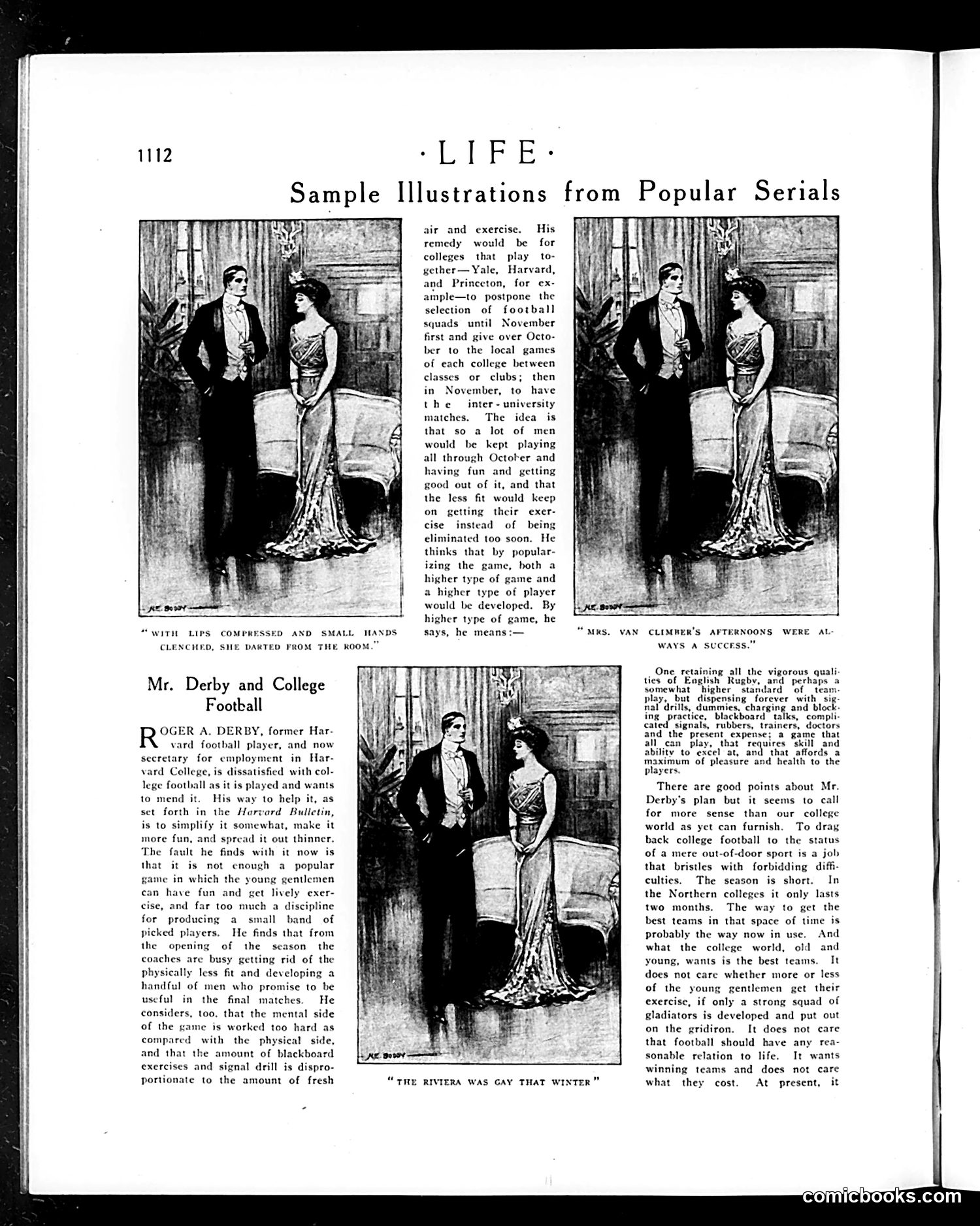
This page discusses Roger A. Derby's proposal to reform college football. The three illustrations show a well-dressed man and an elegant woman in what appears to be a domestic setting, likely depicting a narrative from a serialized story rather than political satire. The article argues that college football has become overly focused on winning and physical conditioning at the expense of broader educational value. Derby proposes postponing fall games until November and scheduling inter-university matches, suggesting this would keep students exercising throughout October while reducing the pressure to develop elite "fit" players too quickly. The satirical point critiques American college culture's obsession with competitive athletics over actual player health and education—a concern that remains relevant today.
📄 Transcribed text from this page (OCR, searchable)
Machine-transcribed from the original scan — historical spelling and the odd misread are preserved.
ZEIT TTT oe 1112 Sample Illustrations from Popular Serials “WITH LIPS COMPRESSED AND SMALL MANDS CLENCHED, SHE DARTED FROM THE OOM.” Mr. Derby and College Football OGER A. DERBY, former Har- vard football player, and now ary for employment in Har- vard College, is dissatisfied with col- lege foot it is played and wants to mend i to help it, as set forth in the Harvard Bulletin, is to simplify it somewhat, make it more fun, and spread it out thinner. The fault he finds with it now is that it is not cnough a popular me in which the young gentlemen n have fun and get lively exer- cise, and far too much a discipline for producing a small band of picked players. He finds that from the opening of the season the coaches are busy getting rid of the physically less fit and developing a handful of men who promise to be useful in the final matches. He considers, too, that the mental side of the game is worked 100 compared with the phys and that the amount of blackboard exercises and signal drill is dispro- portionate to the amount of fresh His wa “LIF E« air and exercise. His remedy would be for colleges that play to- gether—Yale, Harvard, and Princeton, for ex- ample—to postpone the selection of football squads until, November first and give over Octo- ber to the local games of each college between classes or clubs; then in November, to have the — inter- university matches. The idea is that so a lot of men would be kept playing all through October and having fun and getting good out of it, and that the less fit would keep on getting their exer- cise instead of being eliminated 100 soon. He thinks that by popular- izing the game, both a higher type of game and a higher type of player would be developed. By higher type of game, he says, he means :— “THE RIVIERA WAS GAY THAT WID VAN CLIMMER'S AFTERNOONS WERE AL WAYS A SUCCES: One retaining all the vigorous quali ties of English Rugby, and perhaps a somewhat higher standard of team. play, but dispensing forever with sig- nal drills, dummies, charging and block: ing practice, blackboard. talks, compli cated signals, rubbers, trainers, doctors and the present expense; a game that all can play, that requires skill and ability to excel at, and that affords a maximum of pleasure and health to the players, There are good points about Mr. Derby's plan but it seems to call for more sense than our college world as yet can furnish. To dray back college football to the status of a mere out-of-door sport is a job that bristles with forbidding diffi- culties. The season is short. In the Northern colleges it only lasts two months. The way to get the best teams in that space of time is probably the way now in use. And what the college world, old and young, wants is the best teams. It does not care whether more or less of the young gentlemen get their exercise, if only a strong squad of gladiators is developed and put out on the gridiron. It does not care that football should have any rea- sonable relation to life. It wants winning teams and does not care what they cost. At present, it ‘omicbooks.com