
A complete issue · 36 pages · 1910
Life — August 18, 1910
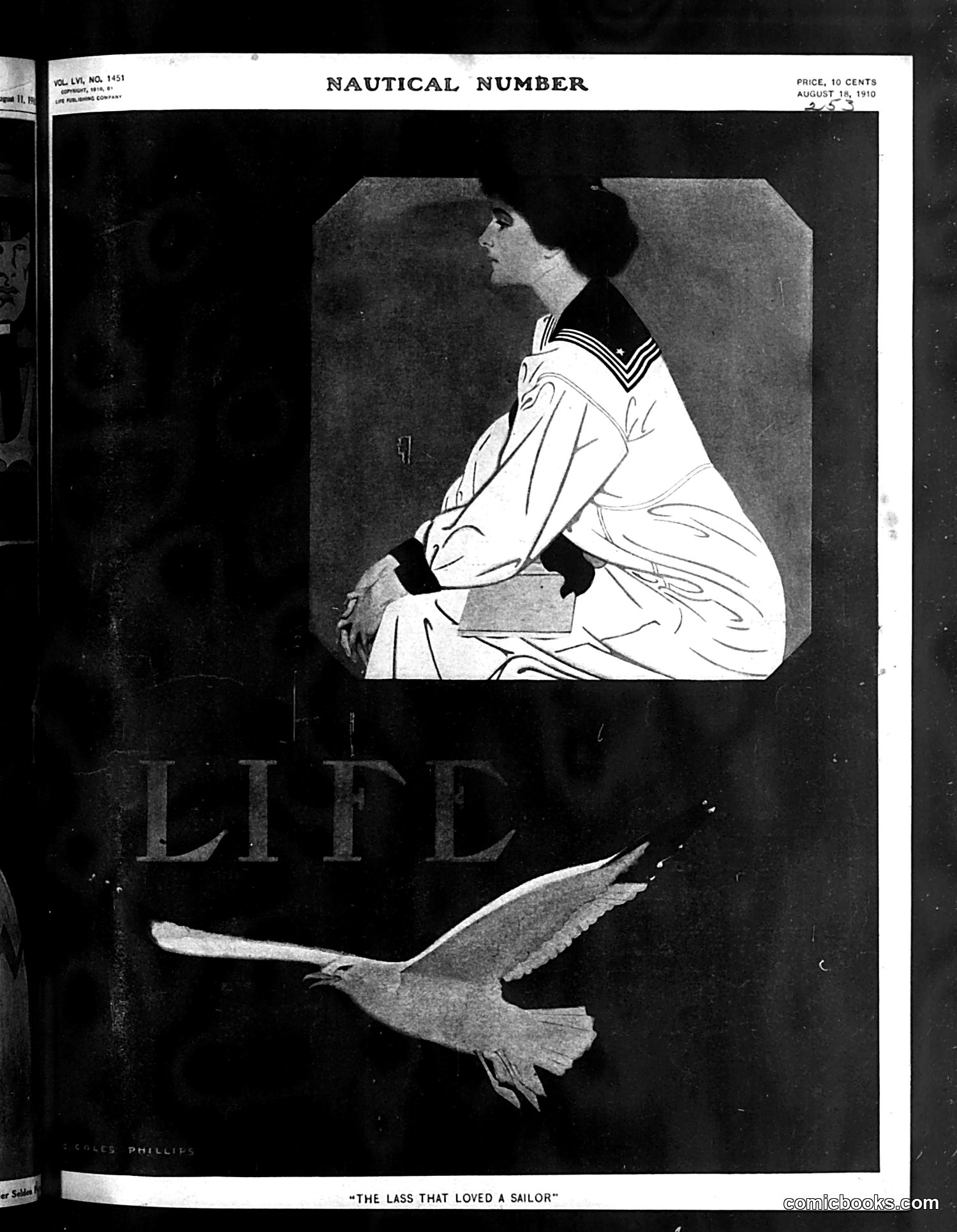
This *Life* magazine cover from August 18, 1910 features an illustration by Coles Phillips depicting a woman in a sailor-inspired outfit gazing upward. The title "The Lass That Loved a Sailor" references the famous Gilbert and Sullivan operetta song, evoking romantic maritime themes popular in early 20th-century culture. The image appears to be a straightforward decorative cover rather than political satire—it showcases Phillips's characteristic Art Nouveau style with elegant linework and a woman in fashionable sailor-influenced dress (the nautical theme was trendy for women's fashion at the time). The flying bird below adds romantic symbolism. This represents the magazine's mix of humor, fashion commentary, and cultural references rather than hard-hitting political cartoons.
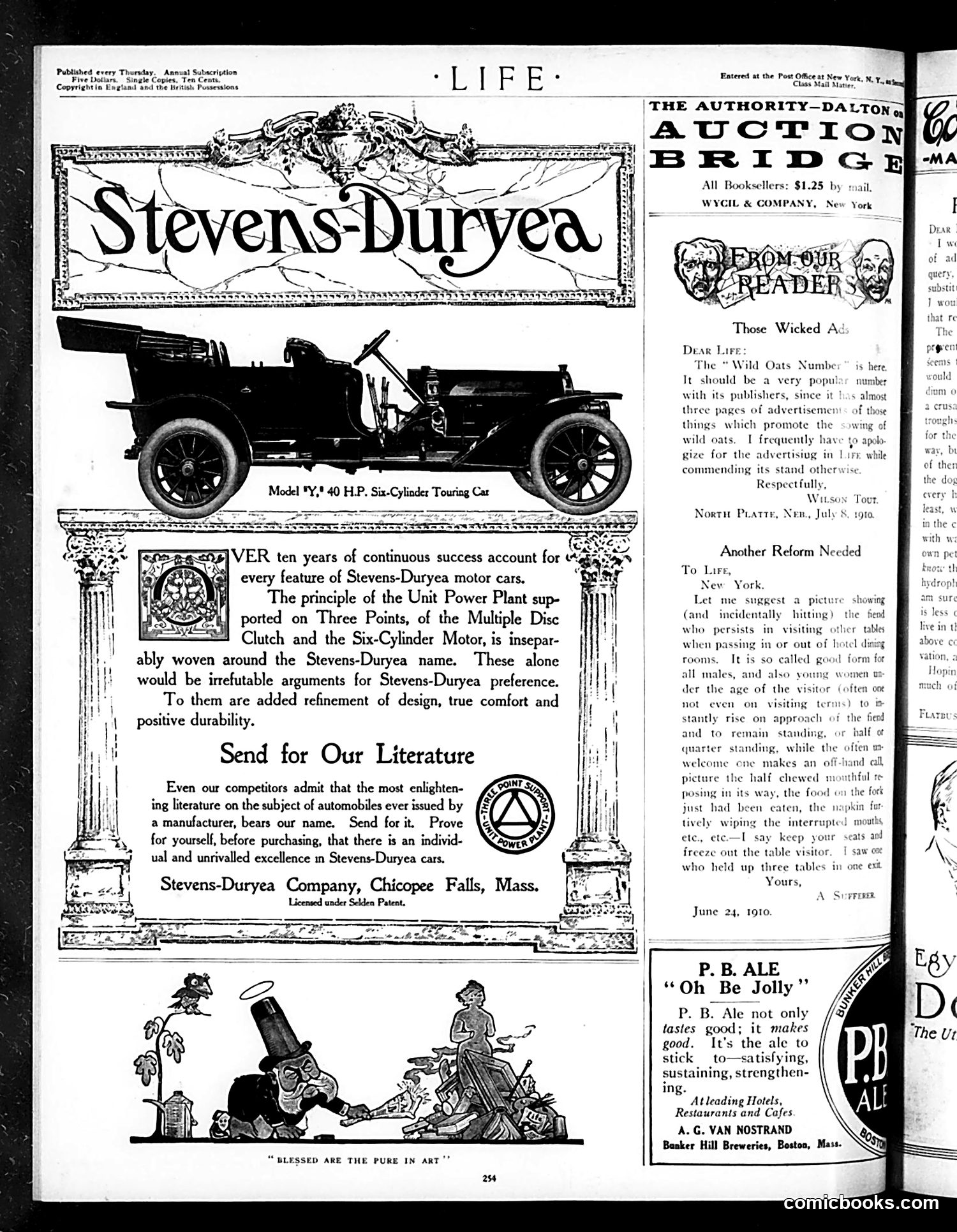
This page is primarily **advertising**, not satirical content. The dominant feature is a large Stevens-Duryea automobile advertisement showcasing their "Model 'Y,' 40 H.P. Six-Cylinder Touring Car." The ad emphasizes the car's technical superiority through "Unit Power Plant" design and claims ten years of "continuous success." The ornamental framing and classical columns create an air of prestige and durability. Below the main ad is a decorative illustration captioned "BLESSED ARE THE PURE IN ART"—a generic decorative element unrelated to political commentary. The right column contains letters to *Life*'s editor on unrelated topics (book advertising, hotel etiquette). **Bottom line**: This is a commercial page with no political cartoons or satirical content to analyze.
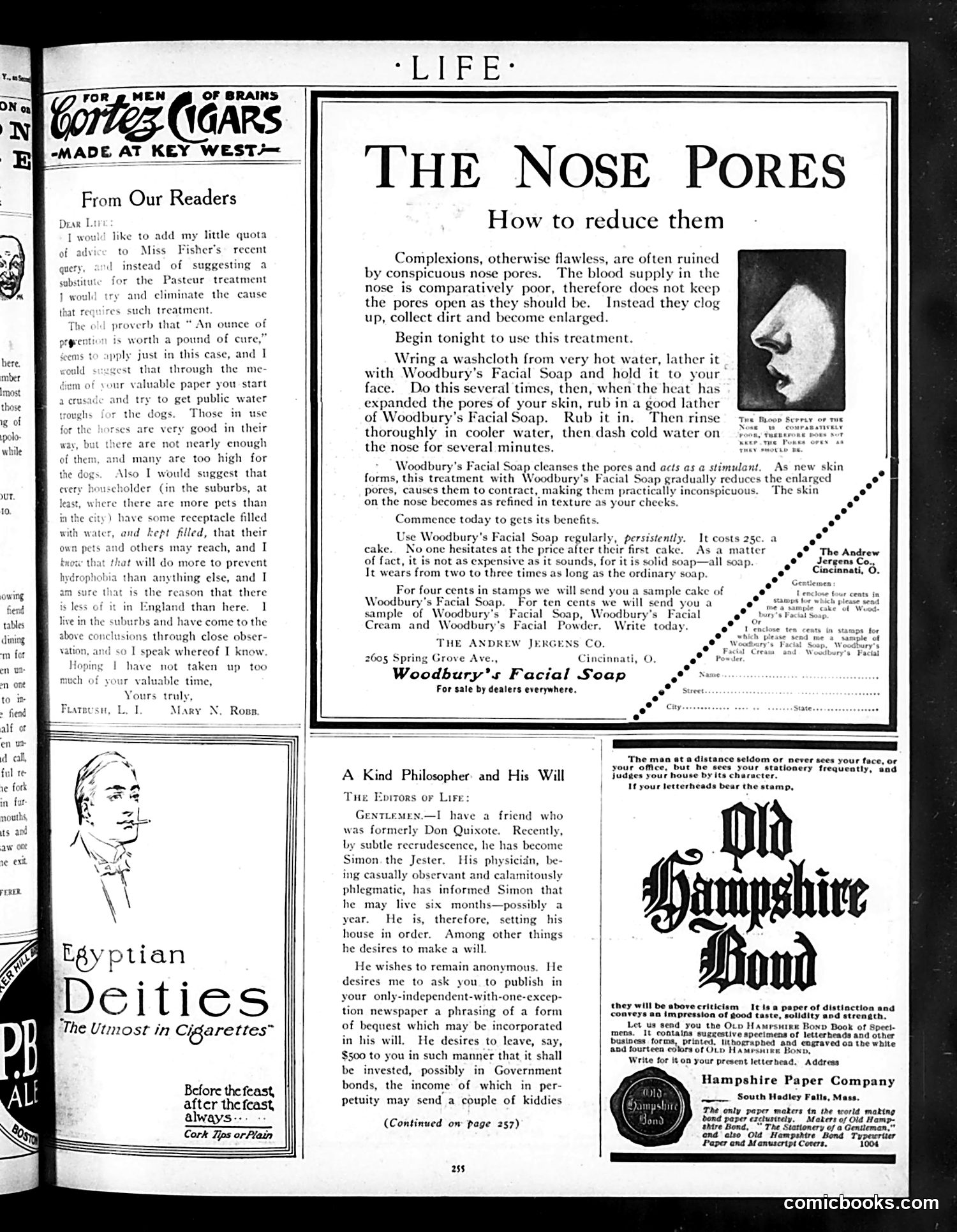
This page is **primarily advertising and advice columns**, not political satire. The main content includes: **"The Nose Pores" advertisement** for Woodbury's Facial Soap—a beauty product promising to reduce enlarged pores through proper cleansing. The accompanying photograph shows a woman's profile, typical of early 20th-century beauty advertising. **"From Our Readers"** column contains personal correspondence offering domestic advice. **"A Kind Philosopher and His Will"** discusses an anonymous friend resembling Don Quixote who plans to leave his estate. **Side advertisements** include Egyptian Deities cigars and Hampshire Bond paper. There is **no political cartoon** on this page. It represents typical Life magazine content: consumer goods advertising mixed with reader advice and light philosophical discussion—reflecting early 1900s magazine culture.
This page is **not a political cartoon** but rather an **advertisement and editorial announcement** for Life magazine's "Thought Bureau" service, run by "Gee Ime Mit." The content satirizes Life's practice of selling "mental subscriptions"—imaginary subscriptions that cost $10 annually in "mental dollars." The satire mocks: 1. **Gullible readers** who might literally subscribe to this absurd service 2. **The magazine's own advertising practices**, suggesting they'll accept imaginary payment for imaginary ads 3. **The concept of "mental capital"** as a humorous critique of how people manage their thoughts and attention The letter from "Gee Ime Mit" uses self-aware absurdism to poke fun at subscription drives and the magazine industry itself. It's satirizing both commercial exploitation and readers' willingness to participate in impractical schemes.
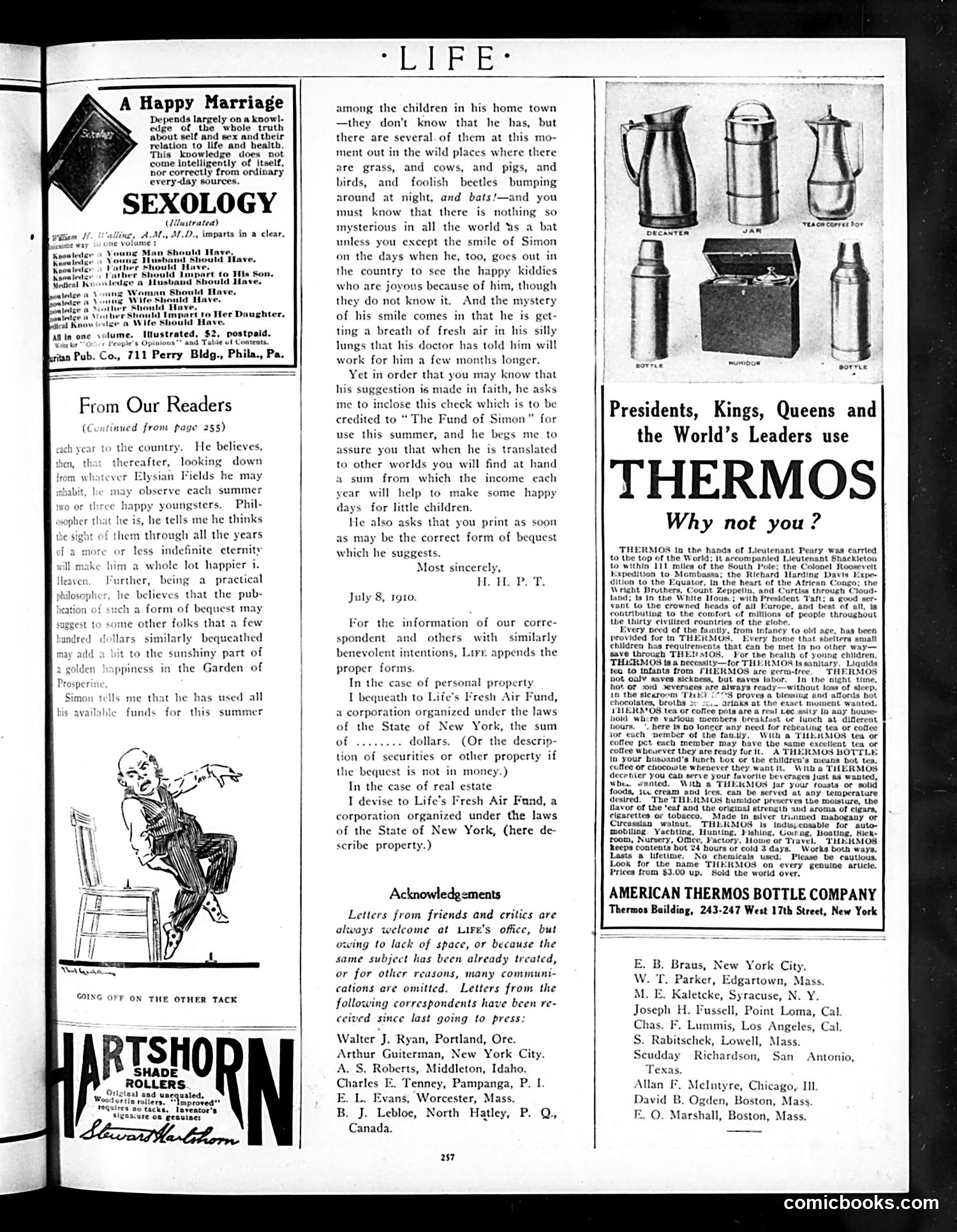
This page is primarily **advertising and reader correspondence**, not political satire. The main cartoon, "Going Off on the Other Tack," shows a thin, agitated man being ejected or falling from a chair—likely satirizing someone losing their temper or composure, though the specific reference is unclear without additional context. The page also features: - A "Sexology" book advertisement (addressing marital/reproductive knowledge) - Reader letters about charitable giving and estate planning - A prominent **Thermos bottle advertisement** claiming world leaders use the product - A Hartshorn Shade Rollers advertisement The content reflects early 1910s concerns: marriage education, charitable giving, and consumer products marketed to affluent readers. No clear political figures or events are identifiable in the cartoon itself.
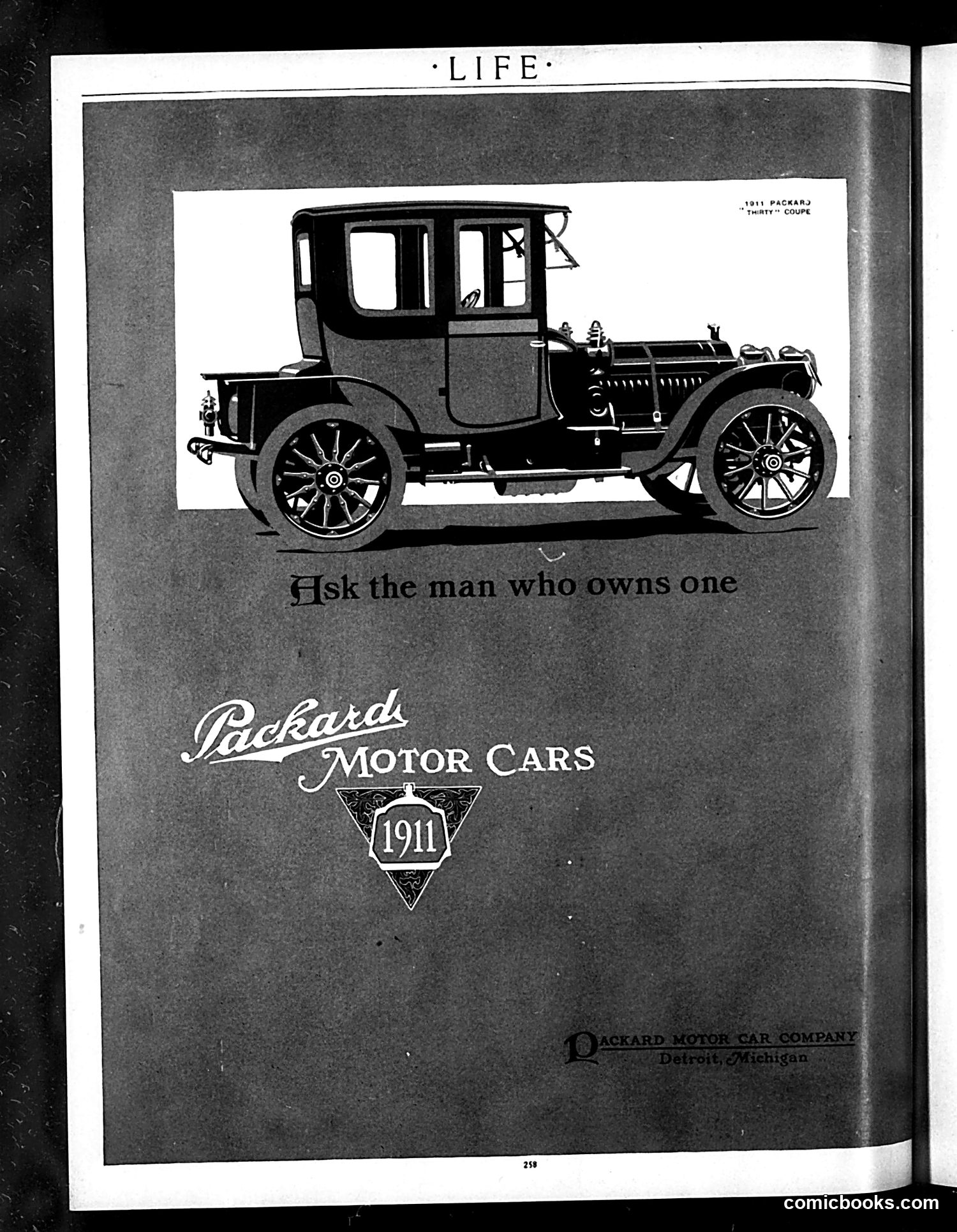
This is a **1911 Packard automobile advertisement**, not political satire. The page features a technical illustration of a 1911 Packard "Thirty" Coupe in side profile, labeled at the top right. The advertisement's clever tagline—"Ask the man who owns one"—is a marketing appeal to consumer testimony and word-of-mouth endorsement. By the early 1900s, this became Packard's famous slogan, suggesting that satisfied owners were the best advertising. The content reflects early automotive culture when cars were luxury items for the wealthy. The phrase implies that actual owners' positive experiences would convince potential buyers better than manufacturer claims. This represents early-20th-century advertising psychology rather than political commentary.
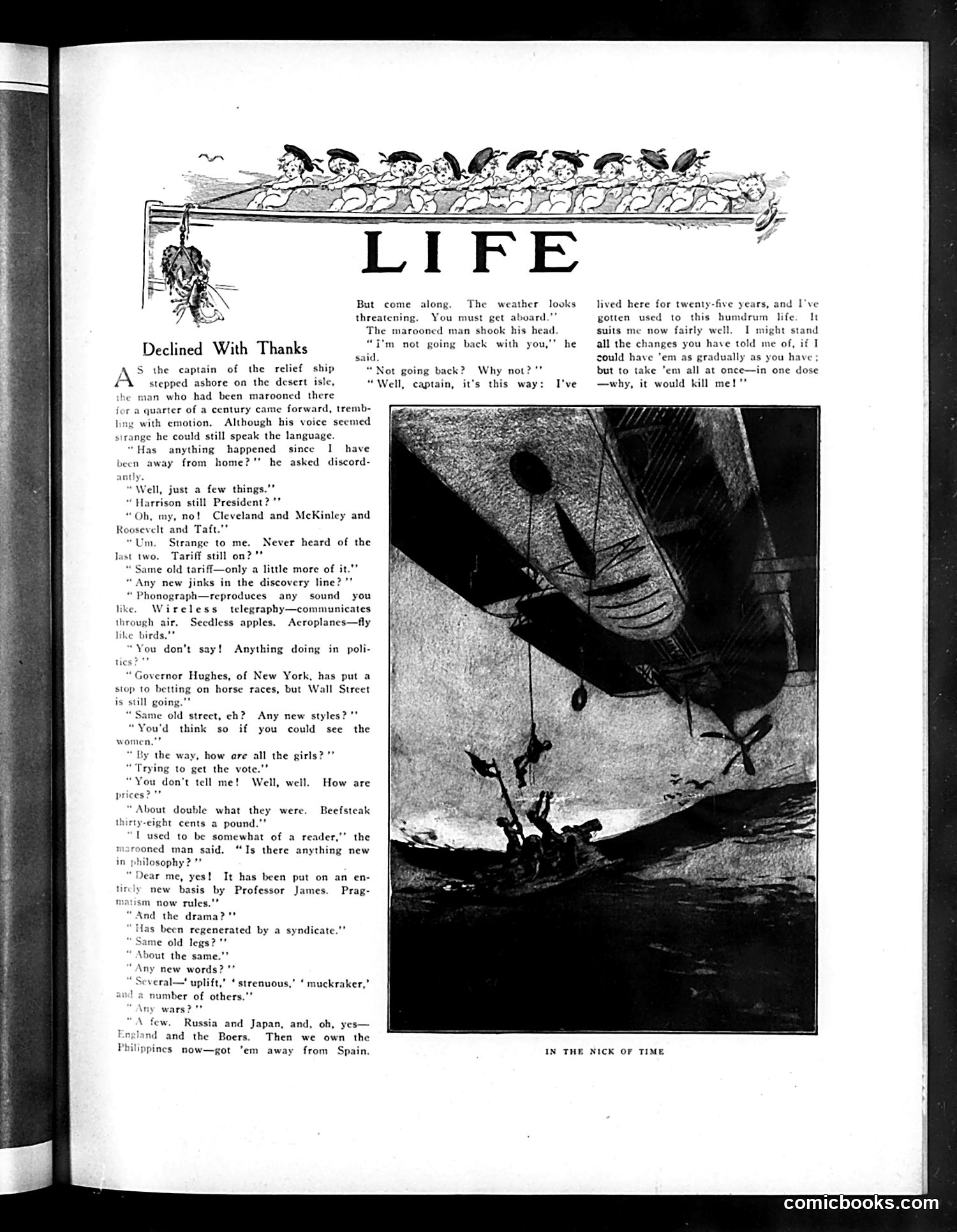
This page features a story titled "Declined With Thanks" alongside a photograph captioned "IN THE NICK OF TIME" showing what appears to be a dramatic rescue scene. The narrative is a dialogue between a ship's captain and a marooned sailor, discussing world events during the sailor's 25-year isolation. The captain updates him on technological advances (wireless telegraphy, aeroplanes, phonographs) and political changes—mentioning President Harrison, Cleveland, McKinley, Roosevelt, Governor Hughes of New York, and international conflicts (Russia, Japan, England, the Boers, Spain, Philippines). The satire's point: the isolated man humorously decides to stay marooned rather than rejoin a world of constant turmoil, technological disruption, and political upheaval. It's commentary on early 1900s anxieties about rapid change and global instability.
This page contains editorial commentary rather than a cartoon. The main illustration shows a figure labeled "Wait there is Life there's Hope" - appearing to be a political allegory about perseverance or faith during difficult times. The text discusses President Taft's tariff reform efforts and criticism of his leadership. It references the Republican Party being "in a scrape" over tariff policy, suggesting internal party conflict. The article critiques both Taft's inability to reform the tariff and Republicans' broader political struggles. The second section discusses Spanish government religious policy regarding Catholic worship and Vatican relations - a geopolitical matter of the era. Overall, this is political commentary on American domestic politics (Taft-era Republican troubles) and international affairs, typical of *Life* magazine's satirical coverage.
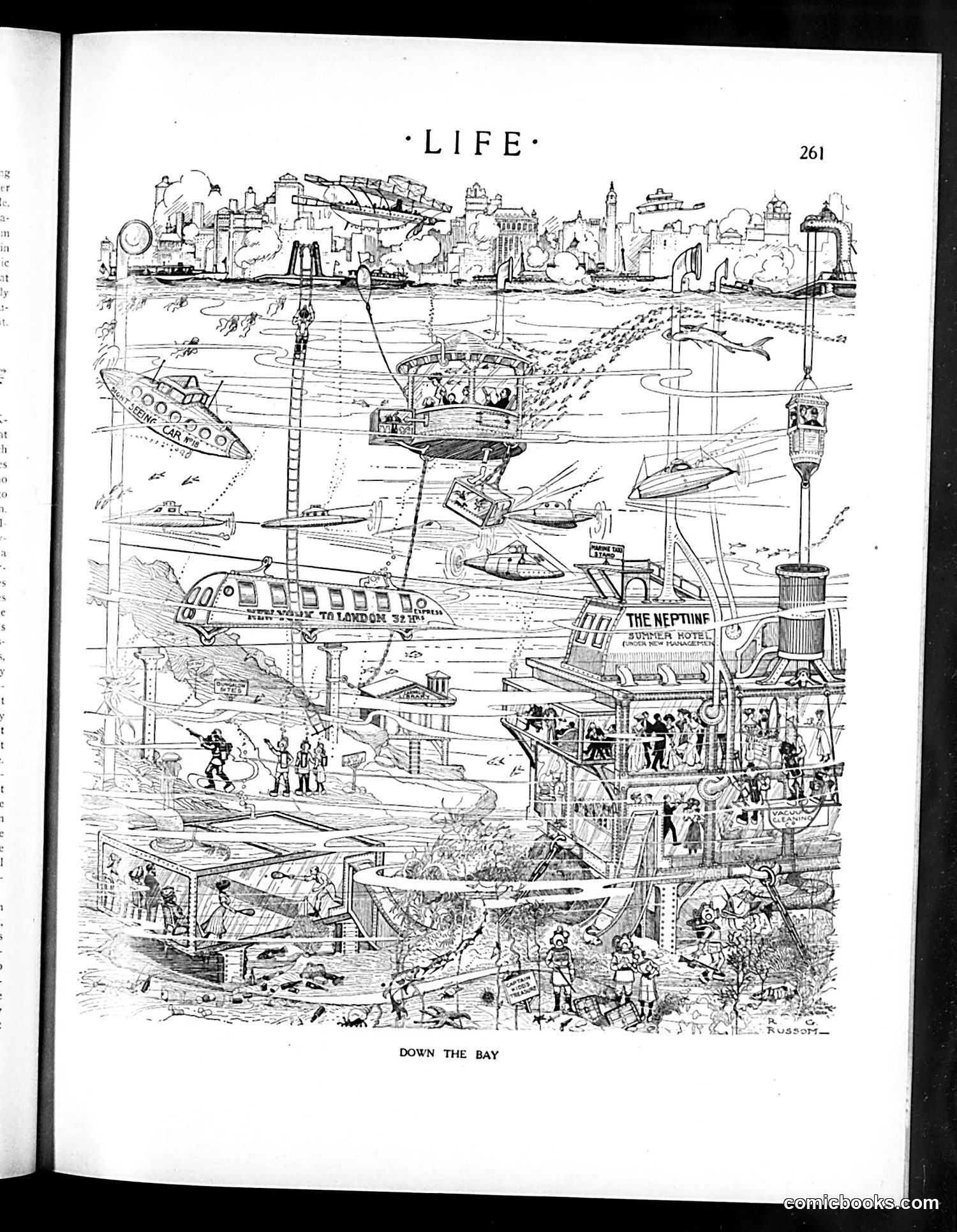
This is a detailed satirical illustration depicting a busy waterfront scene titled "Down the Bay." The drawing shows a bustling harbor with multiple modes of transportation and activity: ships, seaplanes, helicopters, and boats populate the water and sky. A prominent hotel called "The Neptune" appears on the right side. The illustration is crowded with small figures engaged in various activities—leisure, commerce, and tourism. The satire likely comments on modern urban development and commercialization of waterfront areas, showing how beaches and bays have become congested with contemporary transportation, tourism infrastructure, and commercial enterprise. The packed, chaotic composition suggests social commentary on overcrowding and the loss of natural spaces to development during what appears to be the early-to-mid 20th century.
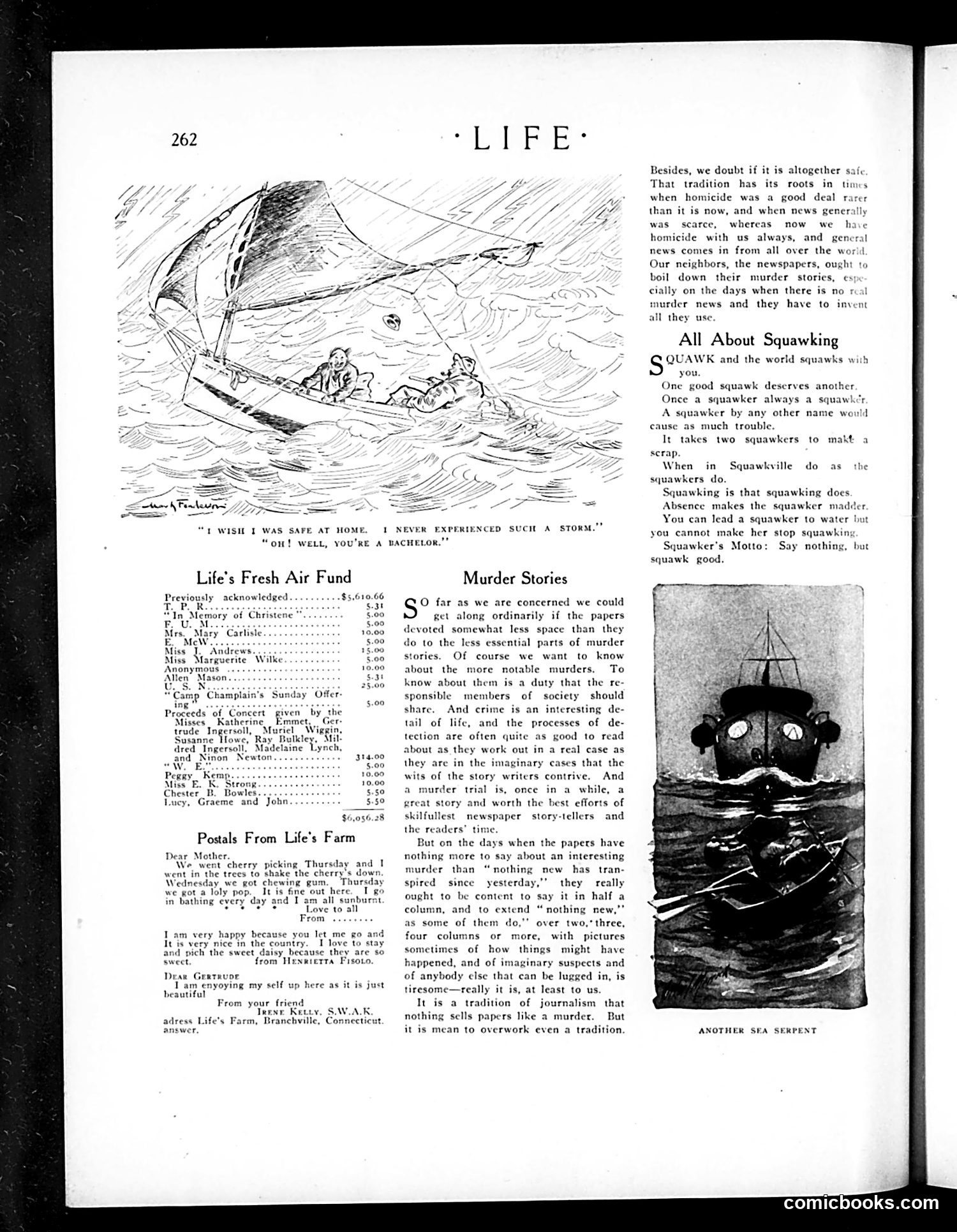
The main illustration depicts a small sailing boat in rough seas with the caption "I WISH I WAS SAFE AT HOME. I HAVE EXPERIENCED SUCH A STORM," and "FOR I WAS, YOU'RE A BACHELOR." This appears to be a humorous commentary on bachelor life. The joke suggests that a bachelor's domestic situation is so chaotic or unpleasant that even a dangerous storm at sea seems preferable. The caption's irony—wishing to be home while simultaneously acknowledging home is worse than a storm—satirizes the challenging or uncomfortable conditions bachelors faced managing their own households, likely in contrast to married men with wives to manage domestic affairs. The surrounding text includes sections on "All About Squawking," "Life's Fresh Air Fund," and "Murder Stories," typical of Life's mixed editorial content.
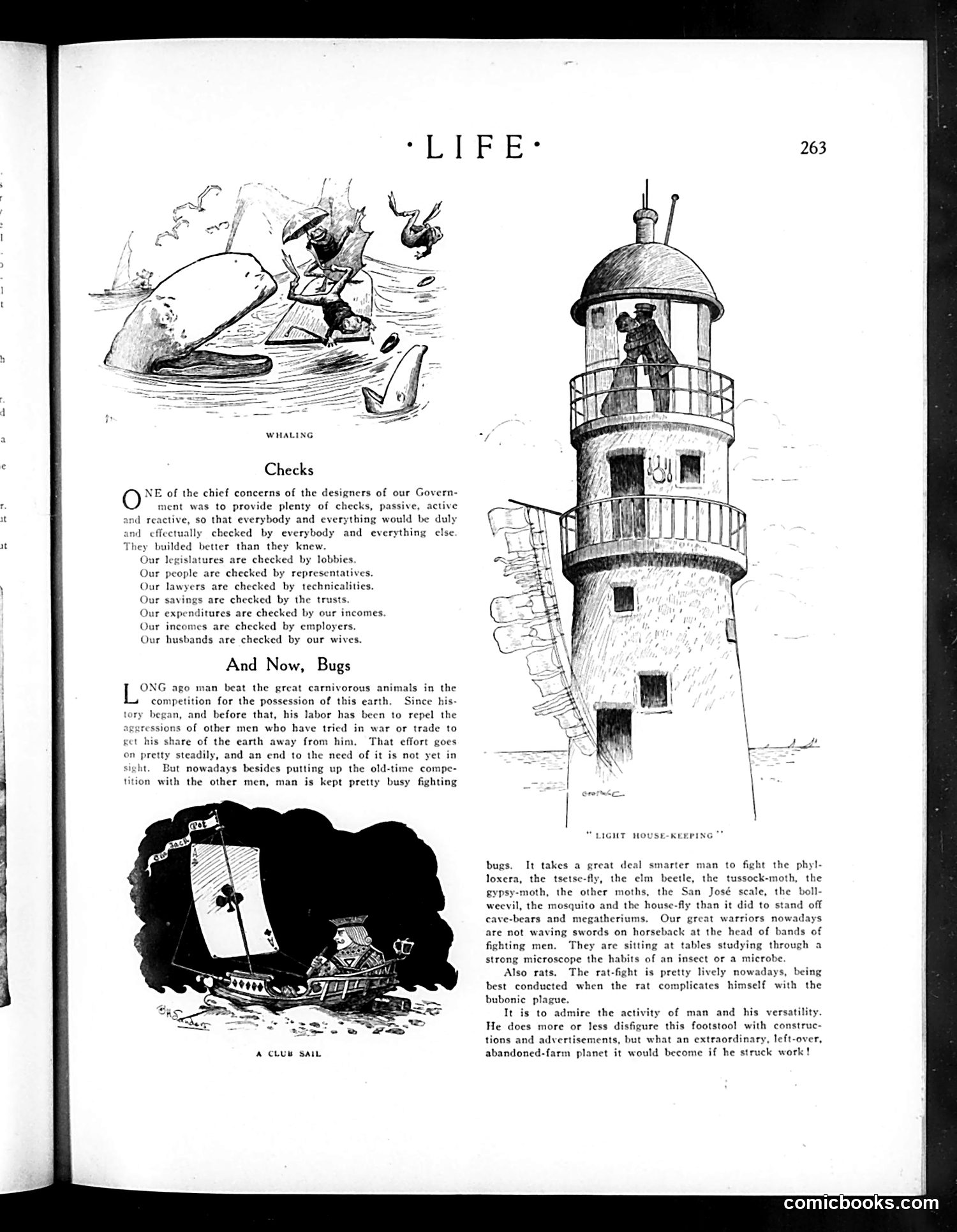
**"Checks" Section:** This is political satire about government oversight systems. The text lists various checks on power: legislators checked by lobbies, people by representatives, lawyers by technicalities, savings by trusts, and so on. The accompanying whaling cartoon shows a whale being hunted—likely representing how despite these theoretical "checks," ordinary citizens remain vulnerable to exploitation. **"And Now, Bugs" Section:** The article compares mankind's historical struggle against animals to modern battles against insects and pests. It sarcastically praises human ingenuity in fighting "phyloxera, the tsetse-fly, the elm beetle" and other creatures, arguing that this represents remarkable human activity and versatility. The lighthouse illustration and "club sail" cartoon appear to represent human engineering triumphs against nature. The overall message: humans boast of progress while remaining caught in endless struggles.
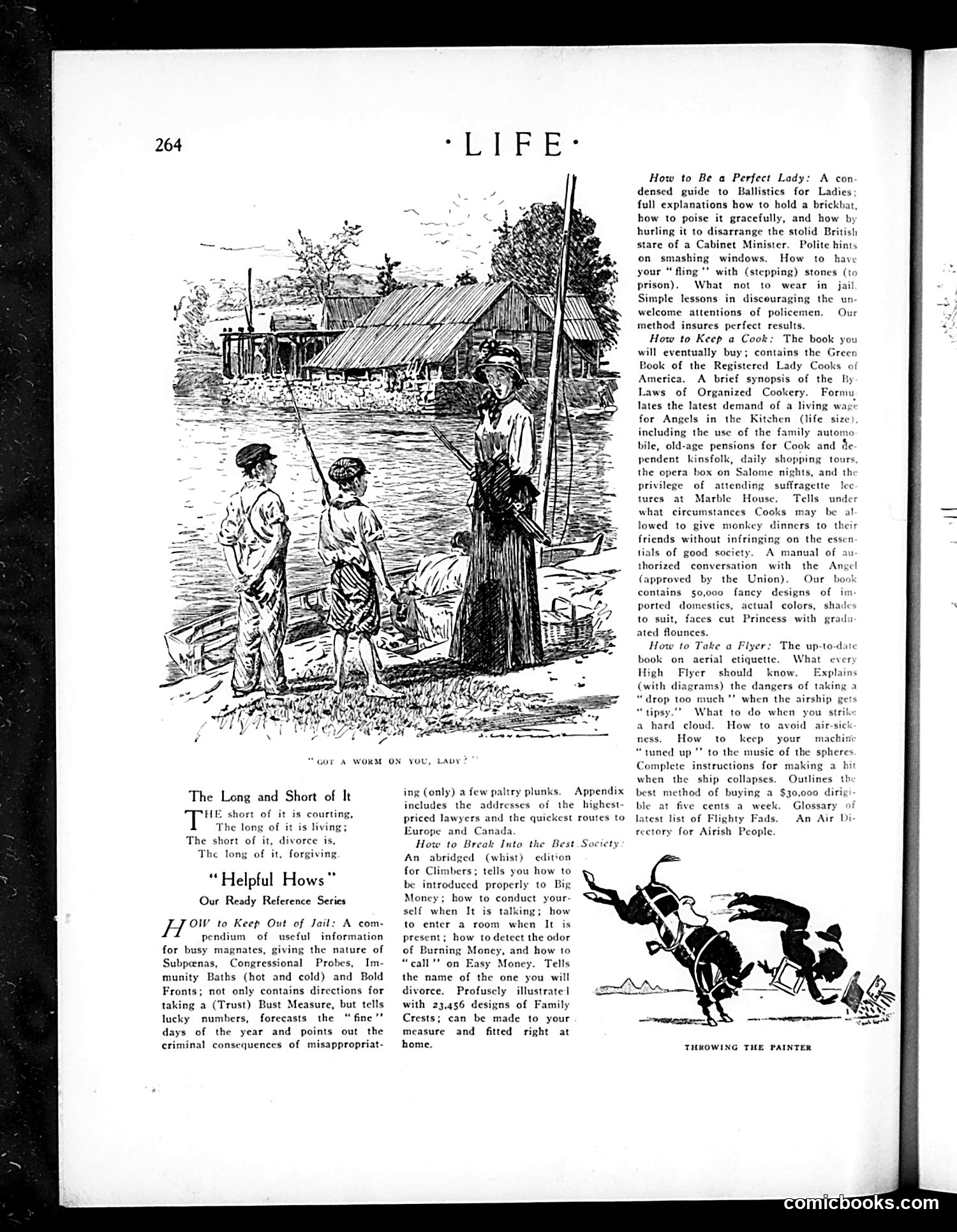
This page features satirical book advertisements disguised as editorial content—a common Life magazine format. The main cartoon, captioned "GOT A WORM ON YOU, LADY?," depicts fishermen at a dock with rural buildings, likely satirizing naive urban women being duped by con artists or crude rural men. The "Helpful Hows" section mocks self-help books through exaggerated titles like "How to Be a Perfect Lady" (teaching women to throw bricks at politicians) and "How to Keep a Cook" (promising domestic perfection). The bottom cartoon showing someone "THROWING THE PAINTER" satirizes another self-help topic. This reflects early 20th-century satire of the booming self-help publishing industry and period gender anxieties about women's propriety and domestic competence.
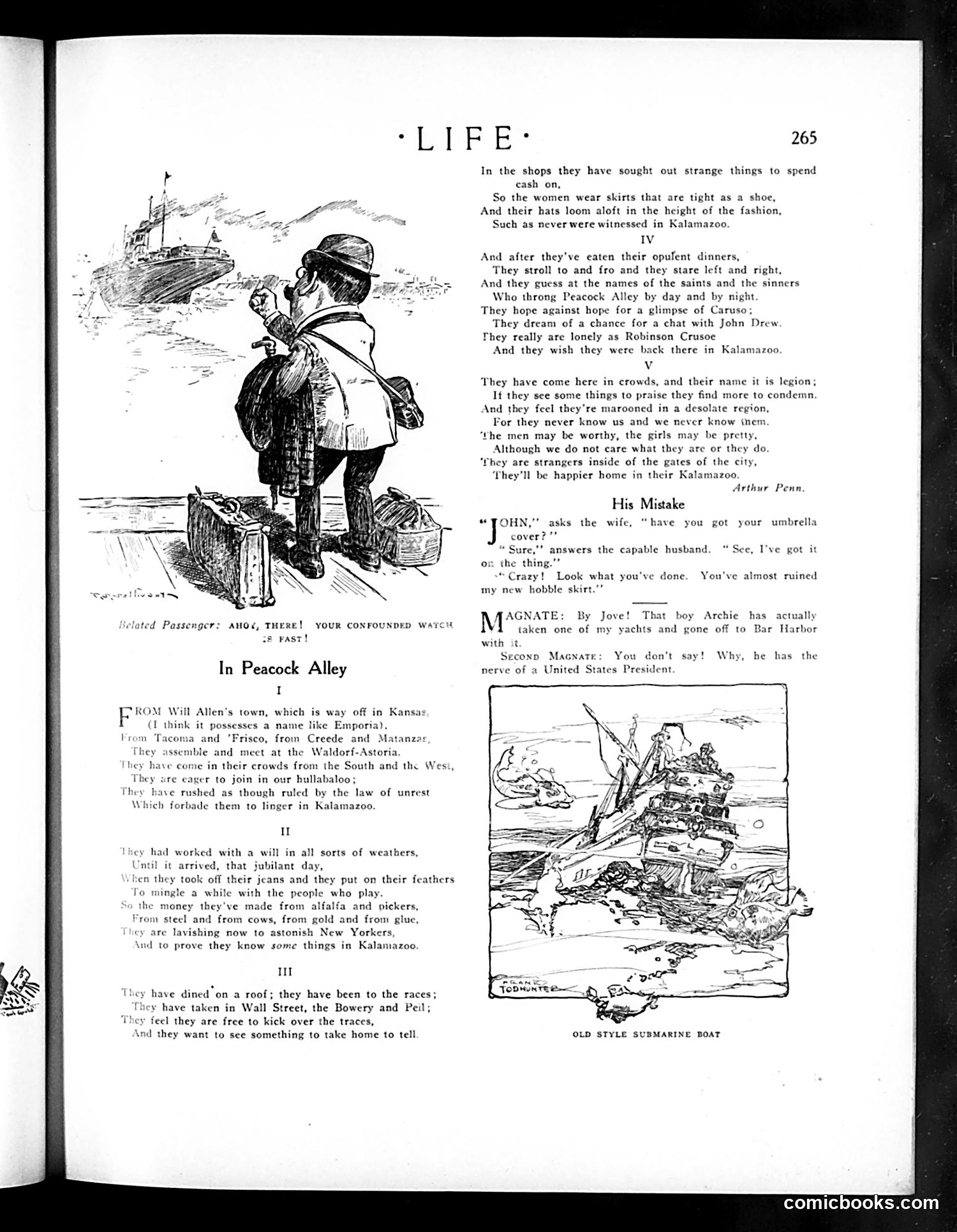
This page contains two separate pieces of satirical content about wealthy American tourists. **"In Peacock Alley"** (left): A poem by Arthur Penn mocking Kansas tourists visiting New York City. They've come from small towns (Will Allen's town, Tacoma, Frisco, Creede, Matanzar) and are visiting urban attractions (Wall Street, the Bowery, the races). The satire targets their conspicuous consumption and unsophistication—they're wealthy enough to spend lavishly on fashionable clothes and entertainment, but remain fundamentally provincial and out of place in sophisticated society. **"His Mistake"** (right): A brief comedic dialogue about a husband's error regarding an umbrella cover and his wife's ruined skirt. The humor is domestic rather than political. The overall theme critiques the nouveau riche American middle class attempting to display wealth and sophistication while remaining culturally naive.
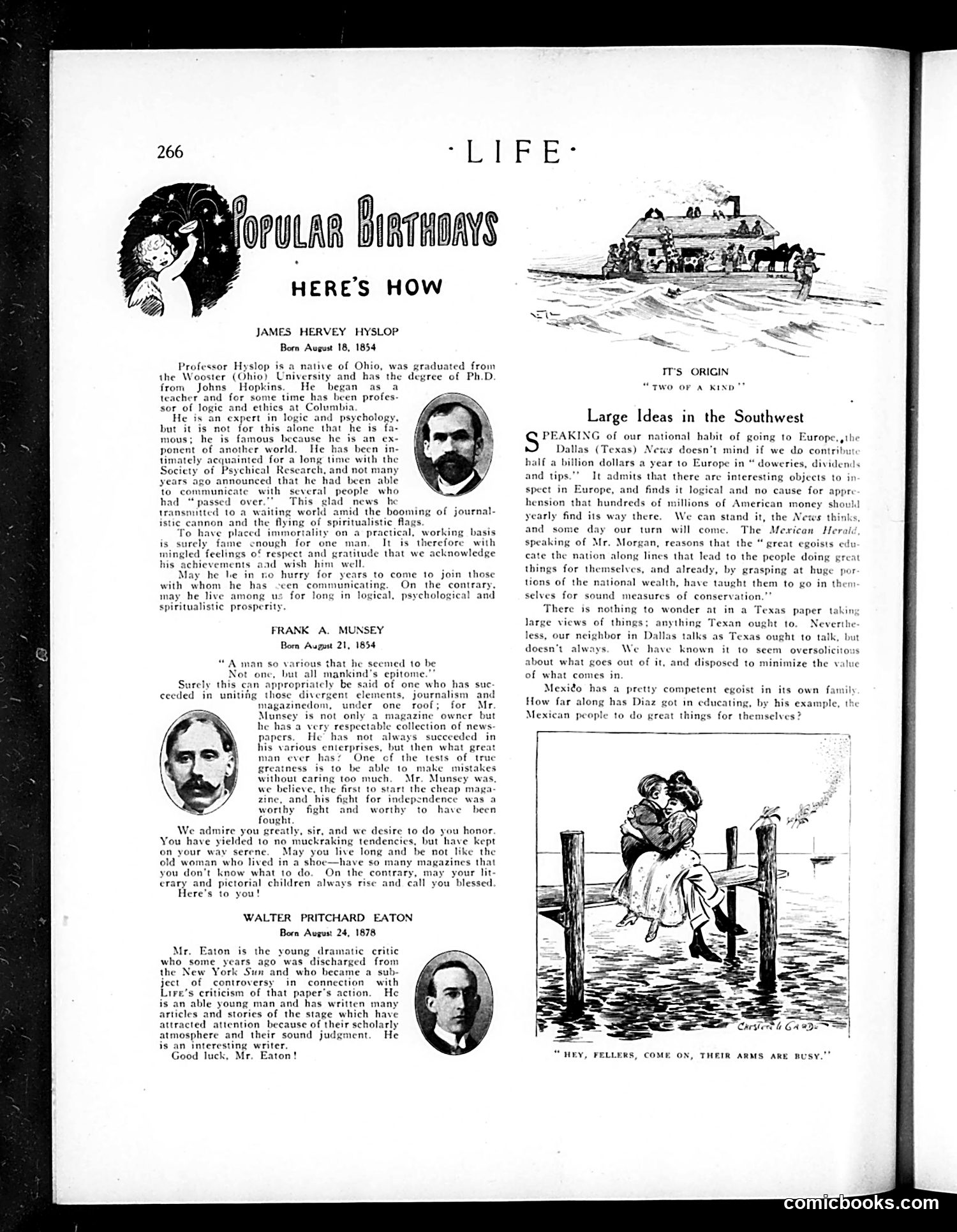
This page celebrates three prominent men born in August through biographical sketches and portraits. The satire is gentle congratulatory humor rather than sharp political critique. **The three honorees:** - **James Hervey Hyslop** (Columbia professor): Mocked for his work with the Society for Psychical Research and claims he could communicate with the dead—Life presents this as absurd but harmless, wishing him long life before he needs to "join those with whom he has been communicating." - **Frank A. Munsey** (publisher): Praised but satirized for consolidating newspapers and magazines under one ownership, joked about having so many publications "you don't know what to do." - **Walter Pritchard Eaton** (theater critic): Described as a young talent who faced controversy after discharge from the New York Sun. The right column discusses Texas and Mexico's economic ambitions. The illustration shows children at a fence with the caption "HEY, FELLERS, COME ON, THEIR ARMS ARE BUSY"—likely political commentary on labor or economic activity, though the exact reference is unclear.
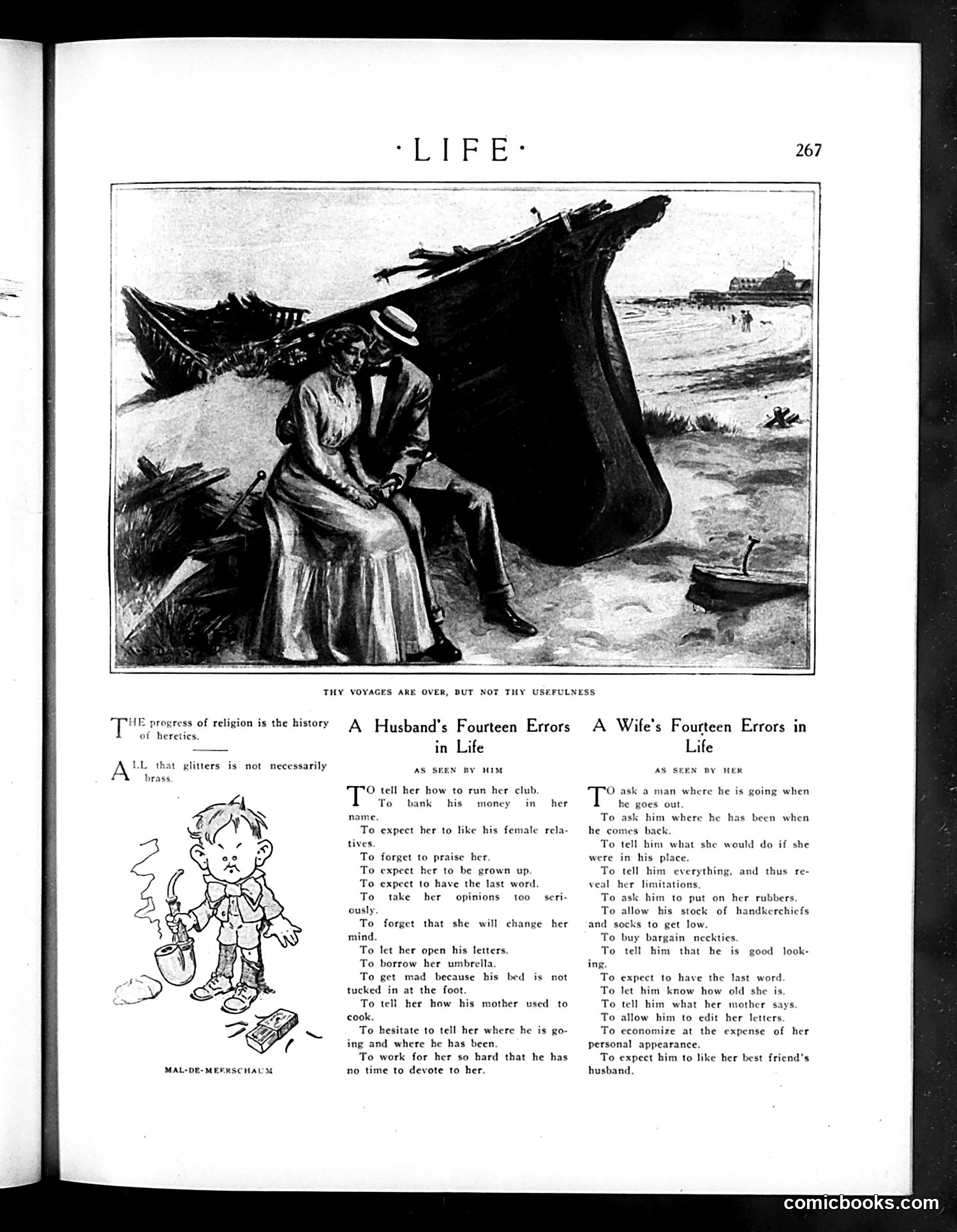
This page presents **marital advice through satirical lists**, a common early-20th-century humor format. The top illustration shows a couple at the seaside with a wrecked boat—the caption "Thy Voyages Are Over, But Not Thy Usefulness" suggests marriage as a completed journey that continues through domestic life. The page's centerpiece lists **fourteen marital "errors"** from each spouse's perspective. The humor operates through **gender role satire**: husbands are mocked for financial control, neglecting praise, and working too hard; wives are mocked for excessive questioning, nagging, overspending on appearance, and poor housekeeping. The small cartoon labeled "MAL-DE-MERRSCHAUM" (a pun on "mal de mer"—seasickness) depicts a disheveled figure, likely representing the miserable married man. The satire targets **bourgeois marriage conventions** of the era, where husbands controlled money and whereabouts while wives managed domestic details. Both genders are presented as frustrating—the joke being that marriage itself is inevitably problematic, yet people continue it anyway (hence "not thy usefulness").
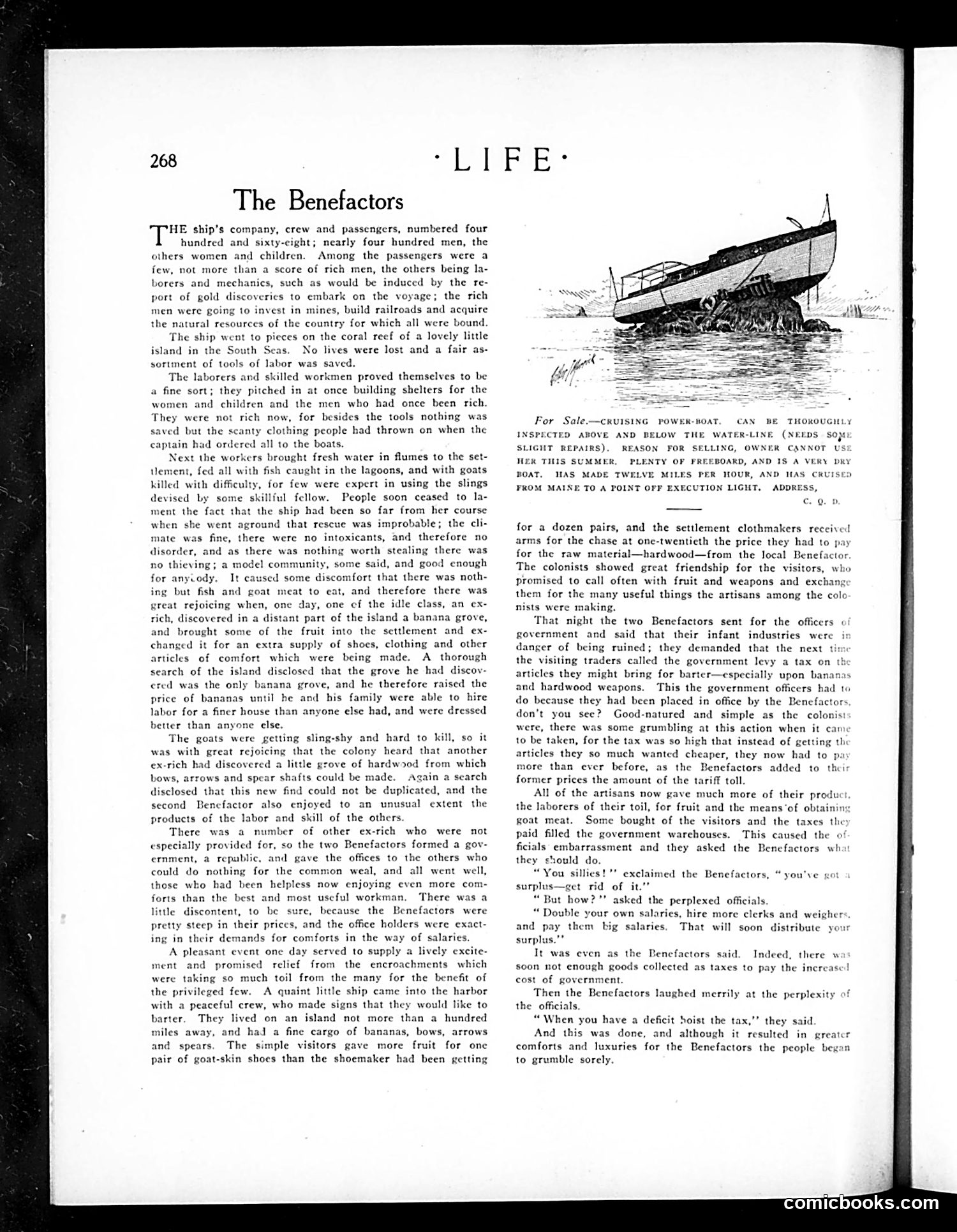
This is not a cartoon but a narrative fable about class and capitalism. It describes shipwrecked colonists who initially form an egalitarian society where skilled workers provide for all. However, two formerly wealthy men ("ex-rich") who discover monopolized resources—bananas and hardwood—become wealthy again by controlling supply and charging exploitative prices. These "Benefactors" then establish a government that rewards idle office-holders over productive workers, recreating class hierarchy from nothing. The satire targets how capitalism naturally concentrates wealth through monopoly rather than merit, and how the wealthy manipulate systems to entrench privilege. The accompanying illustration shows a wrecked ship, visualizing the story's premise. The text's ironic title—calling monopolists "Benefactors"—is the joke: they're presented as saviors when they're actually exploiters. This appears to critique Gilded Age industrialists who claimed to benefit society while accumulating vast fortunes.
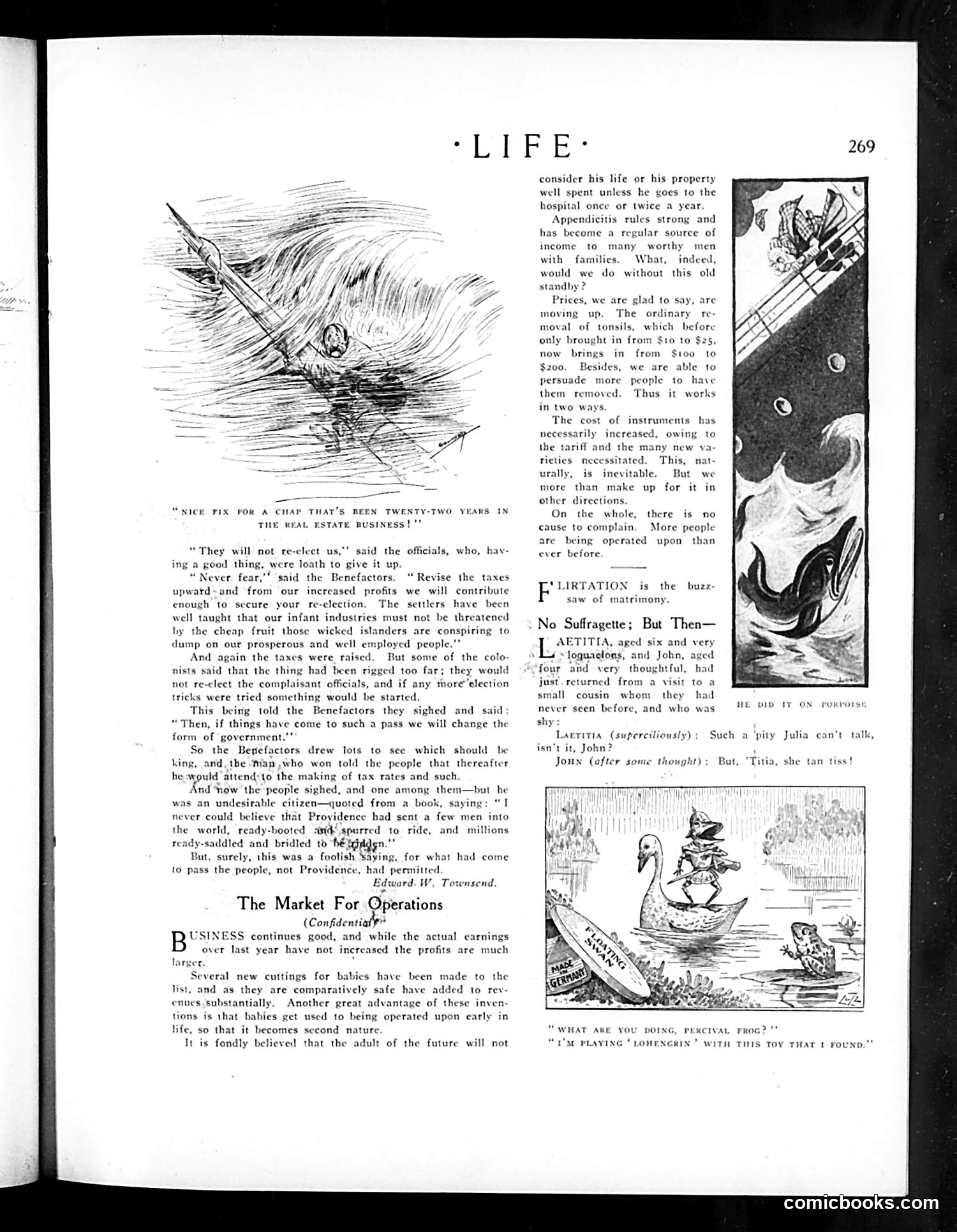
This page contains political and social satire typical of early 20th-century Life magazine. **Top section** (attributed to Edward W. Townsend): A narrative cartoon criticizing colonial governance and corruption. Officials raise taxes to fund their re-election; when voters resist, the "Benefactors" (wealthy interests) simply change the government to a monarchy. The quoted passage about men "ready-booted and spurred to ride" mocking those "bridled" to serve them critiques how power consolidates among elites while masses remain exploited. The anonymous critic is dismissed as "undesirable." **"Market for Operations"**: Dark satire on medical profiteering. Doctors admit expanding surgical procedures (tonsil removal, appendectomies) on children and babies primarily to increase revenue, not medical necessity. The cynical confidence that future adults will normalize frequent hospitalizations reveals healthcare commodification. **Bottom cartoons**: Light domestic humor about children—one contrasting a talkative girl with a shy boy; another showing a child playing with a toy while humming Wagner's "Lohengrin," unaware of its romantic associations.
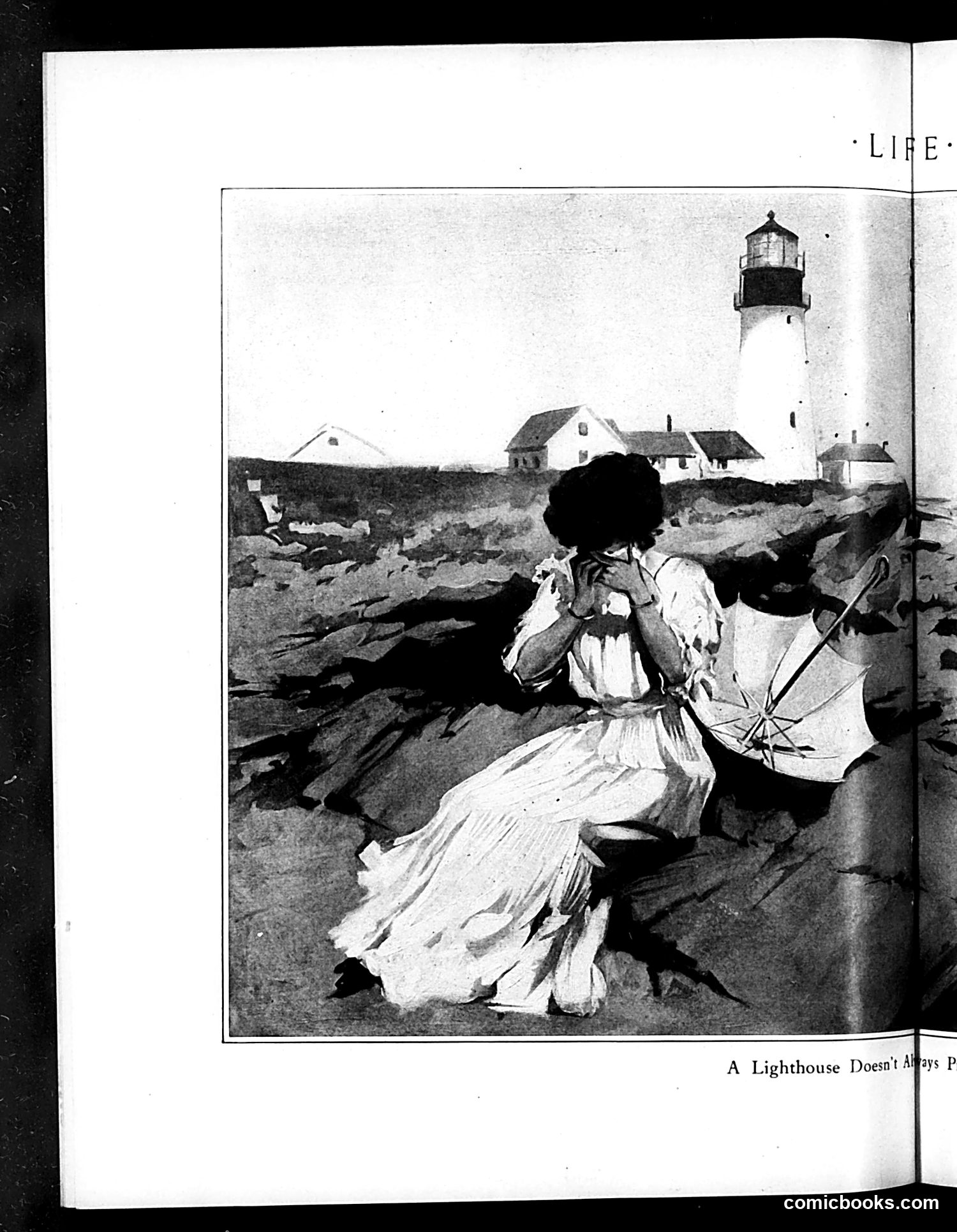
This page from *Life* magazine shows a woman in early 20th-century dress sitting on rocky coastal terrain, holding a parasol, with a lighthouse and keeper's cottage visible in the background. The caption reads "A Lighthouse Doesn't Always P[rovide]..." (text is cut off), suggesting a joke about lighthouse keeping or coastal life. The satire likely plays on romantic notions of lighthouses as picturesque destinations—the woman's elegant white dress and parasol represent genteel expectations, while the barren, rocky reality of the coastal setting undercuts that romanticism. Without the complete caption, the specific point remains unclear, but the contrast between refined appearance and harsh environment appears to be the joke's foundation.
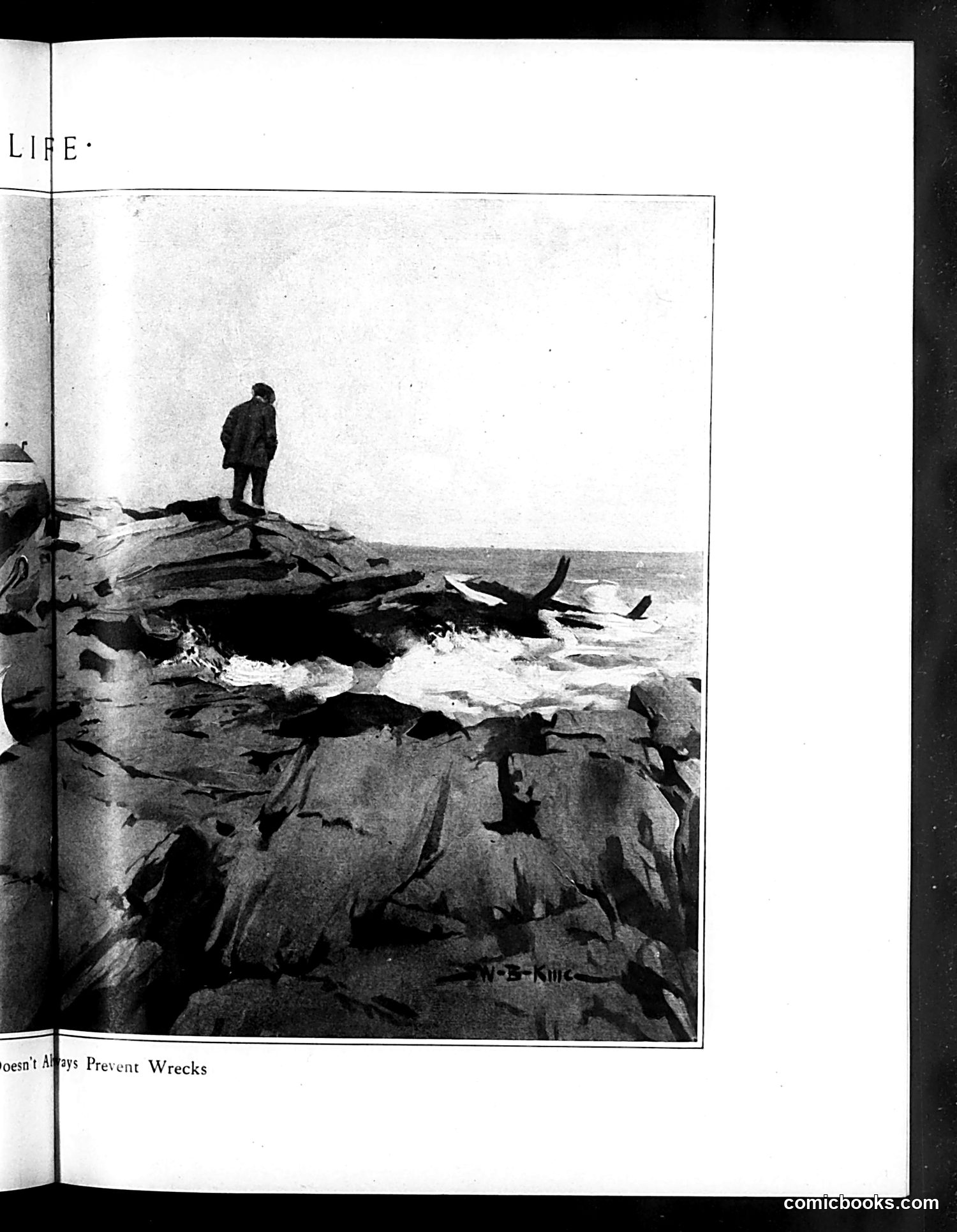
This page shows a photograph rather than a cartoon. The image depicts a solitary figure in dark clothing standing on rocky terrain overlooking wreckage—splintered wood and debris scattered across rocks near water. The caption "Doesn't Always Prevent Wrecks" suggests this is satirical commentary on a safety measure or policy that claims to prevent disasters but fails. Without the magazine's date or broader context, the specific reference remains unclear. The photograph appears to document an actual shipwreck or maritime disaster, used to illustrate the caption's ironic point about ineffective prevention. The "LIFE" magazine header indicates this is from that publication's satirical social commentary tradition, likely critiquing some contemporary safety regulation or public claim.
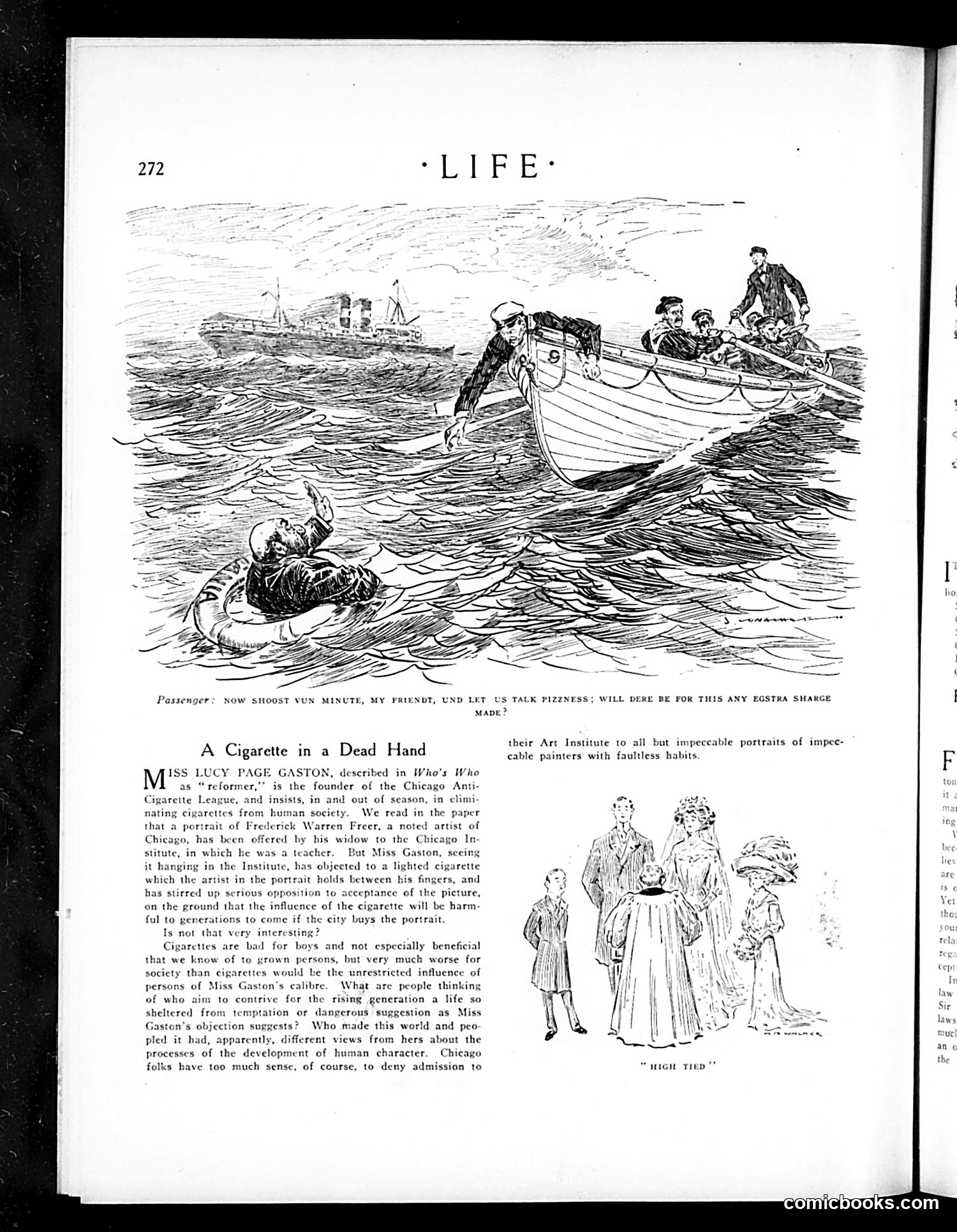
The cartoon satirizes Lucy Page Gaston, founder of the Chicago Anti-Cigarette League, a real reformer who objected to a portrait of artist Frederick Warren (holding a lit cigarette) being accepted into the Chicago Art Institute. **The satire's point**: Life mocks Gaston's censorious moralism—her attempt to remove the painting because the depicted cigarette might "corrupt" viewers. The top cartoon shows a passenger with a heavy accent ("SMOOST VUN MINUTE...PIZZNESS") interrupting a boat rescue, illustrating absurd priorities. **The criticism**: Life argues Gaston's zealous moralism poses greater danger to society than cigarettes themselves. The text sarcastically suggests sheltering people from all temptation is impractical and contrary to human development. Life defends artistic integrity and realistic representation over sanitized censorship, implying Gaston's reformism represents dangerous cultural control masked as protection. The "High Tied" fashion sketches below provide tonal contrast—lighter social observation versus Gaston's heavy-handed intervention.
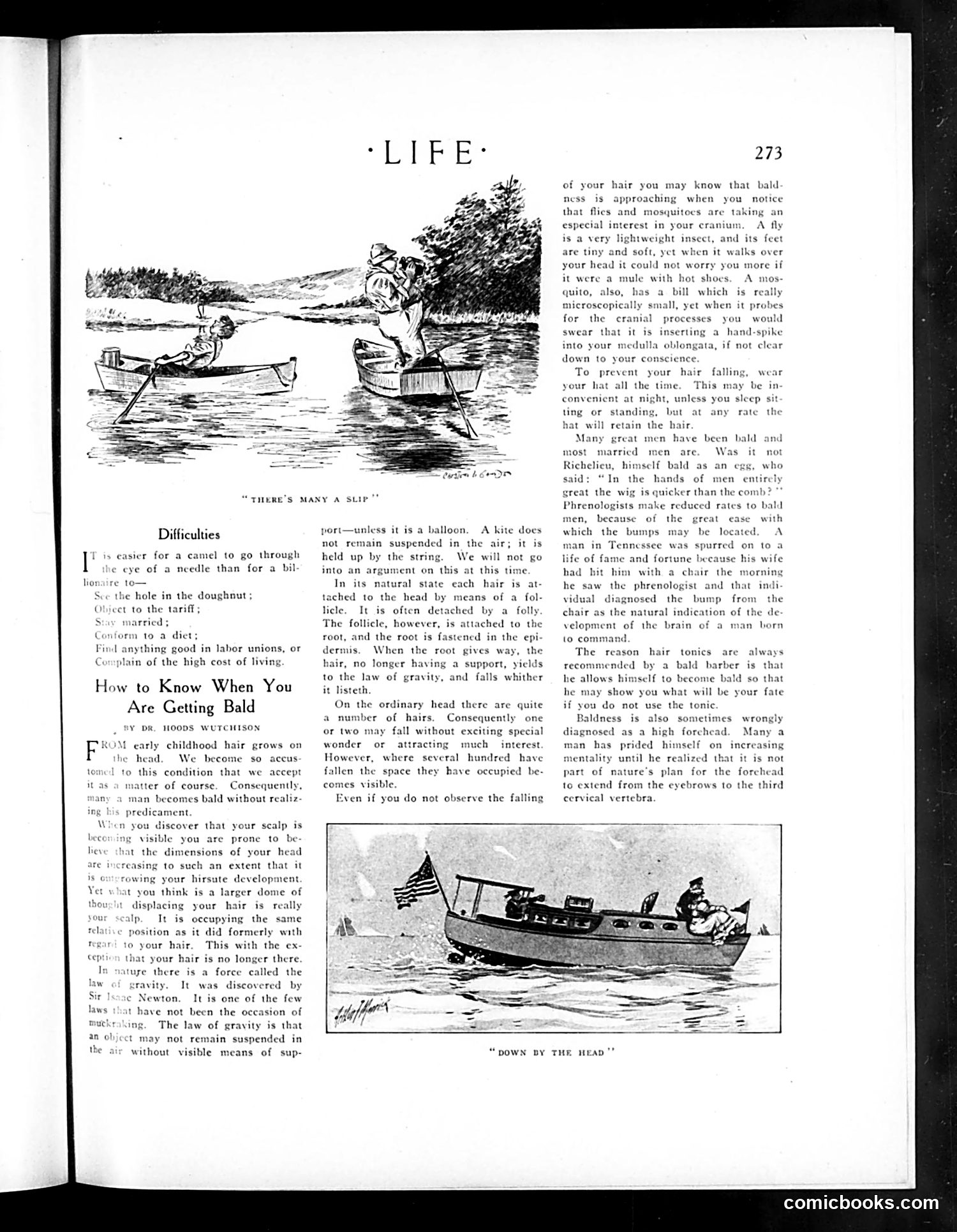
This page presents a humorous medical article by Dr. Hoods Hutchison explaining baldness to readers. The article uses mock-scientific language to discuss hair loss, invoking Sir Isaac Newton's law of gravity as the cause—hair falls because nothing suspends it in air without support. The cartoon "There's Many a Slip" (top) shows two figures in boats, illustrating the idiom about unexpected outcomes. Below, "Down by the Head" depicts a steamboat, likely a visual pun on the baldness article's title. The article's satire targets male vanity and the emerging hair-tonic industry. It mocks men who use tonics to prevent baldness, and references historical figures like Richelieu (famous for wearing wigs) to suggest baldness is inevitable. The piece sardonically notes that barbers recommend tonics as self-interested salesmanship, implying baldness cannot truly be prevented through such products—making the entire grooming industry absurd.
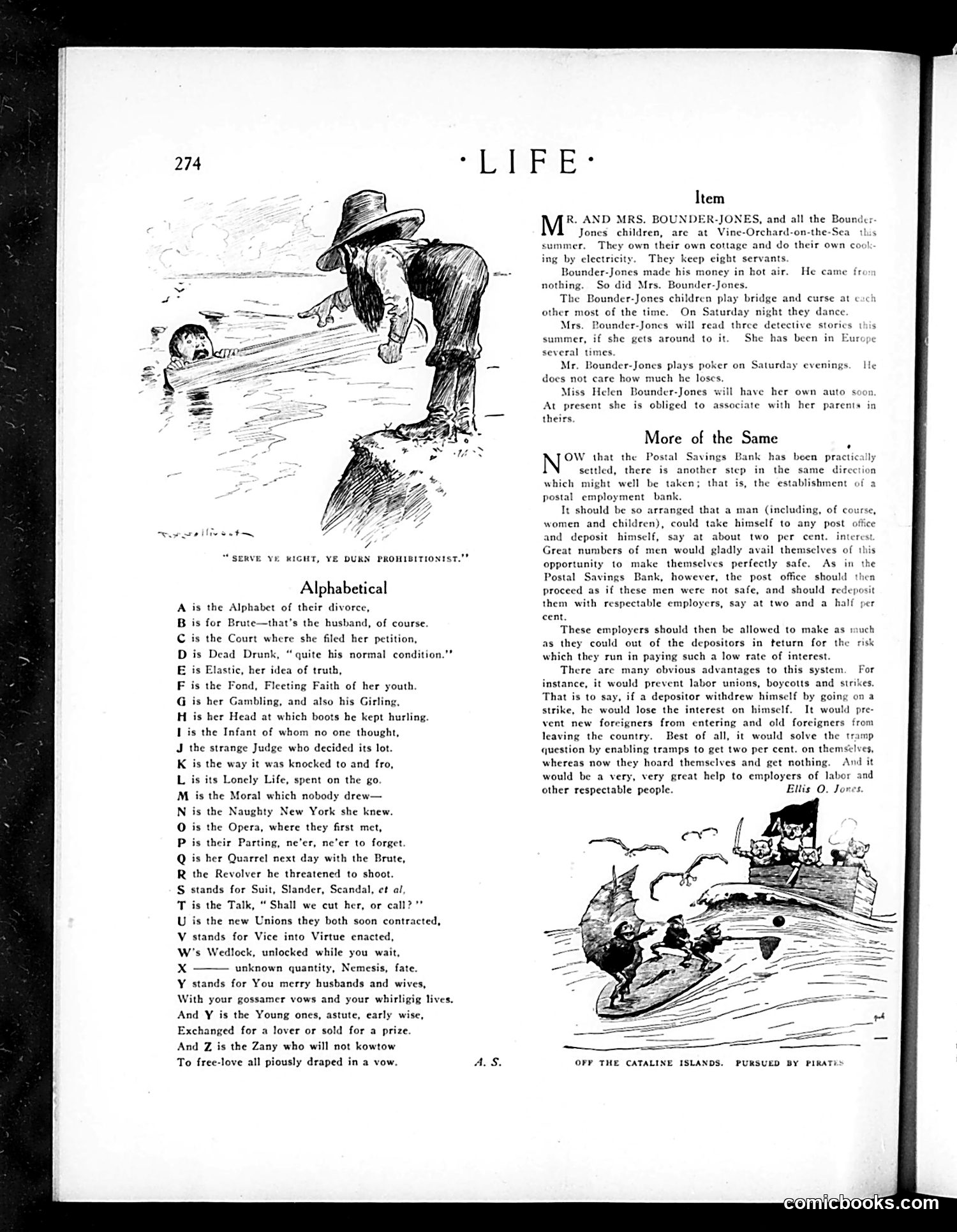
This page contains two distinct satirical pieces typical of early 20th-century Life magazine's social commentary. **The Alphabetical Poem** mocks divorce and marital dysfunction through an A-Z format. It depicts a failed marriage involving domestic violence ("boots he kept hurling"), infidelity, gambling, and custody battles—with particular cynicism about the innocent child caught between warring parents ("its Lonely Life, spent on the go"). The satire targets both spouses' moral failings and society's gossip ("Shall we cut her, or call?"). **The "Bounder-Jones" item** satirizes nouveau-riche pretension: a family that made money through dubious means ("hot air") yet affects respectability. Their children are spoiled and vulgar; the parents are dissolute (gambling, infidelity). **"More of the Same"** proposes a farcical "postal employment bank"—a darkly humorous critique suggesting workers be "deposited" with employers like savings accounts. The satire attacks labor exploitation, immigrant restrictions, and vagrancy, suggesting employers profit from workers while preventing strikes. The quote heading the page—"Serve ye right, ye durn prohibitionist"—likely references alcohol prohibition debates of the era.
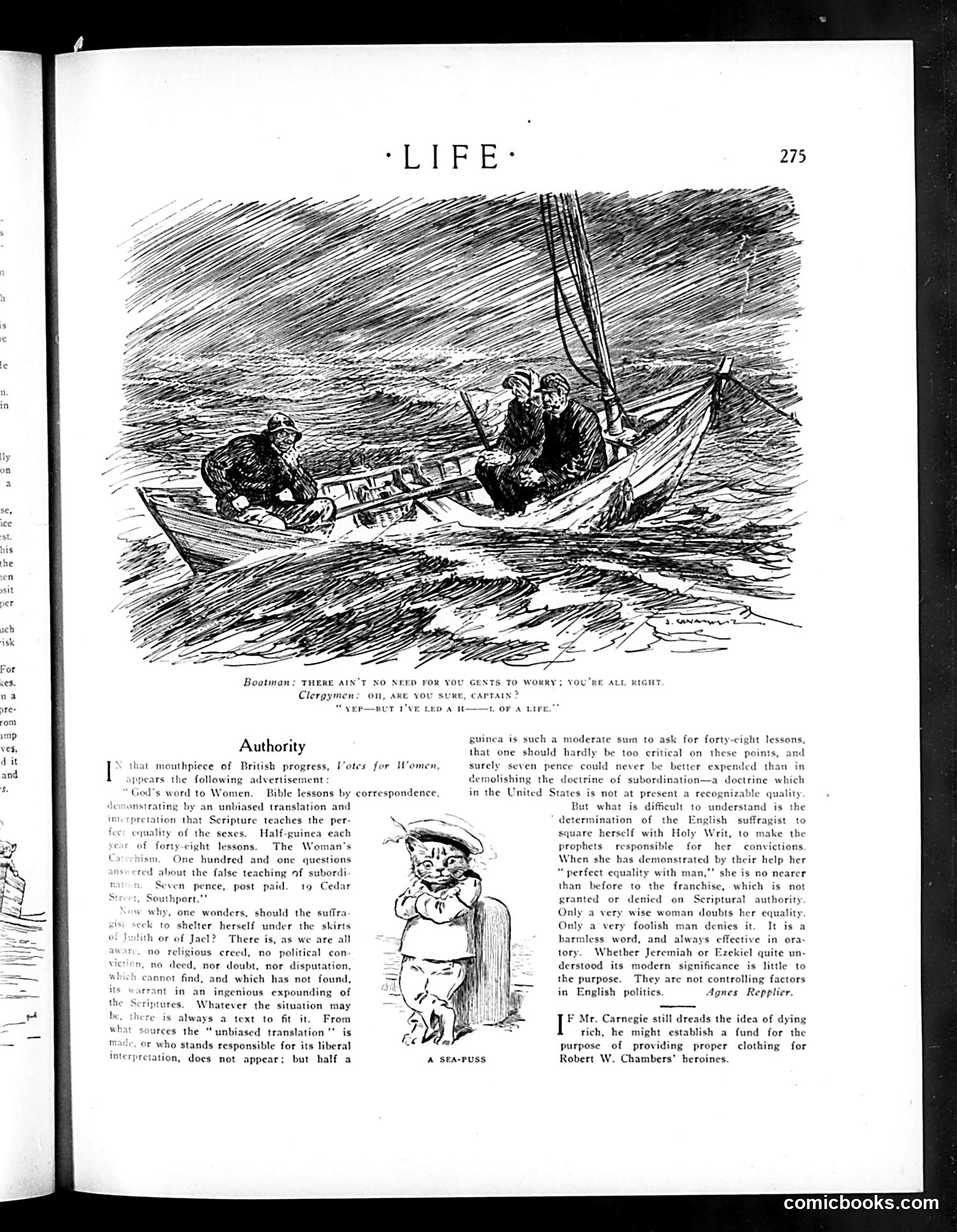
**The Top Cartoon:** A boatman reassures two nervous clergymen in a small boat, claiming "there ain't no need for you gents to worry; you're all right," then adds he's "led a h— of a life"—a crude pun playing on the clergymen's anxiety about morality and the boatman's rough, irreligious past. **The "Authority" Section:** This is satirical commentary on a British suffragist advertisement for "Bible lessons by correspondence" claiming Scripture teaches "perfect equality of the sexes." The author (likely Agnes Repplier, credited at bottom) mocks women suffragists for appealing to religious authority to justify equal rights, arguing that Scripture's actual message is irrelevant to modern political franchise—and that relying on biblical arguments weakens their case rather than strengthening it. **A Sea-Puss illustration** appears to be an unrelated cartoon character. The satire targets the perceived inconsistency of using religious doctrine to argue for secular political rights.
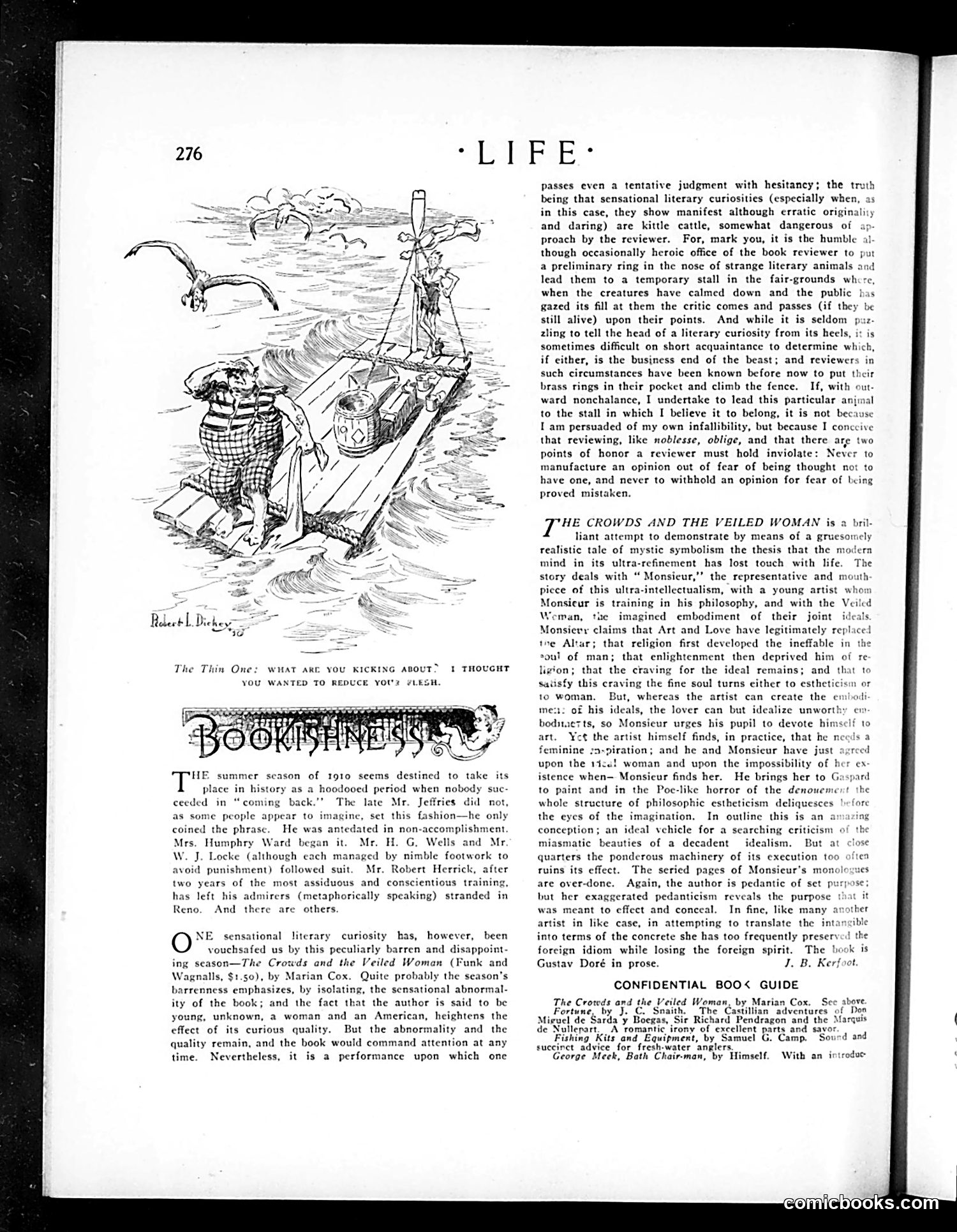
The page contains two distinct elements: **The Cartoon:** "The Thin One" depicts a thin person being kicked by a heavier figure. The thin person protests, saying he thought the kicker wanted to reduce his flesh—a joke about weight loss and physical reduction. **The Book Review:** The main text discusses *The Crowds and the Veiled Woman* by Marian Cox (1910), a symbolist novel exploring the conflict between over-intellectualism and lived experience. The reviewer notes that 1910 was a disappointing year for literary comebacks—referencing failed attempts by writers like H.G. Wells and others to regain relevance after earlier success. The novel's premise: an intellectual character called "Monsieur" argues that Art and Love have replaced Religion as sources of meaning in modern life. A young artist and "Veiled Woman" embody this philosophy, but the author suggests this ultra-refined intellectualism has disconnected people from actual human experience. The reviewer carefully approaches judgment, cautious about this unusual work by an unknown American female author, while defending the reviewer's duty to form honest opinions regardless of fear of error.
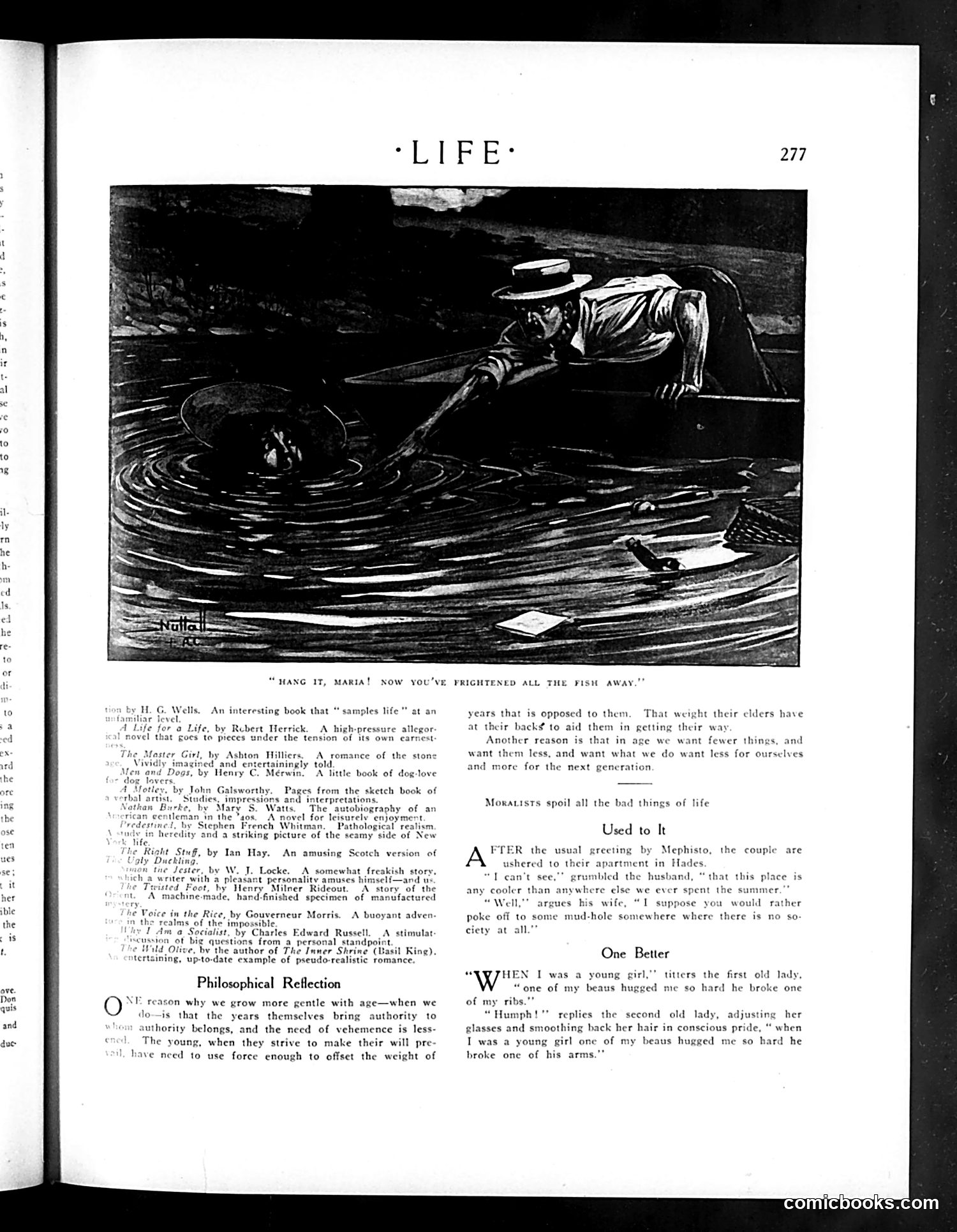
This page contains **three distinct pieces of humor content** rather than a single cartoon: 1. **"Hang It, Maria!"** - The illustrated vignette (top) shows a man fishing while his wife scolds him from shore. The caption suggests marital discord over his fishing hobby—she complains he's "frightened all the fish away," implying his presence (or her nagging) has ruined his sport. It's domestic comedy about spousal frustration. 2. **"Used to It"** - A brief dialogue joke about a couple in Hell (referenced via "Mephisto"), where the husband prefers mud-holes to their current accommodations. The satire targets both marital resignation and the banality of Hell itself—suggesting matrimonial misery rivals damnation. 3. **"One Better"** - Two elderly women trade stories at a competitive pace about suitors who injured themselves through overeager romance. It's generational humor playing on aging vanity and outdated courtship customs. The page also includes book reviews and philosophical reflection on aging's effects on temperament. All content reflects early 20th-century middle-class preoccupations with marriage, propriety, and nostalgic reminiscence.
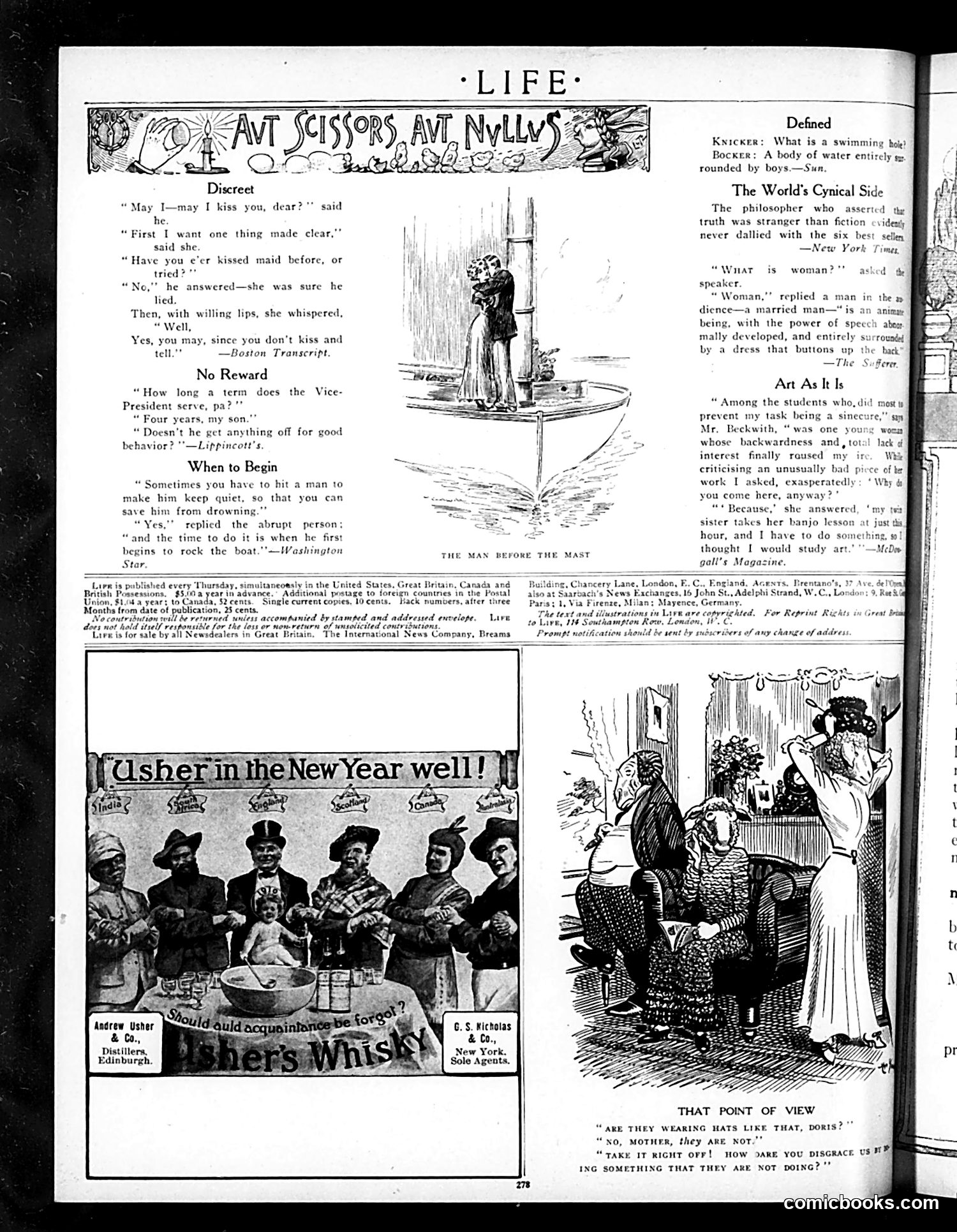
This page contains several unrelated satirical pieces typical of early 20th-century Life magazine: **Top section ("Discreet")**: A flirtation joke about a woman who permits kissing only from men who don't gossip—the humor relies on her certainty the man is already lying about his inexperience. **"No Reward"**: Political satire questioning why the Vice President receives no "good behavior" discount—implying the office itself is punishment or that VPs deserve reduction for their uselessness. **Bottom advertisement**: Usher's Whisky uses a New Year's celebration image with six figures in formal dress, playing on the phrase "auld acquaintance be forgot"—a Scottish/holiday reference. **"That Point of View"**: Satirizes generational fashion conflict. A mother scandalized by young women's hats demands they remove them, then hypocritically rebukes them for "not doing" something they visibly aren't doing—exposing parental illogic and arbitrary social standards. The pieces collectively mock social pretense, political absurdity, and domestic friction.
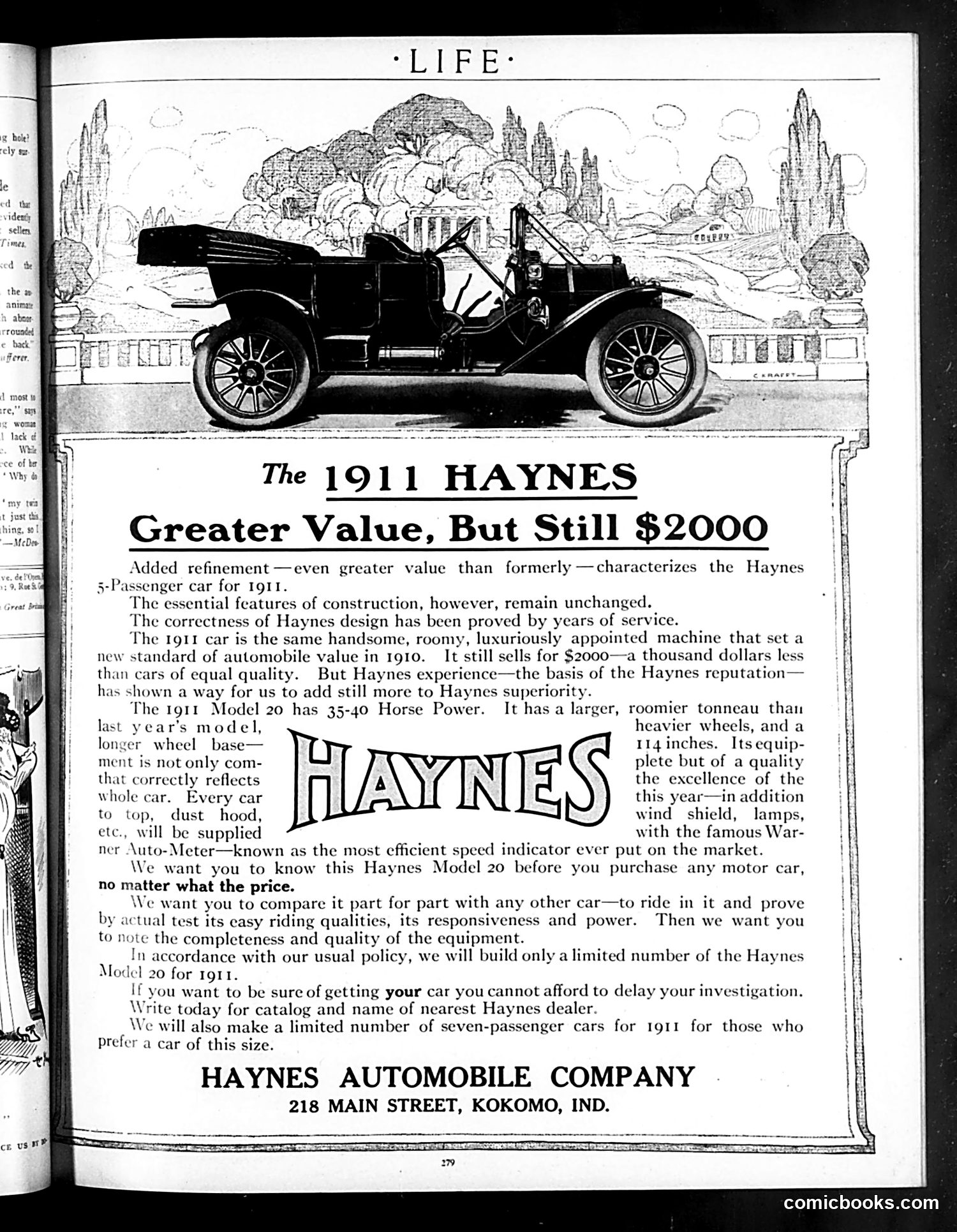
This page is primarily **automobile advertising**, not political satire or cartooning. It's a 1911 advertisement for the Haynes automobile, published in *Life* magazine. The ad features an illustration of a luxury touring car and emphasizes value: the 1911 Model 20 costs $2,000—"a thousand dollars less than cars of equal quality." The pitch highlights engineering reliability, comfort features (larger interior, wind shield, lamps, speedometer), and invites potential buyers to test-drive and compare it against competitors. For modern readers: this reflects early automotive marketing when cars were luxury goods. The $2,000 price (roughly $65,000 in today's dollars) targeted affluent buyers. The emphasis on "proven design" appeals to wealthy consumers' caution about new technology. The urgency ("cannot afford to delay") and limited production claims are classic marketing tactics. This is straightforward commerce, not satire—*Life* magazine carried substantial advertising alongside editorial content.
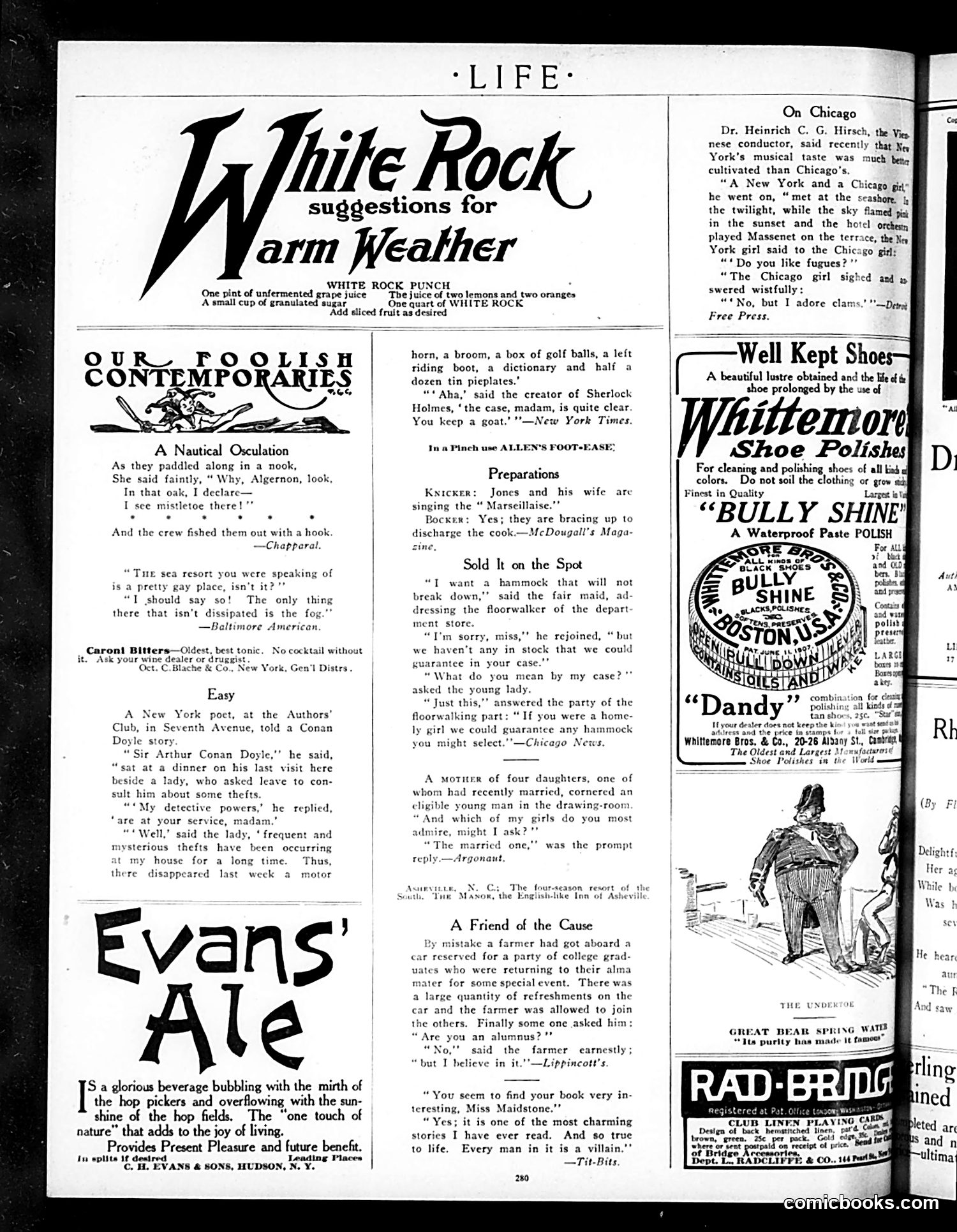
This page from *Life* magazine consists primarily of **humorous anecdotes and advertisements** rather than political cartoons. The content includes various short jokes and stories lampooning American social customs: - **"A Nautical Osculation"** satirizes romantic clichés at seaside resorts - **"Easy"** jokes about a woman consulting Sir Arthur Conan Doyle about household thefts, with the punchline that she "keeps a goat" (implying she's eccentric) - A joke about a floorwalker insulting a customer's appearance - An anecdote about a farmer attending a college reunion who believes in education despite not being an alumnus - **"On Chicago"** contrasts New York and Chicago cultural sophistication—a conductor claims a Chicago woman prefers "clams" to classical fugues, mocking Midwestern taste The advertisements promote products like White Rock Punch, shoe polish, and Evans' Ale. The humor reflects early 20th-century attitudes about regional differences, courtship rituals, and class distinctions.
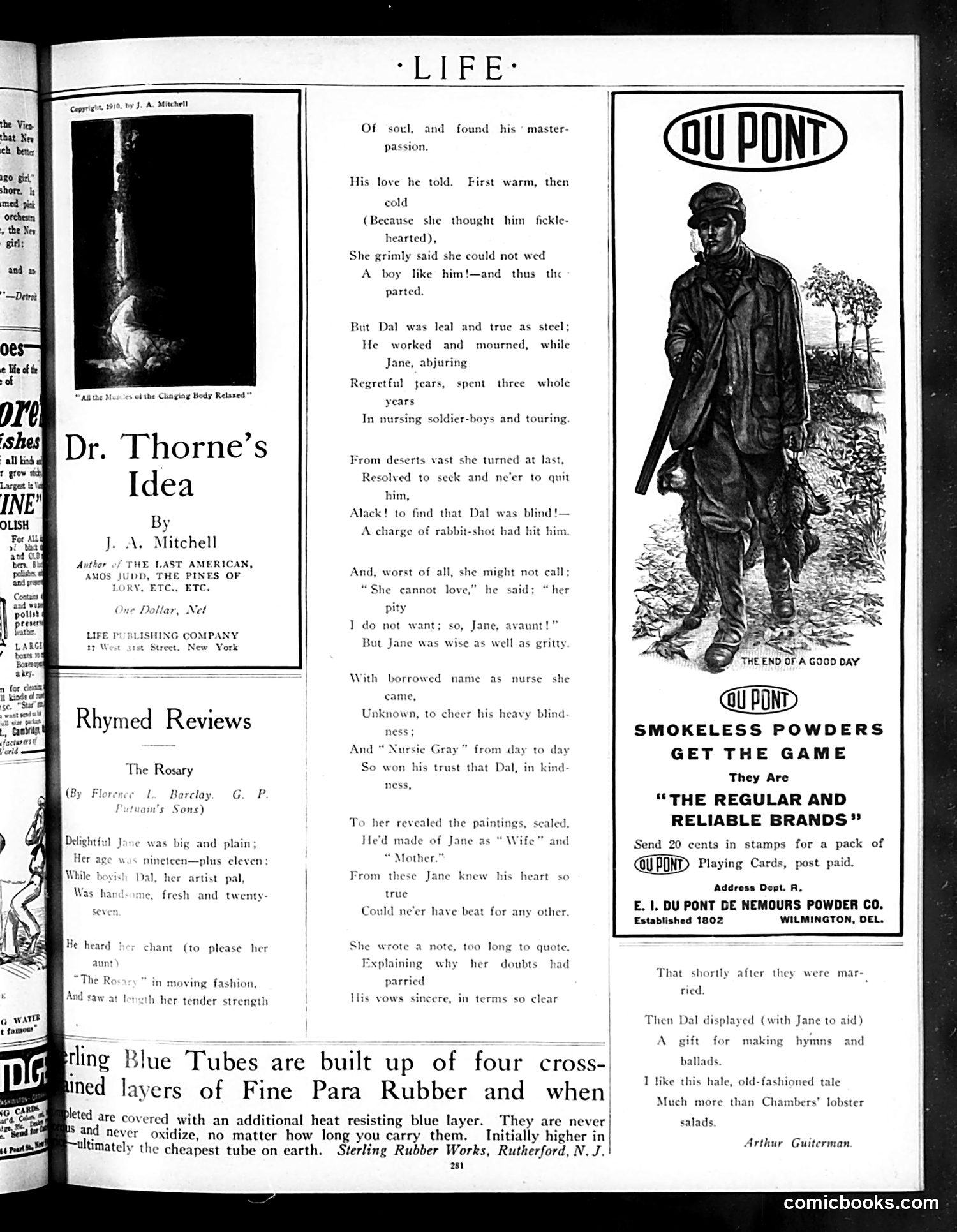
This page contains **serialized fiction and advertising**, not political satire. The main content is "Dr. Thorne's Idea" by J.A. Mitchell—a sentimental short story in verse (the "Rhymed Reviews" section). It tells of Dal, a blind artist, and Jane, a woman who nurses him under an assumed identity after he rejects her out of pride, believing his blindness makes him unworthy of love. The narrative resolves with their marriage and his discovery of artistic talent in hymn-writing. The right side features a **DuPont smokeless powder advertisement** with an illustration titled "The End of a Good Day," depicting a hunter. The ad promotes playing cards as a promotional giveaway. A brief review by Arthur Guiterman appears at bottom, praising the story's old-fashioned sentimentality over contemporary "lobster salads"—a lighthearted jab at modern sophistication. **No political content or satire is present on this page.** It's primarily fiction and advertising typical of *Life* magazine's era.
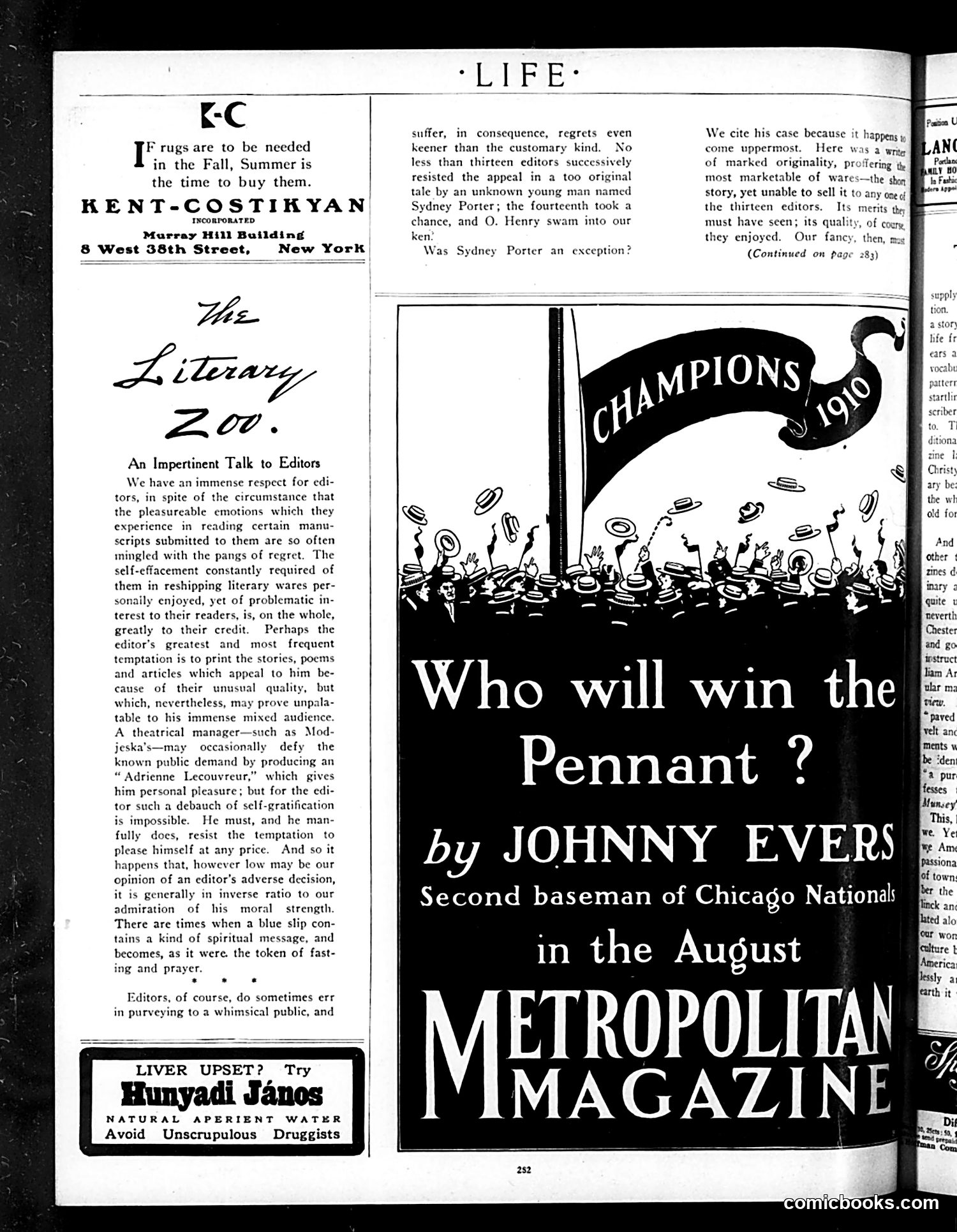
This page combines editorial commentary with advertising. The main content is "The Literary Zoo," an article defending editors against accusations of poor judgment. The piece references **O. Henry** (the pen name of Sydney Porter), a short story writer who faced repeated rejection—thirteen editors refused his work before the fourteenth accepted it. The article uses this as evidence that editors make difficult but principled decisions: they must reject personally appealing work if they judge it unmarketable to their general readership. The article argues editors deserve respect for resisting the "temptation" to publish what they personally enjoy but believe won't appeal to readers—a form of professional self-sacrifice. The large advertisement below promotes an article in *Metropolitan Magazine* by **Johnny Evers**, second baseman for the Chicago Nationals, predicting who will win the baseball pennant—typical sports content for the era. The page reflects early 1900s literary gatekeeping culture and the emerging celebrity athlete magazine feature.
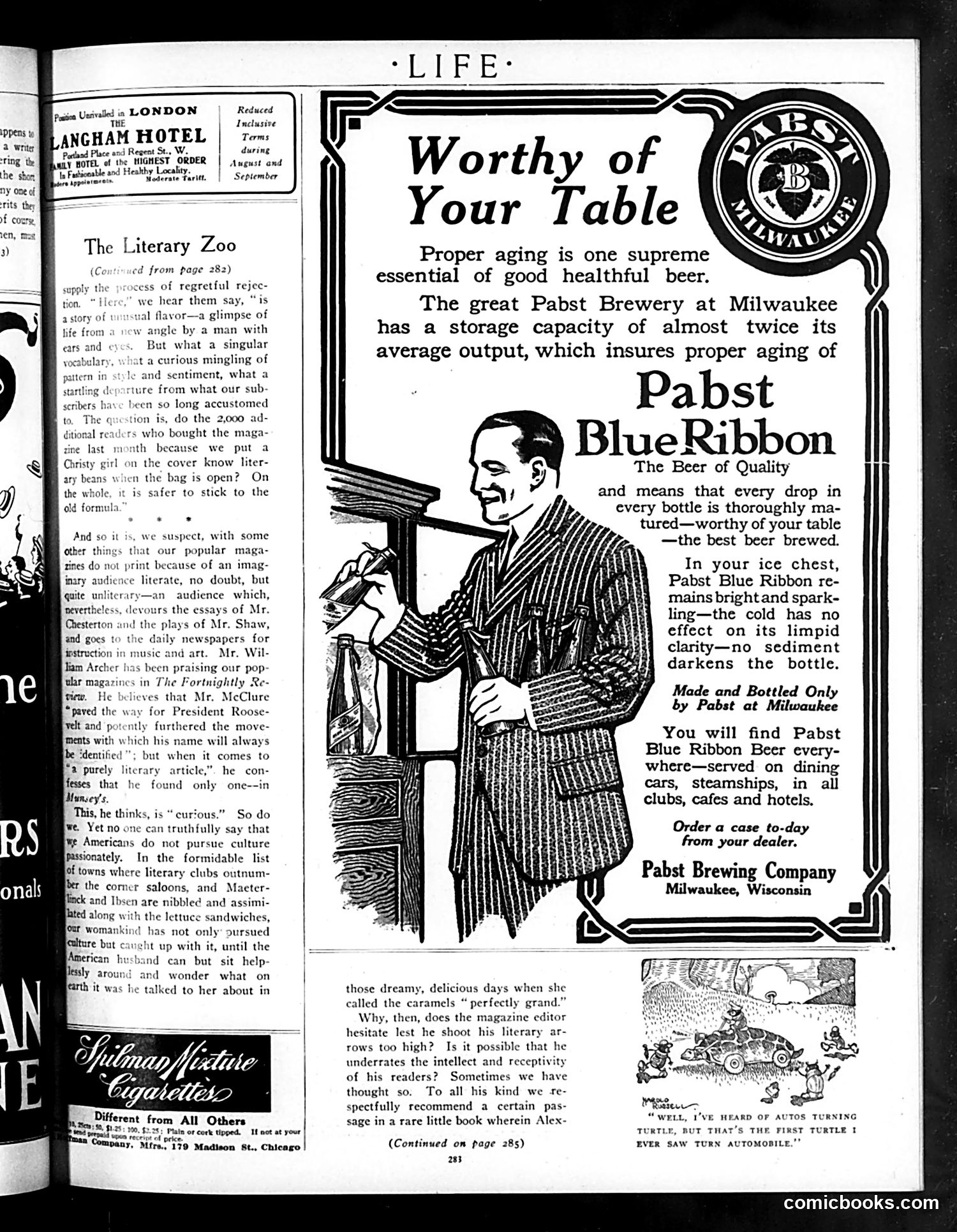
This page mixes editorial content with advertising. **The main feature is "The Literary Zoo,"** a satirical article critiquing American literary taste and magazine editors' assumptions about readers' intelligence. The author argues that despite claims about cultivating culture, Americans don't genuinely pursue serious literature—they prefer lighter fare. The piece questions why editors hesitate to publish challenging literary work, suspecting they underestimate readers' intellect. **The dominant advertisement is for Pabst Blue Ribbon beer**, featuring an illustration of a well-dressed man holding a bottle. The ad emphasizes proper aging and quality, claiming Pabst's storage capacity ensures superior beer. **The bottom cartoon** shows a turtle that has somehow flipped over like a car accident, with the caption joking about seeing "a turtle turn automobile"—a visual pun on automobile accidents of the era. The page reflects early 20th-century anxieties about mass culture, intellectual standards, and consumer advertising's growing dominance in magazines.
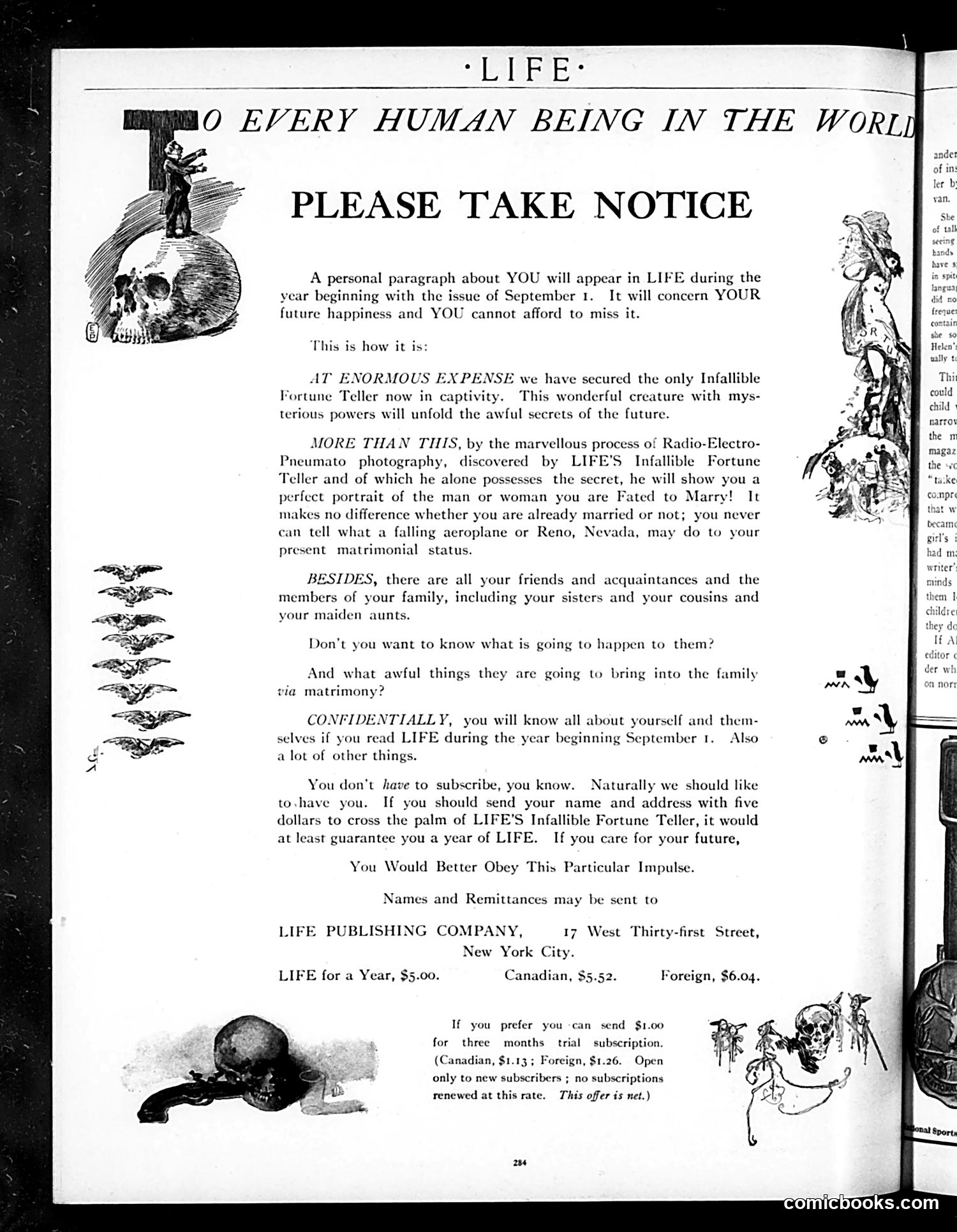
This is primarily a **subscription advertisement** rather than political satire. Life magazine is promoting yearly subscriptions by satirizing the public's fascination with fortune telling—a popular craze of the early 20th century. The ad's humor relies on **mock-serious hyperbole**: Life claims to have captured an "Infallible Fortune Teller" who uses invented "Radio-Electro-Pneumato photography" to reveal who you'll marry, predict disasters (airplanes falling, divorce in Reno, Nevada), and reveal the fates of friends and family. The **visual decorations**—skulls, dancing figures, tarot-like imagery—reinforce the fortune-telling theme while maintaining a darkly comic tone. The satire targets **gullible readers** susceptible to pseudoscience and supernatural claims, while the ad's tongue-in-cheek tone ("You Would Better Obey This Particular Impulse") acknowledges the absurdity even as it pitches subscriptions. The reference to "Reno, Nevada" alludes to divorce tourism, a contemporary scandal. This is clever marketing disguised as mockery.
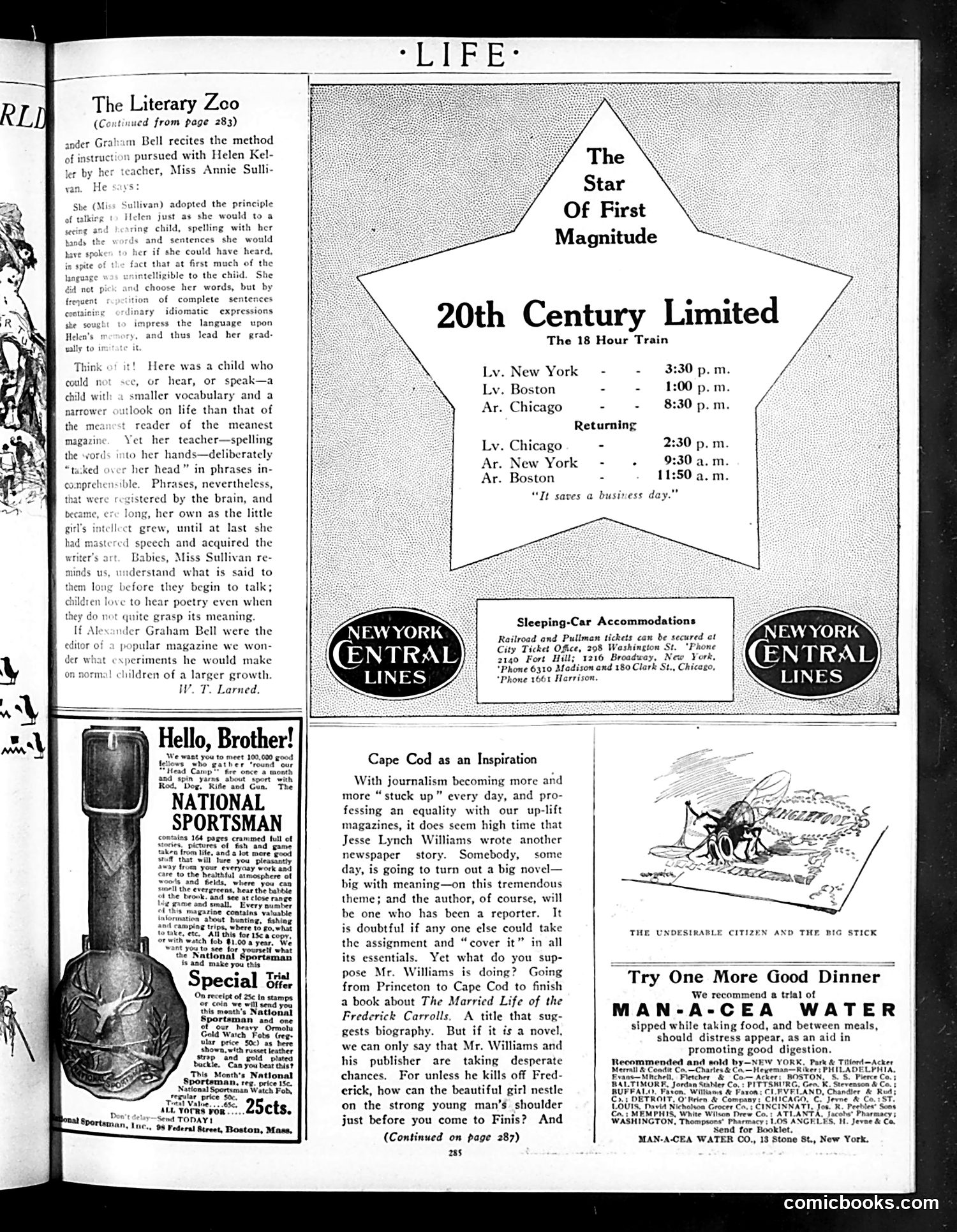
This page is primarily **advertising and miscellaneous content** rather than political satire or comics. The main items are: 1. **"The Literary Zoo"** — A literary critique discussing Helen Keller's education by Annie Sullivan, contrasting her limited vocabulary with what she learned through deliberate instruction. It's an earnest discussion of teaching methods, not satire. 2. **Railroad and Magazine Advertisements** — The prominent "20th Century Limited" train ad and "National Sportsman" magazine ad are straightforward commercial pitches with no satirical content. 3. **"Cape Cod as an Inspiration"** — A brief essay about author Jesse Lynch Williams writing a novel about "The Married Life of the Frederick Carrolls," questioning whether he can resolve the narrative without killing off the male character. This is literary commentary, not satire. 4. **"Man-a-cea Water"** — A patent medicine advertisement. The page contains no recognizable political cartoons, caricatured figures, or satirical commentary that would require historical context explanation for modern readers.
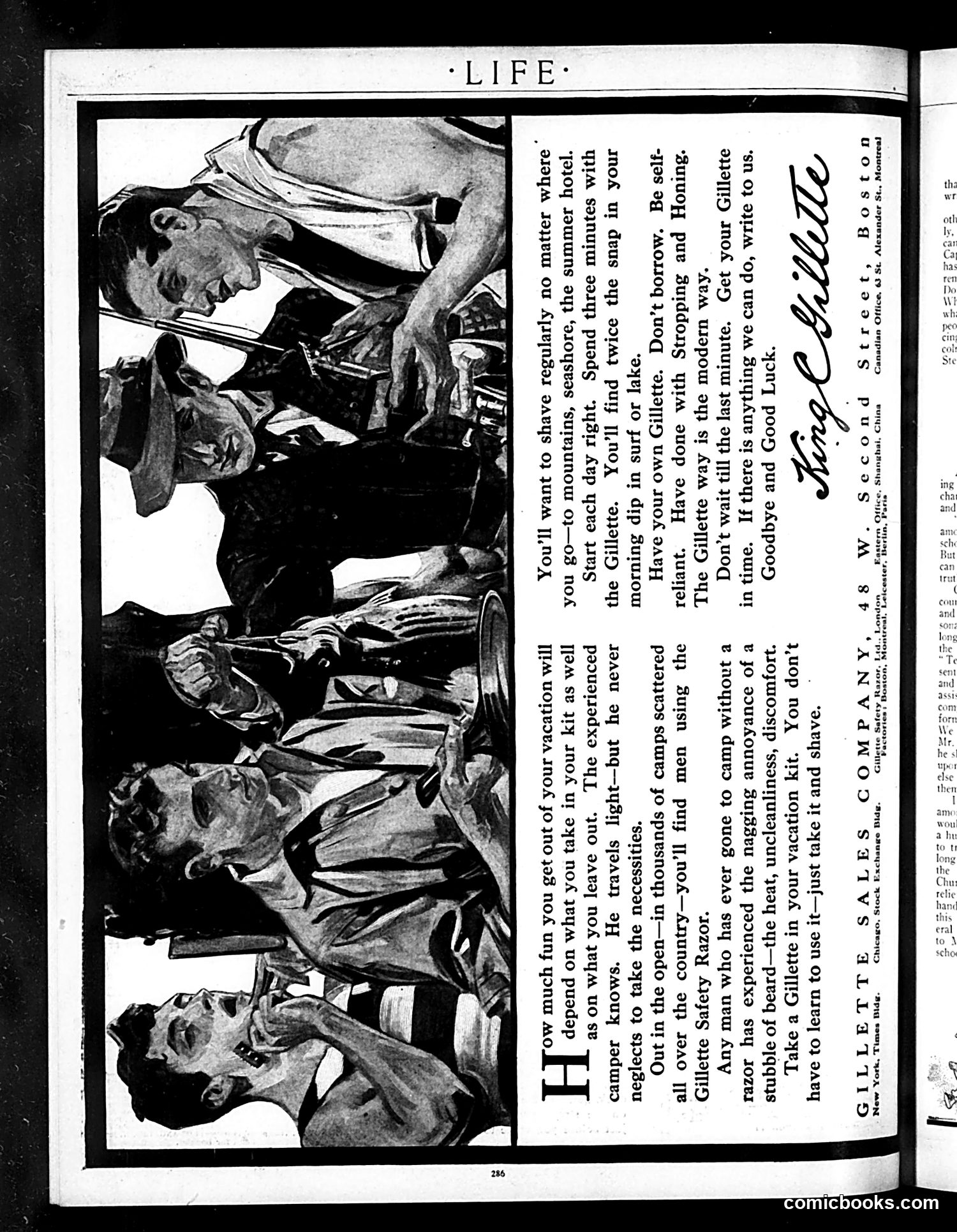
The OCR text is severely corrupted and largely illegible, making precise interpretation difficult. However, the **image shows what appears to be a vintage advertisement or editorial cartoon** featuring illustrated figures in what looks like a camping or outdoor scenario. The visible English text fragments suggest themes related to **vacation, camping, or leisure activities** — references to "vacation," "camp," and "Gillette" (the razor brand) appear in the corrupted text. This appears to be **a Gillette razor advertisement** using humor and illustrated scenarios to promote their product, a common advertising approach in early-to-mid 20th century Life magazine. The cartoon likely makes a joke about maintaining grooming standards even while roughing it outdoors or on vacation. **Without clearer text or context, I cannot identify specific political figures or historical events referenced.** The satirical point seems directed at consumer habits and masculinity norms rather than political satire.
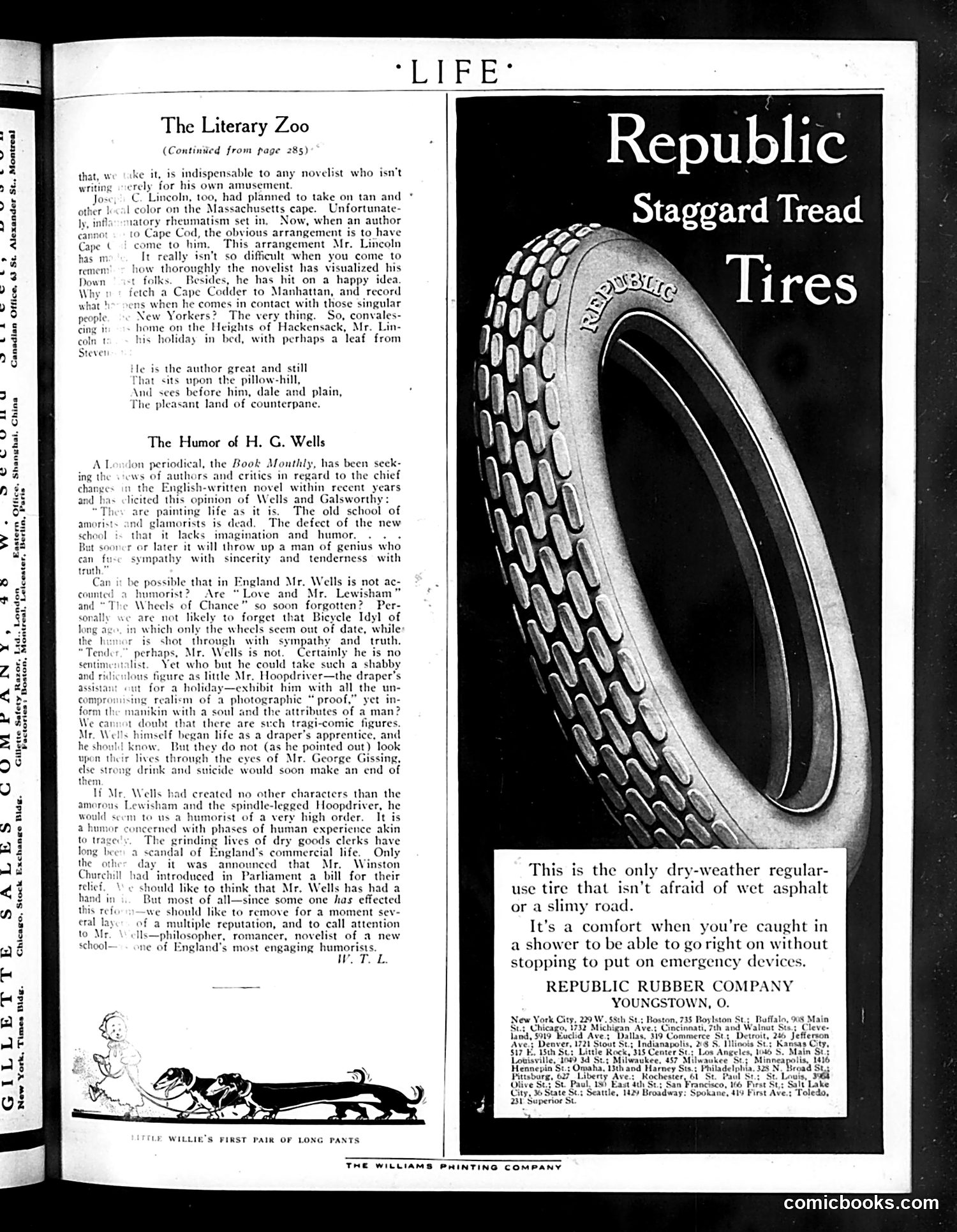
This page contains two distinct sections: **Left side:** Literary criticism of H.G. Wells's humor. The writer defends Wells against critics who claim he lacks imagination and humor, citing his sympathetic portrayal of characters like the shabby draper's assistant Mr. Hoopdriver from "The Wheels of Chance." The critic argues Wells's humor engages with human tragedy—specifically the grinding poverty of English shop clerks—making him a humorist of "very high order." The piece also references Winston Churchill introducing parliamentary relief legislation for such workers, suggesting Wells's social criticism had real-world impact. **Right side:** A full-page advertisement for Republic Staggard Tread Tires, featuring a detailed tire illustration. The ad emphasizes that these tires perform reliably in wet conditions without requiring emergency devices—a practical selling point for early automotive drivers caught in rainstorms. The juxtaposition is typical of Life magazine's format: serious literary commentary paired with commercial advertisements targeting educated, affluent readers who could afford automobiles.
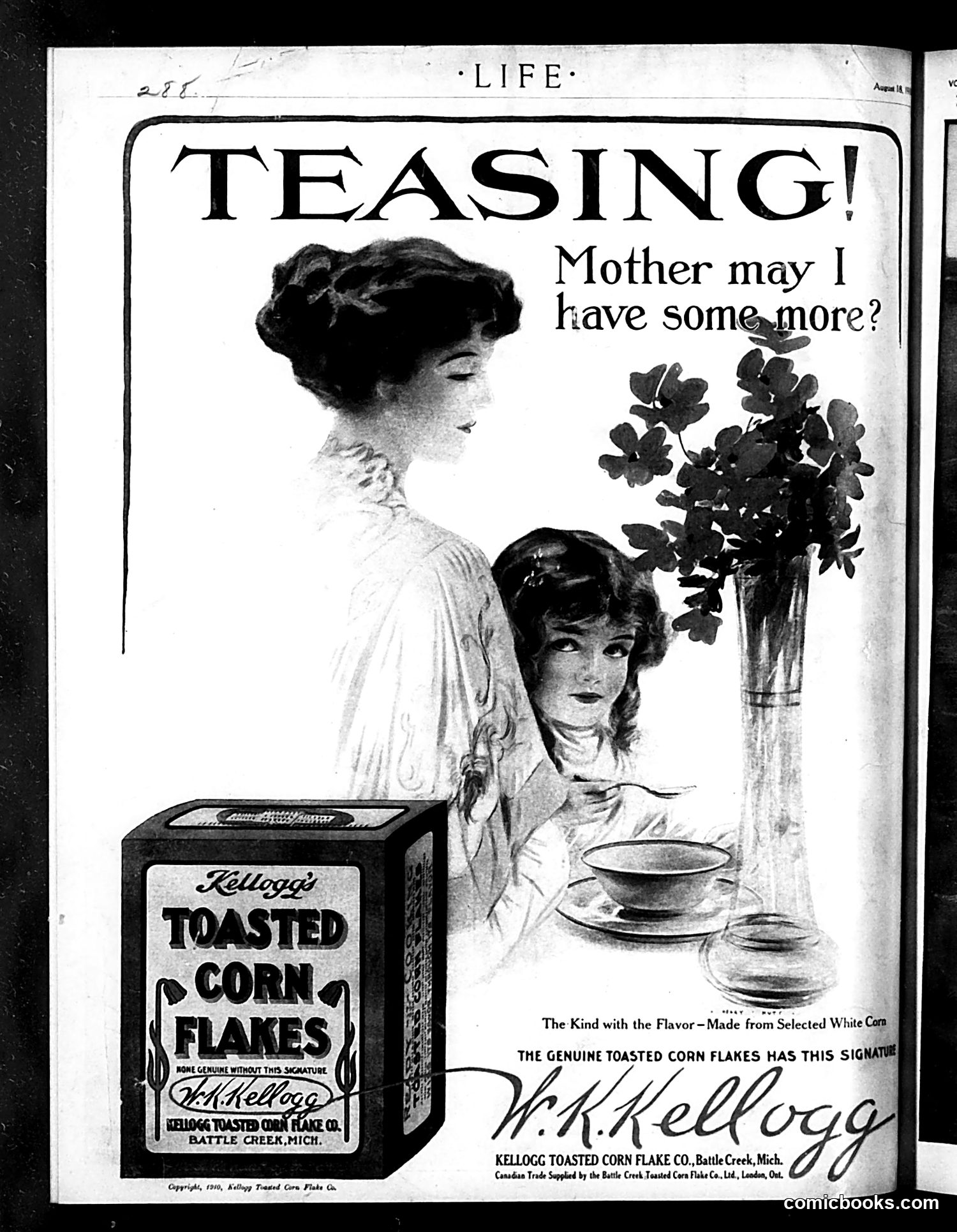
This is a **Kellogg's Toasted Corn Flakes advertisement**, not political satire. The "teasing" refers to a child asking their mother for more cereal—a common domestic scene used in early 20th-century advertising. The image shows an elegant woman (presumably the mother) with a young child at a table with a bowl and flowers. The ad emphasizes the product's appeal to children and positions Kellogg's as a desirable family food. The signature of W.K. Kellogg authenticates the brand. The humor is gentle domesticity rather than social commentary. This reflects early 1900s advertising strategies targeting mothers as household purchasing decision-makers, using appeals to their children's happiness and proper nutrition.