
Life, 1910-08-18 · page 16 of 36
Life — August 18, 1910 — page 16: what you’re looking at
What you’re looking at
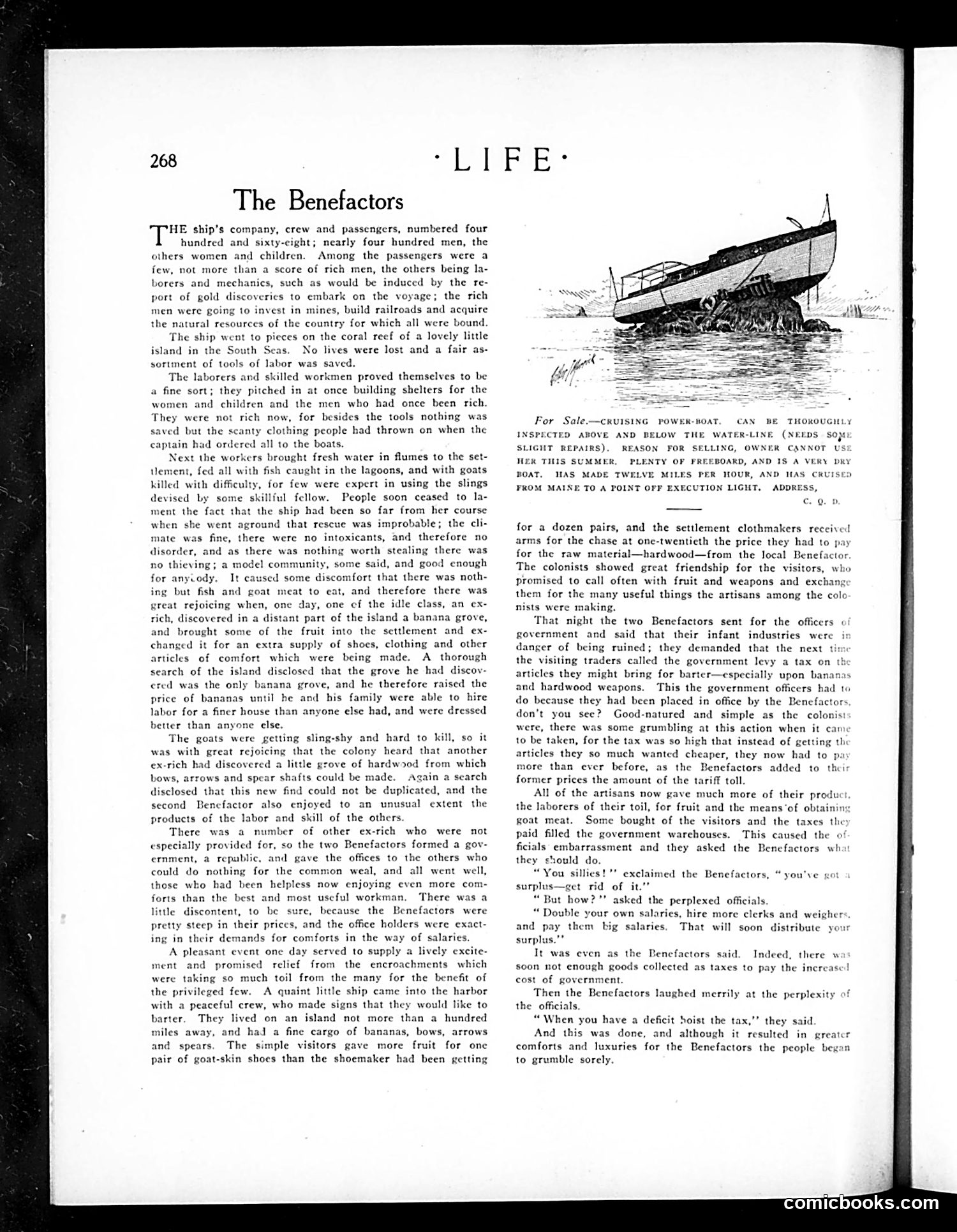
This is not a cartoon but a narrative fable about class and capitalism. It describes shipwrecked colonists who initially form an egalitarian society where skilled workers provide for all. However, two formerly wealthy men ("ex-rich") who discover monopolized resources—bananas and hardwood—become wealthy again by controlling supply and charging exploitative prices. These "Benefactors" then establish a government that rewards idle office-holders over productive workers, recreating class hierarchy from nothing. The satire targets how capitalism naturally concentrates wealth through monopoly rather than merit, and how the wealthy manipulate systems to entrench privilege. The accompanying illustration shows a wrecked ship, visualizing the story's premise. The text's ironic title—calling monopolists "Benefactors"—is the joke: they're presented as saviors when they're actually exploiters. This appears to critique Gilded Age industrialists who claimed to benefit society while accumulating vast fortunes.
📄 Transcribed text from this page (OCR, searchable)
Machine-transcribed from the original scan — historical spelling and the odd misread are preserved.
268 LL PIRAE : The Benefactors HE ship’s company, crew and passengers, numbered four hundred and sixty-eight; nearly four hundred men, the others women and children. Among the passengers were a few, not more than a score of rich men, the others being la- borers and mechanics, such as would be induced by the re- port of gold discoveries to embark on the voyage; the rich men were going to invest in mines, build railroads and acquire the natural resources of the country for which all were bound. The ship went to pieces on the coral reef of a lovely little island in the South Seas. No lives were lost and a fair as- sortment of tools of labor was saved. The laborers and skilled workmen proved themselves to be a fine sort; they pitched in at once building shelters for the women and children and the men who had once been rich. They were not rich now, for besides the tools nothing was saved but the scanty clothing people had thrown on when the captain had ordered all to the boats. Next the workers brought fresh water in flumes to the set- tlement, fed all with fish caught in the lagoons, and with goats killed with difficulty, for few were expert in using the slings devised by some skillful fellow. People soon ceased to la- ment the fact that the ship had been so far from her course when she went aground that rescue was improbable; the cli- mate was fine, there were no intoxicants, and therefore no disorder, and as there was nothing worth stealing there was no thieving; a model community, some said, and good enough for anyvody. It caused some discomfort that there was noth- ing but fish and goat meat to eat, and therefore there was great rejoicing when, one day, one cf the idle class, an ex- rich, discovered in a distant part of the island a banana grove, and brought some of the fruit into the settlement and ex- changed it for an extra supply of shoes, clothing and other articles of comfort which were being made. A thorough search of the island disclosed that the grove he had discov- ered was the only banana grove, and he therefore raised the price of bananas until he and his family were able to hire labor for a finer house than anyone else had, and were dressed better than anyone else. The goats were getting sling-shy and hard to kill, so it was with great rejoicing that the colony heard that another ex-rich had discovered a little grove of hardwood from which bows, arrows and spear shafts could be made. Again a search disclosed that this new find could not be duplicated, and the second Benefactor also enjoyed to an unusual extent the products of the labor and skill of the others. There was a number of other ex-rich who were not especially provided for, so the two Benefactors formed a gov- ernment, a republic, and gave the offices to the others who could do nothing for the common weal, and all went well, those who had been helpless now enjoying even more com- forts than the best and most useful workman, There was a little discontent, to be sure, because the Benefactors were pretty steep in their prices, and the office holders were exact- ing in their demands for comforts in the way of salaries. A pleasant event one day served to supply a lively excite- ment and promised relief from the encroachments which were taking so much toil from the many for the benefit of the privileged few. A quaint little ship came into the harbor with a peaceful crew, who made signs that they would like to barter. They lived on an island not more than a hundred miles away, and had a fine cargo of bananas, bows, arrows and spears. The simple itors gave more fruit for one pair of goat-skin shoes than the shoemaker had been getting For Sale.—cxvuisinG POWER-BOAT. CAN BE THOROUGHLY INSPECTED ANOVE AND BELOW THE WATER-LINE (NEEDS SOM SLIGHT REPAIRS). REASON FOR SELLING, OWNER CANNOT US HER THIS SUMMER, PLENTY OF FREEBOARD, AND 1S A VERY DRY BOAT. MAS MADE TWELVE MILES PER MOUR, AND IAS CRUISED FROM MAINE TO A POINT OFF EXECUTION LIGHT, ADDRE! . for a dozen pairs, and the settlement clothmakers received arms for the chase at one-twentieth the price they had to pay for the raw material—hardwood—from the local Benefactor The colonists showed great friendship for the visitors, who promised to call often with fruit and weapons and exchang them for the many useful things the artisans among the colc nists were making. That night the two Benefactors sent for the officers « government and said that their infant industries were danger of being ruined; they demanded that the next tin the visiting traders called the government levy a tax on tt articles they might bring for barter—especially upon bananas and hardwood weapons. This the government officers had do because they had been placed in office by the Benefactors don’t you see? Good-natured and simple as the colonis: were, there was some grumbling at this action when it can to be taken, for the tax was so high that instead of getting th articles they so much wanted cheaper, they now had to more than ever before, as the Benefactors added to th former prices the amount of the tariff toll. All of the artisans now gave much more of their produ the laborers of their toil, for fruit and the means‘of obtainins goat meat. Some bought of the visitors and the taxes the paid filled the government warehouses. This caused the o ficials embarrassment and they asked the Benefactors wh they should do. You sillies!’" exclaimed the Benefactors, “you've ge surplus—get rid of it.” “But how?’? asked the perplexed officials “Double your own salaries, hire more clerks and weigher them big salaries, That will soon distribute your was even as the Benefactors said. Indeed, there w Soon not enough goods collected as taxes to pay the increase! cost of government. Then the Benefactors laughed merrily at the perplexity of the officials. “When you have a deficit hoist the tax,"’ they said And this was done, and although it resulted in greatc comforts and luxuries for the Benefactors the people bex to grumble sorely. comicbooks.com