
Life, 1910-08-18 · page 24 of 36
Life — August 18, 1910 — page 24: what you’re looking at
What you’re looking at
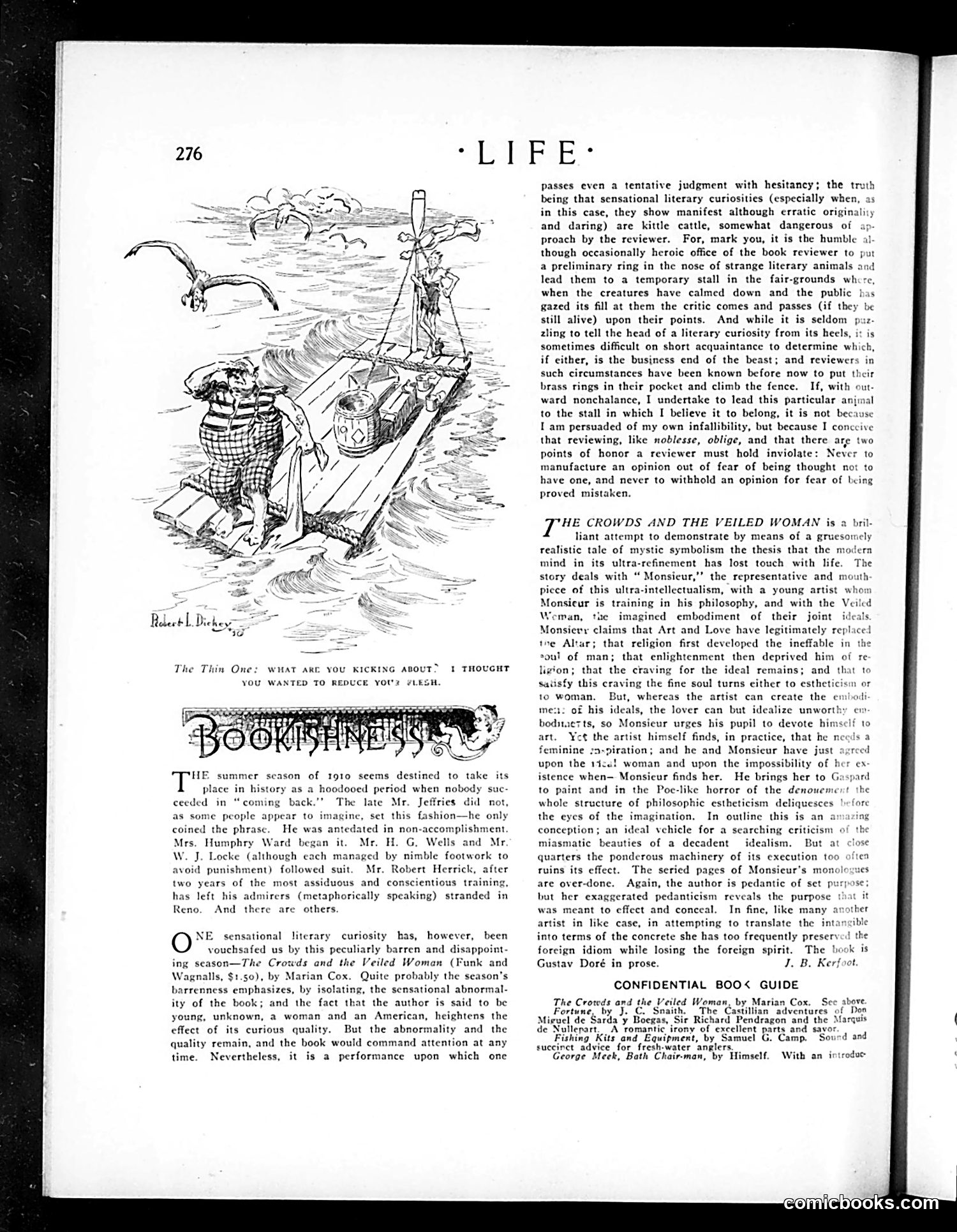
The page contains two distinct elements: **The Cartoon:** "The Thin One" depicts a thin person being kicked by a heavier figure. The thin person protests, saying he thought the kicker wanted to reduce his flesh—a joke about weight loss and physical reduction. **The Book Review:** The main text discusses *The Crowds and the Veiled Woman* by Marian Cox (1910), a symbolist novel exploring the conflict between over-intellectualism and lived experience. The reviewer notes that 1910 was a disappointing year for literary comebacks—referencing failed attempts by writers like H.G. Wells and others to regain relevance after earlier success. The novel's premise: an intellectual character called "Monsieur" argues that Art and Love have replaced Religion as sources of meaning in modern life. A young artist and "Veiled Woman" embody this philosophy, but the author suggests this ultra-refined intellectualism has disconnected people from actual human experience. The reviewer carefully approaches judgment, cautious about this unusual work by an unknown American female author, while defending the reviewer's duty to form honest opinions regardless of fear of error.
📄 Transcribed text from this page (OCR, searchable)
Machine-transcribed from the original scan — historical spelling and the odd misread are preserved.
= EIR * The Thin One: Wuat axt YOU KICKING ApoUT> 1 THOUGHT YOU WANTED TO REDUCE YOUR LESH. HE summer season of 1910 seems destined to take its place in ry as a hoodooed period when nobody suc- ceeded in “coming back.’? The late Mr. Jeffries did not, as some people appear to imagine, set this fashion—he only coined the phrasc. He was antedated in non-accomplishment Mrs. Humphry Ward began it. Mr. H. G, Wells and Mr W. J. Locke (although each managed by nimble footwork to avoid punishment) followed suit. Mr. Robert Herrick, after two years of the most assiduous and conscientious training, has left his admirers (metaphorically speaking) stranded in Reno. And there are others, sensational literary curiosity bas, however, vouchsafed us by this peculiarly barren and disappoint- ing season—The Crowds and the Veiled Woman (Funk and Wagnalls, $1.50), by Marian Cox. Quite probably the season’s barrenness emphasizes, by isolating, the sensational abnormal- ity of the book; and the fact that the author is said to be young, unknown, a woman and an American, heightens the effect of its curious quality. But the abnormality and the quality remain, and the book would command attention at any time. Nevertheless, it is a performance upon which one passes even a tentative judgment with hesitancy; the truth being that sensational literary curiosities (especially when, as in this case, they show manifest although erratic originali:y and daring) are kittle cattle, somewhat dangerous of proach by the reviewer. For, mark you, it is the humble al though occasionally heroic office of the book reviewer to put a preliminary ring in the nose of strange literary animals ar lead them to a temporary stall in the fair-grounds wher when the creatures have calmed down and the public has gazed its fill at them the critic comes and passes (if they be still alive) upon their points. And while it is seldom puz zling to tell the head of a literary curiosity from its heels, i: is sometimes difficult on short acquaintance to determine which, if either, is the business end of the beast; and reviewers in such circumstances have been known before now to put their brass rings in their pocket and climb the fence. If, with out- ward nonchalance, I undertake to lead this particular anjmal to the stall in which I believe it to belong, it is not because I am persuaded of my own infallibility, but because I conceive that reviewing, like noblesse, oblige, and that there are two points of honor a reviewer must hold inviolate: Never to manufacture an opinion out of fear of being thought not to have one, and never to withhold an opinion for fear of being proved mistaken. HE CROWDS AND THE VEILED WOMAN is a bril- liant attempt to demonstrate by means of a gruesomely realistic tale of mystic symbolism the thesis that the modern mind in its ultra-refinement has lost touch with life. The story deals with “ Monsicur,”” the representative and mouth picce of this ultra-intellectualism, with a young artist. wh Monsieur is training in his philosophy, and with the Veiled Weman, imagined embodiment of their joint ic Monsiery claims that Art and Love have legitimately replace Altar; that religion first developed the ineffable in soul of man; that enlightenment then deprived him of re ligion; that the craving for the ideal remains; and t salisfy this craving the fine soul turns cither to esthetic to woman. But, whereas the artist can create the c men: of his ide, the lover can but idealize unwor' boditaetts, so Monsieur urges his pupil to devote him art. Yc¢ the artist himself finds, in practice, that he necds a feminine :a-piration; and he and Monsieur have t agreed upon the 14cu! woman and upon the impossibility of her ex istence when— Monsicur finds her. He brings her to Gaspard to paint and in the Poe-like horror of the denouement the whole structure of philosophic estheticism deliquesces !fore the eyes of the imagination. In outline this is an ay conception; an ideal vehicle for a searching criticism of the miasmatic beauties of a decadent idealism. But at close quarters the ponderous machinery of its execution too often ruins its effect. The seried pages of Monsicur’s mon are over-done. Again, the author is pedantic of set pur but her exaggerated pedanticism reveals the purpose was meant to effect and conceal. In fine, like many artist in like case, in attempting to translate the intangible into terms of the concrete she has too frequently preserved # foreign idiom while losing the forcign spirit. The book Gustav Doré in prose. J.B. Kerfoot CONFIDENTIAL BOO< GUIDE The Croteds and the Veiled Woman, by Marian Cox. Se Fortune, by J. C. Snaith. The Castillian adventures ¢ Mieuel de Sarda'y Boegas, Sir Richard Pendragon and the \ de Nullepart. A romantic irony of excellent parts and sayo: Fishing Kits and Equipment, by Samuel G. Camp. Sourd and succinct advice for fresh-water anglers. George Meek, Bath Chair-man, by Himself. With an introduc