
Life, 1910-08-18 · page 20 of 36
Life — August 18, 1910 — page 20: what you’re looking at
What you’re looking at
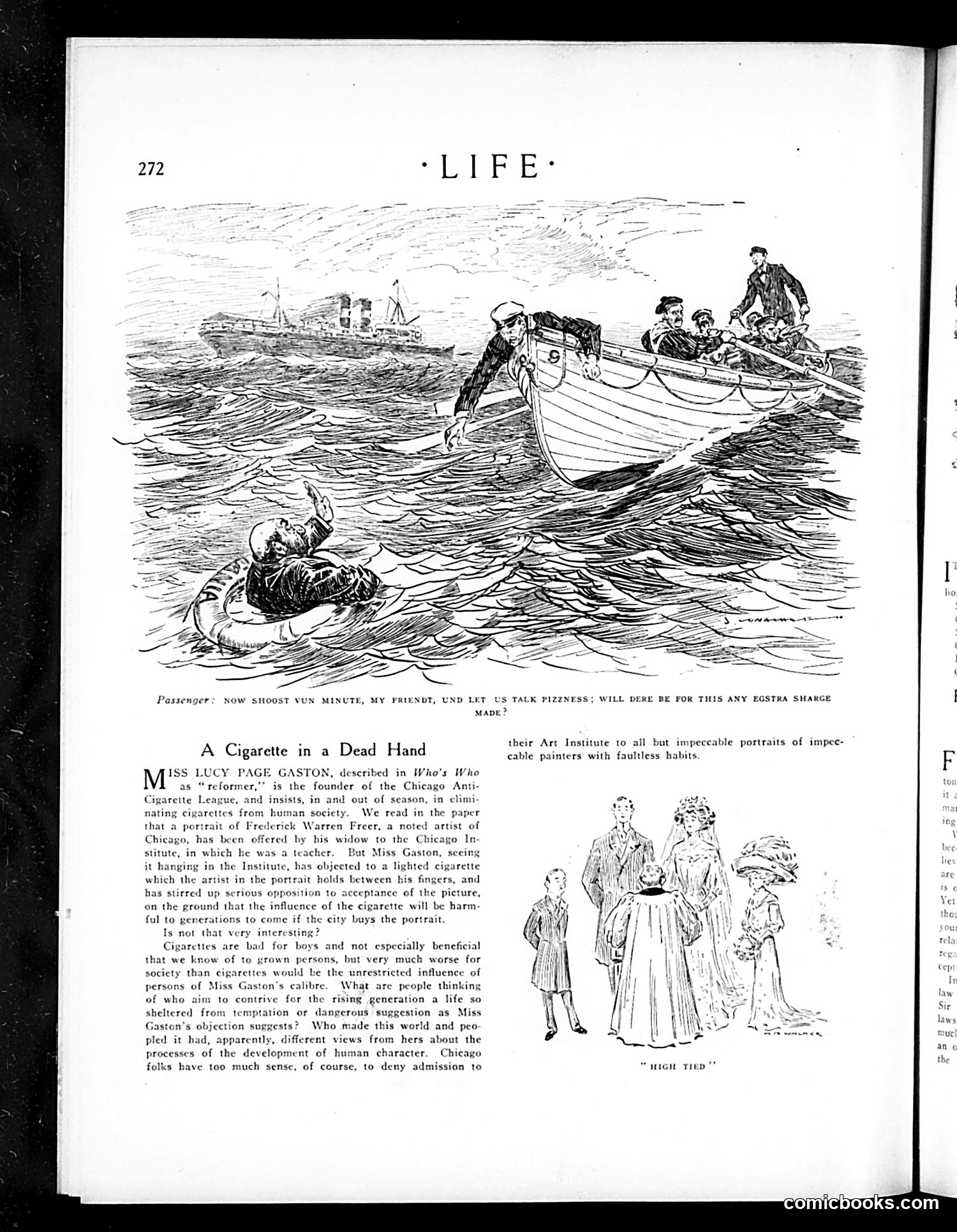
The cartoon satirizes Lucy Page Gaston, founder of the Chicago Anti-Cigarette League, a real reformer who objected to a portrait of artist Frederick Warren (holding a lit cigarette) being accepted into the Chicago Art Institute. **The satire's point**: Life mocks Gaston's censorious moralism—her attempt to remove the painting because the depicted cigarette might "corrupt" viewers. The top cartoon shows a passenger with a heavy accent ("SMOOST VUN MINUTE...PIZZNESS") interrupting a boat rescue, illustrating absurd priorities. **The criticism**: Life argues Gaston's zealous moralism poses greater danger to society than cigarettes themselves. The text sarcastically suggests sheltering people from all temptation is impractical and contrary to human development. Life defends artistic integrity and realistic representation over sanitized censorship, implying Gaston's reformism represents dangerous cultural control masked as protection. The "High Tied" fashion sketches below provide tonal contrast—lighter social observation versus Gaston's heavy-handed intervention.
📄 Transcribed text from this page (OCR, searchable)
Machine-transcribed from the original scan — historical spelling and the odd misread are preserved.
Passenger: NOW SMOOST VUN MINUTE, MY PRIENDT, UND LET US TALK PIZZNESS; MADE? A Cigarette in a Dead Hand ISS LUCY PAGE GASTON, described in Who's Who as “reformer,”’ is the founder of the Chicago Anti- Cigarette League, and insists, in and out of season, in elimi nating cigarettes from human society. We read in the a portrait of Frederick Warre Chicago, has been offered by his widow to the Chicago In- stitute, in which he was a teacher. But Miss Gaston, scei in the Institute, has objected to a lighted cigarette ch the artist in the portrait holds between his fingers, and stirred up serious opposition to acceptance of the picture, on the ground that the influence of the cigarette will be harm- ful to generations to come if the city buys the portrait. Is not that very interesting? Cigarettes are bad for boys and not especially beneficial that we know of to grown persons, but very much worse for society than cigarettes would be the unrestricted influence of persons of Miss Gaston's calibre. What are people thinking of who to contrive for the rising generation a life so sheltered from temptation or dangerous suggestion as Miss Gaston's objection suggests? Who made this world and peo pled it had, apparently, different views from hers about the processes of the development of human character. Chicago folks have too much sense, of course, to deny admission to their Art Institute to all but impeccable portraits of cable painters with faultless habits. “nie trnD impec- icbooks.com