
Life, 1910-08-18 · page 22 of 36
Life — August 18, 1910 — page 22: what you’re looking at
What you’re looking at
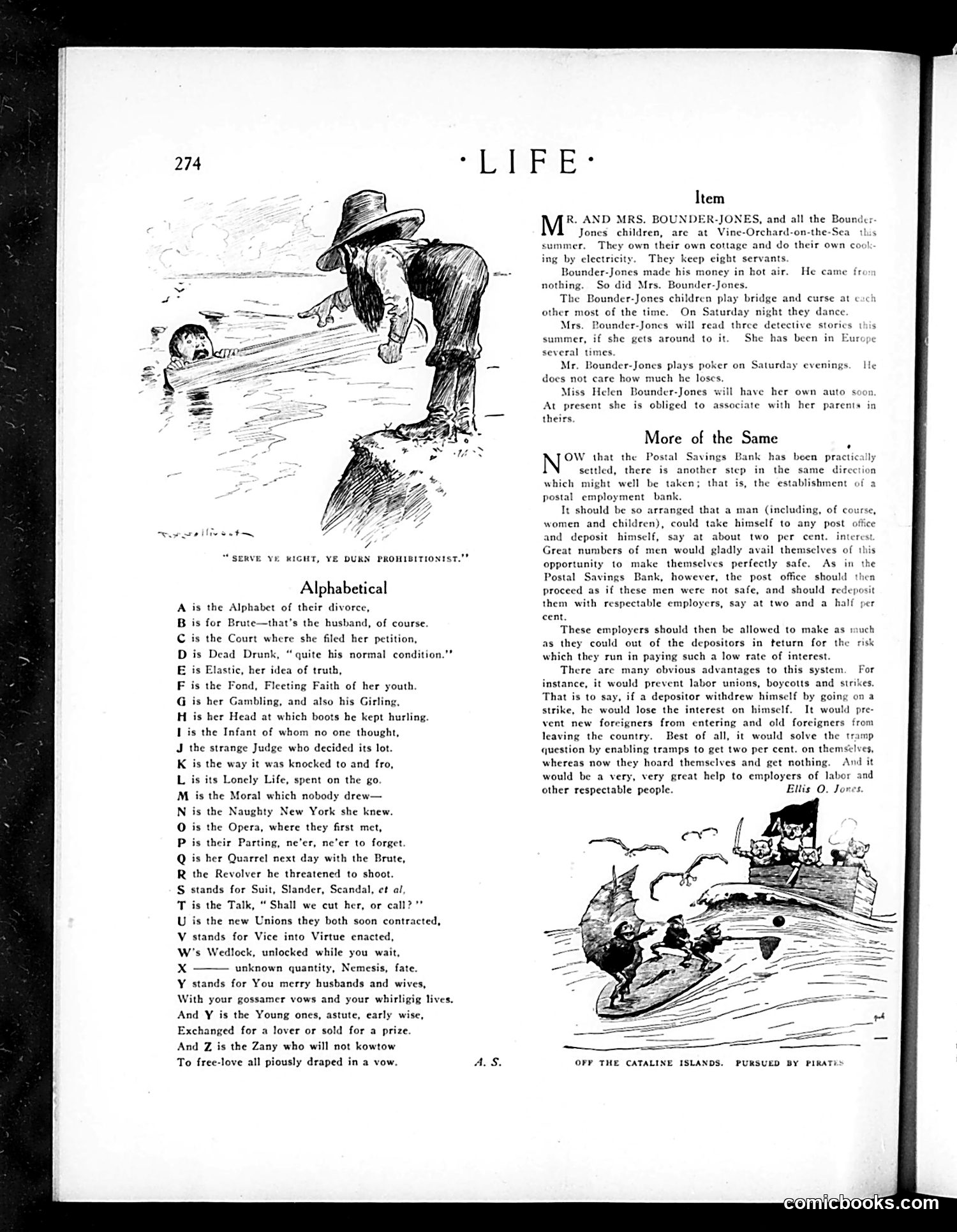
This page contains two distinct satirical pieces typical of early 20th-century Life magazine's social commentary. **The Alphabetical Poem** mocks divorce and marital dysfunction through an A-Z format. It depicts a failed marriage involving domestic violence ("boots he kept hurling"), infidelity, gambling, and custody battles—with particular cynicism about the innocent child caught between warring parents ("its Lonely Life, spent on the go"). The satire targets both spouses' moral failings and society's gossip ("Shall we cut her, or call?"). **The "Bounder-Jones" item** satirizes nouveau-riche pretension: a family that made money through dubious means ("hot air") yet affects respectability. Their children are spoiled and vulgar; the parents are dissolute (gambling, infidelity). **"More of the Same"** proposes a farcical "postal employment bank"—a darkly humorous critique suggesting workers be "deposited" with employers like savings accounts. The satire attacks labor exploitation, immigrant restrictions, and vagrancy, suggesting employers profit from workers while preventing strikes. The quote heading the page—"Serve ye right, ye durn prohibitionist"—likely references alcohol prohibition debates of the era.
📄 Transcribed text from this page (OCR, searchable)
Machine-transcribed from the original scan — historical spelling and the odd misread are preserved.
“RSE * oe “SERVE Yu KIGHT, YE DURN PROHIBITIONIST."* Alphabetical A is the Alphabet of their divorce, B is for Brute—that’s the husband, of course. C is the Court where she filed her petition, D is Dead Drunk, “quite his normal conditior E is Elastic, her idea of truth, F is the Fond, Fleeting Faith of her youth. G is her Gambling, and also his Girling, H is her Head at which boots he kept hurling. 1 is the Infant of whom no one thought, J the strange Judge who decided its lot. K is the way it was knocked to and fro, L is its Lonely Life, spent on the go. M is the Moral which nobody drew— N is the Naughty New York she knew. © is the Opera, where they first met, P is their Parting, ne'er, ne'er to forget Q is her Quarrel next day with the Brute, R the Revolver he threatened to shoot. S stands for Suit, Slander, Scandal, ct al, T is the Talk, “Shall we cut her, or call?" U is the new Unions they both soon contracted, V stands for Vice into Virtue enacted, W's Wedlock, unlocked while you wait, x unknown quantity, Nemesis, fate. Y stands for You merry husbands and wives, With your gossamer vows and your whirligig lives. And Y is the Young ones, astute, early wise, Exchanged for a lover or sold for a prize. And Z is the Zany who will not kowtow To free-love all piously draped in a vow. Item R. AND MRS. BOUNDER-JONES, and all the Bounder Jones children, are at Vine-Orchard-on-the-Sea this mmer. They own their own cottage and do their own ce ing by electricity. They keep eight servants. Bounder-Jones made his money in hot air. He ca nothing. So did Mrs. Bounder-Jones. The Bounder-Jones children play bridge and curse at exc other most of the time. On Saturday night they dance Mrs. Pounder-Jones will read three detective stories 1 summer, if she gets around to it. She has been in Europe several times. Mr. Bounder-Jones plays poker on Saturday evenings. He docs not care how much he loses. Miss Helen Bounder-Jones will have her own auto s At present she is obliged to associate with her parents in theirs, More of the Same . OW that the Postal Savings Bank has been practically settled, there is another step in the same direction which might well be taken; that is, the establishment of a postal employment bank. It should be so arranged that a man (including, of cou women and children), could take himself to any post office and deposit himself, say at about two per cent. interest Great numbers of men would gladly avail themselves of this opportunity to make themselves perfectly safe. As in the Postal Savings Bank, however, the post office should then proceed as if these men were not safe, and should redeposit them with respectable employers, say at two and a half per cent. These employers should then be allowed to make as much as they could out of the depositors in teturn for the risk which they run in paying such a low rate of interest. There are many obvious advantages to this system. For instance, it would prevent labor unions, boycotts and strikes. That is to say, if a depositor withdrew himself by going on a strike, he would lose the interest on himself. It would pre- vent new foreigners from entering and old foreigners from leaving the country. Best of all, it would solve the tramp question by enabling tramps to get two per cent. on themselves, whereas now they hoard themselves and get nothing. And it would be a very, very great help to employers of labor and other respectable people. Ellis O. Jones. OFY THE CATALINE ISLANDS. PURSUED BY