
A complete issue · 28 pages · 1909
Life — September 23, 1909
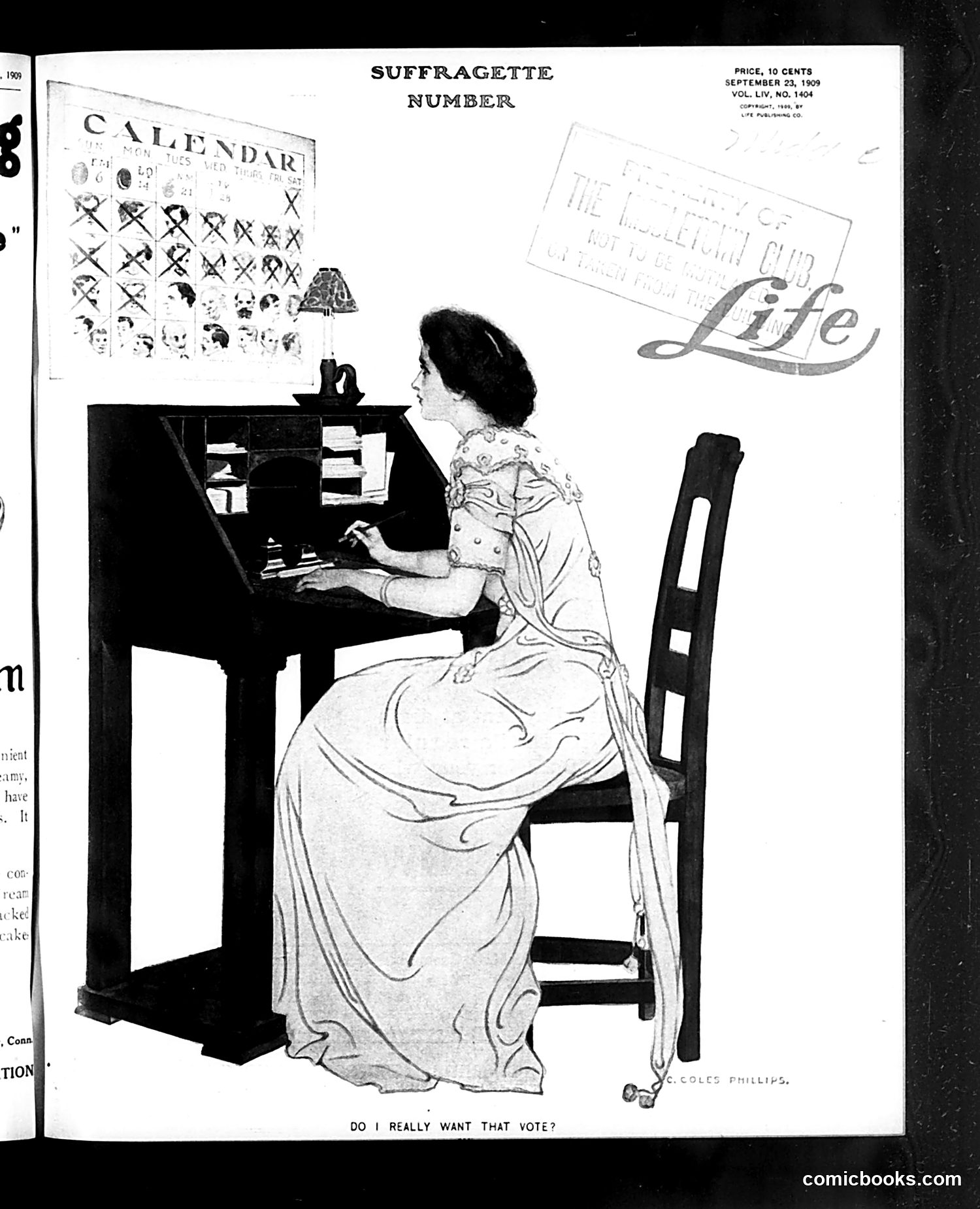
This is a *Suffragette Number* cover from *Life* magazine (September 23, 1909), priced at 10 cents. The illustration, credited to Coles Phillips, shows a woman at a desk with a calendar marked with X's above her head, suggesting tracking or marking time. She's examining what appears to be ballot materials or voting documents. The caption reads "DO I REALLY WANT THAT VOTE?" The satire targets women's suffrage activism by depicting a woman reconsidering her commitment to voting rights—suggesting hesitation or doubt about the cause. The calendar of X's likely represents the suffragists' campaign progress or a countdown to some event. The cartoon expresses skepticism toward women's political engagement, mocking suffragettes' determination through the ironic question posed by a woman herself apparently wavering in her conviction.
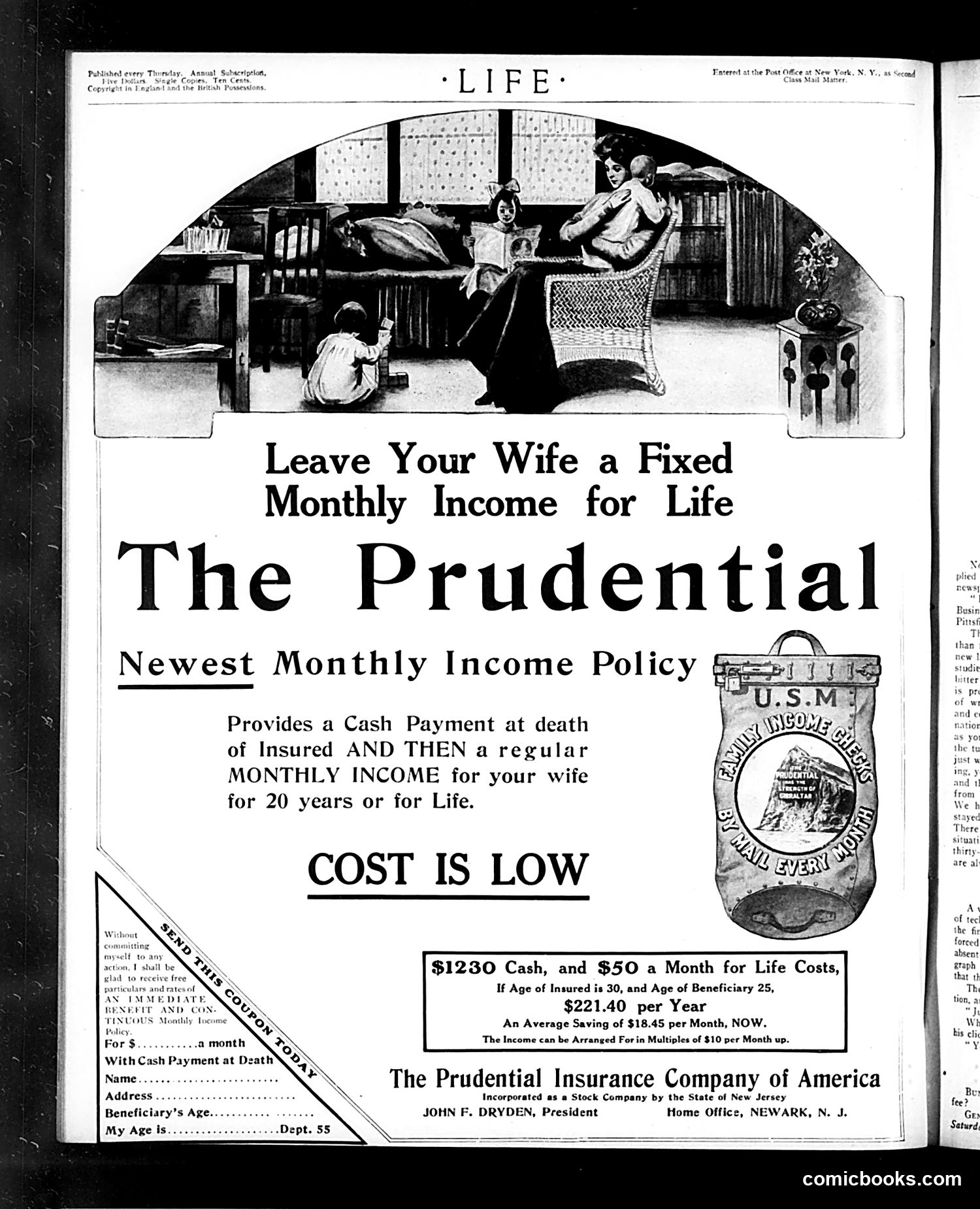
This page is **primarily an advertisement**, not satirical content. It's a Prudential Insurance Company ad for a "Monthly Income Policy" designed to provide widows with fixed monthly payments. The illustration depicts a domestic scene: a woman relaxes while children play, implying financial security after her husband's death. The ad targets male breadwinners, asking them to "Leave Your Wife a Fixed Monthly Income for Life." The product offers death benefits plus regular monthly payments ($50/month in the example) for 20 years or lifetime. The coupon at left invites readers to request information. This reflects early-20th-century gender assumptions—wives as dependents requiring male financial protection—and emerging insurance industry marketing targeting anxious breadwinners. There is no satire here; it's straightforward commercial persuasion.
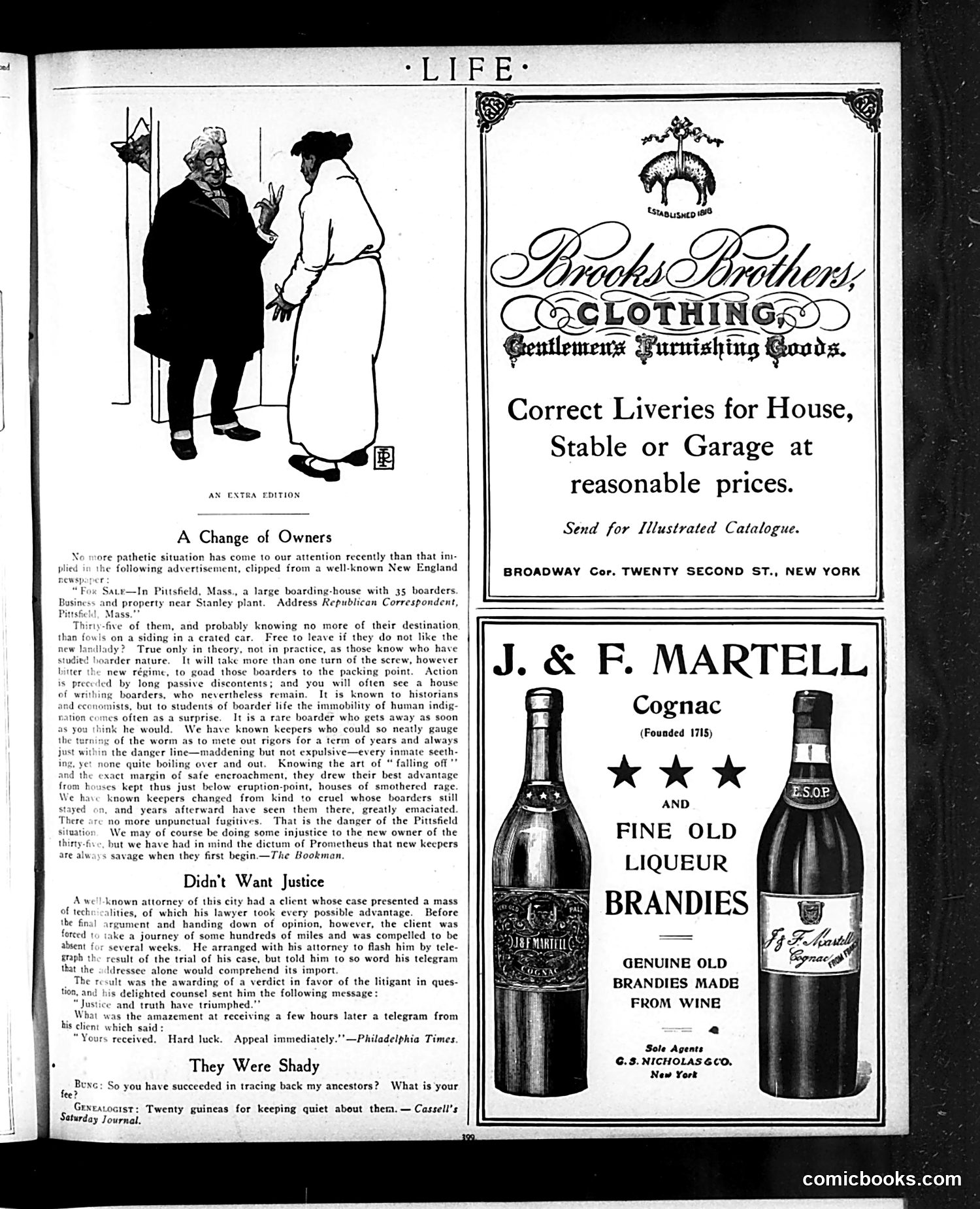
This page contains three distinct sections: **Main Cartoon ("A Change of Owners")**: Depicts an elderly landlord confronting a woman tenant. The accompanying article satirizes New England boarding house owners' callous treatment of tenants, particularly describing how landlords evict boarders without warning or care for their destination. The piece criticizes the impersonal cruelty of property management, contrasting theoretical ideals with actual practice. **"Didn't Want Justice"**: A brief anecdote mocking a lawyer whose client won a verdict but received no actual compensation—illustrating legal system absurdities. **"They Were Shady"**: A genealogy joke about tracing ancestors. The page is otherwise dominated by **period advertisements** for Brooks Brothers clothing and J. & F. Martell Cognac brandy, typical of early 20th-century Life magazine's revenue model.
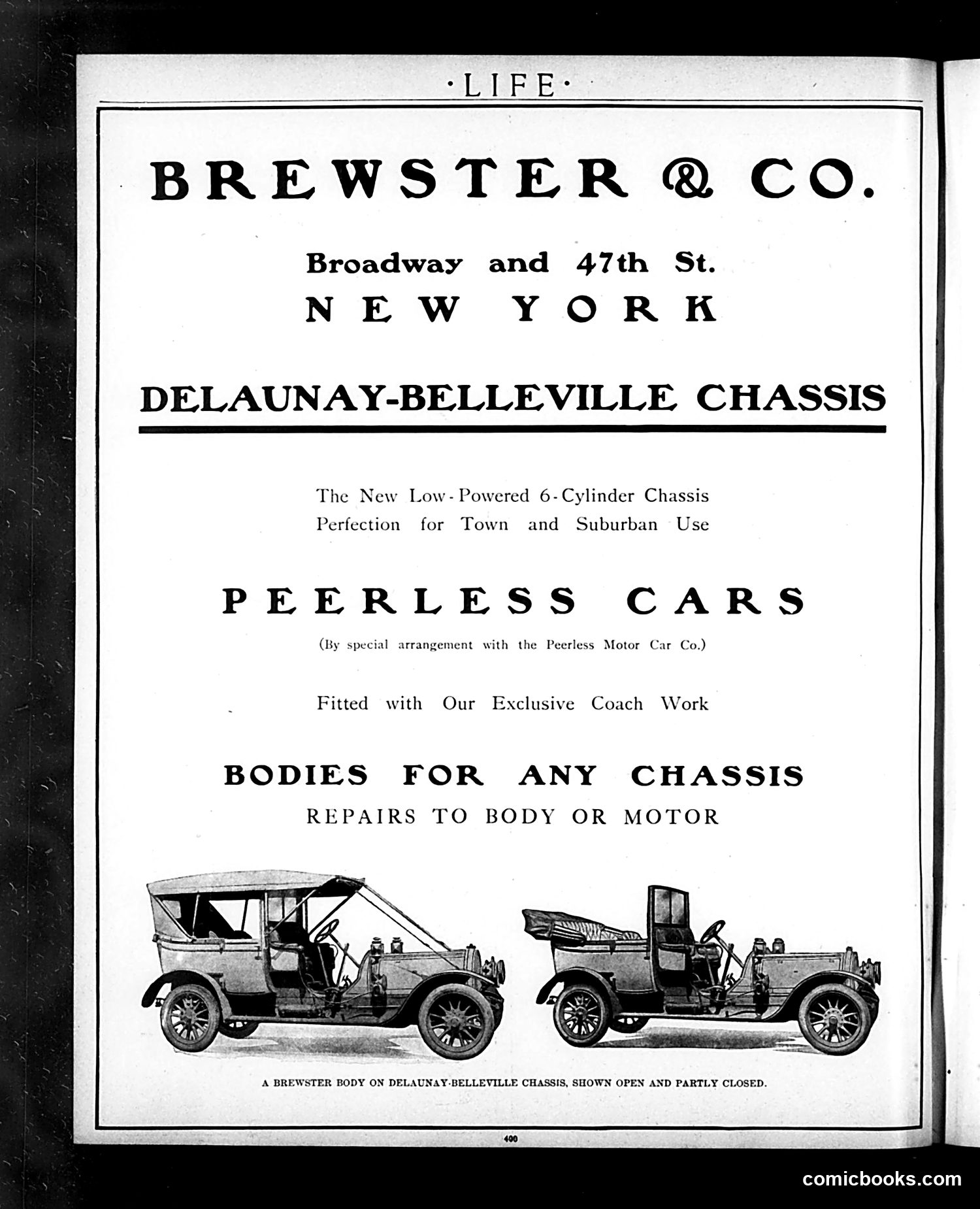
This page is **not a cartoon or satirical content**—it's a straightforward advertisement from *Life* magazine. **Brewster & Co.**, located at Broadway and 47th Street in New York, advertises custom automobile bodies built on the Delaunay-Belleville chassis. The ad emphasizes their "exclusive coach work" and services including custom bodies for any chassis and repairs to body or motor. Two illustrations show the same vehicle in open and partially closed configurations, demonstrating the coachwork's versatility. The Delaunay-Belleville was a prestigious French automobile chassis, suggesting Brewster served wealthy clientele seeking bespoke vehicles. This represents early 20th-century luxury automotive customization before mass production standardized car bodies.
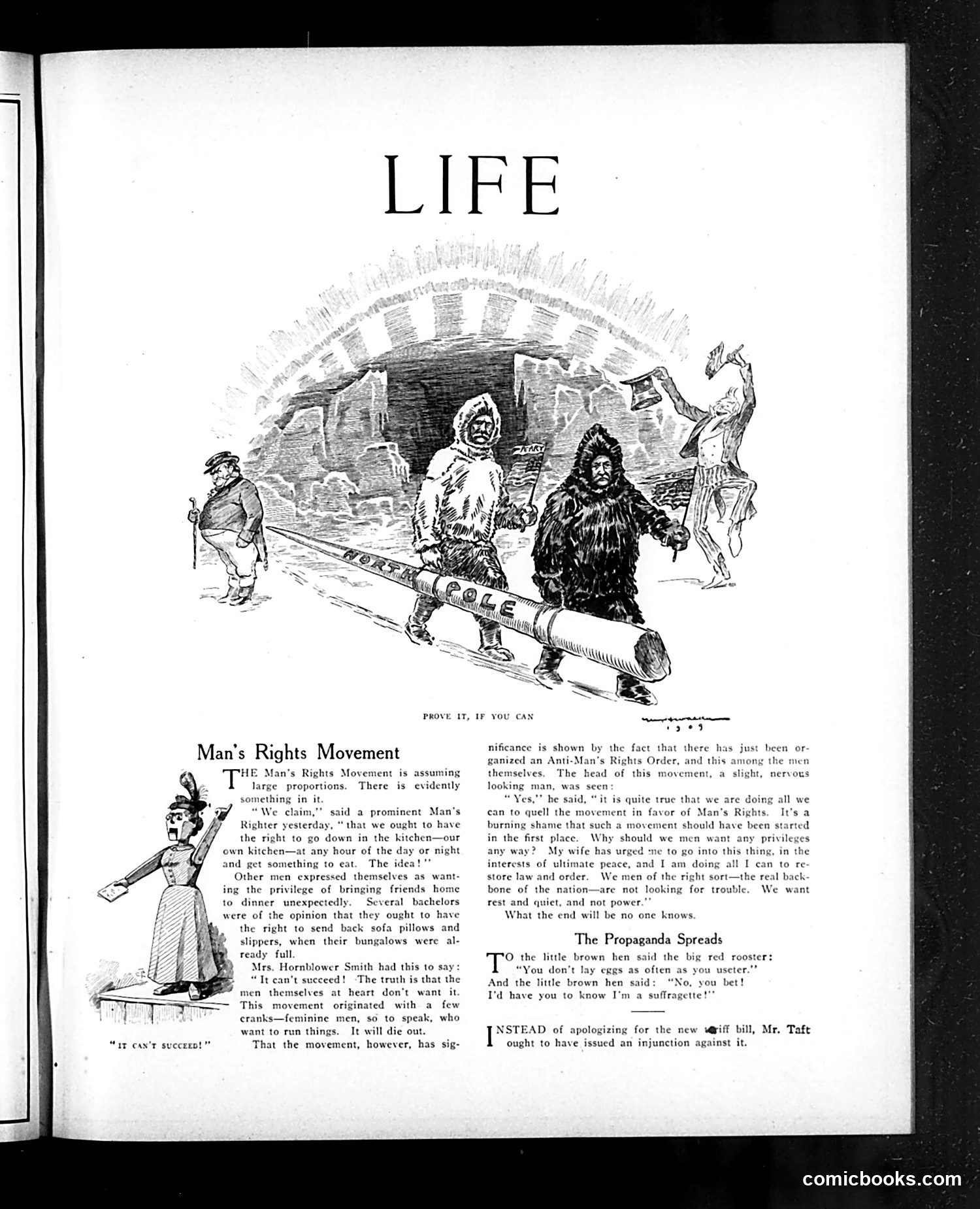
This page satirizes the **Man's Rights Movement**—an anti-feminist backlash opposing women's suffrage and expanding rights. The central cartoon shows men carrying a log labeled "MAN'S COLE" (likely "Man's Cause"), struggling under its weight while women watch. The accompanying text mocks men claiming they lack basic domestic privileges—one man complains he can't enter his own kitchen or send back sofa pillows. The satire ridicules these grievances as trivial compared to women's actual struggles for equality. "The Propaganda Spreads" section uses a farmyard allegory (a hen and rooster debating eggs) to mock how anti-suffrage arguments spread. The final jab suggests Mr. Taft (likely President William Howard Taft) should have blocked women's rights through injunction rather than apologizing—dripping with sarcasm about such efforts' futility.
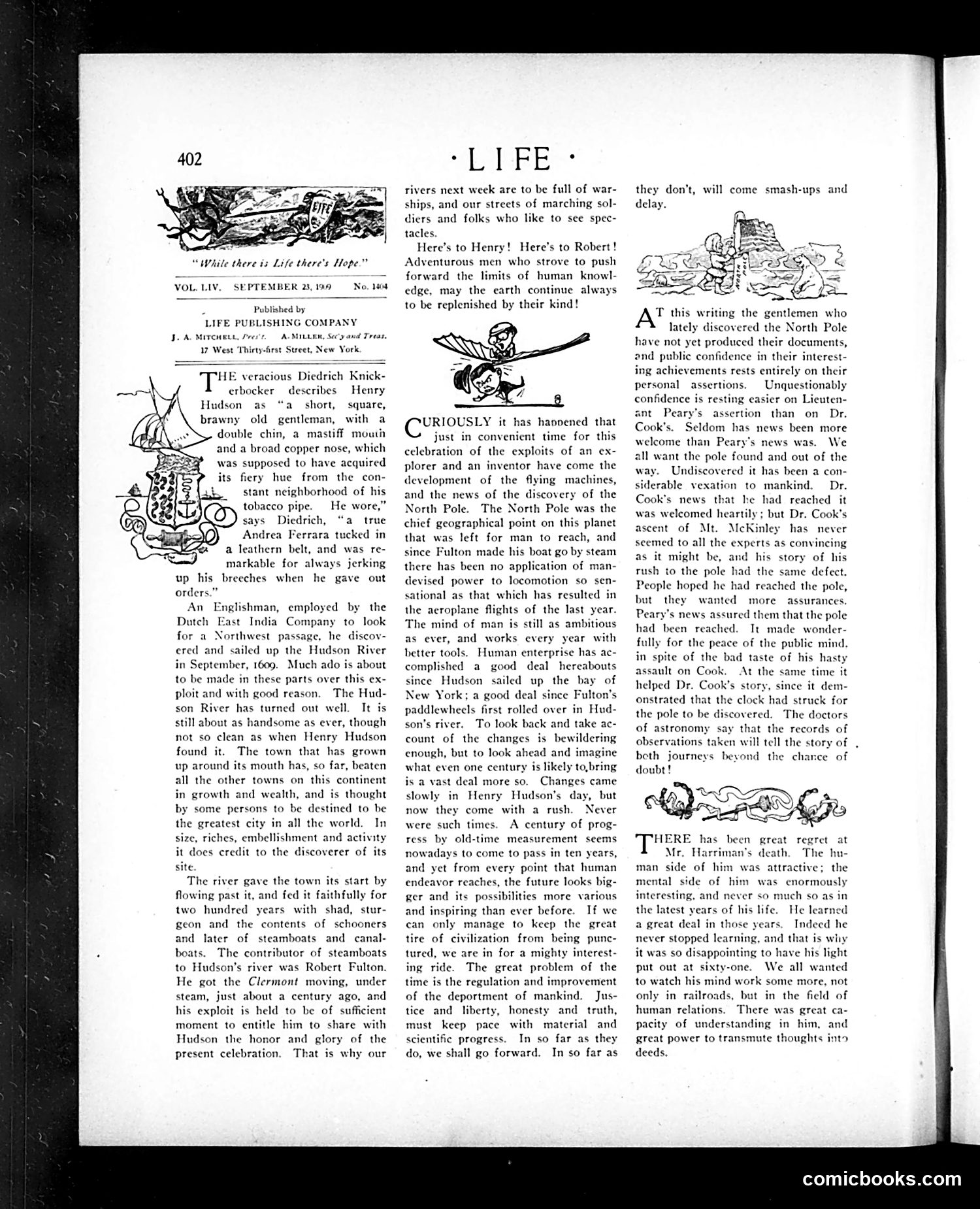
This page celebrates Henry Hudson and Arctic exploration. The left column discusses Hudson's 1609 voyage up the Hudson River, establishing New York's importance. The illustrations show Hudson as a historical figure—a bearded explorer depicted in period dress with a ship's insignia. The right column addresses contemporary Arctic exploration, specifically mentioning Peary's North Pole discovery. The text expresses pride that explorers' achievements rest on "personal assertions" and notes that Peary's news was welcome. There's an apparent dig at Dr. Cook—a rival claimant to the Pole—suggesting skepticism about his competing polar achievement claims. The overall theme celebrates American exploration and discovery, from Hudson's colonial-era voyage to modern Arctic expeditions.
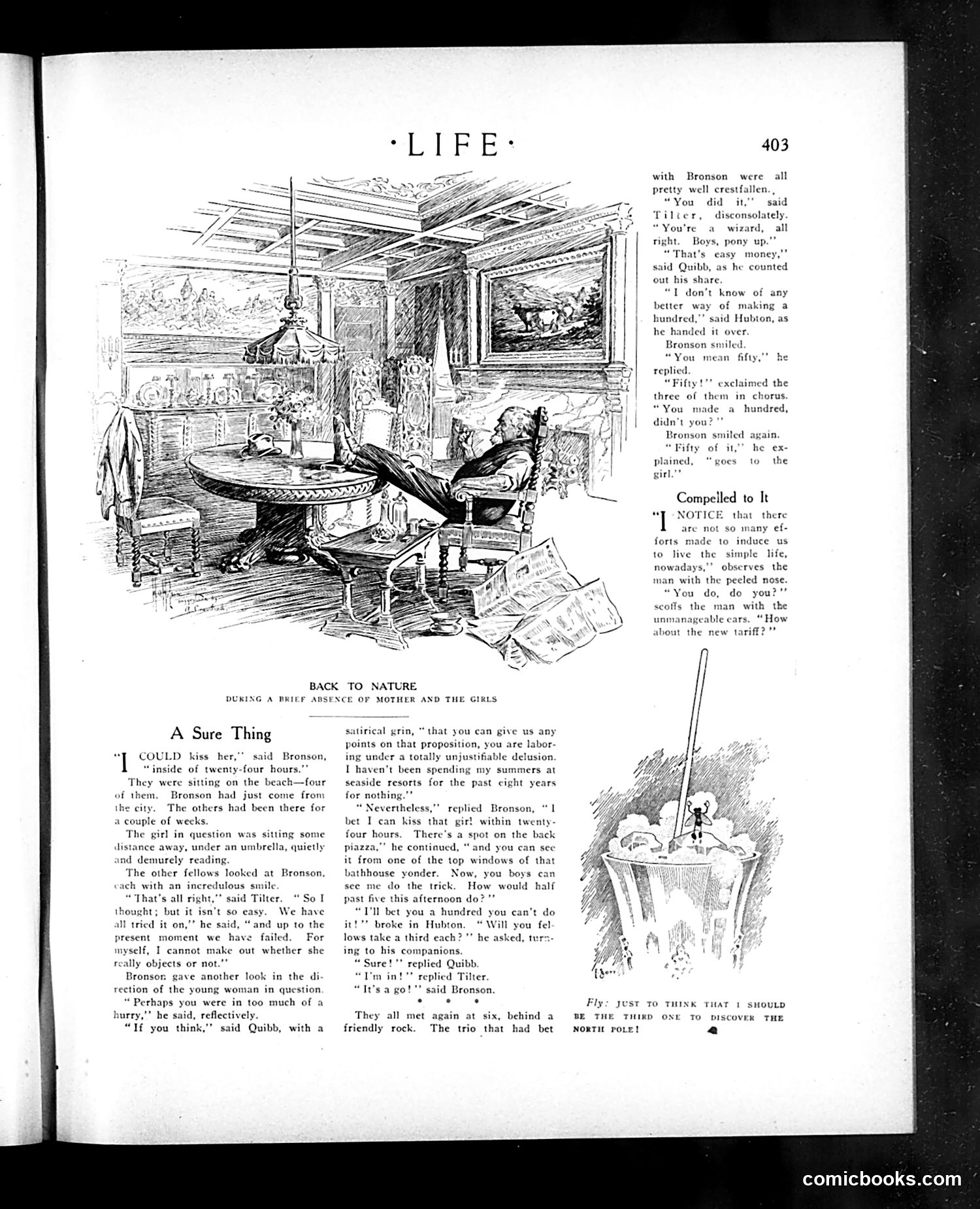
This page from *Life* magazine contains a satirical short story titled "A Sure Thing" rather than a political cartoon. The narrative follows Bronson and his friends wagering on whether Bronson can kiss a girl within twenty-four hours, with the story set at a bathhouse ("piazza" and "top windows of that bathhouse yonder"). The satire appears to mock masculine bravado and casual betting among young men about romantic conquests. The accompanying illustrations show an interior scene of leisure and idle conversation. The second section, "Compelled to It," shifts to social commentary about efforts to promote "the simple life," with a character questioning modern conveniences like tariffs. The satirical tone suggests *Life* is critiquing both youthful swagger and contemporary back-to-nature movements, though specific historical context remains unclear from this page alone.
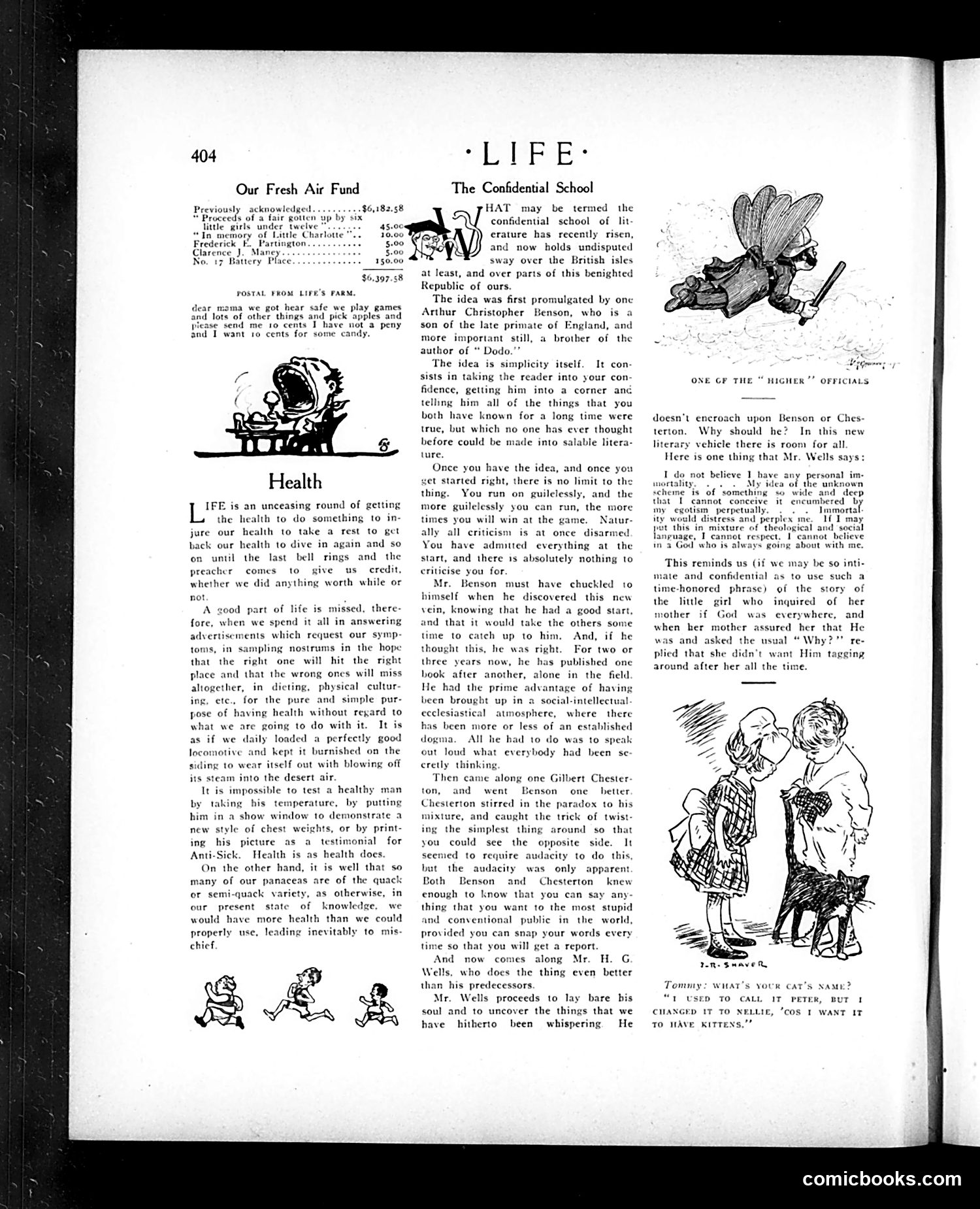
This page contains three distinct pieces: 1. **"Our Fresh Air Fund"** (top left): A brief charitable appeal acknowledging donations for children's fresh air programs, with financial totals listed. 2. **"Health"** (left column): An essay arguing that testing one's health through various physical challenges is pointless. The author advocates for simply living well rather than obsessing over health metrics—a critique of the then-popular "wellness testing" fad. 3. **"The Confidential School"** (right): Discusses a literary concept attributed to Arthur Christopher Benson (brother of "Dodo" author E.F. Benson), where readers are told private truths about common knowledge, presented as exclusive secrets. The piece satirizes how readers enjoy feeling privy to "confidential" information that's actually common sense. The illustrations are humorous spot-drawings typical of Life's style.
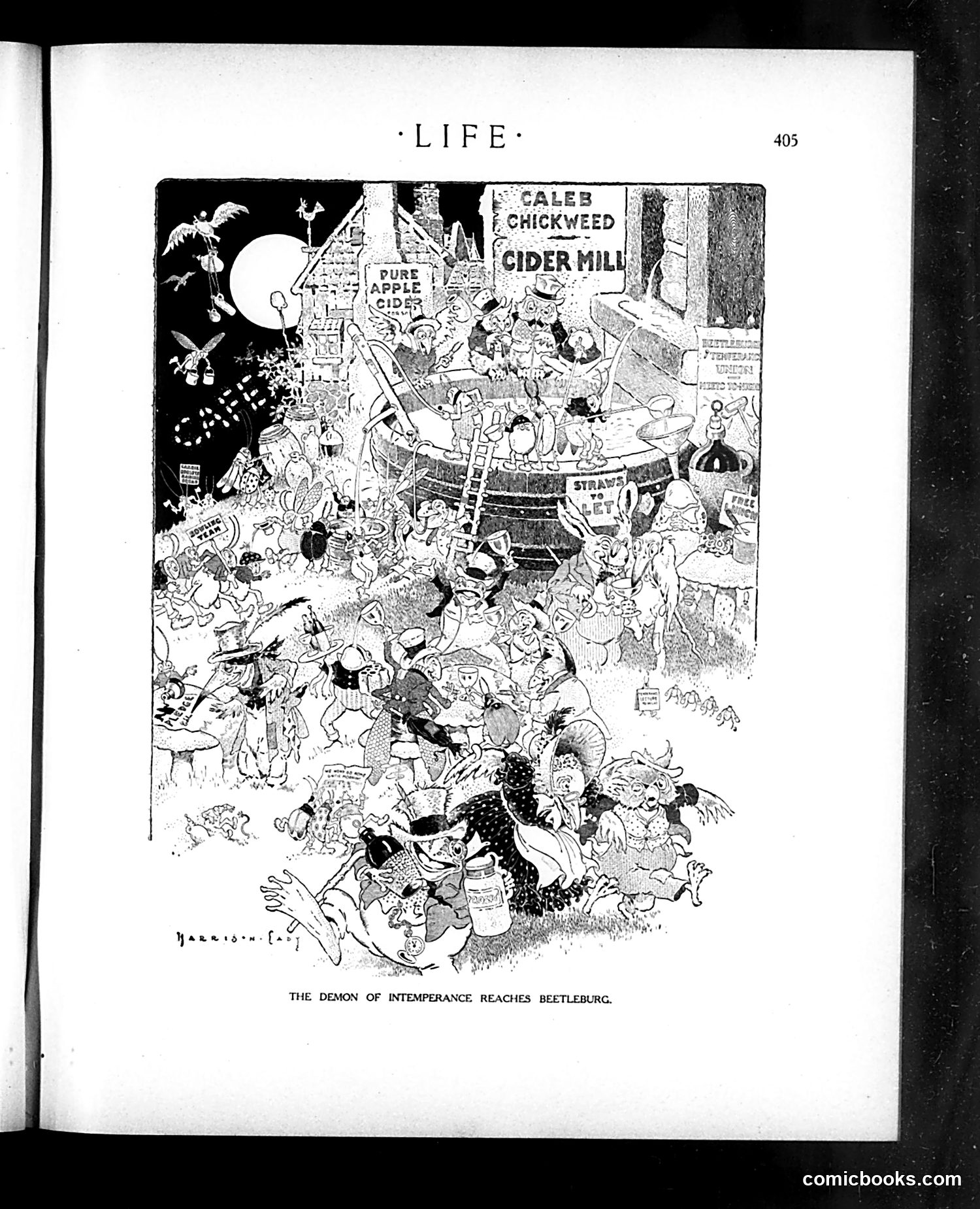
This is a satirical cartoon attacking alcohol consumption and its social effects. The chaotic scene depicts a town (Beetleburg) overrun by drunkenness and disorder, with signs for "Pure Apple Cider" and "Caleb Chickweed's Cider Mill" visible—identifying cider production as the culprit. The cartoon appears to be temperance propaganda, showing grotesque, intoxicated figures engaged in riotous behavior. A demonic figure looms over the scene (the "Demon of Intemperance"), representing alcohol as an evil force corrupting the community. This reflects early 20th-century American temperance movement activism, which eventually led to Prohibition (1920-1933). The exaggerated, chaotic imagery was typical rhetorical strategy—depicting alcohol's social consequences as apocalyptic moral corruption.
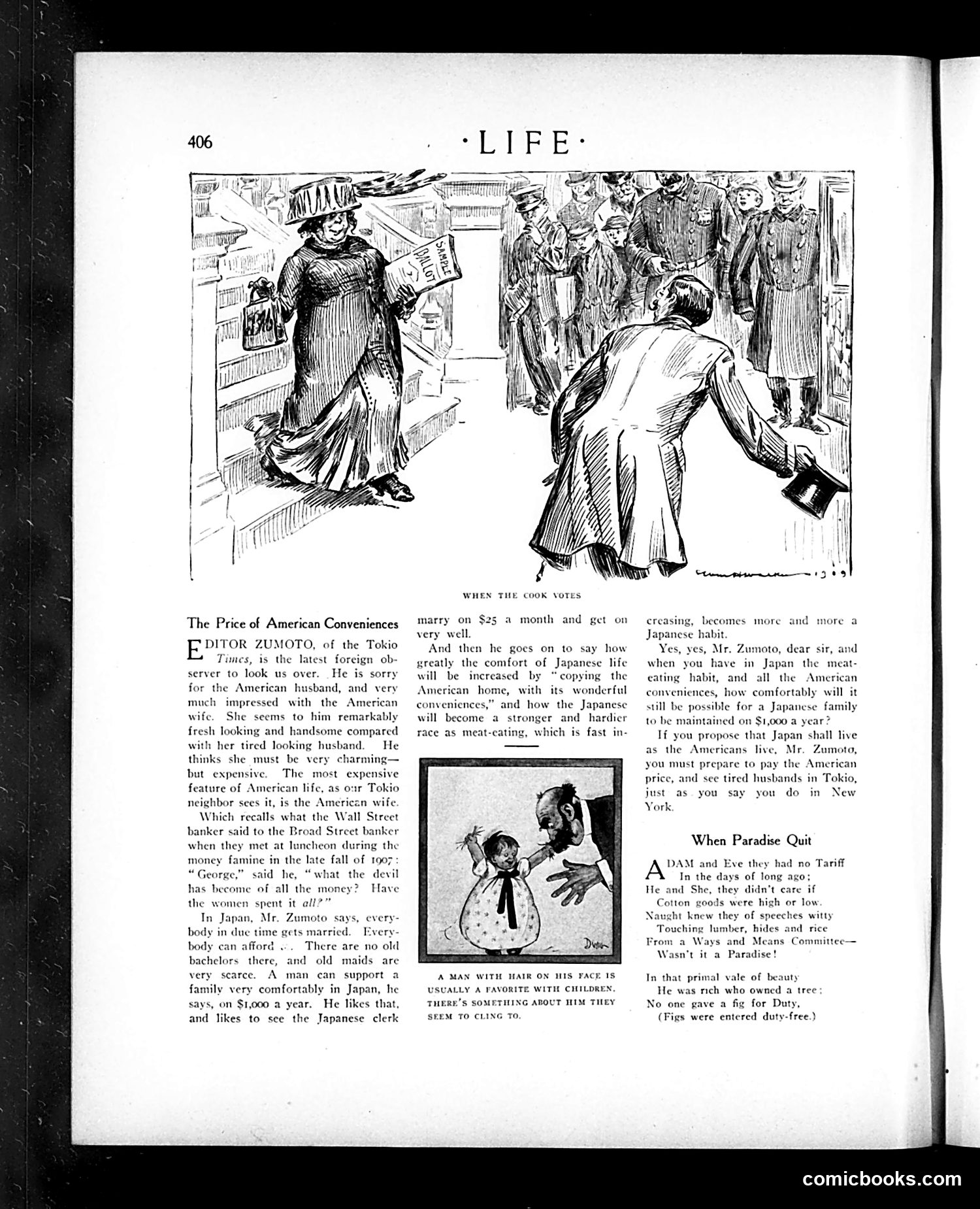
This page satirizes debates about Westernization in Japan. Editor Zumoto of the *Tokio Times* visits to discuss how American conveniences—particularly the "American wife"—are changing Japanese culture. The cartoon shows a man bowing before a woman in Western dress, labeled "When the Cook Votes," suggesting that adopting American customs threatens traditional Japanese gender hierarchies. The satire mocks anxieties that Japan's embrace of American lifestyle—from home conveniences to women's independence—will fundamentally alter Japanese identity. The implication is that allowing servants or women (represented by "the cook") greater autonomy or voting rights disrupts social order. The article presents Zumoto's argument that maintaining Japanese traditions while adopting American comforts is impossible.
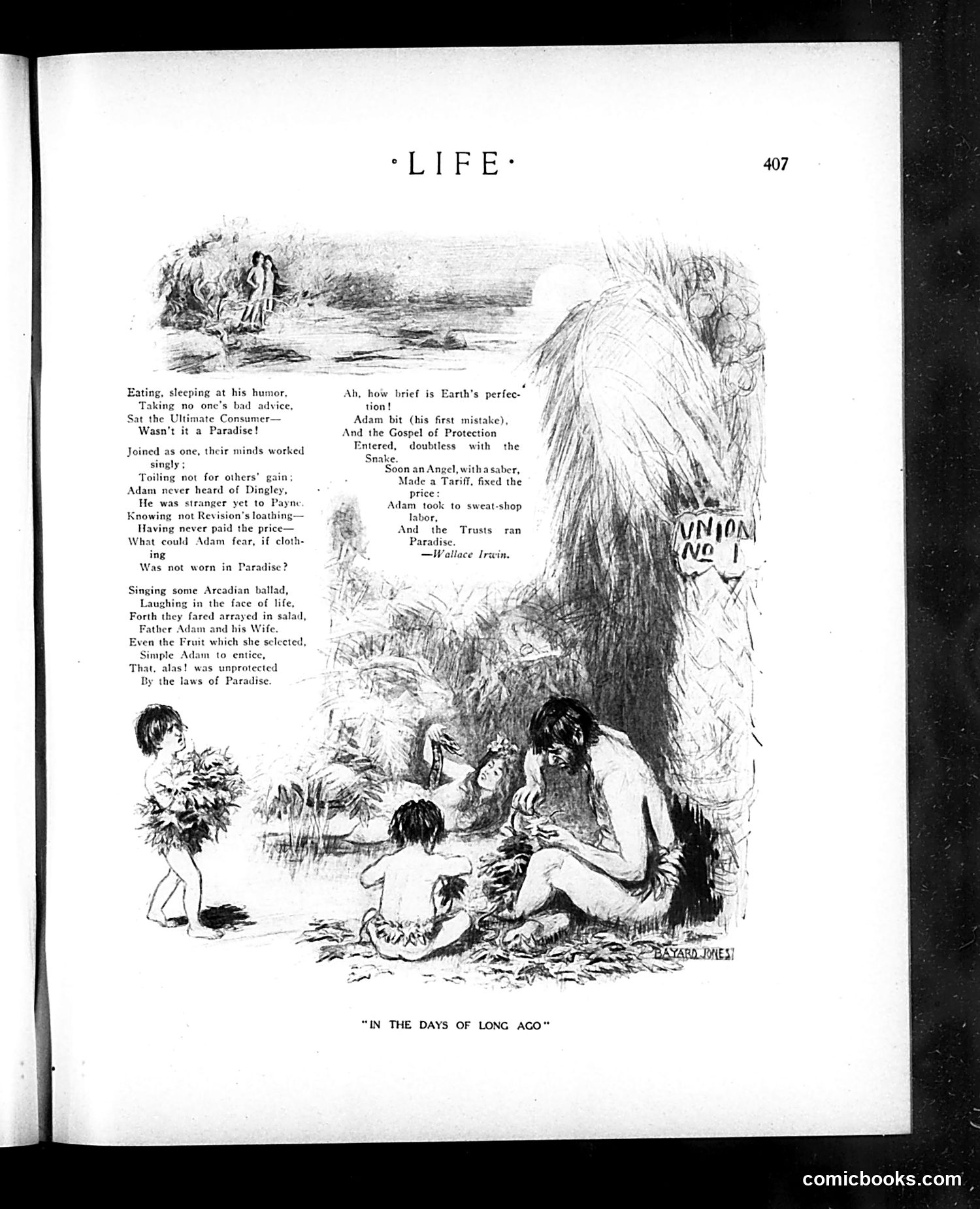
This satirical cartoon critiques economic inequality and labor conditions through a biblical allegory. The illustration depicts Adam and Eve with their children in paradise, contrasted with text mocking how "brief is Earth's perfection." The poem's central joke targets laissez-faire capitalism: Adam's "first mistake" wasn't the forbidden fruit, but rather accepting "the Gospel of Protection" and establishing tariffs and trusts. The satire suggests that economic systems—not original sin—created human suffering. By invoking paradise, the cartoonist argues that protective tariffs and monopolistic trusts corrupted what should have been an innocent world. This reflects early 20th-century American debate over protectionism, tariffs, and corporate monopolies versus free-market ideology.
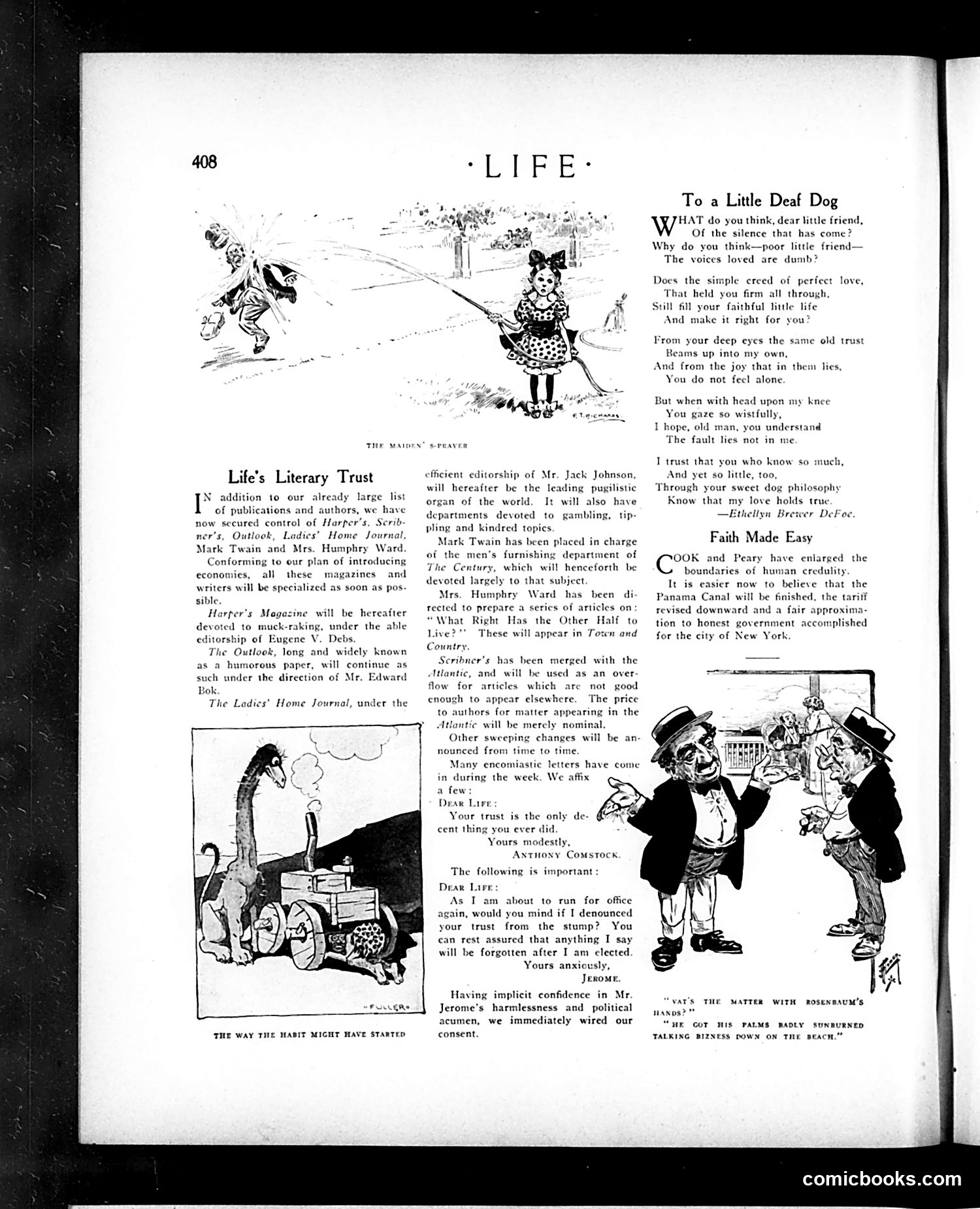
This page combines editorial content with satirical cartoons. The main text discusses "Life's Literary Trust," announcing editorial changes to Harper's publications and other magazines under new leadership, including Mark Twain overseeing a men's furnishing department in *The Century*. **"To a Little Deaf Dog"** is a sentimental poem addressed to a deaf dog, expressing trust and understanding despite communication barriers. **"Faith Made Easy"** discusses political optimism about completing the Panama Canal and tariff reform, suggesting credulous faith in government promises. The bottom cartoon, captioned "The Way the Habit Might Have Started," shows a giraffe and cart—likely satirizing how wasteful or unusual practices become normalized through repetition. The accompanying illustration mocks political deception regarding electoral promises.
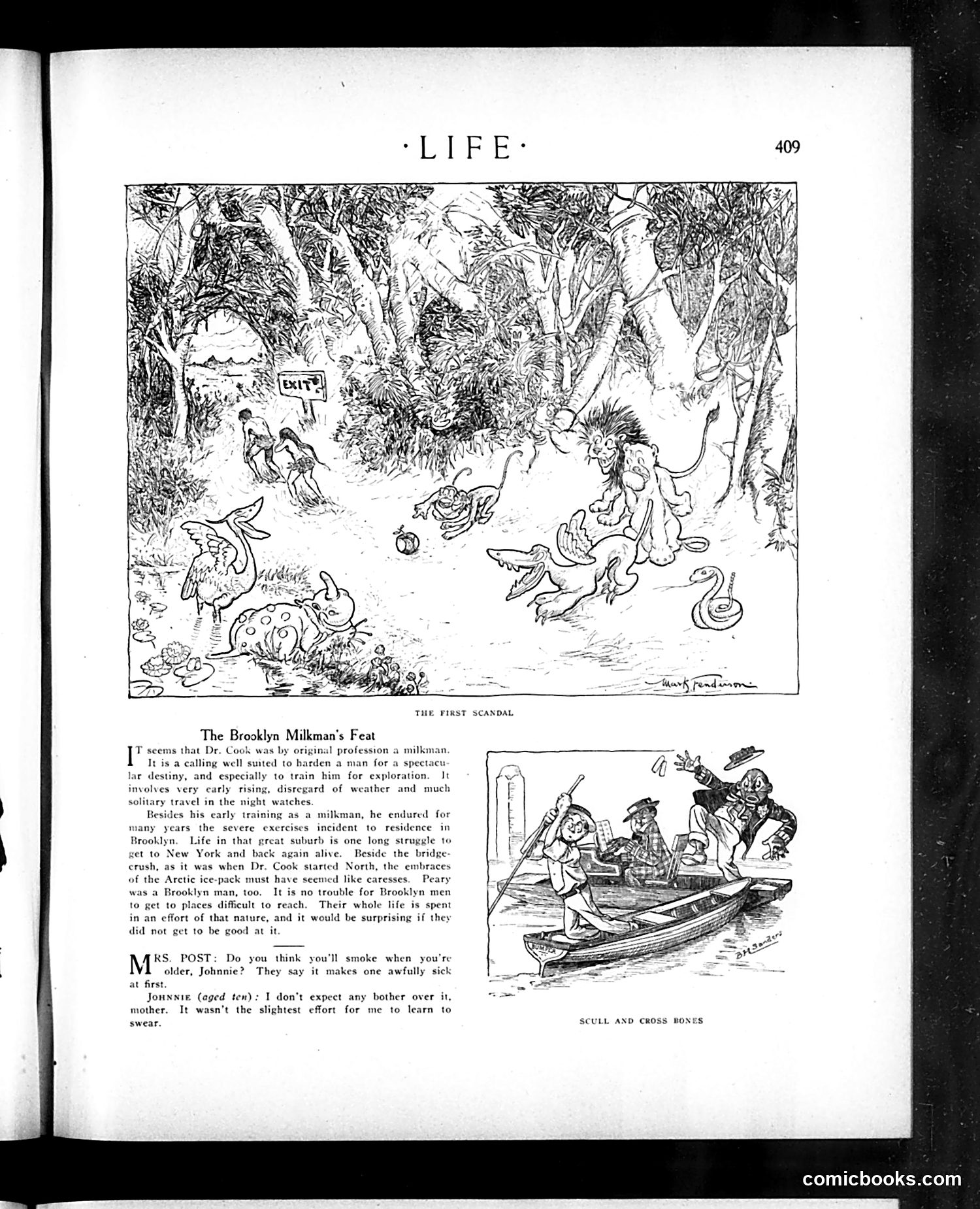
This page contains two cartoons satirizing Brooklyn life in the early 20th century. **"The First Scandal"** depicts what appears to be a chaotic forest or jungle scene with various creatures and figures in disarray. The caption suggests satirical commentary on scandal or misbehavior. **"The Brooklyn Milkman's Feat"** presents a humorous article about the occupation of milkman—described as physically demanding work requiring early rising and harsh conditions. The accompanying text includes dialogue between "Mrs. Post" and "Johnnie" about smoking, implying humor around childhood behavior and parental expectations. **"Scull and Cross Bones"** (bottom right) shows figures in a rowboat, likely a visual pun combining nautical imagery with the skull-and-crossbones pirate symbol. The satirical tone targets working-class Brooklyn life and period attitudes toward labor and youth behavior.
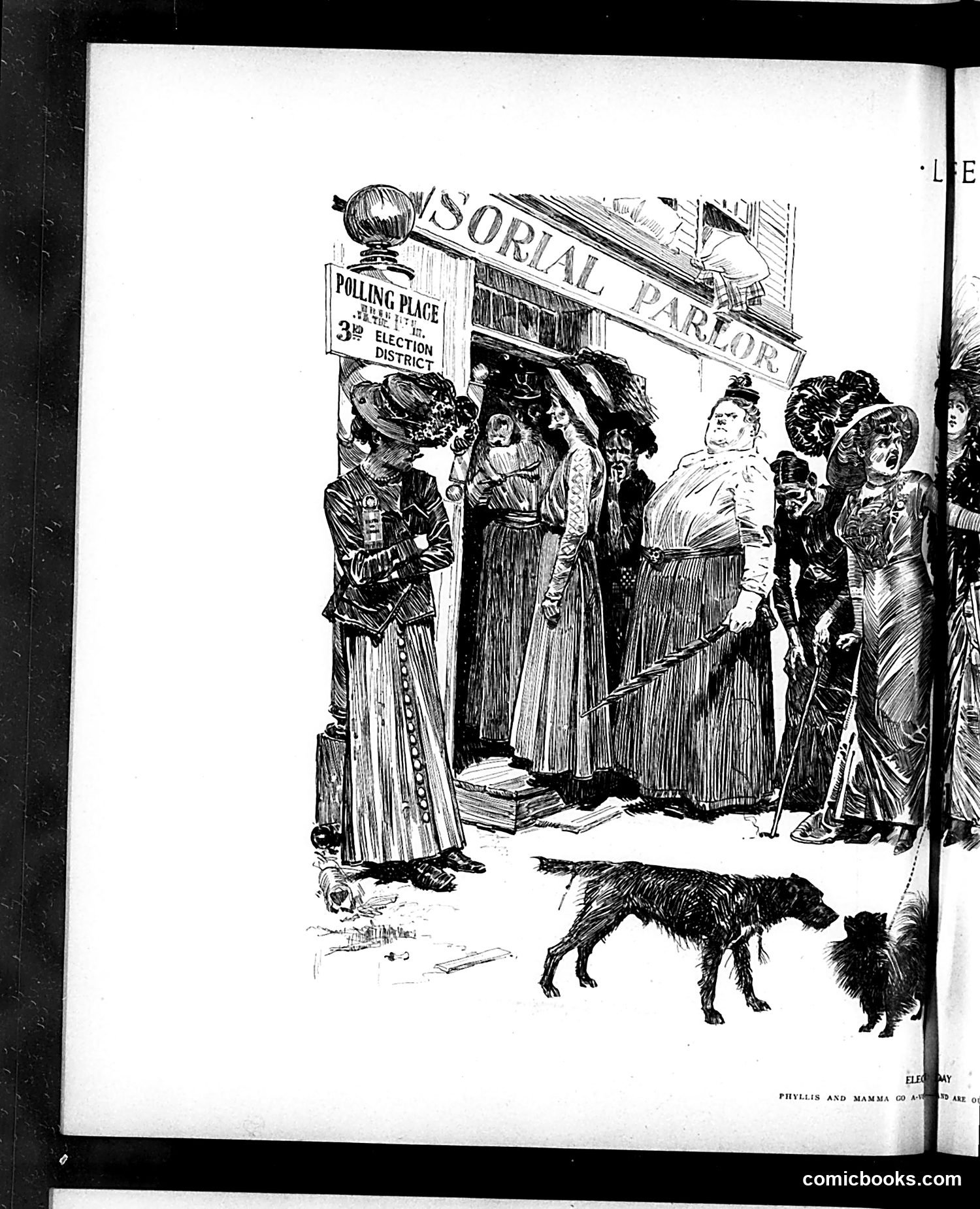
This is a satirical illustration depicting women at a polling place during an election. The sign reads "POLLING PLACE" with "ELECTION DISTRICT" marked as district 3. The cartoon appears to satirize **women's voting**, likely from the early 20th century around women's suffrage debates. The scene shows well-dressed women gathered outside a "Moral Parlor," with a dog in the foreground—possibly suggesting the cartoon mocks women voters as being out of place in the political sphere, or satirizes the contrast between refined femininity and rough electoral politics. The humor appears to rely on period prejudices about women's participation in voting—treating it as incongruous or absurd. Without a caption, the exact satirical point remains somewhat unclear, though the juxtaposition of genteel women and electoral machinery suggests commentary on this social change.
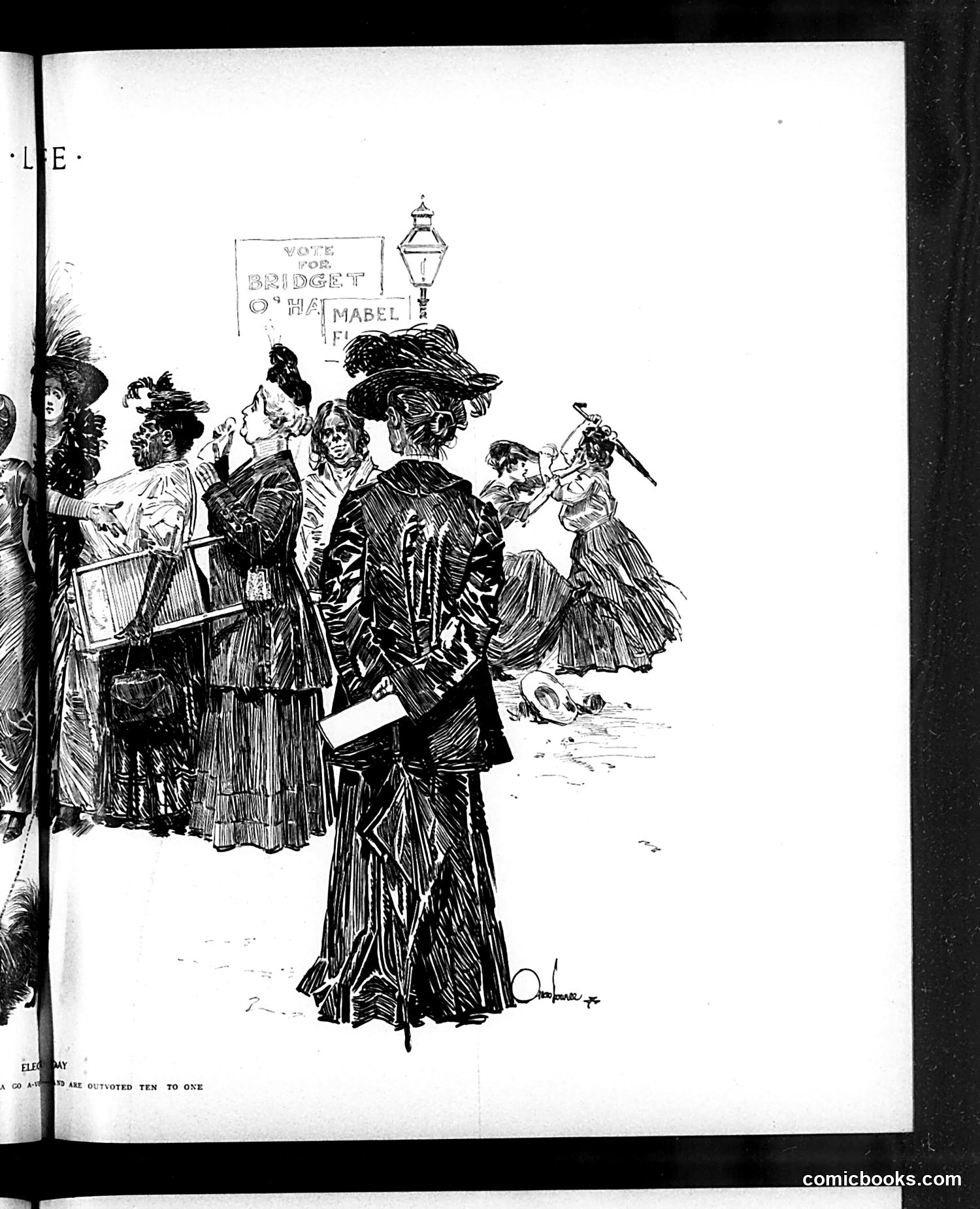
This is a satirical illustration depicting a fashionable woman in Edwardian-era dress standing prominently in the foreground, with a group of well-dressed people (appearing to be at a social gathering or street scene) behind her. A street lamp and a sign reading "VOTE FOR BRIDGET O'HAT" or similar are visible in the background. The satire appears to target women's suffrage and voting rights, likely mocking the idea of women participating in politics or elections. The fashionable, somewhat exaggerated female figure serves as the focal point of ridicule. The crowded social scene and period dress suggest this commentary on women entering the political sphere was intended as humorous social criticism for Life magazine's readers of the early 1900s, when women's voting rights remained controversial in America.
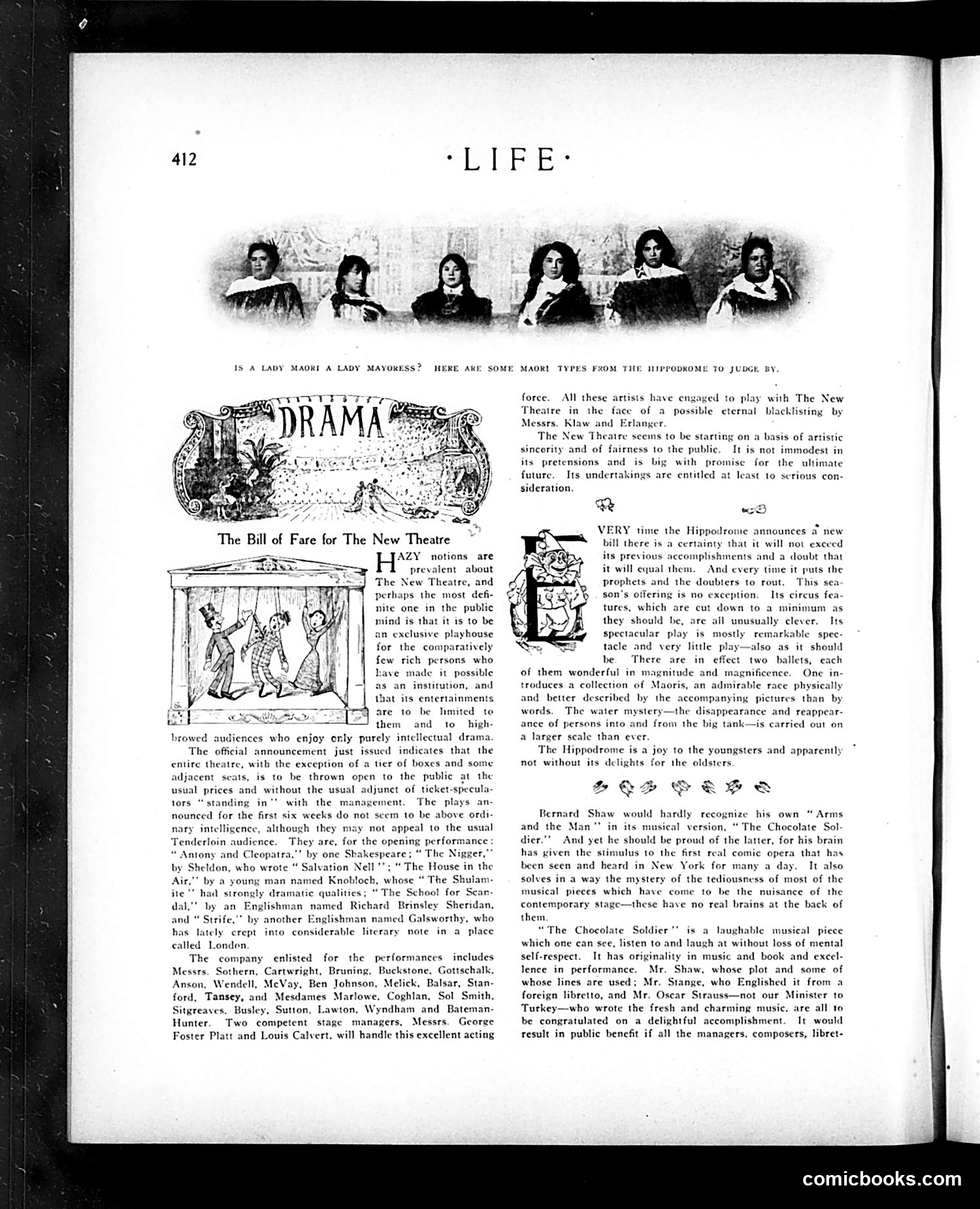
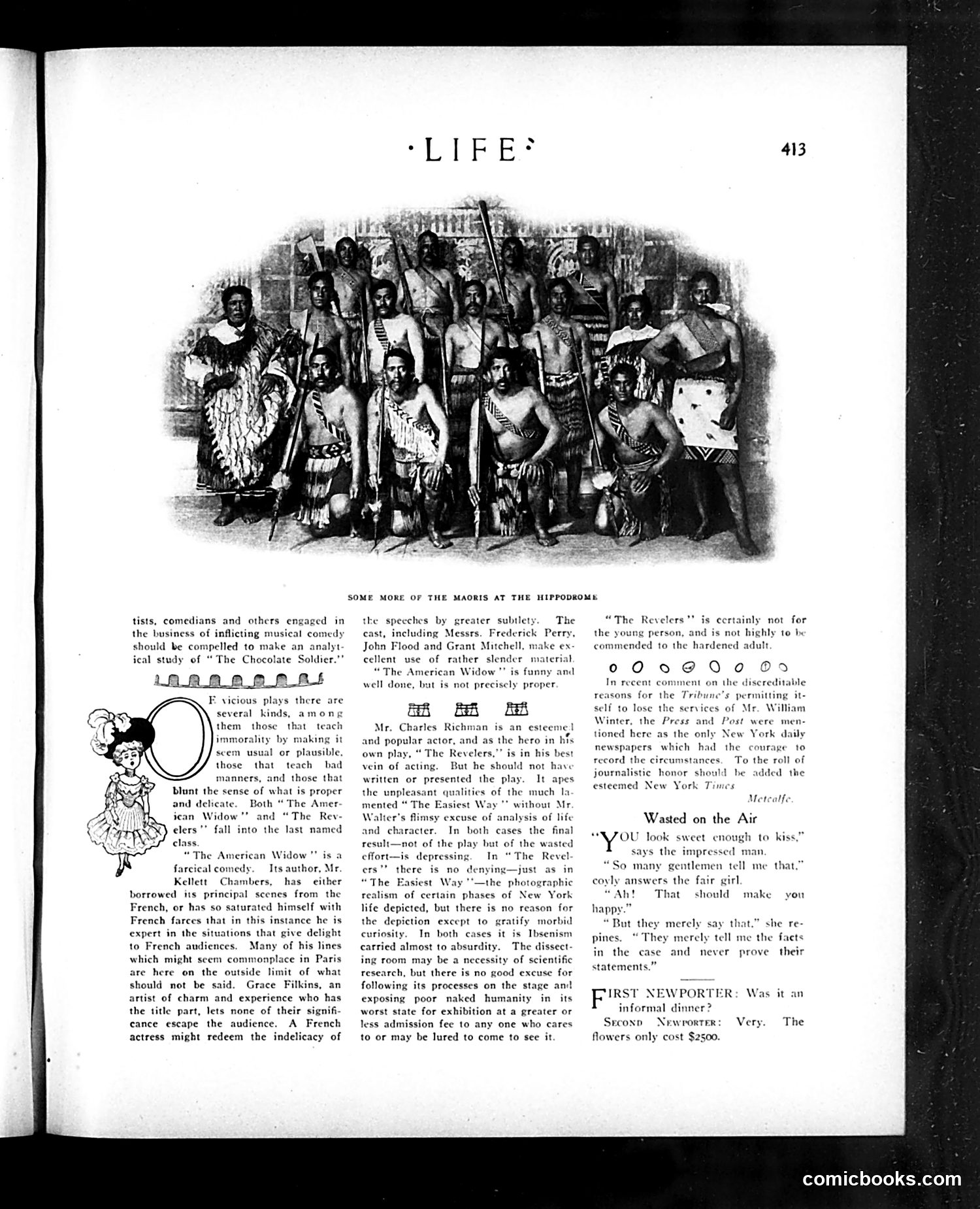
This page critiques contemporary Broadway productions. The main image shows "Maoris at the Hippodrome"—likely performers in an exotic or primitive-themed theatrical production, reflecting early 20th-century entertainment conventions. The text reviews two plays: "The American Widow" (a French farce adapted by Kellett Chambers) and "The Revelers" (starring Charles Richman). The critic attacks both as morally objectionable—the first for indelicate humor, the second for depicting seedy New York life without artistic justification, calling it "Ibsenism carried almost to absurdity." The reviewer argues such plays should be avoided, praising only newspapers (the Tribune, Press, and Post) that refused to advertise them. The bottom section contains a separate joke about a woman claiming gentlemen call her attractive but "merely state facts"—a quip about flattery versus truth-telling. The satire targets theatrical obscenity and sensationalism.
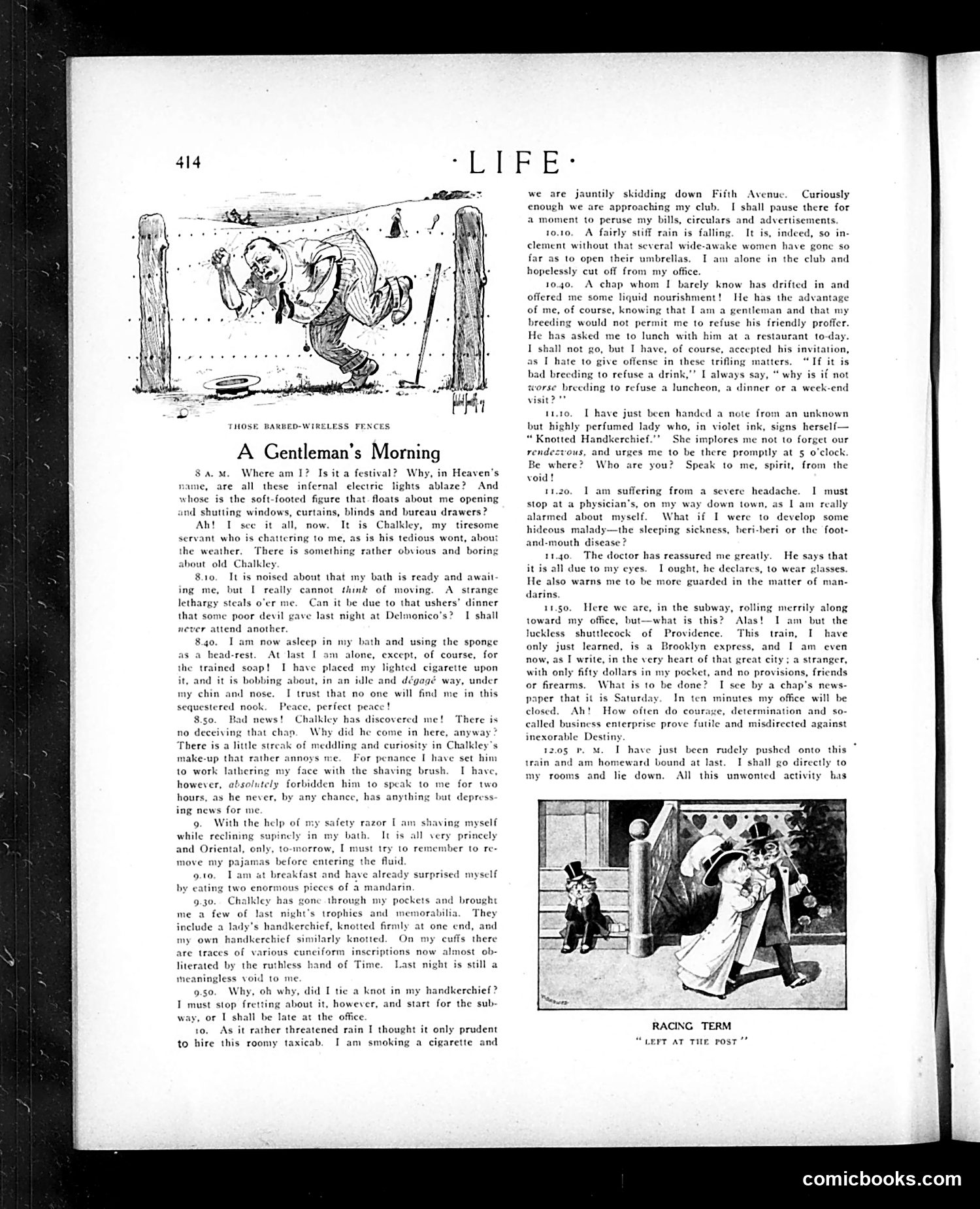
This is a satirical diary piece mocking the absurd anxieties and social pretensions of a wealthy, idle gentleman navigating a single morning in early 20th-century New York. The humor centers on his neurotic overreactions to trivial problems: he frets about unwanted social obligations (refusing drinks would be "bad breeding"), receives a mysterious romantic note he cannot decipher, develops hypochondriacal fears about exotic diseases, and—most comedically—accidentally boards a Brooklyn express train when bound for his office, leaving him stranded in "the very heart of that great city" with only fifty dollars. The cartoon "Those Barbed-Wireless Fences" (top left) appears to show a man entangled in modern technology, reinforcing the satire's theme of how civilization's conveniences frustrate rather than aid the gentleman. The piece satirizes the paralysis of privileged leisure, social anxiety, and the gentleman's complete helplessness when minor plans go awry—he cannot even manage basic navigation or refuse a lunch invitation.
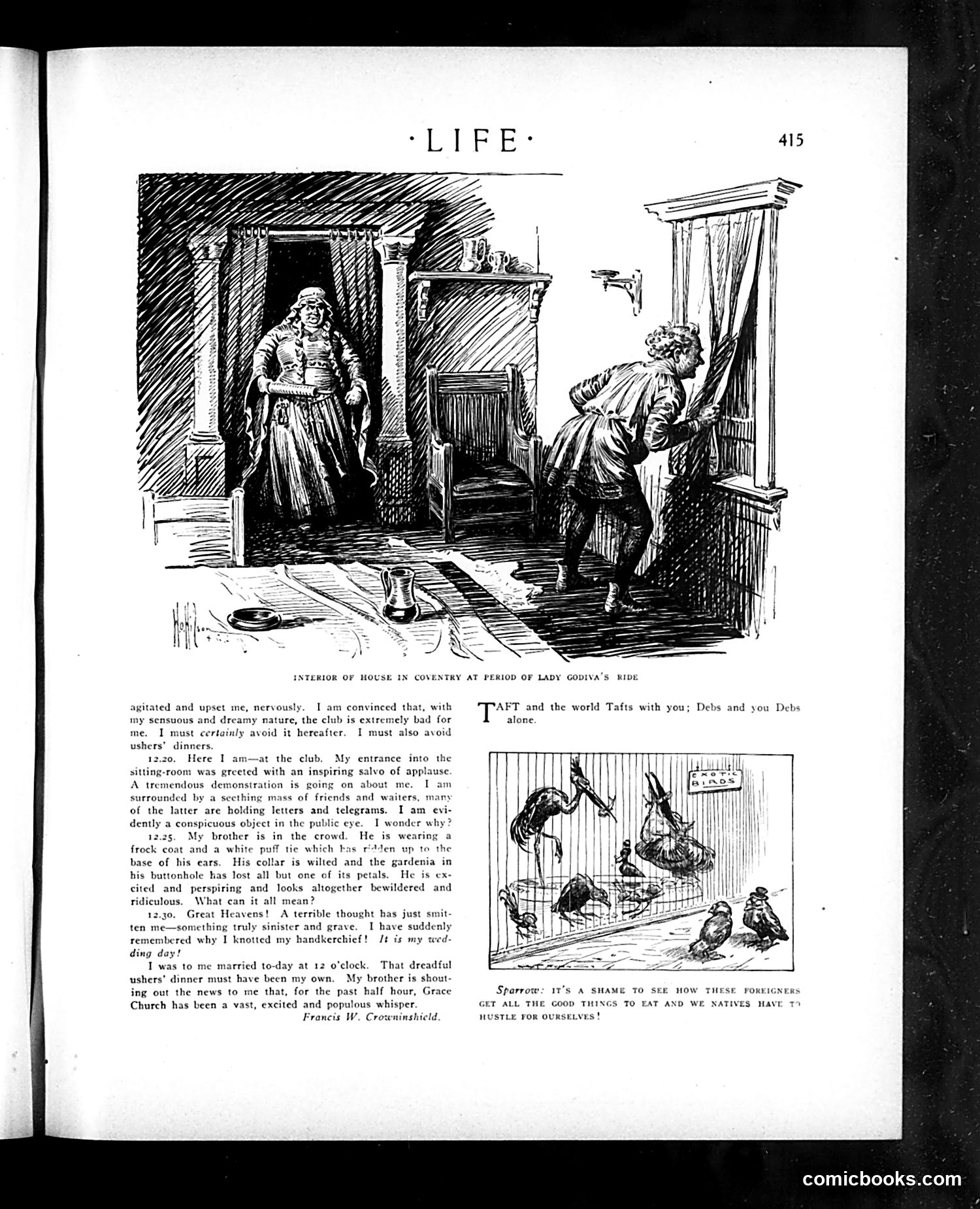
The page contains two distinct pieces of satire: **Top illustration and text:** A humorous narrative about a society man who arrives at his club for what he thinks is an ushers' dinner, only to realize (at 12:30 PM) that he's forgotten his own wedding—scheduled for noon. The joke satirizes the absent-minded frivolity of wealthy clubmen who are so absorbed in their social lives that they neglect major personal obligations. **Bottom cartoon:** Depicts a sparrow complaining that foreign birds (labeled "foreigners") are eating all the good things while native birds must "hustle for ourselves." This appears to be xenophobic satire about immigration, reflecting early 20th-century nativist anxieties—the cartoon suggests resentment toward immigrants receiving benefits while native-born Americans struggle. The page title references Lady Godiva's famous nude ride through Coventry, likely a visual joke accompanying the wedding-day narrative about exposure and public spectacle.
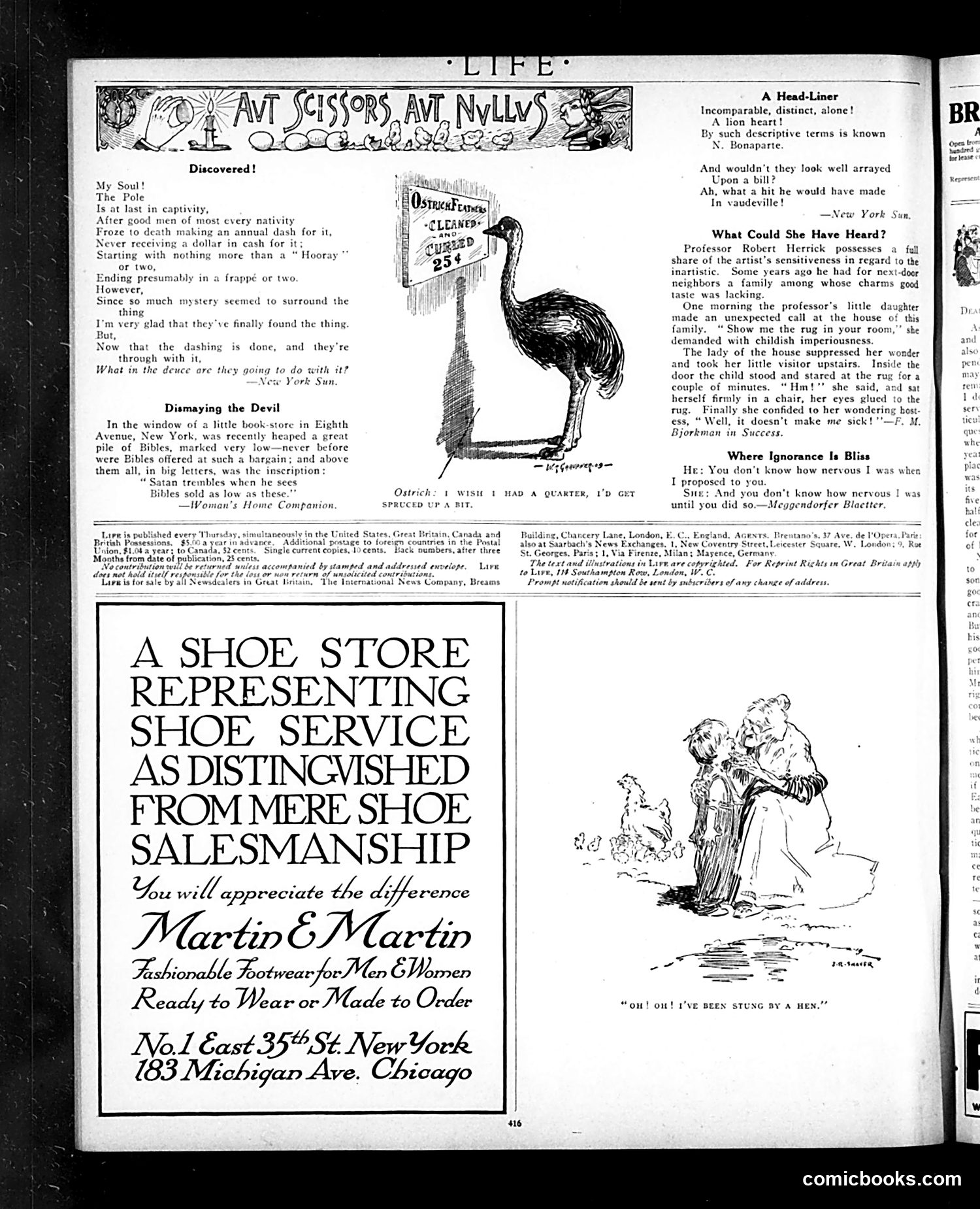
This page contains several satirical pieces typical of Life's early 20th-century humor: **"Discovered!"** mocks the capture of Napoleon, suggesting his legendary status made him seem invincible. The joke questions what authorities will do with him now—implying his mythic reputation exceeds his actual threat. **"Dismaying the Devil"** satirizes a bookstore selling Bibles at bargain prices, with a sign stating "Satan trembles when he sees / Bibles sold as low as these." The satire targets commercialization of religion and the irony of deeply sacred texts being hawked cheaply. **The ostrich cartoon** plays on the phrase "I wish I had a quarter, I'd get spruced up a bit"—humor based on the animal's appearance and the absurdity of an ostrich seeking grooming improvements. **"Where Ignorance is Bliss"** presents a marriage proposal joke: the bride admits she was nervous accepting, implying she knew something troubling about her husband-to-be. The Martin & Martin shoe advertisement occupies substantial space, representing standard commercial content in the magazine. Overall, the page mixes light social satire with advertising.
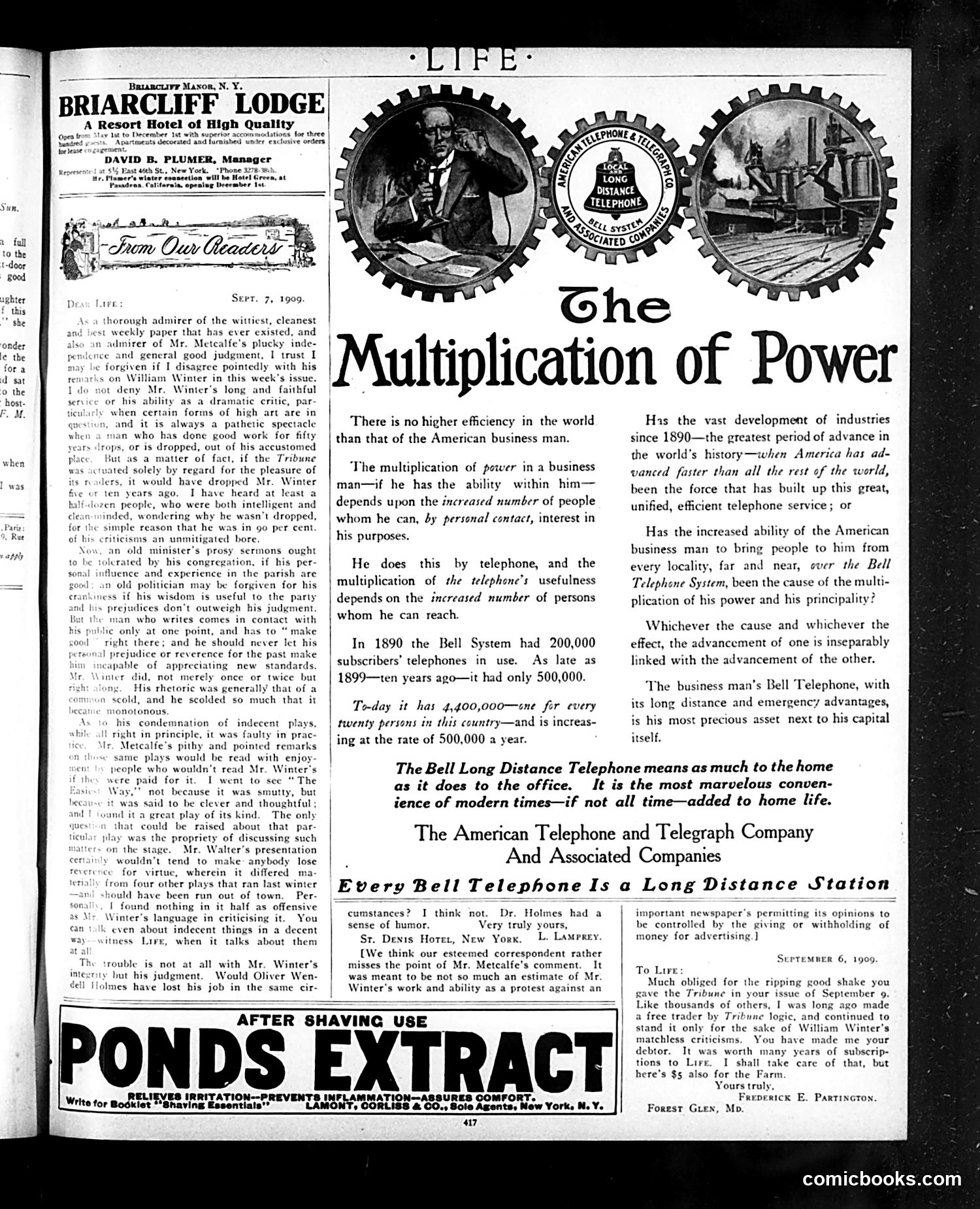
This page is primarily a **Bell Telephone System advertisement** from 1909, not political satire. The three gear-shaped vignettes at top showcase telephone technology and infrastructure. The advertisement argues that American business efficiency depends on reaching people via telephone. It presents statistics showing Bell System growth: 200,000 subscribers in 1890, 500,000 by 1899, and 4,400,000 by 1909—claiming this reflects either industrial advancement OR the businessman's increased power to mobilize distant workers. The rhetorical question posed is essentially circular corporate propaganda: it attributes economic growth to telephone access without proving causation, suggesting the technology itself enables American business dominance. The page also contains unrelated editorial content criticizing dramatic critic William Winter's harsh reviews and outdated standards—a separate discussion about theater criticism in *Life* magazine.
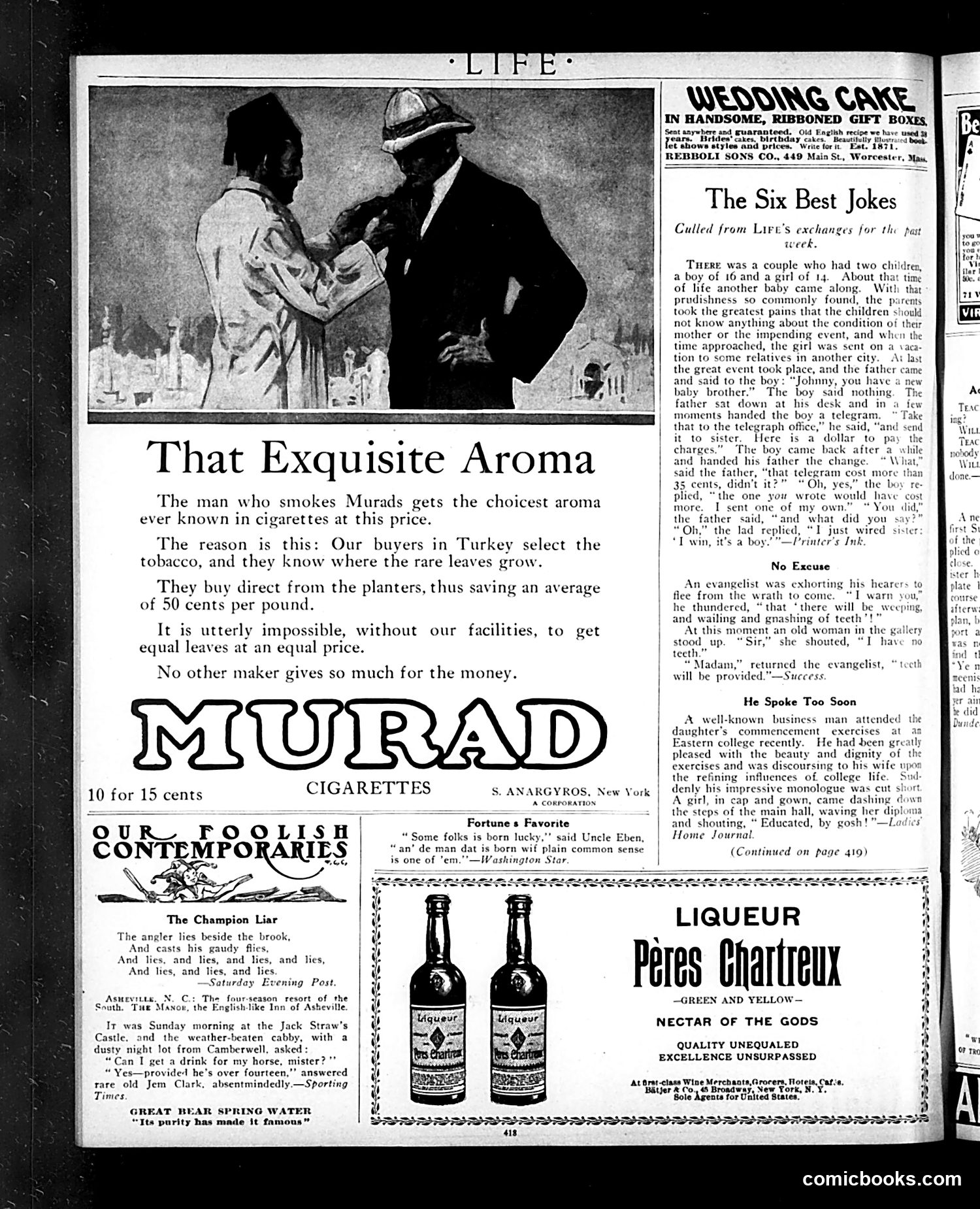
This page mixes advertisements with humor content typical of early 20th-century Life magazine. The main image shows a man in a fedora and overcoat speaking with a woman, illustrating an advertisement for Murad cigarettes that emphasizes Turkish tobacco quality and direct sourcing from planters. The page's primary content is "The Six Best Jokes," a recurring Life feature compiling reader-submitted humor. These jokes rely on period sensibilities: one involves Victorian prudishness about pregnancy, another depicts a misheard sermon about "gnashing of teeth" by a toothless woman, and a third plays on a college girl's unladylike behavior disappointing her refined father. Additional humor includes "Our Foolish Contemporaries" (mocking other publications) and "The Champion Liar," a poem about anglers' tall tales. The advertisements—for wedding cakes, Murad cigarettes, and Pères Chartreux liqueur—represent typical early 1900s Life content where commercial and editorial matter seamlessly blended. The page reflects genteel, middle-class humor emphasizing propriety, education, and irony about social expectations.
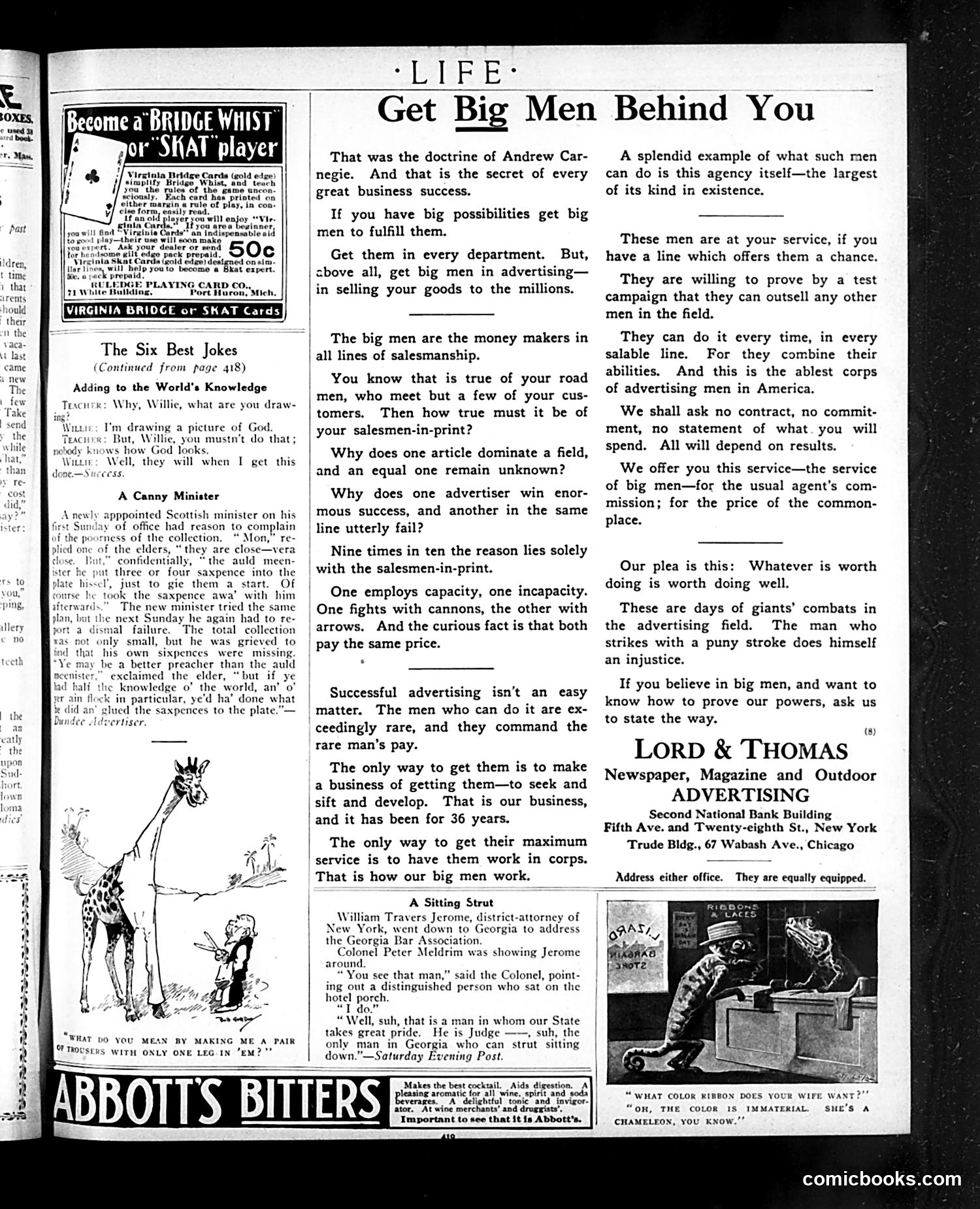
This page primarily consists of **advertising and business articles** rather than political satire or editorial cartoons. The main content is a lengthy advertisement by **Lord & Thomas**, a major advertising agency, promoting their services to businesses. The ad argues that hiring top-tier salesmen and advertising professionals (referred to as "big men") is essential for business success. It references **Andrew Carnegie** as an example of this philosophy and compares advertising competition to "giants' combats." The page also includes: - **"The Six Best Jokes"** section with humorous anecdotes (one involving a Scottish minister and church collection) - A small **cartoon of a giraffe and child** (unrelated to the text) - Various smaller advertisements, including one for **Abbott's Bitters** and **Virginia Bridge Cards** The overall tone reflects **early 20th-century business culture**, emphasizing hiring excellence and professional expertise. There is no significant political commentary or social satire visible on this particular page.
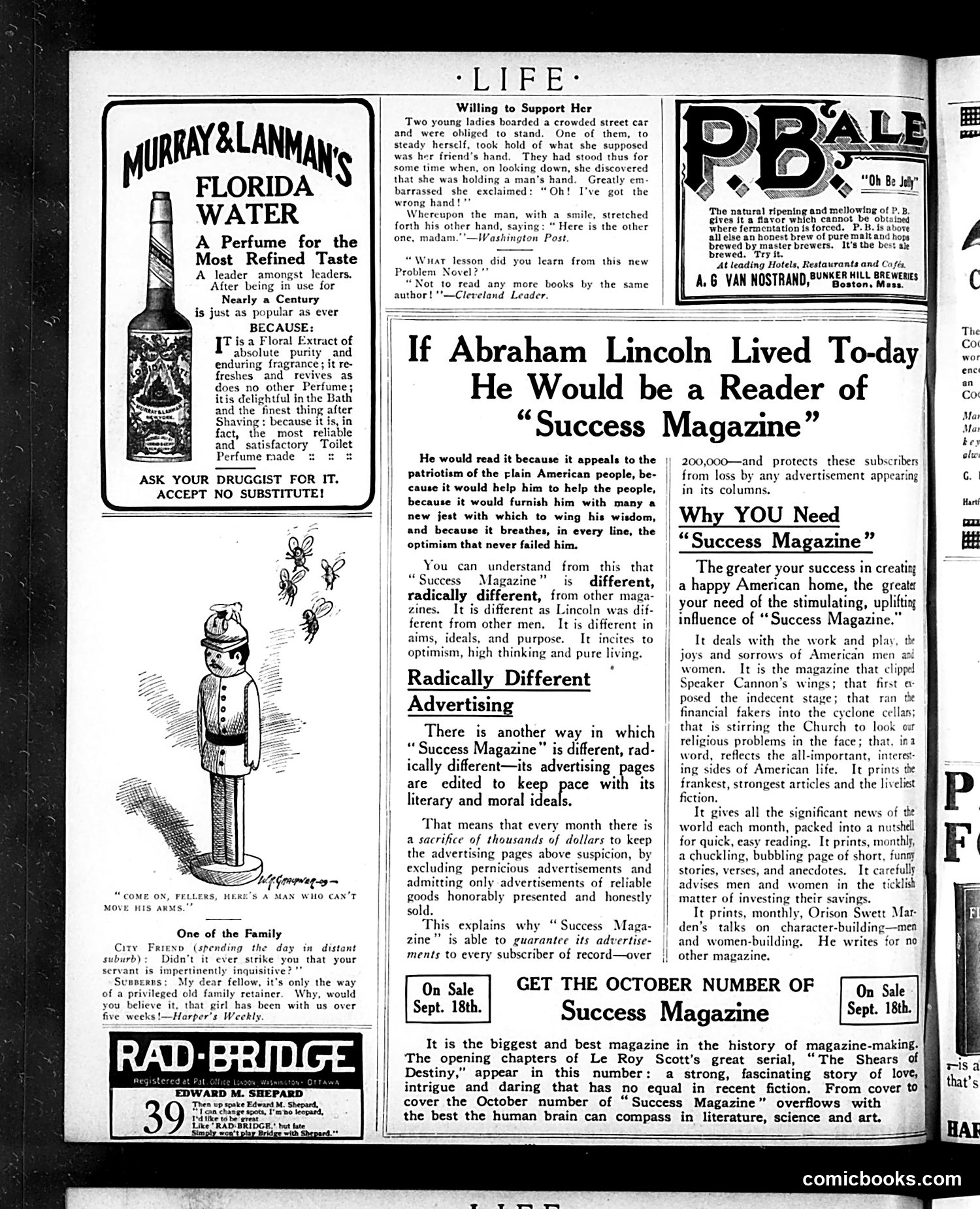
This page primarily consists of **advertisements and humorous short items** rather than political cartoons. The main content includes: **The cartoon** ("Come On, Fellers...") depicts a **servant or working-class figure** unable to move his arms—likely commenting on class dynamics or physical labor. The accompanying text jokes about a "privileged old family retainer," satirizing the relationship between employers and long-serving household staff. **Other humor pieces** are lighthearted anecdotes: a woman mistakenly holding a stranger's hand on a streetcar, and a reader rejecting an author after one book. **The large advertisement** for *Success Magazine* uses Abraham Lincoln as a rhetorical device, claiming he would read it because it promotes "patriotism," "optimism," and "pure living." This represents early-1900s aspirational marketing—linking a product to American ideals and personal improvement. The page reflects turn-of-the-century American magazine culture: mixing gentle social satire with commercial messaging promoting self-improvement and consumerism.
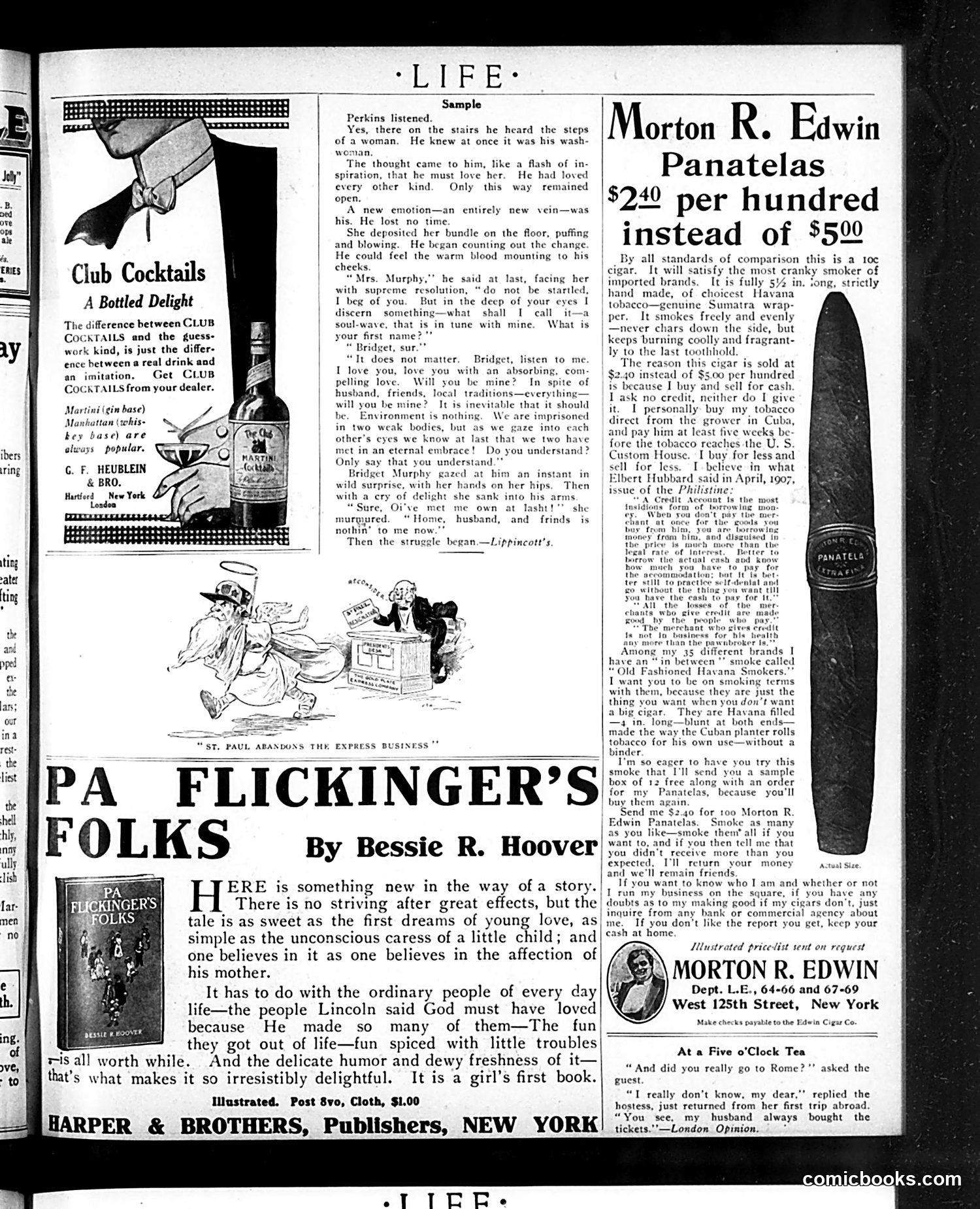
This page mixes literary content with advertising. The main narrative excerpt, titled "Pa Flickinger's Folks" by Bessie R. Hoover, depicts a comedic romantic scene: a man named Perkins, having exhausted other romantic pursuits, decides to court his laundress, Murphy. When he confesses his sudden love in flowery language, she responds with working-class Irish dialect ("Oi've met me own at lasht!"), treating his philosophical declarations as mere romantic overture—the humor derives from the clash between his pretentious sentiment and her practical response. The page also advertises Club Cocktails and Morton R. Edwin cigars, emphasizing affordability and direct purchasing (no credit). The satirical content critiques both affected romanticism and working-class Irish stereotypes common in early 20th-century American humor.
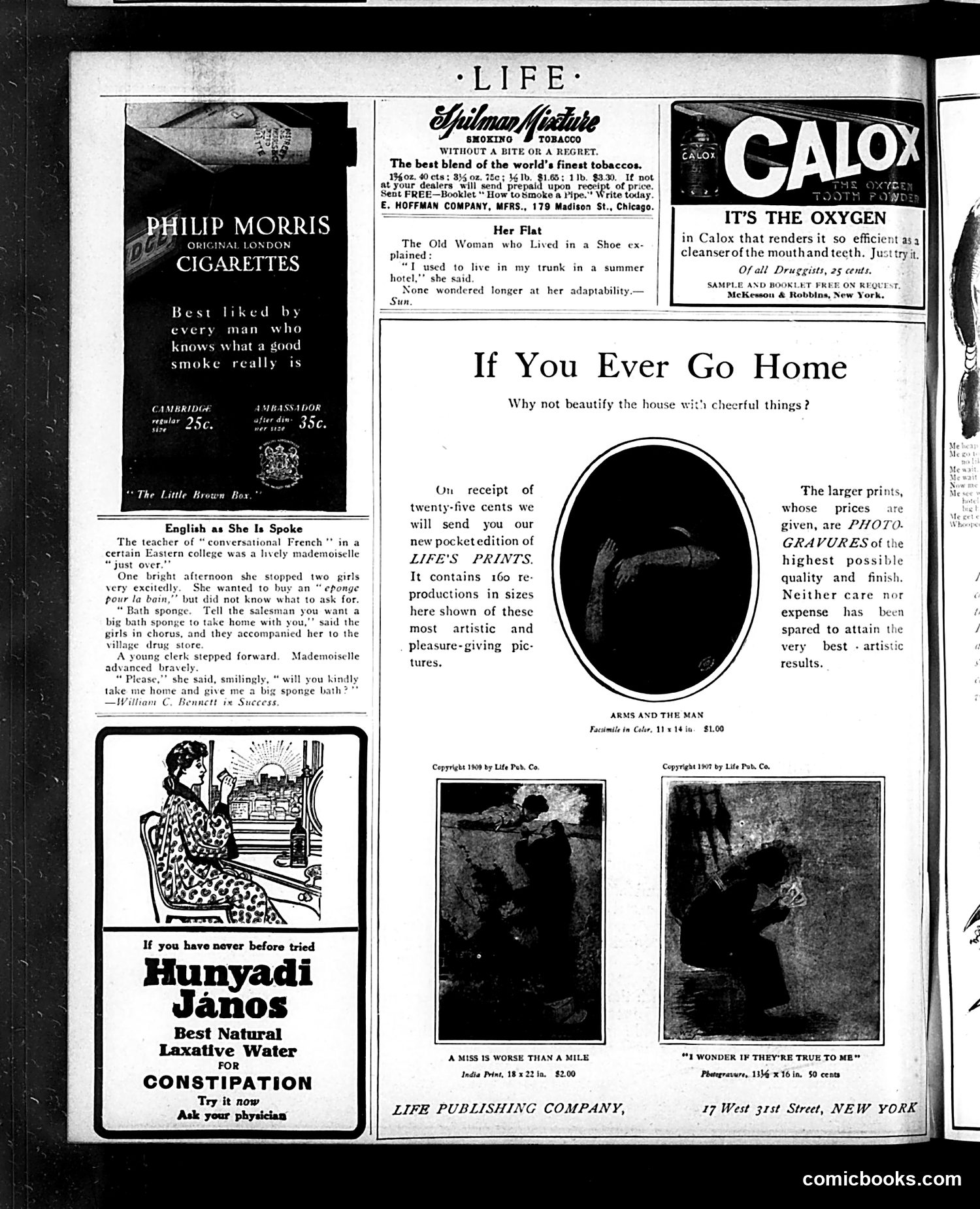
This page is primarily **advertising and humor content** rather than political satire. It contains several distinct elements: **Main Content:** - Product advertisements (Philip Morris cigarettes, Calox toothpaste, Hunyadi Janos laxative) - A humorous anecdote titled "English as She Is Spoke" about a French teacher's linguistic mishap—she asks a drugstore clerk for a "sponge for the bath" but her accent/phrasing causes misunderstanding, leading to an implied inappropriate request - A section promoting Life magazine's art prints available for purchase **The Humor:** The joke relies on double-entendre and the comedy of a non-native speaker's accidental vulgarity. The punchline (attributed to William C. Bennett) plays on the clerk's confused interpretation of her request. **Historical Context:** This appears to be early 1900s Life magazine—a mix of genteel humor, advertising, and fine art reproduction. The magazine marketed itself as offering both entertainment and cultivated taste through affordable art prints.
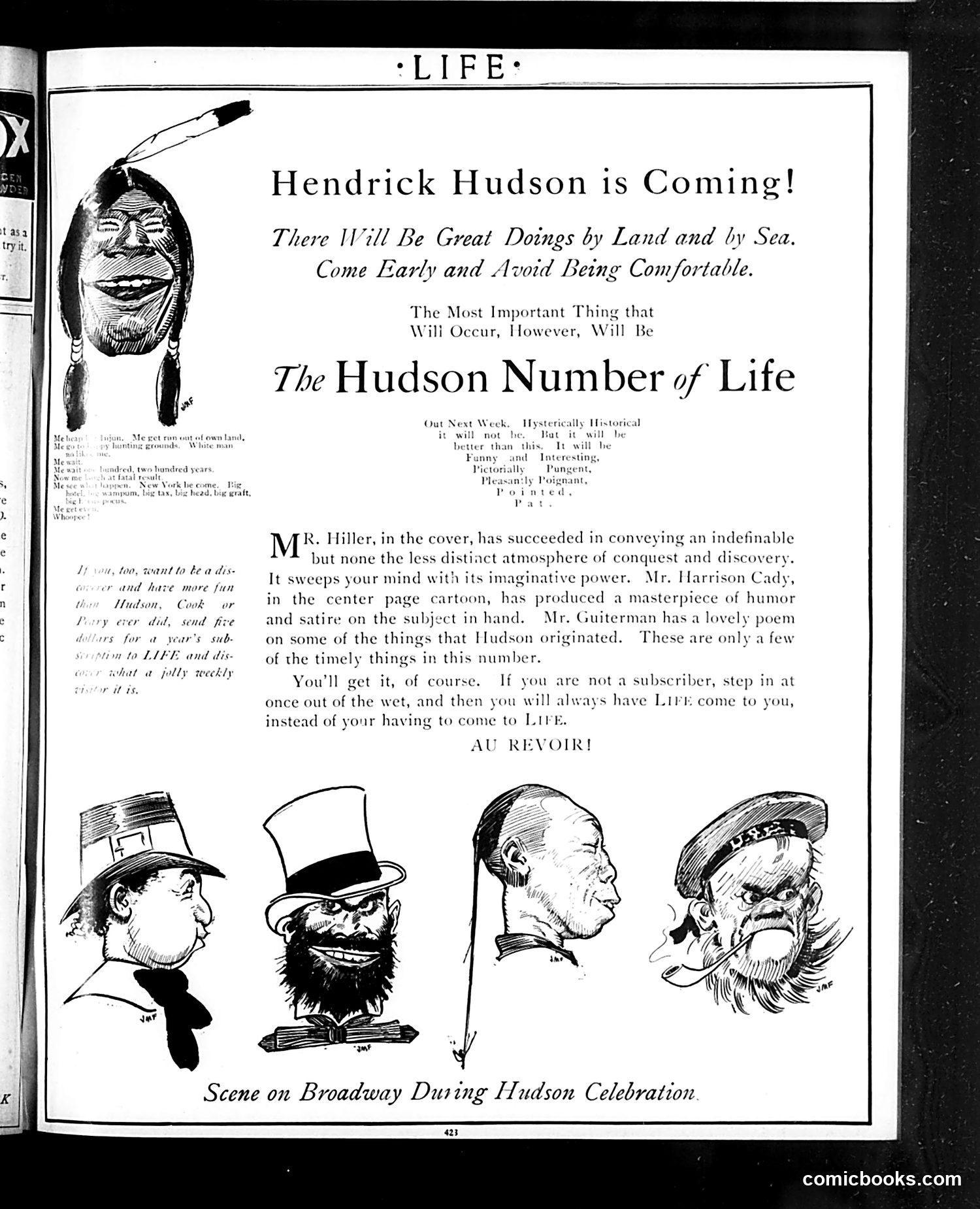
This is a promotional page for *Life* magazine's upcoming "Hudson Number"—a special issue celebrating Henry Hudson, the 17th-century explorer. The page announces that Hudson's arrival/celebration will bring "great doings by land and by sea," humorously warning readers to "come early and avoid being comfortable." The caricatures at the bottom depict four male heads labeled "Scene on Broadway During Hudson Celebration"—likely representing archetypal New York characters (a working man, a gentleman, a Native American, and possibly a sailor or immigrant) reacting to Hudson-related festivities. The satire targets the magazine's own self-promotion: *Life* boasts that its upcoming Hudson issue will be "better than this" current issue, while the text mockingly encourages subscription, suggesting readers should get the magazine delivered rather than having to purchase it. The tone is playfully self-deprecating about the magazine's own content.
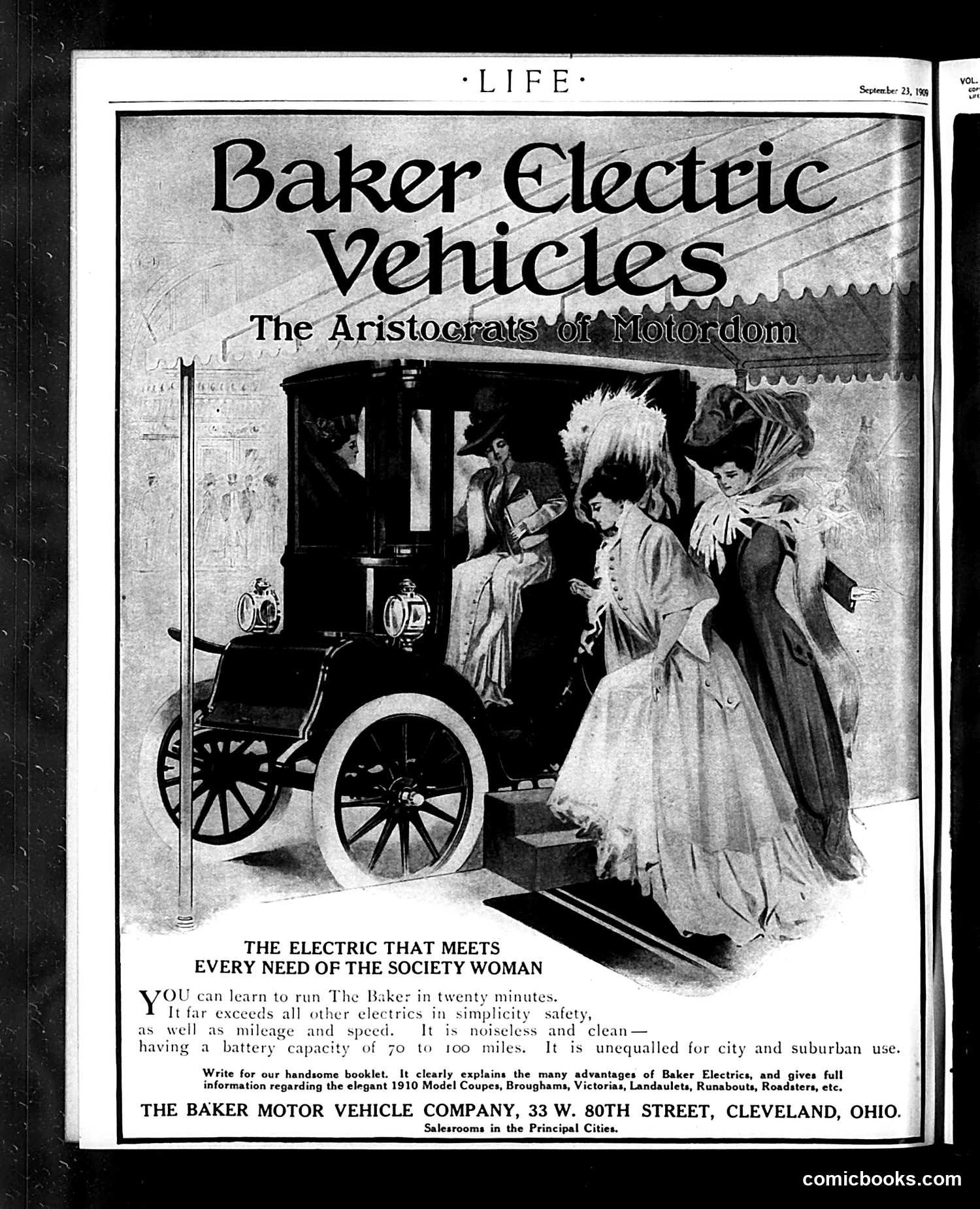
This is primarily a **advertisement**, not satire. It appears in *Life* magazine from September 23, 1908. The ad markets electric automobiles to wealthy women ("society woman"), depicting elegantly dressed ladies entering a Baker vehicle. The tagline promises the car meets "every need of the society woman"—positioning it as safe, simple, and clean. The implicit message reflects early-20th-century gender assumptions: electric cars (quiet, requiring no hand-cranking like gas engines) were marketed to women as easier and more appropriate than gasoline vehicles. The ad emphasizes ease of operation ("learn to run...in twenty minutes") and cleanliness—coded appeals to female consumers. This reveals how manufacturers gendered technology: electrics were positioned as the "ladies' choice," while gas-powered cars were implicitly masculine. The ad exploits class and gender stereotypes to sell vehicles to affluent households.