
Life, 1909-09-23 · page 16 of 28
Life — September 23, 1909 — page 16: what you’re looking at
A restored page from Life, 1909-09-23. Page through the whole issue in the reader above.
📄 Transcribed text from this page (OCR, searchable)
Machine-transcribed from the original scan — historical spelling and the odd misread are preserved.
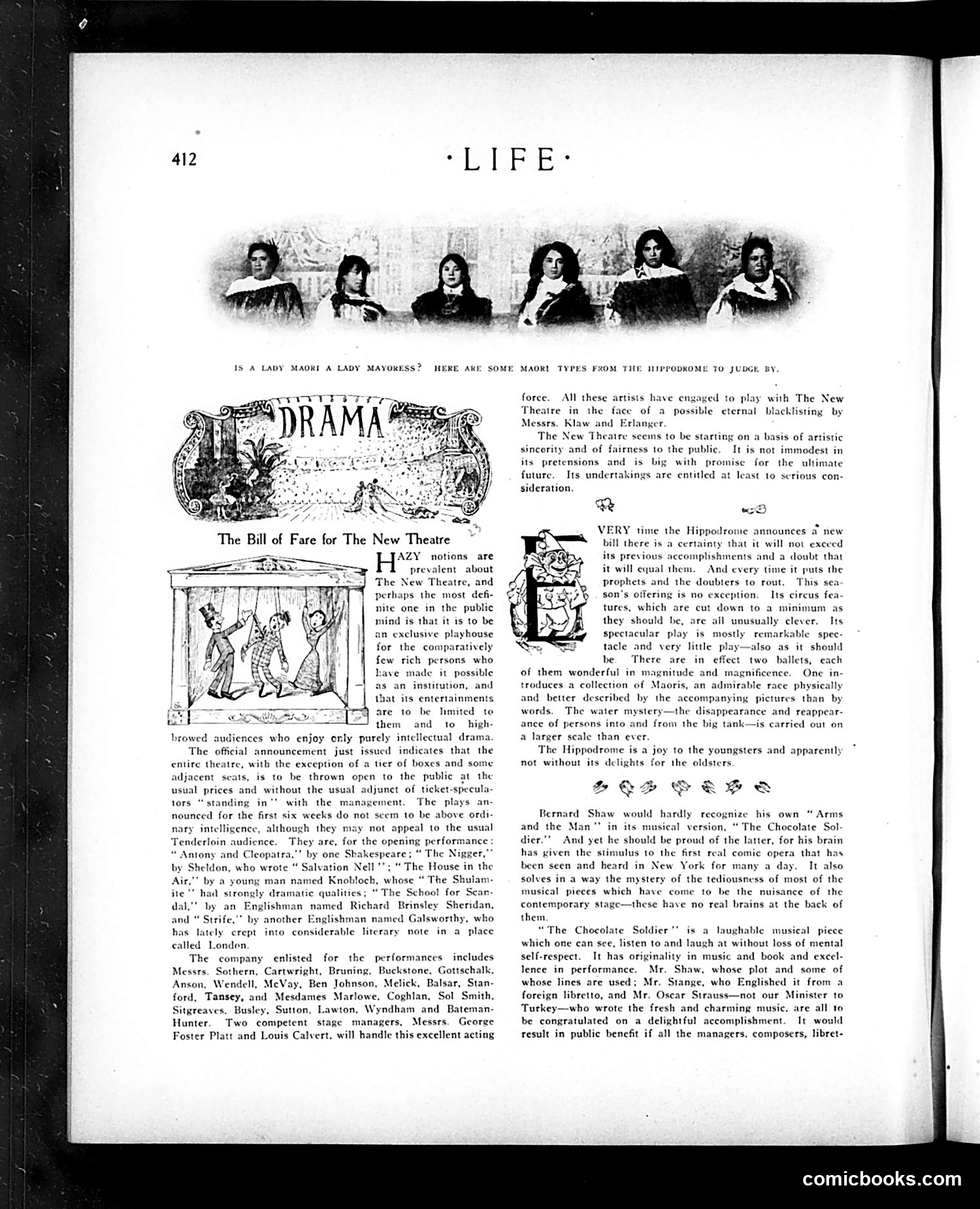
MAOKI A LADY ? ARE SOME ZY notions are prevalent about The New Theatre, and perhaps the most defi- nite one in the public mind is that it is to be an exclusive playhouse for the comparatively few rich persons who ave made it possible as an institution, and that its entertainments are to be limited to them and to high- browed audiences who enjoy orly purely intellectual drama The official announcement just issued indicates that the entire theatre, with the exception of a tier of boxes and some adjacent seats, is to be thrown open to the public at the usual prices and without the usual adjunct of ticket-specula tors “standing in’? with the management. The plays an- nounced for the first six weeks do not scem to be above ordi- nary intelligence, although they not appeal to the usual Tenderloin audience. They are, for the opening performance “ Antony and Cleopatra,”’ by one Shakespeare ; “ The Nigger, by Sheldon, who wrote “ Salvation Nell"; “The House in the Air,” by a young man named Knobloch, whose “ The ite’ had strongly dramatic qualities; “The School for Scan- dal." by an Englishman named Richard Brinsley Sheridan, nd“ Strife.”” by another Englishman named Galsworthy, who has lately crept into considerable literary note in a place called London, The company enlisted for the performances includes Messrs. Sothern, Cartwright, Bruning, Buckstone, Gottschalk, Anson, Wendell, MeVay, Ben Johnson, Melick, Balsar, Stan- ford, Tansey, and Mesdames Marlowe, Coghlan, Sol Smith, Sitgreaves. Busley, Sutton, Lawton, Wyndham and Bateman- Hunter. Two competent stage managers, Messrs, George Foster Platt and Louis Calvert, will handle this excellent acting MAORL TYPES FROM THE MIPPODROME TO JUDGE BY force. All these artisis have engaged to play with The > Theatre in the face of a possible eternal blacklisting by Messrs. Klaw and Erlanger. The New Theatre seems to be starting on a basis of artistic sincerity and of fairness to the public. It is not immodest in its pretensions and is big with promise for the ultimate future. Its undertakings are entitled at least to serious con- sideration. VERY time the Hippodrome announces a new bill there is a certainty that it will not exceed 8 previous accomplishments and a doubt that it will equal them. And every time it puts the prophets and the doubters to rout. This sea son’s offering is no exception. Its circus fe tures, which are cut down to a minimum as they should be, are all unusually clever. Its spectacular play is mostly remarkable spec- tacle and very little play—also as it should be. There are in effect two ballets, each of them wonderful in magnitude and magnificence. One in- troduces a collection of Maoris, an admirable race physically and better dese! words, The water mystery—the disappearance and reappear- ance of persons into and from the big tank—is carried out on a larger scale than ever. The Hippodrome is a joy to the youngsters and apparently not without its delights for the oldsters. oe: Bernard Shaw would hardly recognize his own “ Arms and the Man”? in its musical version, “The Chocolate Sol dier."” And yet he should be proud of the latter, for his brain has given the stimulus to the first real comic opera that has been seen and heard in New York for many a day. It also solves in a way the mystery of the tediousness of most of the musical pieces which have come to be the nuisance of the contemporary stage—these have no real brains at the back of ed by the accompanying pictures than by them “The Chocolate Soldier"? is a laughable musical piece which one can see, listen to and laugh at without loss of mental self-respect. It has originality in music and book and excel- lence in performance. Mr. Shaw, whose plot and some of whose lines are used; Mr. Stange, who Englished it from a foreign libretto, and Mr. Oscar Strauss—not our Minister to Turkey—who wrote the fresh and charming music, are all 10 be congratulated on a delightful accomplishment. It would result in public benefit if all the managers, composers, libret- comicbooks.com