
Life, 1909-09-23 · page 6 of 28
Life — September 23, 1909 — page 6: what you’re looking at
What you’re looking at
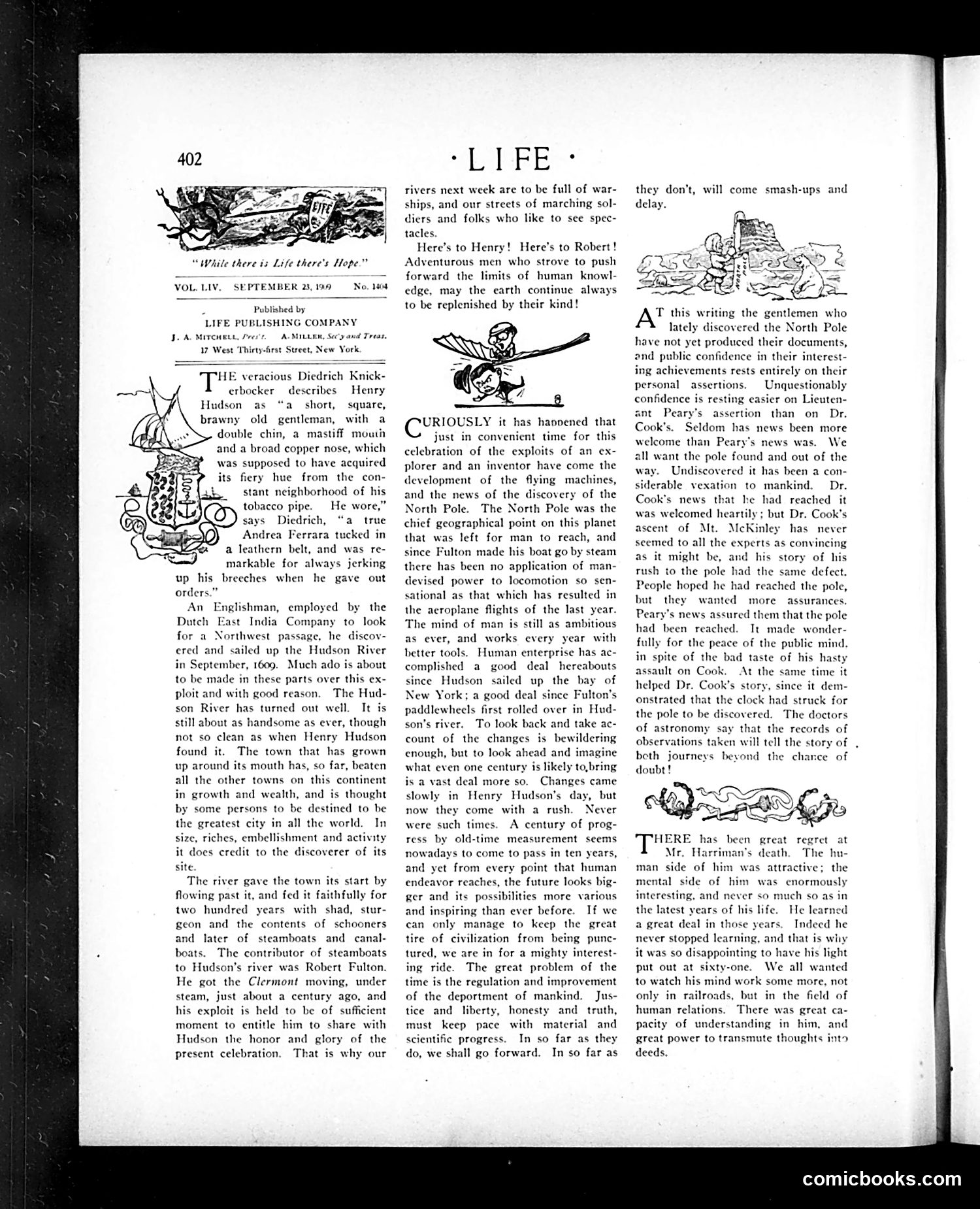
This page celebrates Henry Hudson and Arctic exploration. The left column discusses Hudson's 1609 voyage up the Hudson River, establishing New York's importance. The illustrations show Hudson as a historical figure—a bearded explorer depicted in period dress with a ship's insignia. The right column addresses contemporary Arctic exploration, specifically mentioning Peary's North Pole discovery. The text expresses pride that explorers' achievements rest on "personal assertions" and notes that Peary's news was welcome. There's an apparent dig at Dr. Cook—a rival claimant to the Pole—suggesting skepticism about his competing polar achievement claims. The overall theme celebrates American exploration and discovery, from Hudson's colonial-era voyage to modern Arctic expeditions.
📄 Transcribed text from this page (OCR, searchable)
Machine-transcribed from the original scan — historical spelling and the odd misread are preserved.
5 Published by LIFE PUBLISHING COMPANY Acne 17 West Thirty-first Street, New Vork. J. A. Miron Ett, Press n, Sec“y and Treas. HE veracious Diedrich Knick- erbocker describes Henry Hudson as “a short, square, brawny old gentleman, with a double chin, a mastiff moutir and a broad copper nose, which was supposed to have acquired its fiery hue from the con- stant neighborhood of his tobacco pipe. He wore,” Diedrich, “a true Andrea Ferrara tucked in a leathern belt, and was re- markable for always jerking up his breeches when he gave out orders.” An Englishman, employed by the Dutch East India Company to look for a Northwest passage, he discov- ered and sailed up the Hudson River in September, 1609. Much ado is about to be made in these parts over this ex- ploit and with good reason. The Hud- son River has turned out well. It is still about as handsome as ever, though not so clean as when Henry Hudson found it. The town that has grown up around its mouth has, so far, beaten all the other towns on this continent in growth and wealth, and is thought by some persons to be destined to be the greatest city in all the world. In size, riches, embellishment and activity it does credit to the discoverer of its site The river gave the town its start by flowing past it, and fed it faithfully for two hundred years with shad, stur- geon and the contents of schooners and later of steamboats and canal- The contributor of steamboats to Hudson’s river was Robert Fulton. He got the Clermont moving, under steam, just about a century ago, and his exploit is held to be of sufficient moment to entitle him to share with Hudson the honor and glory of the present celebration, That is why our says boats. “LEE rivers next week are to be full of war- ships, and our streets of marching sol- diers and folks who like to see spec- tacles. Here’s to Henry! Here's to Robert! Adventurous men who strove to push forward the limits of human knowl- edge, may the earth continue always to be replenished by their kind! URIOUSLY it has happened that just in convenient time for this celebration of the exploits of an ex- plorer and an inventor have come the development of the flying machines, and the news of the discovery of the North Pole. The North Pole was the chief geographical point on this planet that was left for man to reach, and since Fulton made his boat go by steam there has been no application of man- devised power to locomotion so sen- sational as that which has resulted in the aeroplane flights of the last year. The mind of man is still as ambitious as ever, and works every year with better tools. Human enterprise has ac- complished a good deal hereabouts since Hudson sailed up the bay of New York; a good deal since Fulton's paddlewheels first rolled over in Hud- son's river. To look back and take ac- count of the changes is bewildering cnough, but to look ahead and imagine what even one century is likely to,bring is a vast deal more so, Changes came slowly in Henry Hudson's day, but now they come with a rush. Never were such times. A century of prog- ress by old-time measurement seems nowadays to come to pass in ten years, and yet from every point that human endeavor reaches, the future looks big- ger and its possibilities more various and inspiring than ever before. If we can only manage to keep the great tire of civilization from being punc- tured, we are in for a mighty interest- ing ride. The great problem of the time is the regulation and improvement of the deportment of mankind. Jus- tice and liberty, honesty and truth, must keep pace with material and scientific progress. In so far as they do, we shall go forward. In so far as they don’t, will come smash-ups and delay. A this writing the gentlemen who lately discovered the North Pole have not yet produced their documents, and public confidence in their interest- ing achievements rests entirely on their personal assertions. | Unquestionably confidence is resting easier on Licuten- ant. Pear assertion than on Dr. Cook's. Seldom has news been more welcome than Peary’s news was. We all want the pole found and out of the way. Undiscovered it has been a con- siderable vexation to mankind. Dr. Cook's news that he had reached it was welcomed heartily ; but Dr. Cook's ascent of Mt. McKinley has never seemed to all the experts as convincing as it might be, and his story of his rush to the pole had the same defect. People hoped he had reached the pole, but they wanted more assurances. Peary’s news assured them that the pole had been reached. It made wonder- fully for the peace of the public mind. in spite of the bad taste of his hasty assault on Cook. At the same time it helped Dr. Cook's story, since it dem- onstrated that the clock had struck for the pole to be discovered. The doctors of astronomy say that the records of observations taken will tell the story of beth journeys beyond the chance of doubt! HERE has been Mr, Harrim: great reg s death. The hu- man side of him was attractive; the mental side of him enormously interesting, and never so much so as in the latest years of his life. He learned a great deal in those years. Indeed he never stopped learning, and that is why it was so disappointing to have his light put out at sixty-one. We all wanted to watch his mind work some more, not only in railroads, but in the field of human relations here was great ca- pacity of understanding in him, and great power to transmute thoughts into deeds, was comicbooks.com