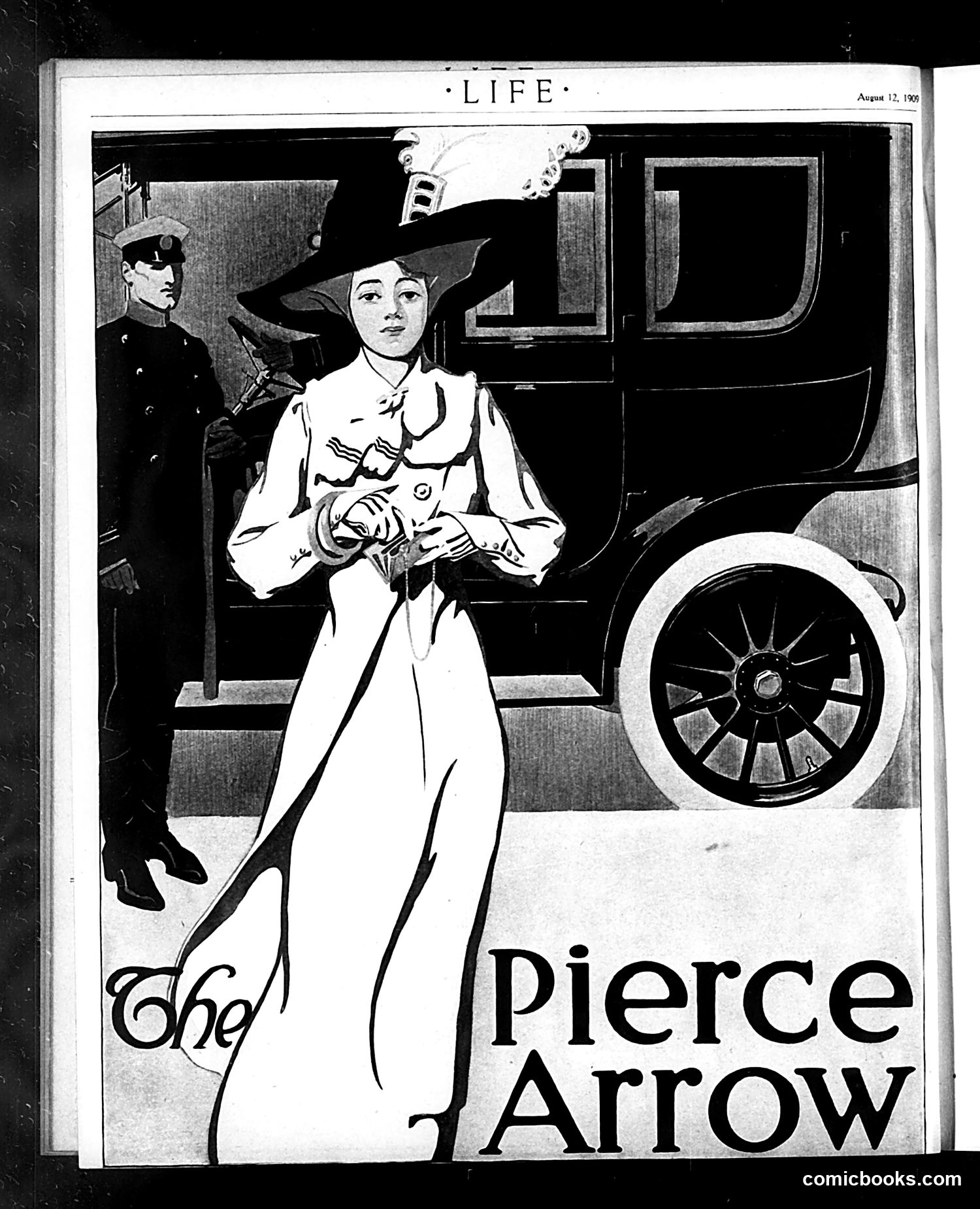
A complete issue · 28 pages · 1909
Life — August 12, 1909
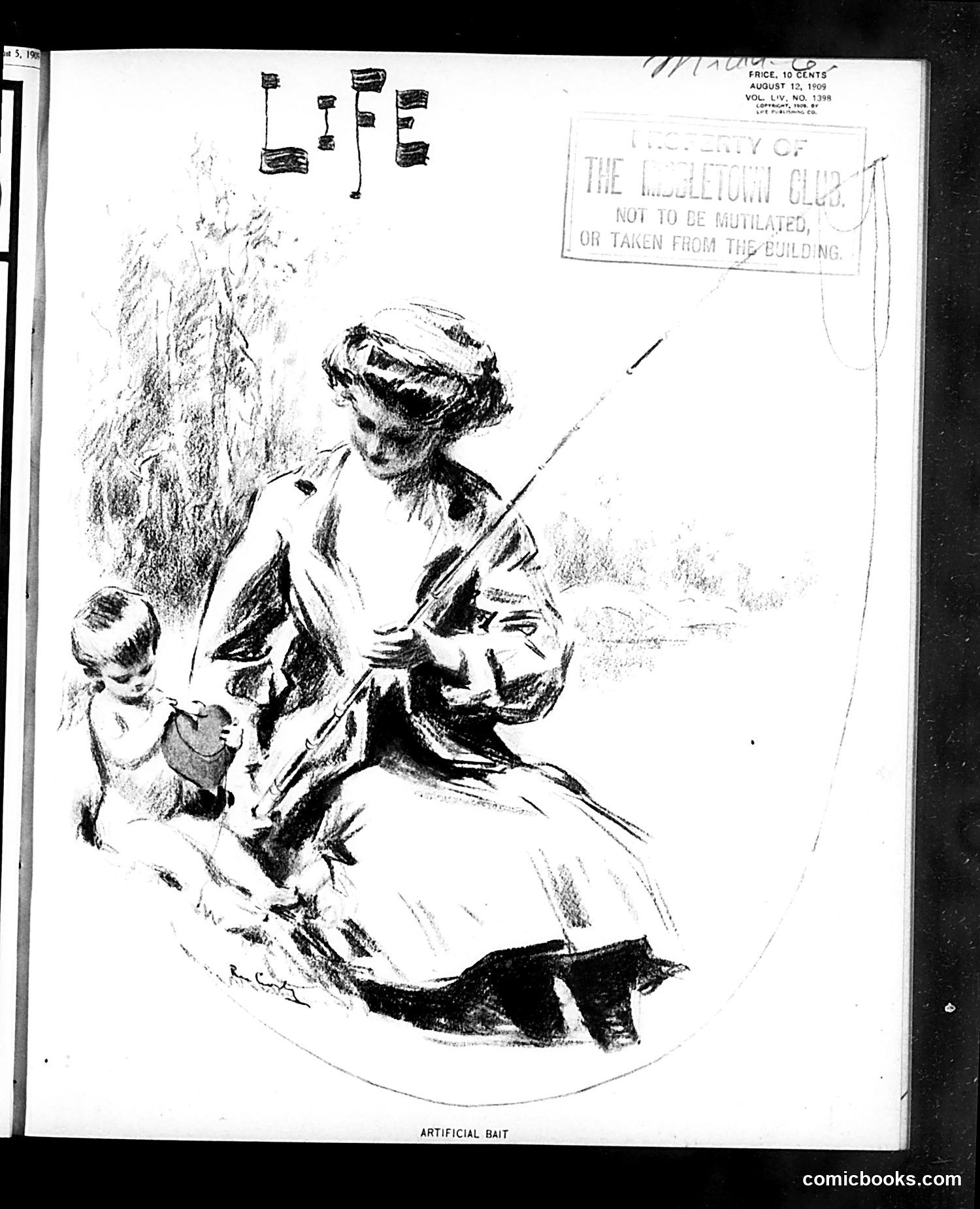
This political cartoon depicts a woman using a small child as bait to attract a man. The title "Artificial Bait" suggests the satire targets courtship deception or manipulation. The specific political/social context remains unclear without additional documentation. However, the image likely comments on: - **Marriage or romance schemes** where women strategically display children to attract suitors - Possibly a critique of **social climbing** or **gold-digging** behavior in early 1900s society - The irony of "artificial" suggests the setup is contrived rather than genuine The sketch style is characteristic of Life's satirical editorial cartoons from this era, which frequently mocked courtship customs and gender relations among the upper classes. Without more context, the exact figures or specific incident referenced cannot be definitively identified.
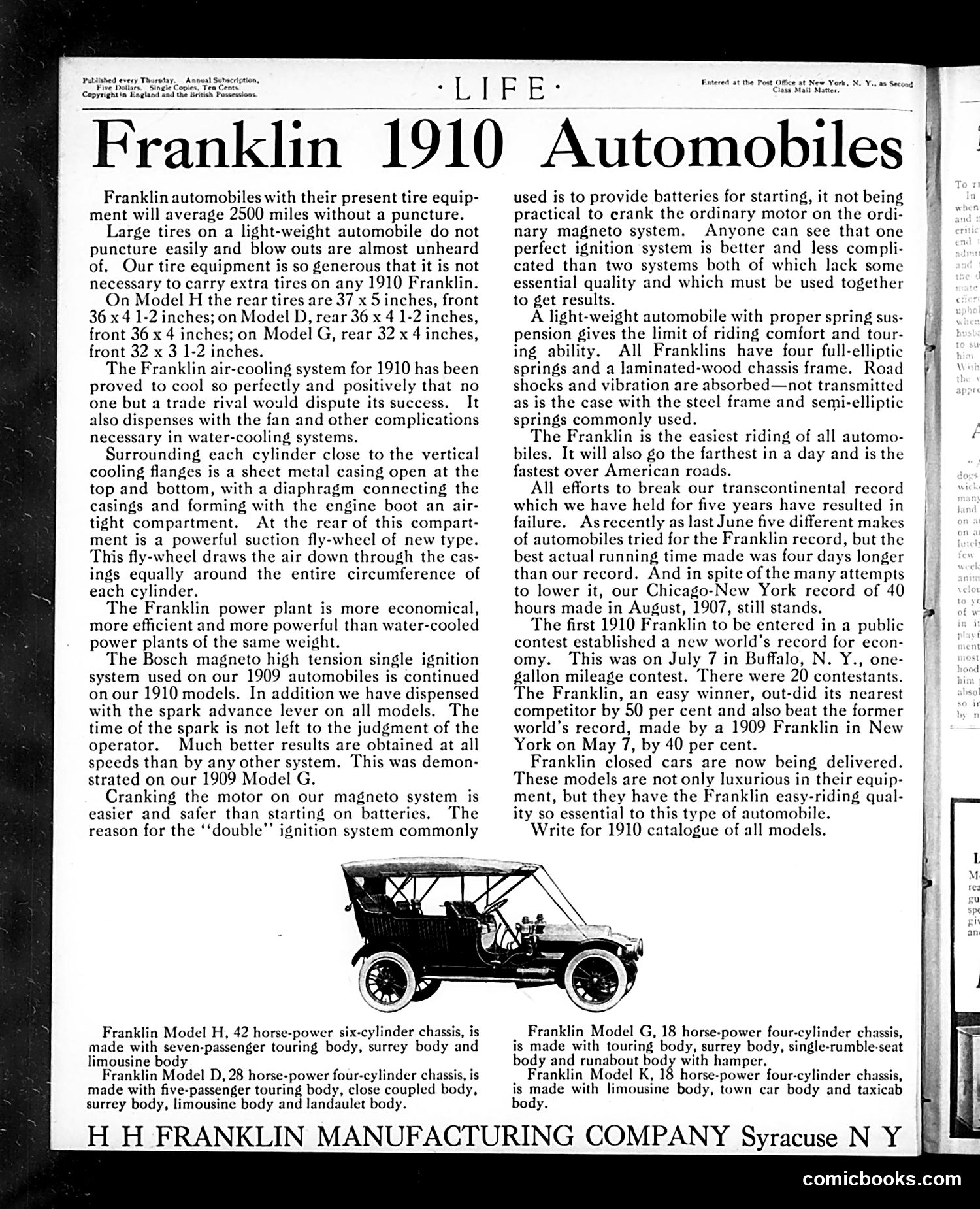
This page is **primarily an advertisement**, not political satire. It promotes Franklin automobiles to *Life* magazine's readers. The text emphasizes Franklin's technical innovations: air-cooling (rather than water), magneto ignition, light weight, and elliptic springs. There's a small illustration of a Franklin touring car. The ad highlights competitive achievements, including a recent transcontinental speed record and a July 1910 Buffalo economy contest where a Franklin outperformed 19 competitors by 50%. The bottom specifies three Franklin models: the Model H (42 horsepower, six-cylinder), Model D (28 horsepower, four-cylinder), and Model G and K variants. This represents early automotive advertising targeting affluent *Life* readers interested in emerging automobile technology.
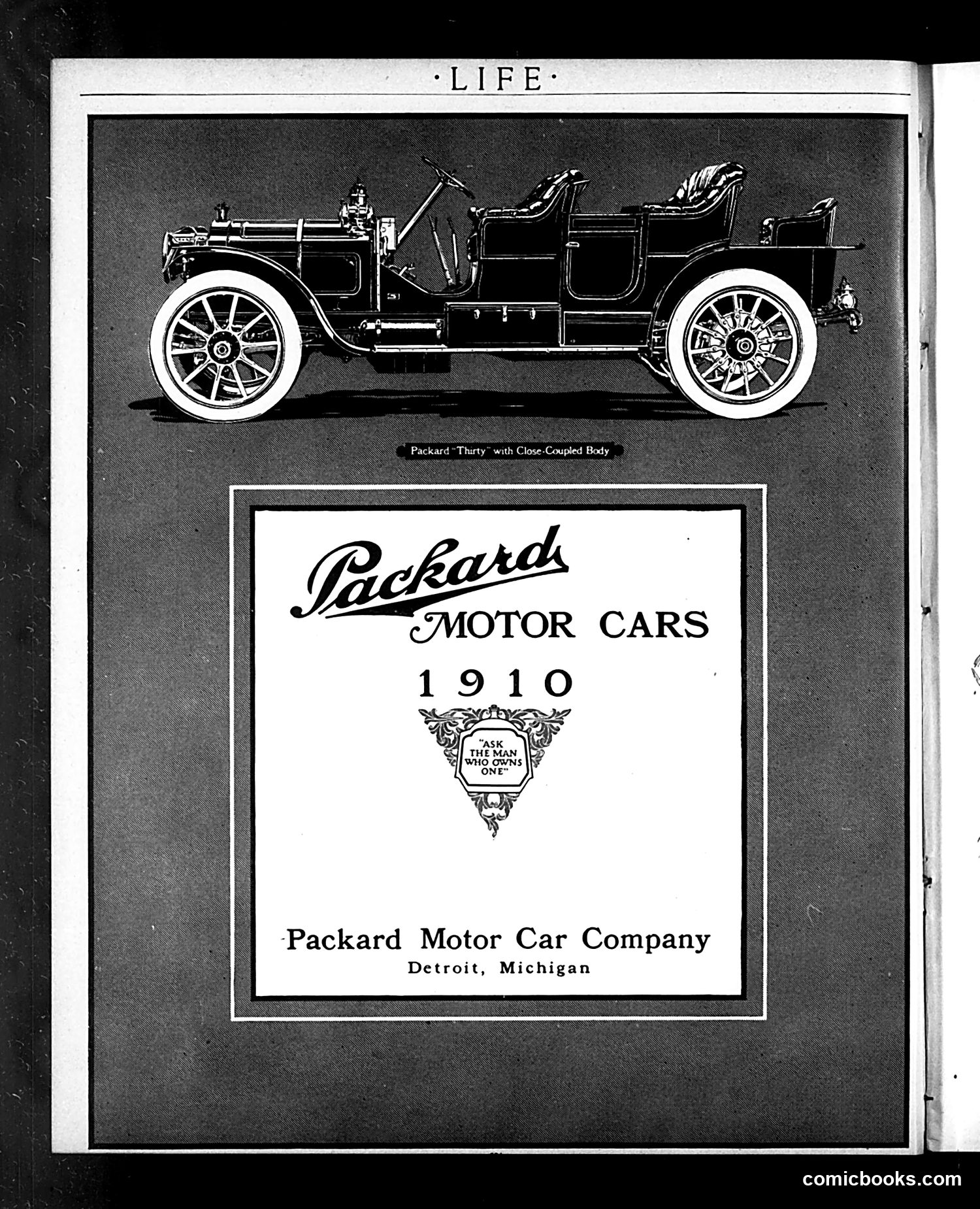
This page is **not a cartoon or satire** — it's an advertisement for Packard Motor Cars from 1910, published in *Life* magazine. The image shows a technical illustration of the "Packard Thirty with Close-Coupled Body," a luxury automobile displayed in profile against a dark background. The advertisement includes the company's tagline "Ask the Man Who Owns One," a marketing slogan emphasizing owner satisfaction and reliability. The Packard Motor Car Company, based in Detroit, Michigan, was a prestigious American automobile manufacturer of the early 20th century. This appears to be a promotional piece targeting wealthy consumers through *Life's* affluent readership. There is no political satire or social commentary present on this page.
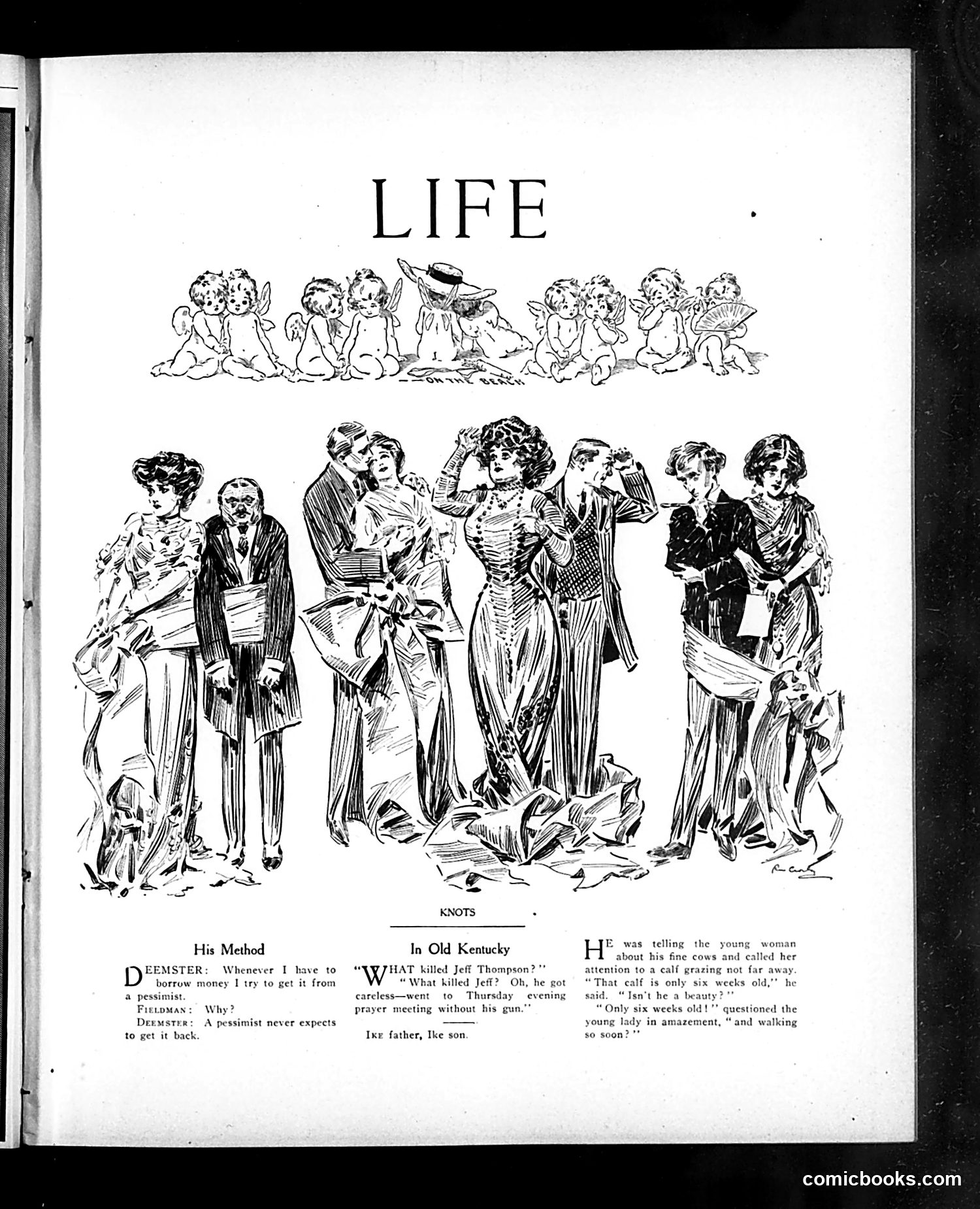
This page presents three separate satirical pieces: **"His Method"**: A brief joke about borrowing money from pessimists, who never expect repayment anyway—wordplay on pessimistic attitudes. **"In Old Kentucky"**: A dialogue joke about someone named Jeff Thompson being killed, with the punchline revealing he died from going to a prayer meeting unarmed—satirizing frontier Kentucky violence as so commonplace that attending church without a gun is dangerous. **"A Call Grazing"**: A narrative joke about a man discussing his six-week-old calf with a young woman, with her innocently misunderstanding his agricultural comment as flirtation. The upper illustration shows life stages from infancy through adulthood. These are light humor pieces typical of early 20th-century Life magazine's satirical content.
This page primarily contains an article titled "The Religion of the Pulpit as Outlined by Dr. Charles W. Eliot" discussing religious discourse among ministers. The small cartoon at the top left shows a figure asking "Where there is Life there's Hope?"—a pun on the magazine's title. The main illustration depicts what appears to be a clergyman or religious figure in period dress (likely early 20th century). The article critiques how ministers of different denominations discuss religion abstractly while their actual beliefs and conduct vary. It references specific clergy including Dr. Eliot, Bishop Brooks, and Dr. Huntington, arguing that examining someone's *actions* rather than their *stated beliefs* better reveals their true character. This reflects Progressive Era skepticism about institutional religion and its actual social impact.
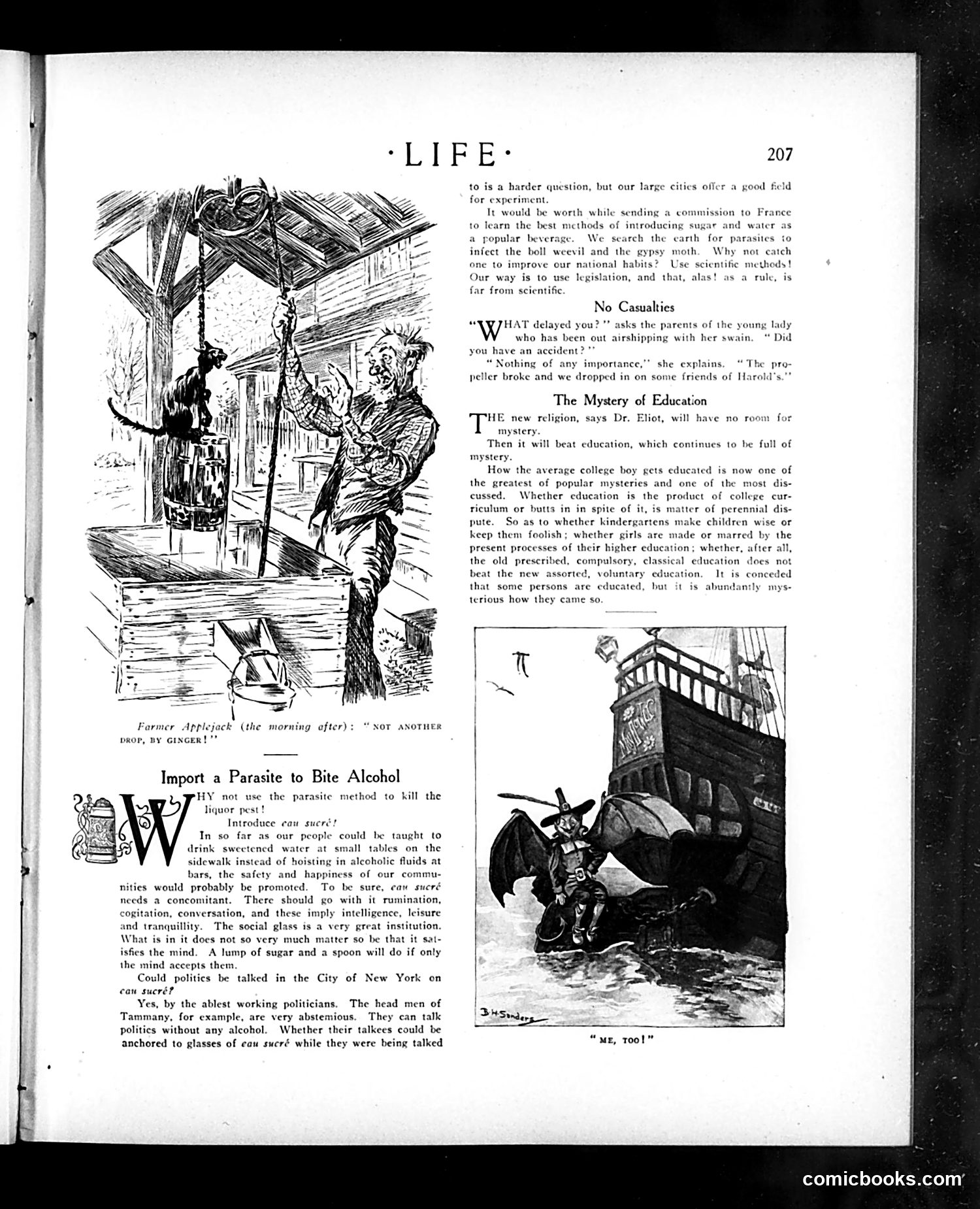
The page contains three distinct pieces of satire: 1. **"No Casualties"** — A brief joke about a young lady airshipping with her "swain" (romantic partner). Parents ask if there was an accident; she replies nothing happened except the propeller broke and they dropped into Harold's. The humor rests on casual dismissal of mechanical failure. 2. **"The Mystery of Education"** — An essay criticizing education's unclear methods and outcomes, questioning whether kindergartens keep children foolish or if college actually educates anyone. 3. **"Import a Parasite to Bite Alcohol"** — Proposes replacing bars with sidewalk tables serving *eau sucré* (sweetened water). The piece satirizes Prohibition-era reform efforts by suggesting absurd substitutes for alcohol. References "Tammany" (New York political machine) politicians as examples of those who might resist. The illustrations are generic satirical drawings rather than specific caricatures.
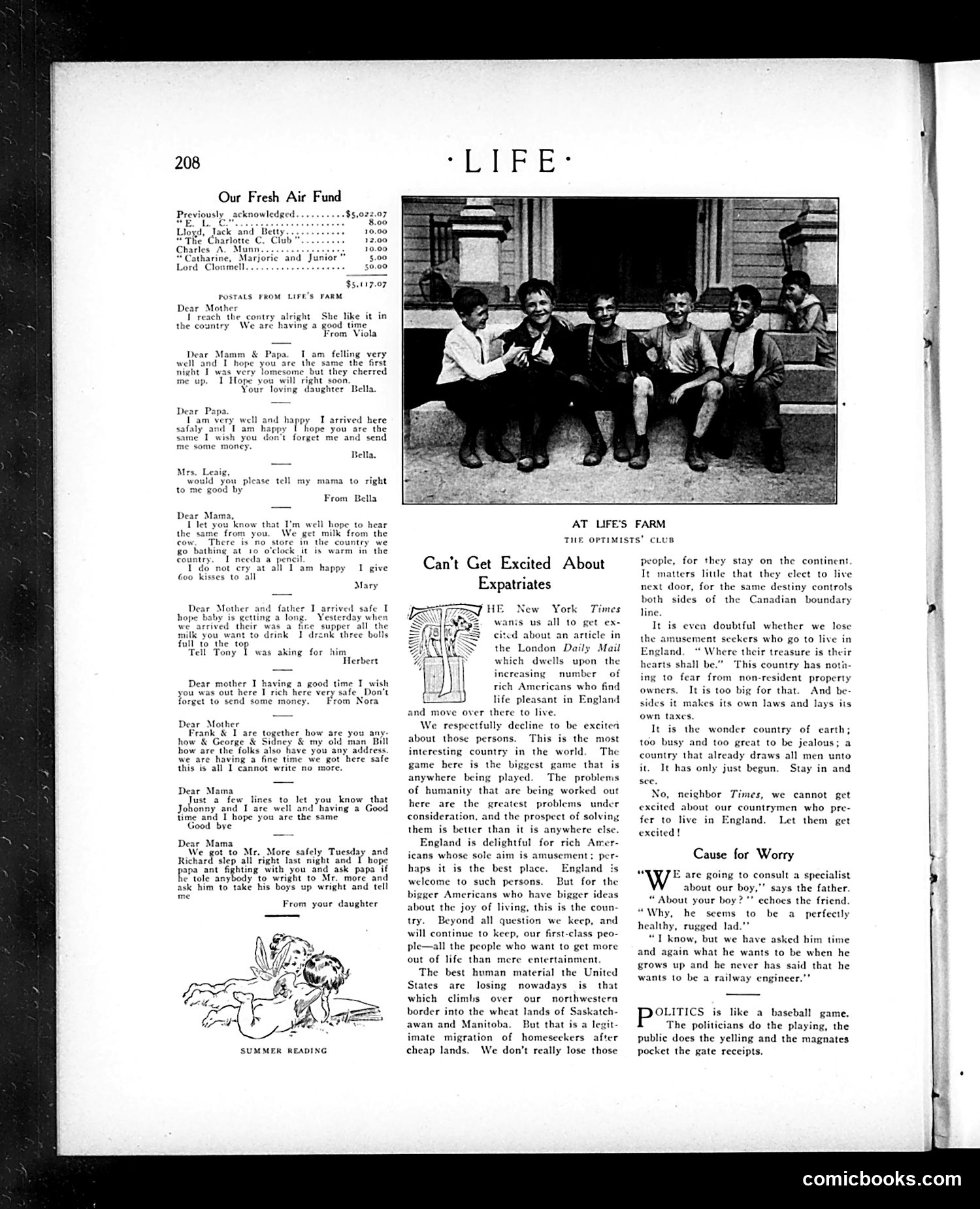
This page contains personal letters from readers ("Postals from Life's Farm") and two opinion pieces. The main cartoon/satirical content appears in the article "Can't Get Excited About Expatriates," which critiques wealthy Americans living abroad in England. The piece argues that expatriates—rich Americans who've relocated to England for leisure—represent a loss of valuable human capital to America. The author sarcastically suggests England is "the wonder country" but contends America needs its ambitious citizens. The satire targets the perceived self-indulgence of wealthy expatriates who abandon their home country for pleasures elsewhere. A second piece, "Cause for Worry," uses baseball as a metaphor for politics, suggesting politicians (like players and managers) treat governance as entertainment for public consumption rather than serious work.
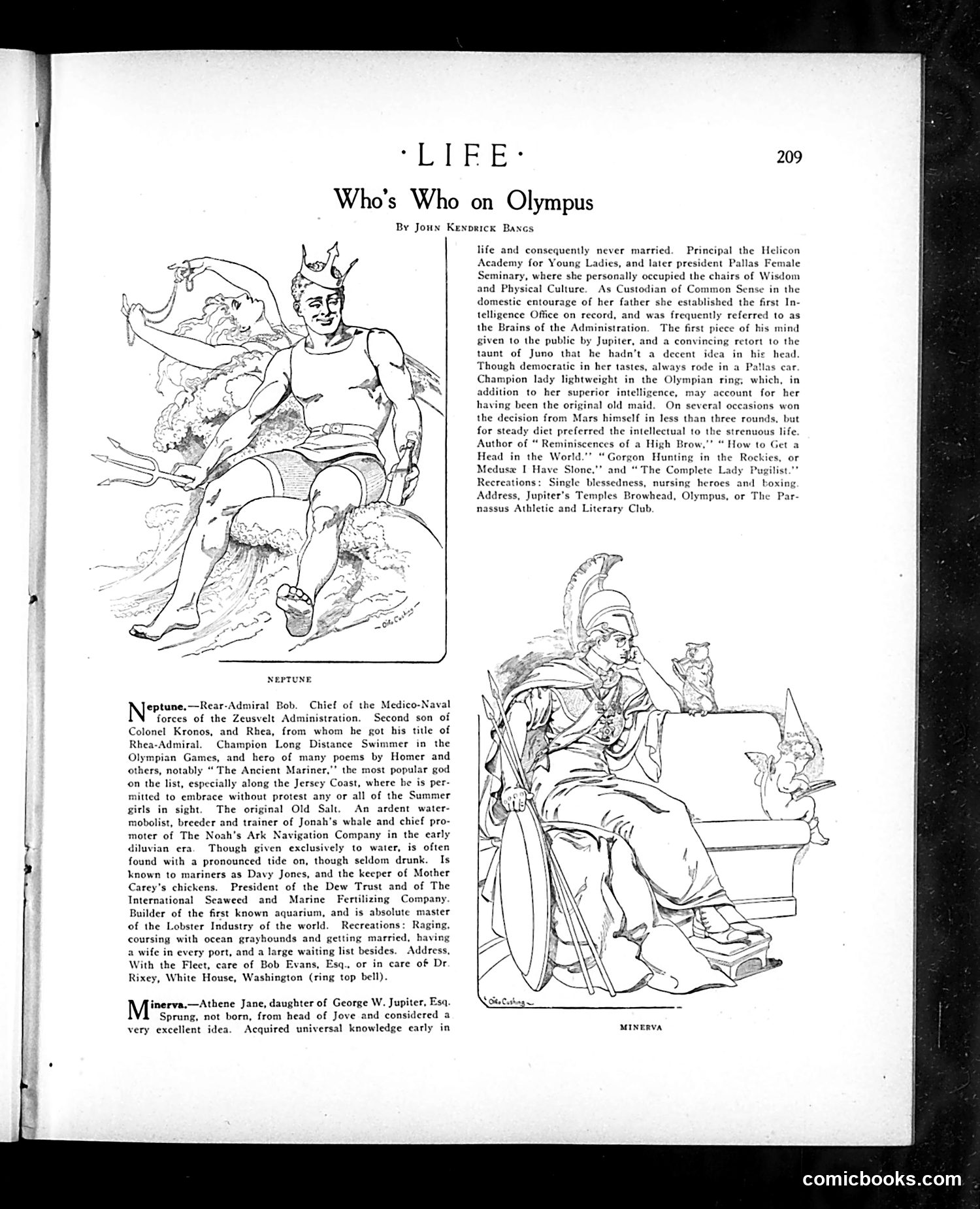
This satirical piece presents contemporary American figures as Greek gods. The page shows caricatures labeled "Neptune" and "Minerva," reimagining modern personalities as classical deities. **Neptune** is identified as "Rear-Admiral Bob," chief of the Medico-Naval forces, described as a champion swimmer and subject of Homer's poetry. The text humorously credits him with aquatic expertise and various business interests including lobster industries. **Minerva** (goddess of wisdom) is "Athene Jane," daughter of George W. Jupiter, Esq., noted for "universal knowledge early in life." The satire mocks prominent contemporary figures by elevating them to mythological status, likely poking fun at their pretensions or public reputations. This format was typical of *Life* magazine's social commentary.
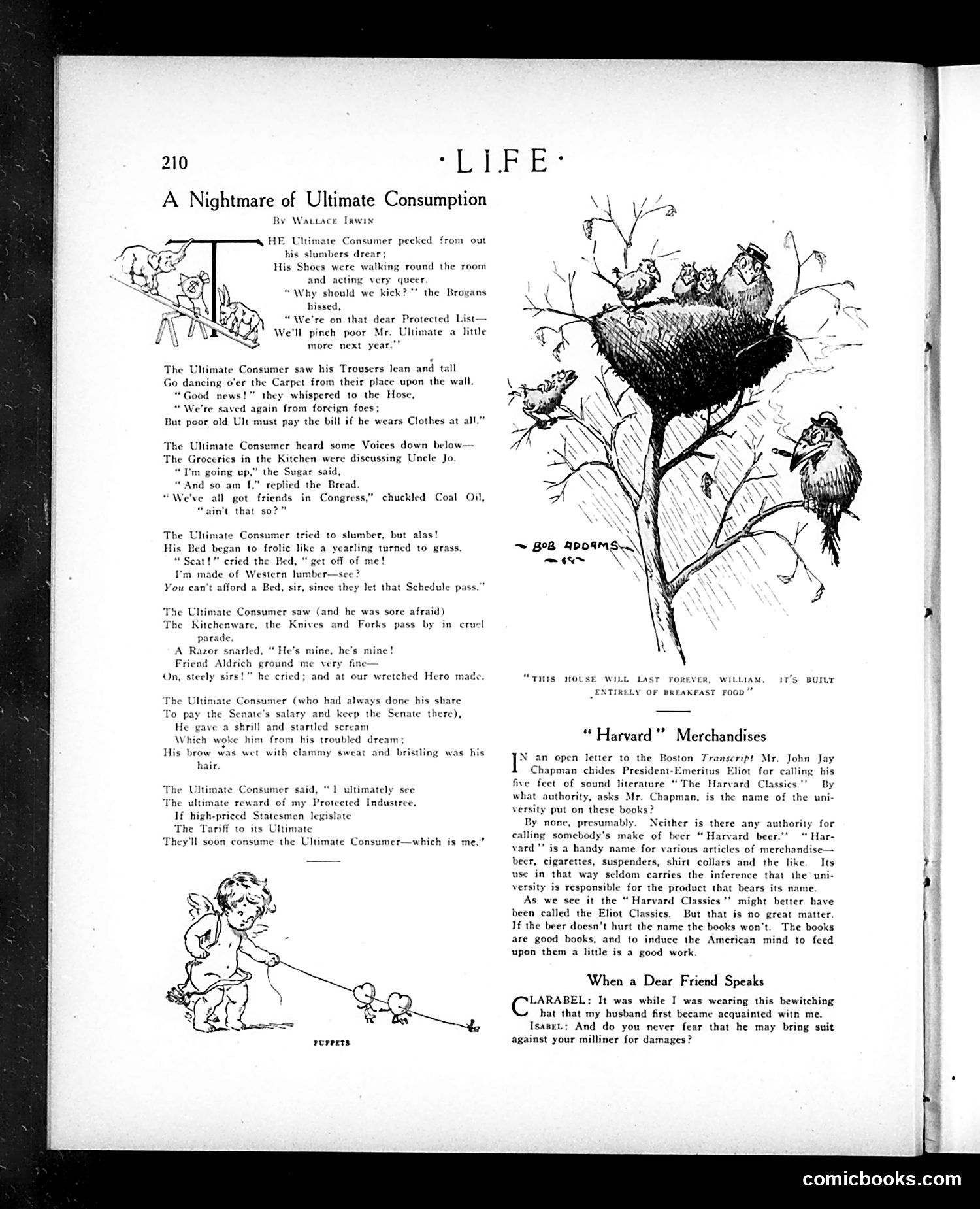
This page contains two distinct satirical pieces: **"A Nightmare of Ultimate Consumption"** (left): A poem satirizing consumer culture and protection of domestic industries. The "Ultimate Consumer" represents an average person overwhelmed by competing commercial interests—grocers, bread makers, coal oil sellers, and kitchenware manufacturers all claiming friendship while actually exploiting him. The satire suggests protectionist tariffs (referenced as "Protected List") ultimately harm the consumer they claim to help, consuming his resources and peace of mind. **"Harvard Merchandises"** (right): Commentary on Harvard University commercializing its name by licensing it to various products (beer, cigarettes, shirt collars). The author questions whether the university bears responsibility for products using its name, suggesting brand-licensing practices of the era lacked clear accountability. The illustrations support these economic/consumer critiques typical of early 20th-century American satire.
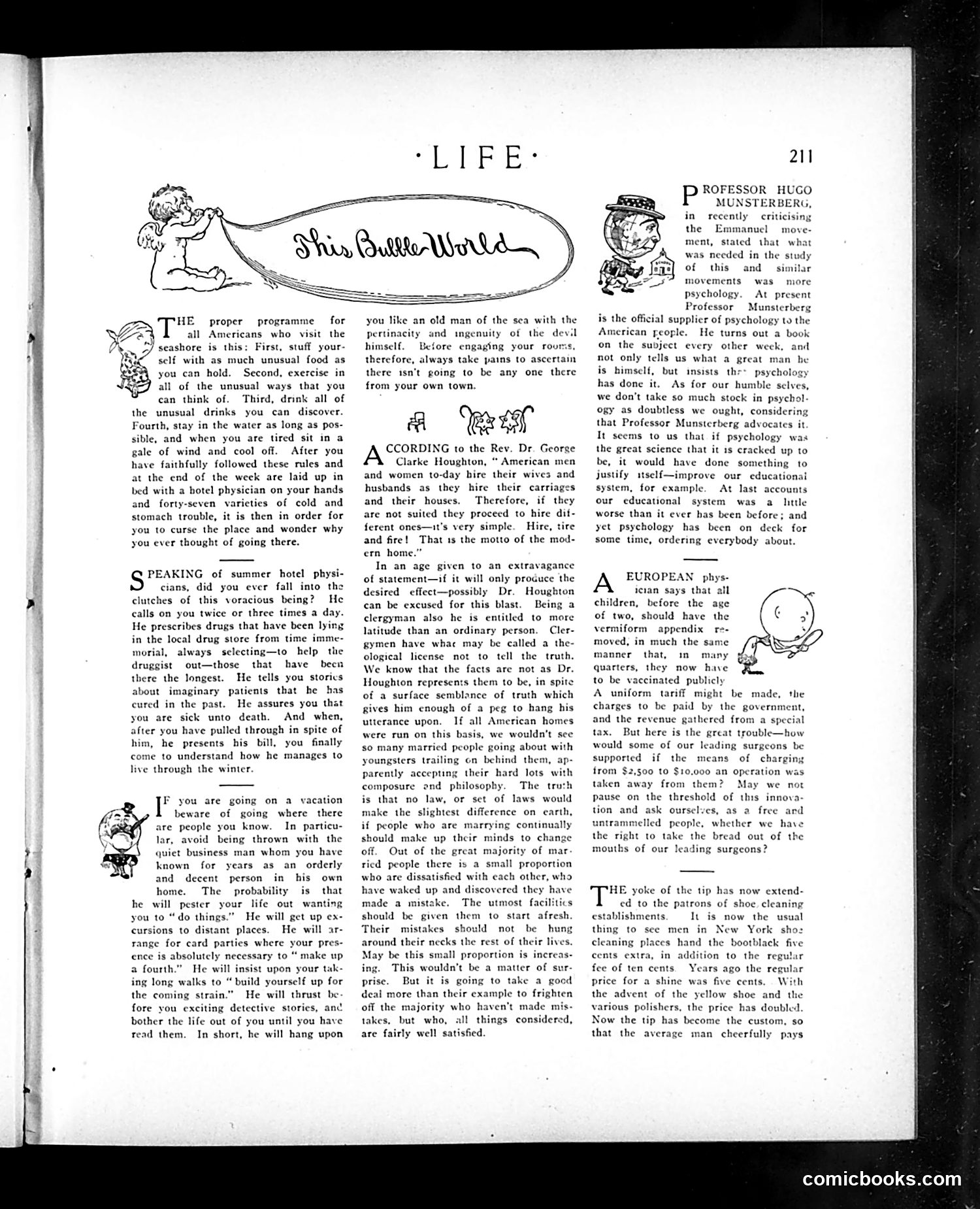
This page contains humorous advice columns rather than political cartoons. The content addresses lifestyle topics for early 20th-century readers: **"This Bubble World"** section offers tongue-in-cheek vacation tips, warning travelers about choosing destinations carefully and packing appropriately. It satirizes the pretentiousness of seaside vacations and the follies of unprepared tourists. Another column discusses hiring practices for household staff, mocking the casual attitudes of "modern homes" where employers and domestic workers alike lack professionalism. The humor targets class attitudes of the era. A final piece discusses European physicians' vaccination recommendations for children, critiquing American resistance to preventive medicine. The small illustrations are decorative rather than satirical political commentary. The overall tone is gently mocking of contemporary social conventions and behaviors rather than sharp political satire.
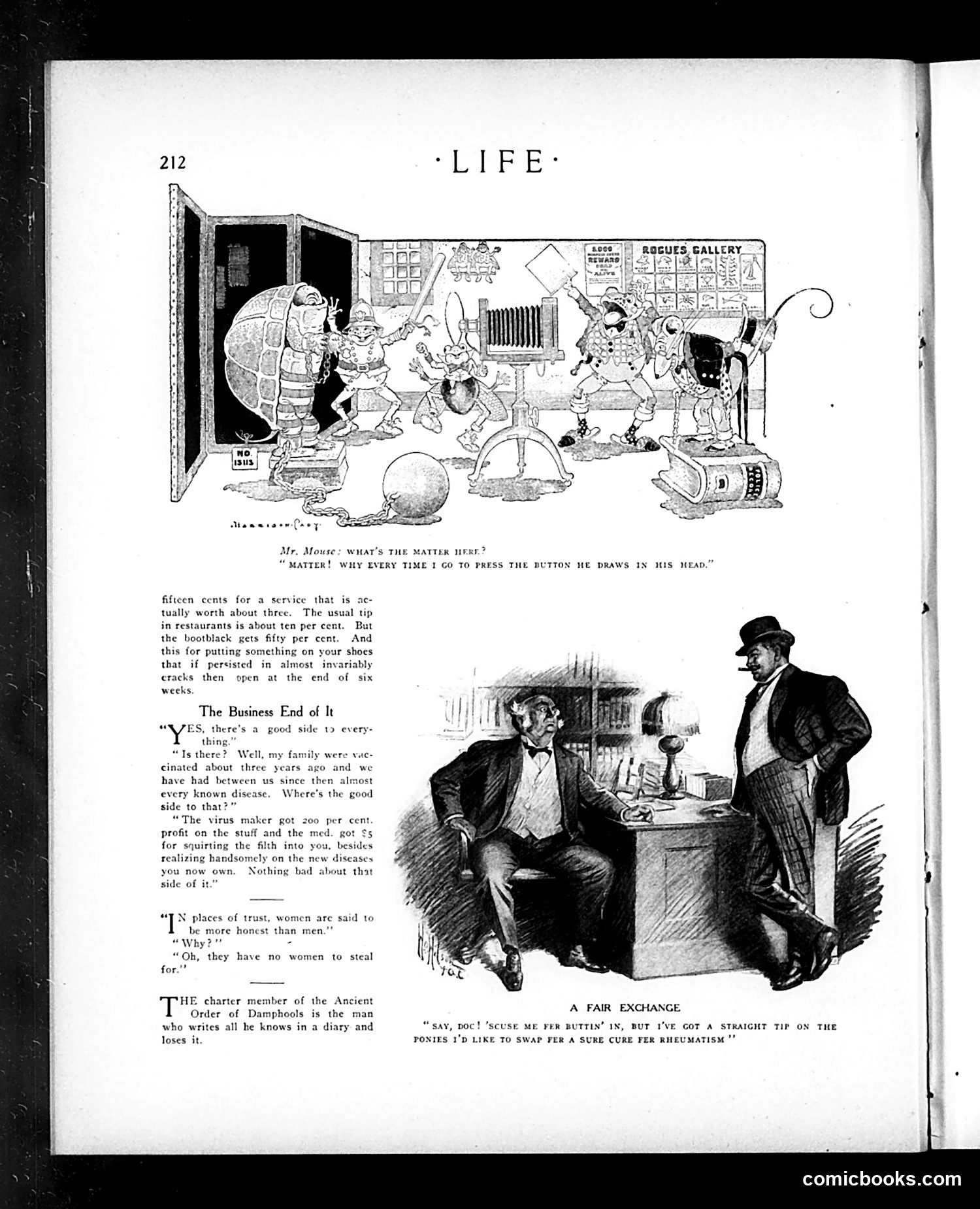
**Top Cartoon:** A chaotic scene depicting what appears to be a laboratory or inventor's workshop. A mouse-like character questions "What's the matter here?" and receives the reply: "Matter! Why every time I go to press the button he draws in his head." This satirizes the unpredictable nature of mechanical or automated systems—possibly mocking early 20th-century gadgetry and its failures. **Bottom Cartoon:** Two men discuss "A Fair Exchange." One proposes trading a "sure cure for rheumatism" for a "straight tip on the ponies" (horse racing). This satirizes common folk remedies and the prevalence of gambling advice, reflecting period anxieties about dubious medical claims and gambling culture among working-class men.
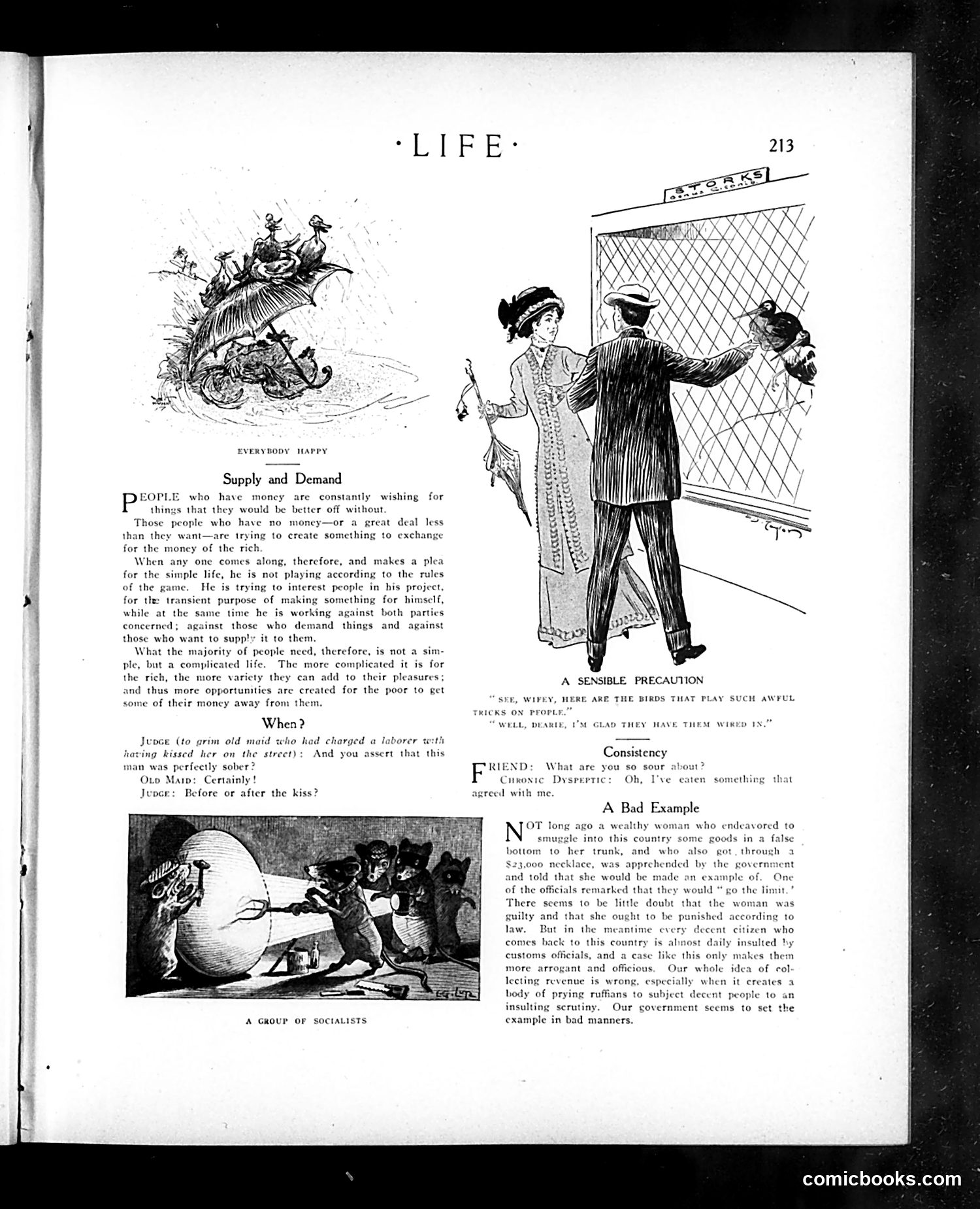
This page contains satirical commentary on economic inequality and government corruption from the early 20th century. **"Supply and Demand"** discusses people seeking wealth redistribution—a reference to socialist or populist movements of the era. **"A Sensible Precaution"** cartoon shows a man at a market stall blocking a woman's access, captioned with dialogue about "birds that play such awful tricks on people." The satire appears to mock dishonest market practices or fraud. **"A Group of Socialists"** illustration depicts what appears to be caricatured socialist figures engaged in conflict. **"A Bad Example"** text criticizes a wealthy woman who evaded customs duties and received government leniency, arguing this sets a corrupt precedent that encourages ordinary citizens to disrespect laws and officials. The overall theme critiques inequality, corruption, and the perception that wealthy individuals receive preferential treatment from government.
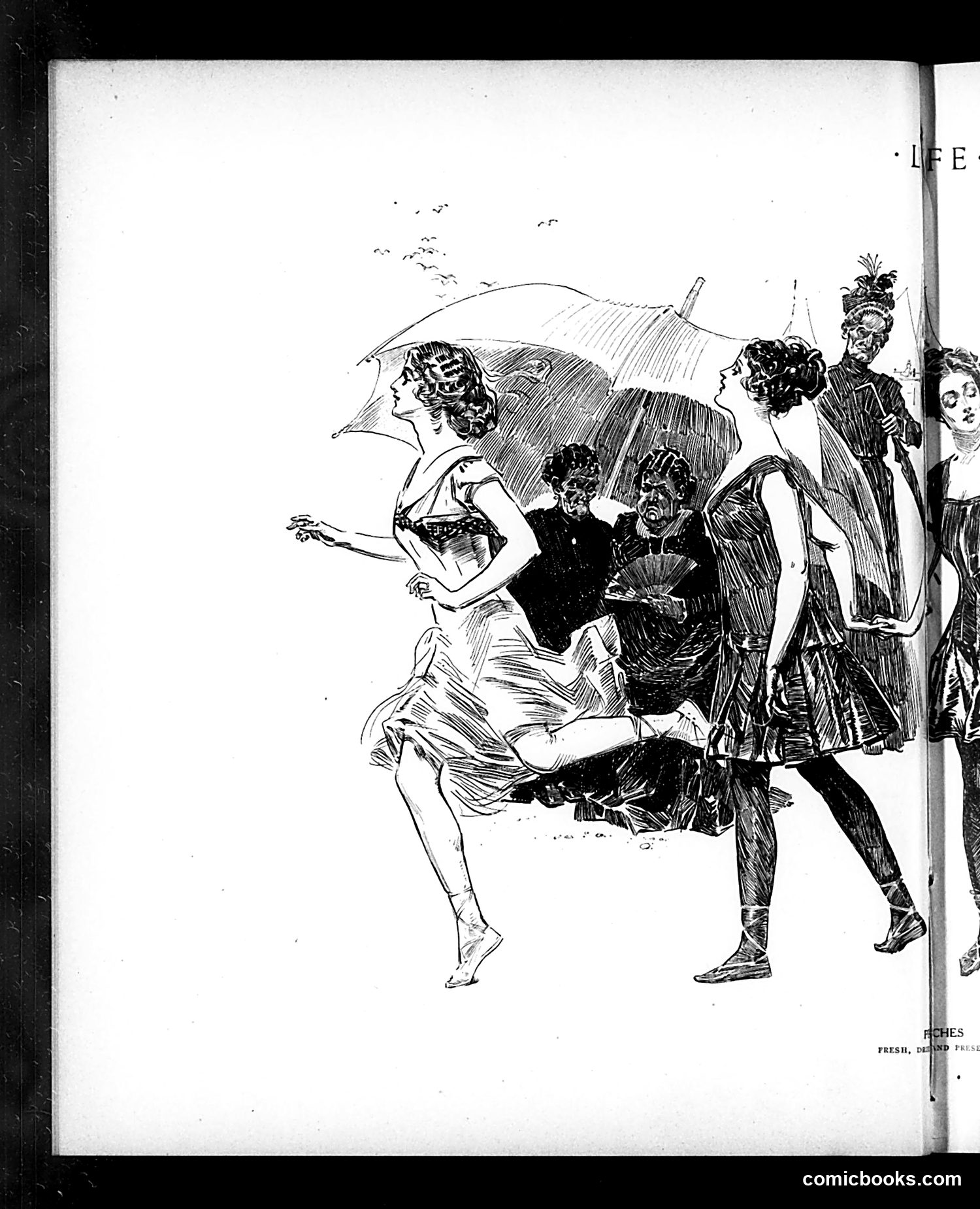
The OCR text is largely illegible, so I'm working primarily from the image. This pen-and-ink illustration depicts a woman dancing in the rain with an umbrella, her dress and leg raised in an exuberant, playful pose. She appears to be enjoying herself despite the weather. In the background, several formally dressed figures (appearing to be from the early 20th century based on their attire and hairstyles) watch with apparent disapproval or concern. The satire likely comments on **social propriety and gender norms**—the woman's uninhibited, joyful behavior in public (particularly her exposed leg and energetic movement) would have been considered scandalous or improper for the era. The observers' reactions suggest disapproval of her disregard for decorum. This reflects Life magazine's frequent satire of changing social attitudes, particularly regarding women's increasing freedom and rejection of Victorian restraint in the early 1900s.
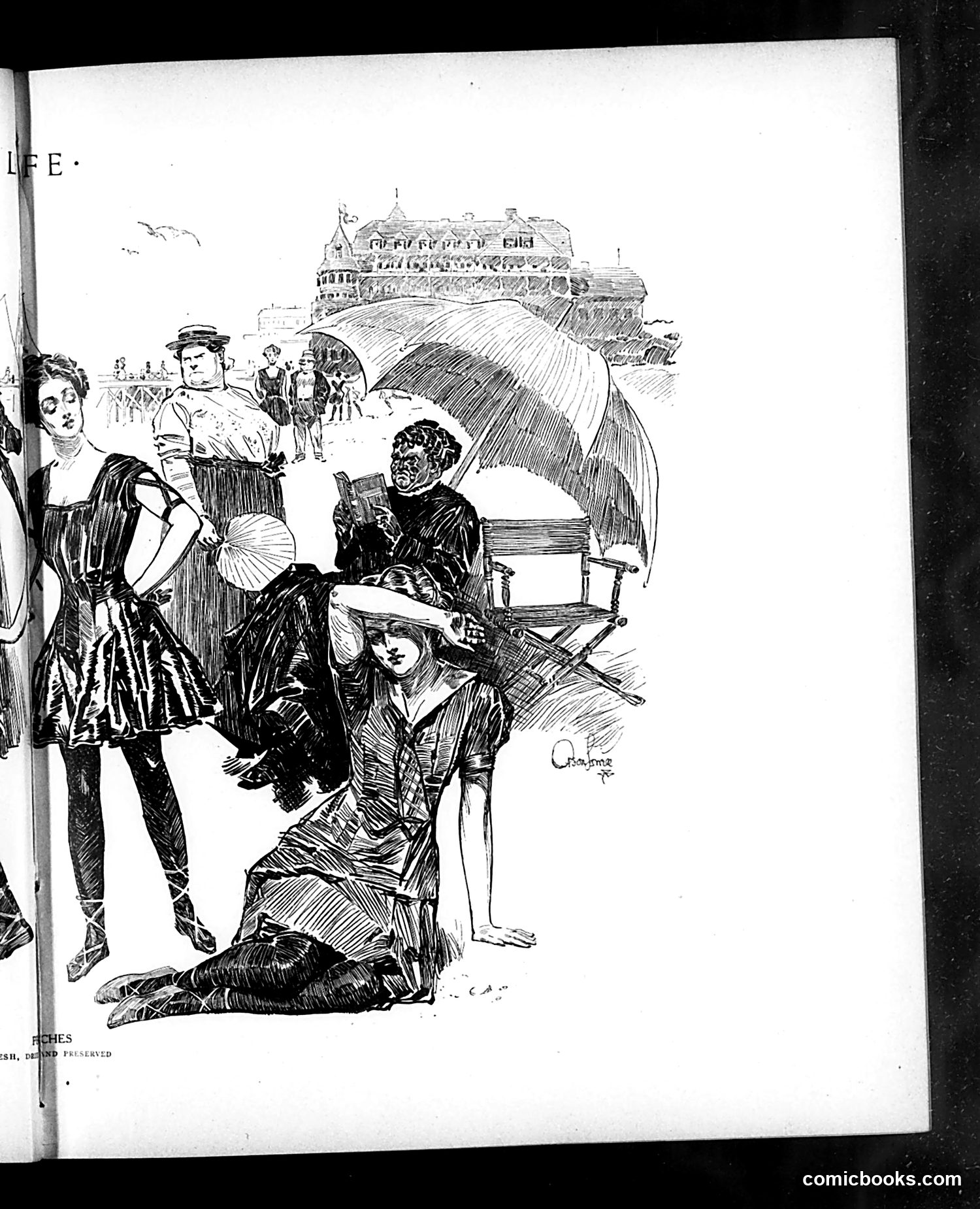
This page from *Life* magazine presents a satirical beach scene, likely from the early 1900s based on the artistic style. The illustration depicts fashionable beachgoers at what appears to be a seaside resort (note the elaborate hotel structure in background). The satire targets **class pretension and social posturing** at leisure destinations. A woman kneels dramatically in the foreground while holding a parasol, seemingly distressed or performing distress. The well-dressed figures around her—including a man in a boater hat and another holding an umbrella—appear indifferent or amused rather than concerned, suggesting mockery of exaggerated emotional displays among the fashionable set. The cartoon satirizes how wealthy beachgoers performed social roles and affected manners, treating public spaces as stages for displaying status rather than genuine relaxation.
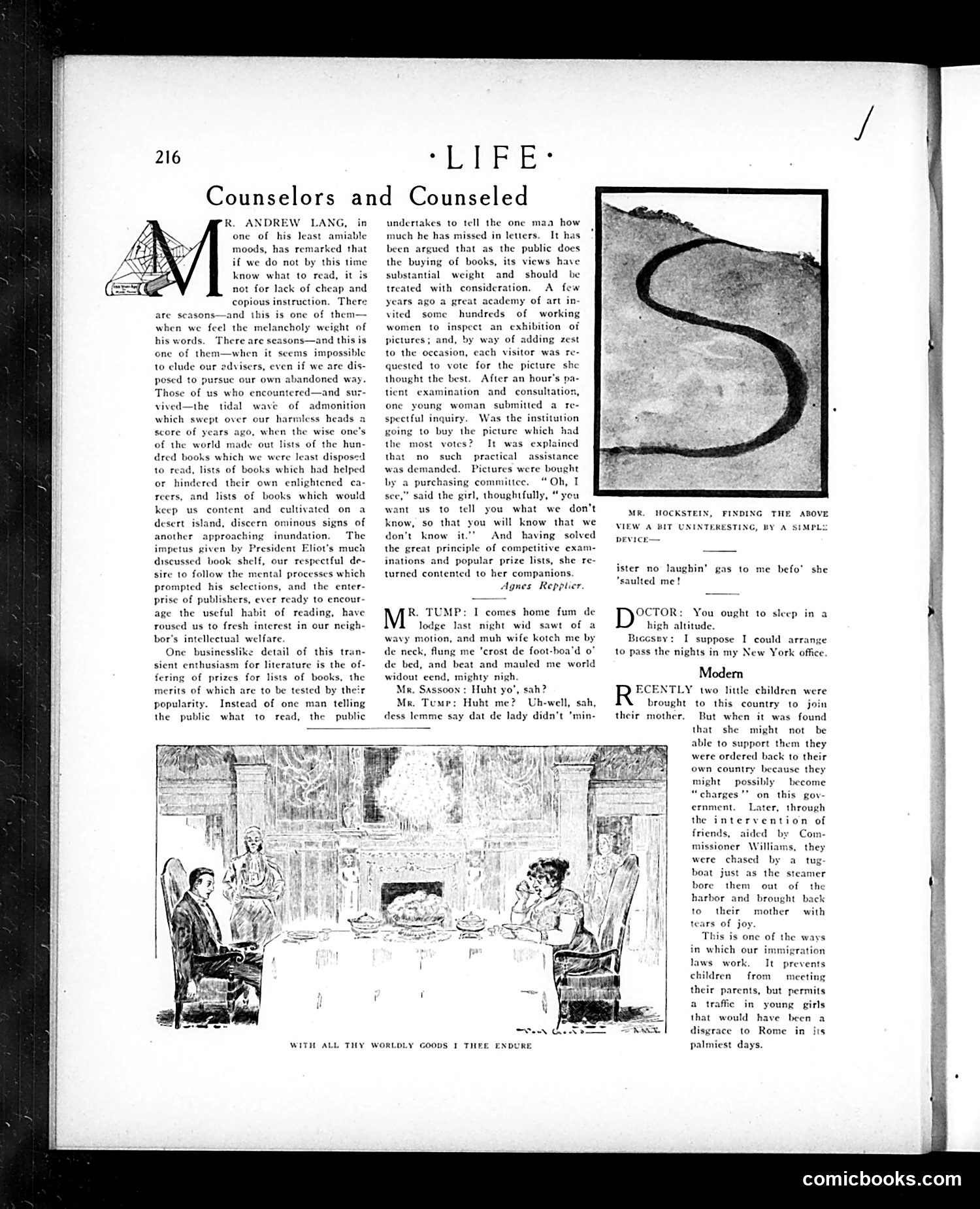
This page contains social commentary and humor pieces typical of early 20th-century Life magazine: **Main Article ("Counselors and Counseled"):** Agnes Repplier critiques the era's obsession with "best books" lists and competitive cultural judgment. She notes President Eliot's famous "Five-Foot Shelf" prompted publishers to offer prizes for popular book selections. Repplier's anecdote about an art academy asking working women to vote on paintings they couldn't afford to buy satirizes the absurdity: institutions ask common people for opinions on matters where their preferences won't be acted upon—"you want us to tell you what we don't know, so that you will know that we don't know it." **Cartoon/Dialogue Pieces:** The lower sections contain dialect humor (appears to be minstrel-style, reflecting period conventions) about domestic discord and a separate piece about immigration policy—children ordered deported but later rescued and reunited with their mother through intervention. The page reflects Gilded Age anxieties about cultural authority, class, and immigration policy.
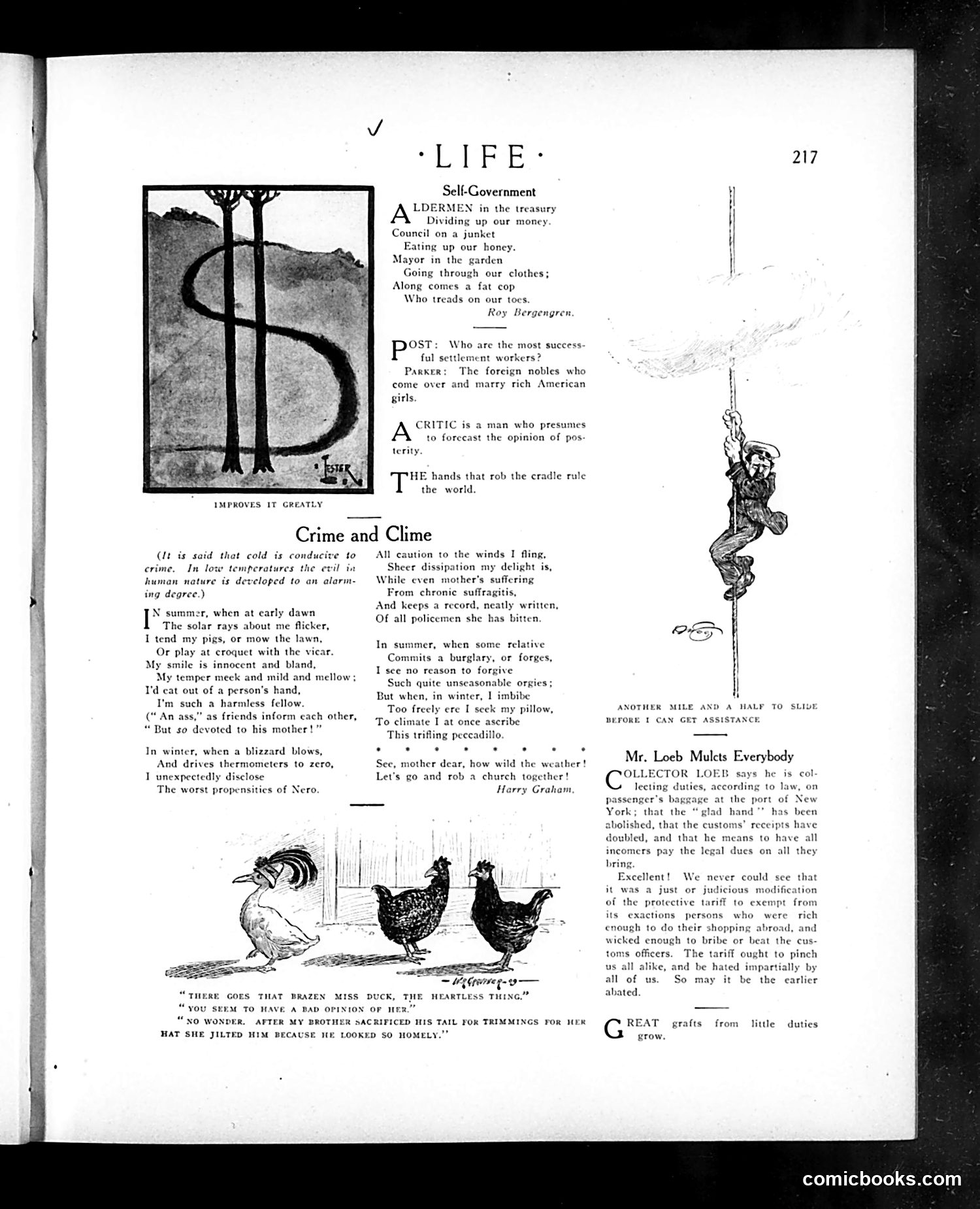
This page contains satirical commentary on corruption and morality in early 20th-century America. **"Self-Government"** mocks local political corruption: aldermen dividing treasury money, councils on junkets, mayors raiding public resources, and police taking bribes ("treads on our toes"). **"Crime and Clime"** is a darkly humorous poem suggesting that winter cold brings out criminal behavior—a man ordinarily harmless becomes violent and lawless in freezing weather, blaming climate rather than accepting responsibility. **The duck cartoon** depicts romantic betrayal: a drake sacrificed his tail feathers for a hen's hat trim, only to be jilted for looking homely. **"Mr. Loeb Mulcts Everybody"** celebrates Collector Loeb's enforcement of customs duties on wealthy travelers' baggage—previously exempt through bribes. The satire applauds ending preferential treatment for the rich, forcing all passengers to pay tariffs equally. The overall theme: exposing petty corruption, human moral weakness, and class-based tax evasion in American society.
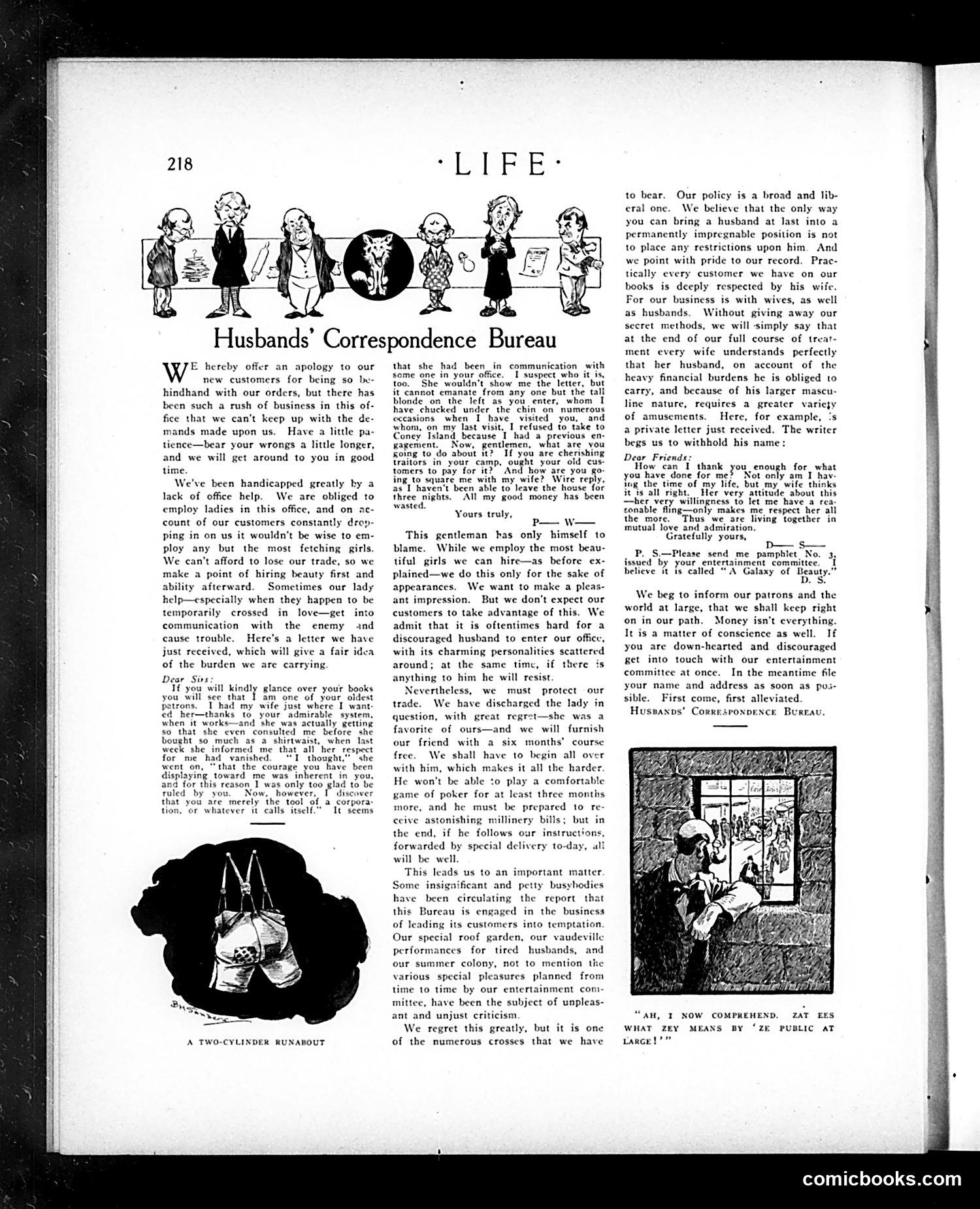
This is a humorous satire on marital discord and turn-of-the-century gender dynamics. The "Bureau" is a fictional service that purportedly helps husbands maintain dominance over wives through correspondence advice. The joke centers on a complaining customer whose wife has regained independence after consulting with an attractive female employee at the Bureau's office. The husband blames the "tall blonde" staffer for encouraging his wife's rebellion—she even refused a trip to Coney Island with him. The Bureau's response reveals the satire's target: they admit hiring beautiful women "for appearances," cynically acknowledging that attractive staff distract customers while claiming this shouldn't be exploited. They've fired the offending employee but warn the husband he'll now face "astonishing millinery bills" and marital discord. The cartoon mocks both husbands' attempts to control wives and the era's paternalistic assumptions about women's proper submissiveness. The illustration shows a two-cylinder car, likely referencing another contemporary marital complaint.
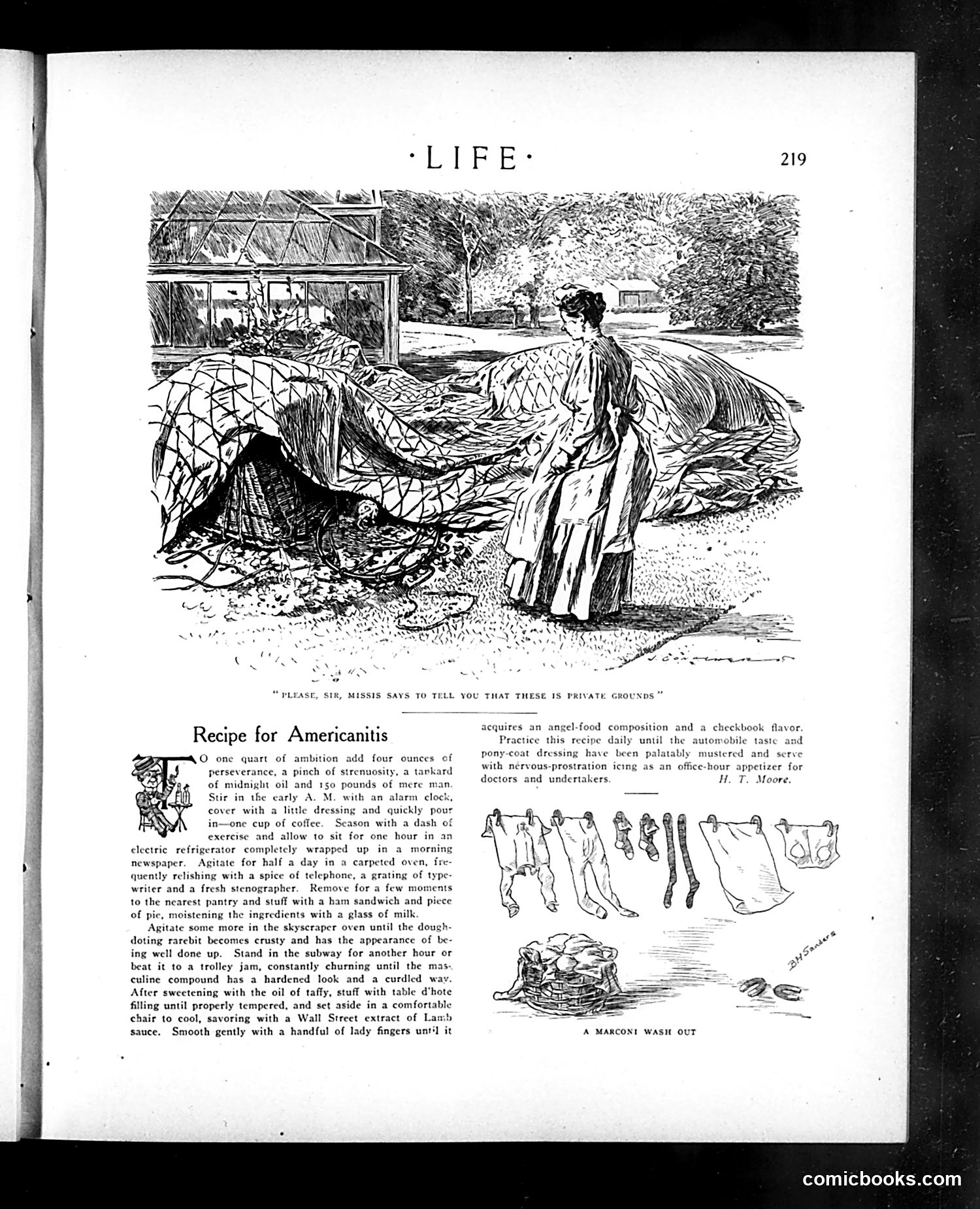
This page from *Life* magazine satirizes American overwork and stress culture through two interconnected pieces: **The Cartoon:** Shows a servant delivering a message about "private grounds" to a well-dressed man hanging laundry. The satire appears to mock the pretensions of the nouveau riche or middle class—people so busy with their ambitious pursuits that they've lost leisure and dignity, reduced to domestic drudgery despite their social aspirations. **"Recipe for Americanitis":** A mock recipe by H.T. Moore that equates the American pursuit of success with a disease. The "ingredients" (ambition, perseverance, midnight oil, coffee, exercise, telephones, stenographers) are stirred together in "carpeted ovens" and "subway" conditions, producing a hardened, stressed result. The satire critiques the relentless work ethic, constant stimulation (telephones, typewriters), and nervous exhaustion that define American business culture. The term "Americanitis" suggests this frantic lifestyle is distinctly American—a cultural pathology created by unchecked ambition and mechanized modern life.
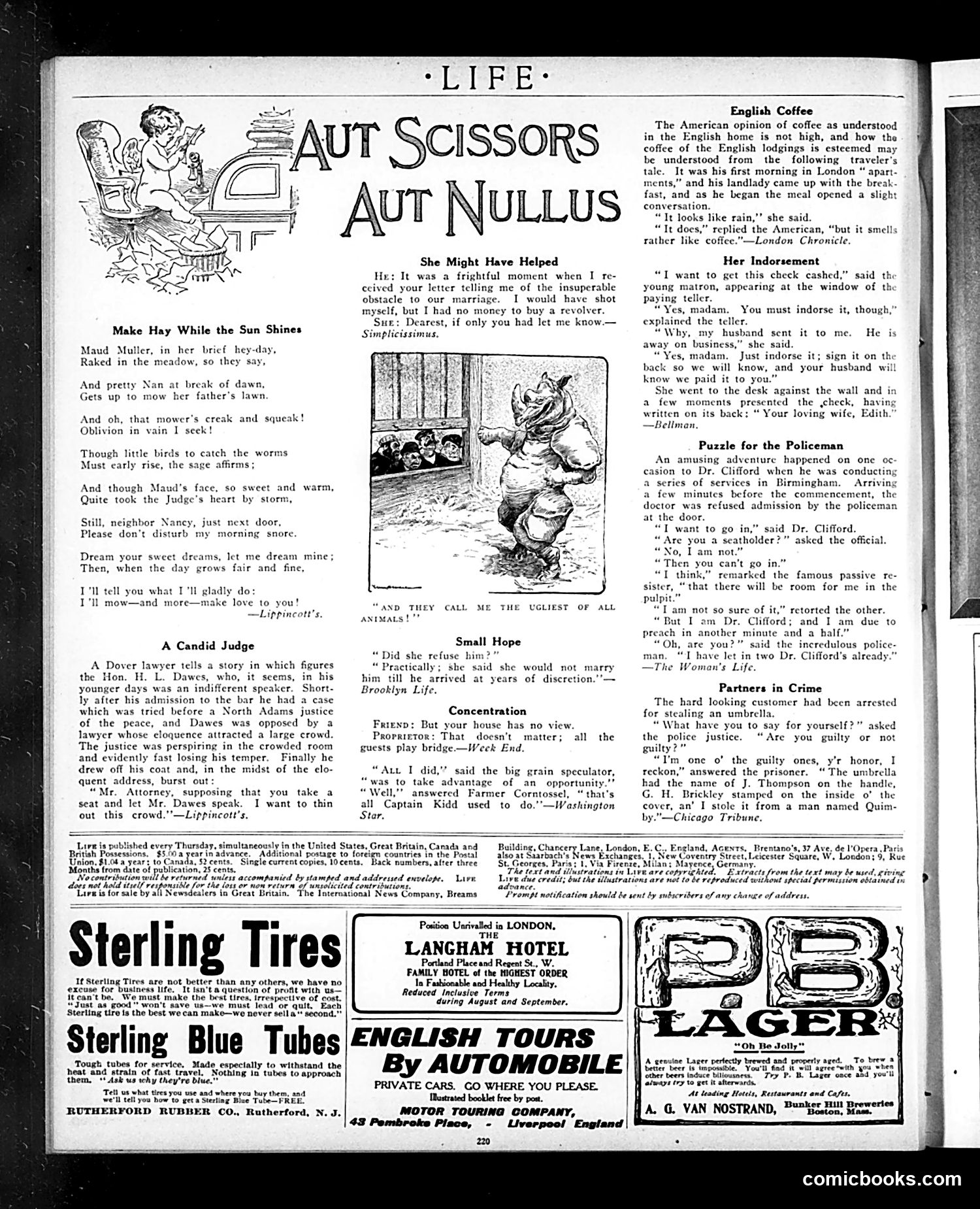
This page contains several humorous anecdotes and light satirical pieces typical of Life's early format: **"Make Hay While the Sun Shines"** is a poem mocking the cliché "early bird" wisdom, with a narrator annoyed by neighbors Maud Muller and Nan doing farm work at dawn. **"A Candid Judge"** recounts a story where an impatient judge, frustrated by an eloquent opposing lawyer, demands the other attorney (Dawes) be allowed to speak simply to clear the crowded courtroom—suggesting incompetence is preferable to tedious eloquence. **Other brief anecdotes** satirize: romantic desperation, deflated expectations in relationships, and social absurdities (a policeman refusing entry to Dr. Clifford, who appears to be a notable preacher). **"English Coffee"** mocks English hospitality—an American visitor comparing the taste to rain. The humor targets Victorian social conventions, gender roles, small-town justice, and Anglo-American cultural differences. The page is primarily humorous commentary rather than political satire.
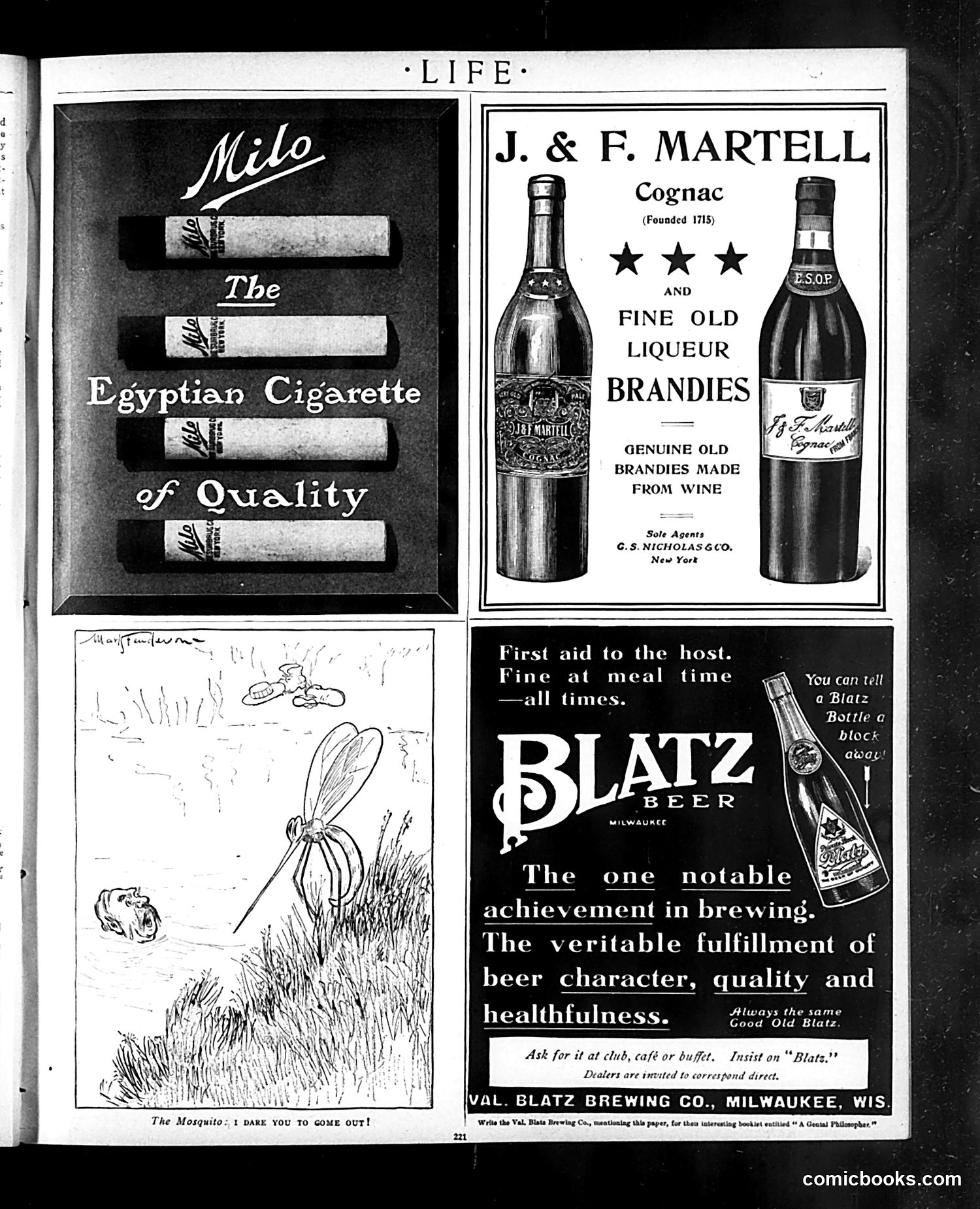
This page is primarily **advertising content** rather than political satire. It contains three commercial advertisements: 1. **Milo Cigarettes** (top left): An Egyptian cigarette brand emphasizing quality, shown with illustrated cigarettes. 2. **J. & F. Martell Cognac** (top right): Featuring two bottles of brandy and cognac, founded 1715, sold through G.S. Nicholas & Co. in New York. 3. **Blatz Beer** (bottom right): Milwaukee-based brewery advertising beer as "first aid to the host" and claiming brewing excellence. The only cartoon element is a **small humorous illustration** (bottom left) captioned "The Mosquito: I dare you to come out!" depicting an insect confrontation—likely a lighthearted filler rather than political commentary. The page represents typical early 20th-century *Life* magazine advertising, mixing product promotion with occasional comic relief. No political figures or social satire are evident.
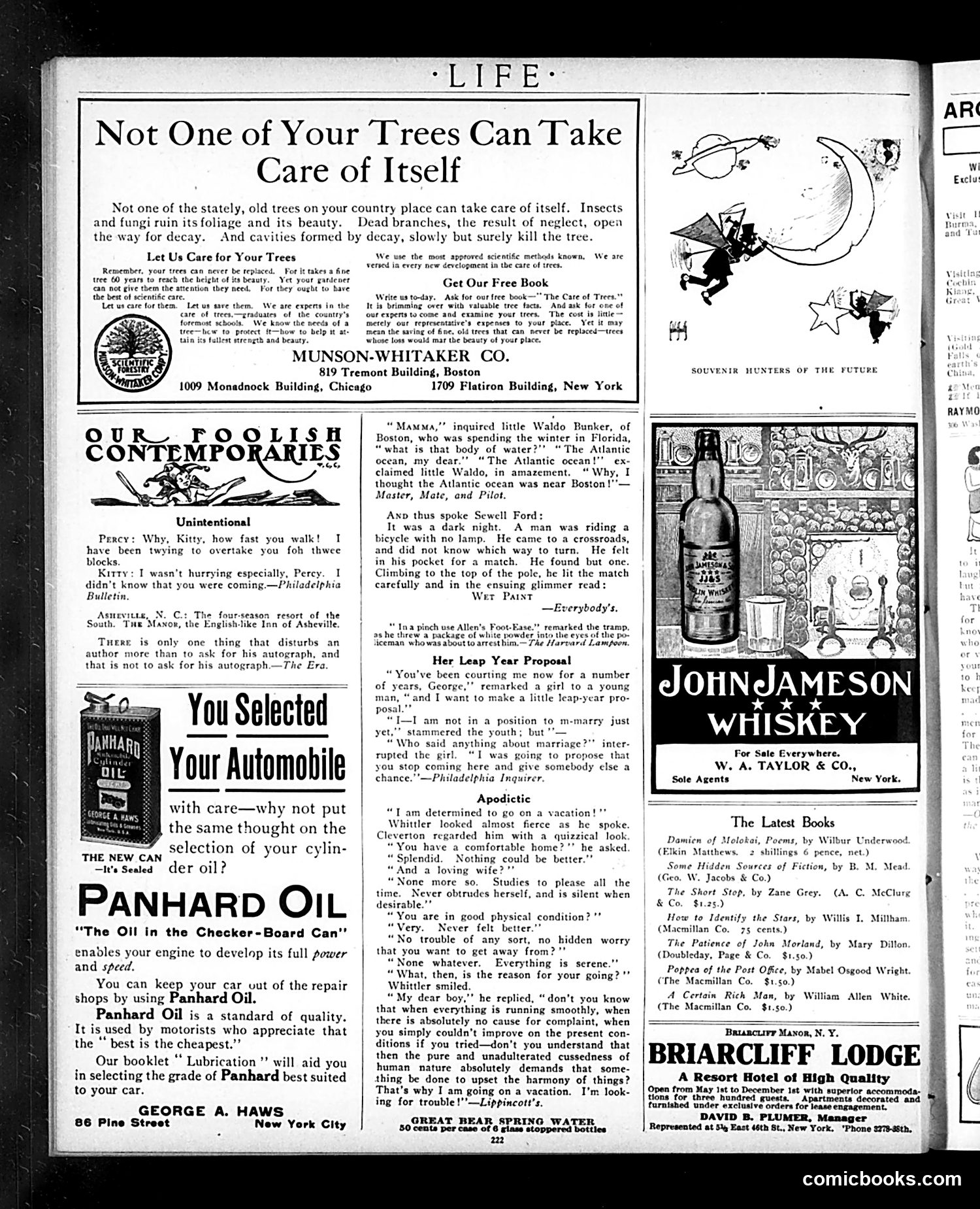
This page primarily contains **advertisements and light humor pieces** rather than political cartoons. The main content includes: **"Souvenir Hunters of the Future"** (top right): A whimsical illustration showing cherub-like figures riding on a crescent moon and star, likely satirizing sentimental Edwardian aesthetics popular at the time. **"Our Foolish Contemporaries"** section: Brief anecdotes mocking everyday absurdities—a child's geographical confusion about the Atlantic Ocean, a man without a bicycle lamp, and a miscommunication about a leap-year proposal. These represent gentle social satire typical of Life's humor. **Advertisements dominate**: Panhard Oil, John Jameson Whiskey, and Munson-Whitaker tree care services occupy significant space. The page reflects early 20th-century concerns (tree preservation, automobile maintenance) mixed with light domestic comedy. There's no evident political satire—the humor targets minor social follies and commercial pitches rather than major political figures or events.
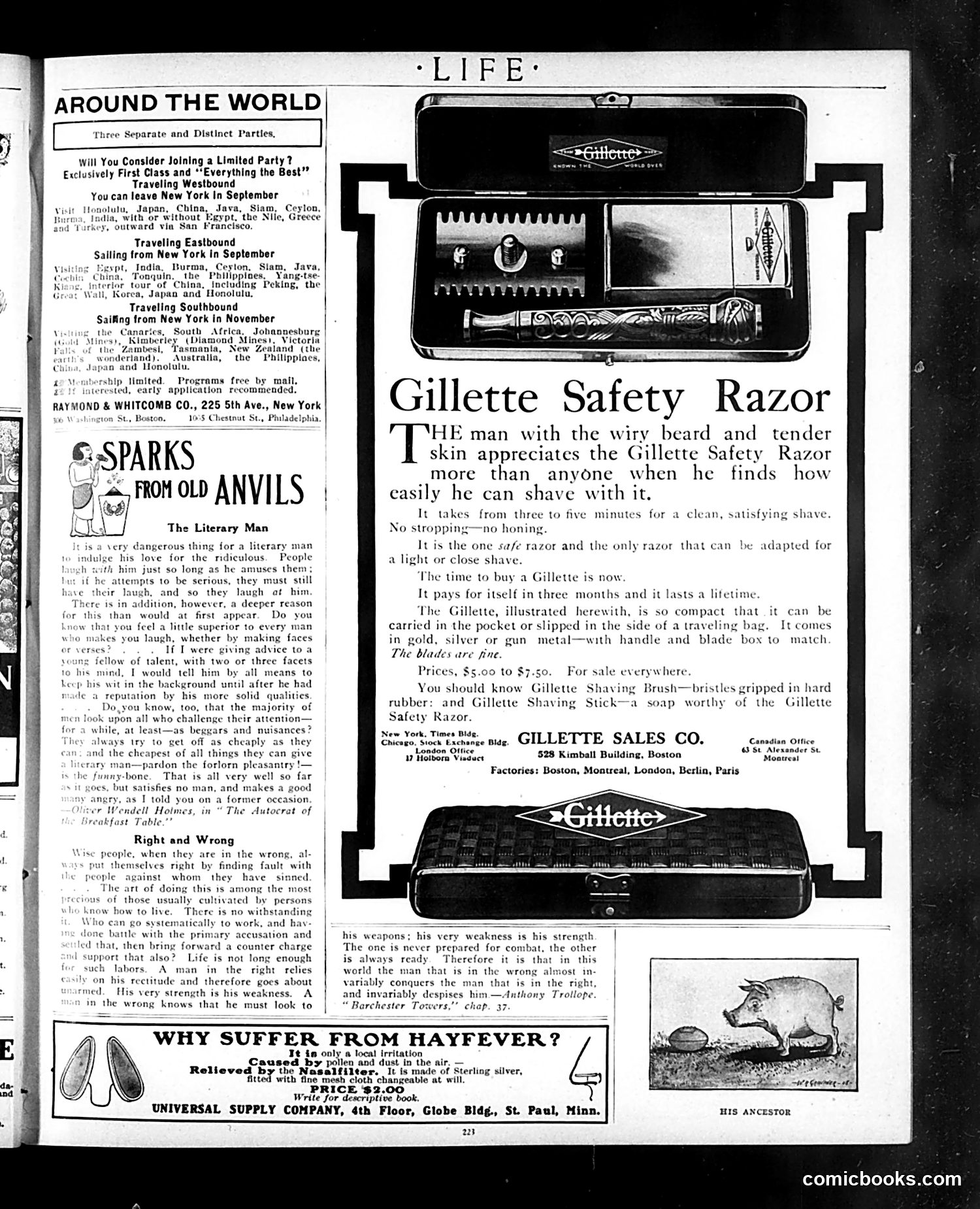
This is primarily an **advertising page** from Life magazine, dominated by a large Gillette Safety Razor advertisement. The ad targets men with "wiry beard and tender skin," emphasizing the razor's convenience—it takes only 3-5 minutes, requires no stropping, and lasts a lifetime. The pricing ($5-7.50) and portability appeal to the traveling businessman. The page also includes travel advertisements (Raymond & Whitcomb tours), a brief satirical essay titled "Sparks from Old Anvils" about why literary men are dangerous (they amuse people but aren't taken seriously), and a moralistic piece about "Right and Wrong" using an Anthony Trollope quote. At the bottom is an unrelated ad for a hayfever remedy. **For modern readers**: This represents early 20th-century *Life* as a lifestyle and humor magazine mixing editorial content with luxury advertising aimed at affluent readers. The Gillette ad is notable as an early example of modern consumer marketing emphasizing convenience and status.
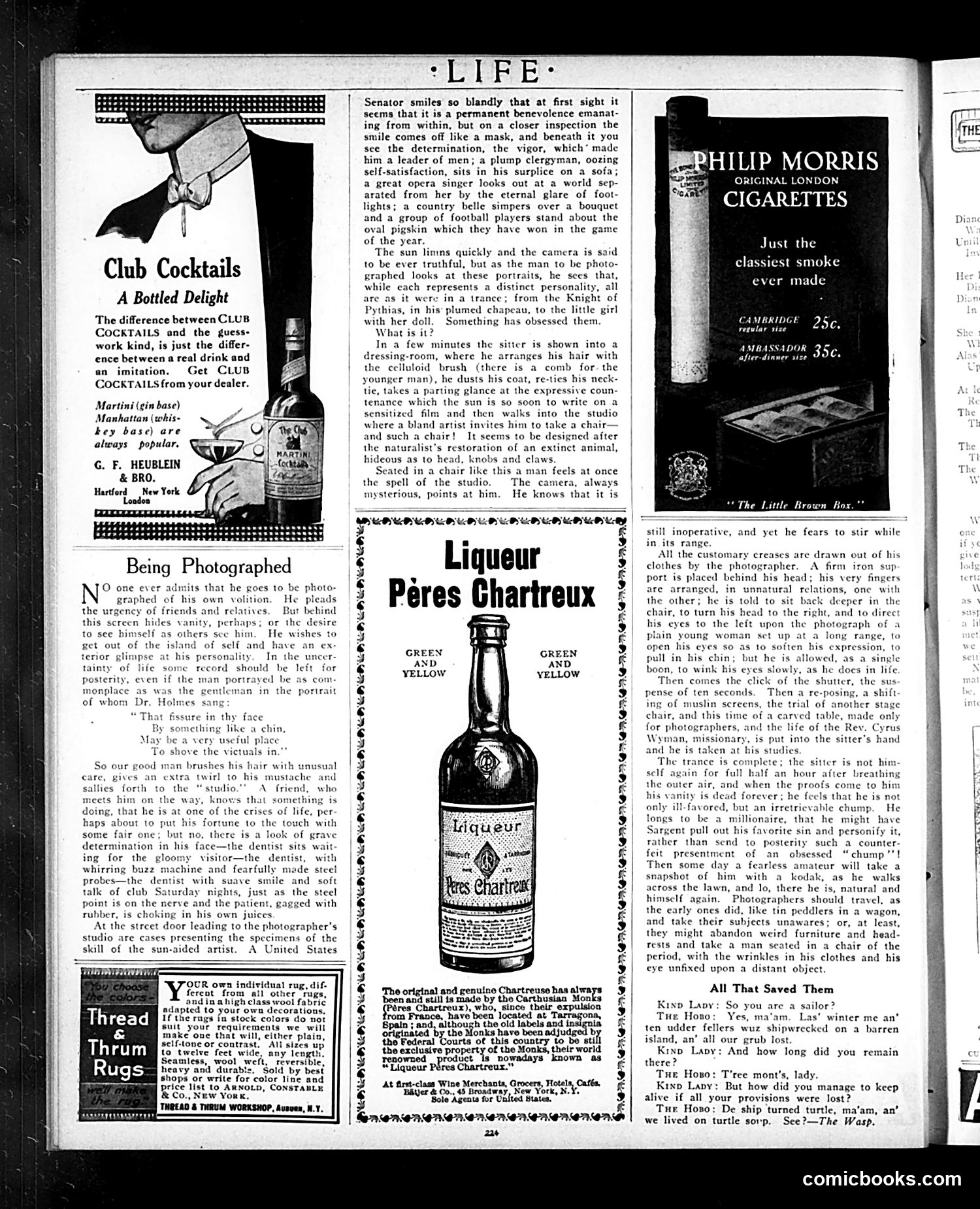
This page is primarily **advertising and satirical commentary** rather than political cartooning. The main content is an extended humorous essay titled "Being Photographed," satirizing the vanity and awkwardness of sitting for portrait photographs. The satire targets **middle-class social types**: a pompous senator whose smile is revealed as a mask hiding ambition, a self-satisfied clergyman, a vain opera singer, country girls, and athletes. The piece mocks how people present false versions of themselves before the camera, yet appear entranced or possessed once photographed. The humor derives from the **gap between vanity and reality**—people deny wanting photographs while carefully grooming themselves, and the supposedly "truthful" camera somehow captures something artificial in everyone. The page also features period **advertisements** for Club Cocktails, Heublein spirits, Philip Morris cigarettes, Liqueur Pères Chartreux, and Thread & Thrum Rugs—typical early 20th-century consumer goods marketing.
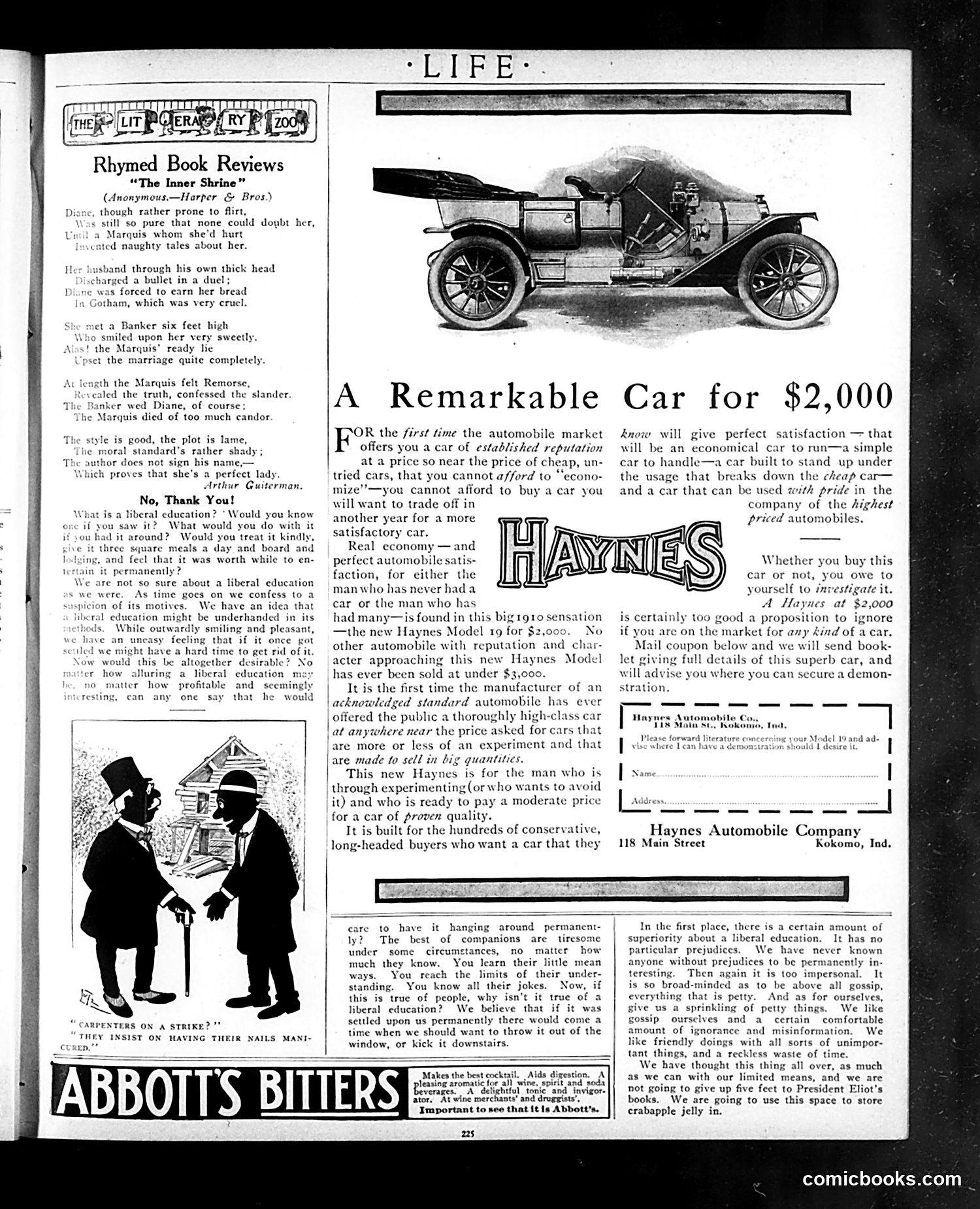
This page mixes literary satire with advertising. The "Rhymed Book Reviews" section mocks an anonymous novel called "The Inner Shrine," critiquing both its melodramatic plot (woman wrongly slandered, banker rescues her) and its "rather shady" moral standard. The reviewer, Arthur Guiterman, notes the author's anonymity itself suggests shame—"Which proves that she's a perfect lady." Below that, an essay questions what "liberal education" means, sarcastically suggesting educated people become burdensome and hard to "get rid of"—poking fun at pretentious intellectualism. The main content is a **Haynes automobile advertisement** claiming to offer a $2,000 "established" car at cheap-car prices. It targets conservative buyers wanting proven quality without experimentation. A cartoon titled "Carpenters on a Strike" (lower left) shows two working-class men; the caption jokes they "insist on having their nails manicured"—sarcastic commentary on labor demands. The page reflects early 1910s American attitudes: skepticism toward "artistic" anonymous literature, anti-intellectual humor, and marketing automobiles as status symbols for the cautious middle class.
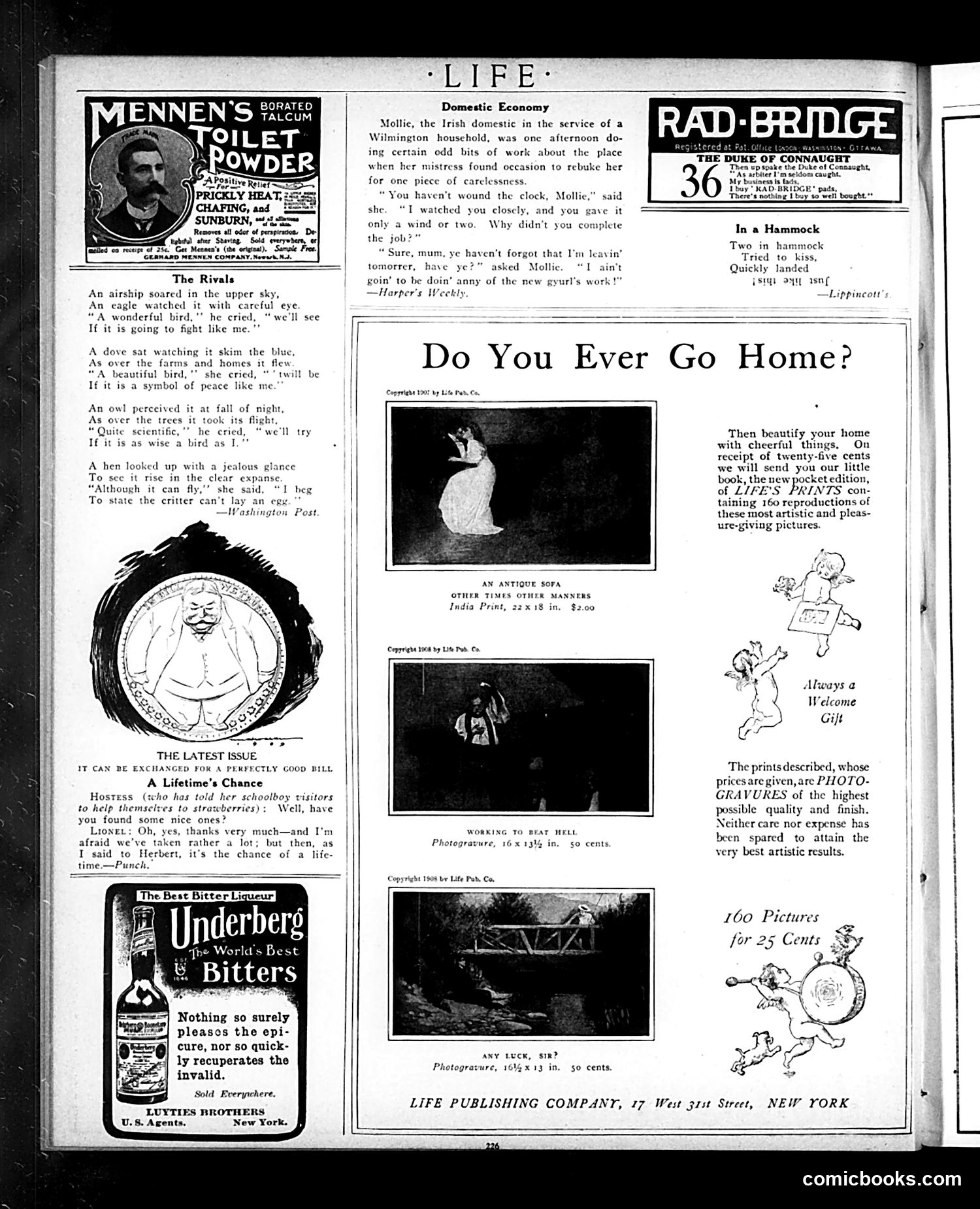
This page contains three distinct satirical pieces: **"The Rivals"** (poem with circular illustration): Animals observe an airship and each interprets it through their own nature—the eagle sees a fighter, the dove a peacemaker, the owl a scientist, the hen a rival. This satirizes how people project their own values and anxieties onto new technologies. The airship, a novel invention of the era, becomes a mirror reflecting each observer's worldview. **"Domestic Economy"** (brief anecdote): An Irish servant named Mollie refuses to wind the clock before leaving her job, saying she won't do "the new gyurl's work." This mocks the pettiness of domestic staff disputes and class tensions in early 1900s households. **"Do You Ever Go Home?"** (advertisement): Life Publishing promotes its photogravure prints as home decoration, suggesting beautifying one's home affirms respectability—a middle-class aspiration of the period. The page also contains period advertisements (Mennen's talcum powder, Underberg bitters) typical of *Life* magazine's commercial support.
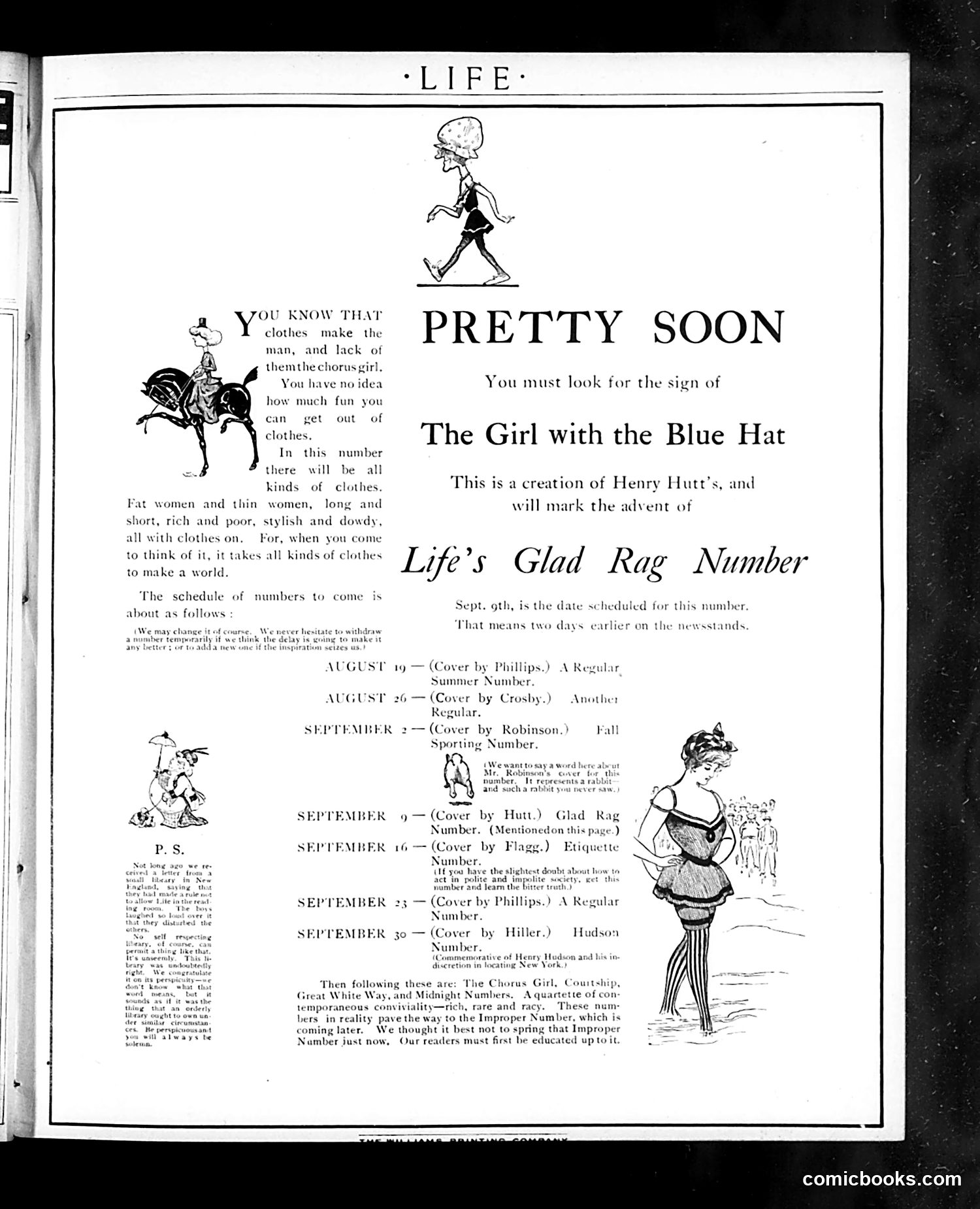
This is primarily an **announcement/promotional page** rather than a political cartoon. It advertises upcoming issues of Life magazine, specifically promoting the "Glad Rag Number" scheduled for September 9th. The page announces a series of themed issues featuring different cover artists (Phillips, Crosby, Robinson, Flagg, Hiller). The central feature—"The Girl with the Blue Hat"—is a character creation by illustrator Henry Hutt that will anchor this fashion-focused issue. The satirical content is mild: the opening text humorously notes that clothes define social status and character ("Fat women and thin women, long and short, rich and poor"), suggesting that fashion enables people to present themselves however they wish. The page jokes about planning an "Improper Number" for later, noting readers must first be "educated up to it"—gentle satire on magazine content progression. This reflects early 20th-century Life's focus on fashion, social satire, and illustrated entertainment rather than hard news.