
Life, 1909-08-12 · page 2 of 28
Life — August 12, 1909 — page 2: what you’re looking at
What you’re looking at
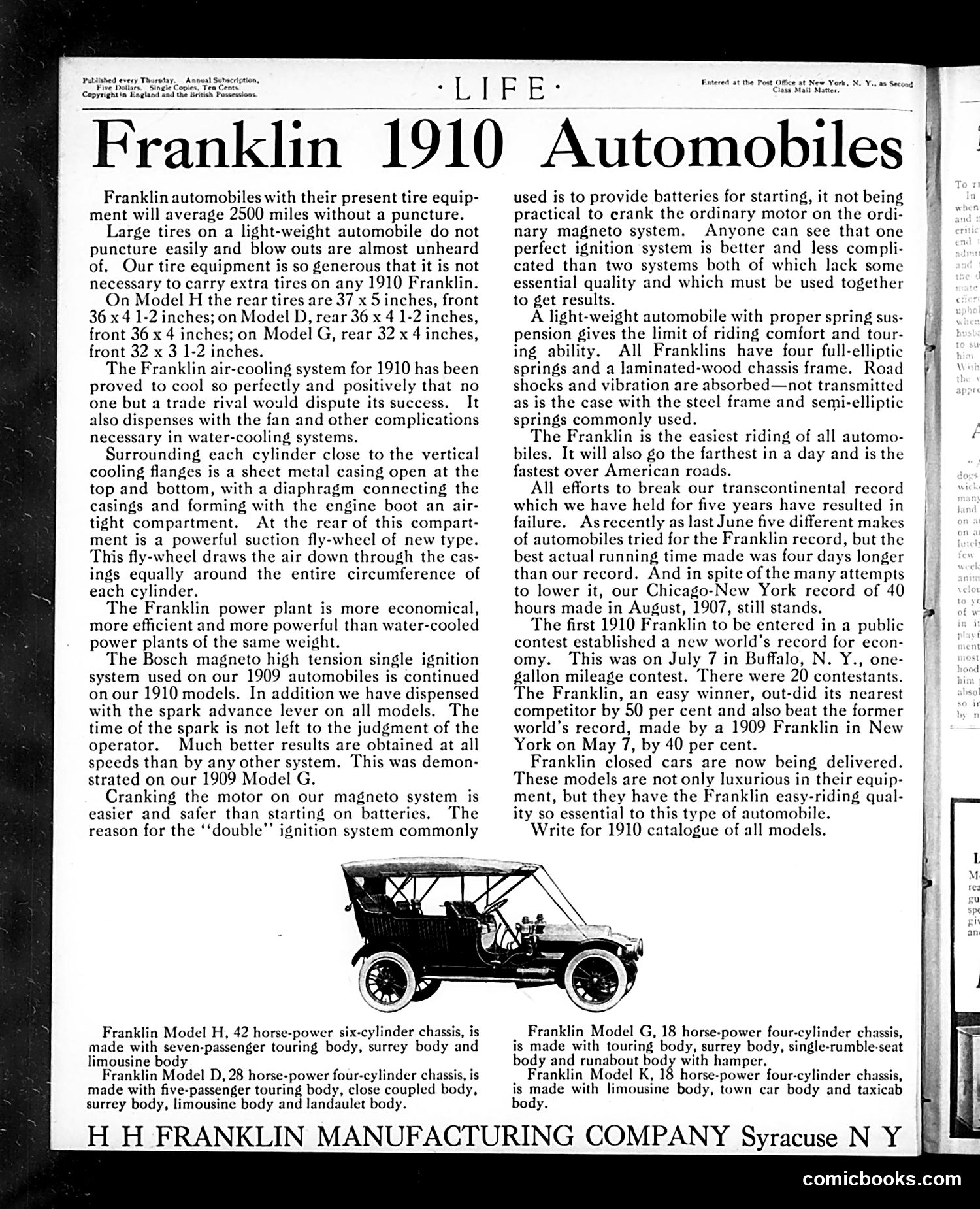
This page is **primarily an advertisement**, not political satire. It promotes Franklin automobiles to *Life* magazine's readers. The text emphasizes Franklin's technical innovations: air-cooling (rather than water), magneto ignition, light weight, and elliptic springs. There's a small illustration of a Franklin touring car. The ad highlights competitive achievements, including a recent transcontinental speed record and a July 1910 Buffalo economy contest where a Franklin outperformed 19 competitors by 50%. The bottom specifies three Franklin models: the Model H (42 horsepower, six-cylinder), Model D (28 horsepower, four-cylinder), and Model G and K variants. This represents early automotive advertising targeting affluent *Life* readers interested in emerging automobile technology.
📄 Transcribed text from this page (OCR, searchable)
Machine-transcribed from the original scan — historical spelling and the odd misread are preserved.
Published every Tharsay. Annual Sctucristion, Five Dollars, “Single Copies. Tea Cente Copyrightin England sed the British Possessions eRAES Franklin 1910 Automobiles Franklin automobiles with their present tire equip- ment will average 2500 miles without a puncture. Large tires on a light-weight automobile do not puncture easily and blow outs are almost unheard of. Our tire equipment is so generous that it is not necessary to carry extra tires on any 1910 Franklin. On Model H the rear tires are 37 x 5 inches, front 36 x 4 1-2 inches; on Model D, rear 36 x 4 1-2 inches, front 36 x 4 inches; on Model G, rear 32 x 4 inches, front 32 x 3 1-2 inches. The Franklin air-cooling system for 1910 has been proved to cool so perfectly and positively that no one but a trade rival would dispute its success. It also dispenses with the fan and other complications necessary in water-cooling systems. Surrounding each cylinder close to the vertical cooling flanges is a sheet metal casing open at the top and bottom, with a diaphragm connecting the casings and forming with the engine boot an air- tight compartment. At the rear of this compart- ment is a powerful suction fly-wheel of new type. This fly-wheel draws the air down through the cas- ings equally around the entire circumference of each cylinder. The Franklin power plant is more economical, more efficient and more powerful than water-cooled power plants of the same weight. The Bosch magneto high tension single ignition system used on our 1909 automobiles is continued onour 1910 models. In addition we have dispensed with the spark advance lever on all models. The time of the spark is not left to the judgment of the operator. Much better results are obtained at all speeds than by any other system. This was demon- strated on our 1909 Model G. Cranking the motor on our magneto system is easier and safer than starting on batteries. The reason for the ‘‘double”’ ignition system commonly Franklin Model H, 42 horse-power six-cylinder chassis, is made with seven-passenger touring body, surrey body and limousine body Franklin Model D, 28 horse-power four-cylinder chassis, is made with five-passenger touring body, close coupled body, surrey body, limousine body and landaulet body. H_ H FRANKLIN MANUFACTURING COMPANY Syracuse N Y comicbooks.com Fetered at the Post Office at New Yor Chass Mail Mas used is to provide batteries for starting, it not being practical to crank the ordinary motor on the ordi- nary magneto system. Anyone can see that one perfect ignition system is better and less compli- cated than two systems both of which lack some essential quality and which must be used together to get results. A light-weight automobile with proper spring sus- pension gives the limit of riding comfort and tour- ing ability. All Franklins have four full-elliptic springs and a laminated-wood chassis frame. Road shocks and vibration are absorbed—not transmitted as is the case with the steel frame and semi-elliptic springs commonly used. The Franklin is the easiest riding of all automo- biles. It will also go the farthest in a day and is the fastest over American roads. All efforts to break our transcontinental record which we have held for five years have resulted in failure. Asrecently as last June five different makes of automobiles tried for the Franklin record, but the best actual running time made was four days longer than our record. And in spite of the many attempts to lower it, our Chicago-New York record of 40 hours made in August, 1907, still stands. The first 1910 Franklin to be entered in a public contest established a new world’s record for econ- omy. This was on July 7 in Buffalo, N. Y., one- gallon mileage contest. There were 20 contestants. The Franklin, an easy winner, out-did its nearest competitor by 50 per cent and also beat the former world’s record, made by a 1909 Franklin in New York on May 7, by 40 per cent. Franklin closed cars are now being delivered. These models are not only luxurious in their equip- ment, but they have the Franklin easy-riding qual- ity so essential to this type of automobile. Write for 1910 catalogue of all models. Franklin Model G, 18 horse-power four-cylinder chassis, is made with touring body, surrey body, single-rumble-seat body and runabout body with hamper. Franklin Model K, 18 horse-power four-cylinder chassis, i made with limousine body, town car body and taxicab ody.