
A complete issue · 28 pages · 1909
Life — July 8, 1909
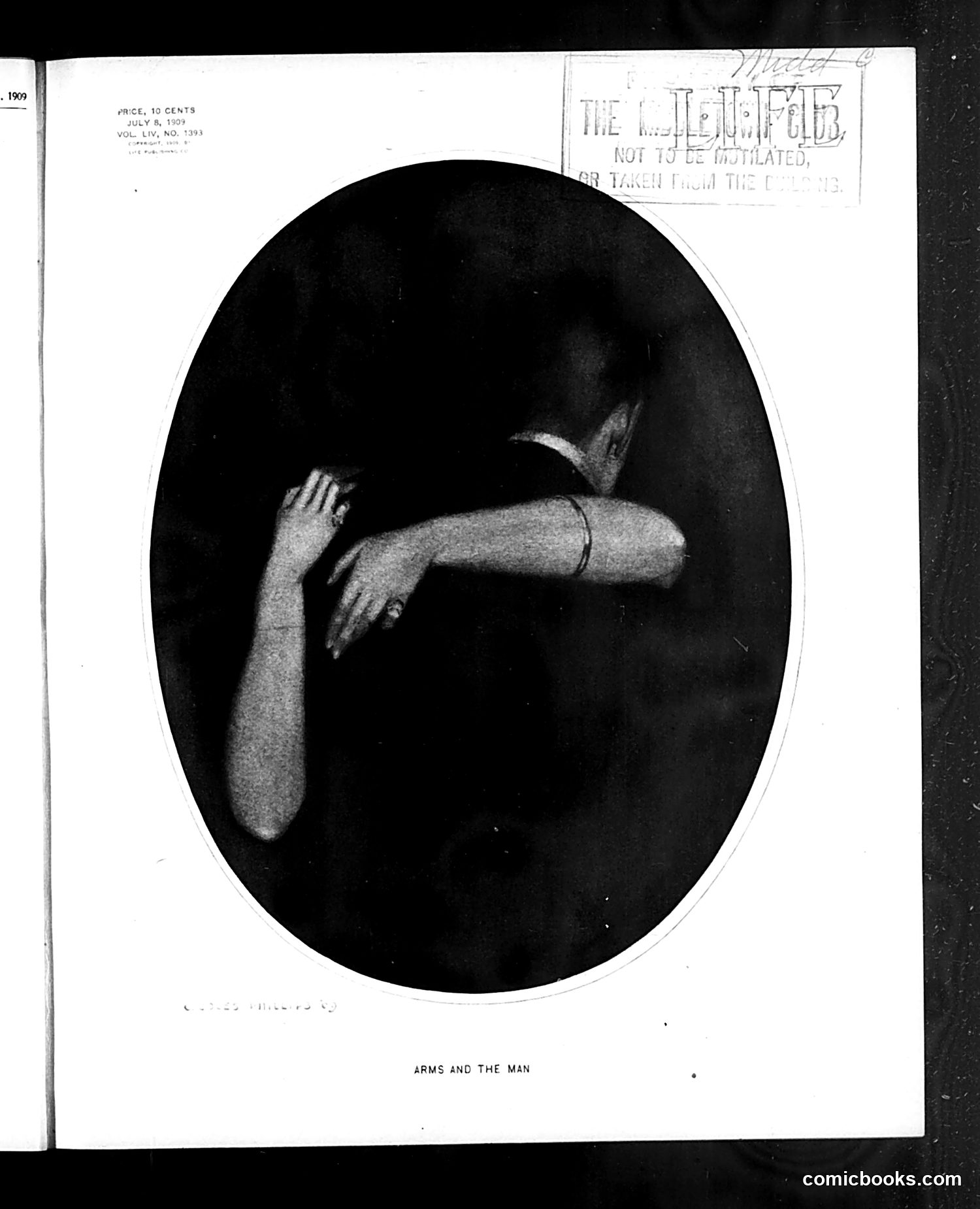
This page from *Life* magazine (dated July 6, 1909, Vol. LIV, No. 1393) features a photograph titled "Arms and the Man." The image shows a shirtless male figure in an oval frame, photographed from behind with his arms crossed or positioned across his torso in a classical pose. The title "Arms and the Man" references the famous opening of Virgil's *Aeneid* ("I sing of arms and the man"), suggesting this is satirical commentary on masculinity, military culture, or physical prowess. The photograph appears to be a humorous study of male physiology or bodily display—possibly mocking contemporary ideals of masculine strength or military bearing. The specific social or political reference remains unclear without additional context from the magazine's surrounding content.
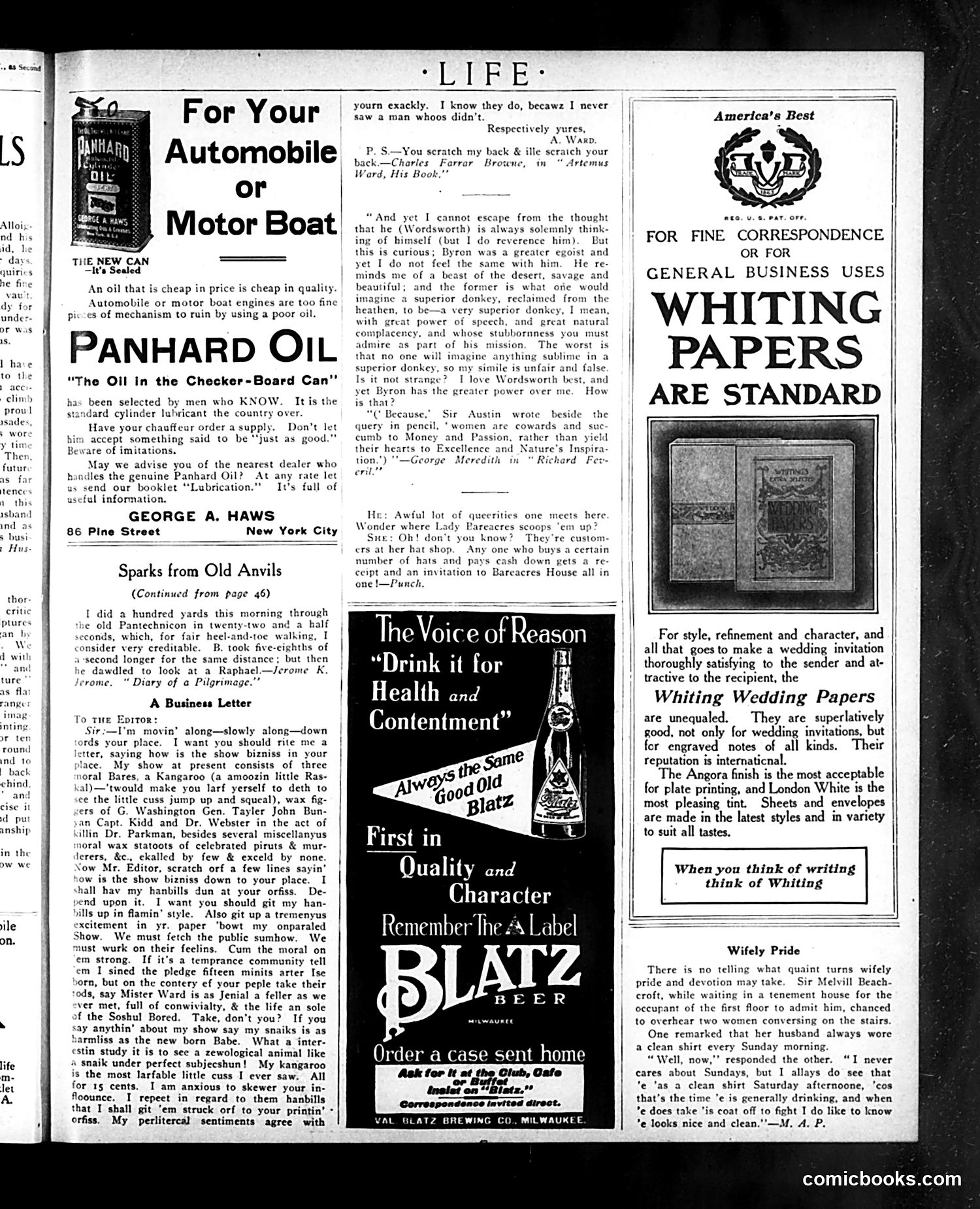
This page is **primarily advertising**, not political satire or comics. It contains several period advertisements: - **Panhard Oil**: Motor oil marketed as a quality product ("The Oil in the Checker-Board Can") - **Whiting Papers**: Premium stationery for correspondence and wedding invitations - **Blatz Beer**: Milwaukee brewery advertisement emphasizing quality and character There is one brief article titled **"Sparks from Old Anvils"** (continued from page 46) and another called **"A Business Letter,"** which appear to be humorous personal correspondence pieces common to *Life* magazine's satirical format, though the OCR'd text is difficult to parse clearly. The page reflects early 20th-century consumer culture and advertising conventions rather than political commentary or visual satire.
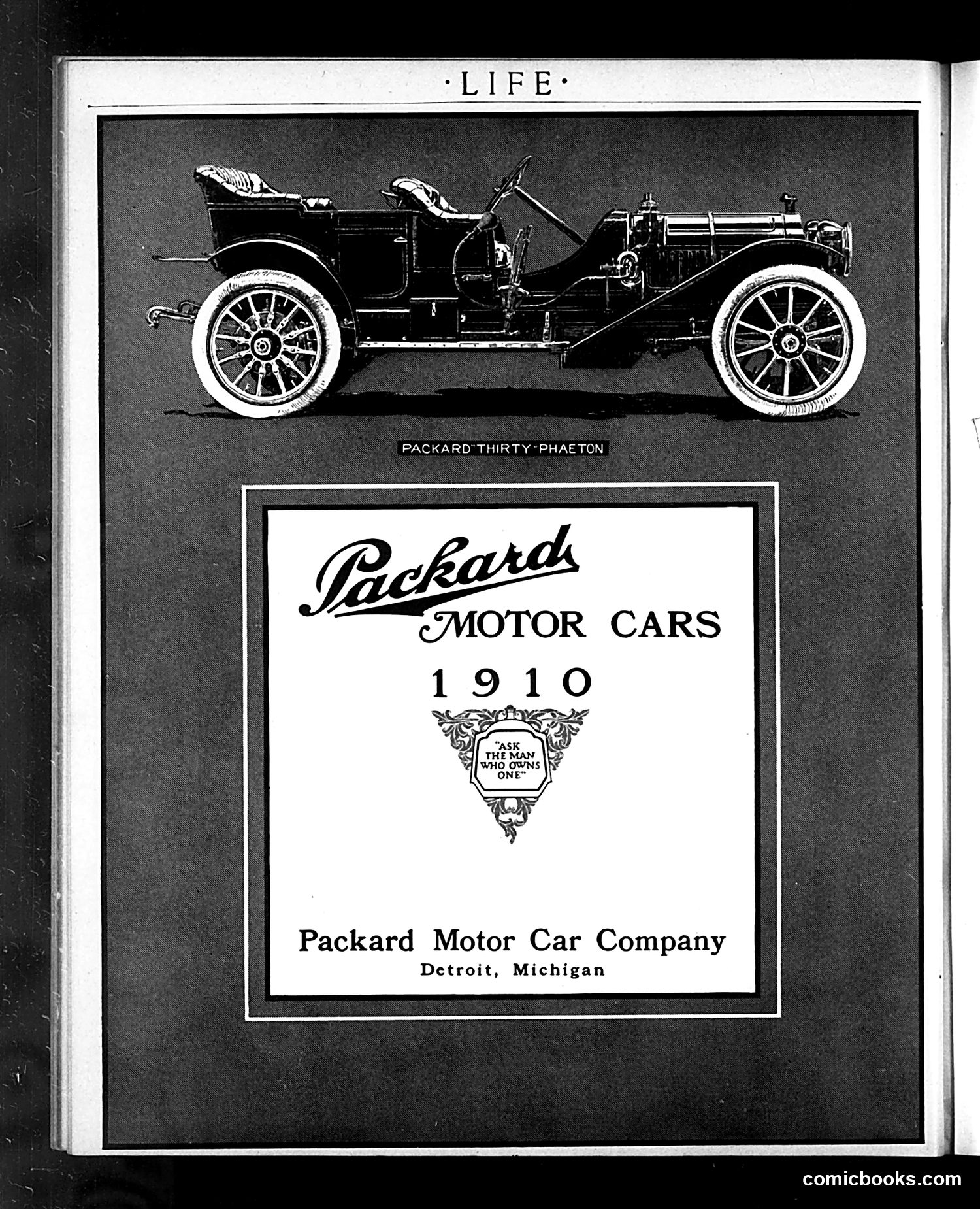
This is primarily a **Packard automobile advertisement**, not a political cartoon. It appears in *Life* magazine from 1910 and showcases the "Packard Thirty Phaeton" — a luxury motorcar manufactured by the Packard Motor Car Company of Detroit, Michigan. The page displays a side-view technical illustration of the vehicle with prominent white-wall tires, typical of early 1900s automotive advertising. The tagline "Ask the man who owns one" was Packard's famous marketing slogan, appealing to exclusivity and prestige by suggesting satisfied customers would vouch for quality. This represents early automotive marketing in a major American magazine, targeting wealthy consumers during the era when automobiles were still luxury items rather than mass-market products.
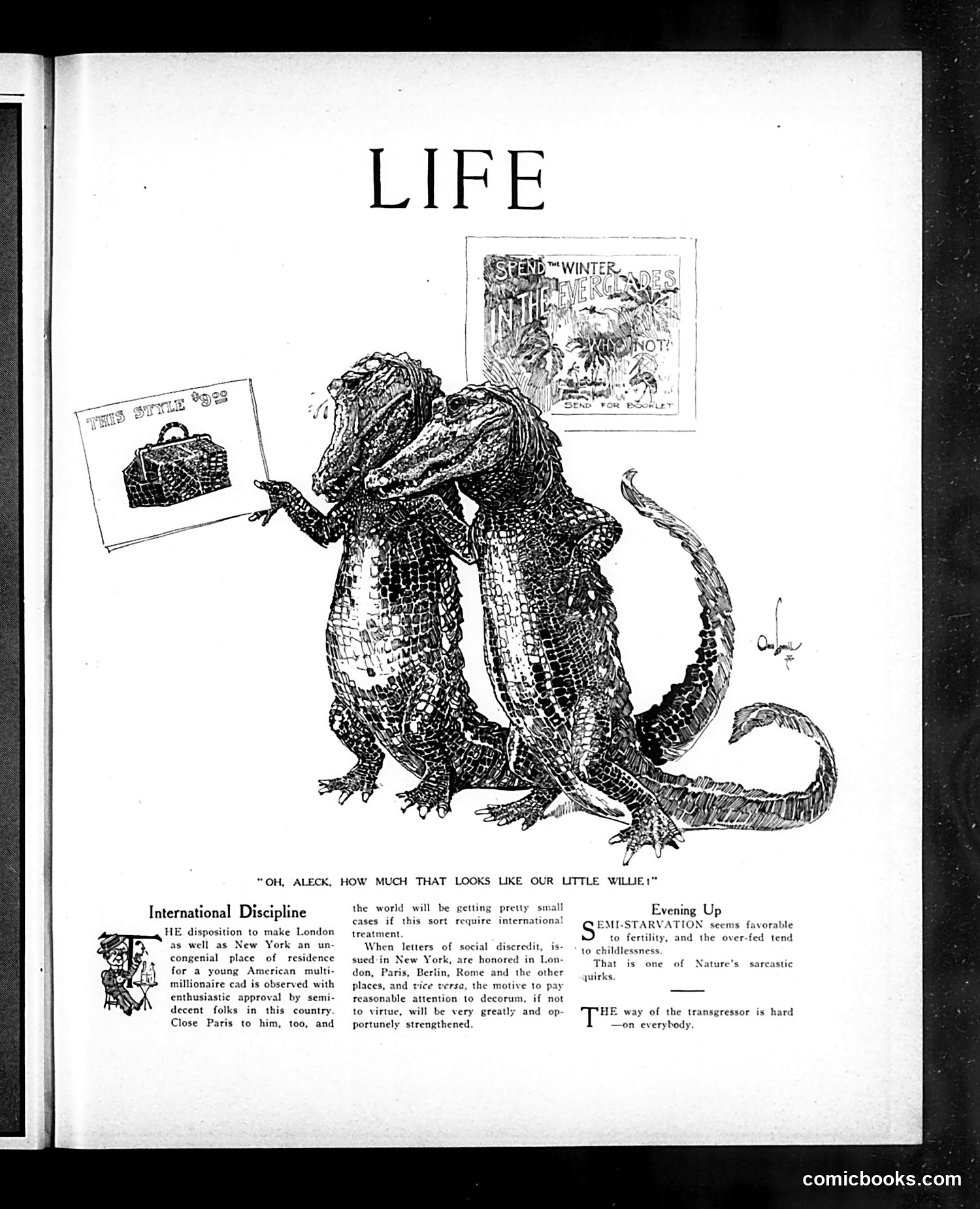
The main cartoon depicts two alligators examining magazines titled "The Little Ones" and what appears to be "Winter" content. The caption reads: "Oh, Aleck, how much that looks like our little Willie!" This is satirical commentary on parenting and child-rearing. The alligators—representing parents—are sarcastically comparing their own offspring to magazine illustrations, suggesting that actual children are as rough, primitive, and difficult to manage as young alligators. The joke mocks both the idealized images of children in popular magazines and parents' frustration with real child behavior. The page also contains brief articles on "International Discipline" and "Evening Up," continuing Life magazine's typical format of mixing satirical illustrations with short social commentary pieces.
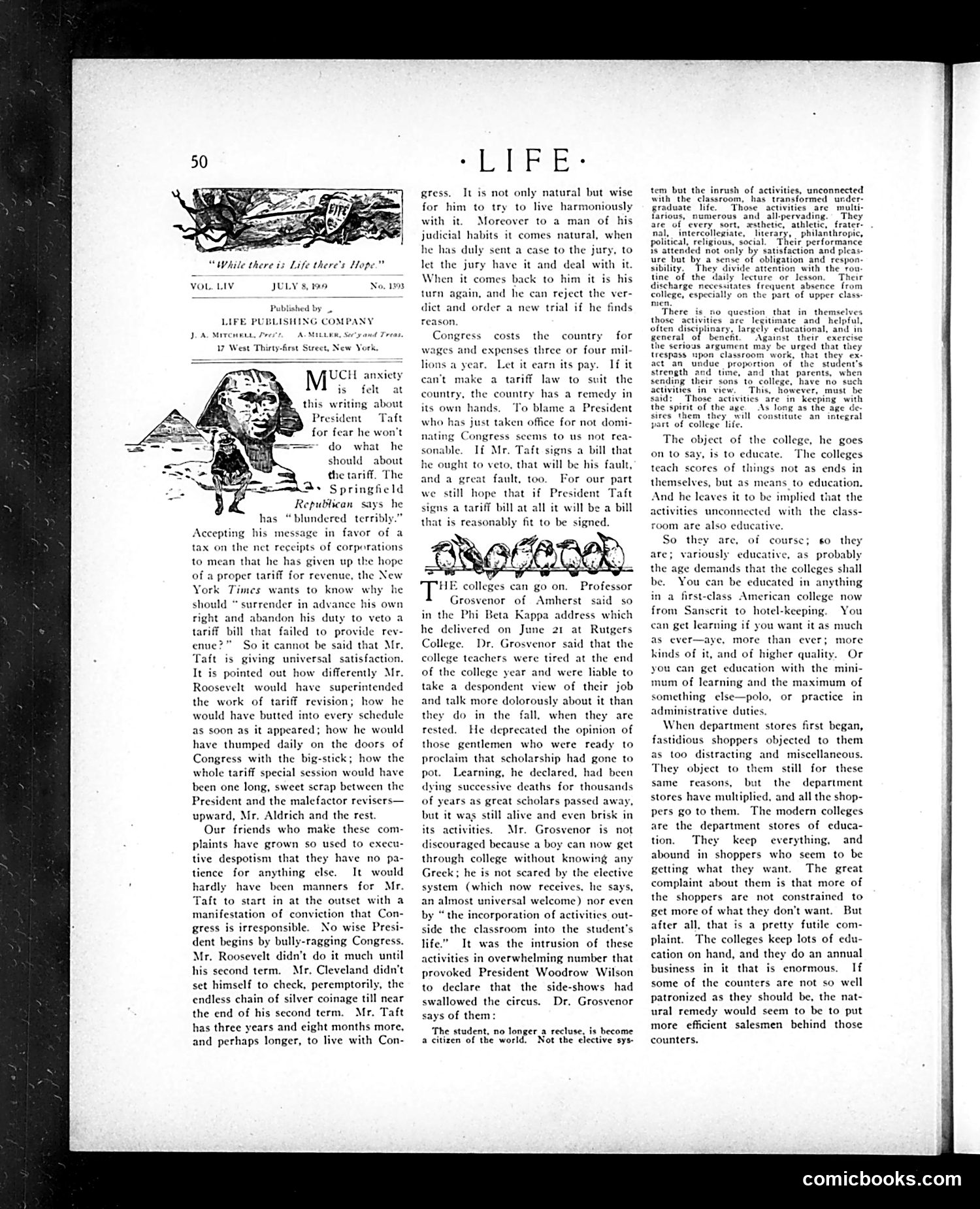
The page features an editorial discussing President Taft's approach to tariff legislation and congressional costs. The two cartoons appear to satirize political figures of the era. The left illustration shows a caricatured head in profile, labeled "Republican says he has blundered terribly!" This likely mocks Republican positions on tariffs or Taft's early presidency challenges. The central cartoon depicts what appears to be caricatured heads, though the specific figures are unclear from the image quality. The editorial argues that Congress spends excessively ($3-4 million yearly) and criticizes both blaming President Taft for tariff issues and Roosevelt's previous tariff policies. It also defends college activities as educationally legitimate, countering arguments they distract from classroom learning. The overall tone is satirical commentary on early-1900s political debates surrounding executive authority, legislative spending, and educational policy.
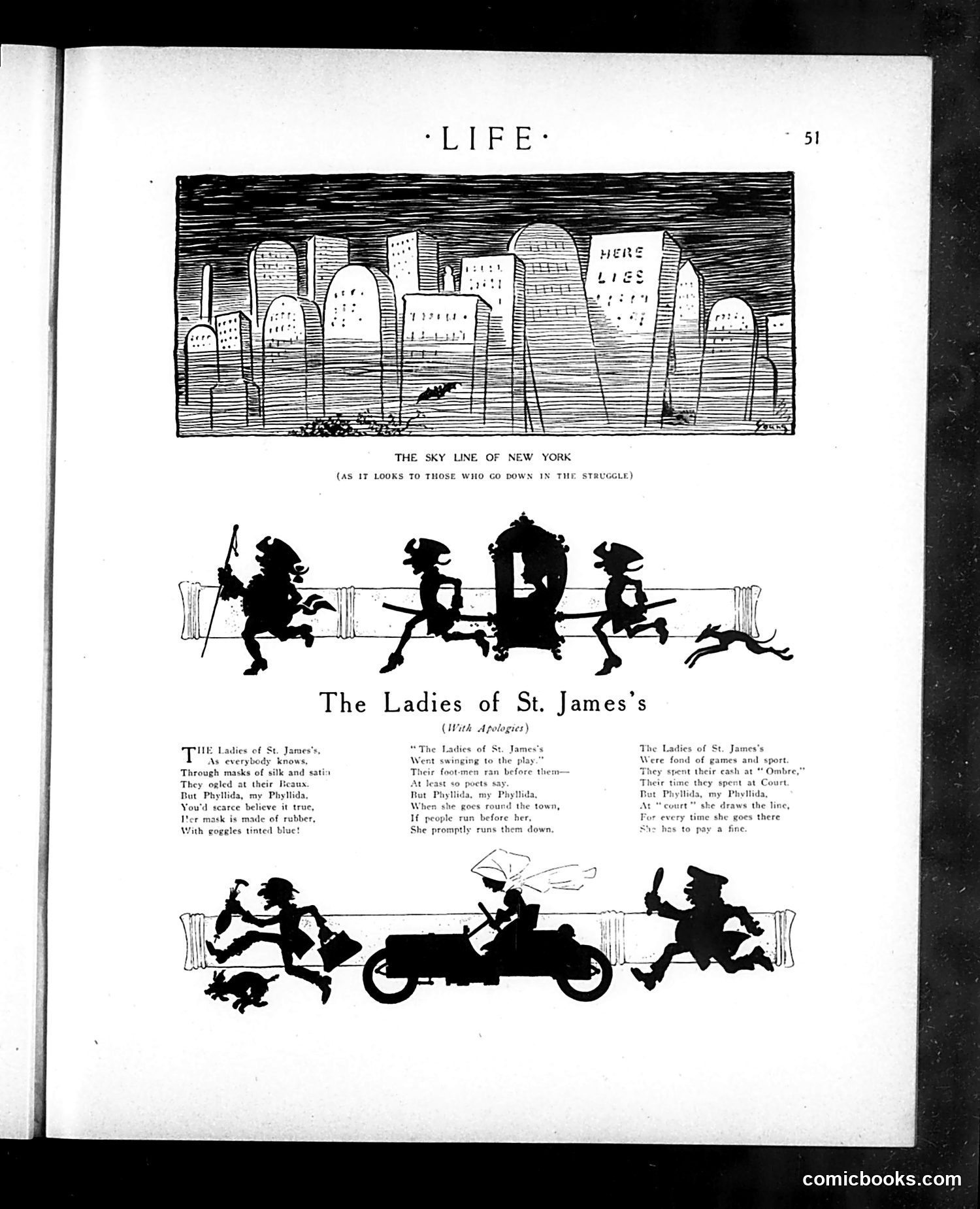
This page contains satirical silhouette illustrations mocking upper-class British women, specifically those associated with St. James's (an affluent London neighborhood). The top panel depicts New York's skyline labeled "as it looks to those who go down in the struggle"—suggesting financial ruin. The main cartoon shows exaggerated silhouettes of fashionable ladies engaged in vigorous, unladylike activities: running, riding motorcycles, and generally behaving with athletic abandon. The accompanying verse mocks their pretensions and social climbing, particularly focusing on "Phyllida," who appears to be a stock character representing frivolous upper-class women. The satire critiques Edwardian-era society women's contradictions between refined expectations and their actual reckless behavior.
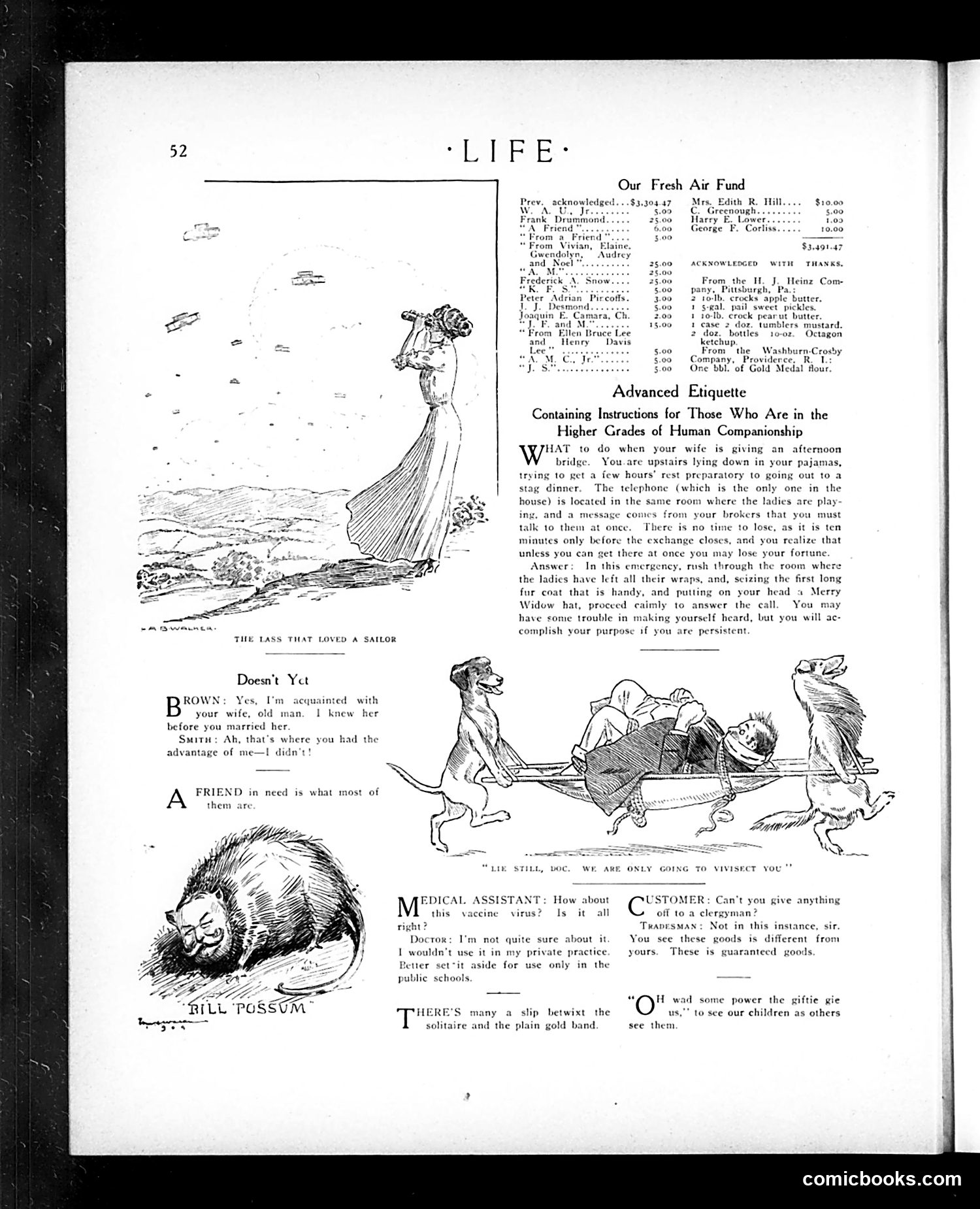
This page contains several satirical humor pieces and illustrations typical of early 20th-century Life magazine: **"The Lass That Loved a Sailor"** depicts a woman in flowing dress looking out at the sea—likely a romanticized reference to sailors' romantic conquests. **"Doesn't Yet"** features dialogue between "Brown" and "Smith" about a woman, with an illustration of a possum, playing on wordplay about courtship disadvantages. **"Advanced Etiquette"** offers humorous advice on social situations—how to handle a wife's absence before a dinner party—satirizing upper-class social conventions and anxieties. The bottom section includes brief comedic dialogues between a Medical Assistant and Doctor about vaccines, and a Customer and Tradesman about goods quality. The tone throughout is lighthearted social satire aimed at middle/upper-class readers' domestic and social concerns.
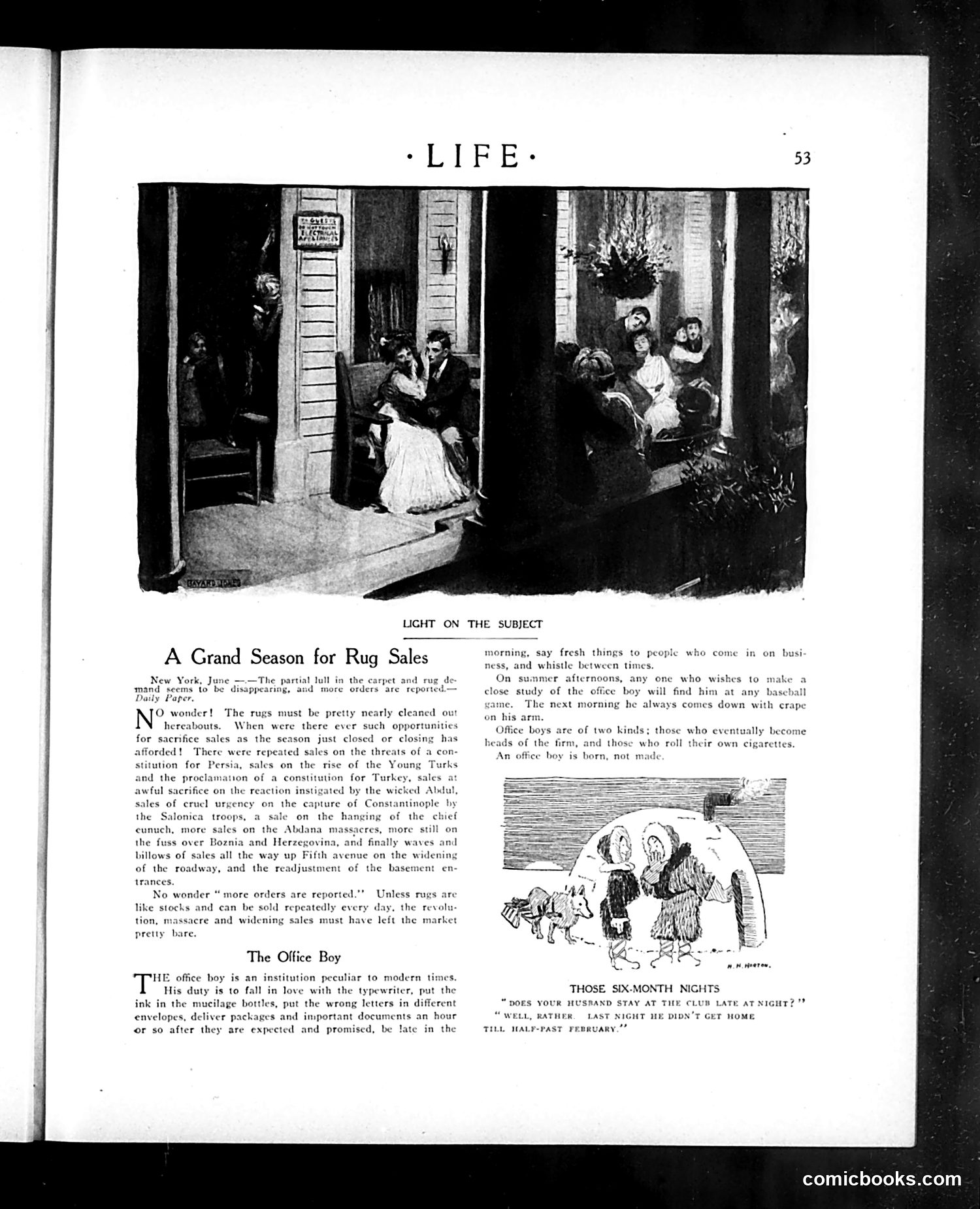
**Main Content:** This page contains two satirical pieces about office life and rug sales in early 20th-century New York. **"A Grand Season for Rug Sales"** mocks the carpet industry's aggressive marketing during summer, when offices supposedly need cleaning. The satire suggests rugs are sold repeatedly through manufactured urgency and questionable sales tactics tied to current events (references to Turkish conflicts and Constantinople). **"The Office Boy"** humorously describes a young office worker's thankless duties: maintaining typewriters, delivering packages, and running errands. The accompanying cartoon shows the boy exhausted, illustrating his low status. **"Those Six-Month Nights"** is a brief joke about a husband staying late at a club, with his wife sarcastically noting his absence. The overall tone reflects period workplace humor about clerical labor and commercial excess.
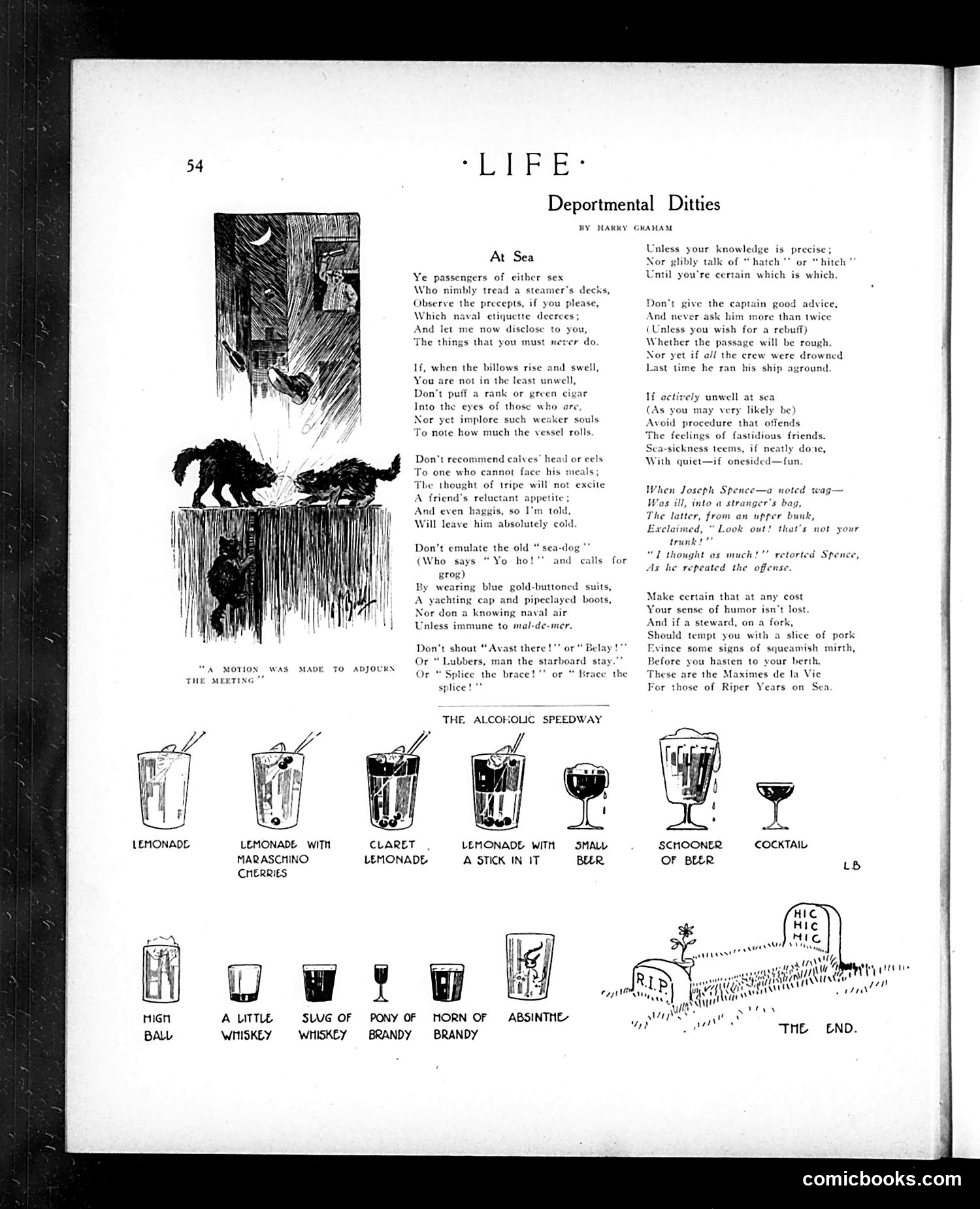
This page satirizes nautical etiquette and behavior through humorous "rules" for ship passengers. The left illustration shows men in formal dress losing their balance—mocking the pretension of maintaining decorum at sea. The poem advises against typical passenger behaviors: giving unsolicited advice to captains, discussing seasickness openly, complaining about rough passages, or using affected nautical slang like "Yo ho!" The satirical "Maximes de la Vie" mock those trying to appear experienced sailors. The bottom section, "The Alcoholic Speedway," humorously illustrates the progression from light drinks (lemonade) through increasingly strong alcohol to absinthe, ending with a tombstone marked "R.I.P." This darkly comedic sequence jokes about alcohol's dangerous escalation—a timely reference given early 20th-century concerns about drinking culture.
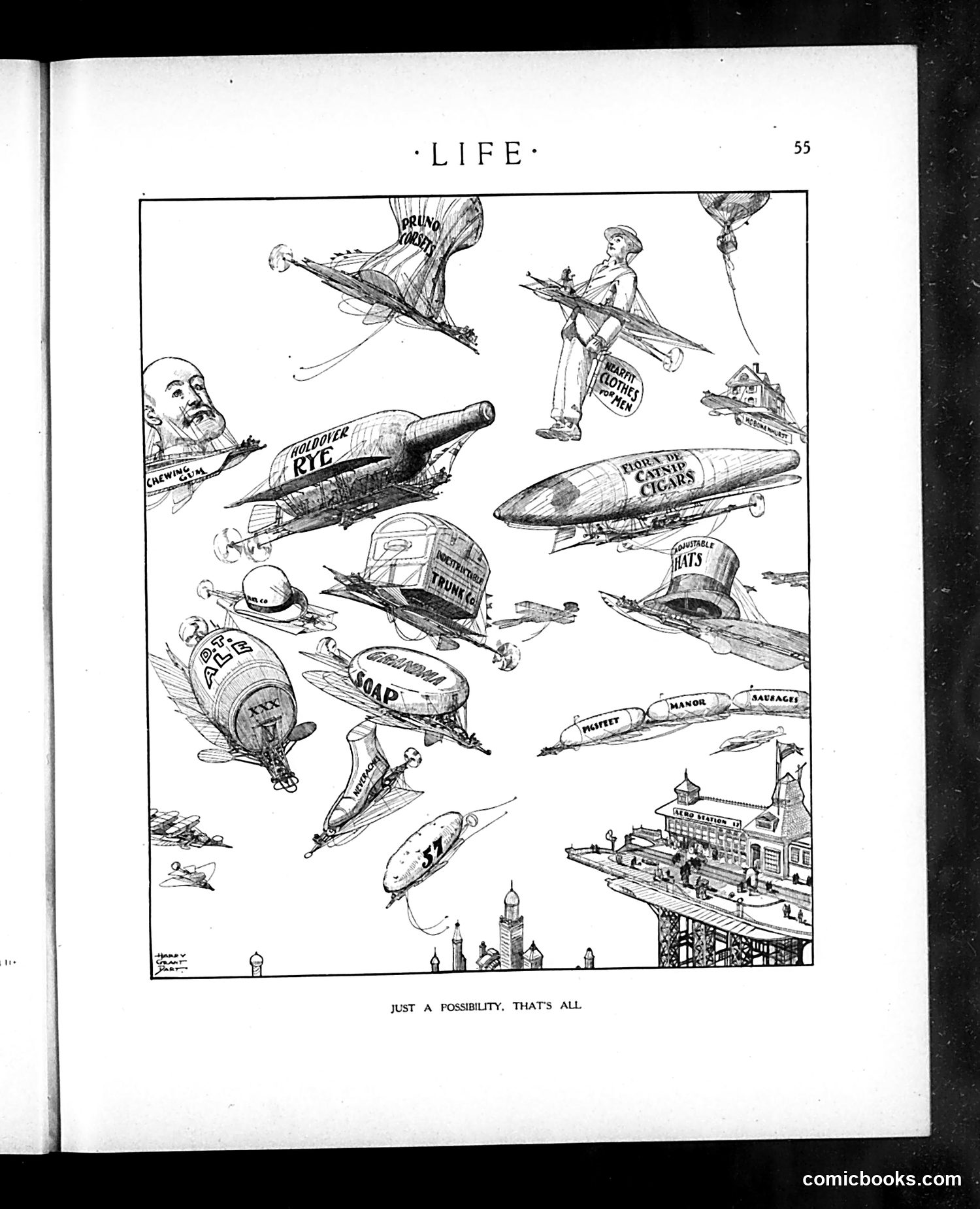
This is a satirical illustration titled "Just a Possibility, That's All," depicting various consumer products and advertisements transformed into airships or flying vessels. The cartoon appears to be early 20th-century commentary on commercial advertising and consumerism. Visible product names include: Rye whiskey, Soap, Cigars, Hats, and Sausages—all rendered as zeppelins or dirigibles with wings. A bearded man's head (likely representing a businessman or advertiser) appears in the upper left. The satire suggests how advertising aggressively "bombards" the public with commercial messages, depicted here as an invasion fleet of branded products. The London skyline at the bottom grounds the scene. The caption emphasizes this is merely speculative commentary on advertising's pervasive influence in modern life.
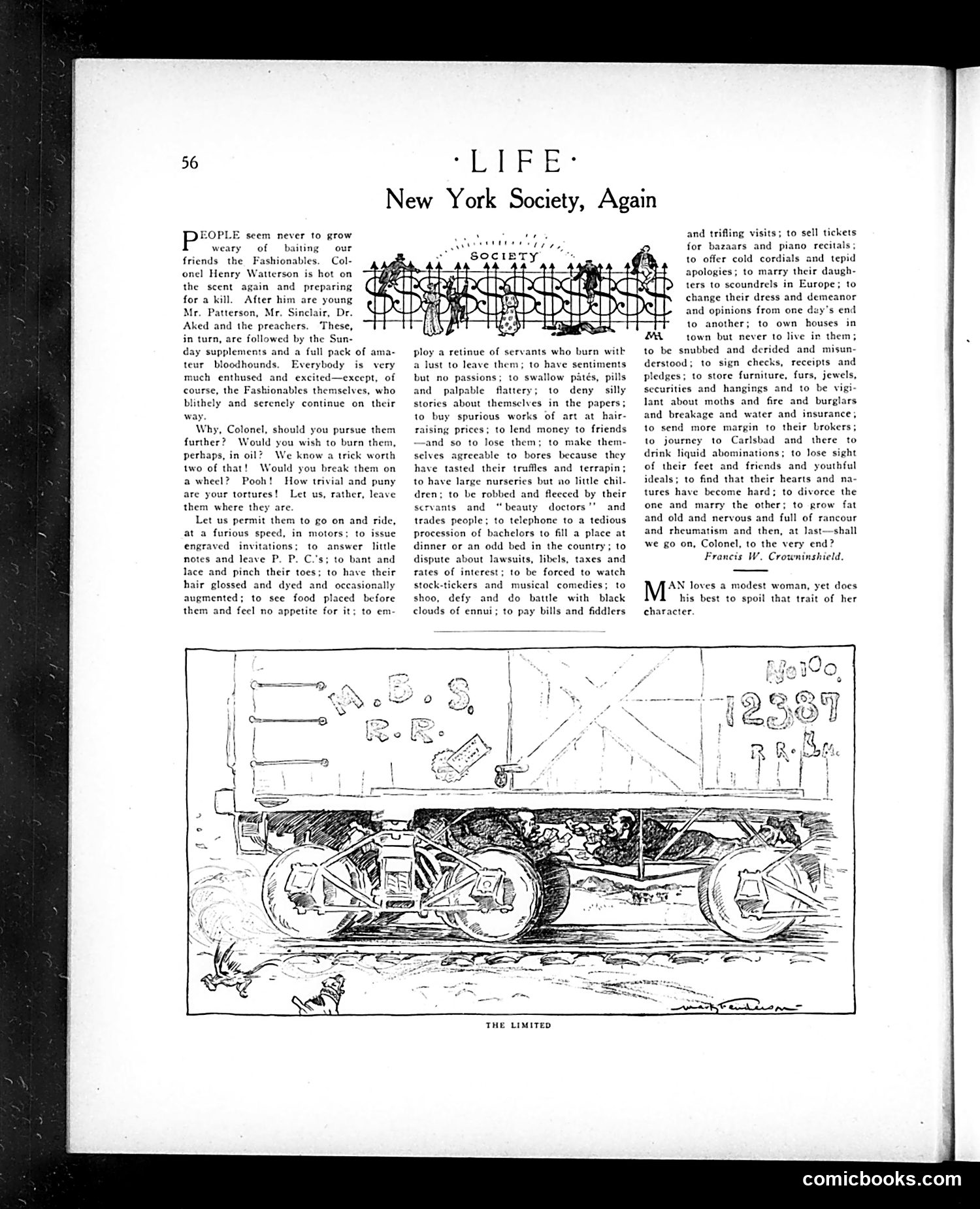
This satirical piece mocks wealthy New York society's endless, trivial pursuits. The text catalogs their shallow activities: hosting balls, burning through servants, arranging social events, pursuing gossip, and obsessing over fashionable minutiae. The main cartoon depicts "THE LIMITED"—a train with an ornate passenger car, likely satirizing how the wealthy isolate themselves from ordinary people. The detailed mechanical diagrams above suggest the "machinery" of high society—its complicated, artificial social structures and rules. The satire's point: New York's elite spend enormous energy maintaining appearances and status through meaningless activities, treating life as an elaborate mechanical performance disconnected from reality. The "Limited" train symbolizes their exclusive, self-contained world.
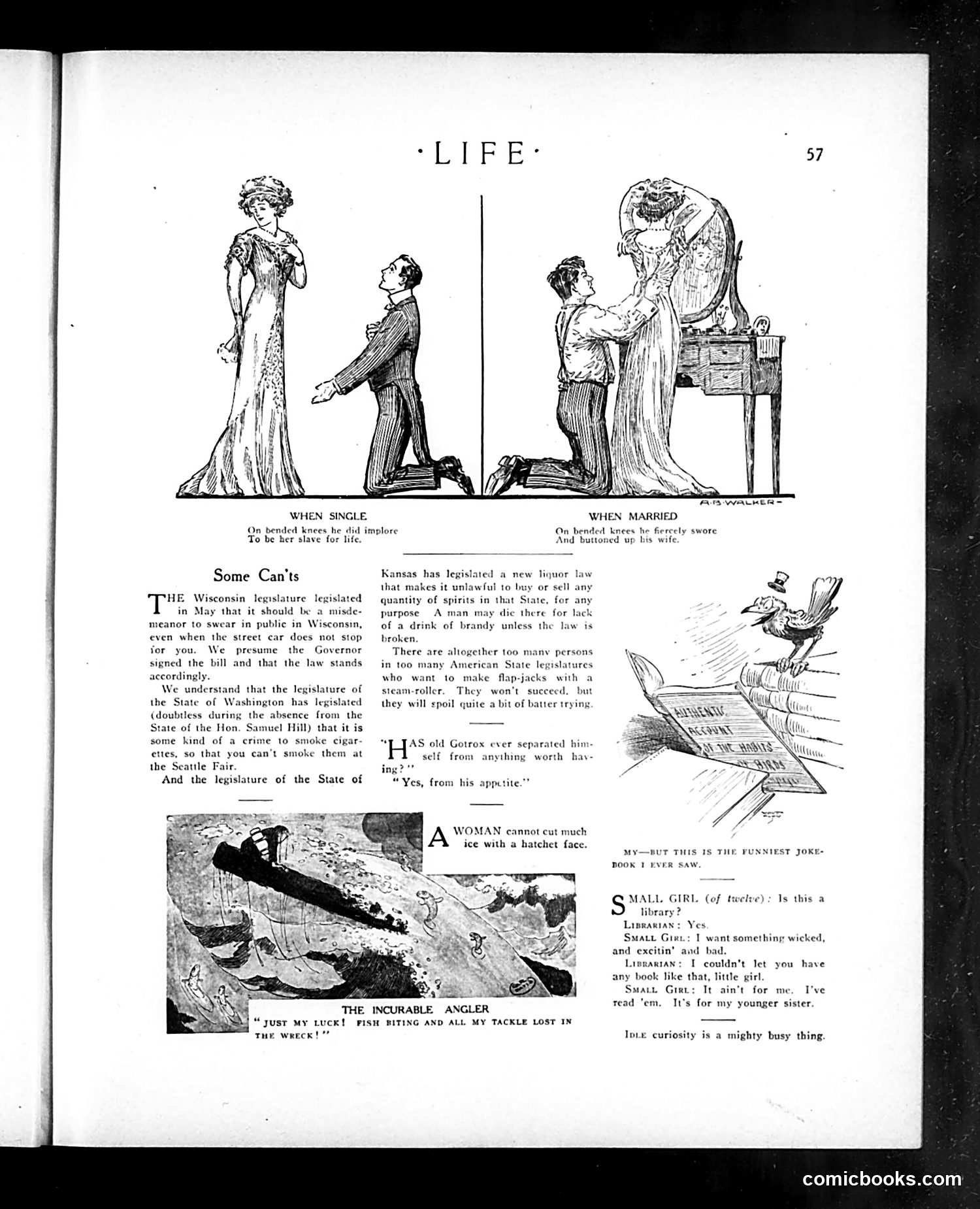
The top cartoon contrasts courtship and marriage through contrasting male behavior. When single, a man kneels before a woman, imploring her to marry him. Once married, he sits while his wife stands, buttoning his jacket—a visual commentary on reversed power dynamics and lost romance after marriage. The "Some Can'ts" section discusses state liquor laws, noting Wisconsin's ban on public swearing and Washington's absence from the "lion" list (State of the Lion speeches). The humor targets legislators attempting moral legislation. Lower jokes address gender stereotypes: women's ice-cutting ability, library book requests, and curiosity. The angler photograph illustrates comic misfortune—losing fishing tackle. These represent early-20th-century domestic and recreational humor targeting conventional social roles.
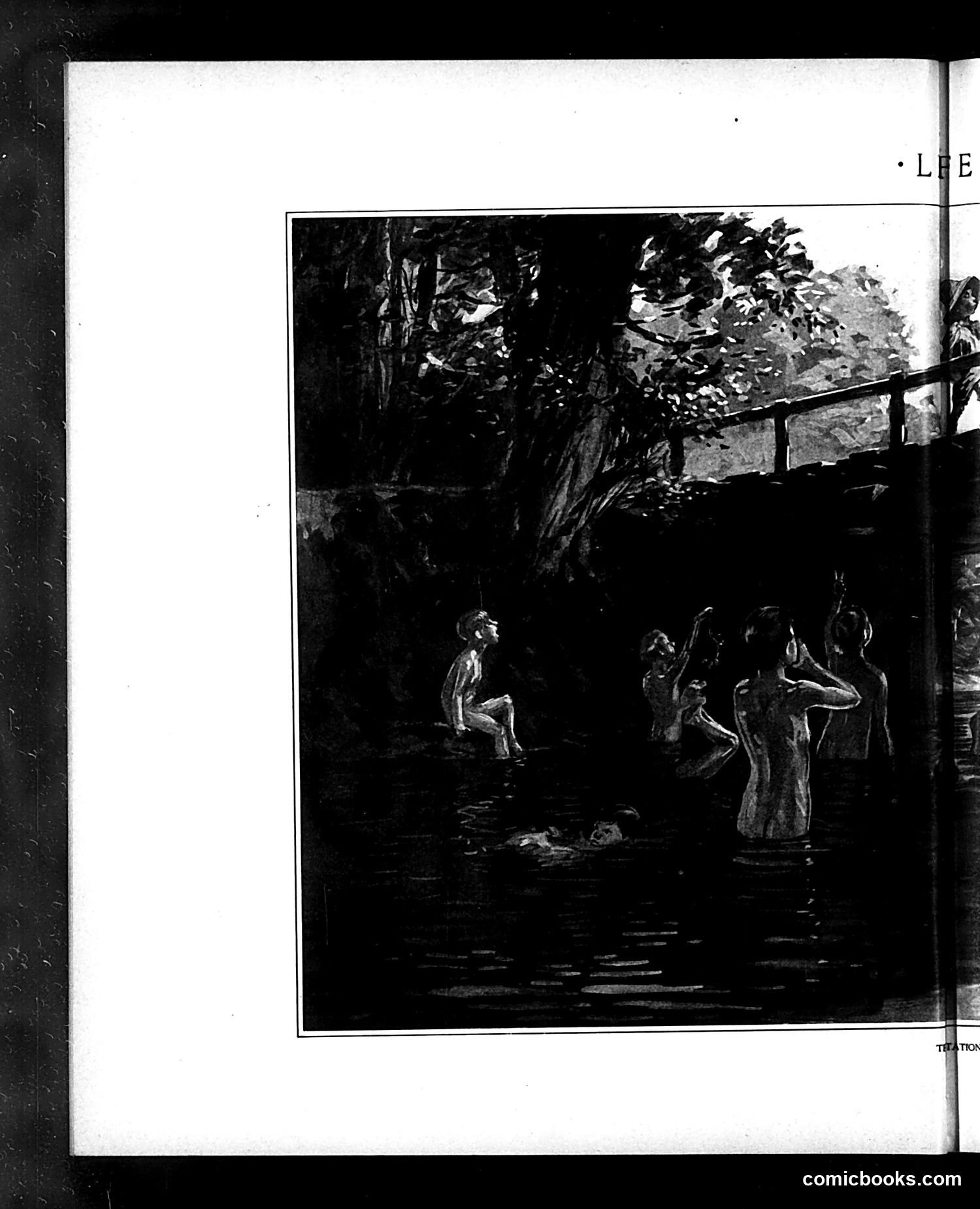
The image shows what appears to be a dramatic nighttime scene with multiple human figures in a wooded or shadowy setting, possibly depicting some kind of gathering or ritual. However, the OCR text provided ("comicbooks.com") offers no contextual information about the cartoon's subject, date, political references, or satirical intent. Without visible captions, labels, or identifying text within the image itself, I cannot reliably identify the figures, explain the specific historical or political reference, or determine what satire or joke is being made. The architectural elements and vegetation suggest a tropical or colonial setting, but this alone is insufficient for accurate historical interpretation. To properly analyze this *Life* magazine content, clearer OCR text or additional publication details would be necessary.
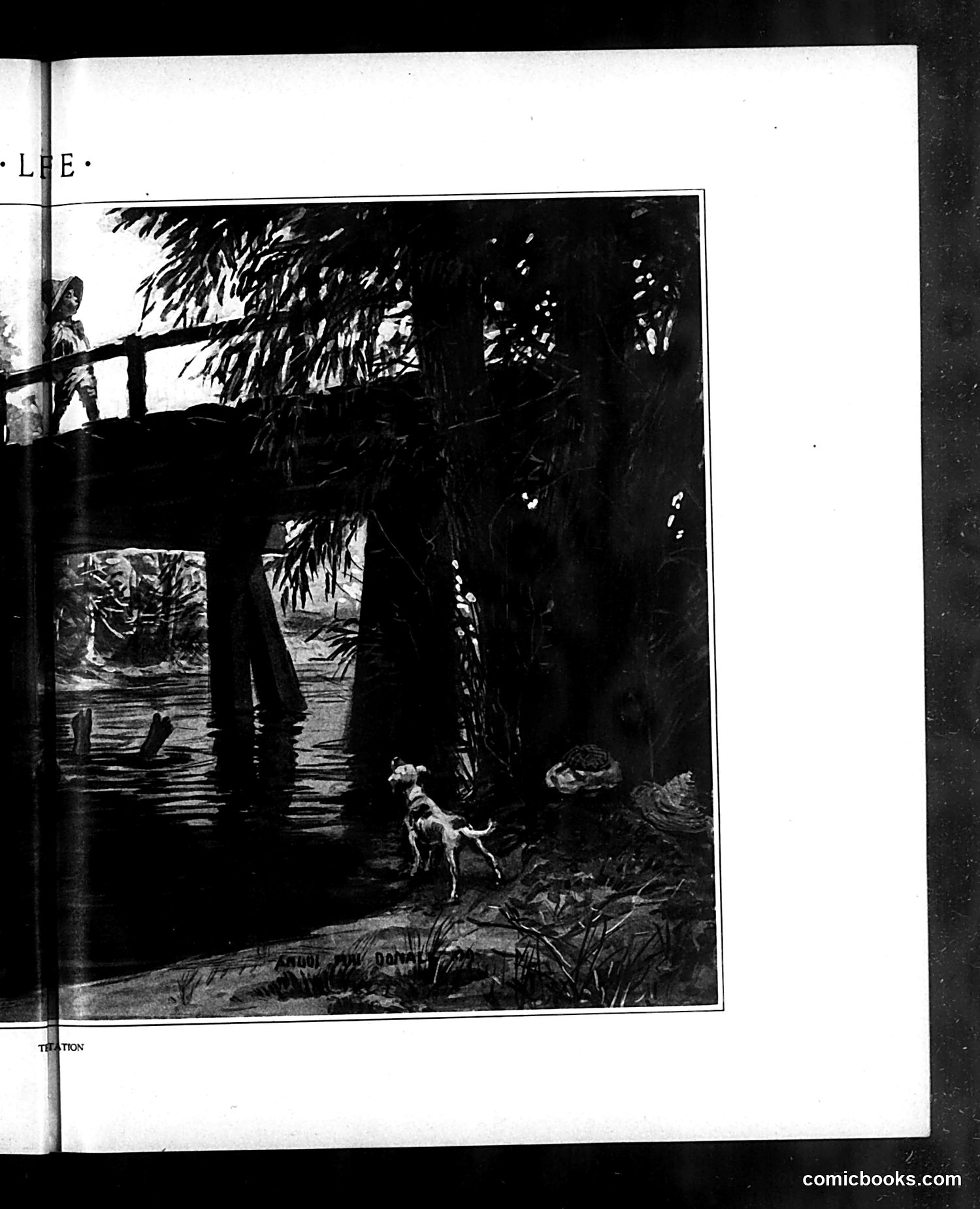
This appears to be an illustration rather than a political cartoon. The image depicts a dramatic nighttime scene at what looks like a swamp or bayou setting, with hanging Spanish moss, wooden structures, and water. A small dog stands in the foreground while a figure stands on an elevated platform or bridge above. The composition emphasizes shadows and atmospheric mood through high-contrast black-and-white illustration. Without additional text or context on this page identifying the subject matter, the specific satirical point or social/political reference is unclear. The "Life" magazine credit and "comicbooks.com" notation suggest this may be from an illustrated story or serial feature, but the page itself contains no visible OCR text that would clarify the narrative or satirical intent.
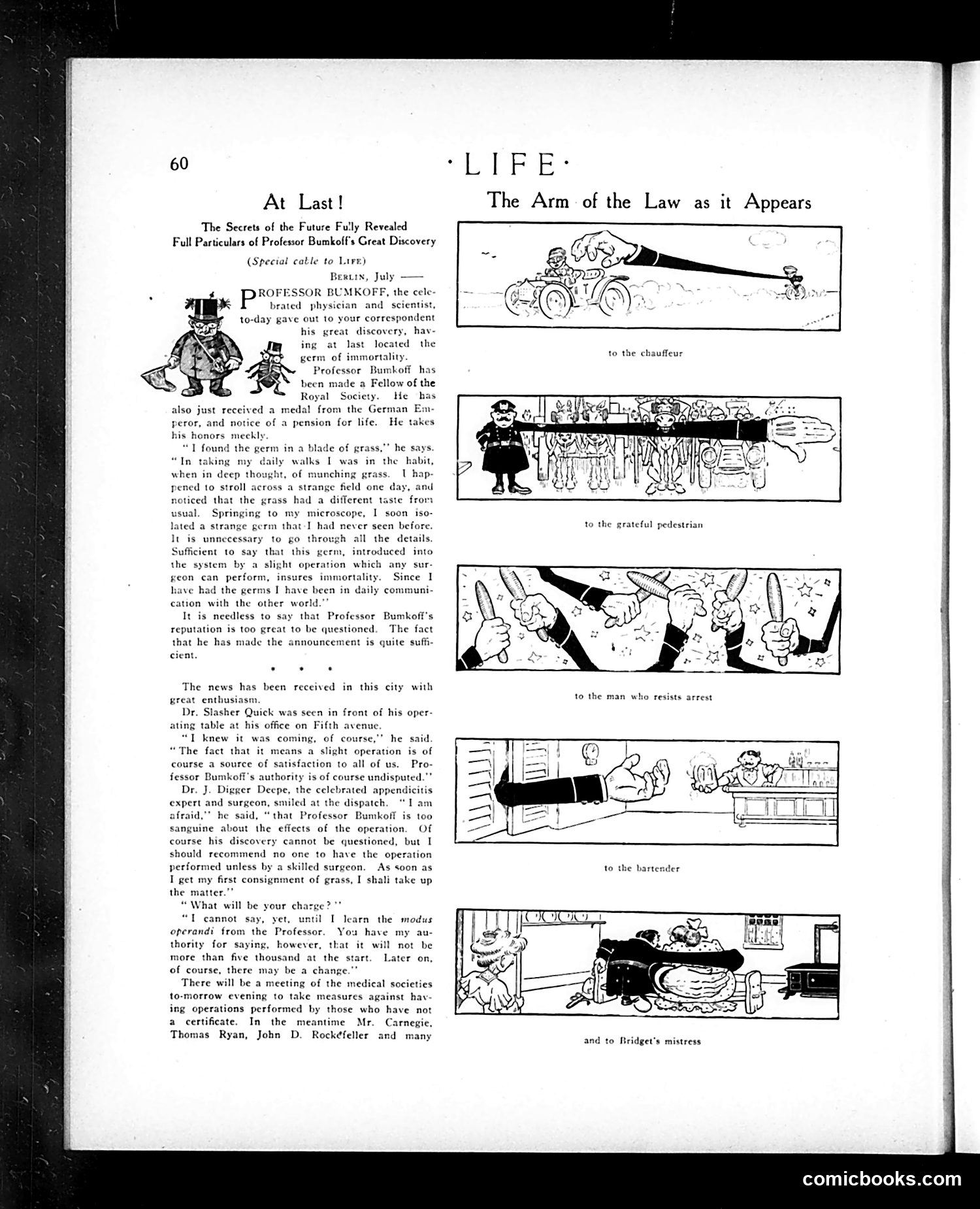
This 1900s-era satirical piece mocks the era's credulous embrace of dubious scientific claims and medical charlatanism. "Professor Bumkoff" (a caricatured Eastern European scientist) claims to have discovered an "immortality germ" in grass—a transparent hoax that prestigious doctors immediately validate without question. The satire targets: 1. **Scientific pretension**: Bumkoff's vague methodology and implausible discovery go unchallenged by his reputation alone. 2. **Medical greed**: Doctors like "Dr. Slasher Quick" and "Dr. Digger Deepe" (transparent names mocking surgeons' profit motives) eagerly adopt the treatment, charging exorbitant fees ($5,000 opening price). 3. **Wealthy industrialists' gullibility**: Carnegie, Rockefeller, and Ryan are mentioned as eager patients—mocking the ultra-rich's susceptibility to schemes. The cartoon series on the right shows "The Arm of the Law" applying this discovery indiscriminately to various citizens, satirizing how such frauds inevitably become widespread despite regulatory warnings about unlicensed practitioners.
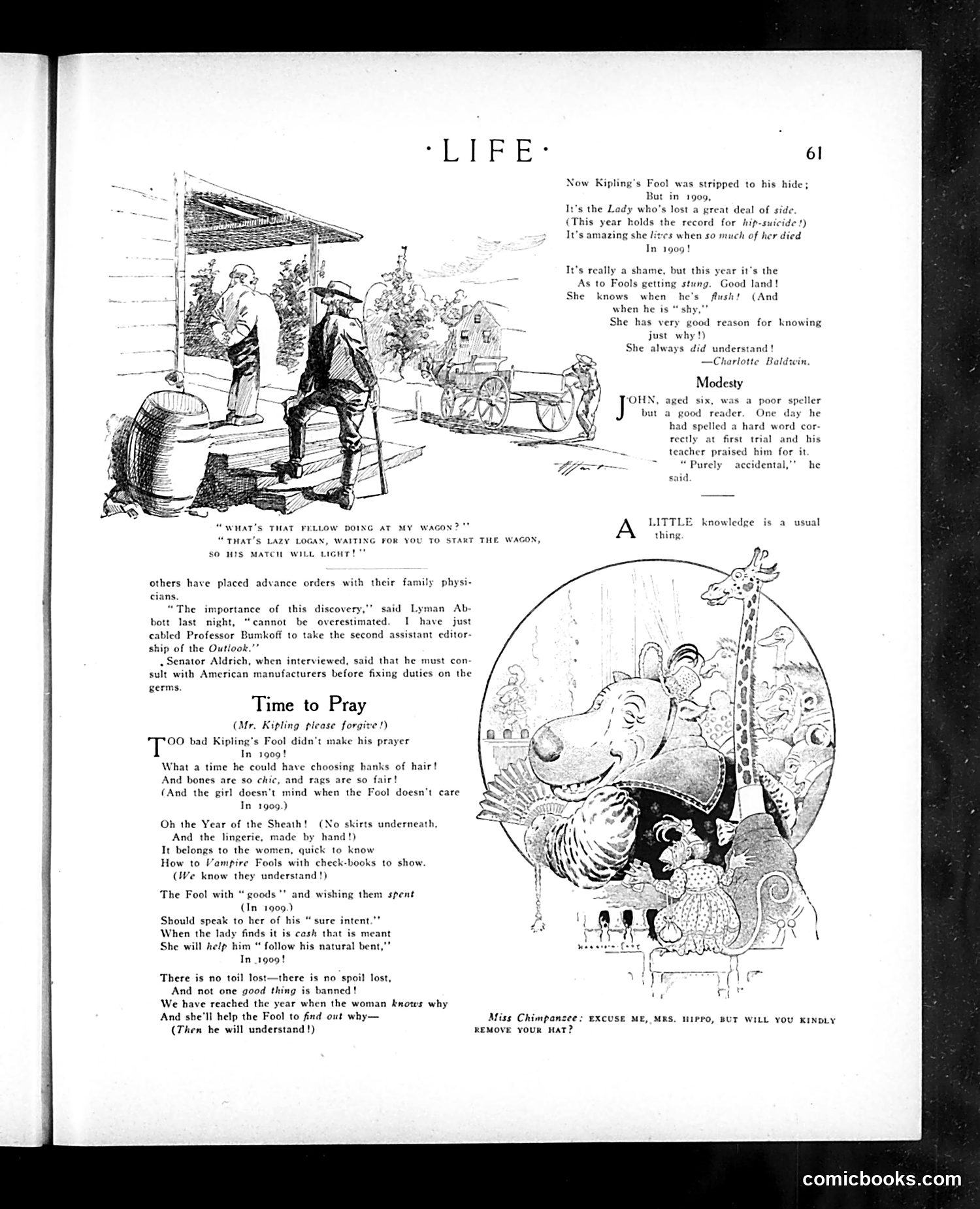
This page contains multiple satirical pieces mocking 1909 society and gender relations. **"Time to Pray"** satirizes Rudyard Kipling's character "the Fool" through verses about a foolish man in 1909. The satire targets women who exploit wealthy but naive men—the "Lady" and "woman" who understand how to extract money from fools through flattery and manipulation. References to "Vampire Fools with check-books" and women helping fools "find out why" suggest predatory gold-digging behavior. **The cartoon below** shows a chimpanzee asking a woman to remove her hat—likely satirizing women's excessively large, elaborate hats fashionable in 1909 (the "Gibson Girl" era). The humor mocks both the impracticality of these hats and the imperative to wear them despite blocking others' views. **"Modesty"** is a brief anecdote about a child's accidental spelling success, presenting mild humor about luck versus merit. The overall tone critiques both female materialism and male gullibility in Edwardian-era courtship.
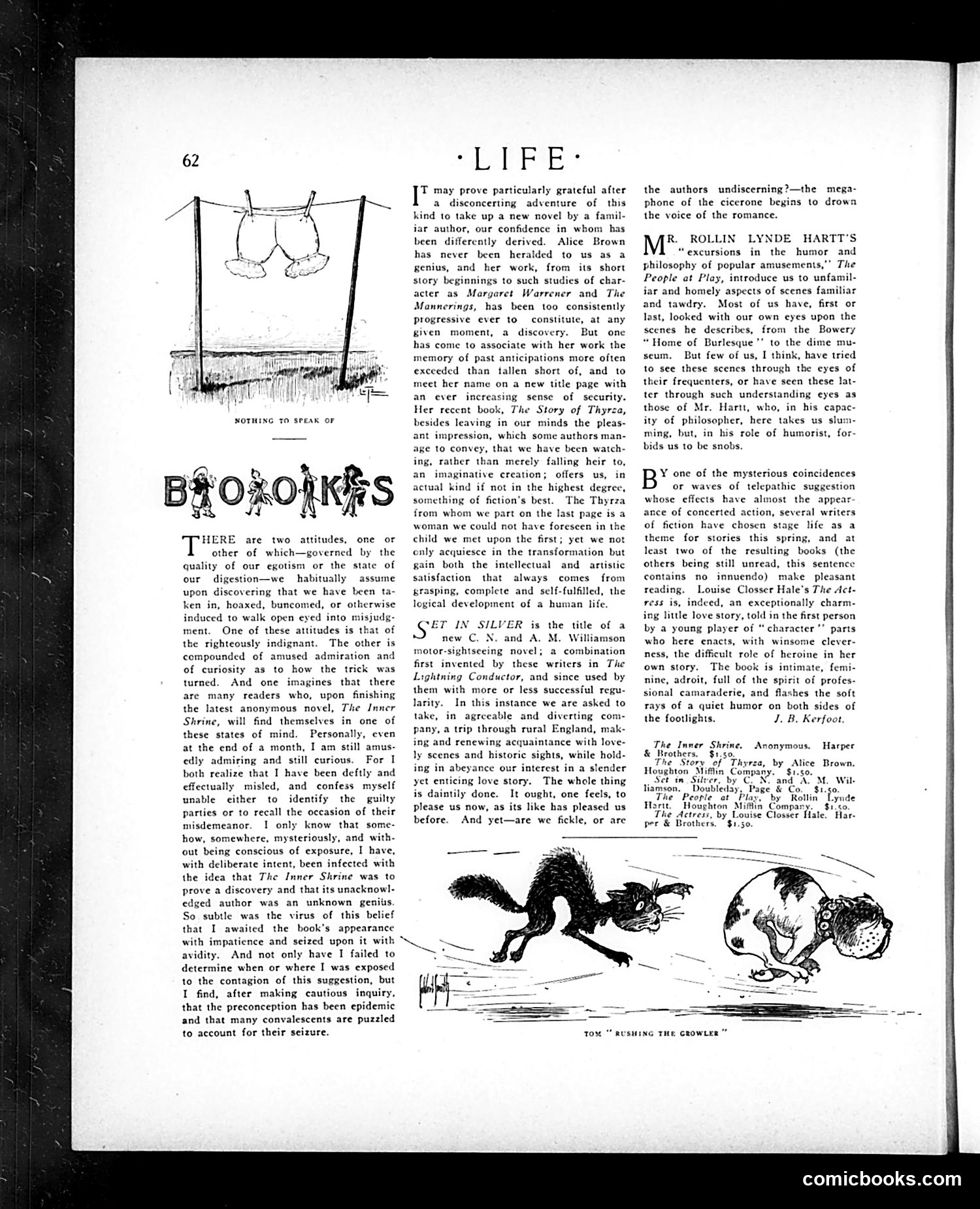
This page from *Life* magazine contains no political cartoon in the traditional sense. Instead, it's a book review section titled "BROLORKES" (likely a playful made-up word). The illustration at bottom—showing a cat chasing or "rushing" at growling dogs—is a humorous visual metaphor accompanying the review text. It's not political satire but rather decorative art supporting the literary discussion. The page critiques readers' susceptibility to hype around anonymous novels like *The Inner Shrine*, contrasting this with established author Alice Brown's reliable, character-driven work (*The Story of Thyrza*). The reviewer discusses how marketing and mystery create false anticipation versus earned reputation. The cat-and-dogs image likely represents the playful literary "battle" being discussed—the conflict between gullible readers and clever publishers' promotional tactics.
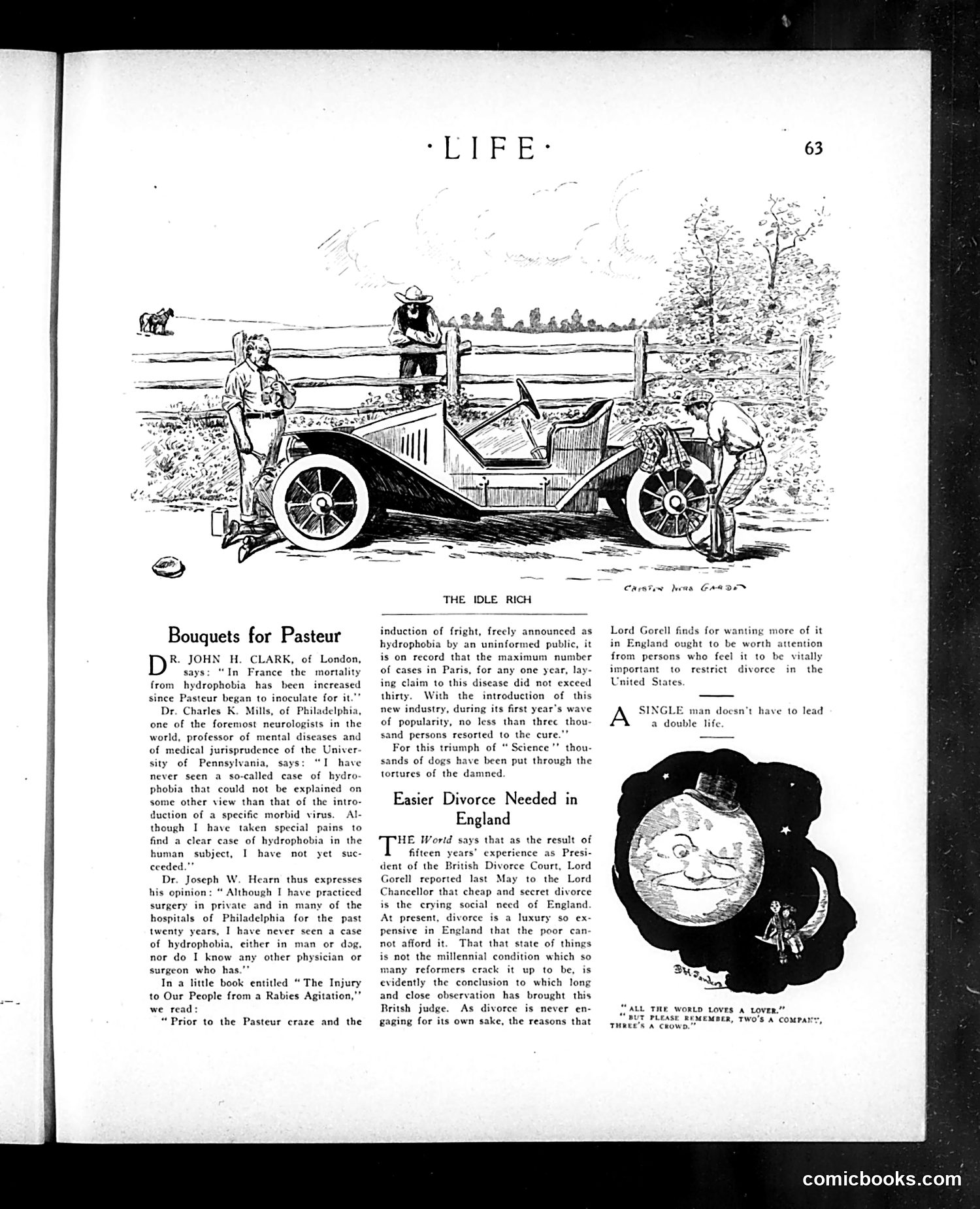
**Top Cartoon ("The Idle Rich"):** A humorous illustration of wealthy people broken down on a rural road, needing assistance from farmers. The satire mocks the leisure class's helplessness and dependence on working people—they cannot even repair their own automobiles. **"Bouquets for Pasteur" Section:** This is satirical criticism of Louis Pasteur's rabies vaccine (1880s onward). The text quotes American physicians skeptical of rabies's existence, claiming Pasteur created hysteria and unnecessary treatments. The article argues that before Pasteur's "craze," Paris recorded only ~30 rabies cases yearly; afterward, 3,000 people sought his cure. It concludes thousands of dogs were tortured unnecessarily for this "triumph of Science"—the sarcasm targeting both Pasteur and the public's gullible fear-mongering. This represents anti-vaccination sentiment masquerading as scientific criticism. **"Easier Divorce Needed in England":** Reports that England's Lord Gorell recommends cheaper divorce access so poor people can afford it—currently a luxury only the wealthy enjoy.
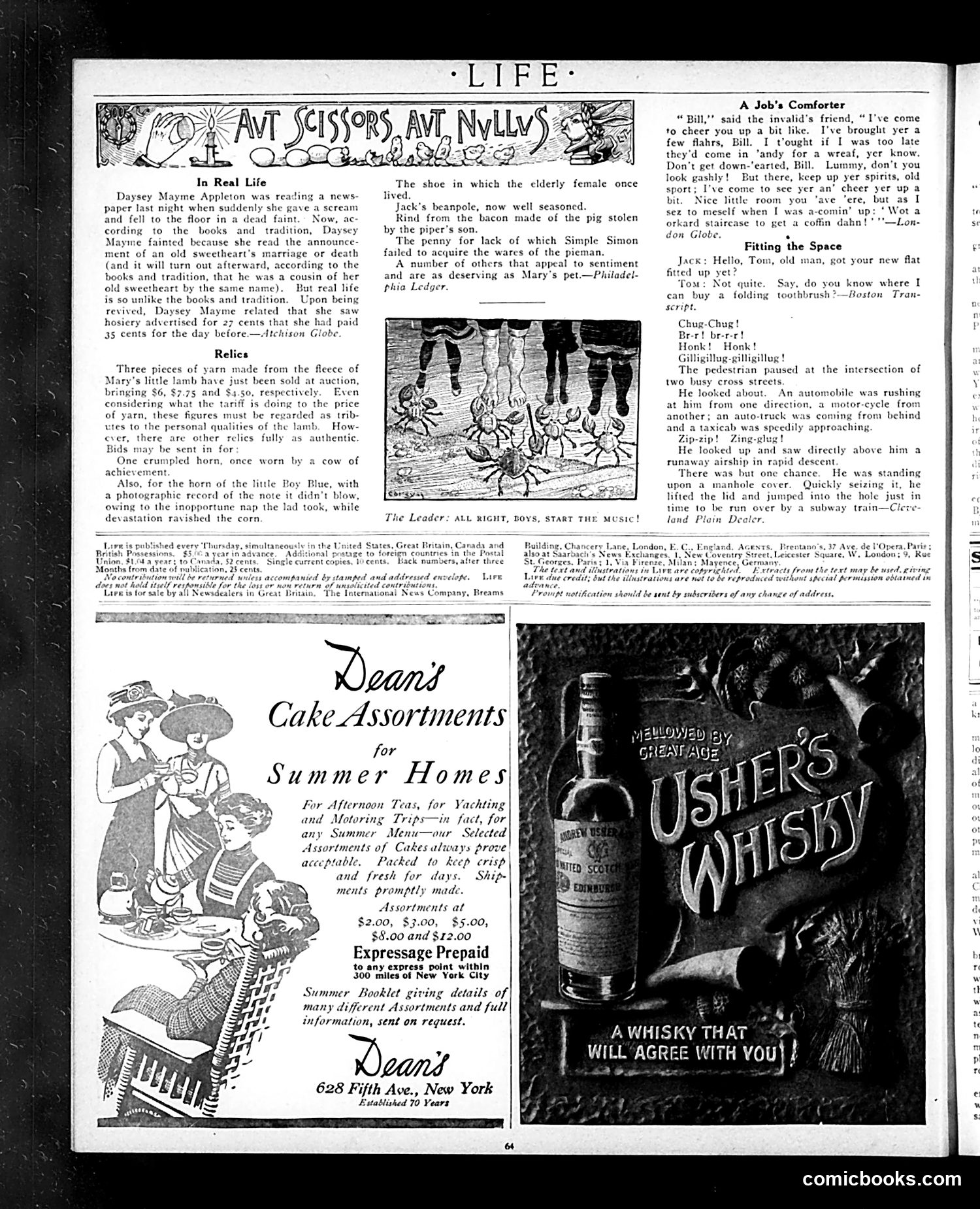
This page contains three distinct pieces: **"Avi Scissors, Avi Nullus"** (top): A satirical cartoon contrasting literary conventions with real life. The text discusses how books portray fainting women dramatically (like fainting upon hearing of an old sweetheart's marriage), but real-life Daysey Mayme simply fainted over hosiery prices—a mundane, humorous deflation of romantic tropes. **"Relics" section**: Satirizes auction mania by proposing ridiculous items for sale: yarn from Mary's Little Lamb and the horn of Boy Blue (from nursery rhymes). It mocks how people will pay inflated prices for trivial items with celebrity or literary connections. **"The Leader" cartoon (center)**: A darkly comic illustration showing a pedestrian at a street intersection narrowly avoiding multiple disasters—a car, motorcycle, taxicab, and falling airship—only to be run over by a subway train emerging from a manhole. It satirizes urban traffic hazards and ironic fate. The page also contains period advertisements for Dean's Cakes and Usher's Whisky.
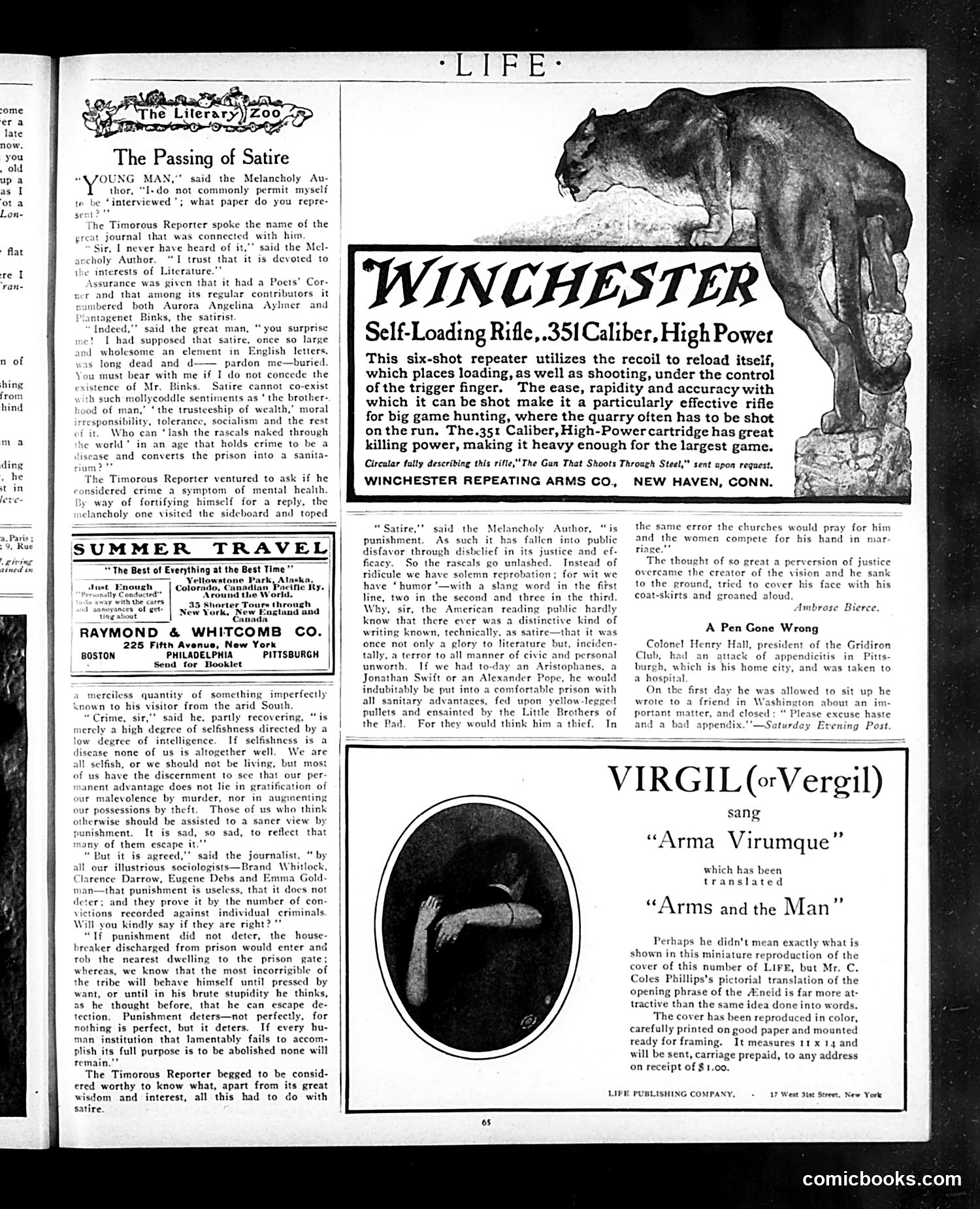
This page contains a satirical dialogue titled "The Passing of Satire," where a melancholy author argues that **true satire is dead** in modern America because contemporary society has embraced sentimental values incompatible with satire's harsh purpose. The author claims satire once "lashed the rascals naked through the world," but cannot survive in an age that treats crime as disease rather than moral failing, advocates rehabilitation over punishment, and celebrates "the brotherhood of man" and tolerance. He references real Progressive-era figures—**Brand Whitlock, Clarence Darrow, Eugene Debs, and Emma Goldman**—who argued punishment doesn't deter crime. The satirist's point: **Modern reform movements and humanitarian thinking have made satirical mockery impossible** because society no longer accepts the harsh moral judgments satire requires. The "timorous reporter" represents conventional journalism unable to understand this paradox. The page also includes period advertisements (travel, Winchester rifles) typical of Life magazine's commercial content.
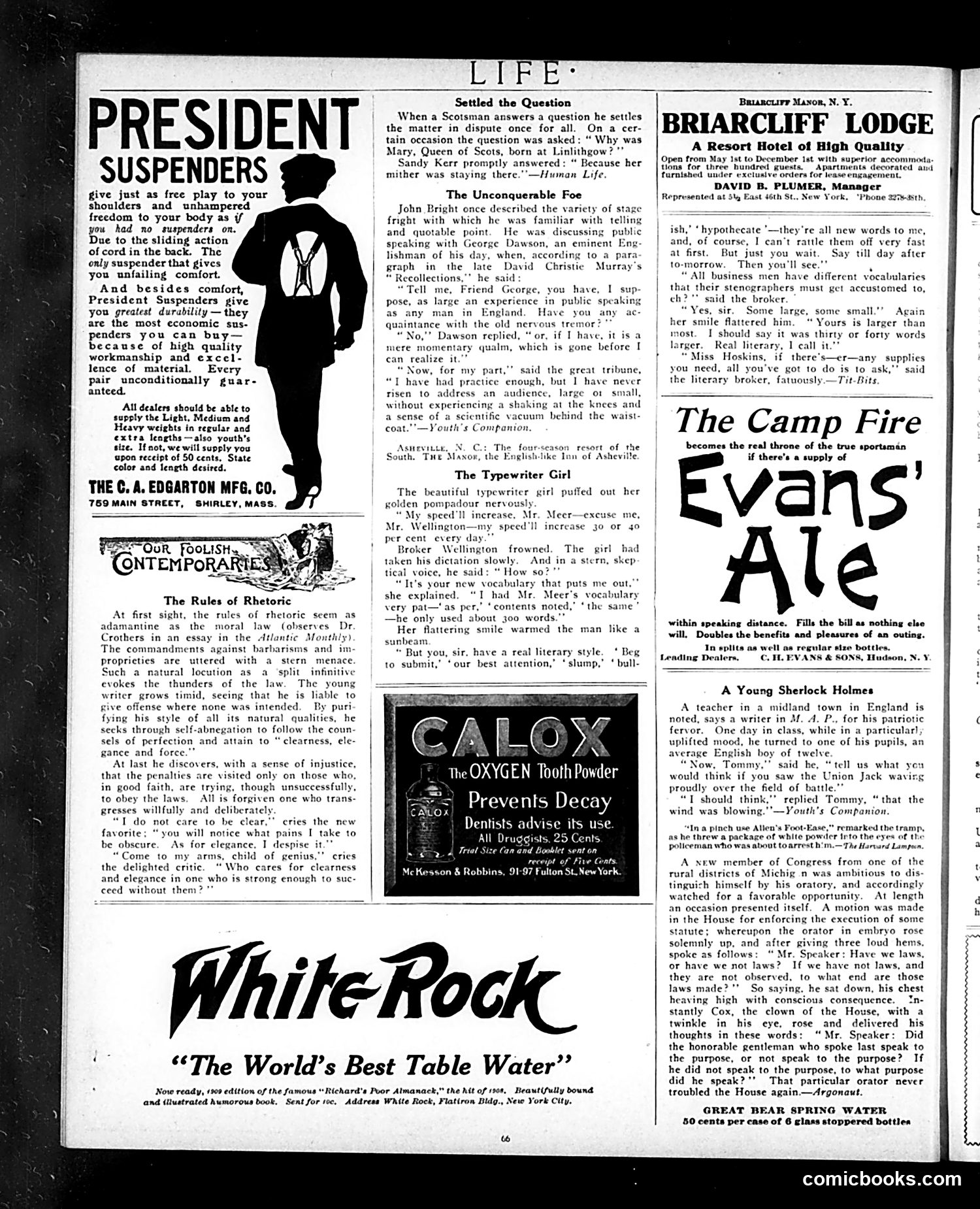
This page from *Life* magazine contains mostly **advertisements and humorous anecdotal pieces** rather than political cartoons. The main content includes: **"President Suspenders"** ad — a straightforward product advertisement claiming ergonomic comfort. **"Our Foolish Contemporaries"** — a satirical essay on rhetoric, mocking overly strict writing rules and the paradox that rule-breakers gain critical praise while earnest rule-followers face contempt. **Three humorous anecdotes:** - A Scottish joke about Mary, Queen of Scots - John Bright's account of stage fright experienced by public speakers - A typewriter operator's excuse for slow typing (her boss's vocabulary is too advanced) **Other advertisements** for Calol tooth powder, White Rock water, Evans' Ale, and Briarcliff Lodge resort. No political cartoons appear on this page. The satire targets **contemporary literary pretension and stuffy social conventions** rather than political figures or events.
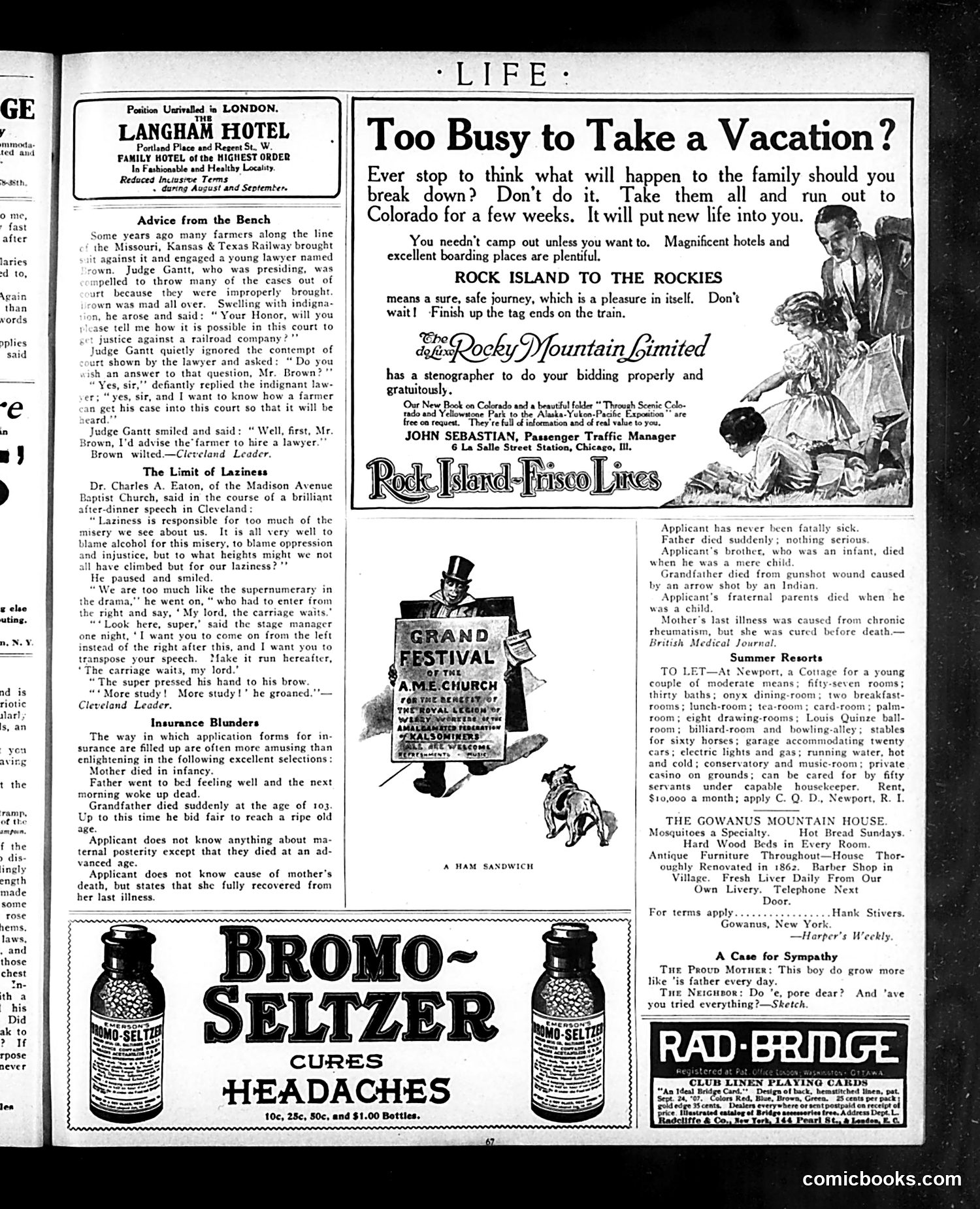
This page contains primarily **humor and advertisements** rather than political cartoons. The main content includes three humorous anecdotes ("Advice from the Bench," "The Limit of Laziness," "Insurance Blunders") that satirize **American social types and institutions**: a hot-headed lawyer confronting railroad company favoritism in court; a lazy actor who can't memorize simple stage directions; and absurd insurance application responses revealing applicant incompetence or negligence. The advertisements promote **vacation travel** (Rock Island Railroad to Colorado/Rockies), **Bromo-Seltzer** headache remedy, and various hotels and resorts. A small illustration shows "A Ham Sandwich" (possibly mocking vaudeville or low entertainment). The satirical humor targets **everyday American incompetence and pretension** rather than specific political figures or events. The insurance section particularly mocks how people fill out forms carelessly or dishonestly—a recurring comedy theme in this era's magazines. This reflects Life magazine's typical format: light domestic satire, practical jokes, and consumer advertising aimed at middle-class readers.
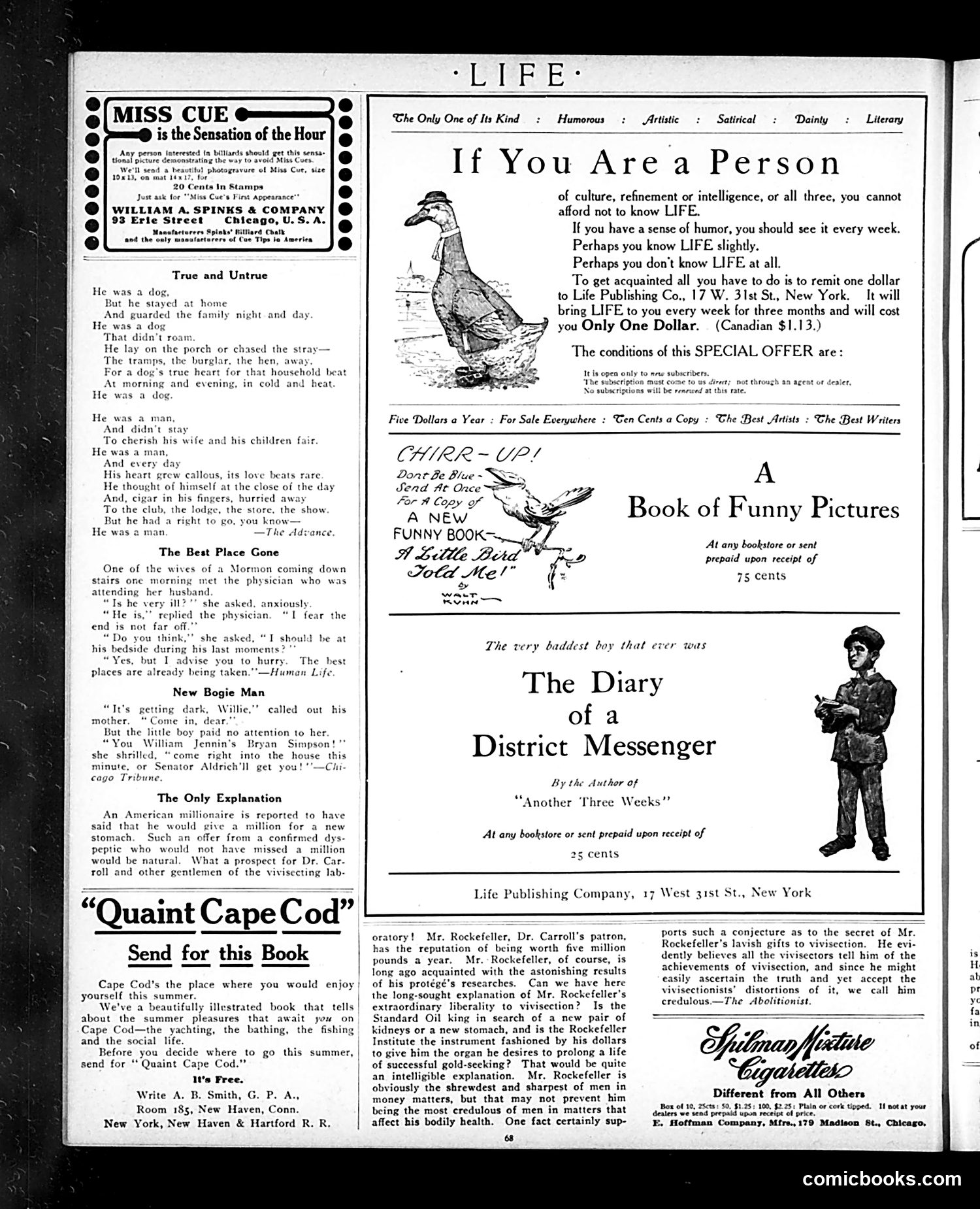
This page is primarily **advertising and promotional content** for Life magazine and related books, rather than political cartoons. The few short humorous pieces included are mild satire: **"True and Untrue"** contrasts a loyal dog with a selfish man who neglects his family for clubs and shows—a commentary on masculine neglect and domestic duty, common Progressive-era critique. **"New Bogie Man"** references **William Jennings Bryan** and **Senator Aldrich** as names mothers invoke to frighten children into obedience, suggesting both were viewed as threatening or unpopular figures to the magazine's readership. **"The Only Explanation"** mocks a millionaire's dyspepsia so severe he'd pay a fortune for a new stomach—satirizing both wealth's inability to solve health problems and the era's vivisection debates in medical research. The page mostly advertises Life's subscription offer, books on billiards and messengers, and Cape Cod travel—reflecting early 1900s leisure marketing more than political commentary.
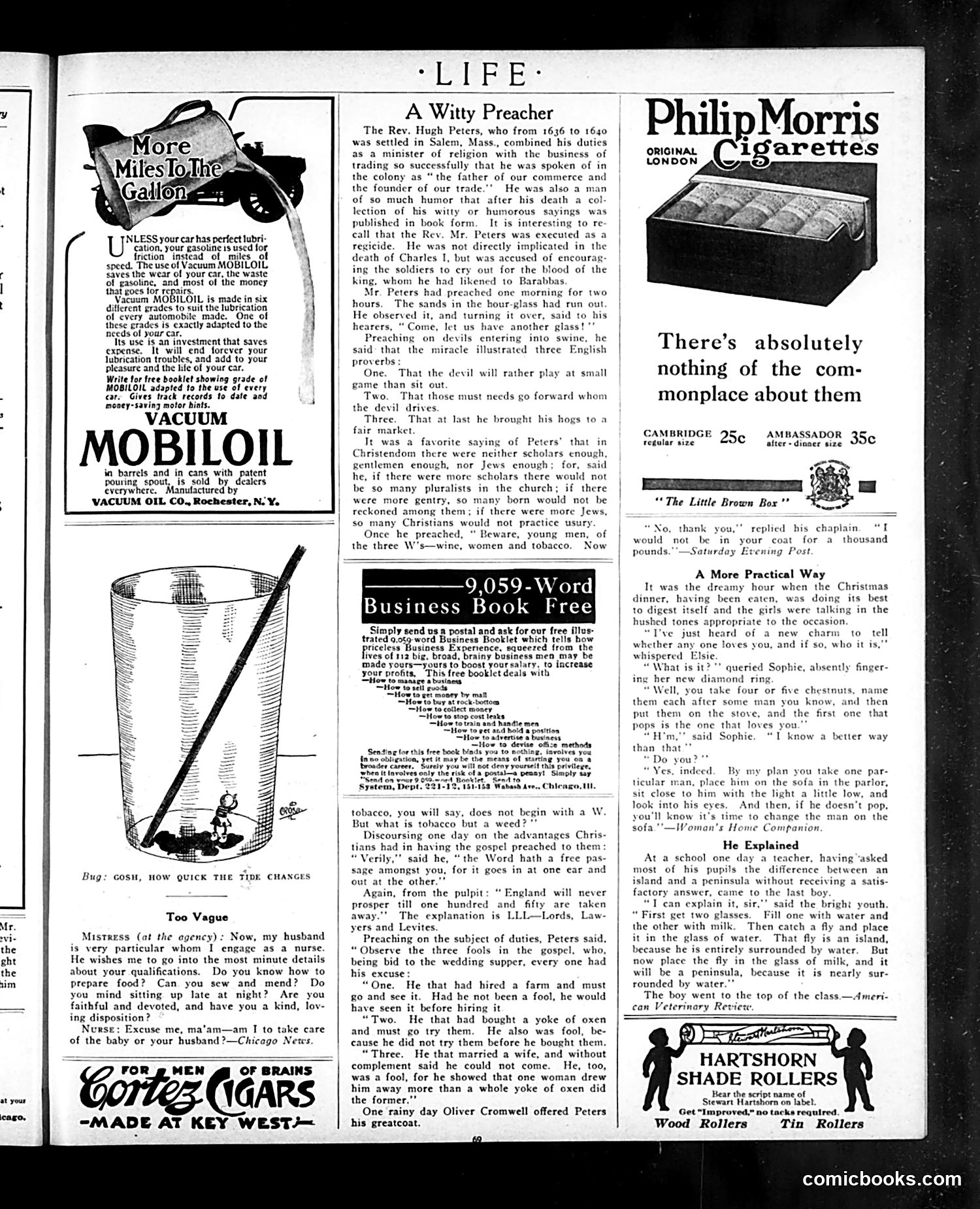
This page contains **mostly advertising** (Mobiloil motor oil, Cortes Cigars, Philip Morris cigarettes, a business book offer) interspersed with light humor pieces typical of *Life* magazine's satirical content. The main article, "A Witty Preacher," recounts humorous anecdotes about Reverend Hugh Peters (1636-1640), a Salem minister known for combining commerce with ministry. The jokes illustrate his wordplay: he famously said "Come, let us have another glass" when his hourglass ran out mid-sermon, and used biblical stories (demons entering swine) to illustrate proverbs about devils, commerce, and human nature. The small cartoon "Too Vague" is a domestic comedy: a mistress interviewing a nurse lists exhausting qualifications—cooking, sewing, night duty, devotion—prompting the nurse to ask sardonically whether she's being hired to care for the baby or the husband. It's gentle satire on unrealistic employer demands. These pieces reflect *Life*'s early 20th-century blend of historical anecdotes and domestic humor aimed at educated readers.
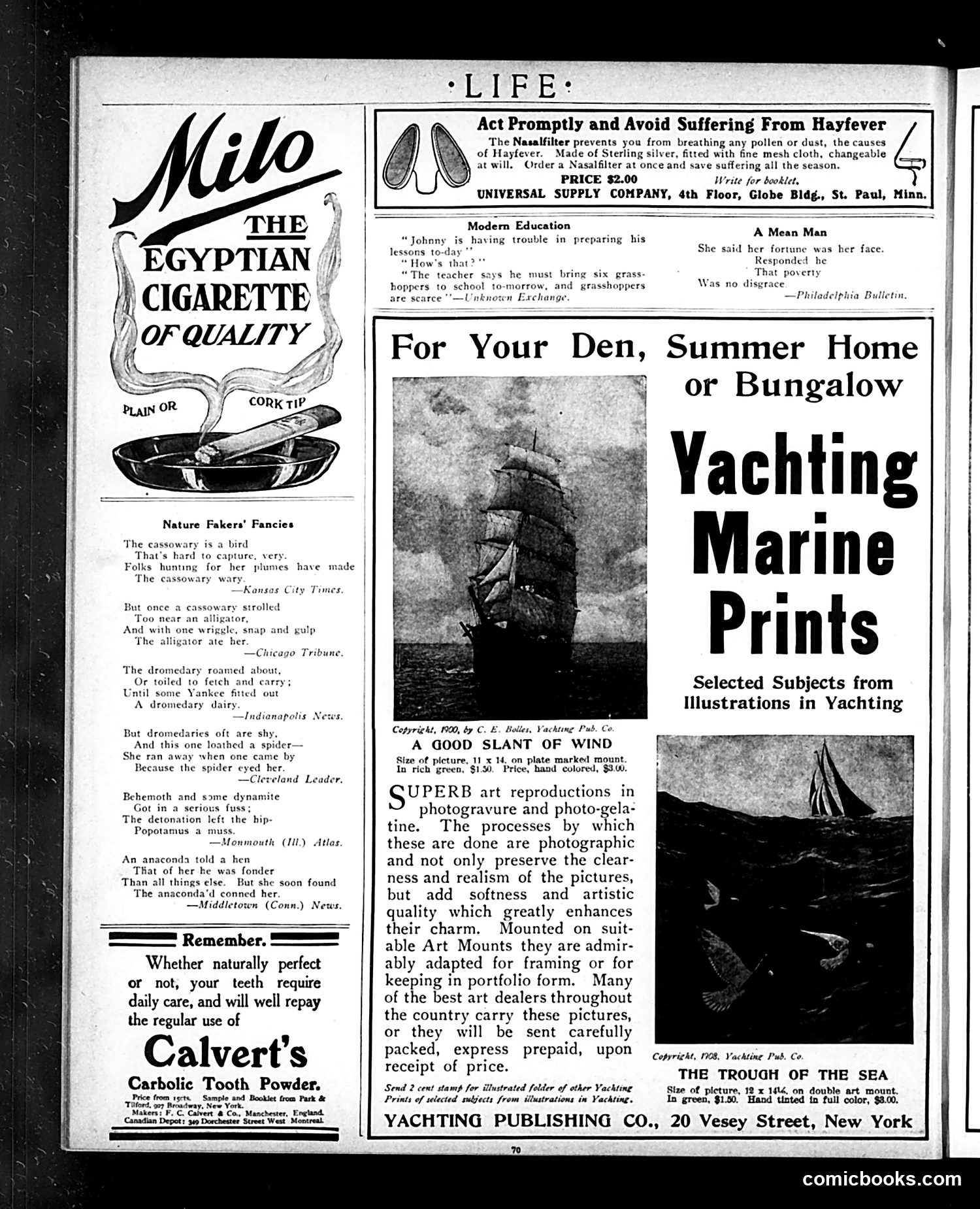
This page features a series of humorous poems poking fun at what were called "nature fakers"—a real early-1900s controversy over writers and naturalists who exaggerated or fabricated animal behavior in their work. Each brief poem uses animal puns and wordplay to mock this trend. Examples include a cassowary made "wary" by hunters, a "dromedary dairy," and a dromedary afraid of spiders because it would be "eyed her." An anaconda "conned" a hen; a hippopotamus gets blown up ("hippo-potamus a muss"). The satire targets both the gullible public who believed exaggerated nature stories and the authors who invented them for dramatic effect. The poems, credited to various newspapers, suggest this was a widespread cultural joke—readers found amusement in absurd animal tales. The page also includes period advertisements and unrelated humor, typical of *Life* magazine's format.
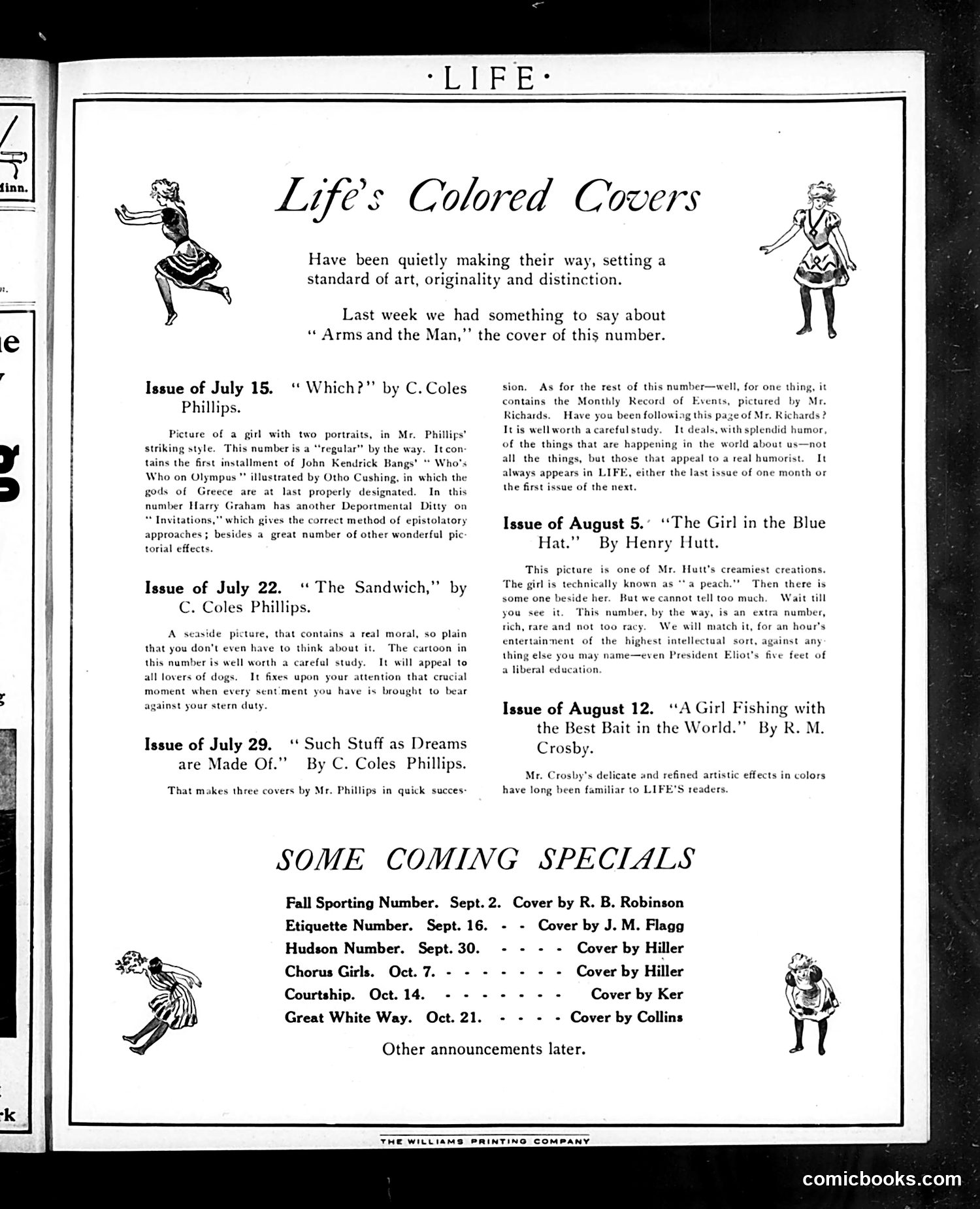
This page showcases Life's recent colored magazine covers, highlighting their artistic quality and originality. The text reviews covers from July and August by prominent illustrators C. Coles Phillips, Henry Hutt, and R.M. Crosby. Key references include a cover titled "Which?" featuring a girl with two portraits, and references to serialized content like John Kendrick Bangs' "Who's Who on Olympus" (humorously assigning Greek gods proper identities). A notable mention compares an intellectual number favorably to "President Eliot's five feet of a liberal education"—likely referencing Harvard president Charles Eliot's famous educational philosophy. The page advertises upcoming special issues (Fall Sporting, Etiquette, Hudson, Chorus Girls, Courtship, Great White Way), each with different cover artists. Overall, this is primarily an in-house advertisement celebrating Life's visual sophistication and upcoming editorial content for affluent readers.
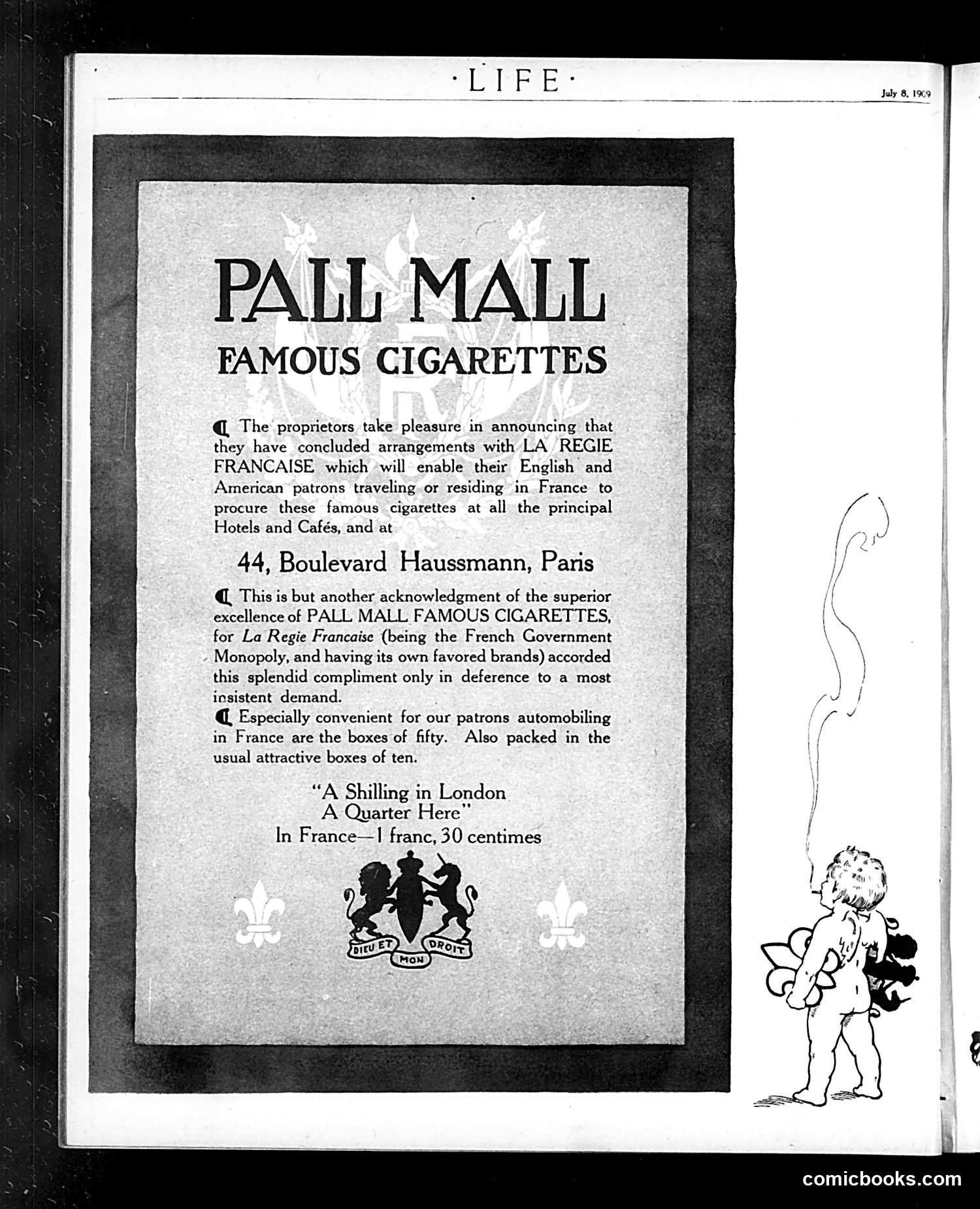
This page is primarily a **cigarette advertisement**, not political satire. It announces that Pall Mall cigarettes are now available in France through arrangements with La Régie Française (the French government tobacco monopoly). The ad boasts that this placement represents an endorsement of Pall Mall's "superior excellence," claiming the French monopoly made this exception only due to "insistent demand." The copy uses flattery and exclusivity as sales tactics—suggesting that even a government-controlled entity couldn't resist the brand's quality. Pricing is listed for London, America, and France (1 franc, 30 centimes). The cartoon on the right margin appears unrelated to the advertisement—it shows a cherub or cupid figure with what looks like a smoking or steam effect, likely part of a separate humorous piece in Life magazine. This reflects early 20th-century advertising practices and transatlantic commerce before modern cigarette health warnings.