
Life, 1909-07-08 · page 18 of 28
Life — July 8, 1909 — page 18: what you’re looking at
What you’re looking at
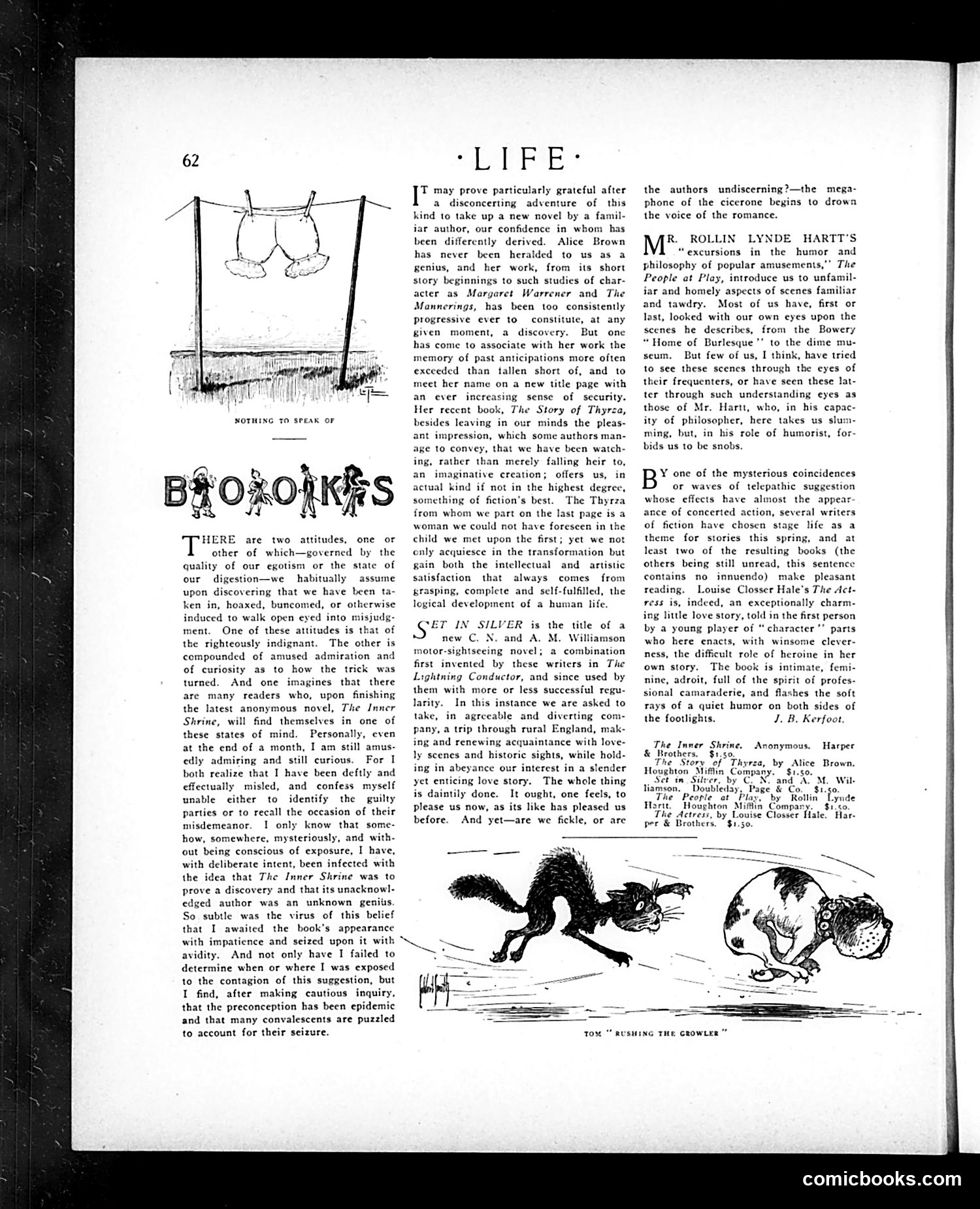
This page from *Life* magazine contains no political cartoon in the traditional sense. Instead, it's a book review section titled "BROLORKES" (likely a playful made-up word). The illustration at bottom—showing a cat chasing or "rushing" at growling dogs—is a humorous visual metaphor accompanying the review text. It's not political satire but rather decorative art supporting the literary discussion. The page critiques readers' susceptibility to hype around anonymous novels like *The Inner Shrine*, contrasting this with established author Alice Brown's reliable, character-driven work (*The Story of Thyrza*). The reviewer discusses how marketing and mystery create false anticipation versus earned reputation. The cat-and-dogs image likely represents the playful literary "battle" being discussed—the conflict between gullible readers and clever publishers' promotional tactics.
📄 Transcribed text from this page (OCR, searchable)
Machine-transcribed from the original scan — historical spelling and the odd misread are preserved.
NOTHING TO SPEAK OF BROLORKES HERE are two attitudes, one or other of which—governed by the quality of our egotism or the state of our digestion—we habitually assume upon discovering that we have been ta- ken in, hoaxed, buncomed, or otherwise induced to walk open eyed into misjudg- ment. One of these attitudes is that of the righteously indignant. The other is compounded of amused admiration and of curiosity as to how the trick was turned. And one imagines that there are many readers who, upon finishing the latest anonymous novel, The Inner Shrine, will find themselves in one of these states of mind. Personally, even at the end of a month, I am still amus- edly admiring and still curious. For I both realize that I have been deftly and effectually misled, and confess myself unable either to identify the guilty parties or to recall the occasion of their misdemeanor. I only know that some- how, somewhere, mysteriously, and with- out being conscious of exposure, I have, with deliberate intent, been infected with the idea that The Inner Shrine was to prove a discovery and that its unacknow!- edged author was an unknown geniis So subtle was the virus of this belief that I awaited the book's appearance with impatience and seized upon it with avidity. And not only have I failed to determine when or where I was exposed to the contagion of this suggestion, but I find, after making cautious inquiry, that the preconception has been epidemic and that many convalescents are puzzled to account for their seizure. “LAPSE * T may prove particularly grateful after a disconcerting adventure of this kind to take up a new novel by a famil- iar author, our confidence in whom has been differently derived. Alice Brown has never been heralded to us as a genius, and her work, from its short story beginnings to such studies of char- acter as Margaret Warrener and The Mannerings, has been too consistently Progressive ever to constitute, at any ven moment, a discovery. But one has come to associate with her work the memory of past anticipations more often exceeded than fallen short of, and to meet her name on a new title page with an ever increasing sense of security. Her recent book, The Story of Thyrza, besides leaving in our minds the pleas- ant impression, which some authors man- age to convey, that we have been watch- ing, rather than merely falling heir to, an imaginative creation; offers us, in actual kind if not in the highest degree, something of fiction’s best. The Thyrza from whom we part on the last page is a woman we could not have foreseen in the child we met upon the first; yet we not only acquiesce in the transformation but gain both the intellectual and artistic satisfaction that always comes from grasping, complete and self-fulfilled, the logical development of a human life. T IN SILVER is the title of a new C. N. and A. M. Williamson motor-sightsecing novel; a combination first invented by these writers in The Lightning Conductor, and since used by them with more or less successful regu- larity. In this instance we are asked to take, in agreeable and diverting com- pany, a trip through rural England, mak- ing and renewing acquaintance with love- ly scenes and historic sights, while hold- ing in abeyance our interest in a slender yet enticing love story. The whole thing is daintily done. It ought, one feels, to please us now, as its like has pleased us before. And yet—are we fickle, or are the authors undiscerning?—the mega- phone of the cicerone begins to drown the voice of the romance. ME ROLLIN LYNDE HARTT'S “excursions in the humor and philosophy of popular amusements," The People at Play, introduce us to unfamil- iar and homely aspects of scenes familiar and tawdry. Most of us have, first or last, looked with our own eyes upon the scenes he describes, from the Bowery “Home of Burlesque" to the dime mu- scum. But few of us, I think, have tried to see these scenes through the eyes of their frequenters, or have seen these lat- ter through such understanding eyes as those of Mr. Hartt, who, in his capac- ity of philosopher, here takes us slum- ming, but, in his role of humorist, for- bids us to be snobs. BY one of the mysterious coincidences or waves of telepathic suggestion whose effects have almost the appear ance of concerted action, several writers of fiction have chosen stage life as a theme for stories this spring, and at least two of the resulting books (the others being still unread, this sentence contains no innuendo) make pleasant reading. Louise Closser Hale’s The Act- ress is, indeed, an exceptionally charm- ing little love story, told in the first person by a young player of “character '” parts who here enacts, with winsome clever- ness, the difficult role of heroine in her own story. The book is intimate, fem nine, adroit, full of the spirit of profes- jonal camaraderie, and flashes the soft rays of a quiet humor on both sides of the footlights. J.B. Kerfoot. The Inner Shrine, & Brothers. $1.50. The Story of Thyrza, by Alice Brown. Houghton Mifflin Company. $1.50. Set im Silver, by C.N. and AL M. Wil- liamson. | "Doubleday, Page & Co." $1.50. The People at Play, by Rollin Lynde Hartt. Houghton Miftha Company. $1.50 The Actress, by Louise Closer Hale. Har- per & Brothers. $1.50. Anonymous, Harper Tow “RUSHING THE CRowLEE ” comicbooks.com