
Life, 1909-07-08 · page 6 of 28
Life — July 8, 1909 — page 6: what you’re looking at
What you’re looking at
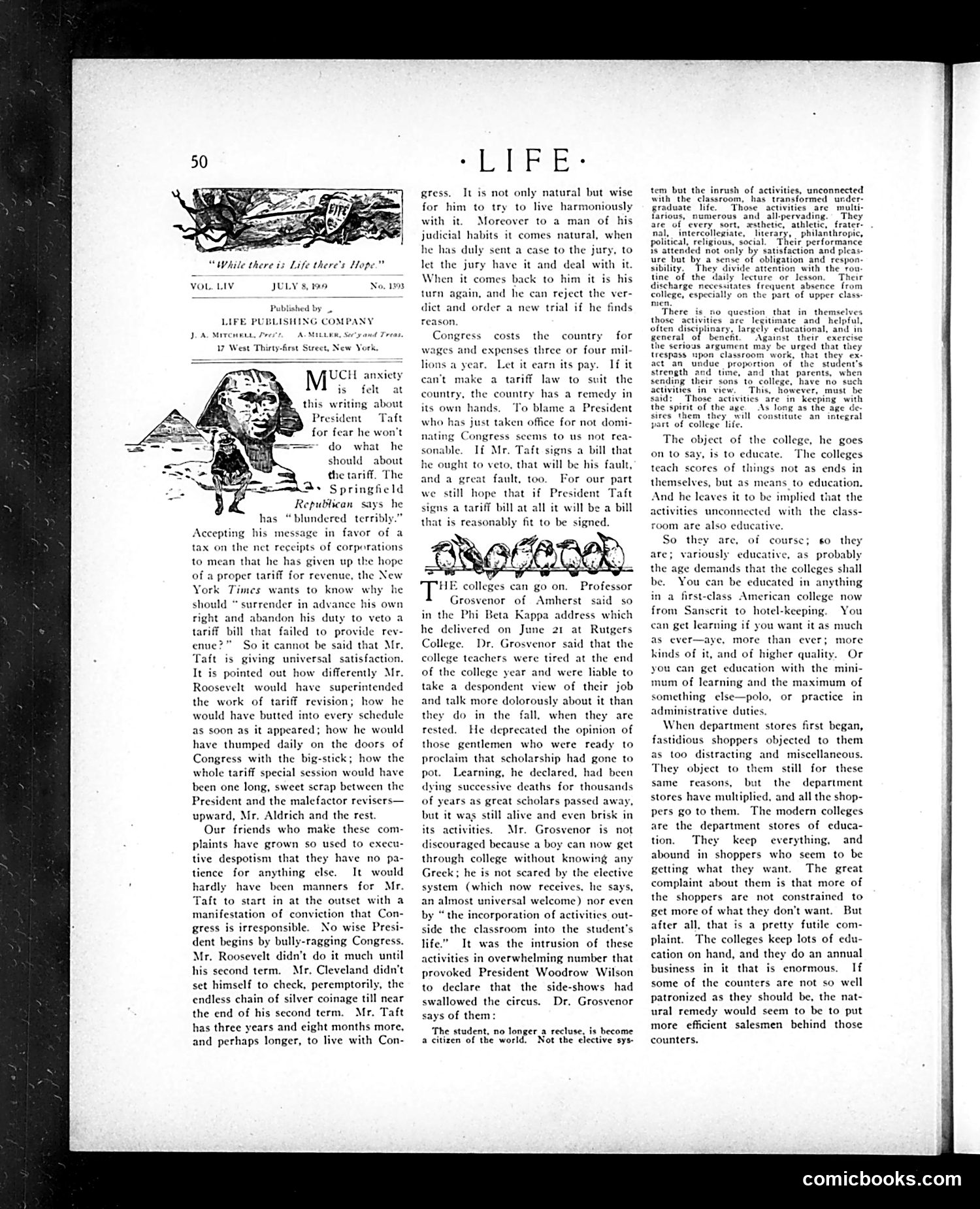
The page features an editorial discussing President Taft's approach to tariff legislation and congressional costs. The two cartoons appear to satirize political figures of the era. The left illustration shows a caricatured head in profile, labeled "Republican says he has blundered terribly!" This likely mocks Republican positions on tariffs or Taft's early presidency challenges. The central cartoon depicts what appears to be caricatured heads, though the specific figures are unclear from the image quality. The editorial argues that Congress spends excessively ($3-4 million yearly) and criticizes both blaming President Taft for tariff issues and Roosevelt's previous tariff policies. It also defends college activities as educationally legitimate, countering arguments they distract from classroom learning. The overall tone is satirical commentary on early-1900s political debates surrounding executive authority, legislative spending, and educational policy.
📄 Transcribed text from this page (OCR, searchable)
Machine-transcribed from the original scan — historical spelling and the odd misread are preserved.
“While there iz Life there's Hope.” LAY JULY 8,190 Published by LIFE PUBLISHING COMPANY A. Mivcnnt, Prey 17 West Thi AL MILLER, Ser'pamt Treas y-first Street, New York. CH anxiety s felt at this writing about President Taft for fear he won't do what he should about the tariff. The aoe Ss Springfield Republican says he has “blundered terribly.” Accepting his message in favor of a tax on the net receipts of corporations to mean that he has given up the hope of a proper tariff for revenue, the New York Times wants to know why he should * surrender in advance his own right and abandon his duty to veto a tariff bill that failed to provide rev- enue So it cannot be said that Mr. Taft is giving universal satisfaction. It is pointed out how differently Mr. Roosevelt would have superintended the work of tariff revision; how he would have butted into every schedule as soon as it appeared; how he would have thumped daily on the doors of Congress with the big-stick; how the whole tariff special session would have been one long, sweet scrap between the President and the malefactor revisers— upward, Mr, Aldrich and the rest. Our friends who make these com- plaints have grown so used to exect- tive despotism that they have no pa- tience for anything else. It would hardly have been manners for Mr. Taft to start in at the outset with a manifestation of conviction that Con- gress is irresponsible. No wise Presi- dent begins by bully-ragging Congress. Mr. Roosevelt didn’t do it much until his second term. Mr, Cleveland didn’t set himself to check, peremptorily, the endless chain of silver coinage till near the end of his second term. Mr. Taft has three years and eight months more, and perhaps longer, to live with Con- SES ERAES gress. It is not only natural but wise for him to try to live harmoniously with it. Moreover to a man of his judicial habits it comes natural, when he has duly sent a case to the jury, to let the jury have it and deal with it. When it comes back to him it is his turn again, and he can reject the ver- dict and order a new trial if he finds reason. Congress costs the country for ges and expenses three or four mil- Let it earn its pay. If it a tariff law to suit the lions a year. can't_ make country, the country has a remedy in its own hands. To blame a President who has just taken office for not domi- nating Congress seems to us not If Mr. Taft signs a bill that he ought to veto, that will be his fault, and a great fault, too. For our part we still hope that if President Taft signs a tariff bill at all it will be a bill that is reasonably fit to be signed. rea- sonable. HE. colleges can go on. Professor Grosvenor of Amherst said so in the Phi Beta Kappa address which he delivered on June 21 at Rutgers College. Dr. Grosvenor said that the college teachers were tired at the end of the college year and were liable to take a despondent view of their job and talk more dolorously about it than they do in the fall. when they are rested. He deprecated the opinion of those gentlemen who were ready to proclaim that scholarship had gone to pot. Learning, he declared, had been dying successive deaths for th of years as great scholars passed away, but it was still alive and even brisk in its activities. Mr. Grosvenor is not discouraged because a boy can now get through college without knowing an Greck; he is not scared by the elective system (which now receives. he says, an almost universal welcome) nor even by “the incorporation of activities out- side the classroom into the student's life.” It was the intrusion of these activities in overwhelming number that provoked President Woodrow Wilson to declare that the side-shows had swallowed the circus. Dr. Grosvenor says of them: ousands ‘The student, no longer a recluse, is become a citizen of the world. Not the elective sys- tem but the inrush of activities, unconnected with the classroom, has transformed. under- graduate life. Those activities are multi- farious, numerous and all-pervading. | They are of every sort, aesthetic, athletic, frater nal, intercollegiate, literary, philanthropic, political, religious, social. Their performance 3s attended not only by satisfaction and pleas ure but by a sense of obligation and respon. sibility, They divide attention with the rou, tine of the daily lecture or lesson, Their discharge necessitates frequent absence from college, especial per class nie. There is no question that in themselves those activities are. legitimate and help{v often disciplinary, largely educational, and general of benefit. Against their exercise serioas argument may be urged that they trespass upon classroom work, thot they. ¢ act an undue proportion of the student's strength and that parents, whe sending their sons’ to college, have no such activities in view. This, however, must b id: Those activities are the spirit of the age. As I res them they will rt of college life. n the part of uy constitute an integral The object of the college, he goes on to say The colleges teach scores of things not as ends in themselves, but as means to education. And he leaves it to be implied that the activities unconnected with room are also educative. So they are, of so they are; variously educative, as probably the age demands that the colleges shall be. You can be educated in anything in a first-class American college now from Sanserit to hotel-keeping. You can get learning if you want it as much as ever—aye, more than ever; more kinds of it, and of higher quality. Or you can get education with the mini- mum of learning and the maximum of something else—polo, or practice in administrative duties. When department stores first began, fastidious shoppers objected to them as too distracting and miscellancous. They object to them still for these reasons, but the department stores have multiplied, and all the shop- pers go to them. The modern colleges are the department stores of educa- tion. They keep everything, and abound in shoppers who seem to be getting what they want. The great complaint about them is that more of the shoppers are not constrained to get more of what they don't want. But after all, that is a pretty futile com- plaint. The colleges keep lots of edu- cation on hand, and they do an annual business in it that is enormous. If some of the counters are not so well patronized as they should be, the nat- ural remedy would seem to be to put more efficient salesmen behind those counters. is to educate. the class- ‘ourse; same comicbooks.com