
A complete issue · 36 pages · 1909
Life — March 25, 1909
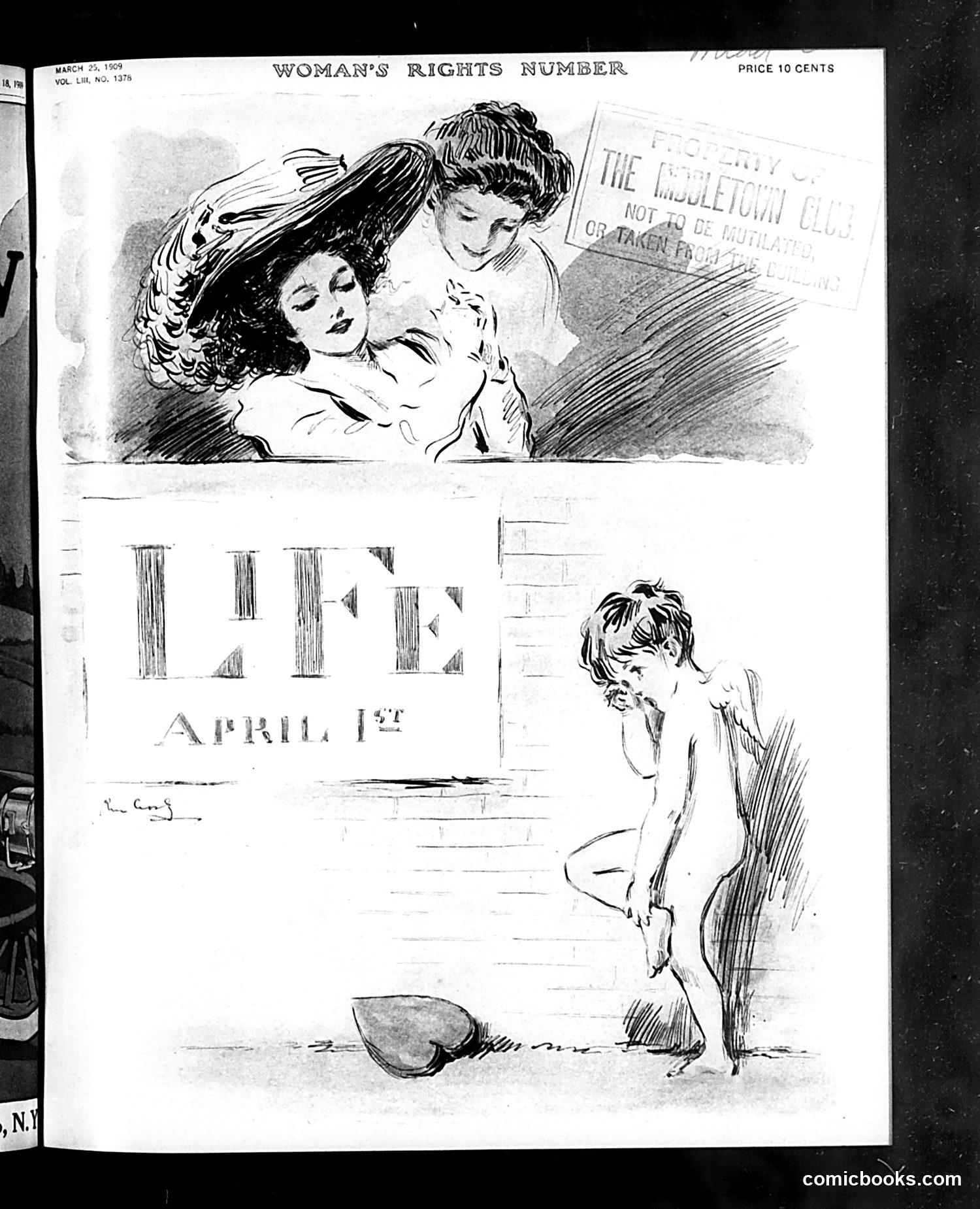
This is a satirical "Woman's Rights Number" issue priced at 10 cents. The cartoons employ common anti-suffrage humor of the era. The top illustration shows two women at what appears to be a club, with one saying women shouldn't be "mutilated or taken from it"—likely mocking concerns that political rights would somehow harm women or remove them from domestic/social spaces. The bottom cartoon depicts a child looking at a calendar marked "LIFE APRIL 1ST," seemingly abandoned. This appears to satirize fears that women's rights activism would cause women to neglect motherhood and childcare—a common anti-suffrage argument suggesting women couldn't balance political participation with domestic duties. Both images mock anxieties about women's suffrage through exaggeration and domestic scenarios.
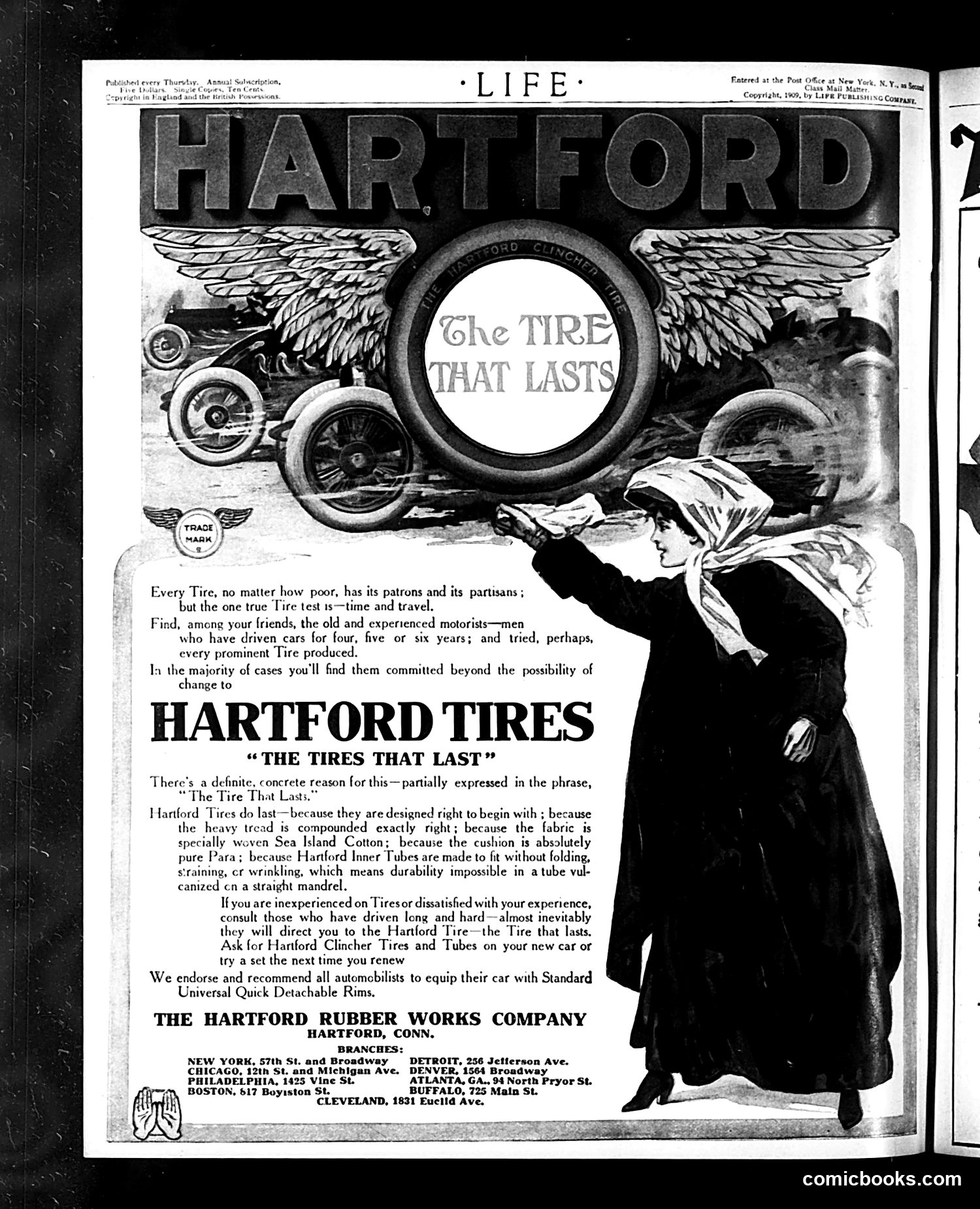
This is primarily a **commercial advertisement**, not political satire. It's a full-page ad for Hartford Tires from The Hartford Rubber Works Company (Hartford, Connecticut), appearing in *Life* magazine. The ad features: - A large tire as the central image with wings (suggesting reliability/flight) - Early automobiles in the background - A well-dressed woman in period clothing (appearing to be 1910s-1920s era) pointing toward the tire - Marketing copy claiming Hartford Tires "last" longer than competitors The appeal targets experienced motorists and suggests consulting longtime drivers about tire quality. The tagline "The Tire That Lasts" emphasizes durability—the key selling point for early automotive tires, which were prone to punctures and deterioration. This is straightforward product marketing without satirical commentary.

This page is primarily a **Winchester rifle advertisement**, not political satire. It features a map of Africa with a rifle superimposed across it, targeting the continent. The ad copy emphasizes Winchester rifles and ammunition as "the invariable choice of experienced and discriminating big game hunters." The phrase "Coming Events Cast Their Shadows" at the bottom appears ominous in hindsight, but in context it likely refers to upcoming African hunting seasons or expeditions. The advertisement reflects early 20th-century attitudes toward Africa as a hunting destination for wealthy Western sportsmen. It uses the continent itself as visual metaphor for game to be pursued, which today reads as deeply problematic given the colonial context, but the ad is straightforward marketing rather than explicit political commentary.
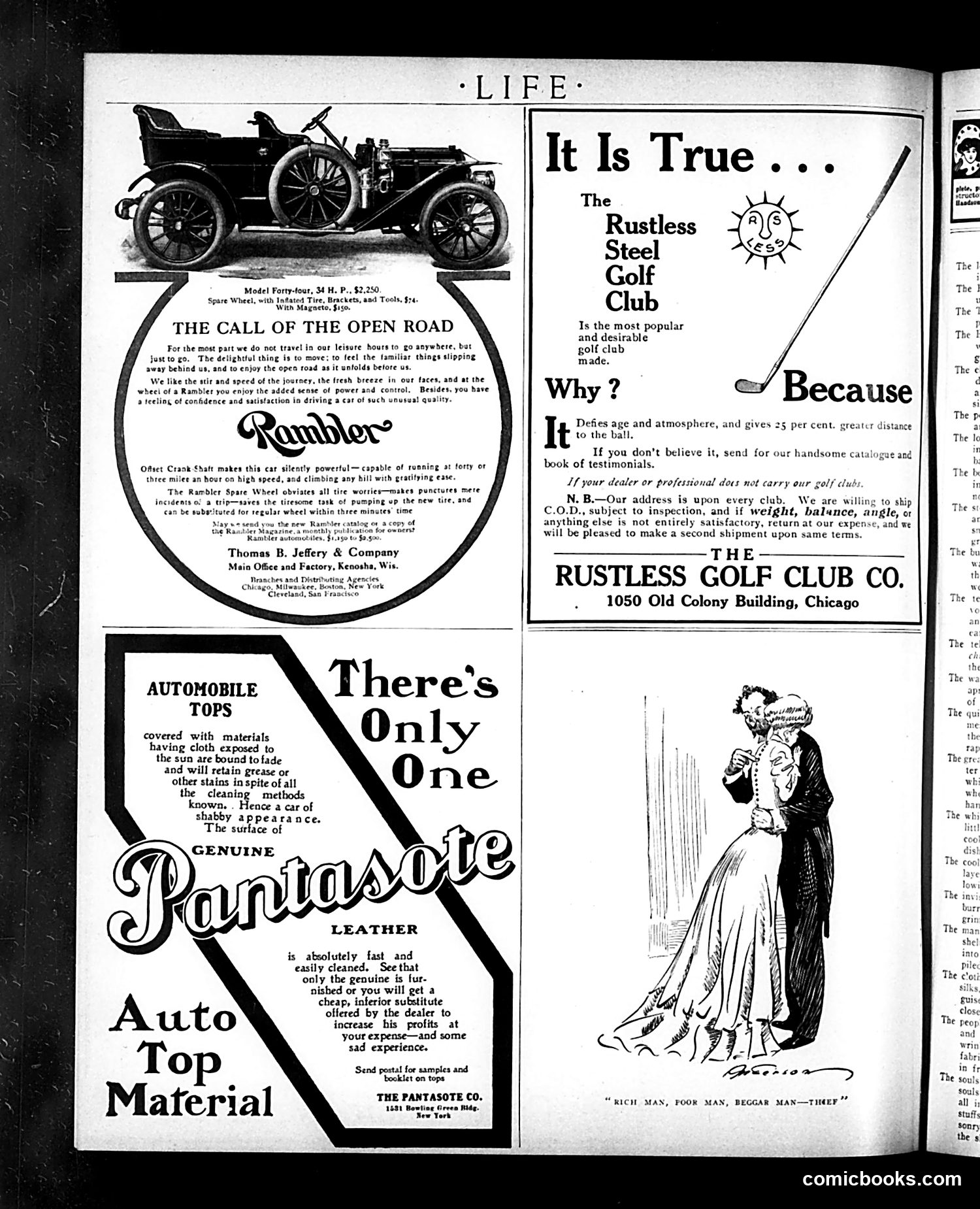
This page is primarily **advertising** rather than editorial content. Three product advertisements occupy the space: 1. **Rambler automobile** ("The Call of the Open Road") - promotes a Model Forty-four car 2. **Rustless Steel Golf Club** - claims superior distance and popularity; includes testimonial language 3. **Pantasote Leather** - advertises automobile top material as superior to substitutes The only cartoon illustration is unrelated to these ads: a sketch captioned "Rich Man, Poor Man, Beggar Man—Thief" depicting a couple in formal dress (appears to reference a children's rhyme about fortune-telling). The page reflects early 20th-century commercial culture, emphasizing technological innovation (automobiles, golf equipment) and material quality as status markers. No political satire is evident.
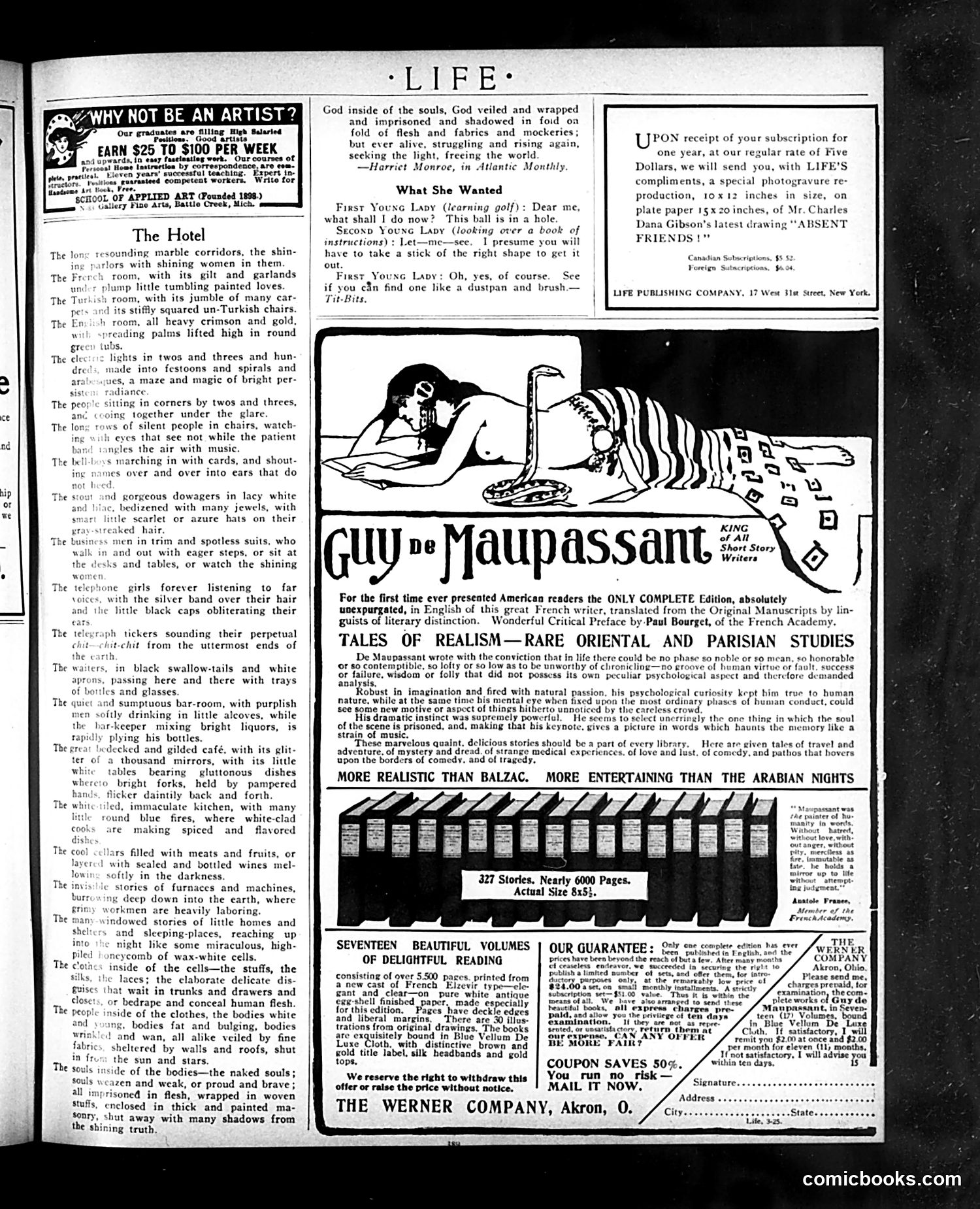
This page is primarily **advertising and literary promotion**, not political satire. The dominant content advertises a complete edition of Guy de Maupassant's works—17 volumes totaling nearly 6,000 pages—published by The Werner Company of Akron, Ohio. The illustration shows a reclining woman in classical pose alongside Maupassant imagery, used to market the French author's fiction to American readers. The ad emphasizes this as "the ONLY COMPLETE Edition" with "Wonderful Critical Preface by Paul Bourget of the French Academy." Secondary content includes "The Hotel" (descriptive prose about a grand establishment) and advice columns addressing etiquette questions. A small "Why Not Be an Artist?" vocational ad appears in the upper left. The page reflects early 20th-century publishing marketing rather than political commentary.
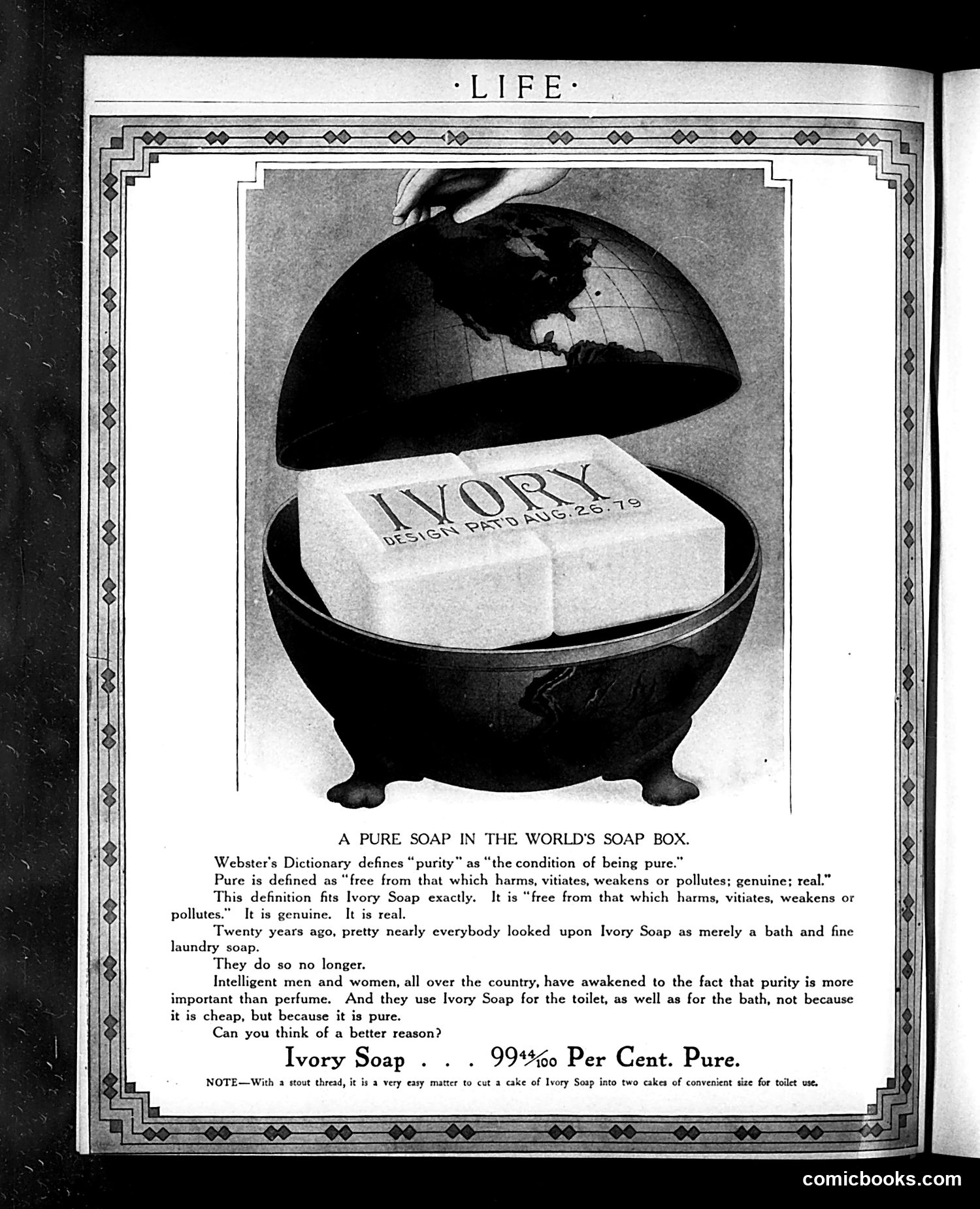
This is **an advertisement, not satire or political cartoon**. It promotes Ivory Soap using a visual pun. The image shows a globe emerging from a large clam shell—a clever visual metaphor since the ad emphasizes purity and uses Webster's Dictionary definition of "pure" as the selling point. The globe represents global reach or the world market. The text argues that Ivory Soap's appeal has evolved: twenty years prior, consumers viewed it merely as a bath soap, but intelligent people now recognize its superiority for toilet use specifically *because* of its purity. The pun works by suggesting the soap comes from the "world's soap box"—a sealed, pristine container. **Design Patent date: Aug. 26, 1919** (visible on the soap bars). Price: 99 4/100 percent pure.
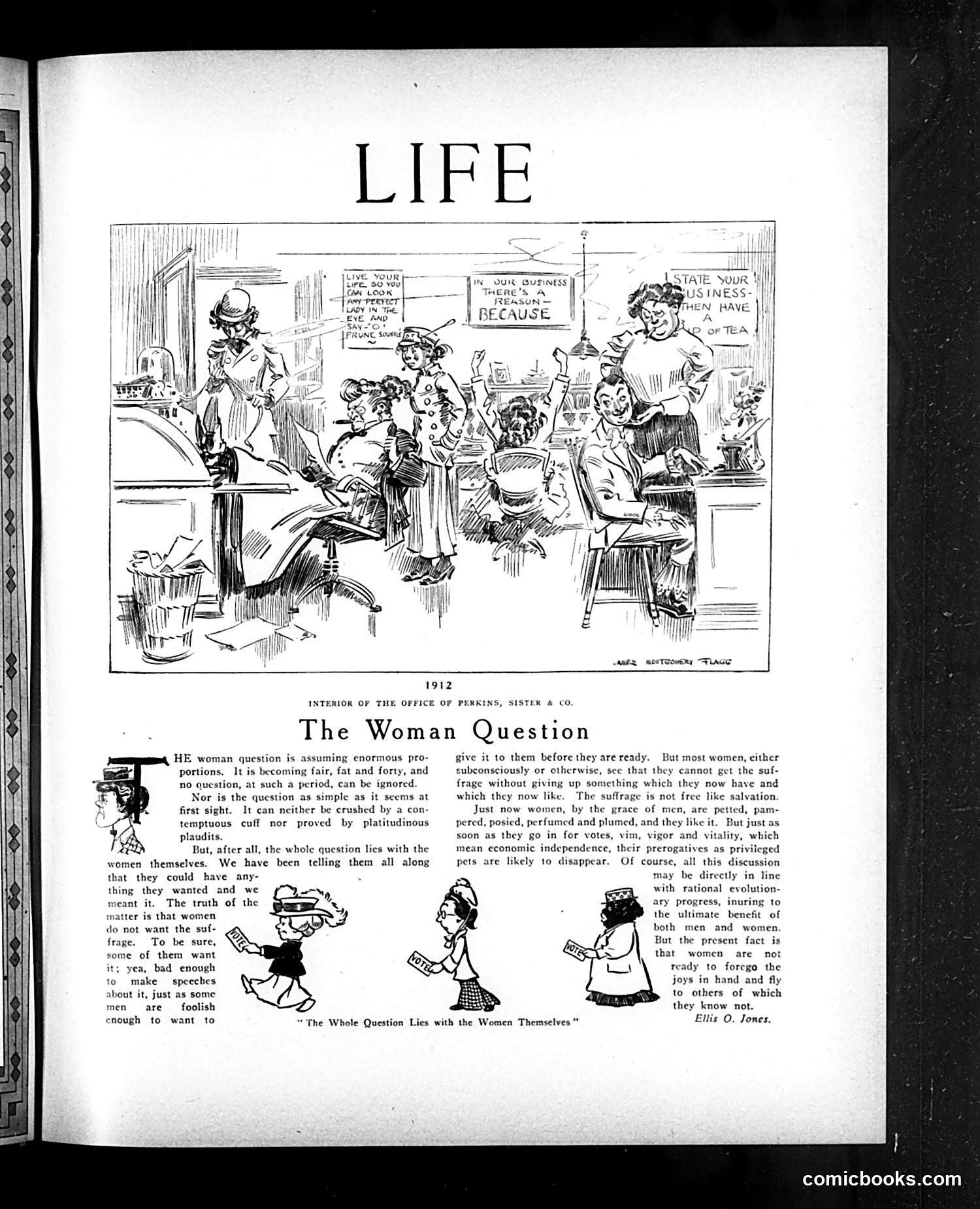
This page satirizes early 20th-century debates over women's suffrage and social roles. The top cartoon shows an office scene where women discuss business matters, with speech bubbles indicating they're debating whether women should engage in business "because" of unspecified reasons—the humor resting on women's supposed inability to articulate serious arguments. The article below, titled "The Woman Question," presents a common anti-suffrage argument: women don't actually want voting rights; they're content with their current status. The author (Ellis O. Jones) dismissively suggests women "are not ready to forgo the joys in hand and fly to others of which they know not." The cartoons and text together mock both suffragists and anti-suffrage sentiment, positioning women as either incompetent or disinterested in equality.
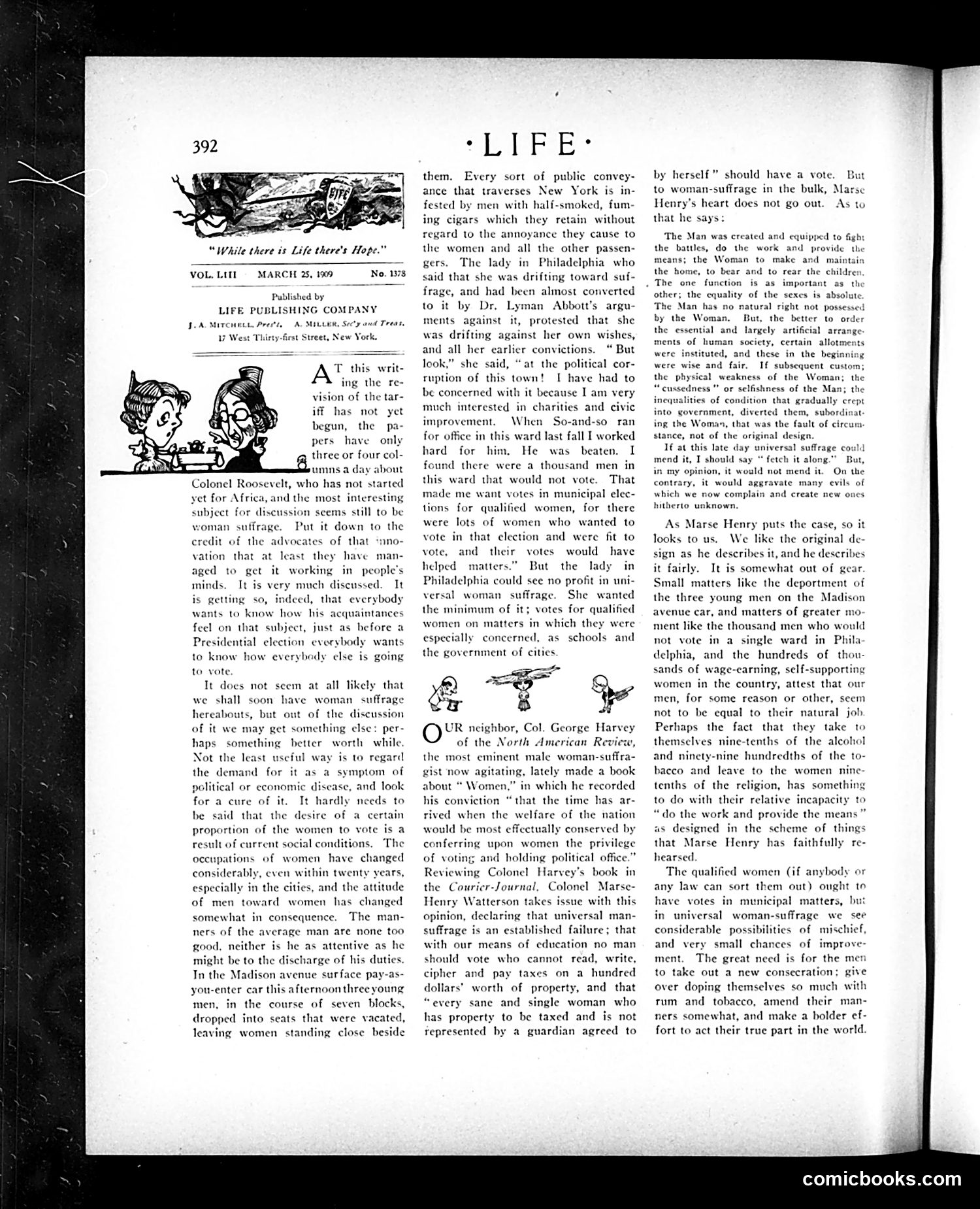
This page from *Life* magazine (Vol. LIII, March 29) discusses women's suffrage through political commentary and debate. The small cartoon at top left shows two caricatured figures in what appears to be a disagreement, likely representing opposing views on the suffrage question. The text engages Colonel Roosevelt's stance on women's voting rights and references Colonel George Harvey of the *North American Review* and Marse Henry Watterson, who debated whether universal male suffrage represents an "established failure." The article argues that objections to women voting—based on property ownership, taxation representation, and literacy—apply equally to men, exposing the hypocrisy of restricting women's votes while men with similar limitations retain theirs. The satire critiques the gendered logic used to deny women political participation.
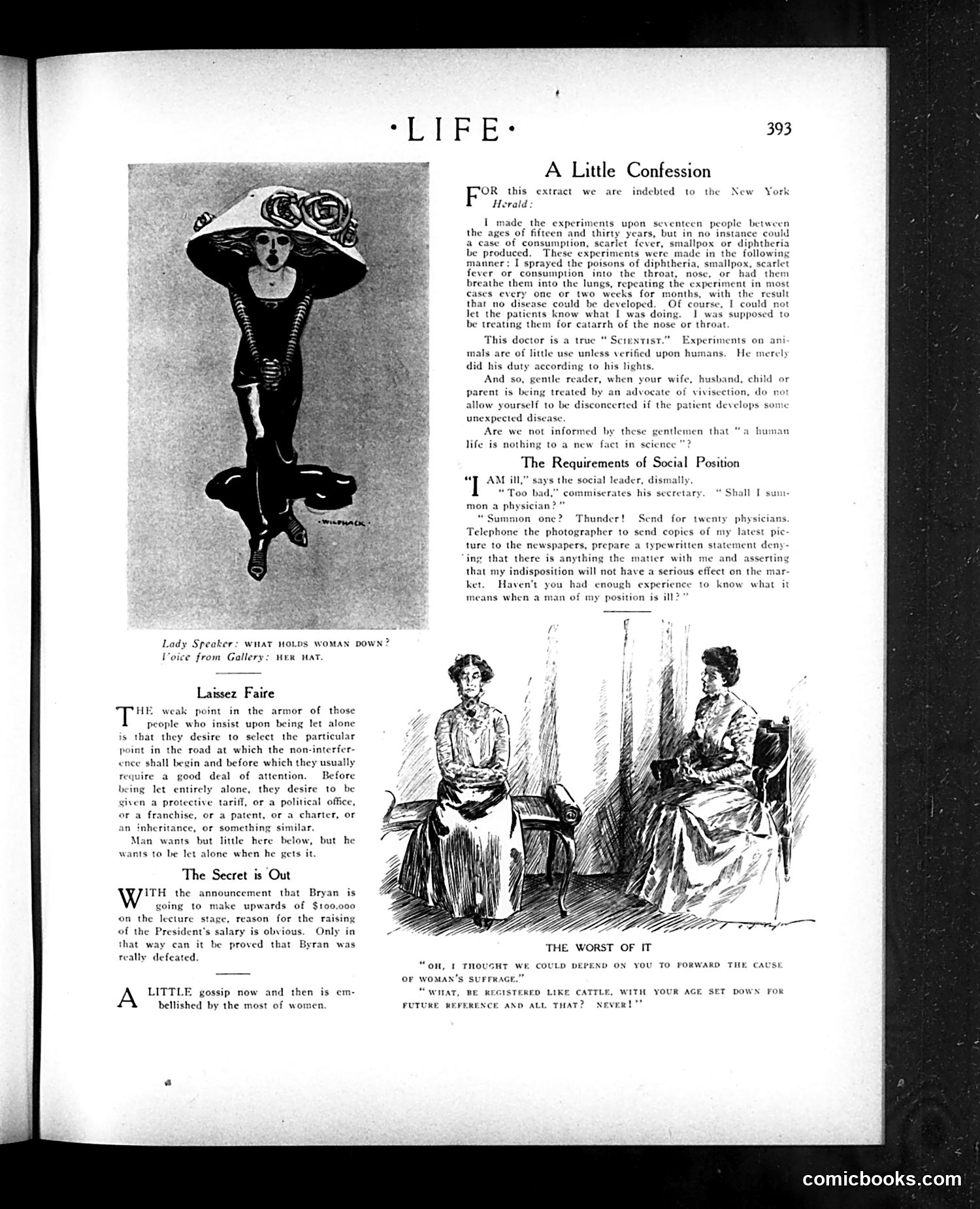
This page satirizes early-20th-century medical ethics and social hypocrisy. "A Little Confession" describes a doctor who conducted dangerous experiments on poor patients (spreading diphtheria, smallpox, and scarlet fever into their lungs) to test treatments—justified as scientific advancement. The satire criticizes how wealthy society embraces such "scientists" while remaining ignorant of patient harm. The lower section, "The Requirements of Social Position," mocks how society women obsess over status markers. The illustration shows a woman dismissing suffrage concerns, prioritizing social standing instead. The caption quotes her refusing to support women's suffrage because it conflicts with maintaining her elevated social position—satirizing how privileged women ignore broader women's rights for personal prestige.
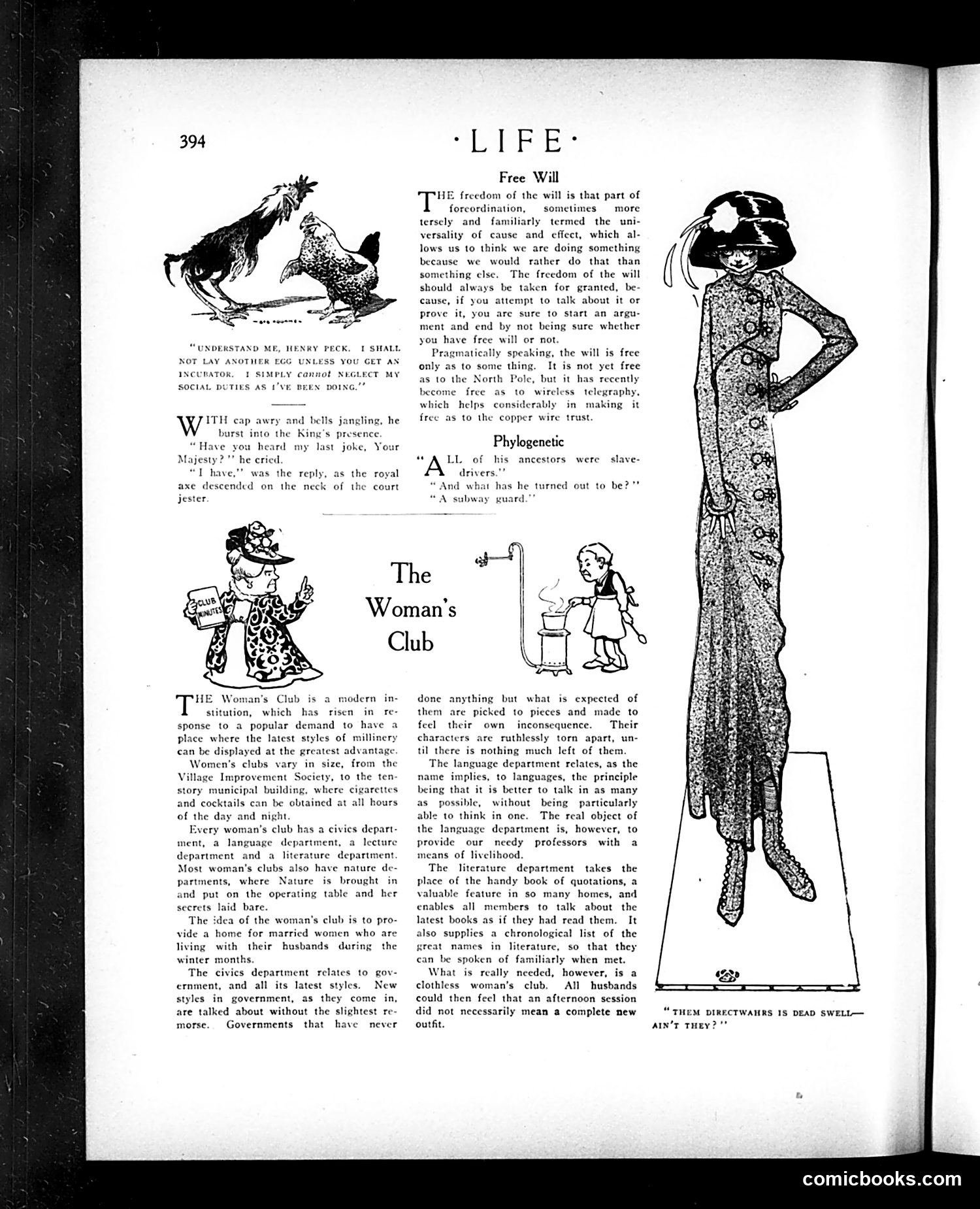
This page contains two main satirical pieces: **"Free Will"** (top): A philosophical humor piece questioning whether humans truly possess free will, illustrated with a rooster and fox. The joke suggests our choices are predetermined, mocking serious philosophical debates. **"The Woman's Club"** (center/bottom): Social satire on women's clubs—institutions that had become fashionable among middle and upper-class women by the early 20th century. The text humorously critiques these organizations' various departments (civics, literature, language) as somewhat pretentious, while acknowledging their social function. The illustration shows a fashionably dressed woman, likely mocking the refined image such clubs cultivated. The final caption jokes darkly about a "clothless woman's club"—satirizing the clubs' tendency to focus on trivial matters like fashion and appearance.
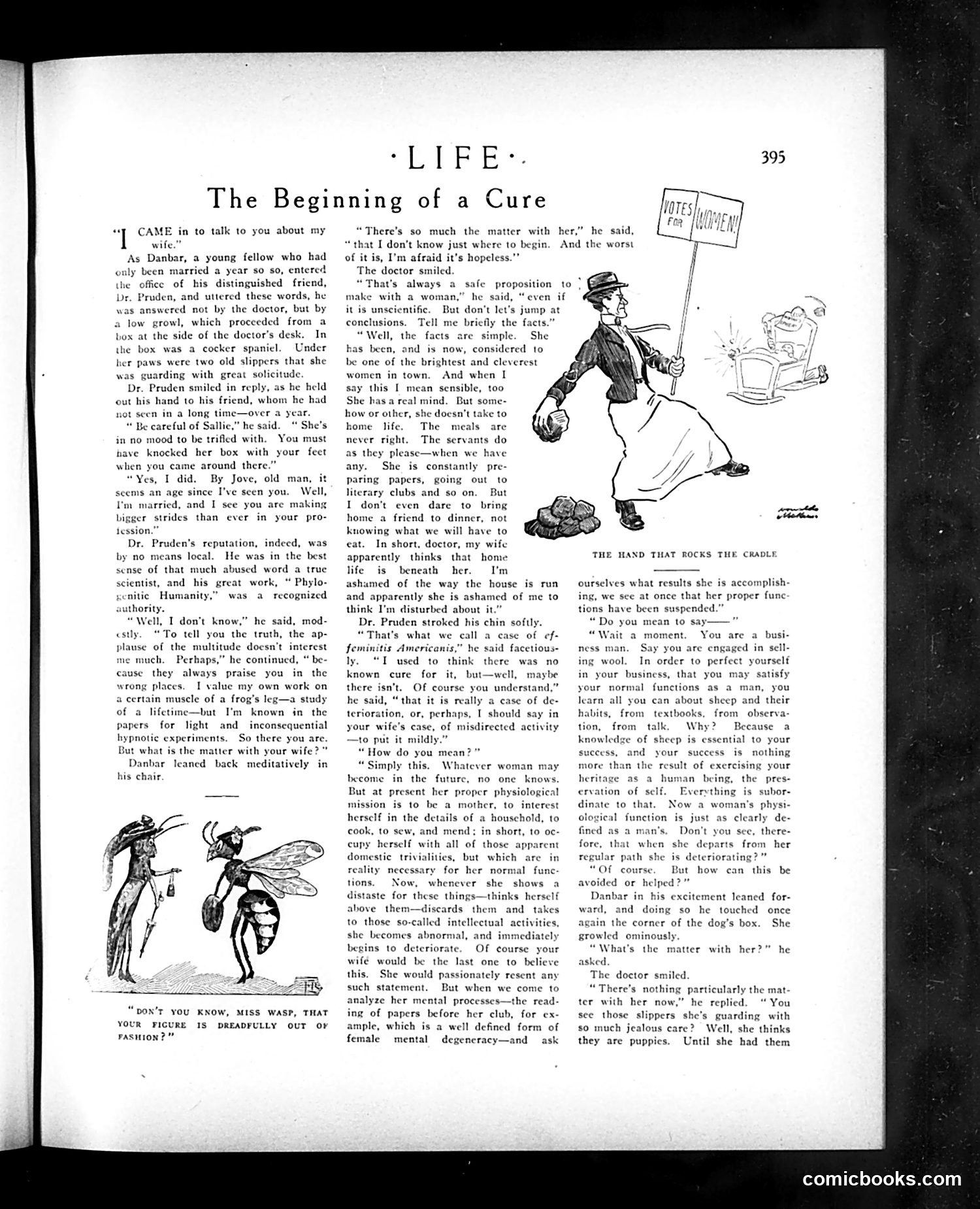
This page contains a short story titled "The Beginning of a Cure" featuring dialogue between a doctor (Dr. Pruden) and a man named Danbar discussing Danbar's wife's behavior and household management. The accompanying cartoons appear to be unrelated satirical illustrations. The bottom cartoon shows small figures (appearing to be insects or fairies) with the caption "DON'T YOU KNOW, MISS WASP, THAT YOUR FIGURE IS DREADFULLY OUT OF FASHION?" - mocking changing fashion standards by applying them absurdly to insects. The story itself satirizes contemporary gender roles and "nervous conditions" in women, suggesting the wife's anxieties stem from her straying from proper domestic duties. The doctor's diagnosis reflects early-20th-century attitudes pathologizing women's independence and intellectual pursuits as mental illness requiring domesticity as "cure."
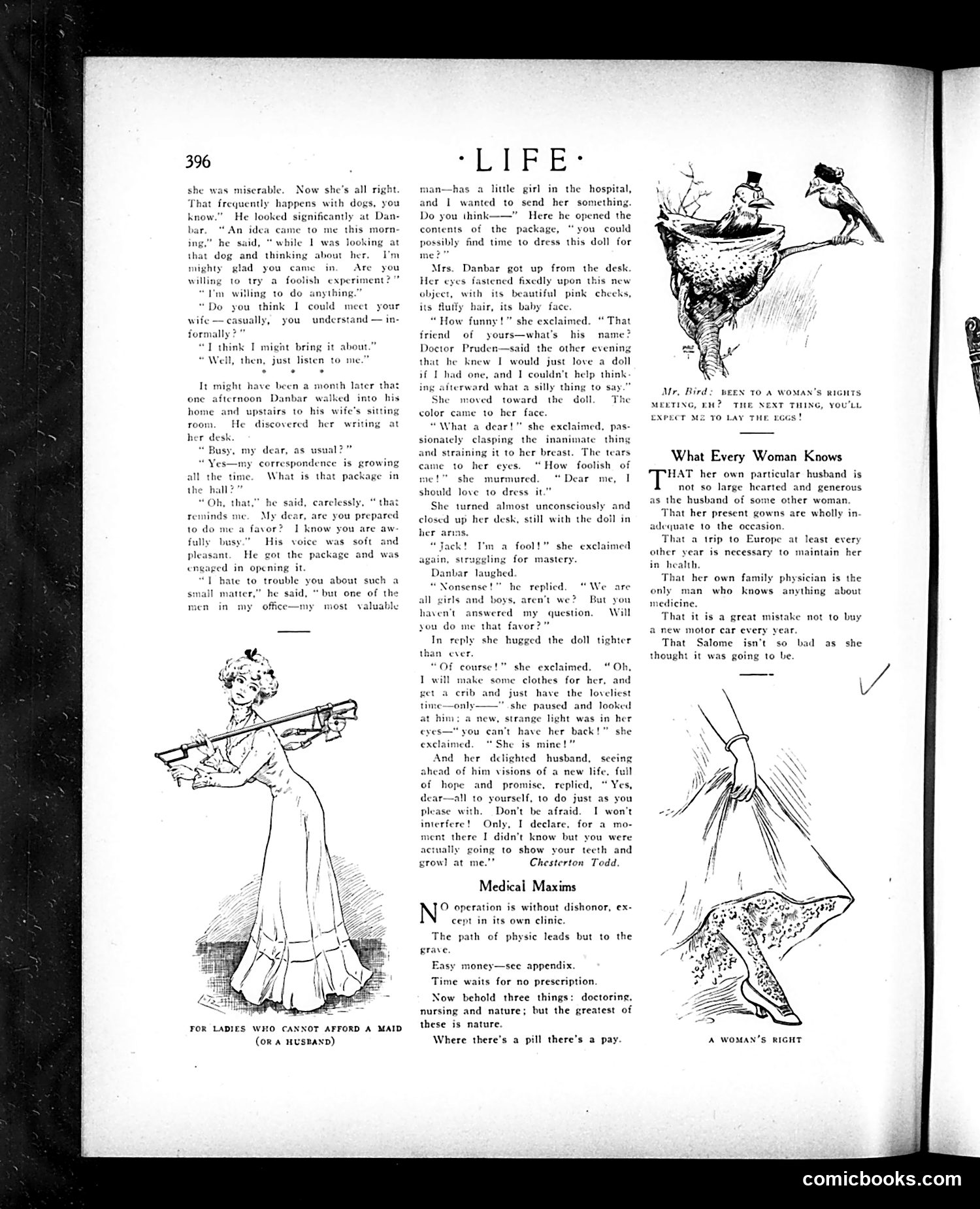
This page contains satirical commentary on early 20th-century gender roles and domestic life. The main cartoon, captioned "For Ladies Who Cannot Afford a Maid (Or a Husband)," depicts a woman performing household labor—likely cleaning or scrubbing—and satirizes women's economic dependence on marriage or domestic help. The adjacent section "What Every Woman Knows" lists truisms about women's lives, including expectations about clothing, European travel, and relying on family physicians. The tone is gently mocking women's limited spheres of influence and the assumptions made about their priorities. The "Medical Maxims" section offers dry, cynical observations about healthcare and money, suggesting skepticism toward medical professions. Overall, the page reflects Period attitudes about women's domestic roles while employing satire to critique those very limitations.
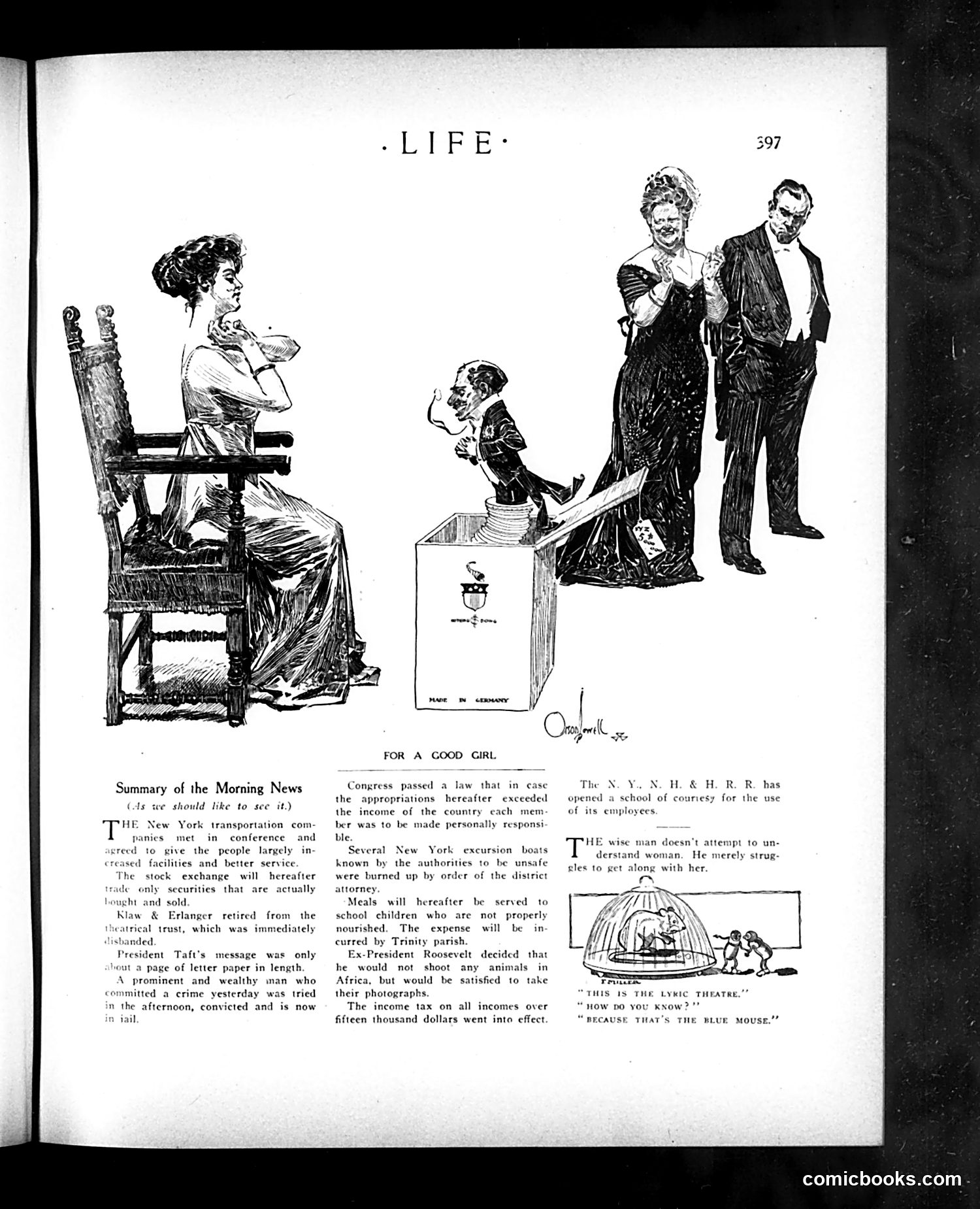
This satirical cartoon depicts a domestic scene where a woman sits passively while a small child emerges from a box (likely a Jack-in-the-box toy), and wealthy-dressed adults observe. The title "For a Good Girl" is ironic—suggesting rewards for female obedience. The satire critiques gender roles and class dynamics of the era. The woman's passive posture and the condescending observation by the well-dressed figures suggest mockery of how women of means were treated as decorative objects requiring "rewards" for compliance. The child-like toy imagery reinforces the infantilizing attitudes toward women in early 20th-century society. The accompanying news summary discusses legislative and social matters, though the cartoon's specific political target remains unclear from context alone.
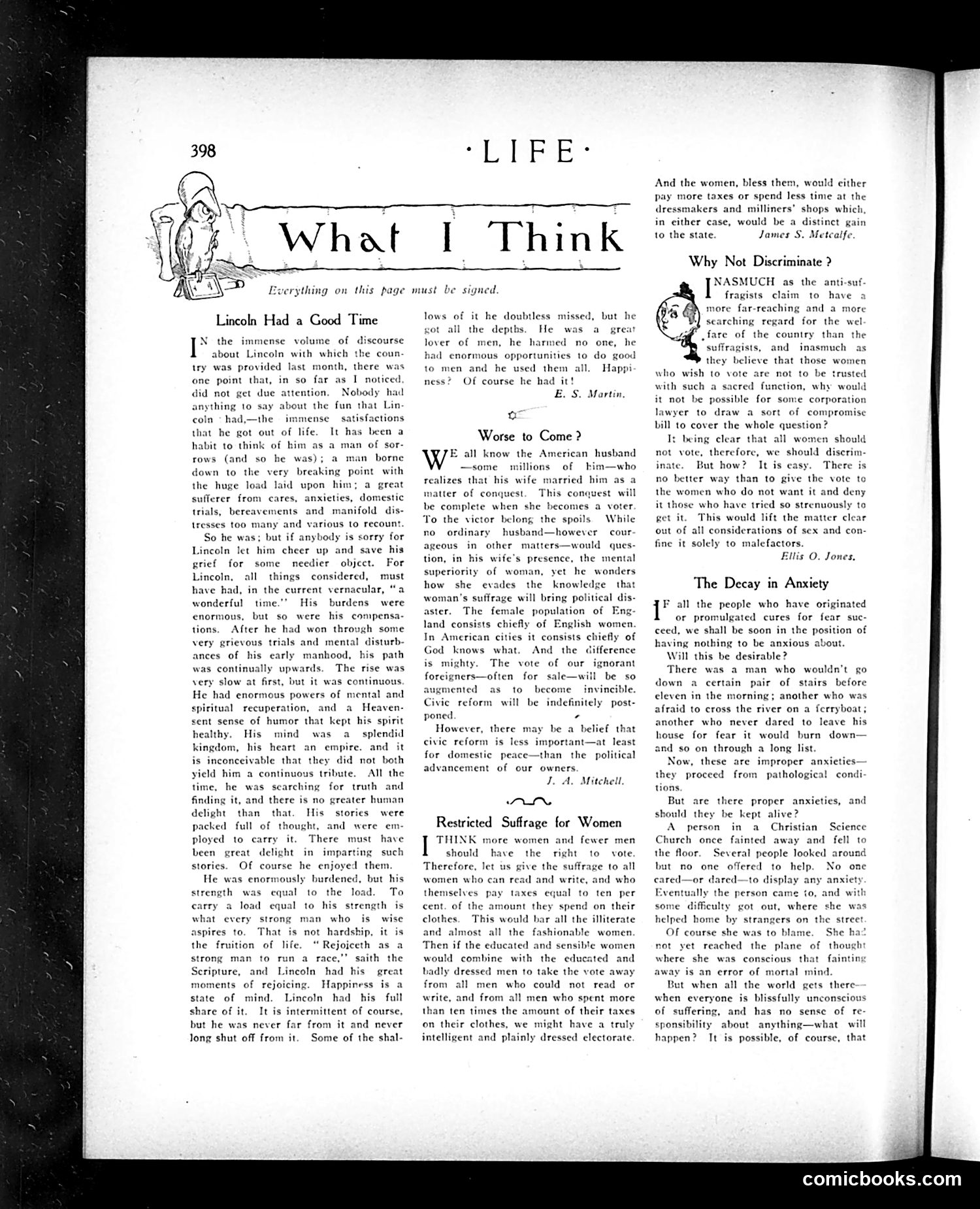
This page contains three opinion pieces reflecting early 20th-century debates about women's suffrage and social reform. **"Lincoln Had a Good Time"** celebrates Abraham Lincoln's resilience and humor amid hardship, arguing he found joy despite tremendous burdens—a character study rather than political commentary. **"Worse to Come?"** expresses anti-suffrage anxiety. The author fears granting women the vote will prove disastrous because American cities contain many immigrant women (implicitly: uneducated, foreign-born) who might be manipulated or "sold" votes. The piece warns that women's suffrage will augment an already problematic electorate and bring "political disaster," positioning women's voting rights as threatening civic stability. **"Restricted Suffrage for Women"** proposes a compromise: voting rights only for literate women who pay substantial taxes relative to their clothing expenditures. This would exclude poor and immigrant women while enfranchising educated, wealthy ones—a class-based restriction designed to address suffrage opponents' fears about "undesirable" voters. Together, these pieces reveal contemporary elite anxieties about democracy, immigration, and women's political participation.
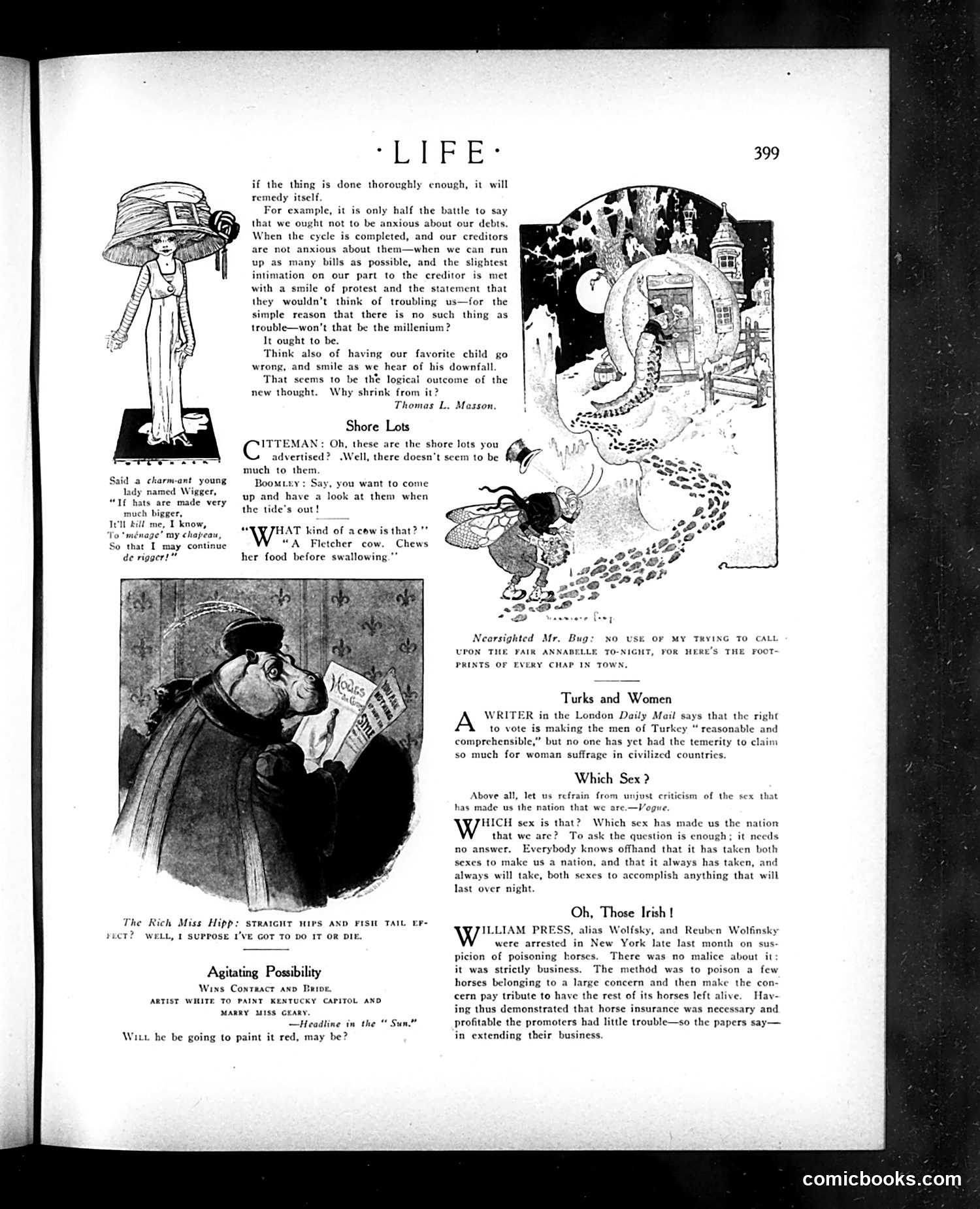
This page contains multiple satirical pieces typical of Life's early 20th-century humor: **"Shore Lots"**: A real-estate con joke where a salesman shows empty beachfront property, suggesting the buyer return "when the tide's out"—implying there's nothing to see even then. It mocks speculative real-estate schemes. **"Nearsighted Mr. Bug"**: A bug cannot court his love interest because footprints of rival suitors cover the ground—satirizing competitive courtship and popularity contests. **"Turks and Women"**: Commentary on voting rights. The piece notes Turkish men became "reasonable" after gaining votes, while questioning whether women's suffrage achieved similar results in "civilized countries"—reflecting early 20th-century skepticism about women's political participation. **"Oh, Those Irish!"**: A darkly comic reference to horse-poisoning extortion by men with Yiddish names (Press/Wolfsky/Wolfinsky), though the headline blames "Irish"—likely satirizing ethnic stereotyping and newspaper sensationalism. **"Agitating Possibility"**: A brief joke about painting something red, likely political satire.
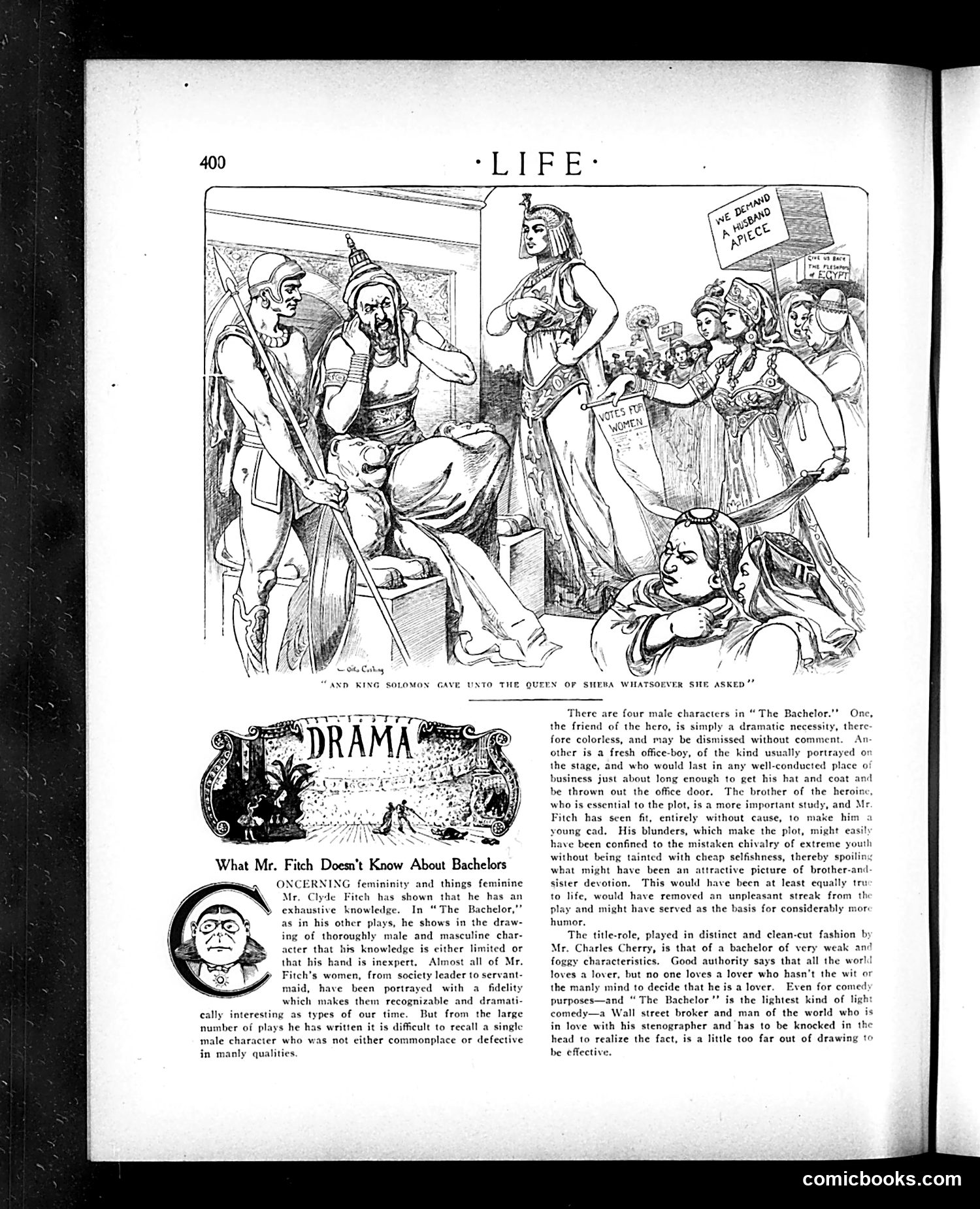
This page critiques playwright Clyde Fitch's work, specifically his play "The Bachelor." The satirical article argues that while Fitch excels at portraying female characters with nuance and realism, his male characters are consistently weak, clichéd, or morally compromised. The complaint centers on the title character—a wealthy Wall Street broker and man-of-the-world who fails to recognize he's in love with his stenographer and needs to be literally "knocked in the head" to realize it. The critic finds this implausible and unfunny, arguing it contradicts the character's supposed sophistication. Other male roles are dismissed as stock types: a colorless friend, a generic office boy, and a brother portrayed as a selfish cad. The satirist suggests Fitch's male characterizations reveal genuine limitations in his understanding of masculine psychology and virtue—a pointed inversion of his claimed expertise in depicting femininity.
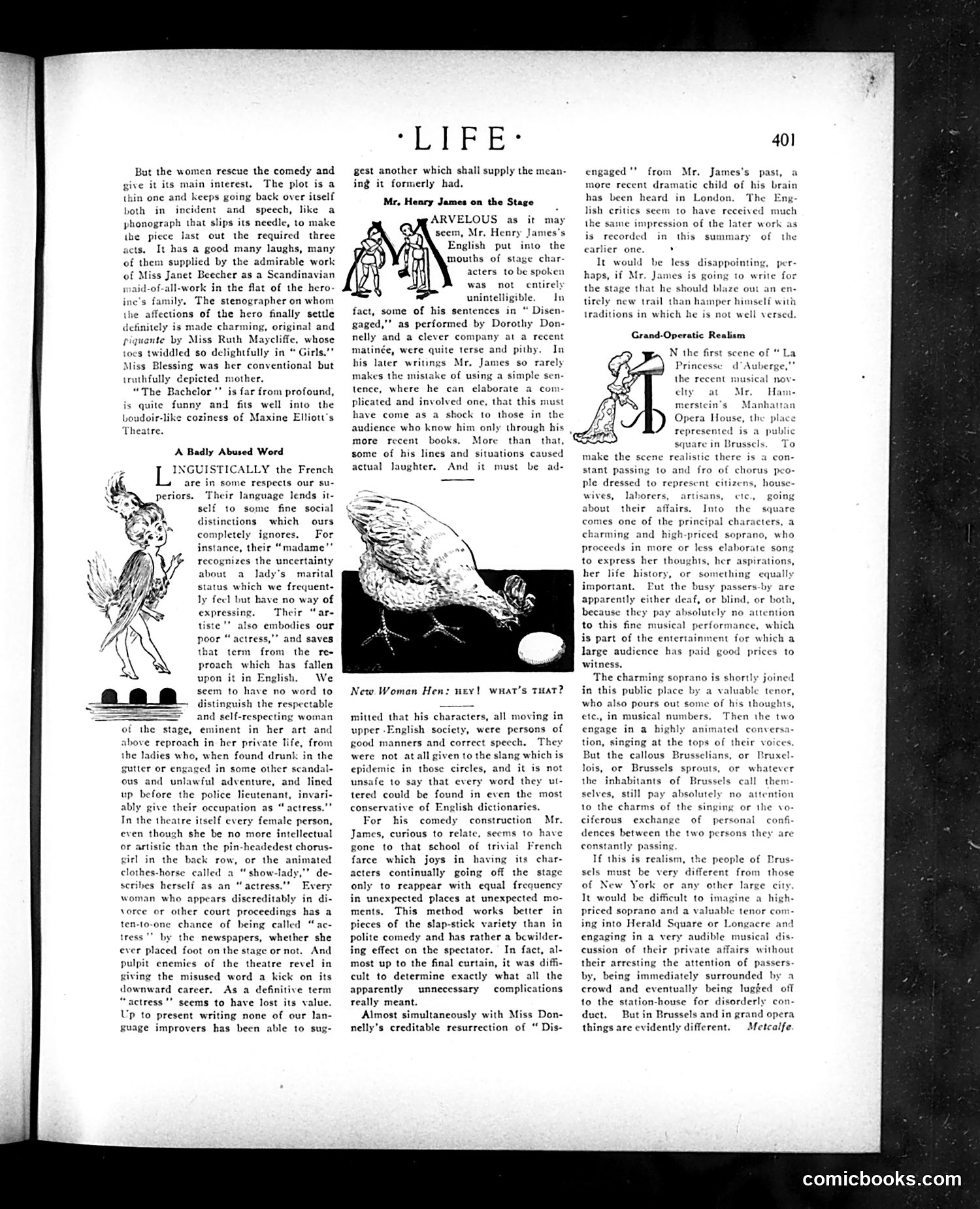
This page contains theater criticism rather than political cartoons. The main content discusses three theatrical productions: **Henry James on Stage**: The critic praises a dramatization of James's work ("Disengaged"), noting with surprise that James's notoriously complex, convoluted prose actually worked on stage. The joke is that James—known for elaborate, difficult sentences in his novels—produced dialogue that was "quite terse and pithy" and even caused "actual laughter." The implication is that James's prose style is so famously verbose that audiences expected incomprehensibility. **Language Commentary**: A section titled "A Badly Abused Word" discusses how "actress" has become a catch-all term for any woman in legal trouble, losing its respectability. The author argues the French language better distinguishes between respectable stage performers and disreputable women. **Illustrations**: Small sketches show theatrical scenes, including one captioned "New Woman Hen: hey! what's that?"—likely satirizing contemporary "New Woman" social attitudes. The page reflects early 1900s theater culture and language concerns rather than political satire.
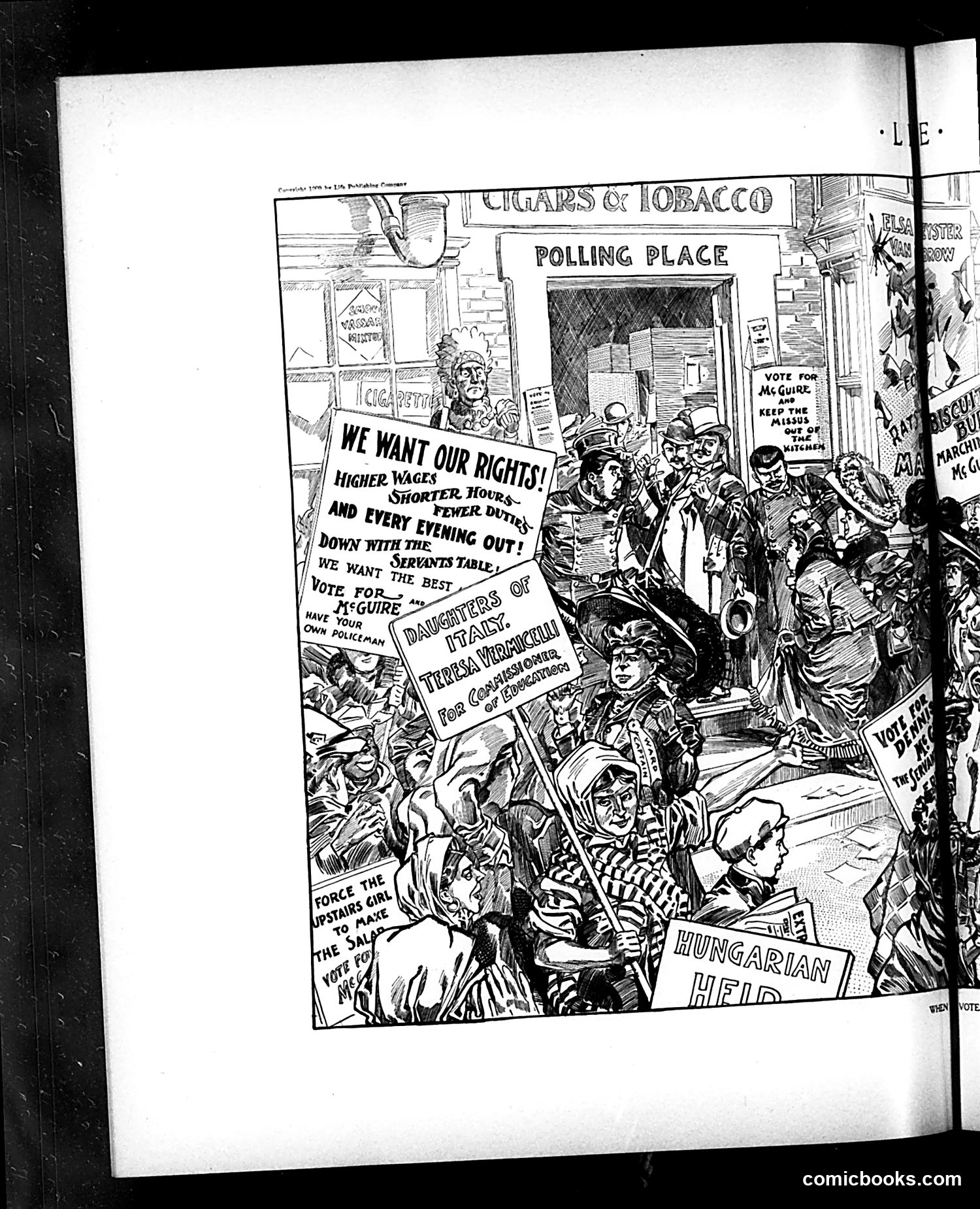
This is a satirical illustration depicting a polling place during what appears to be an early 20th-century election. The cartoon shows a crowd of workers and immigrants demanding labor rights, holding signs reading "WE WANT OUR RIGHTS! HIGHER WAGES, SHORTER HOURS, FEWER DUTIES AND EVERY EVENING OUT!" and "DOWN WITH THE SERVANTS TABLE!" The scene mocks working-class political activism by crowding the polling place with diverse figures—including those labeled "DAUGHTERS OF HUNGARY" and "HUNGARIAN HELP"—suggesting immigrant workers organizing for better conditions. A cigar and tobacco shop serves as the polling location. The satire likely ridicules the growing labor movement and immigrant political participation, portraying such activism as disruptive or illegitimate. The caricatured styles reflect period attitudes toward working-class and immigrant voters.
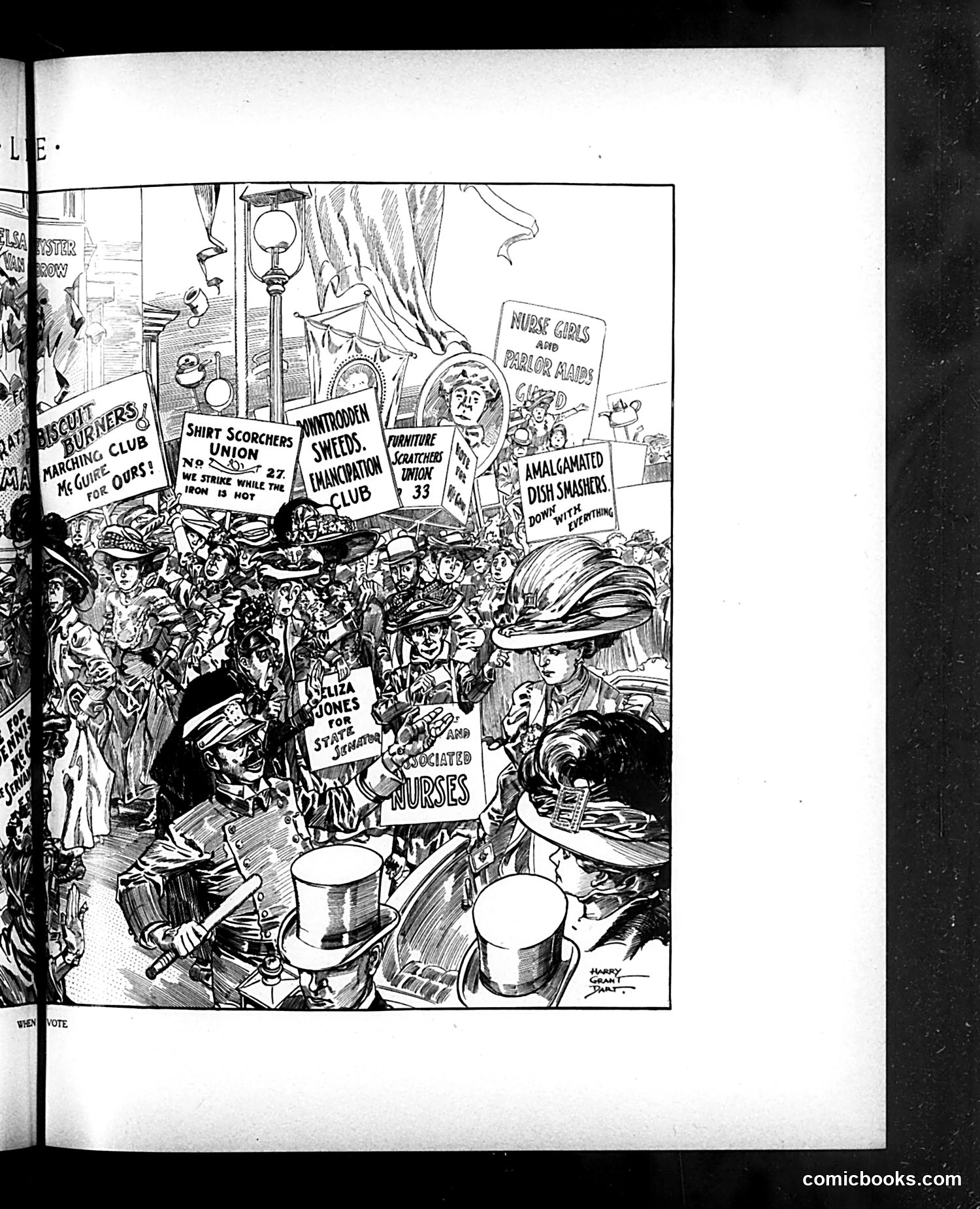
This is a satirical cartoon depicting a large labor protest or parade featuring various striking workers and their unions. Visible signs reference: - "Shirt Scorchers Union" - "Forbidden Swedes Emancipation Club" - "Furniture Scratchers Union" - "Nurse Girls and Parlor Maids" - "Amalgamated Dish Smashers" The cartoon mocks the proliferation of labor unions by depicting absurdly specific, trivial occupational groups organizing as unions and striking. The exaggerated, chaotic crowd and ridiculous union names suggest the cartoonist views labor organizing as increasingly frivolous and ridiculous—extending to absurd categories like "shirt scorchers" and "dish smashers." This likely reflects early 20th-century skepticism toward labor movements and unionization efforts, presenting the movement as having become parody of itself through over-organization.
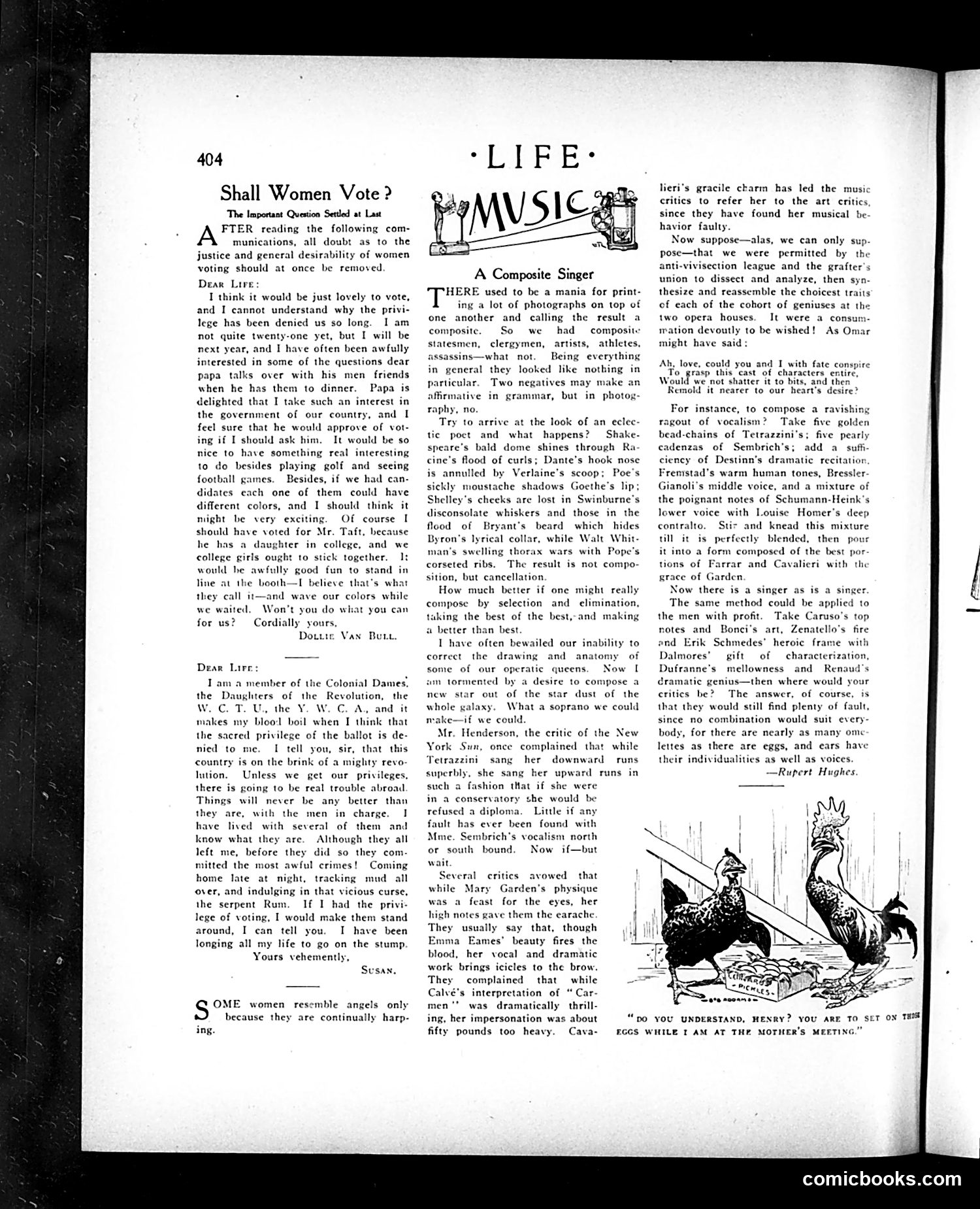
This page satirizes women's suffrage through two contrasting mock letters. The first, from "Dottie Van Burt," presents a frivolous young woman viewing voting as entertainment—choosing candidates by color like a fashion statement, comparable to "playing golf." The second, from "Susan," portrays an angry suffragist citing legitimate grievances (men's bad behavior at home) but expressed so shrilly and vindictively that she undermines her own cause. The satire's point: women's arguments for voting deserve ridicule because they range from trivial to hysteric. By pairing these exaggerated personas, *Life* mocks both naive society girls and militant suffragists, suggesting neither represents serious political reasoning. The "Composite Singer" article parodies similar logic applied to opera—combining great poets' features produces something meaningless. The visual parallel suggests women's suffrage arguments similarly fail through poor composition.
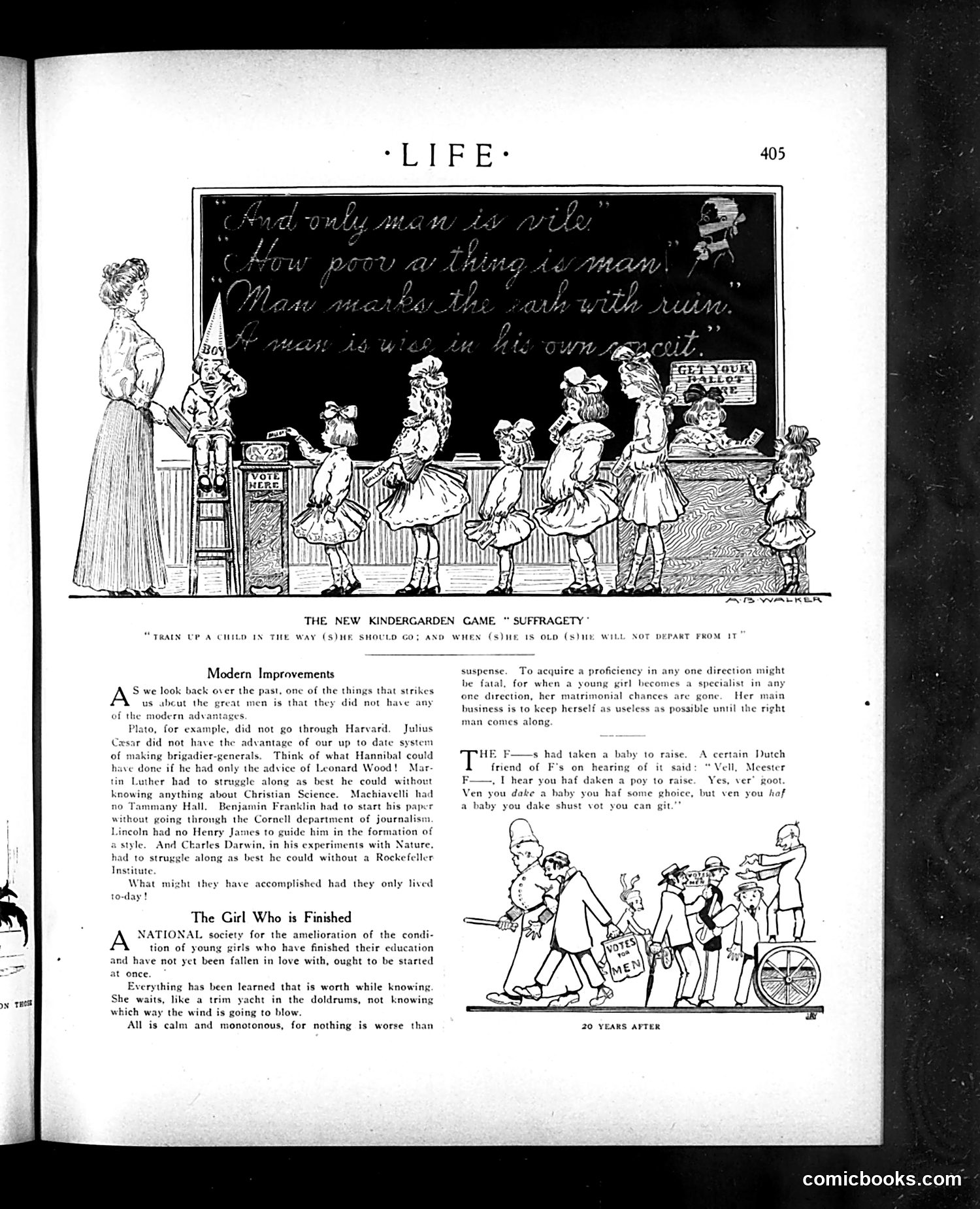
This page satirizes turn-of-the-century attitudes about women's education and suffrage. The top cartoon mocks the "new kindergarten game" of teaching girls about suffrage—depicting a teacher instructing young girls on voting and civic participation while holding signs reading "VOTE" and "GET YOUR BALLOT." The proverb-like text above criticizes training girls in feminist politics. The "Modern Improvements" section ironically praises how historical figures lacked modern educational institutions, suggesting contemporary education may not actually produce greatness—a jab at contemporary American institutions and presumed superiority. "The Girl Who is Finished" sarcastically describes educated women as useless social ornaments, "finished" in education but now unemployable and awaiting marriage. The satire suggests women's proper "business" is remaining idle until a man chooses them. The Dutch accent joke at bottom appears to contrast working-class practicality (taking what child you get) with upper-class choices. Overall, the page reflects anti-suffrage, anti-women's-education sentiment common in early 1900s *Life* magazine's conservative humor.
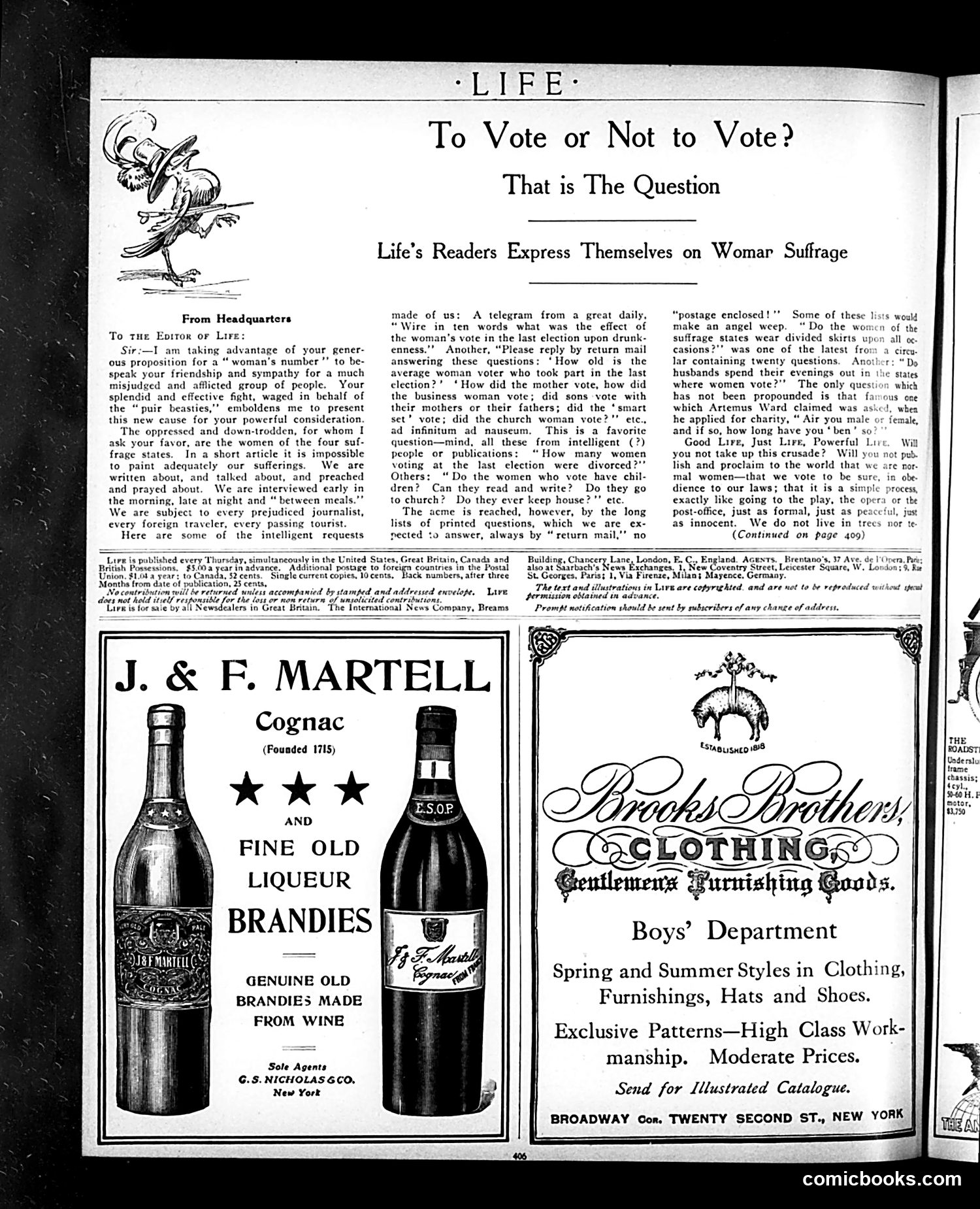
This page presents letters from readers debating **women's suffrage**—a major political controversy of the early 20th century. The lead letter satirizes the absurd, invasive questions posed to women voters in the four U.S. states that had already granted suffrage (likely Wyoming, Utah, Colorado, and Idaho). The writer mocks journalists and curious outsiders demanding answers about whether women voters wore "divided skirts," if their husbands stayed home, whether divorced women voted, and other intrusive inquiries. The satire highlights how women's voting rights were treated as a curiosity requiring constant explanation and justification, rather than a normal civic right. The letter pleads with *Life* magazine to advocate that women voters are simply ordinary citizens exercising normal democratic participation—"exactly like going to the play, the opera or the post-office." The page continues a reader-response feature allowing *Life* readers to weigh in on this contentious social question. The advertisements for liquor and clothing are incidental to the editorial content.
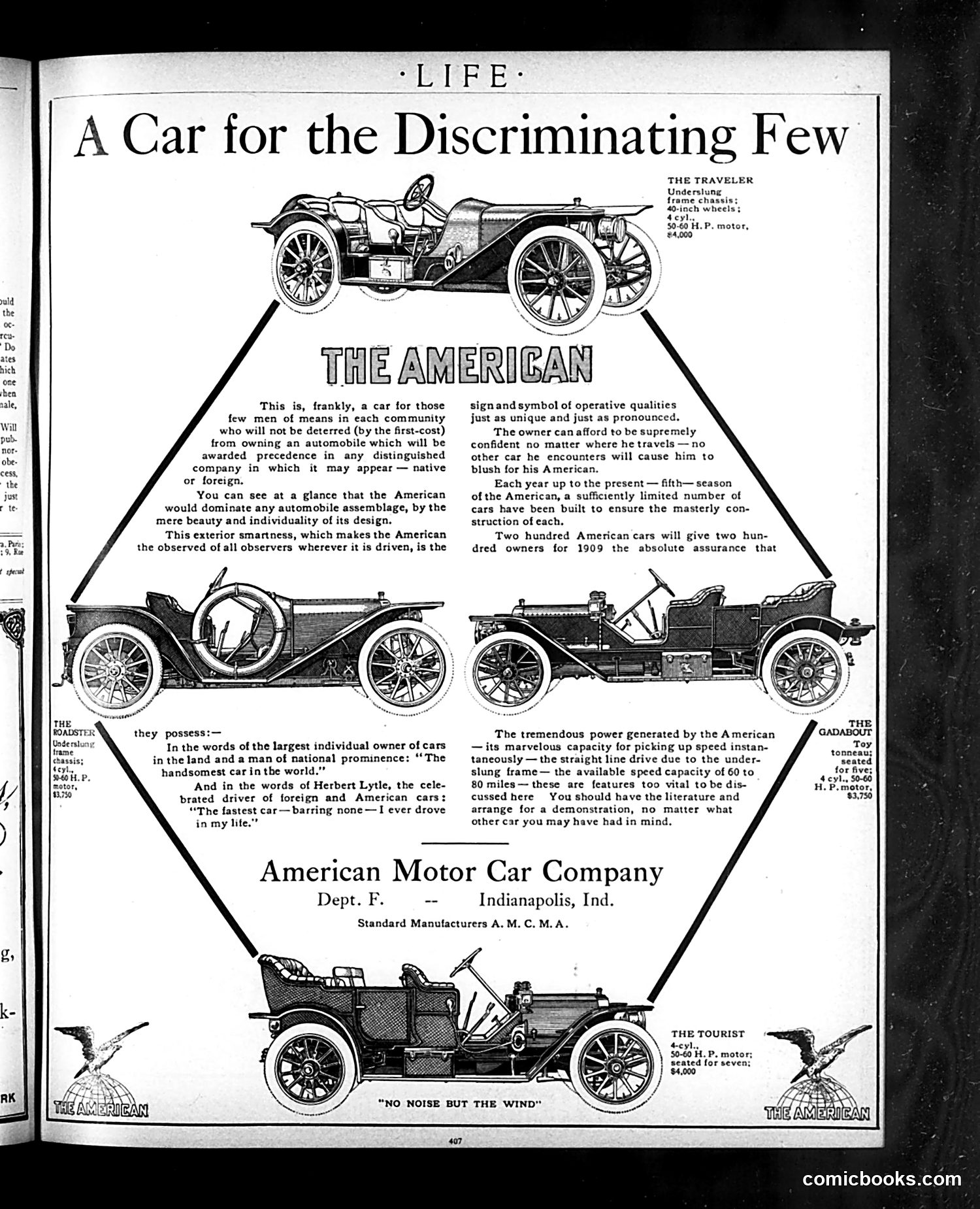
This is a straightforward advertisement, not satire, from Life magazine for the American Motor Car Company (Indianapolis). The page showcases four automobile models—the Traveler, the American, the Roadster, and the Tourist—arranged in a hexagonal layout. The ad's messaging targets wealthy elites, emphasizing exclusivity and superiority. It quotes a "largest individual owner of cars in the land" calling it "the handsomest car in the world" and a celebrated driver praising its speed. The tagline "No Noise But the Wind" and emphasis on limited production (200 cars annually) reinforce the luxury positioning. This reflects early 1900s automobile marketing: cars were expensive luxuries for the wealthy, and manufacturers competed on prestige, not affordability. The ad assumes its readers are among the discriminating few who could afford such vehicles—likely Life's affluent audience.
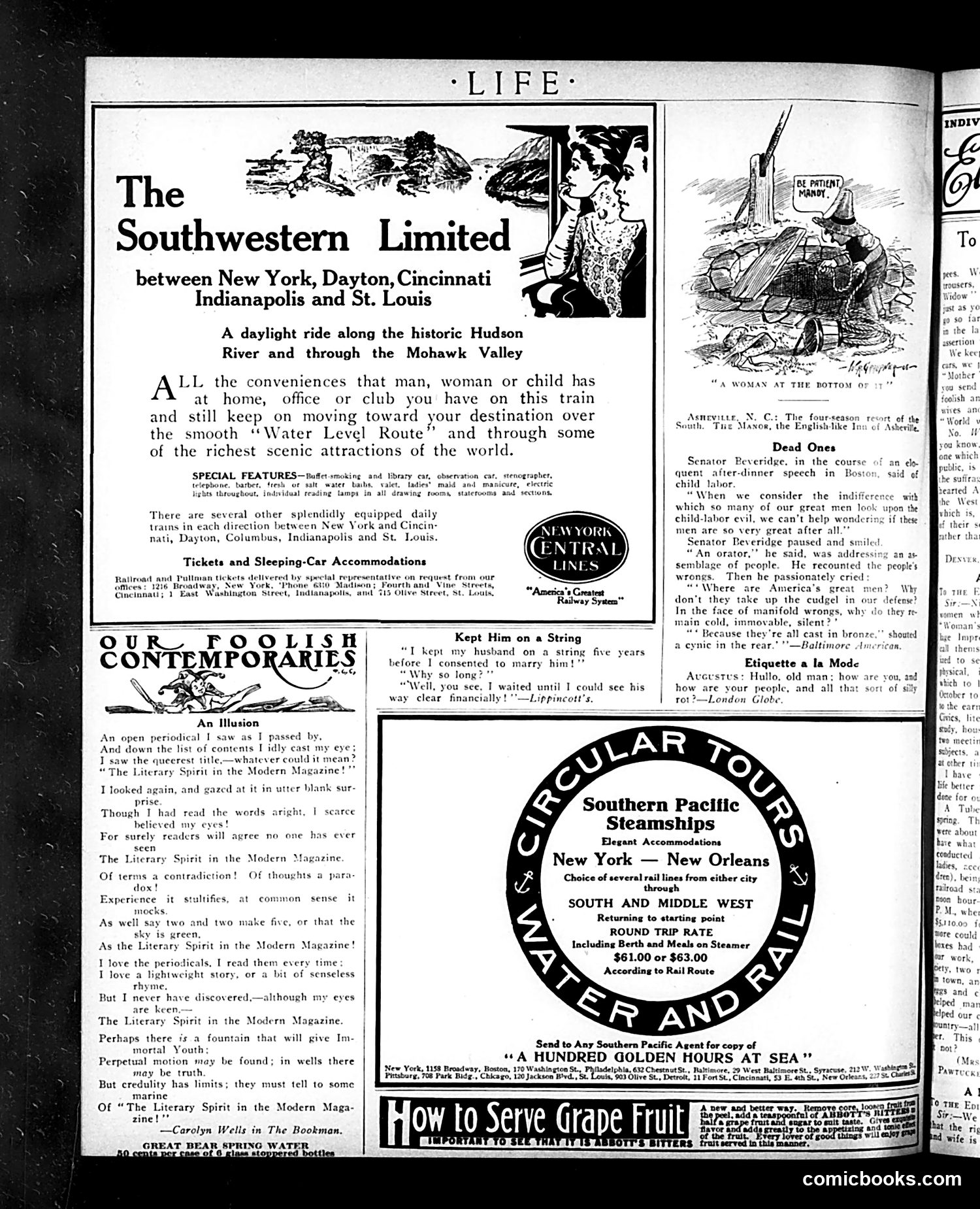
This page is primarily **advertising** for transportation services (trains and steamships), interspersed with light humor and poetry. The cartoons and jokes are mild social commentary: 1. **"Kept Him on a String"**: A domestic humor joke playing on the phrase "kept on a string" (controlled someone). The wife's punchline—she waited until he could afford marriage—reflects early 20th-century attitudes about women's economic dependence. 2. **"An Illusion"**: A meta-joke about *Life* magazine itself. The poet mock-laments finding "The Literary Spirit in the Modern Magazine"—a paradoxical title suggesting modern magazines lack literary merit. This is self-deprecating satire about the magazine's own content. 3. **"Dead Ones"**: A brief anecdote about Senator Beveridge criticizing indifference to child labor, followed by a cynic's quip that great men are merely statues ("cast in bronze"). 4. **"Etiquette à la Mode"**: A one-liner mocking overly casual British greetings. Overall, this reflects *Life*'s role as a satirical publication mixing entertainment, light social criticism, and advertising for a leisure-class readership.
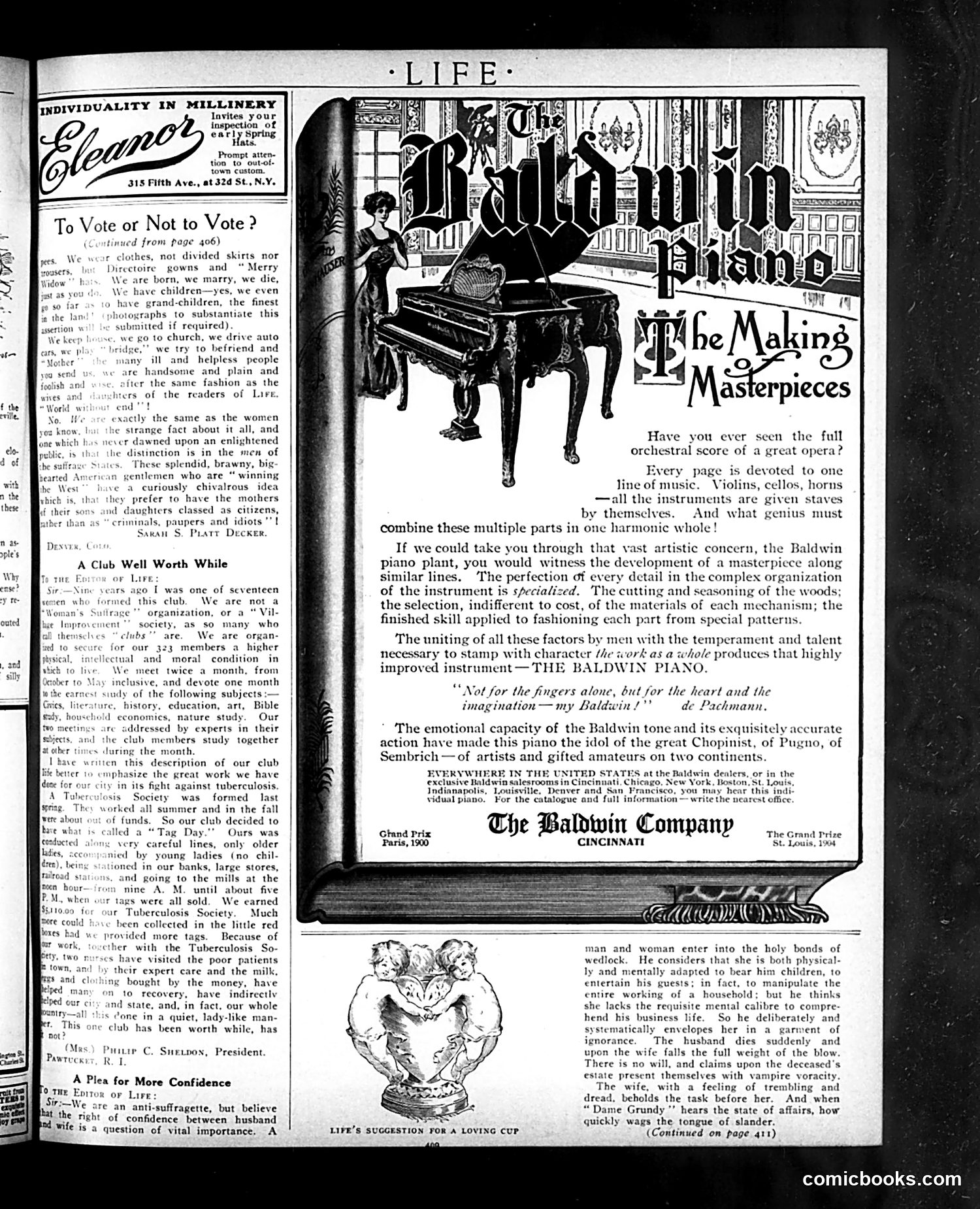
This page contains three distinct articles/advertisements: **Left column:** Two opinion pieces—"To Vote or Not to Vote?" argues against women's suffrage by claiming women already influence society through domestic roles, and "A Club Well Worth While" describes a women's philanthropic club fighting tuberculosis. **Center/Right:** A Baldwin Piano advertisement styled as an article titled "The Making of Masterpieces." It uses an extended metaphor comparing piano manufacturing to orchestral composition, emphasizing specialized craftsmanship and quality materials. The ad includes a quote attributed to pianist de Pachmann praising Baldwin pianos' emotional capacity. **Bottom:** A small illustration labeled "Life's Suggestion for a Loving Cup" depicting cherubs with text about marriage dynamics (appears unrelated to other content). The anti-suffrage piece is notable for its paternalistic argument that women shouldn't vote because men prefer them as mothers and citizens rather than voters—reflecting contemporary opposition to women's suffrage (pre-1920).
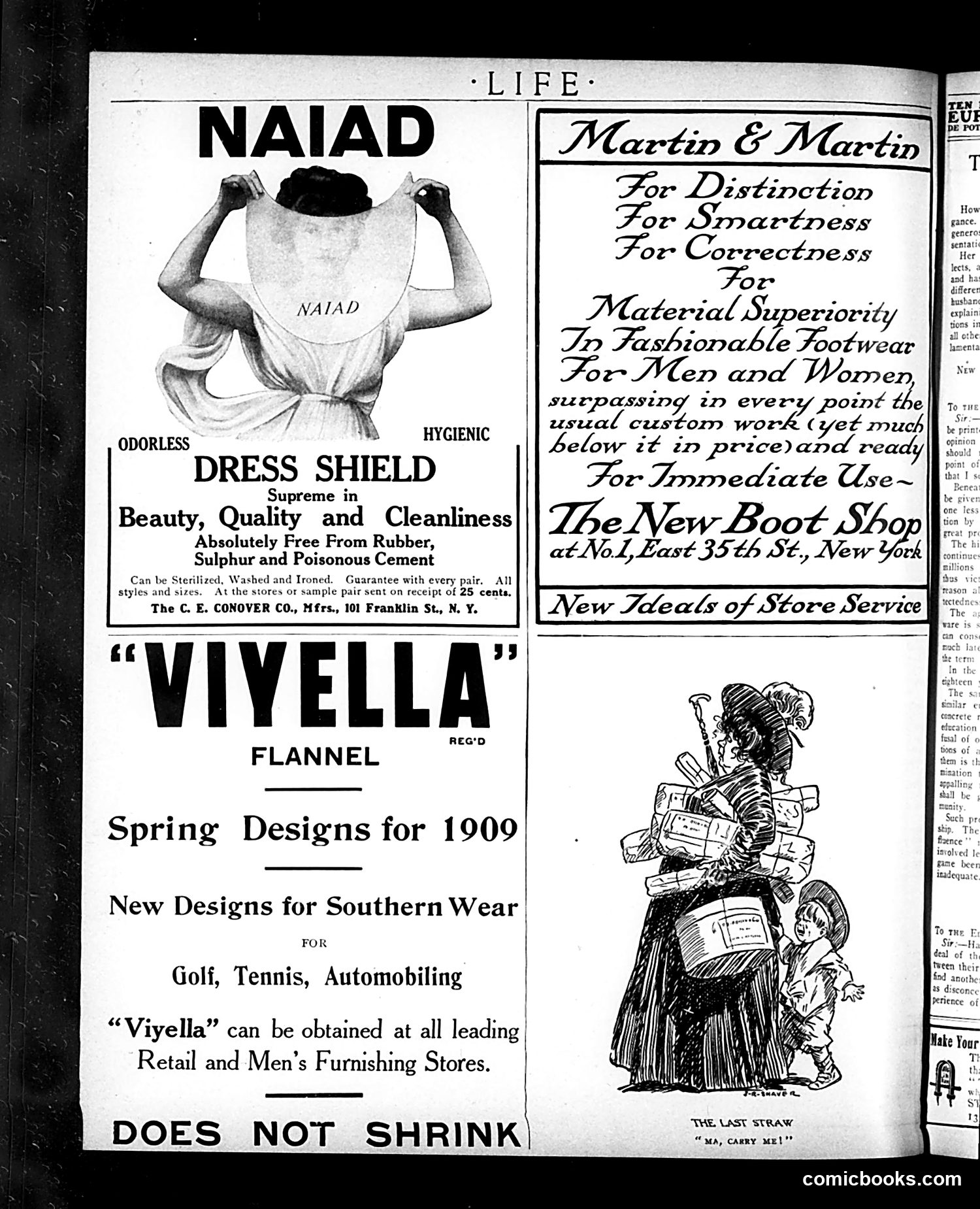
This page consists entirely of **period advertisements**, not political satire. The content reflects early 1900s consumer culture and gender norms: **Left side:** Ads for women's undergarments (NAIAD dress shields to prevent sweat stains) and Vivella flannel fabric marketed for emerging leisure activities (golf, tennis, automobiling). **Right side:** The New Boot Shop advertisement emphasizing quality footwear, and a small cartoon titled "The Last Straw" showing a woman overburdened with packages, exclaiming "Ma, carry me!" **The joke:** The cartoon satirizes consumerism and shopping excess—a woman so laden with purchases she cannot carry herself, demanding to be carried like a child. It's gentle social commentary on the era's emerging consumer culture and women's shopping habits, not political in nature. The page demonstrates how early *Life* mixed satirical cartoons with advertisements reflecting contemporary aspirations around modern fashion, sports, and automobiles.
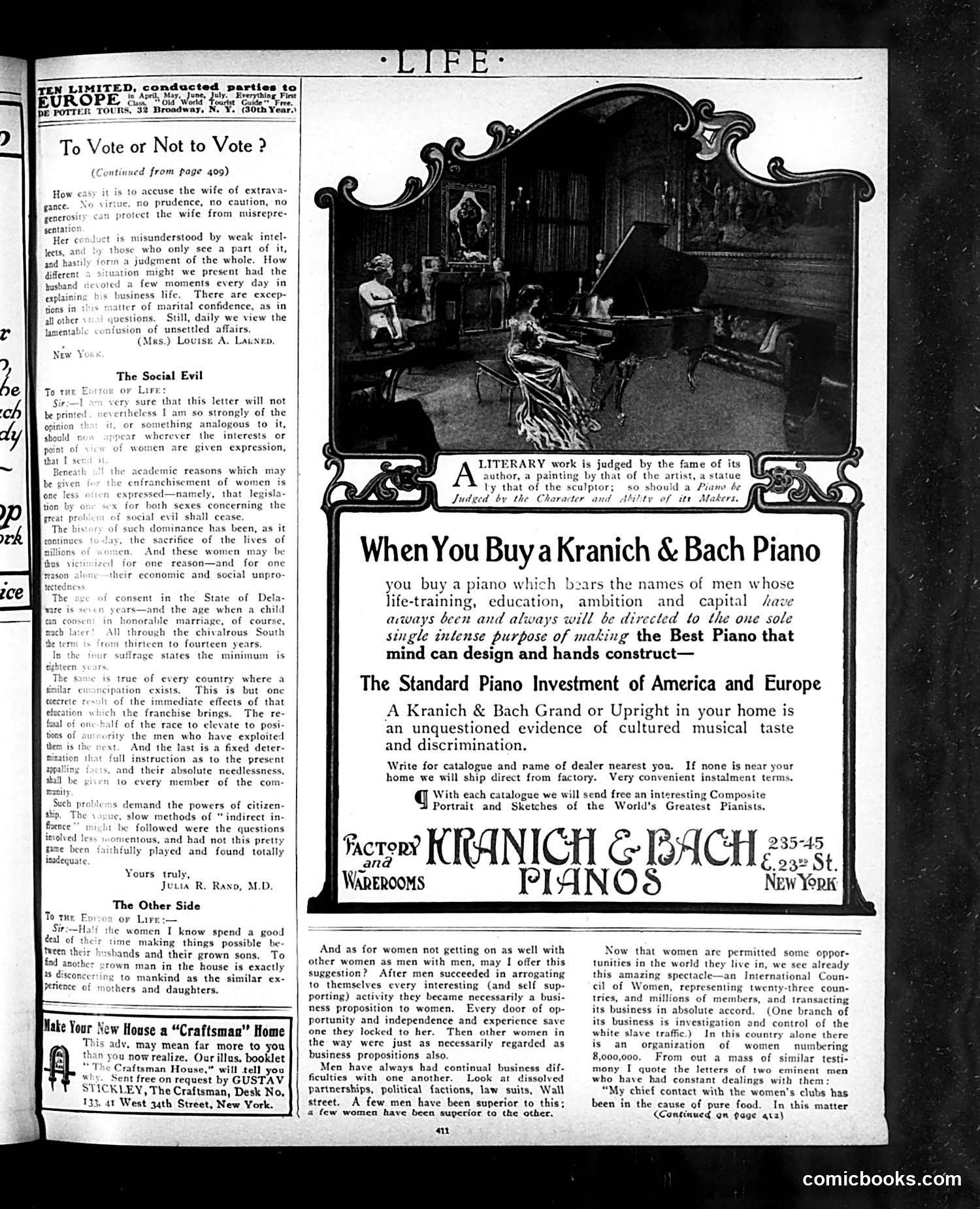
This page mixes editorial letters with advertising. The main content consists of **reader responses to a debate about women's suffrage** (the "To Vote or Not to Vote?" column continued from page 409). The letters present opposing views: one arguing women should vote to address social problems (particularly the "social evil"—likely prostitution); another countering that women already wield sufficient influence through domestic and family roles without voting rights. **The political context**: This appears from the early 1900s when women's suffrage remained contested in America. The debate reflects genuine period arguments: suffragists claimed voting power was necessary for reform; opponents claimed women's "indirect influence" through husbands and sons was adequate. The **large Kranich & Bach piano advertisement** dominates the page, positioning piano ownership as evidence of cultured taste—typical of early 20th-century marketing linking consumer goods to social status and respectability. The page reflects the pre-1920 suffrage debate, when voting rights for women remained controversial among educated readers who filled Life's letters section.
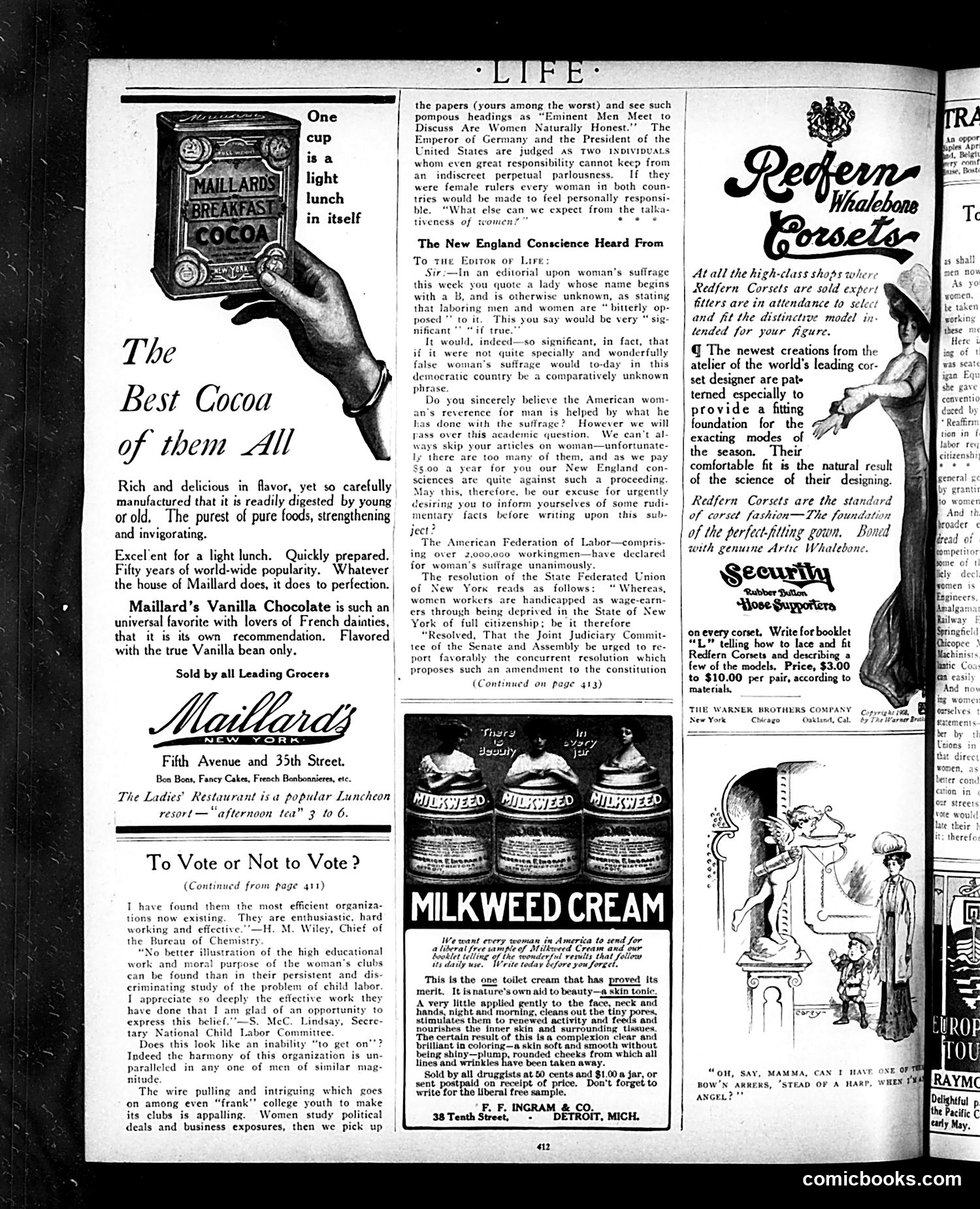
This page is primarily **advertisements and reader letters**, not political cartoons. The main content is a debate over **women's suffrage**. Two letters challenge an earlier Life editorial that quoted unnamed opposition to women voting. The writers argue: 1. **Women's organizations are effective and harmonious**, citing their work on child labor issues—better organized than men's clubs with their "wire pulling and intriguing." 2. **Male leaders aren't held to the same standard**: when male rulers act recklessly, they're judged individually; when women do, all women are blamed for "talkativeness." 3. **Labor unions support suffrage**: The American Federation of Labor (representing over 2 million workingmen) unanimously endorses women's suffrage, contradicting the claim that working people oppose it. The writers accuse Life of publishing poorly-researched anti-suffrage arguments. This reflects the heated pre-1920 suffrage debate, with opponents claiming women lacked political judgment while advocates demonstrated women's organizational competence and broad support.
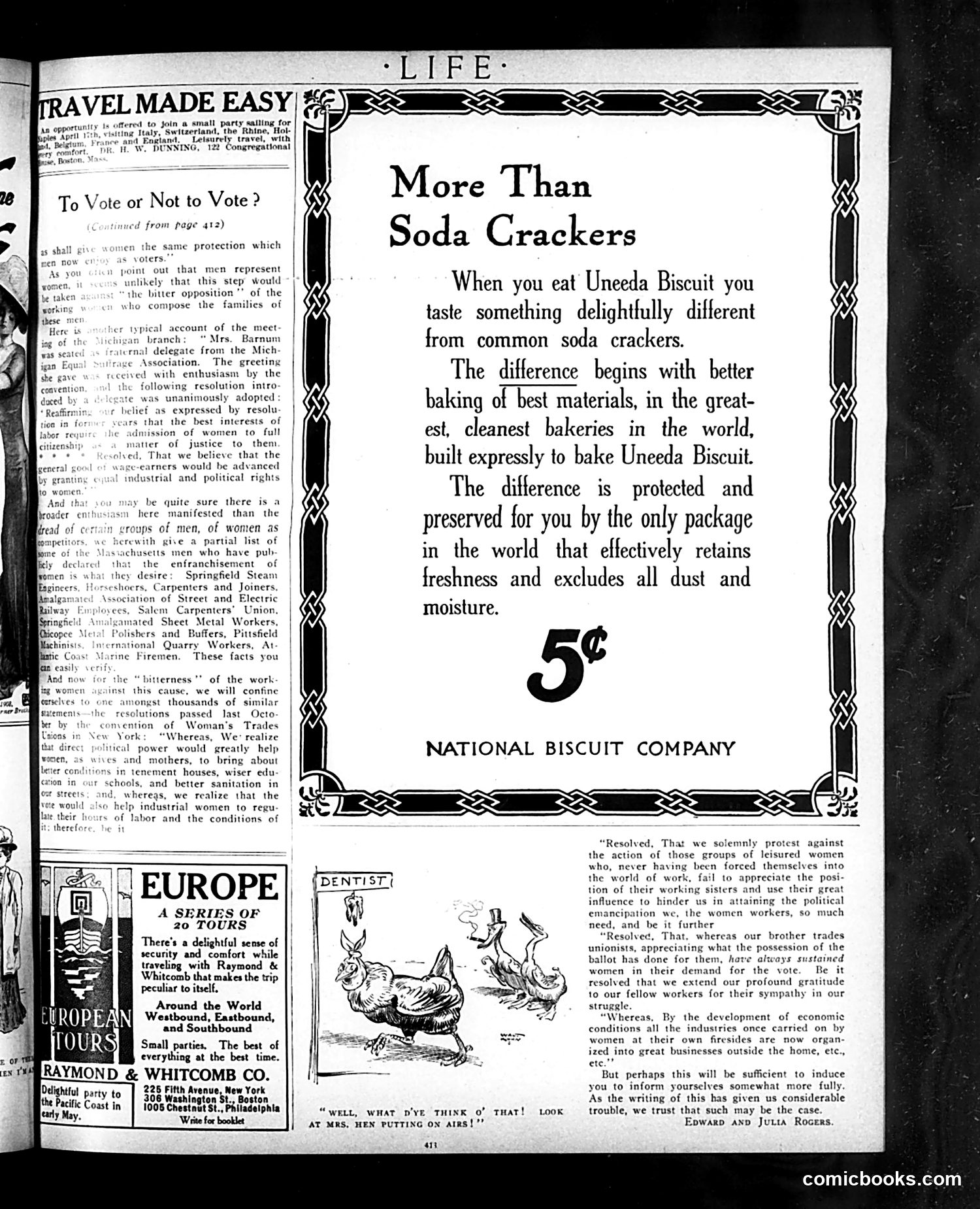
This page mixes political editorial content with advertising. The main substantive piece is "To Vote or Not to Vote?" (left column), which presents resolutions from working women's labor unions supporting women's suffrage. The unions argue that political enfranchisement would help working women improve conditions in tenement housing, schools, and sanitation—practical concerns distinct from leisured women's abstract activism. The cartoon at bottom shows a hen sitting on eggs, captioned "Well, what d'ye think o' that! Look at Mrs. Hen putting on airs!"—a satirical visual gag mocking pretension, though the connection to the suffrage debate appears tangential. The page's dominant feature is actually a large **Uneeda Biscuit advertisement** (center-right), highlighting superior packaging and freshness. Travel and European tour ads occupy remaining space. The juxtaposition suggests Life's editorial voice supported labor-based women's suffrage arguments while commercial interests filled pages.
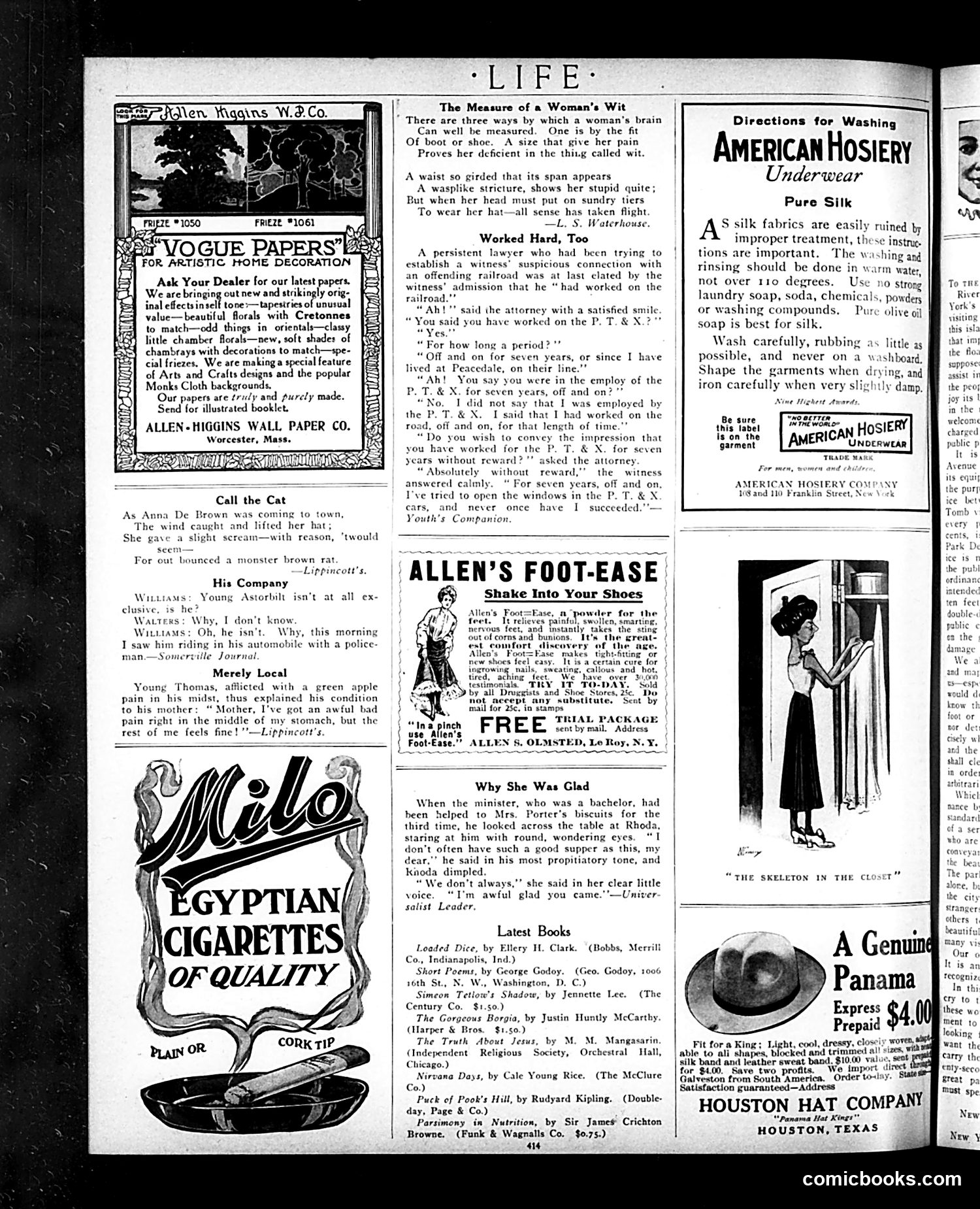
This page is **primarily advertising and filler content** rather than political satire. It comprises: **Actual Content:** - Brief humor snippets (wordplay and anecdotes) in the vein of early 1900s comic magazines - "The Skeleton in the Closet" cartoon (right side) showing an interior scene—likely a domestic humor piece about hidden embarrassments - Book reviews section listing contemporary publications **Notable Elements:** The one potentially satirical piece is "Worked Hard, Too"—a lawyer-witness joke mocking persistent legal questioning and railroad labor conditions. The witness's admission of "seven years" trying unsuccessfully to open train windows is absurdist humor suggesting either railroad negligence or worker futility. **Advertisements:** The page is dominated by product ads (Allen-Higgins wallpaper, Milo Egyptian Cigarettes, Allen's Foot-Ease powder, American Hosiery, Houston Hat Company). The magazine's satirical edge—if present—is minimal here. This appears a typical humor/lifestyle magazine page of its era, mixing light domestic comedy with commercial content.
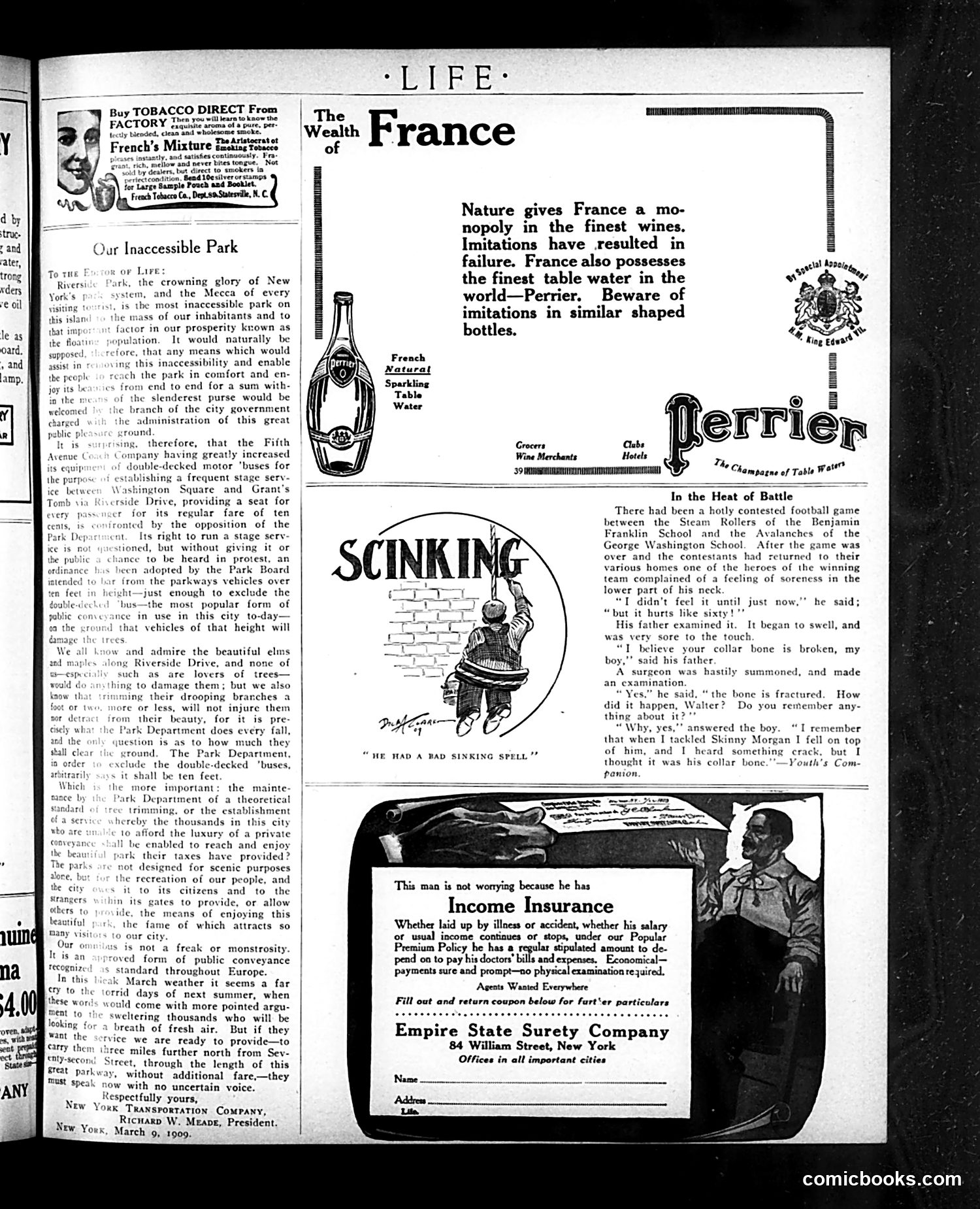
The main cartoon depicts a figure labeled "HE HAD A BAD SINKING SPELL"—a visual pun on the word "sinking." The character appears to be a poorly dressed or vagrant man, illustrated in a humorous, exaggerated style typical of Life magazine's satirical humor. The accompanying story "In the Heat of Battle" concerns a boy who breaks his collarbone during a football game but doesn't immediately notice the injury, only feeling pain later. The narrative is lighthearted, demonstrating the magazine's use of domestic humor to entertain readers. The page also contains advertisements (Perrier water, Income Insurance, Empire State Surety Company) and a letter about Riverside Park accessibility—typical Life content mixing satirical commentary on public issues with consumer advertising. The "sinking" cartoon's exact satirical target is unclear from context alone, though it likely referenced a contemporary figure or social condition recognizable to 1909 readers.
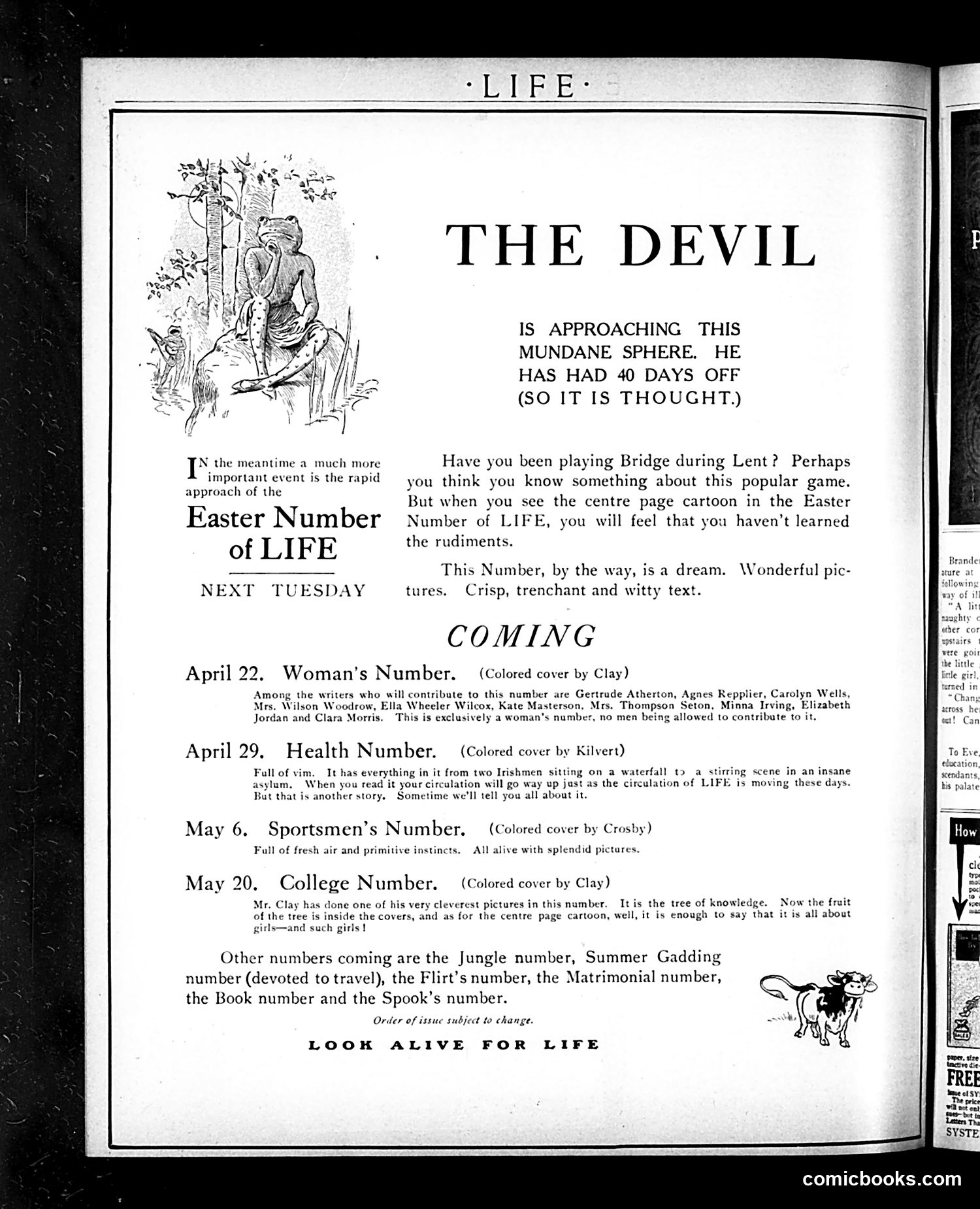
This is a promotional page advertising upcoming issues of *Life* magazine, a satirical weekly publication. The header joke references Lent (the 40-day Christian period of fasting/penance), suggesting the Devil has had 40 days off—implying that during Lent, people behave so virtuously that even evil takes a vacation. The main content lists forthcoming special issues: a Woman's Number (April 22), Health Number (April 29), Sportsmen's Number (May 6), and College Number (May 20). Each description contains light satire—the Woman's Number explicitly excludes male contributors; the Health Number promises absurdist content (Irishmen on waterfalls, asylum scenes); the College Number reduces university life to girls. This demonstrates *Life's* early-20th-century satirical approach: mocking social conventions, gender roles, and contemporary leisure pursuits through humor aimed at educated, middle-class readers. The page functions as both advertisement and comedy, using playful announcements to entertain subscribers about what's coming next.
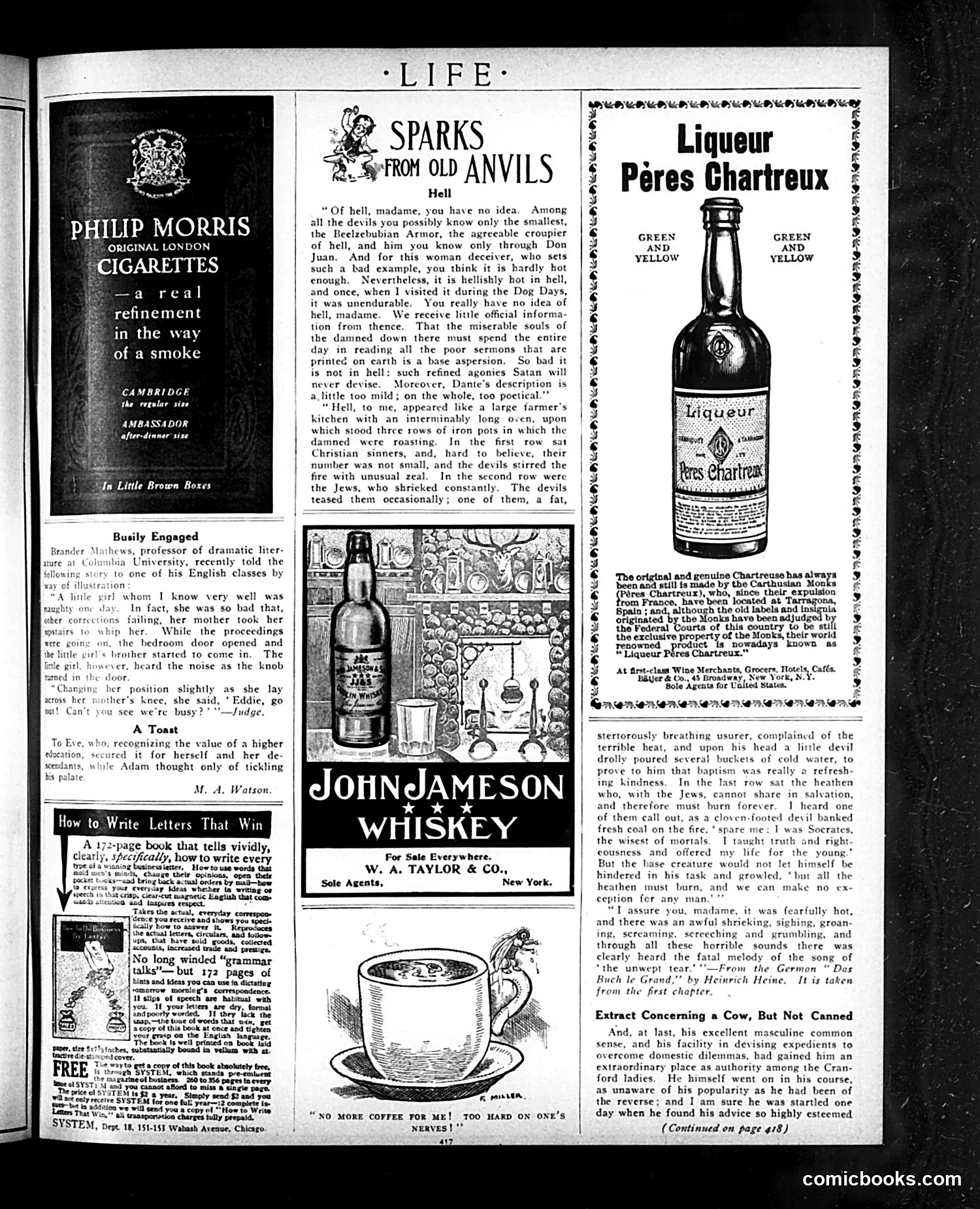
This page is primarily **advertising**, featuring prominent liquor and tobacco ads (Philip Morris cigarettes, John Jameson Whiskey, Pères Chartreux liqueur) interspersed with short humorous articles and a writing guide advertisement. The substantive content includes: **"Sparks from Old Anvils"** — a satirical piece describing Hell. The author claims personal experience visiting Hell during "Dog Days," describing it as a literal farmer's kitchen with roasting pots. The satire appears to mock both religious sermonizing (suggesting damned souls read bad sermons eternally) and Dante's *Inferno* as "too poetical." The passage stereotypically includes separate torments for "Christian sinners" and "Jews," reflecting period antisemitism embedded in ostensibly humorous commentary. **Other brief articles** include anecdotes about a girl's discipline and a professor's classroom story—light domestic humor typical of Life's satirical style. The **coffee cartoon** (bottom) shows a nervous figure rejecting coffee as "too hard on one's nerves"—likely referencing contemporary health anxieties about caffeine. The page reflects early 20th-century Life: mix of advertising, light social satire, and casual prejudices now jarring to modern readers.
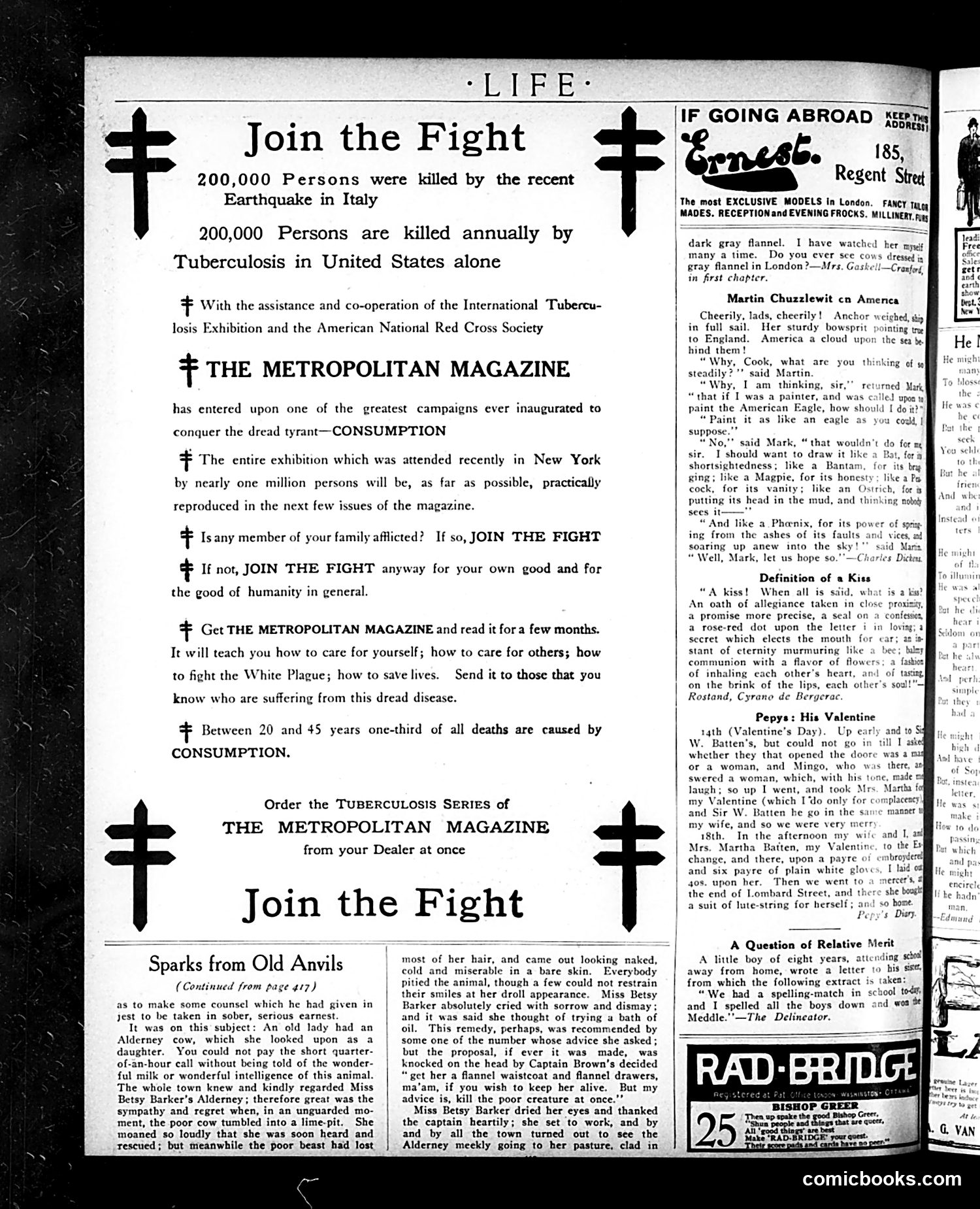
This page promotes The Metropolitan Magazine's campaign against tuberculosis (then called "consumption" or "the White Plague"). The publication juxtaposes two deaths: 200,000 killed by Italy's recent earthquake versus 200,000 killed annually by tuberculosis in the U.S. alone—arguing the disease deserves equal attention to natural disasters. The magazine urges readers to "join the fight" by subscribing to learn how to prevent and treat TB through proper self-care and hygiene education. They promise to reproduce a major tuberculosis exhibition from New York for readers. The campaign emphasizes tuberculosis as a preventable epidemic worthy of urgent public health mobilization, partnering with the International Tuberculosis Exhibition and Red Cross Society. The satire is implicit: a silent killer affecting one-third of deaths aged 20-45 receives far less public alarm than earthquakes, yet remains conquerable through education and action.
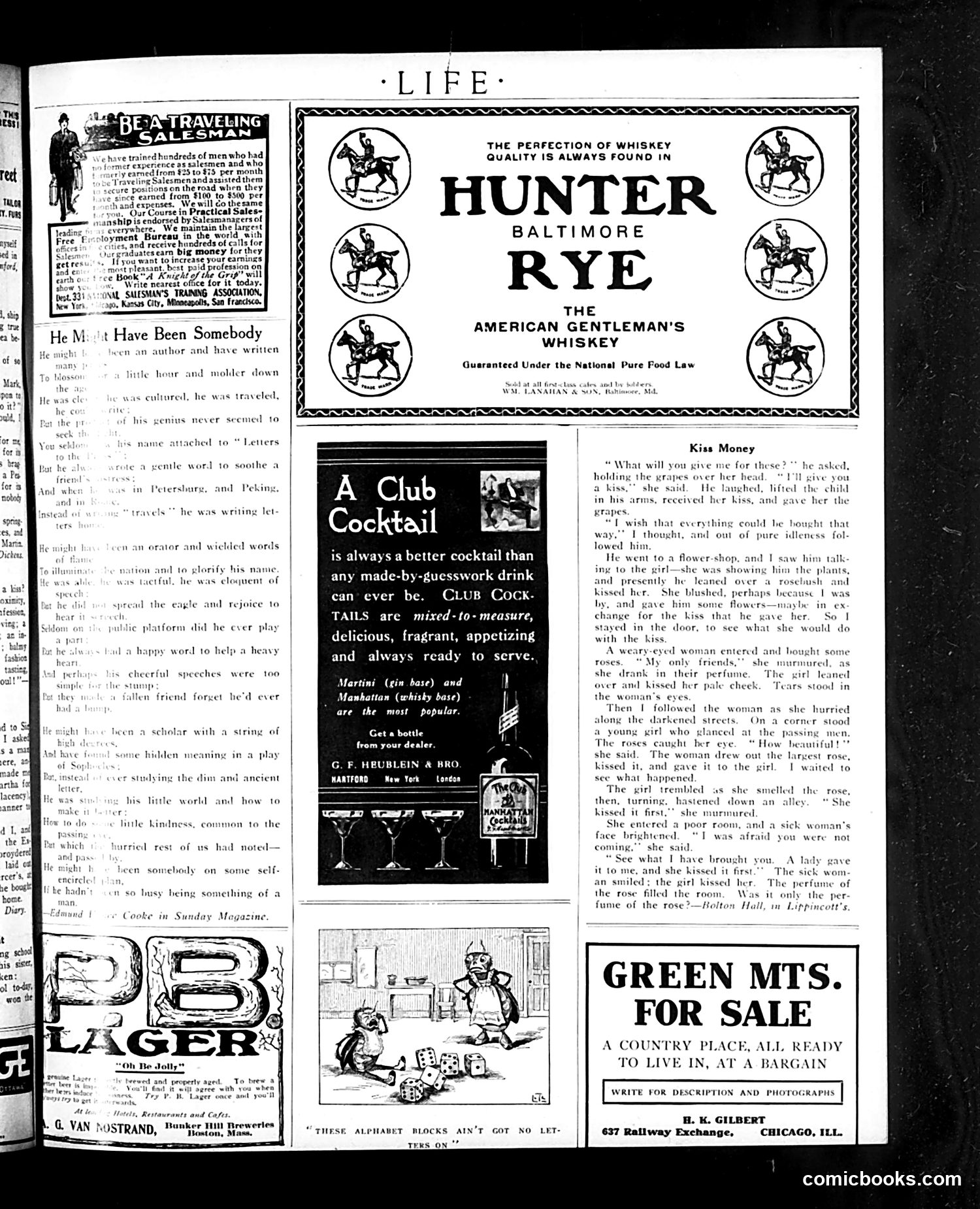
This page consists primarily of **advertisements and serialized fiction**, not political satire. The main content includes: 1. **"Hunter Baltimore Rye" whiskey ad** - Appeals to "American Gentleman" status, emphasizing quality guaranteed under Pure Food Law (likely referencing early 1900s food safety regulations). 2. **"Club Cocktail" advertisement** - Promotes pre-mixed cocktails as superior to homemade drinks, suggesting cocktail culture was becoming commercialized. 3. **"Kiss Money" serialized story** - A sentimental narrative about roses being exchanged through kisses, passed from a young couple to a flower girl to a poor woman to a sick patient, emphasizing emotional/human connection over monetary transaction. 4. **Other ads** - PB Lager beer, real estate in Illinois. The page reflects early 20th-century consumer culture and mass-market advertising targeting middle-class readers. There is **no apparent political cartoon or satirical commentary**—this is a typical commercial magazine page of the era.

This is a straightforward **product advertisement**, not political satire or a cartoon. The page shows a commercial for Crystal Domino Sugar from *Life* magazine (dated March 25, 1908). The ad features sugar cubes spilling from a box into a large bowl, with text reading "By Grocers Everywhere" on the bowl's rim. The tagline claims it's the "Best Sugar for Tea and Coffee!" This represents early 20th-century advertising in American magazines. The domino branding (visible on the package) was apparently the manufacturer's trademark. There's no political commentary or satire present—it's simply a product promotion emphasizing the brand's availability and suitability for hot beverages, which were common daily staples of the era.