
Life, 1909-03-25 · page 17 of 36
Life — March 25, 1909 — page 17: what you’re looking at
What you’re looking at
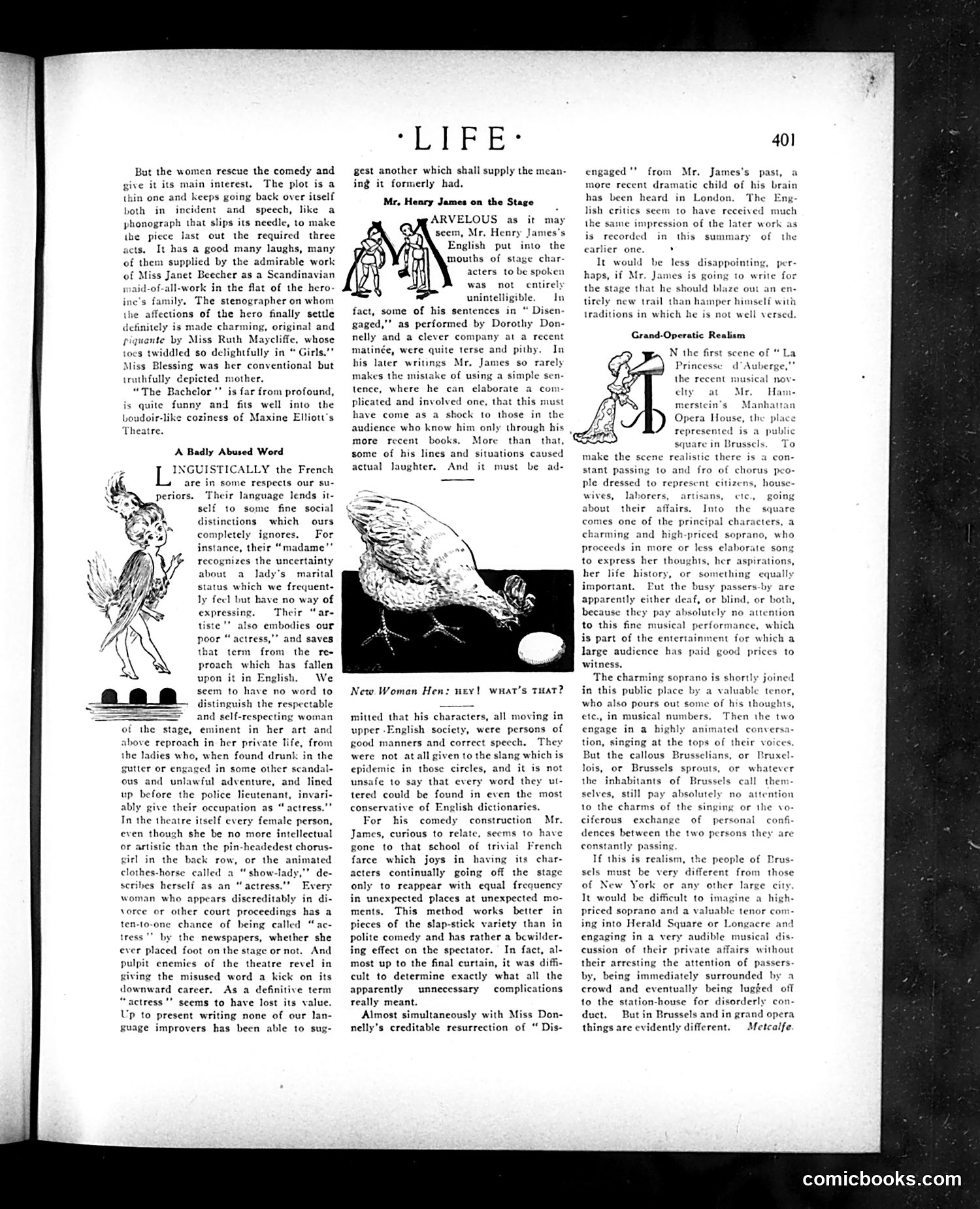
This page contains theater criticism rather than political cartoons. The main content discusses three theatrical productions: **Henry James on Stage**: The critic praises a dramatization of James's work ("Disengaged"), noting with surprise that James's notoriously complex, convoluted prose actually worked on stage. The joke is that James—known for elaborate, difficult sentences in his novels—produced dialogue that was "quite terse and pithy" and even caused "actual laughter." The implication is that James's prose style is so famously verbose that audiences expected incomprehensibility. **Language Commentary**: A section titled "A Badly Abused Word" discusses how "actress" has become a catch-all term for any woman in legal trouble, losing its respectability. The author argues the French language better distinguishes between respectable stage performers and disreputable women. **Illustrations**: Small sketches show theatrical scenes, including one captioned "New Woman Hen: hey! what's that?"—likely satirizing contemporary "New Woman" social attitudes. The page reflects early 1900s theater culture and language concerns rather than political satire.
📄 Transcribed text from this page (OCR, searchable)
Machine-transcribed from the original scan — historical spelling and the odd misread are preserved.
But the women rescue the comedy and give it its main interest. The plot is a thin one and keeps going back over itself both in incident and speech, like a phonograph that slips its needle, to make ihe picce last out the required three acts, It has a good many laughs, many of them supplied by the admirable work of Miss Janet Beecher as a Scandinavian maid-of-all-work in the flat of the hero ine’s family, The stenographer on whom the affections of the hero finally settle definitely is made charming, original and piguante by Miss Ruth Maycliffe, whose tocs twiddled so delightfully in“ Girls.”” Miss Blessing was her conventional but truthfully depicted mother. “The Bachelor '” is far from profound, is quite funny and fits well into the Loudoir-like coziness of Maxine Elliott's Theatre, A Badly Abused Word INGUISTICALLY the French some respects our su- heir language lends it- self to some fine social distinctions which ours completely ignores, For instance, their “madame”? recognizes the uncertainty about a Jady’s marital status which we frequent ly feel but have no way of expressing. Their “ar- u "" also embodies our poor “‘actress,"” and saves that term from the ree proach which has fallen upon it in English. We seem to have no word to istinguish the respectable and self-respecting woman of the stage, eminent in her art and above reproach in her private life, from the ladies who, when found drunk: in the gutter or engaged in some other scandal- ous and unlawful adventure, and lined up before the police lieutenant, invari- ably give their occupation as “actress.” In the theatre itself every female person, even though she be no more intellectual or artistic than the pin-headedest chorus- girl in the back row, or the animated a “show-lady,"” de- “actress.” Every woman who appears disereditably in di- \orce or other court proceedings has a ten-to-one chance of being called “ac- by the newspapers, whether she ever placed foot on the stage or not. And pulpit enemies of the theatre revel in giving the misused word a kick on its downward career. As a definitive term “actress '’ seems to have lost its value. Up to present writing none of our lan- guage improvers has been able to sug- are ir periors. clothes-horse called scribes herself as an tress” "LIE * gest another which shall supply the mean- ing it formerly had. Mr, Henry James on the Stage ARVELOUS as it seem, Mr, Henry James's English put into the mouths of stage char- A acters to be spoken was not entirely unintelligible, In fact, some of his sentences in “ Diser ed," as performed by Dorothy Dor nelly and a clever company at a recent matinée, were quite terse and pithy. In his later writings Mr. James so rarely ake of using a simple sen- may makes the iis tence, where he can elaborate a com- plicated and involved one, that this must have come as a shock to those in the audience who know him only through his more recent books. More than that, some of his lines and situations caused actual laughter. And it must be ad- New Woman Hen: wey! wuat’s THAT? mitted that his characters, all moving in upper -English society, were persons of good manners and correct speech. TI were not atall given to the slang which is epidemic in those circles, and it is not unsafe to say that every word they ut- tered could be found in even the most conservative of English dictionaries. For his comedy construction Mr. James, curious to relate, seems to have gone to that school of trivial French farce which joys in having its char- acters continually going off the stage only to reappear with equal frequency in unexpected places at unexpected mo- ments. This method works better in pieces of the slap-stick variety than in polite comedy and has rather a bewilder- ing effect on the spectator. In fact, al- most up to the final curtain, it was diffi- cult to determine exactly what all the apparently unnecessary complications really meant. Almost simultaneously with Miss Don- nelly’s creditable resurrection of “ Dis- 401 engaged’ from Mr. James’s past, a more recent dramatic child of his brain has been heard in London. The E "to have received uch the same impression of the later work as summary lish critics s is recorded in this of the earlier one. , It would haps, if Mr. James is going to write for be less disappointing, per- the stage that he should blaze out an en- y new trail than hamper himself with traditions in which he is not well versed. Grand-Operatic Realism the first scene of Princesse d'Aubergs the recent musical nov- ely at) Mr. Ham Manhattan lace merstein’s Opera House, the represented is a public square in Brussels. To make the scene realistic there is 2 con- stant passing to and fro of chorus peo- ple dressed to represent citizens, house- laborers, going their 3. wives, about comes one of the principal characters, a who artisans, te, Into the square charming and high-priced soprano, proceeds in more or less elaborate song to express her thoughts, her asp: her life history, or something equally important. Lut the busy passers-by are apparently either deaf, or blind, or both, because they pay absolutely no attention to this fine musical is part of the entertainment for which a large audience has paid good witness, ‘The charming soprano is shortly joined in this public place by a valuable tenor, who also pours out some of his thou ete. in musical numbers, Then the two engage in a highly an tion, singing at the tops of their But the callous Brusse lois, or Brussels the inhabitants of Bi ations, performance, which prices to nated conversa- Bruxel- whatever ans, or sprouts, or assels call selves, still pay absolutely no attention to the charms of the singing of the vo- ciferous exchange of personal confi- dences between the two persons they are constantly passing If this is realism, the people of Prus- sels must be very different from those of New York or any other large city It would be difficult to imagine a priced soprano and a valuable tenor ¢ ing into Herald Square or Longacre engaging in a very audible musical dis- cussion of their private affairs without their arresting the attention of passers. by, being immediately surrounded by a crowd and eventually being lugked off to the station-house for disorderly con- duct. But in Brussels and in grand opera things are evidently different. Metcalfe comicbooks.com