
Life, 1909-03-25 · page 14 of 36
Life — March 25, 1909 — page 14: what you’re looking at
What you’re looking at
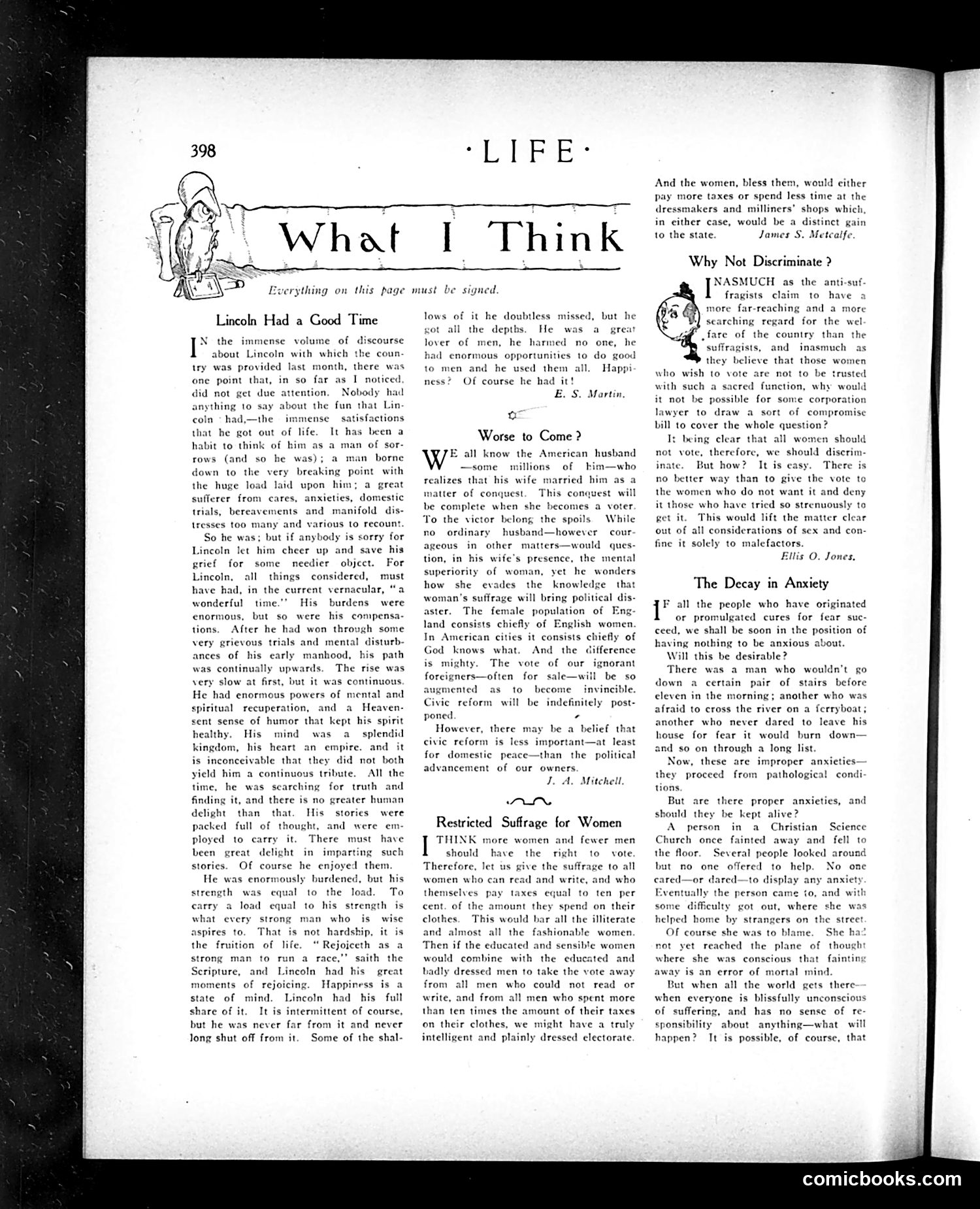
This page contains three opinion pieces reflecting early 20th-century debates about women's suffrage and social reform. **"Lincoln Had a Good Time"** celebrates Abraham Lincoln's resilience and humor amid hardship, arguing he found joy despite tremendous burdens—a character study rather than political commentary. **"Worse to Come?"** expresses anti-suffrage anxiety. The author fears granting women the vote will prove disastrous because American cities contain many immigrant women (implicitly: uneducated, foreign-born) who might be manipulated or "sold" votes. The piece warns that women's suffrage will augment an already problematic electorate and bring "political disaster," positioning women's voting rights as threatening civic stability. **"Restricted Suffrage for Women"** proposes a compromise: voting rights only for literate women who pay substantial taxes relative to their clothing expenditures. This would exclude poor and immigrant women while enfranchising educated, wealthy ones—a class-based restriction designed to address suffrage opponents' fears about "undesirable" voters. Together, these pieces reveal contemporary elite anxieties about democracy, immigration, and women's political participation.
📄 Transcribed text from this page (OCR, searchable)
Machine-transcribed from the original scan — historical spelling and the odd misread are preserved.
a Oo | Think Lincoln Had a Good Time I° the about try was provided last month, there was one point that, in so far as 1 did not get due attention, Nobody had pout the fun that Li sfactions immense volume of discourse Lincoln with which the coun noticed, anything 10 sa coin “had,—the immense sa that he got out of life. It has been a him as a man of sor- borne with habit to think of (and so he was); a man down to the point the huge load laid upon him; a s, domestic bereavements manifold Iresses too many and various to recount So he was; but if anybody is sorry for Lincoln rows very breaking great from cares, sufferer anx trials, and dis- let him cheer up and save his grief for object. For Lincoln, all considered, must have had, in the current vernacular, “a wonderful time."’ His were enormous, but so were tions. After he had won through some very grievous trials and mental disturb- ances of his early manhood, his path was continually upwards. The rise was very slow at first, but it was continuous He had enormous powers of mental and spiritual recuperation, and a Heaven- nt sense of humor that kept his spirit healthy. His mind was a_ splendid gdom, his heart an empire. and it is inconceivable that they did not both yield him a continuous tribute. All the truth and finding it, and there is no greater human delight that. His packed full of thought, and to carry it. There great delight in’ imparting Of course he enjoyed them. He was enormously burdened, but his strength equal to the load. To carry a load his strength is who is hardship, it is “Rejoiccth as a strong man to run a race,”’ saith the Scripture, and Lincoln had his great moments of rejoicing. Happiness is a state of mind had his full share of it. It is intermittent of course, but he was never far from it and never long shut off from it. Some of the shal- some needier things burdens his compensa- time, he was searching for than stories were were em have such ployed must been stories. was equal to what every strong man wise That is not the fruition of aspires to. life. Lincoln must be signed. he doubtless missed, but he great one, he lows of it got all the depths. He was a lover of men, he harmed no had enormous opportunities 10 do good to men and he used them all, Happi ness? Of course he had it! E. S. Mart o Worse to Come ? American husband of bhim—who his wife married him as a matter of conquest. This conquest will be complete when she becomes a voter To the victor belong the spoils While husband—however cour all know the —some millions realizes tha no ordinary ageous in other n tion, in his wife's presence, the mental woman, yet he wonders how she evades the knowledge that woman’s suffrage will bring political dis- aster. The female population of Eng- land consists chiefly of English women. In American cities it consists chiefly of God knows what. And the difference is mighty. The vote of our ignorant forcigners—often for sale—will be so become ters—would ques: superiority of augmented as to invincible. will be indefinitely poned - be a belief that reform is less ii t ast political Civic reform post- However, there m civic for domestic peace—than the of our owners oa. aN advancement Mitchell Restricted Suffrage for Women THINK more women and fewer men should have the right to vote Therefore, let us give the suffrage to all women who can read and write, and who themselves pay taxes equal to ten per cent. of the amount they spend on their clothes. This would bar all the illiterate and almost all the fashionable ‘Then if the educated and sensible women would combine with the educated and badly dressed men to take the vote away from all men who could not read or and from all men who spent more amount of their taxes on their clothes, we might have a truly intelligent and plainly dressed electorate. women. write, than ten times the And the women, bless them, pay more taxes or sp dressmakers and milliners’ shops which, in either case, would be a distinct gain to the state. James S. Metcal, Why Not Discriminate ? I* ASMUCH as the anti-su fragists claim to have a far-reaching and a more Id either nd less time at the more searching regard for the wel wfare of the country than the suffragists, and inasmuch as they believe that the who wish to vote are not to © women sted with such a sacred function, why would it not be possible for some corporation lawyer to draw a sort of compromise bill to cover the whole question? I: being clear that all women should not vote, therefore, we should discrim But how? It is ¢ There is no better way than to give the vote to the women who do not want it and deny it those who have tried so stre get it. This would lift the matter clear out of all considerations of sex and con- fine it solely to malefactors. Ellis O. Jones, The Decay in Anxiety 1 7 all the people who have originated or promulgated cures for fear suc- ceed, we shall be soon in the position of having nothing to be anxious al Will this be desirable? There was a man who wouldn't go down a pair of stairs before eleven in the morning; another who was afraid to cross the river on a ferryboat; anot! inate wously to certain + who never dared to leave his house for fear it would burn down— and so on through a long list. improper anxiet pathologic Now, these are they proceed from tions But are there proper anxieties, and should they be kept alive? A person in a Christian Science Church once fainted away and fell to the floor. Several people looked around offered to help. No one or dared—to display any anxiety but no one cared Ever some difficulty got helped home by strangers on the street ¢ had reached the plane of though faintin mind. ally the person came to, and out, where she wai Of course she was to blame. S| not yet where she was conscious that away is an error of morta But when all the world gets there when everyone is blissfully unconscious of suffering, and has no sense of re- sponsibility about anything—what will happen? It is possible, of course, that comicbooks.com