
Life, 1909-03-25 · page 16 of 36
Life — March 25, 1909 — page 16: what you’re looking at
What you’re looking at
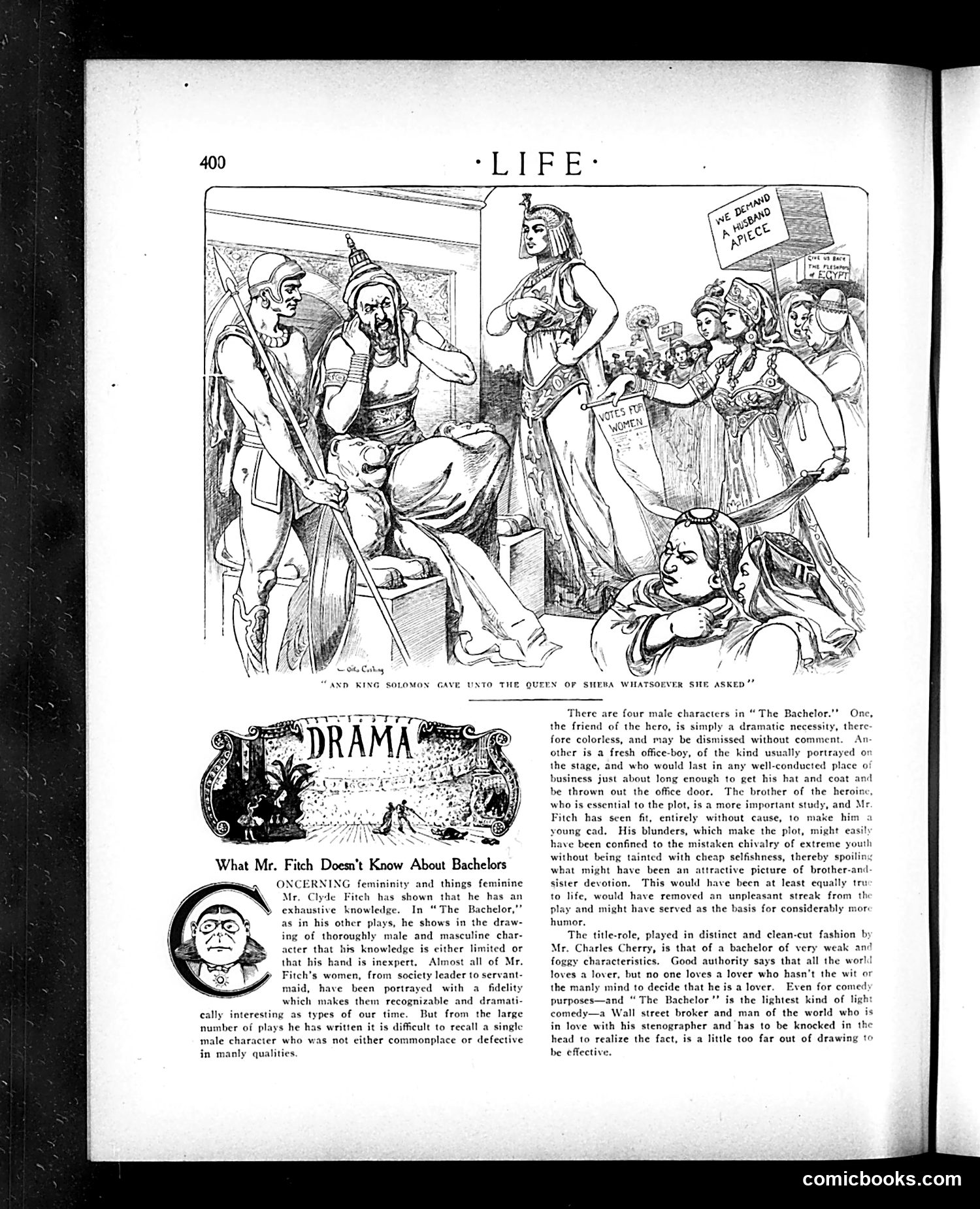
This page critiques playwright Clyde Fitch's work, specifically his play "The Bachelor." The satirical article argues that while Fitch excels at portraying female characters with nuance and realism, his male characters are consistently weak, clichéd, or morally compromised. The complaint centers on the title character—a wealthy Wall Street broker and man-of-the-world who fails to recognize he's in love with his stenographer and needs to be literally "knocked in the head" to realize it. The critic finds this implausible and unfunny, arguing it contradicts the character's supposed sophistication. Other male roles are dismissed as stock types: a colorless friend, a generic office boy, and a brother portrayed as a selfish cad. The satirist suggests Fitch's male characterizations reveal genuine limitations in his understanding of masculine psychology and virtue—a pointed inversion of his claimed expertise in depicting femininity.
📄 Transcribed text from this page (OCR, searchable)
Machine-transcribed from the original scan — historical spelling and the odd misread are preserved.
Fitch Doesn't Know About Bachelors ONCERNING femininity and things feminine Mr. Clyde Fitch has shown that he has an exhaustive knowledge. In “The Bachelor,” as in his other plays, he shows in the draw- ing of thoroughly male and masculine char- acter that his knowledge is either limited or that his hand is inexpert, Almost all of Mr. Fitch's women, from society leader to servant- maid, have been portrayed with a fidel which makes them recognizable and dramati- cally interesting as types of our time. But from the large number of plays he has written it is difficult to recall a single male character who was not either commonplace or defective in manly qualities. here are four male characters in “ The Bachelo the friend of the hero, is simply a dramatic nece! fore colorless, and 1 other is a fresh office-boy, of the kind usually portrayed on the stage, and who would last in any well-conducted place o: business just about Jong enough to get his hat and coat be thrown out the office door. The brother of the heroin who is essential to the plot, is a more important study, and \ Fitch has scen fit, entirely without cause, 10 make hin young cad. His blunders, which make the plot, might have been confined to the mistaken chivalry of extreme youth without being tainted with cheap selfishness, thereby spoili what might have been an attractive picture of brother-and- sister devotion, This would have been at least equally tru to life, would have removed an unpleasant streak from th play and might have served as the basis for considerably mor: humor. The title-role, played in distinct and clean-cut fashion b Mr. Charles Cherry, is that of a bachelor of very weak an‘ foggy characteristics. Good authority says that all the worl loves a lover, but no one loves a lover who hasn't the wit or the manly mind to decide that he is a lover. Even for comedy purposes—and “The Bachelor’? is the lightest kind of light comedy—a Wall street broker and man of the world who is in love with his stenographer and has to be knocked in head to realize the fact, is a little too far out of drawing to be effective. comicbooks.com