
Life, 1909-03-25 · page 8 of 36
Life — March 25, 1909 — page 8: what you’re looking at
What you’re looking at
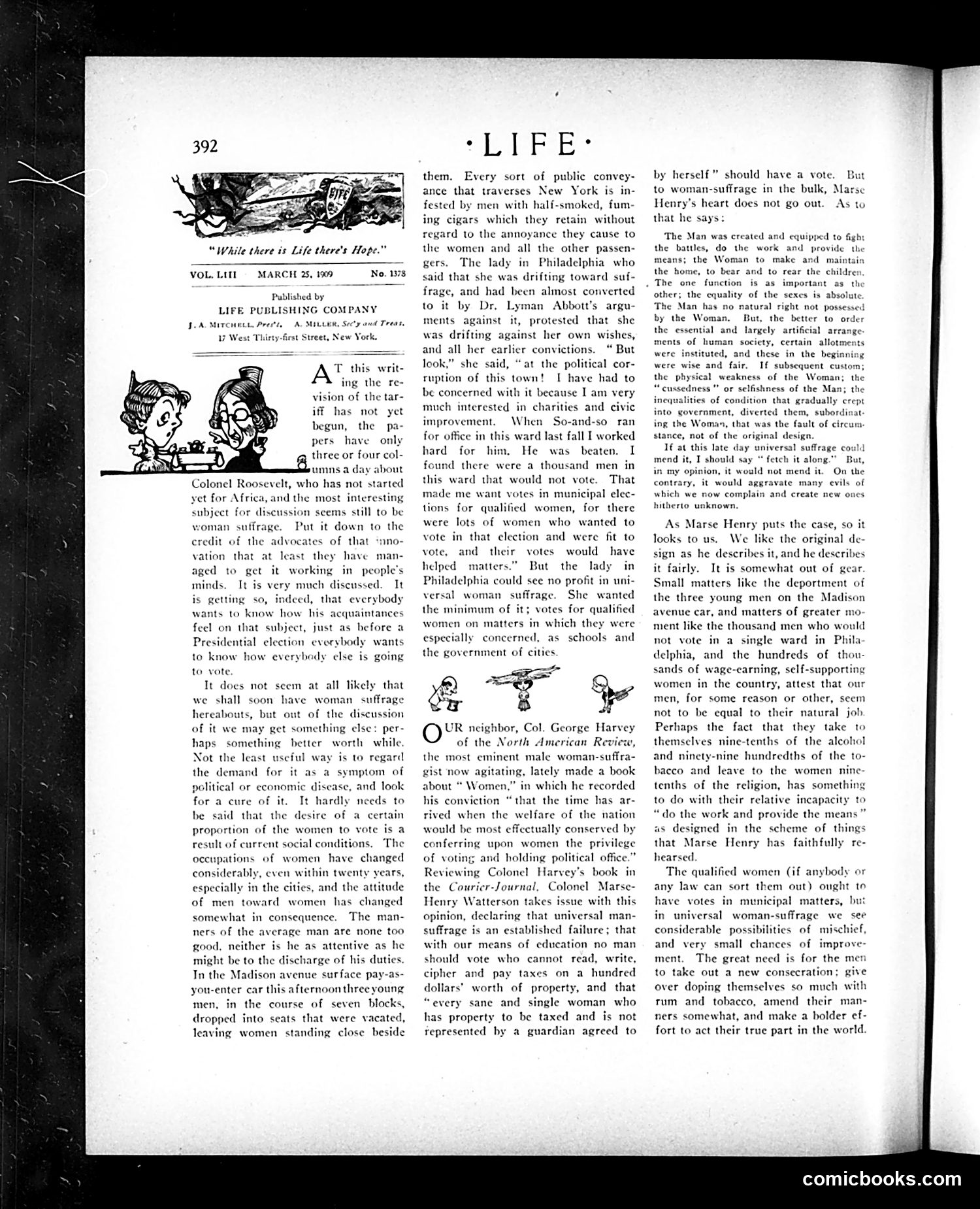
This page from *Life* magazine (Vol. LIII, March 29) discusses women's suffrage through political commentary and debate. The small cartoon at top left shows two caricatured figures in what appears to be a disagreement, likely representing opposing views on the suffrage question. The text engages Colonel Roosevelt's stance on women's voting rights and references Colonel George Harvey of the *North American Review* and Marse Henry Watterson, who debated whether universal male suffrage represents an "established failure." The article argues that objections to women voting—based on property ownership, taxation representation, and literacy—apply equally to men, exposing the hypocrisy of restricting women's votes while men with similar limitations retain theirs. The satire critiques the gendered logic used to deny women political participation.
📄 Transcribed text from this page (OCR, searchable)
Machine-transcribed from the original scan — historical spelling and the odd misread are preserved.
“While there is Life there's Hope.” VOL. LI MARCH 25, 1909 Published by LIFE PUBLISHING J.A. Mite UF West Thirty-first Street, New York. tte Pret, A MILLER, Secty and Treas, A! this writ- ing the re- vision of the tar- iff has not yet begun, the pa- pers have only three or four col- umns a day about Colonel Roosevelt, who has not started yet for Africa, and the most interesting subject for discussion seems still to be woman suffrage. Put it down to the credit of the advocates of that vation that at least they have man- aged to get it working in people's minds. It is very much discussed. It is getting so, indeed, that everybody wants to know how his acquaintances feel on that subject, just as before a Presidential election everybody wants nno- to know how everybody else is going to vote, It does not seem at all likely that we shall soon have woman suffrage hereabouts, but out of the discussion of it we may get something else: per- haps something better worth while Not the least useful way is to regard the demand for it as a symptom of political or economic disease, and look for a cure of it. It hardly be said that the desire of a certain proportion of the women to vote is a result of current social conditions. The occupations of women have changed considerably, even within twenty years, especially in the cities, and the attitude of men toward women has changed somewhat in consequence. The man- ners of the average man are none too good, neither is he as attentive as he might be to the discharge of his duties. In the Madison avenue surface pay-as- you-enter car this afternoon three young men, in the course of seven blocks, dropped into seats that were vacated, leaving women standing close beside needs to No. 1378, 1) 0 fel them. Every sort of public convey- ance that traverses New York is in- fested by men with half-smoked, fum- ing cigars which they retain without regard to the annoyance they cause to the women and all the other passen- gers. The lady in Philadelphia who aid that she was drifting toward suf- frage, and had been almost converted to it by Dr. Lyman Abbott's argu- ments against it, protested that she was drifting against her own wishes, and all her earlier convictions. “ But look,” she said, “ the political cor- ruption of this town! [ have had to be concerned with it because I am very much interested in charities and civic improvement. When So-and-so. ran for office in this ward last fall I worked hard for him, He was beaten. I found there were a thousand men in this ward that would not vote. That made me want votes in municipal elec- tions for qualified women, for there were lots of women who wanted to vote in that clection and were fit to vote, and their would have helped) matters.”. But. the lady in Philadelphia could see no profit in uni- versal woman suffrage. She wanted the minimum of it; votes for qualified women on matters in which they were especially concerned, as schools and the government of cities. votes R neighbor, Col. George Harvey of the North American Review, the most eminent male woman-suffra gist now agitating, lately made a book about “ Women,” in which he recorded his conviction “that the time has ar- rived when the welfare of the nation would be most effectually conserved by conferring upon women the privilege of voting and holding political office.” Reviewing Colonel Harvey's book in the Courier-Journal, Colonel Marse- Henry Watterson takes issue with this opinion, declaring that universal man- suffrage is an established failure; that with our means of education no man should vote who cannot read, write, cipher and pay taxes on a hundred dollars’ worth of property, and that “every sane and single woman who has property to be taxed and is not fepresented by a guardian agreed to . The one function by herself” should have a vote, But to woman-suffrage in the bulk, Marse Henry's heart does not go out. As to he says: ‘The Man was created and eq the battles, do the means; the Woman to make and maintain the home, to bear and to rear the childre: important as th other; the equality of the sexes is absolute The Man has no natural right not possessed, by the Woman. But, the better to order the essential and largely artificial arrange ments of human society, certain allot were instituted, and these in the beginning were wise and fair. If subsequent custom; the physical weakness of the Woman; th ness” of selfishness of the Man; inequalities of condition that gradually crept into government, diverted ped to fight work and provide the is as cuss em, subordinat ing the Woman, that was the fault of circum: stance, not of the original design. If at this late day universal suffrage co: mend it, I should say “fetch it along.” But, in my opinion, it would not mend it. On the contrary, it would aggravate many evils of which we now compl a and create new ones hitherto unknown, As Marse Henry puts the case, so it looks to us. We like the original de- sign as he describes it, and he describes it fairly. It is somewhat out of gear. Small matters like the deportment of the three young men on the Madison avenue car, and matters of greater mo: ment like the thousand men who would not vote in a single ward in Phila delphia, and the hundreds of thou- sands of wage-carning, self-supporting women in the country, attest that our men, for some reason or other, seem not to be equal to their natural job. Perhaps the fact that they take to themselves nine-tenths of the alcohol and ninety-nine hundredths of the to- bacco and leave to the women nine- tenths of the religion, has something to do with their relative incapacity to “do the work and provide the means’ as designed in the scheme of things that Marse Henry has faithfully re- hearsed The qualified women (if anybody or any law can sort them out) ought to have votes in municipal matters, but in universal woman-suffrage we see considerable possibilities of mischief, and very small chances of improve- ment. The great need is for the men to take out a new consecration; give over doping themselves so much with rum and tobacco, amend their man- ners somewhat, and make a bolder ef- fort to act their true part in the world. comicbooks.com