
A complete issue · 28 pages · 1909
Life — January 28, 1909
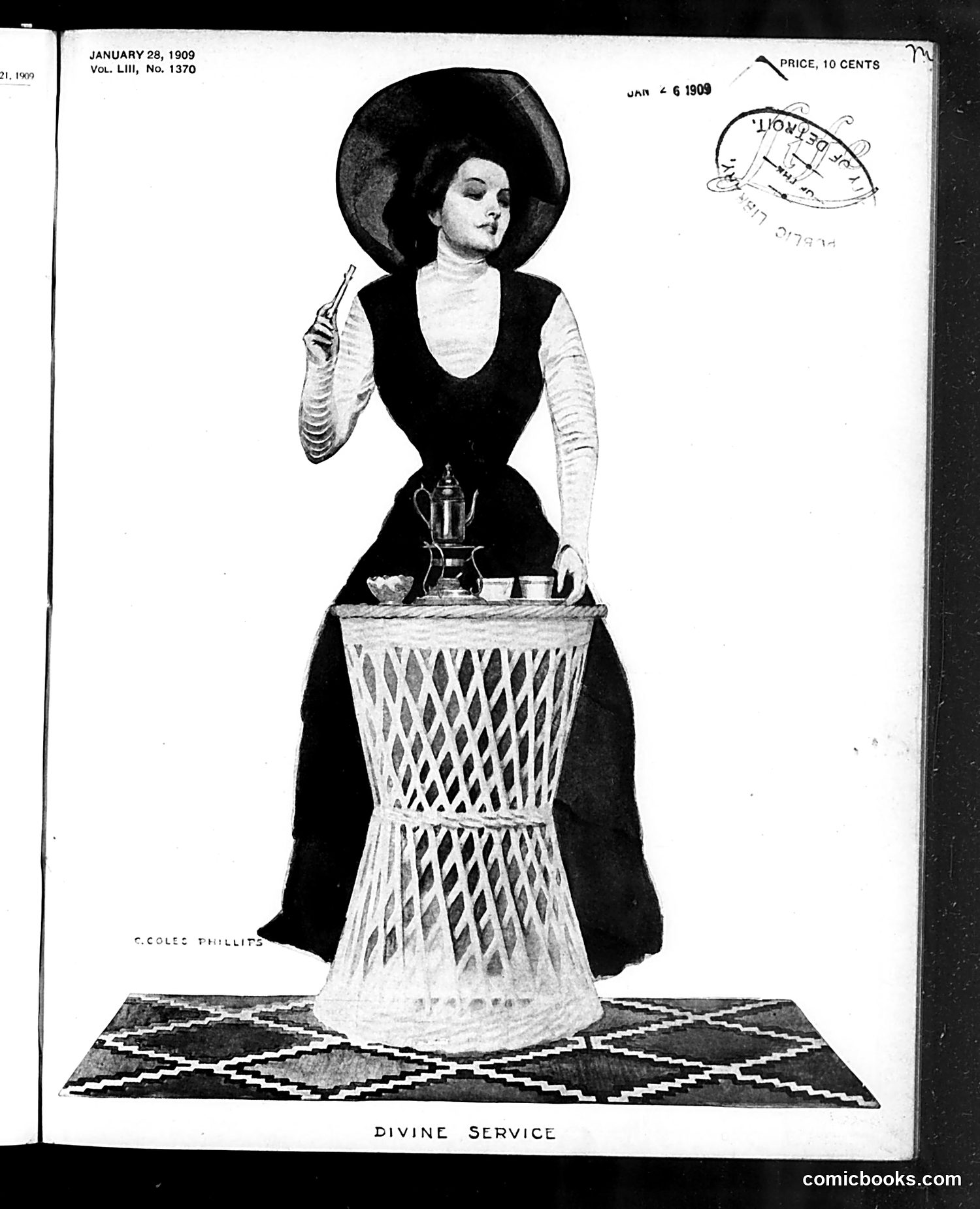
This satirical cartoon by Coley Phillips depicts a fashionably dressed woman with an enormous wide-brimmed hat, holding a cosmetic bottle and standing before a vanity table draped in an ornate basket-weave skirt. The title "Divine Service" is ironic wordplay—a religious term twisted to mock women's devotion to beauty rituals and personal grooming. The satire targets the era's conspicuous consumption and vanity culture among wealthy women, particularly their obsession with elaborate hats (a status symbol), cosmetics, and beauty preparation. By framing this as "divine service," the cartoon suggests women treat beauty maintenance with almost religious fervor, mocking both excessive materialism and the social pressures on women to maintain fashionable appearance.
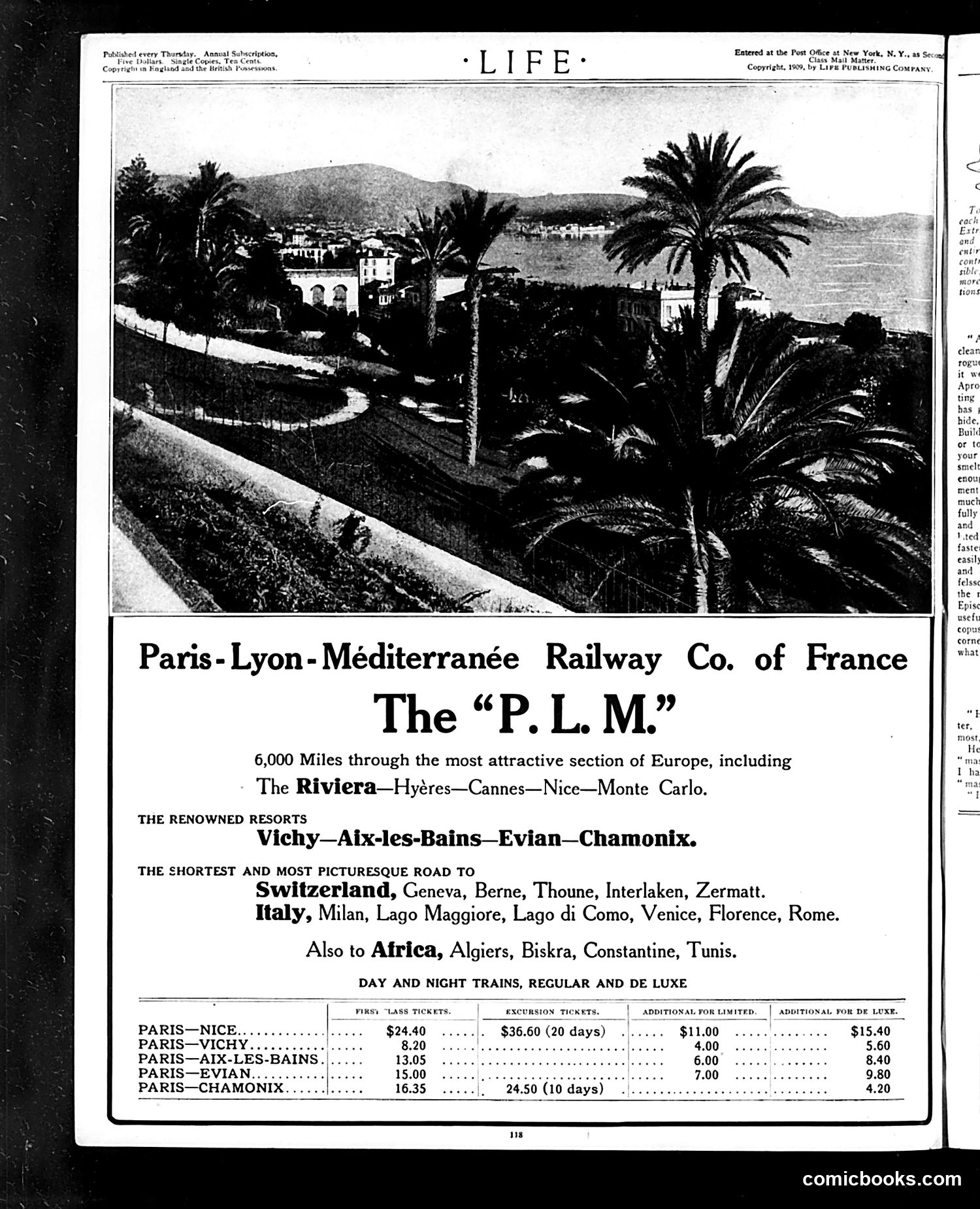
This is **not a cartoon or satire page**—it's a travel advertisement from *Life* magazine (circa 1920s, based on styling). The image shows a Mediterranean coastal landscape with palm trees, a villa, and mountains, advertising the Paris-Lyon-Méditerranée Railway (the "P.L.M."). The ad promotes the railway's 6,000-mile route through Europe, highlighting resort destinations like the Riviera, Nice, Monte Carlo, and connections to Switzerland, Italy, and North Africa. The table lists first-class ticket prices from Paris to various destinations, with both regular and excursion fares. This represents early-20th-century luxury travel marketing targeting affluent readers who could afford continental rail journeys. There is no political satire or social commentary present.
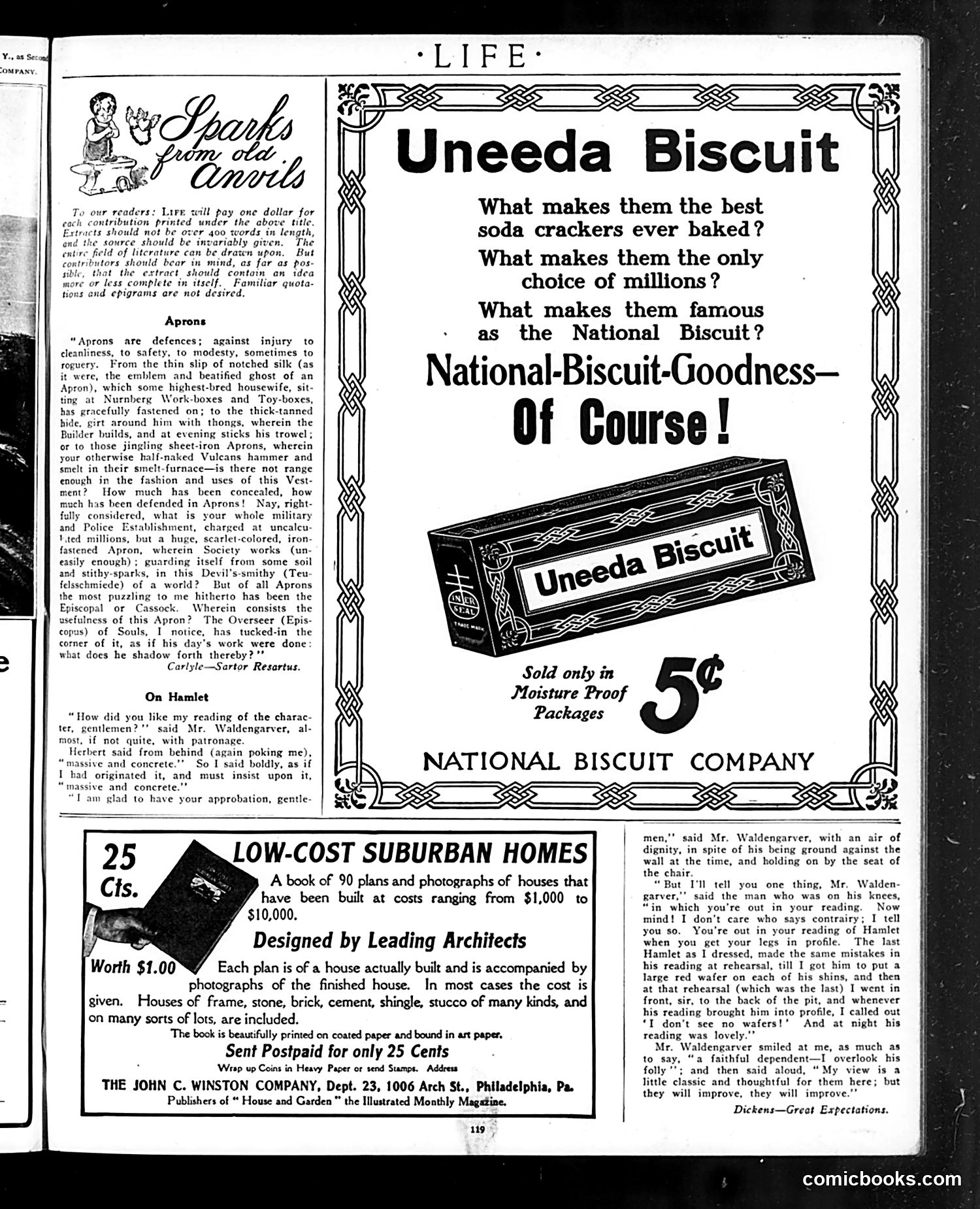
This page is **primarily advertising**, not satire or political commentary. It features two major ads: 1. **Uneeda Biscuit** (top): A straightforward product advertisement for soda crackers, priced at 5¢ per moisture-proof package. The copy uses rhetorical questions to promote the brand as "the National Biscuit" and emphasizes its widespread popularity. This is conventional early-20th-century advertising. 2. **Low-Cost Suburban Homes** (bottom): Promotes an architectural book offering 90 house plans costing $1,000-$10,000, designed by "leading architects." It's aimed at middle-class homebuyers interested in affordable suburban construction. The left sidebar contains unrelated fiction excerpts ("Pearls from Old Amrils," "On Hamlet"). There is no political cartoon or satirical content on this page.
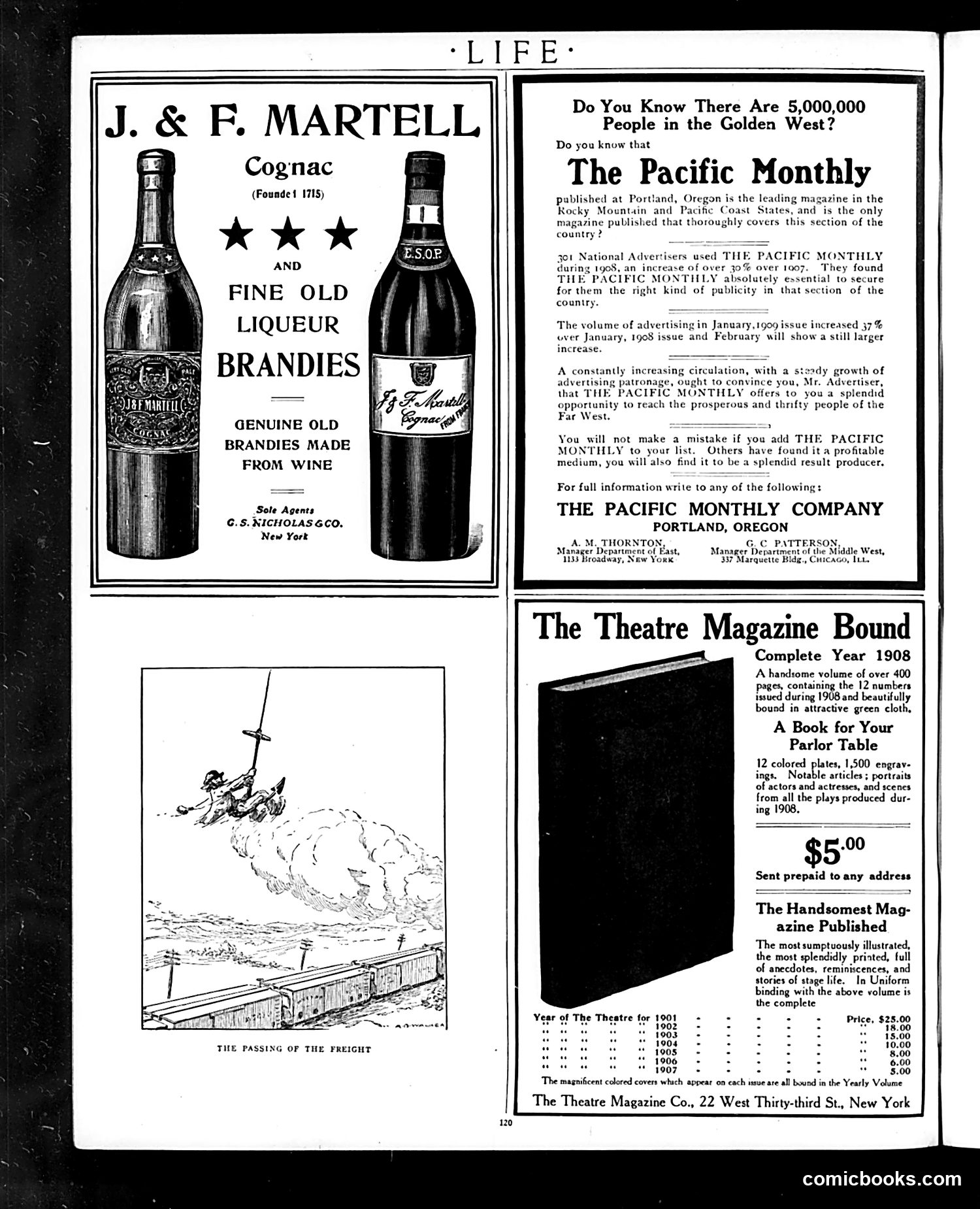
This page is primarily **advertising**, not satire or political commentary. The left side advertises J. & F. Martell Cognac (founded 1715), featuring two bottles of brandy with three-star and V.S.O.P. designations, sold through C.S. Nichols & Co. in New York. Below is an illustration titled "THE PASSING OF THE FREIGHT"—a dramatic maritime scene showing a ship in distress during what appears to be a storm, with a smaller vessel nearby. The specific historical event it references is unclear from the image alone. The right side contains two advertisements: one promoting *The Pacific Monthly* magazine to Oregon/Western businesses, and another selling *The Theatre Magazine Bound* complete year 1908 volumes for $5.00. The page reflects early 1900s advertising practices and consumer products typical of *Life* magazine's commercial content.
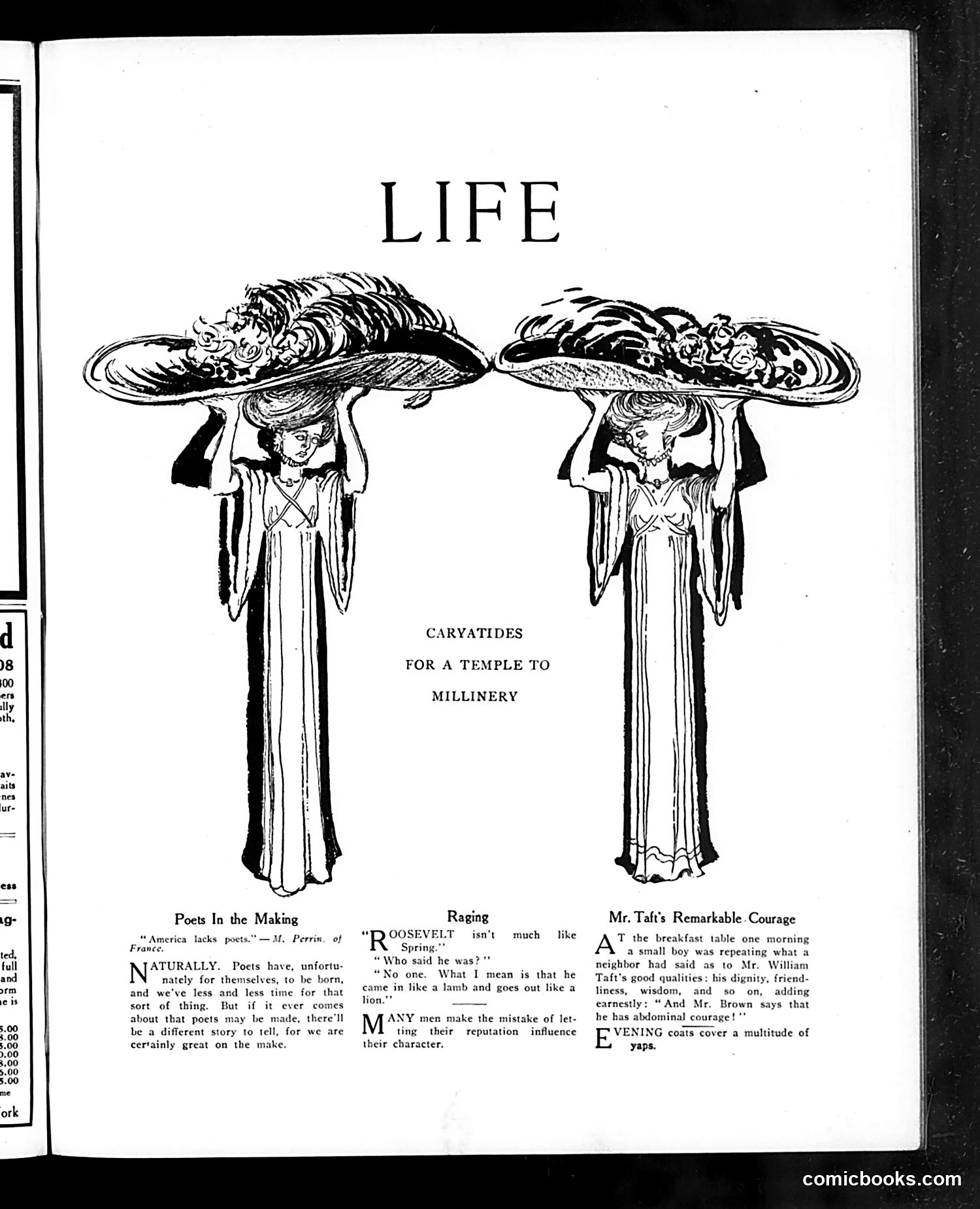
This page features an Art Nouveau-style illustration titled "Caryatides for a Temple to Millinery"—a satirical architectural drawing showing two female figures as supporting columns, their heads topped with enormous, elaborately decorated hats. The satire mocks women's fashion obsession, specifically the era's extravagant millinery (hat-making). By depicting women as architectural supports literally weighed down by hats, the cartoon suggests women have become mere objects or props to display fashion excess. The "temple to millinery" implies hat-wearing has become almost religious devotion. The accompanying text articles address poets' reputations and Roosevelt comparisons, unrelated to the visual satire. This appears to be an early 20th-century critique of conspicuous consumption and feminine fashion culture.
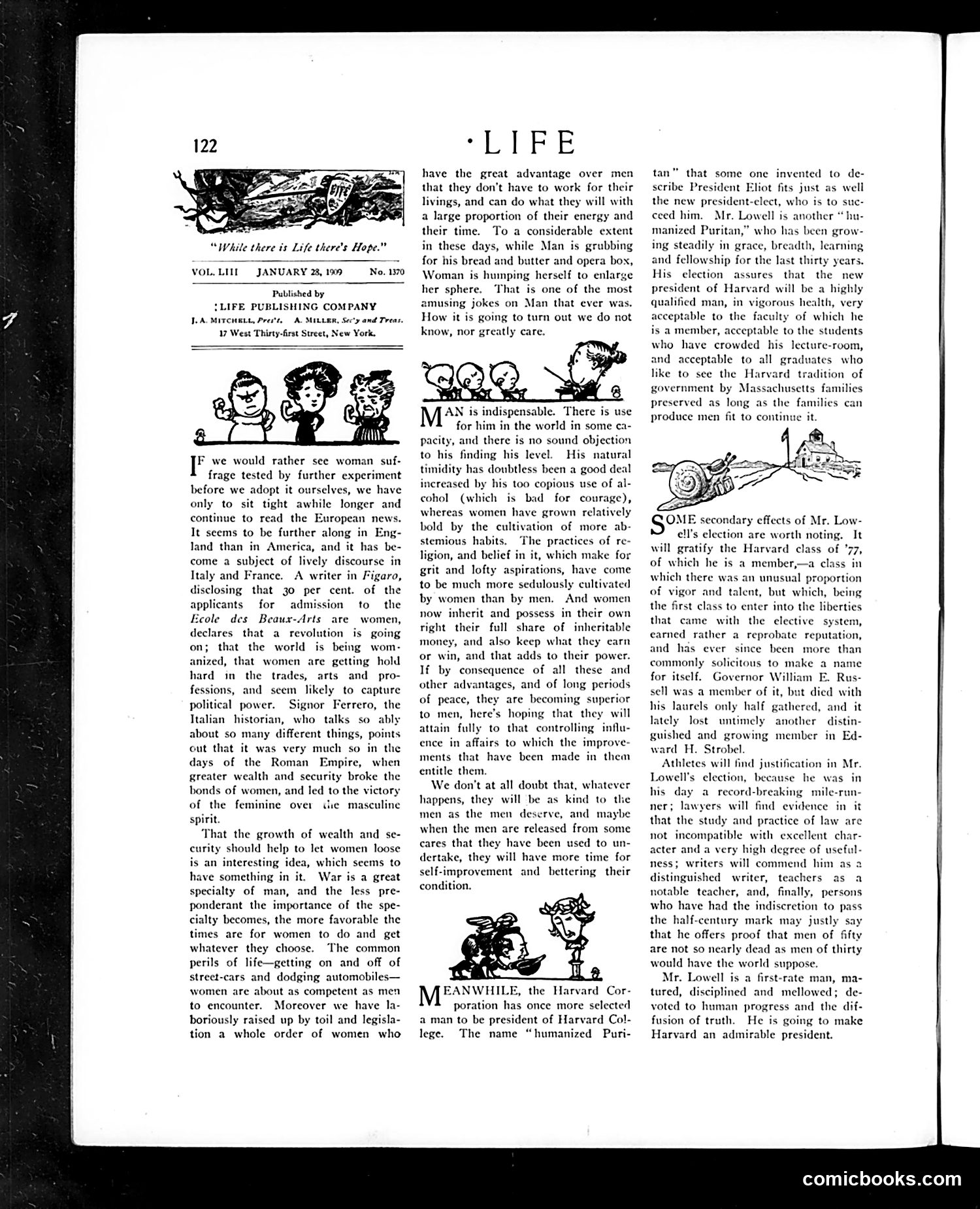
The page contains editorial commentary on women's suffrage and social progress, with accompanying satirical illustrations of women and children. The text argues that women have become indispensable to society and should have greater influence in civic affairs. It references a 30% rate of female applicants to the Ecole des Beaux-Arts in Paris, suggesting women's growing participation in professional fields. The small cartoon illustrations appear to depict women and children in domestic or social settings, likely intended to satirize contemporary debates about women's expanding roles beyond the home. The editorial also discusses Harvard College's election of a new president ("humanized Puritan"), suggesting this institutional development somehow relates to broader social progress regarding women's participation and influence in American civic and intellectual life.
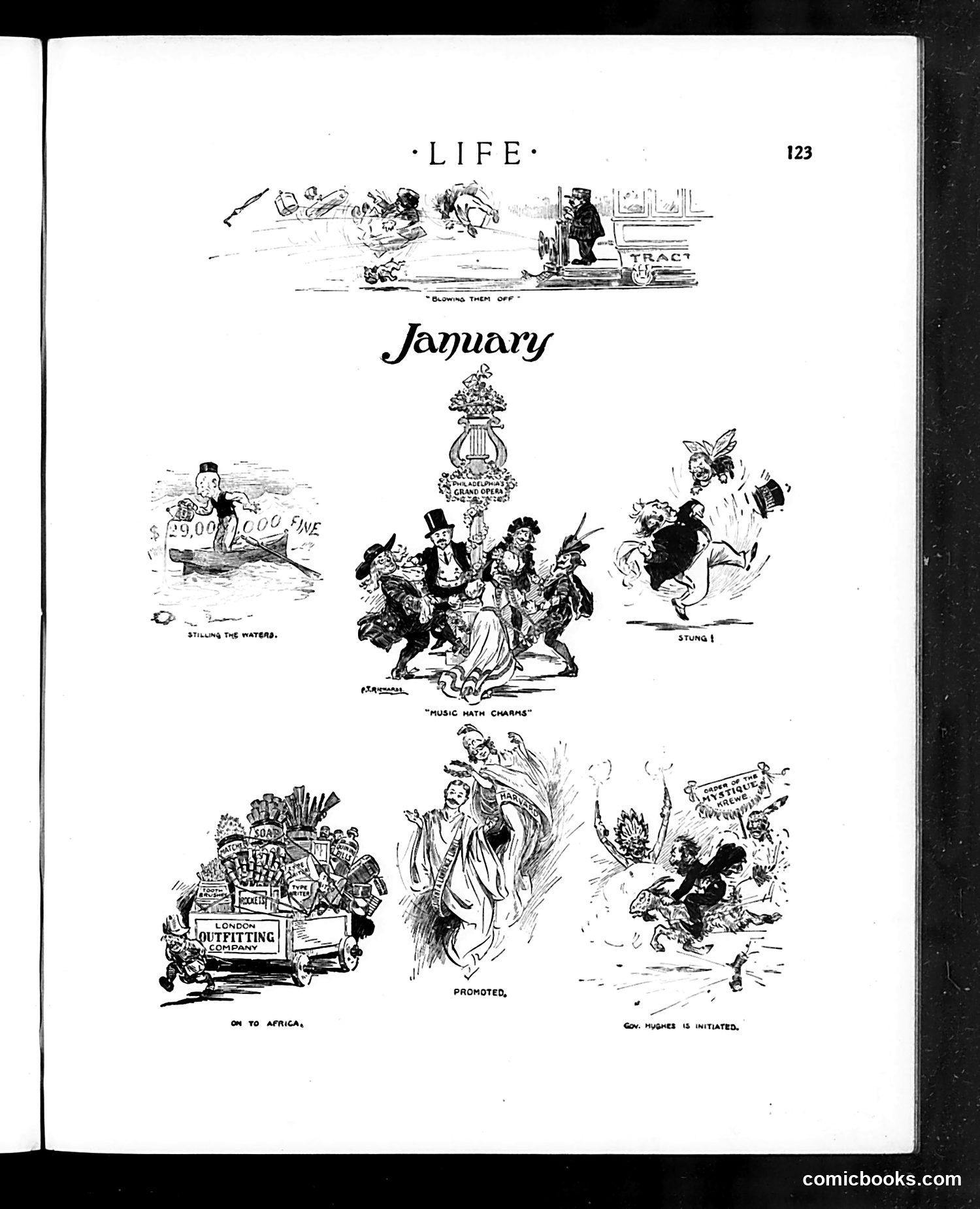
This satirical calendar page for January contains six political cartoons mocking early 1900s events and figures: **Top**: "Blowing Them Off" shows a tractor or industrial machine literally blowing away figures—likely referencing political upheaval or labor disputes. **Center**: "Music Hath Charms" depicts well-dressed figures dancing around a decorative urn, satirizing upper-class frivolity. **Left**: "Stilling the Waters" shows a figure in water marked "29,000 FINE"—likely mocking a legal case or financial scandal. **Right**: "Stung!" depicts someone being attacked by what appears to be a wasp or bee—suggesting political retaliation or comeuppance. **Bottom left**: "On to Africa" shows an elaborate carriage labeled "London Outfitting"—possibly referencing colonial expeditions. **Bottom right**: "Gov. Hughes Is Initiated"—unclear without additional context, but suggests Governor Hughes's political maneuvering or initiation into some group or scandal.
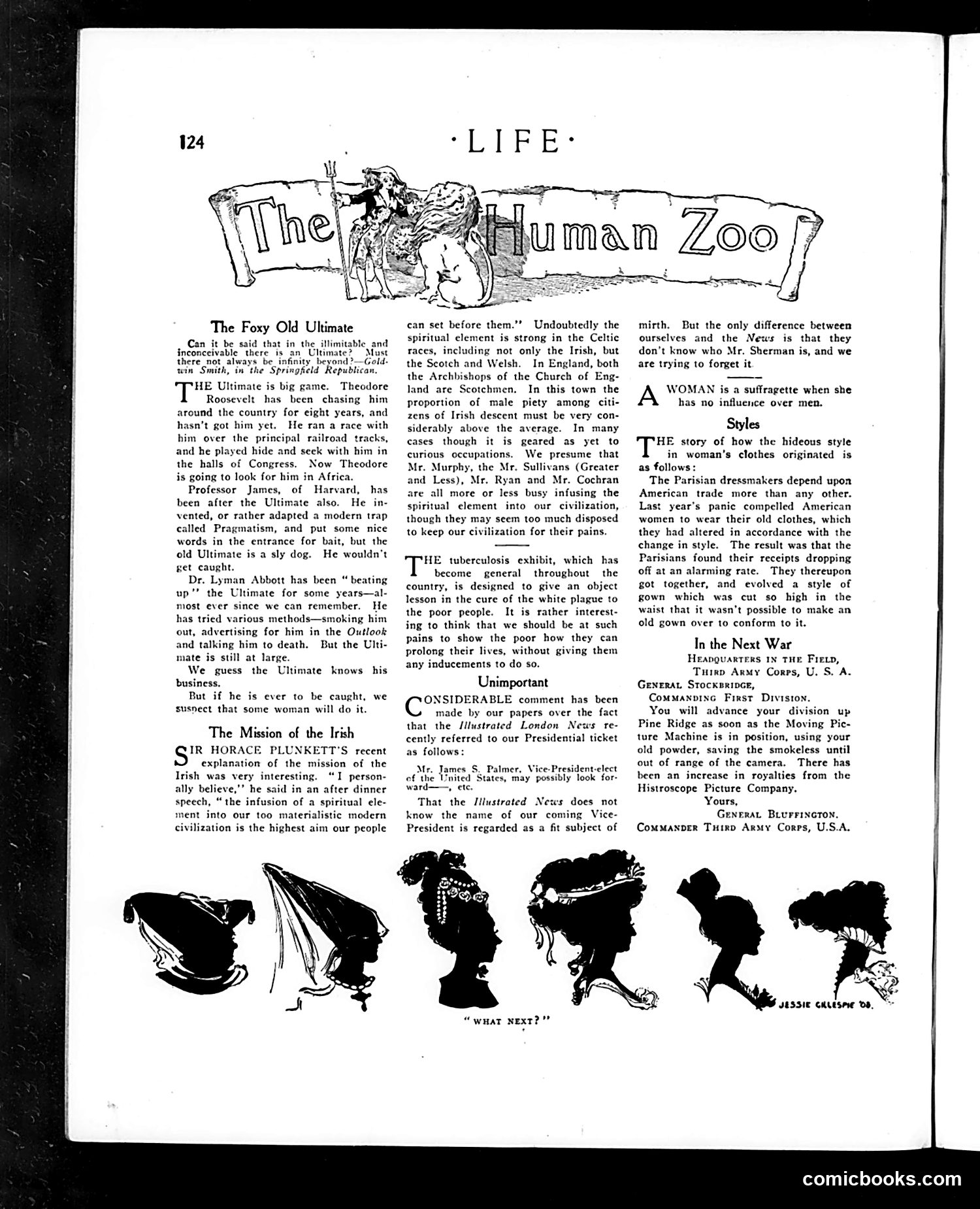
This page contains three satirical sections: **"The Foxy Old Ultimate"** mocks Theodore Roosevelt, whom Life calls a habitual political operator ("the Ultimate is his game"). The text suggests Roosevelt has been persistently pursuing political office and won't accept defeat. **"The Mission of the Irish"** critiques Sir Horace Plunkett's recent expansion of Irish missionary work, sarcastically suggesting the Irish aim to inject "spiritual element" into American civilization—implying Irish immigrants are viewed as culturally unsophisticated. **"Styles" section** discusses how Parisian fashion designers depend on American women to adopt their designs, noting American women altered French fashions, creating a fashion trend. The bottom silhouettes captioned **"What Next?"** appear to mock evolving women's fashion styles.
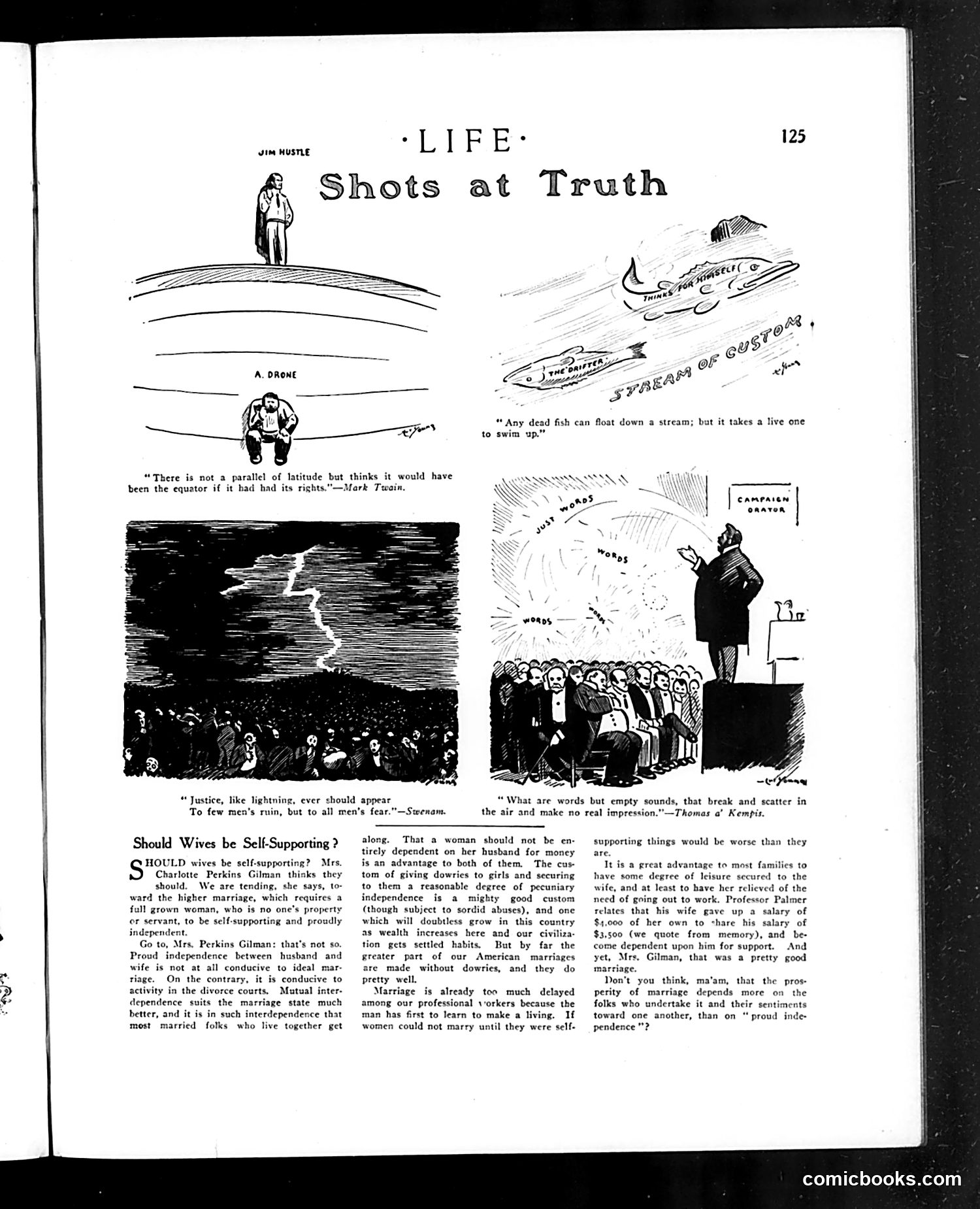
This LIFE magazine page satirizes marriage and gender roles through multiple cartoons and commentary. The main article debates whether wives should be "self-supporting," featuring quotes attributed to Mark Twain, Seneca, Thomas à Kempis, and others about justice, independence, and marriage. The cartoons illustrate the debate visually: one shows a man standing on a platform addressing a crowd labeled "Campaign Orator," suggesting politicians speak empty words about marriage and women's roles. Another depicts "A Drone" — a man appearing idle or dependent. The satirical point appears to be that contemporary marriage debates were filled with rhetoric and platitudes from famous figures, while the actual question of women's economic independence in marriage remained contentious and unresolved in early 20th-century America.
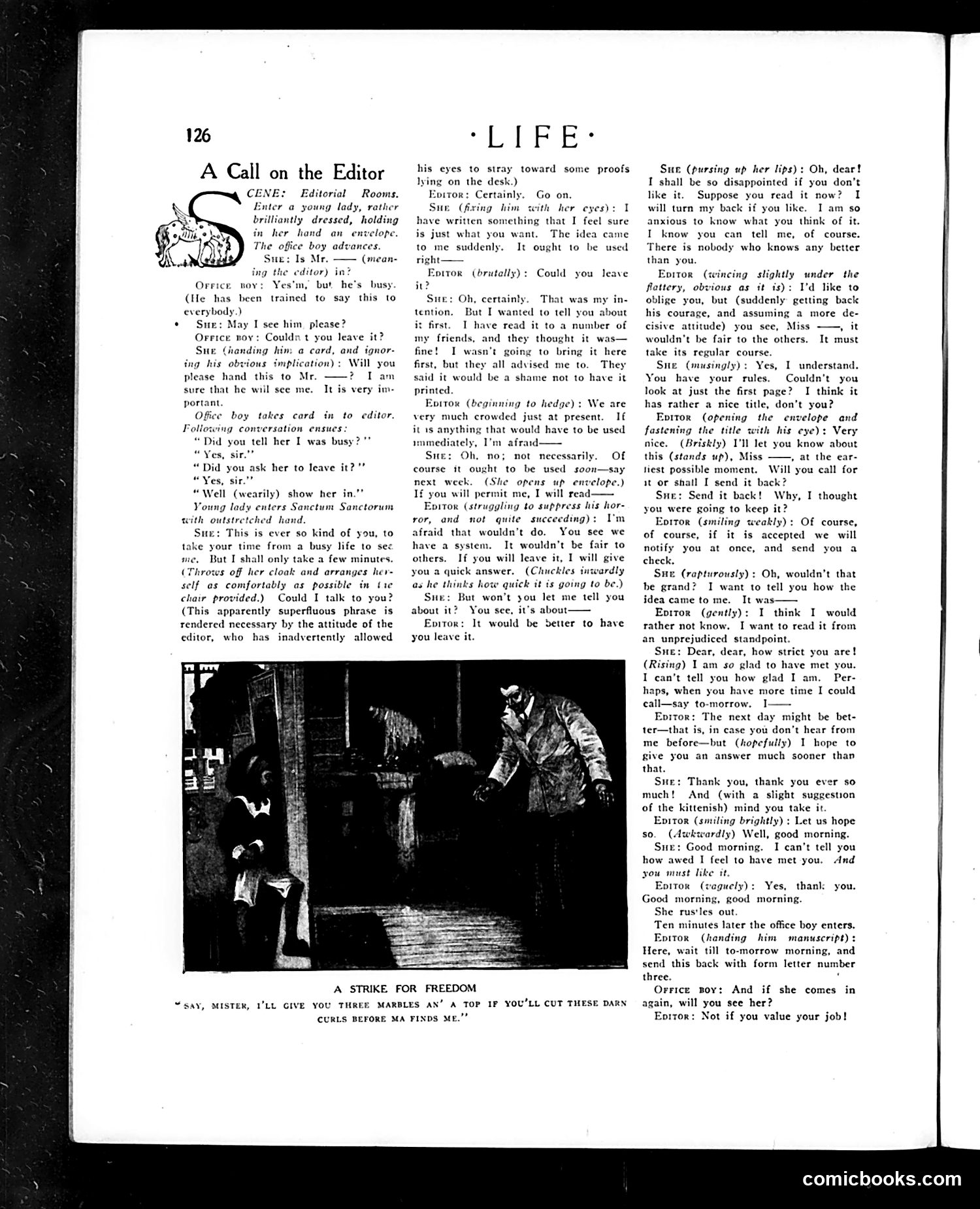
This page presents a satirical dialogue between an editor and a young female visitor to a newspaper office. The accompanying illustration shows what appears to be a dramatic nighttime scene with figures in period costume. The dialogue's humor centers on workplace dynamics: the young woman wants the editor to publish her writing, but he's reluctant. She persistently argues her case while he makes excuses about space and timing. The satire targets both editorial gatekeeping and gender dynamics in publishing—her determination contrasts with his dismissive bureaucratic responses. The illustration's caption—"Say, mister, I'll give you these marbles an' a top if you'd cut these barn curses before ma finds me"—suggests juvenile mischief or corruption, likely commenting ironically on the serious tone of the dialogue above. The overall piece appears to satirize power imbalances in the publishing world.
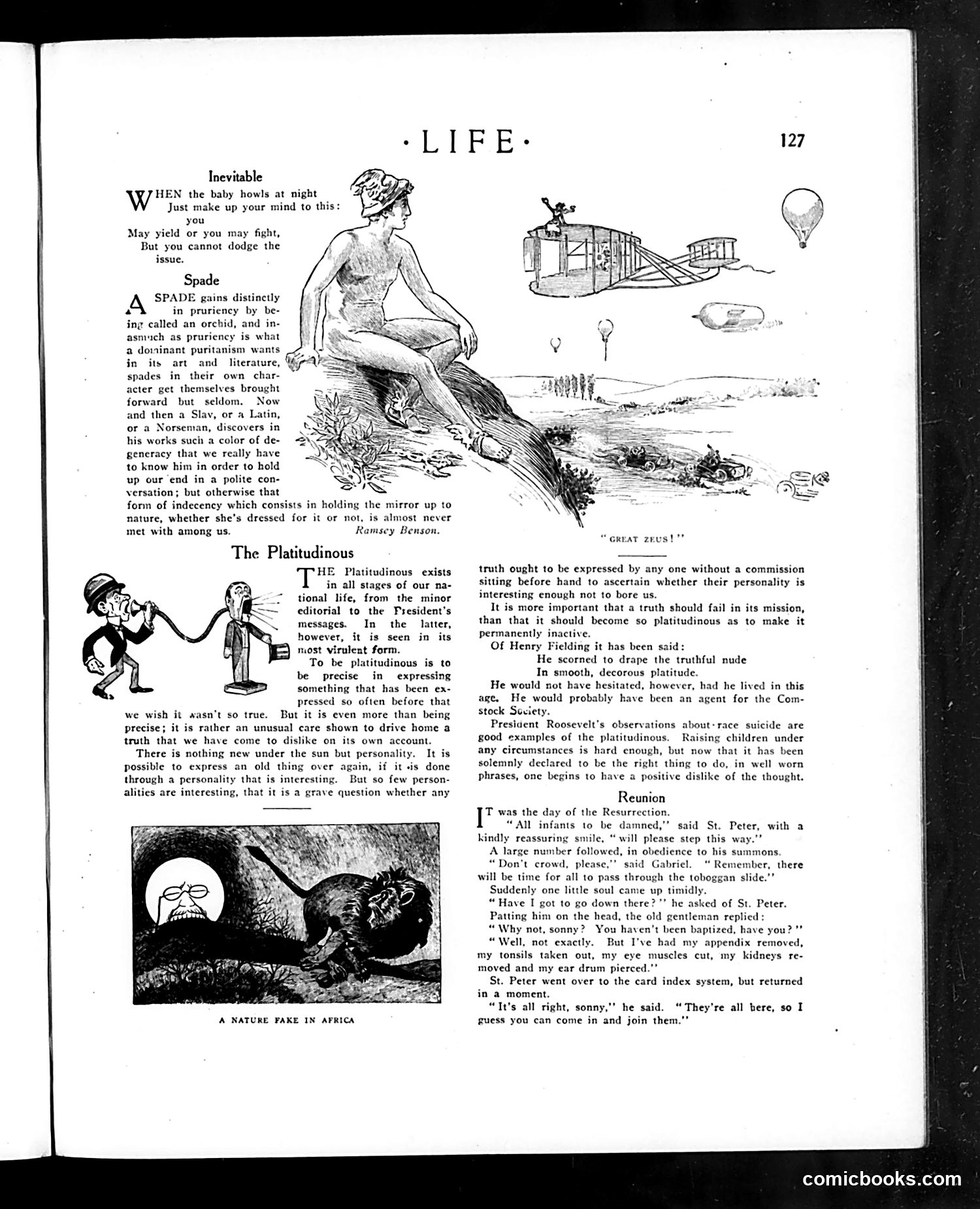
This page contains three separate pieces of social commentary: 1. **"Inevitable"** (top): A poem about accepting life's hardships, illustrated with a woman and infant. 2. **"A Spade" (left column)**: Critiques imprecision in language and art, using "spade" as a metaphor for calling things by their true names. The text argues against euphemistic or vague expression, particularly in literature and conversation—a call for intellectual honesty. 3. **"The Platitudinous"** (center): Satirizes the overuse of clichés and platitudes in everyday discourse, including political and editorial speech. It mocks the tendency to express obvious truths repeatedly rather than offering genuine insight. 4. **"Reunion"** (bottom): A humorous dialogue imagining St. Peter admitting souls to heaven, with comedic references to surgical procedures. The page emphasizes clarity, authenticity, and avoiding hollow conventionality in speech and thought.
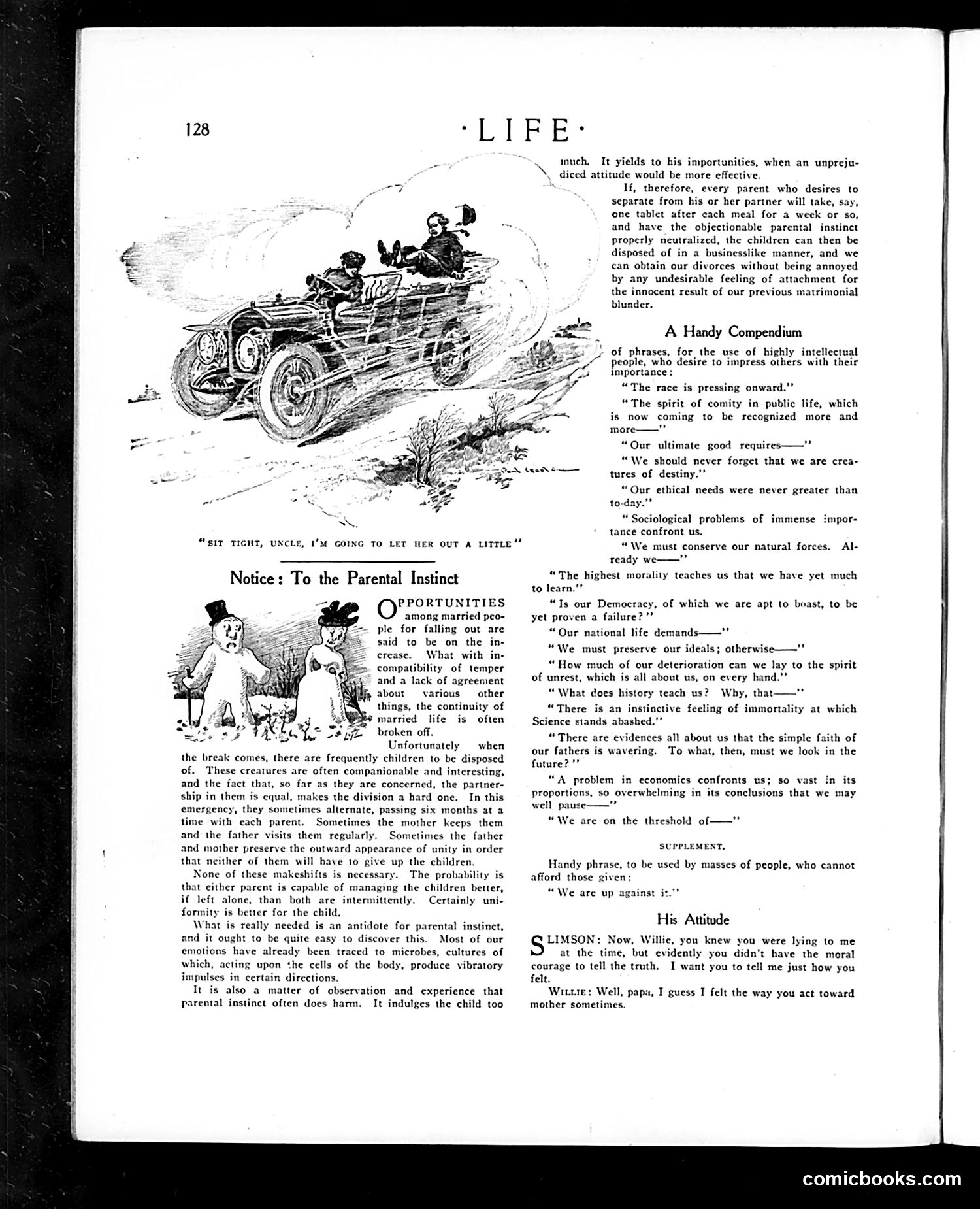
The main cartoon shows a car full of people speeding dangerously on a winding road, with the caption "SIT TIGHT, UNCLE, I'M GOING TO LET HER OUT A LITTLE." This satirizes reckless driving and youthful disregard for safety—a concern of the era when automobiles were relatively new. Below, "Notice: To the Parental Instinct" discusses marital discord and child custody arrangements. The accompanying illustration depicts a couple arguing over children. The text argues that divorce needn't harm children if parents handle separation maturely and avoid using children as weapons. It advocates for businesslike, unemotional separation agreements rather than custody battles driven by attachment or spite. The page reflects early-20th-century anxieties about modernization, driving, and changing family structures.
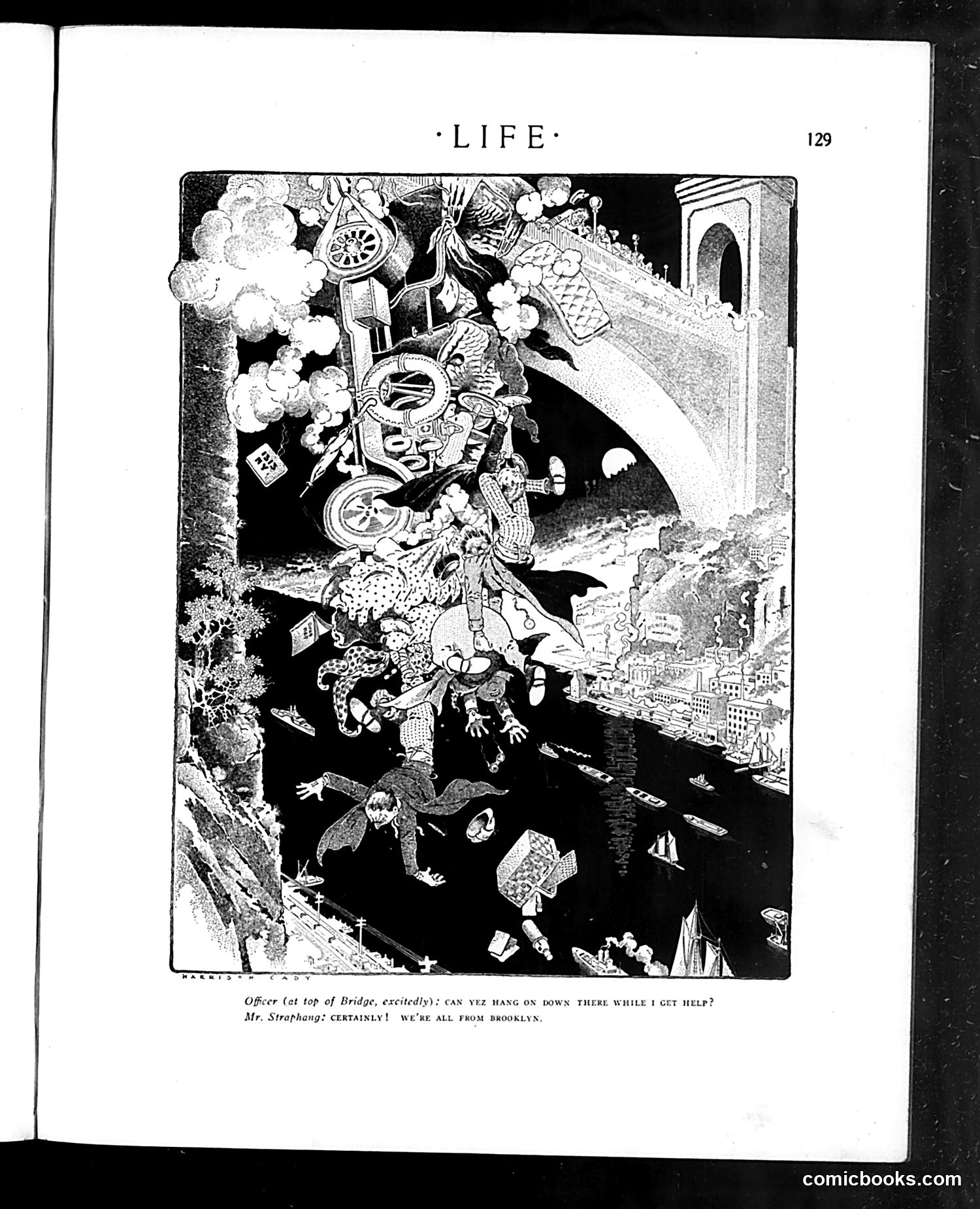
This surrealist cartoon satirizes urban chaos and ethnic stereotypes of 1920s-30s New York. The central figure appears to be a grotesque caricature juggling various objects—clocks, money, produce—suggesting the frenetic pace of modern city life and commerce. The dialogue identifies "Mr. Straphang" (a reference to subway commuters holding overhead straps) responding to a police officer about people hanging from a bridge. His reply—"We're all from Brooklyn"—uses Brooklyn as a punchline for working-class ethnicity and immigrant populations. The composition, with its chaotic layering of architectural elements, explosions, and scrambling figures, depicts the overwhelming sensory and social complexity of Depression-era urban America, likely mocking both the absurdity of city living and contemporary anxieties about immigration and class.
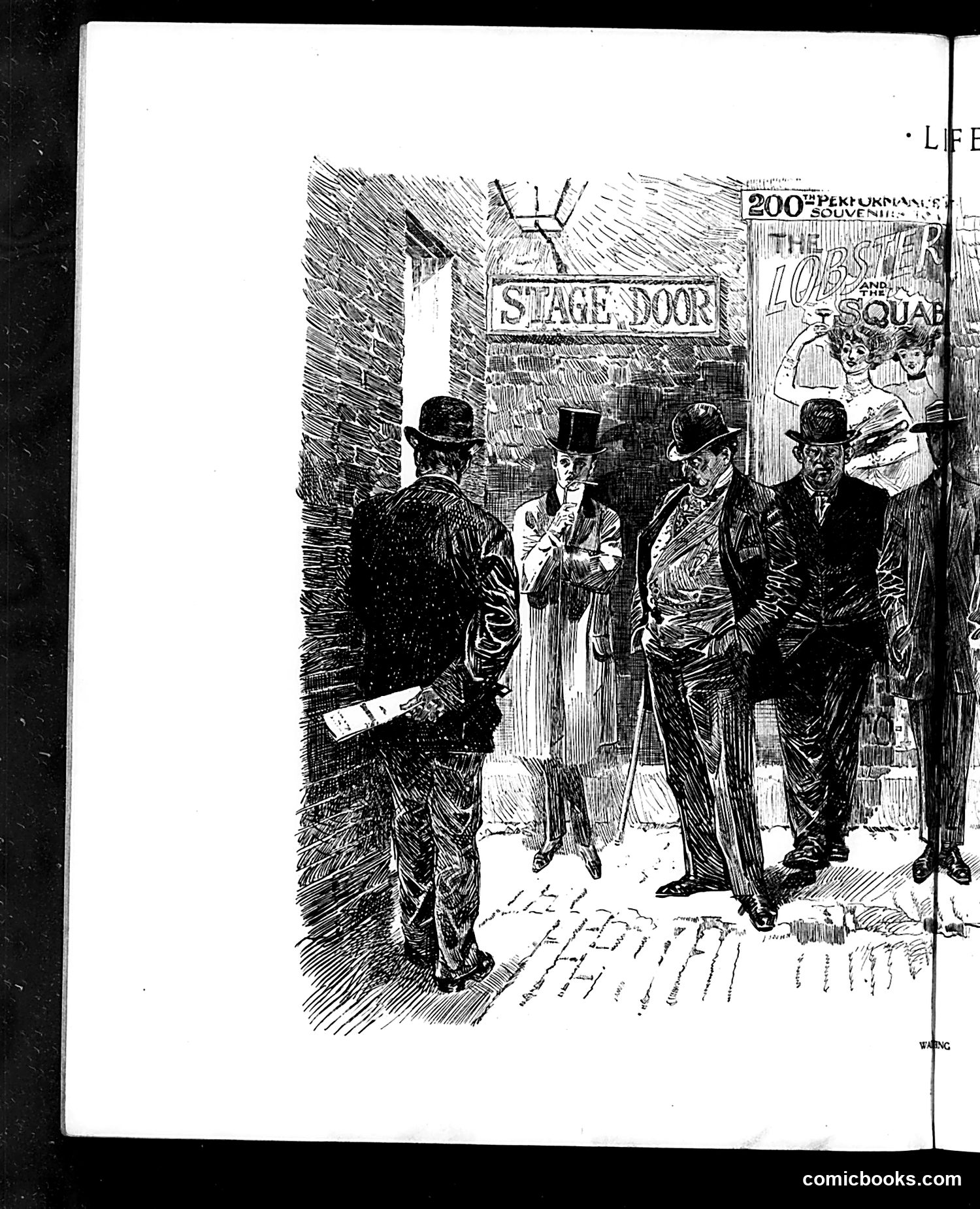
This is a black-and-white sketch showing five well-dressed men in formal attire (top hats and coats) gathered outside a theater's stage door. Visible signage reads "STAGE DOOR" and references "200th PERFORMANCE" and what appears to be "LOBSTER AND SQUAB" (likely a show title or advertisement). The cartoon satirizes theater-goers or perhaps theater professionals of the era, depicting them in a social scene at a stage door—a location historically associated with courting actresses or theatrical socializing. The formal dress and gathering suggest commentary on the social pretensions or behaviors of theater audiences or the theater world itself, though the specific satirical point is unclear without additional context about contemporary theatrical culture or events Life's readers would have recognized.
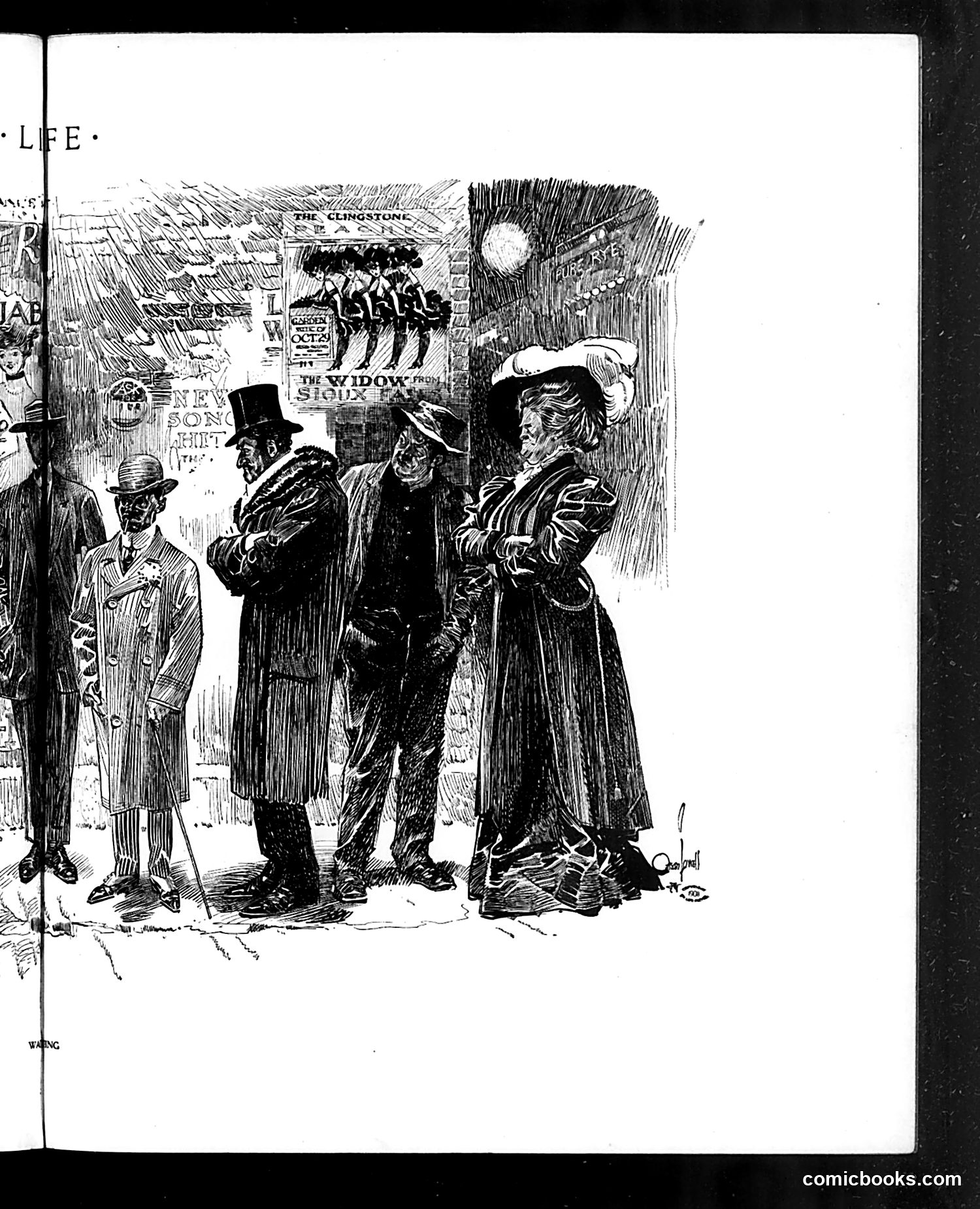
This appears to be a satirical illustration from Life magazine showing several well-dressed men in formal Victorian-era clothing gathered on a street at night. They're positioned near theater posters visible in the background, including text referencing "The Widow from Sioux" and other theatrical productions. The cartoon likely satirizes urban nightlife or theater-going culture of the period. The exaggerated facial expressions and caricatured features suggest social commentary on a specific group or behavior—possibly mocking wealthy men attending shows, or commenting on contemporary entertainment trends. Without clearer identification of the specific figures or dated context, the precise political or social target remains unclear, though the theatrical setting and formal dress indicate commentary on elite urban leisure activities.
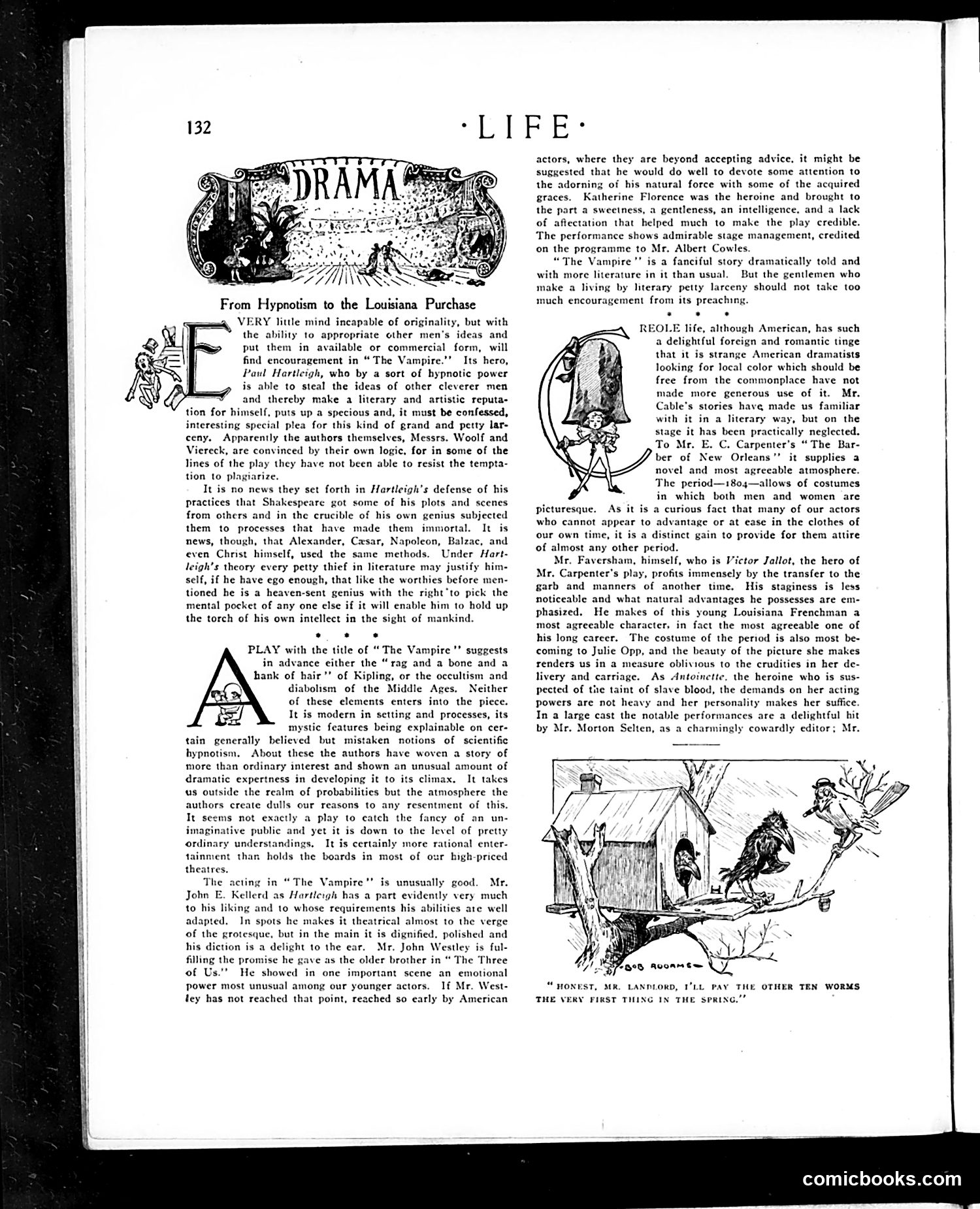
This page reviews a theatrical production of "The Vampire," a play about a man named Paul Hartleigh who uses hypnotic power to steal ideas from cleverer men and pass them off as his own creative work. The critic argues the play ironically undermines itself: it defends plagiarism and idea-theft by citing great historical figures (Shakespeare, Napoleon, Caesar) who allegedly did the same—yet the critic contends this logic dangerously justifies common theft. The authors themselves, Woolf and Viereck, apparently plagiarized *within the play*, proving the critic's point. The review then praises the acting, particularly John E. Kellerd's performance as the morally dubious Hartleigh, while offering constructive notes to younger cast members. The satire targets both the play's flawed moral argument and—implicitly—contemporary artistic practices of idea-appropriation disguised as genius.
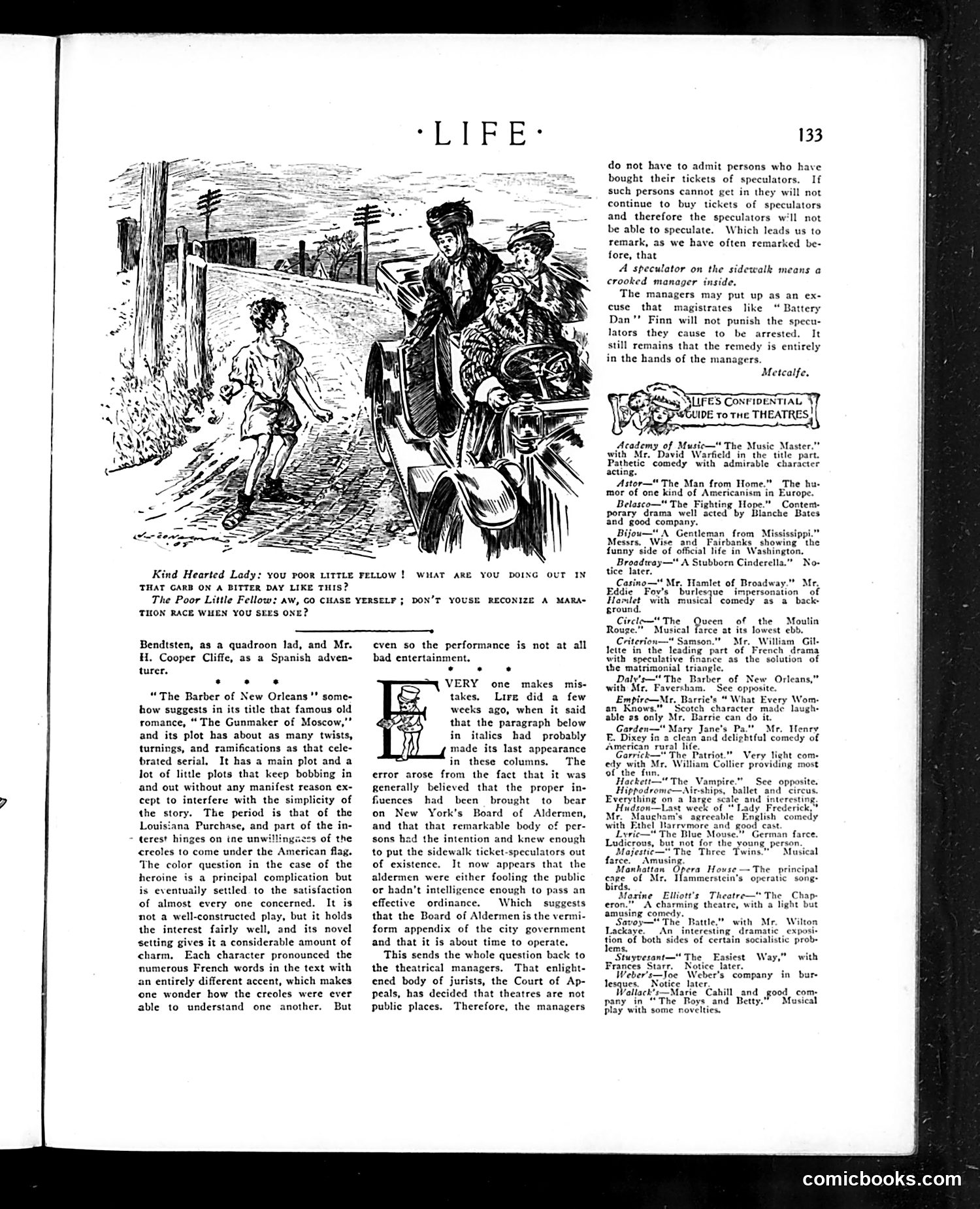
The main cartoon depicts a social satire about street urchins in ragged clothes. A well-dressed woman expresses pity for a poor child on a cold day, but the boy responds sarcastically, claiming he's not poor—he's participating in a "marathon race" (likely a reference to endurance contests or stunts popular at the time). The accompanying text discusses theatrical ticket scalping on New York sidewalks. Life magazine criticizes the Board of Aldermen for failing to stop speculators from selling theater tickets outside venues, calling them ineffective ("veriform appendix"). The piece argues that theater managers could solve the problem by refusing entry to people with scalped tickets, but instead tolerate crooked dealings ("A speculator on the sidewalk means a crooked manager inside"). The page also includes theater reviews under "Life's Confidential Guide to the Theatres," listing contemporary Broadway productions with brief critiques.
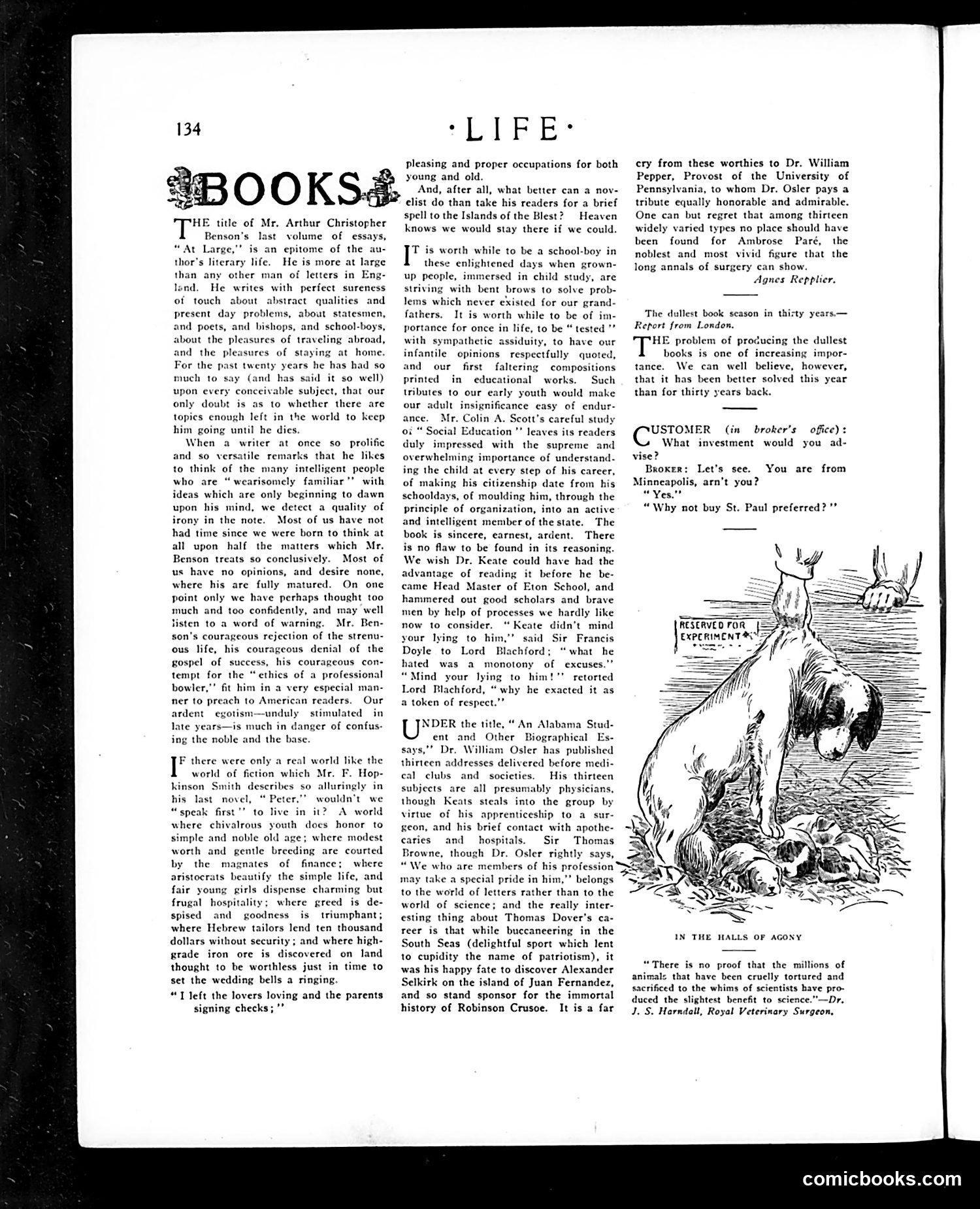
This page is primarily a **books section** reviewing recent literary works rather than political satire. The reviews discuss essays by Arthur Christopher Benson, a novel called "Peter" by F. Hopkinson Smith, and a study on "Social Education" by Colin A. Scott. The **cartoon** (titled "IN THE HALLS OF AGONY") depicts a dog and appears illustrative rather than satirical—likely accompanying a quote about animal suffering in medical research. The **satirical content** is embedded in the text itself: the reviewer gently mocks Benson's prolific output and Smith's idealized fictional world where "Hebrew tailors lend ten thousand dollars without security" and greed is despised—obvious fantasy. The irony targets both the authors' escapism and American readers' susceptibility to it. The page reflects *Life*'s role as a literary and cultural commentary magazine for educated readers.
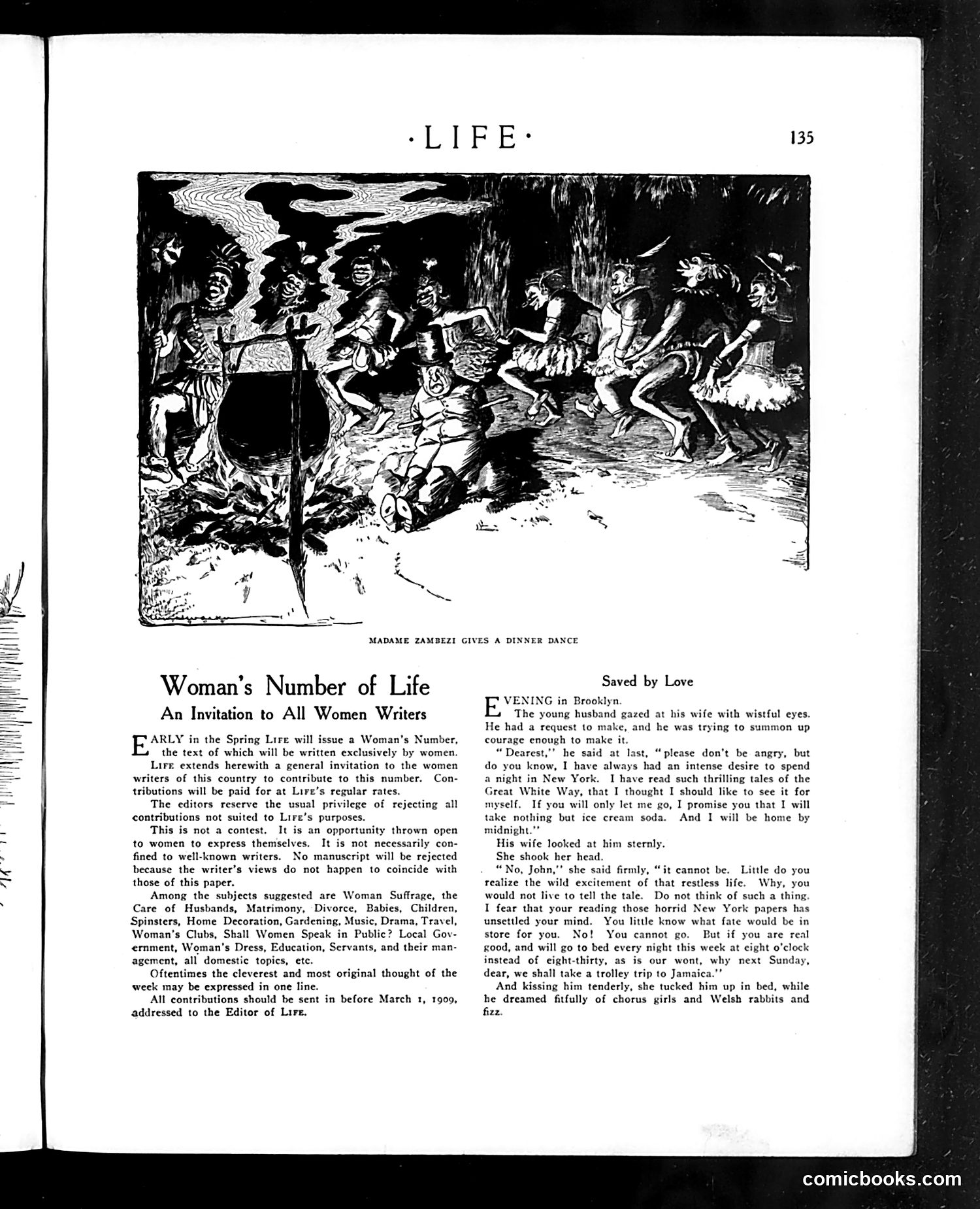
The page contains two distinct items from *Life* magazine: **Top illustration:** "Madame Zambezi Gives a Dinner Dance" depicts a wild, chaotic party scene with multiple figures in an exotic or fantastical setting—likely satirizing high-society social pretension or exaggerated accounts of scandalous gatherings. **Main content:** An announcement inviting women writers to contribute to a special "Woman's Number" of *Life*, with suggested topics ranging from suffrage to housekeeping. This reflects early 1900s debates about women's roles and expanding women's participation in public discourse. **"Saved by Love" story:** A comedic domestic sketch mocking gender dynamics. A husband wants to visit New York City's exciting nightlife (implied: morally dangerous attractions like "chorus girls"), but his wife forbids it, treating him like a child requiring bedtime discipline. She offers a suburban trolley trip as consolation. The humor targets both male desire for urban vice and wives' controlling domesticity—reflecting anxieties about modernization, gender power, and proper behavior circa 1909.
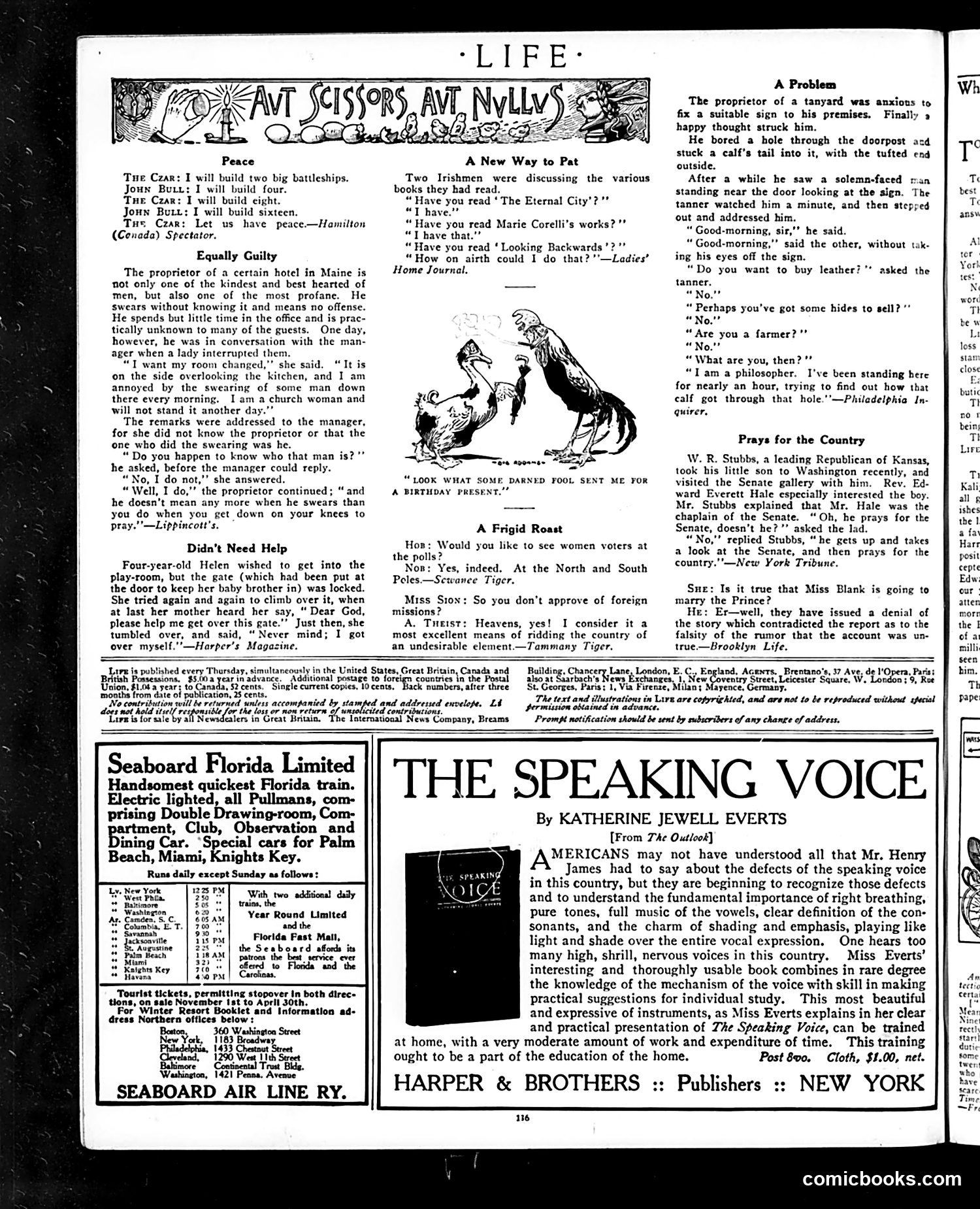
This page from *Life* magazine contains several brief humorous anecdotes and a political cartoon, typical of the publication's satirical format. The opening cartoon depicts an arms race between "The Czar" (Russia) and "John Bull" (Britain), with each pledging to build escalating numbers of battleships before concluding with "Let us have peace"—a satirical commentary on the absurdity of competitive military buildup as a path to peace. The remaining content consists of short jokes and anecdotes mocking various subjects: a profane Maine hotel proprietor, a child's unselfconscious prayer, Irish ignorance, women voters, foreign missionaries, and a philosopher confused by a tanyard's crude cattle-hide sign. One piece ridicules a Kansas Republican whose son jokes that the Senate chaplain prays for the country rather than *for* the Senate itself. These items collectively represent *Life*'s brand of gentle, domestic satire targeting human folly, vanity, and social pretension rather than serious political critique.
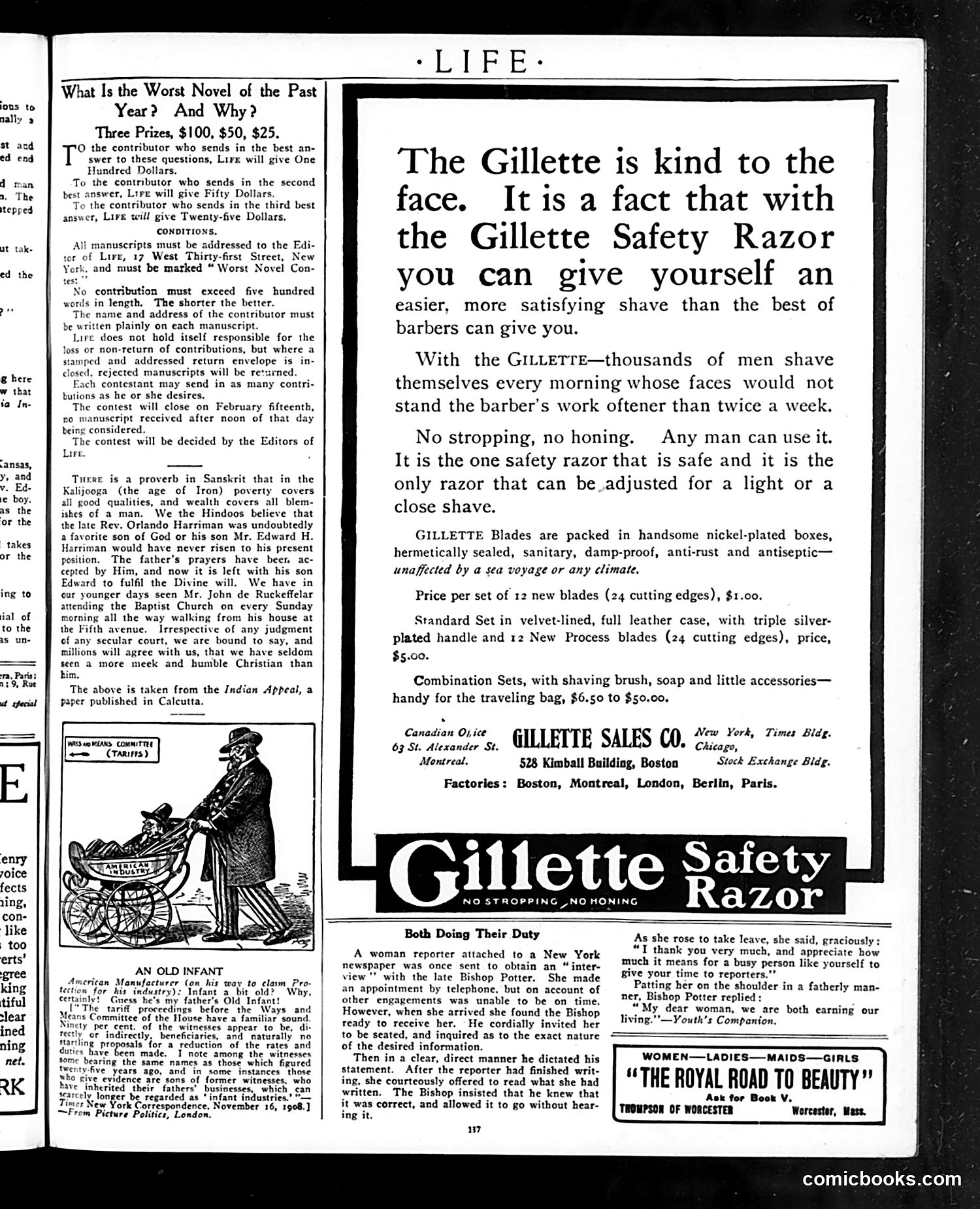
This cartoon satirizes American tariff policy and industrial protectionism. The figure is an "American Manufacturer" testifying before Congress's Ways and Means Committee, claiming his industry deserves tariff protection as an "infant industry"—a standard argument for shielding new domestic businesses from foreign competition. The joke: the "infant" is elderly. The manufacturer admits his father used the same excuse decades earlier, and now the son inherits both the business *and* the tired justification. The cartoon mocks how so-called "infant industries" never actually mature or stop demanding protective tariffs. Industries that claimed temporary protection in the 1880s were still using identical arguments in 1908, suggesting the system was perpetually rigged for established manufacturers rather than genuinely protecting nascent enterprises. This reflects Progressive Era skepticism toward corporate lobbying and tariff abuse.
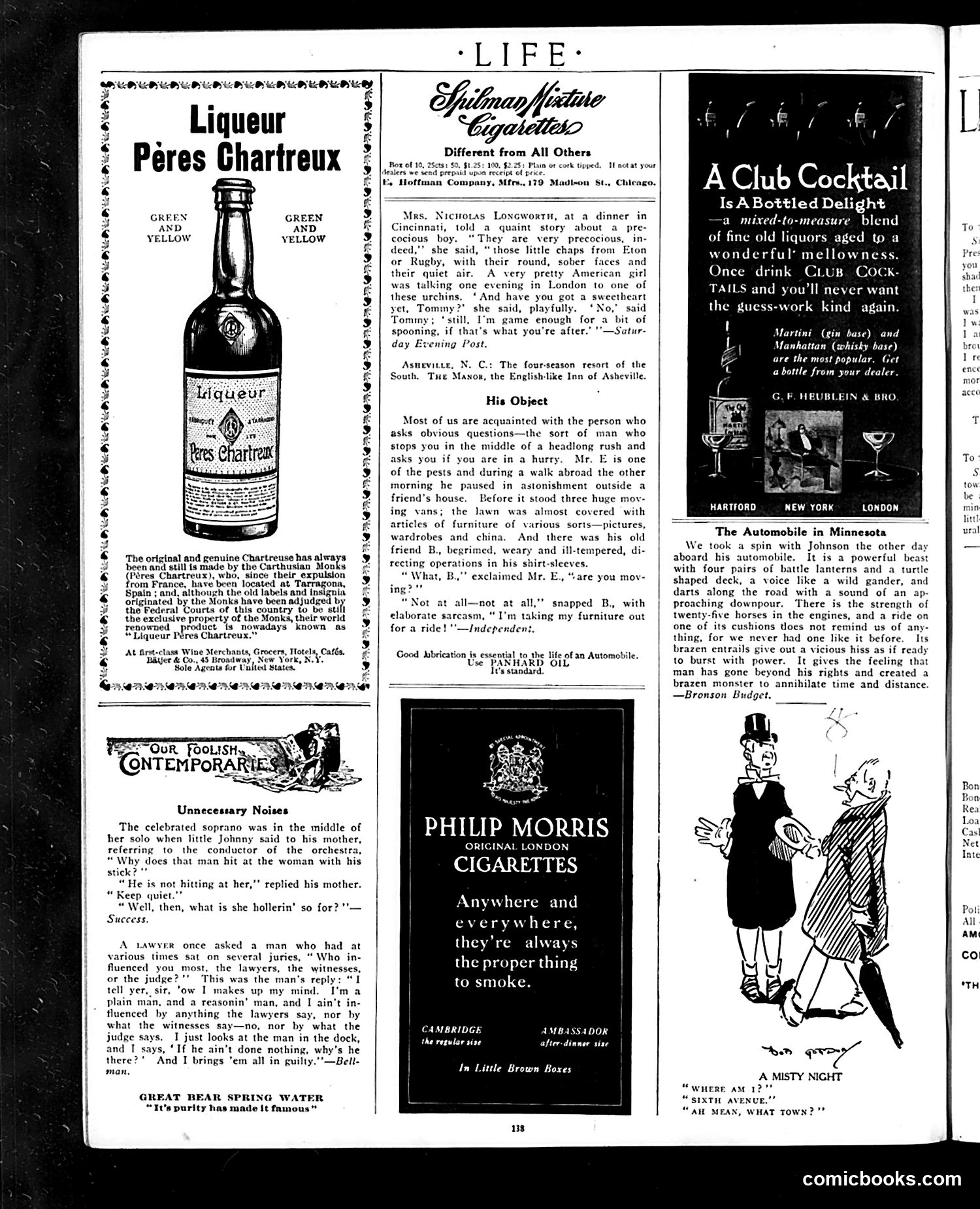
This page is primarily **advertisements and humor content**, not political cartoons. The main elements are: **Advertisements:** Liqueur Pères Chartreux (French liqueur), Philip Morris cigarettes, Club Cocktails, and Great Bear Spring Water dominate the layout. **Humor Section ("Our Foolish Contemporaries"):** Three brief anecdotes satirizing everyday absurdities: 1. A child asks why the orchestra conductor "hits" the soprano with his stick 2. A jury member admits he convicts defendants simply because they're on trial ("if he ain't done nothing, why's he there?") 3. A man moving houses sarcastically tells an overly-obvious acquaintance he's taking his furniture "for a ride" **The cartoon** (lower right) shows two well-dressed men—one gesturing dramatically—with caption "A Misty Night" referencing Sixth Avenue locations, likely depicting a comedic urban encounter. The page reflects early 20th-century Life magazine's mix of product promotion and gentle social satire about human foibles and miscommunication.
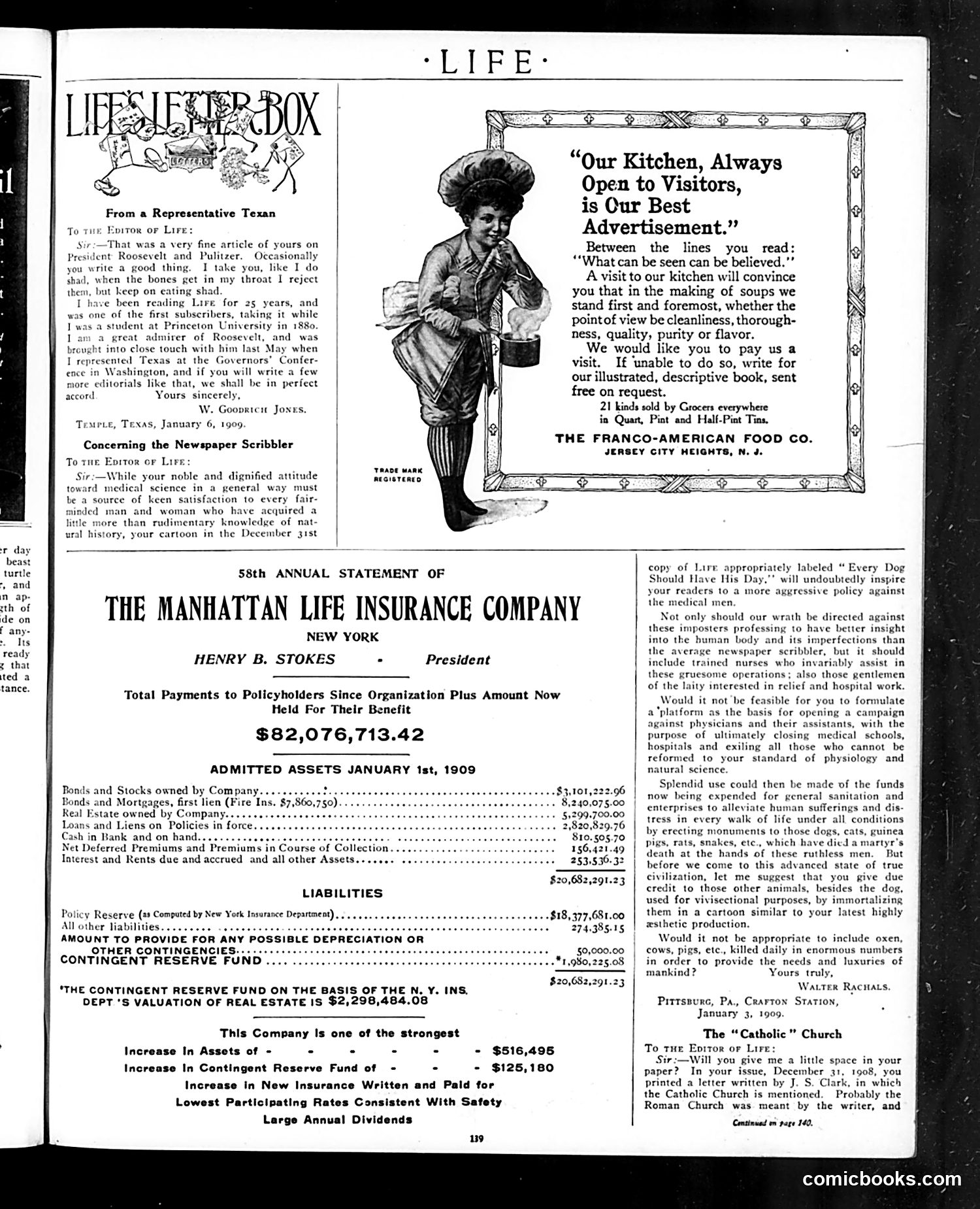
This page mixes reader letters, advertisements, and an insurance company statement—typical for Life's format. The key satirical content appears in the second letter, "Concerning the Newspaper Scribbler." A reader sarcastically praises Life's "noble and dignified attitude toward medical science," referencing a recent cartoon (December 31st) labeled "Every Dog Should Have His Day." The writer uses heavy irony to mock Life's apparent anti-medical stance, suggesting the magazine should expand its campaign to include not just doctors but also nurses and hospital administrators—ultimately calling for closing medical schools and "exiling" unreformable physicians. The satire targets Life's editorial position: the magazine apparently ran anti-doctor content that the letter-writer treats as absurdly extremist. By pushing the magazine's logic to ridiculous conclusions, the writer satirizes both Life's stance and broader early-20th-century medical skepticism or quackery debates. The Franco-American Foods advertisement above represents the contemporary "open kitchen" marketing trend.
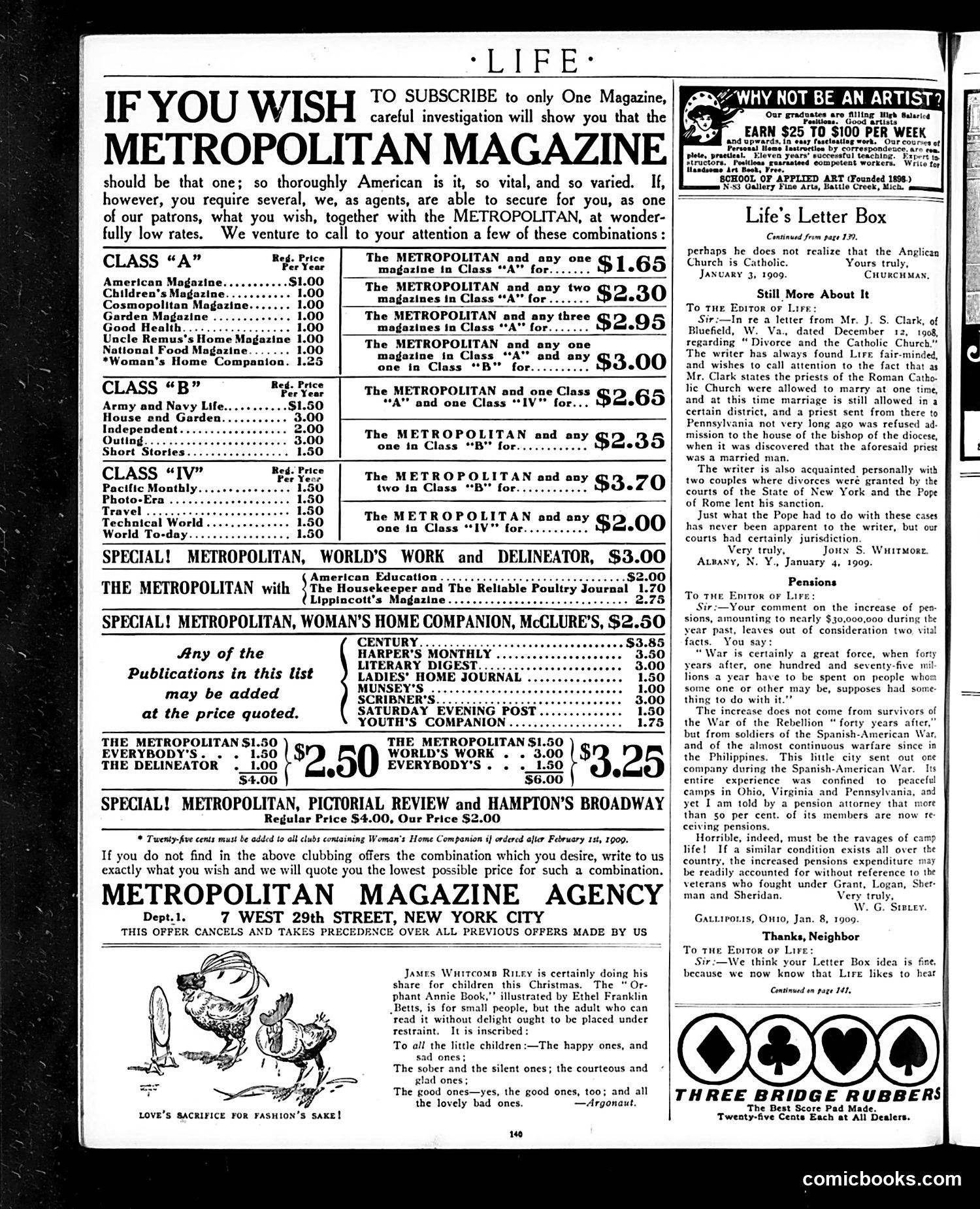
This page is primarily **advertising and reader correspondence**, not political satire. The bulk consists of subscription offers for *Metropolitan Magazine* bundled with other publications (Century, Harper's Monthly, Ladies' Home Journal, etc.) in tiered "classes" at discounted rates—typical early 1900s magazine marketing. The single cartoon, captioned "Love's Sacrifice for Fashion's Sake," depicts a stylized figure and appears to mock women's fashion obsessions, though details are unclear in this reproduction. The "Life's Letter Box" section contains reader correspondence addressing contemporary social issues: Catholic Church doctrine on divorce, pensions for war veterans and their families, and children's literature (specifically praising James Whitcomb Riley's "Orphant Annie Book"). These letters reflect Progressive Era concerns about social welfare and religious practice. An advertisement for an art school offering income ("Earn $25-$100 per week") rounds out the page. Overall, this is a commercial/editorial page with minimal satire.
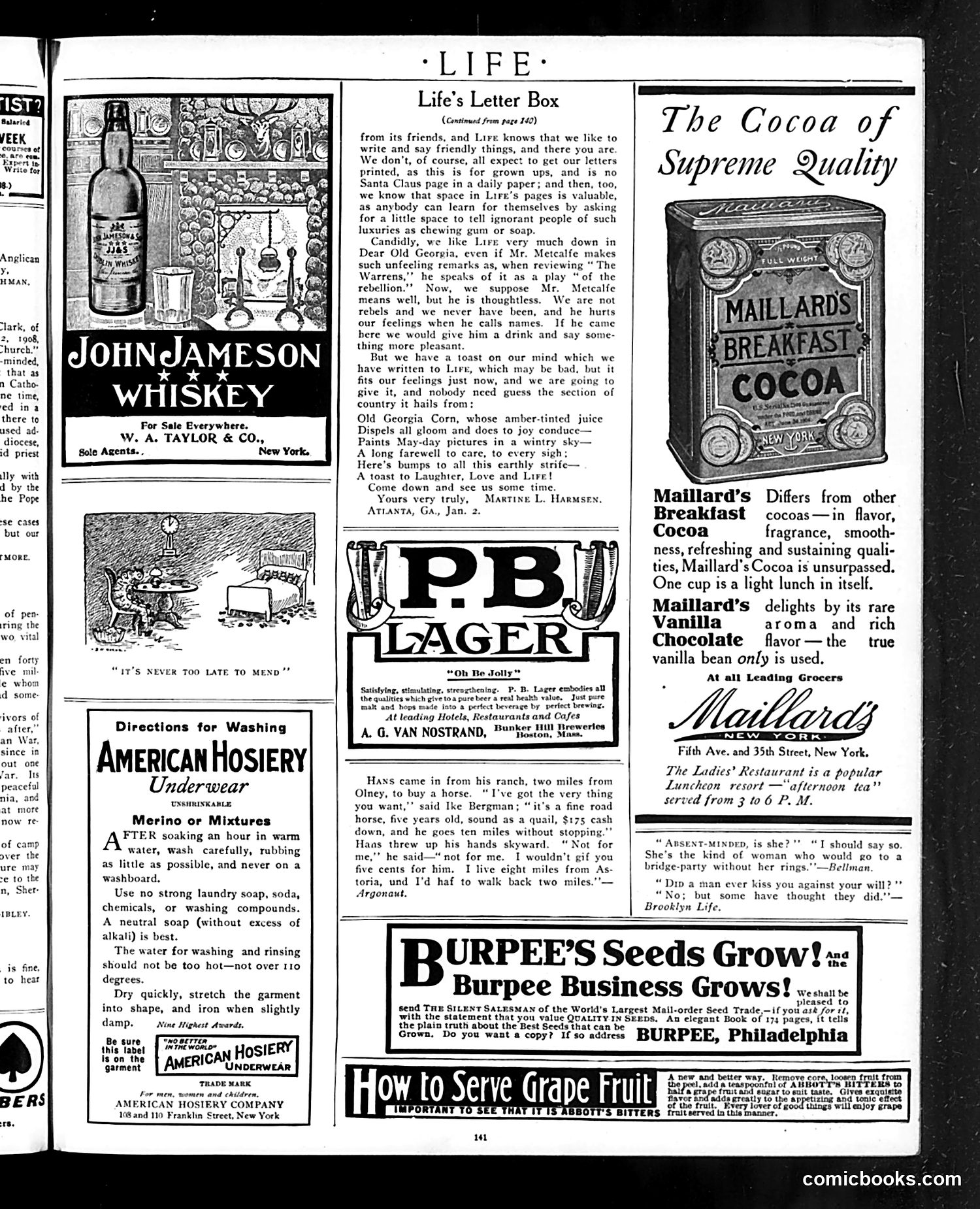
This page consists primarily of **advertisements and reader letters**, not political satire. The main content is "Life's Letter Box"—a reader correspondence section. A Georgia reader writes defending the South against perceived slights, specifically objecting to a theater review calling a play "of the rebellion." The writer claims Southerners aren't rebels and requests friendlier treatment, ending with a toast to "Old Georgia Corn" whiskey. The accompanying **cartoon** ("It's Never Too Late to Mend") shows a simple domestic scene with unclear satirical intent—likely a pun or gentle domestic humor now obscure. The page is dominated by **product advertisements**: John Jameson Whiskey, American Hosiery, P.B. Lager beer, Maillard's Cocoa, Burpee Seeds, and care instructions for underwear. This is not a page of political commentary but rather typical early-20th-century magazine filler mixing reader letters with commercial advertising.
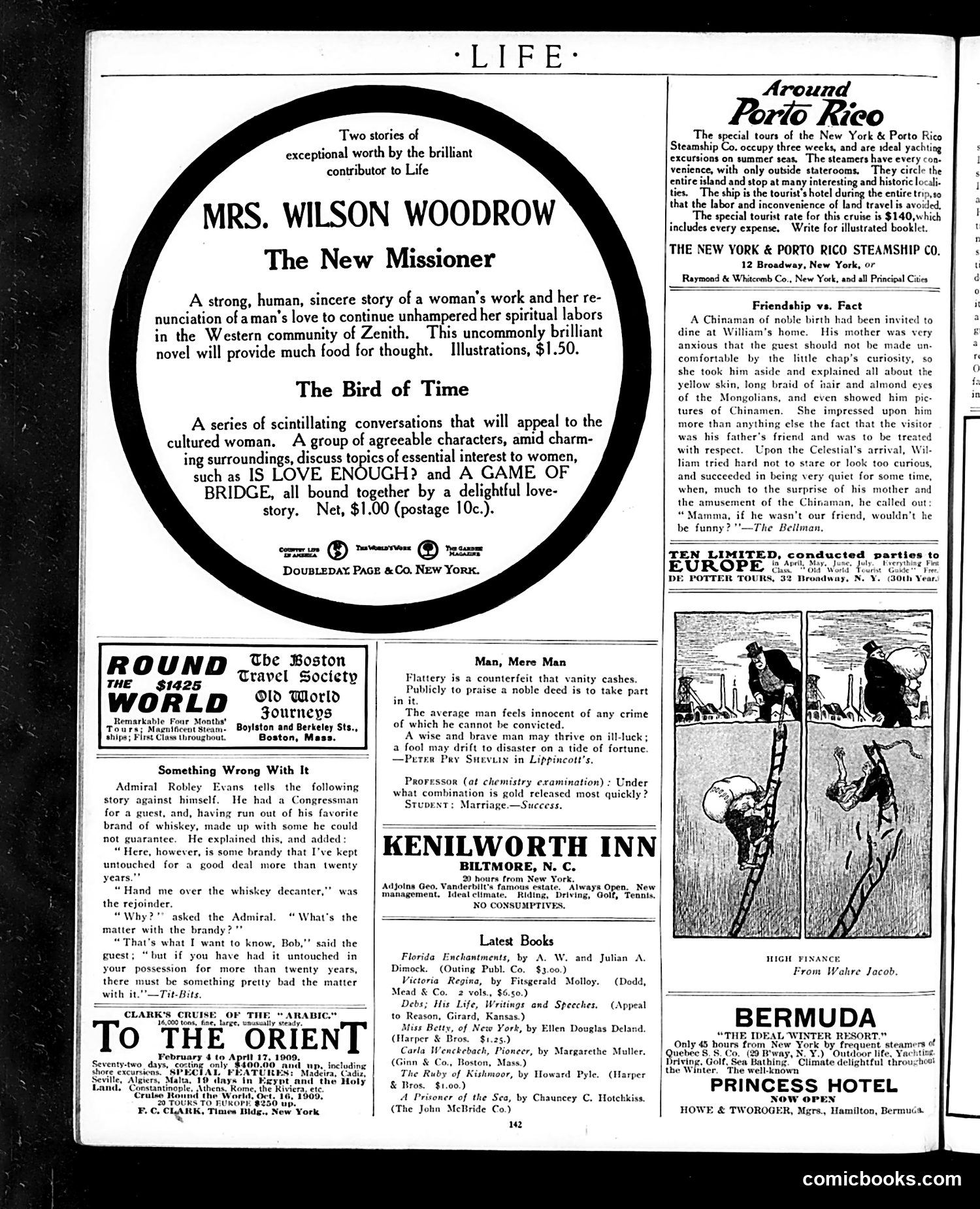
This Life magazine page (numbered 142) is largely devoted to book and travel advertisements with minimal cartoons. The main content includes: **Featured Literary Works**: The page heavily promotes two stories by "Mrs. Wilson Woodrow"—*The New Missioner* and *The Bird of Time*—both published by Doubleday, Page & Co. **Humor Content**: Small scattered jokes appear: - A brief anecdote attributed to Admiral Robley Evans about substituting inferior whiskey - A "Man, Mere Man" section with aphorisms about flattery and human nature - A chemistry exam joke about gold and marriage **Context**: The page is typical of early 20th-century Life magazine format—mixing literary promotion with light satirical commentary. The "humor" is gentle and domestic rather than politically pointed. The heavy advertising emphasizes the magazine's commercial function alongside its editorial content. The book advertisements and travel promotions (Bermuda, Porto Rico cruises) indicate the target audience: educated, wealthy Americans interested in literature and leisure travel.
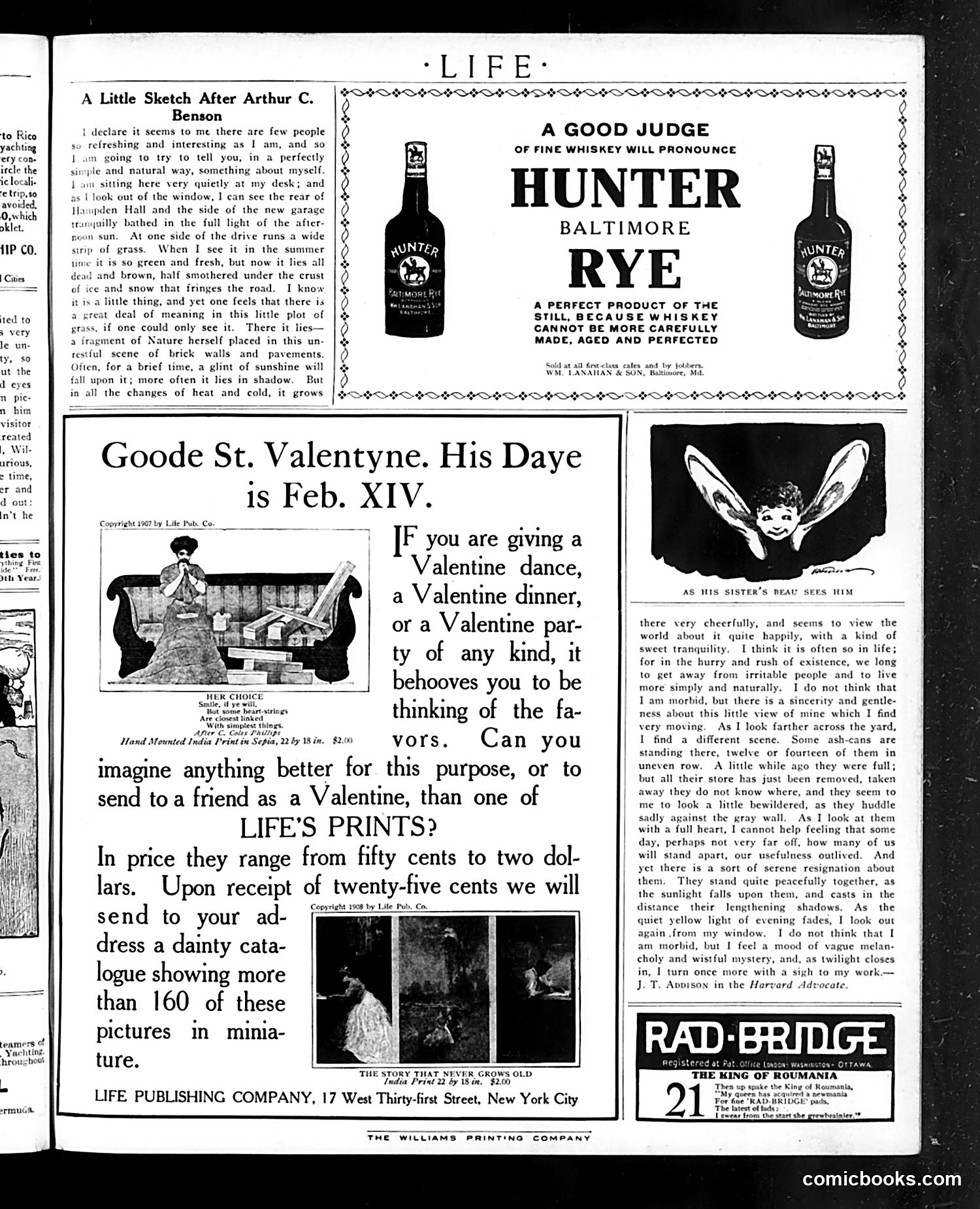
This page is primarily **advertising and literary content** rather than political satire. The main elements are: 1. **"A Little Sketch After Arthur C. Benson"** — a contemplative essay about observing nature from a window, with philosophical musings on meaning and mortality (ash cans as metaphor for life's usefulness). 2. **Hunter Baltimore Rye whiskey advertisement** — promotes the product as "a perfect product" made with careful aging and perfection. 3. **Valentine's Day promotion** — Life Publishing Company advertises "Life's Prints," affordable art prints (50 cents to $2) suitable for Valentine's gifts, offering a catalog for 25 cents. 4. **"Goode St. Valentyne"** — a period-appropriate holiday heading referencing February 14th. 5. **Minor illustration** — shows a cupid-like figure labeled "As His Sister's Beau Sees Him." The page reflects early 20th-century Life magazine's mixture of gentle humor, literary content, and commercial advertising. There is **no evident political cartoon or satire** here—it's a standard magazine page blending editorial and advertising content.
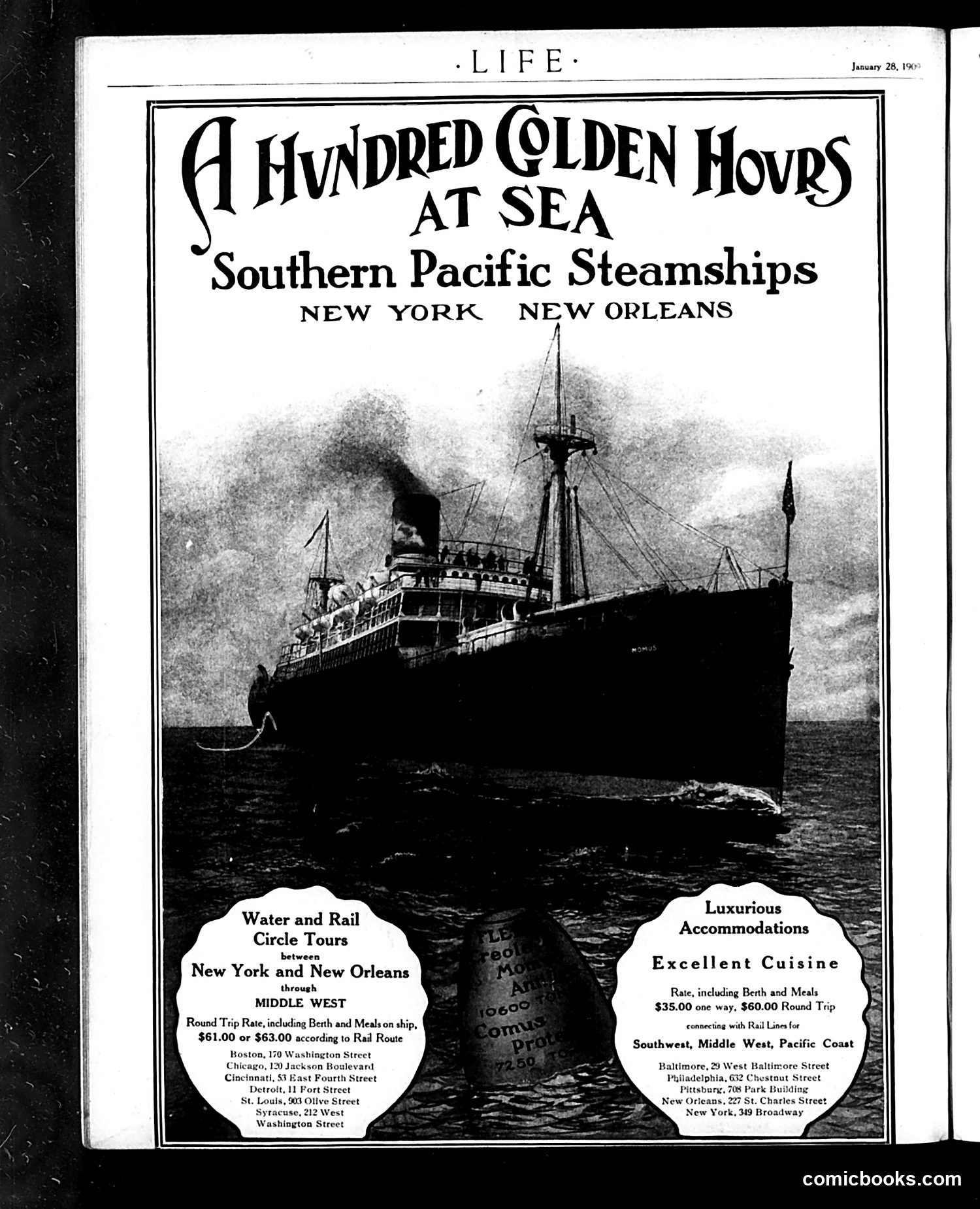
This is a **steamship advertisement**, not a political cartoon. It promotes Southern Pacific Steamships' luxury passenger service between New York and New Orleans, featuring a photograph of a large steamship at sea. The ad emphasizes comfort ("Luxurious Accommodations," "Excellent Cuisine") and affordability, offering round-trip fares of $60-$63 that include meals and berth. It advertises combined water-and-rail circle tours through the Midwest, appealing to travelers wanting scenic routes between coasts. The text lists booking offices across major American cities (Boston, Chicago, Cincinnati, etc.), indicating this was a significant commercial service. The prominent ship image and detailed pricing suggest this was a substantial advertisement in *Life* magazine from January 1900. There is no satire or political commentary visible on this page—it is straightforward commercial promotion.