
Life, 1909-01-28 · page 17 of 28
Life — January 28, 1909 — page 17: what you’re looking at
What you’re looking at
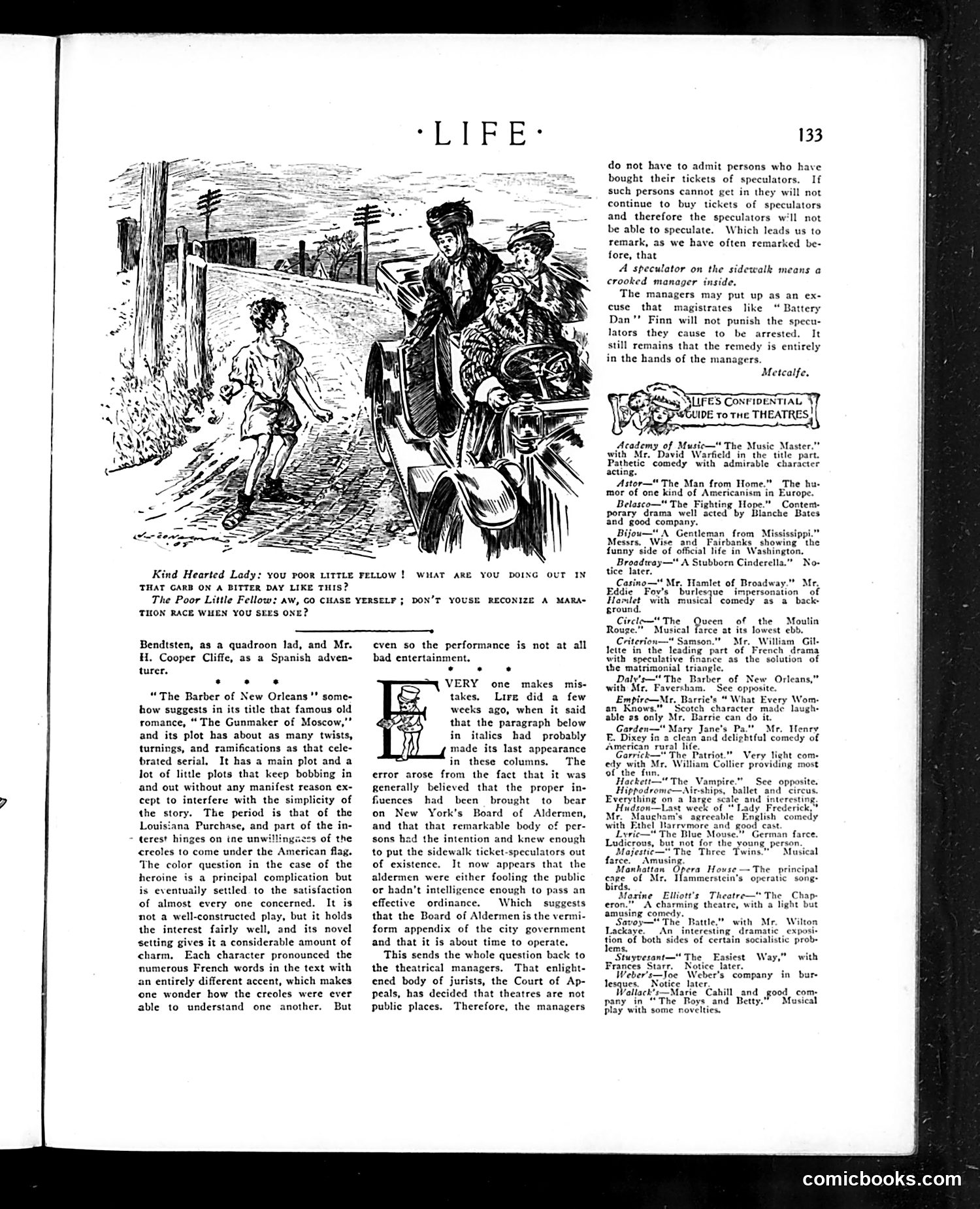
The main cartoon depicts a social satire about street urchins in ragged clothes. A well-dressed woman expresses pity for a poor child on a cold day, but the boy responds sarcastically, claiming he's not poor—he's participating in a "marathon race" (likely a reference to endurance contests or stunts popular at the time). The accompanying text discusses theatrical ticket scalping on New York sidewalks. Life magazine criticizes the Board of Aldermen for failing to stop speculators from selling theater tickets outside venues, calling them ineffective ("veriform appendix"). The piece argues that theater managers could solve the problem by refusing entry to people with scalped tickets, but instead tolerate crooked dealings ("A speculator on the sidewalk means a crooked manager inside"). The page also includes theater reviews under "Life's Confidential Guide to the Theatres," listing contemporary Broadway productions with brief critiques.
📄 Transcribed text from this page (OCR, searchable)
Machine-transcribed from the original scan — historical spelling and the odd misread are preserved.
Kind Hearted Lady: you poor Little FeLLow ! WHAT ARE YOU DOING OUT IN THAT GARB ON A BITTER DAY LIKE THIS? The Poor Little Fellow: aw, CO CHASE YERSELF ; DON’T YOUSE RECONIZE A MARA- TION RACE WHEN YOU SEES ONE? Bendtsten, as a quadroon lad, and Mr. H. Cooper Cliffe, as a Spanish adven- turer. s 8 6 “The Barber of New Orleans "* some- how suggests in its title that famous old romance, “ The Gunmaker of Moscow,’’ and its plot has about as many twists, turnings, and ramifications as that cele- brated serial, It has a main plot and a lot of little plots that keep bobbing in and out without any manifest reason ex- cept to interfere with the simplicity of the story. The period is that of the Louisiana Purchase, and part of the in- terest hinges on ine unwillingacss of the creoles to come under the American flag. ‘The color question in the case of the heroine is a principal complication but is eventually settled to the satisfaction of almost every one concerned. It is not a well-constructed play, but it holds the interest fairly well, and its novel setting gives it a considerable amount of charm, Each character pronounced the numerous French words in the text with an entirely different accent, which makes one wonder how the creoles were ever able to understand one another. But even so the performance is not at all bad entertainment, ee VERY one makes mis- takes, Lire did a few weeks ago, when it said that the paragraph below in italics had probably made its last appearance in these columns, The error arose from the fact that it was generally believed that the proper in- fiuences had been brought to bear on New York’s Board of Aldermen, and that that remarkable body of per- sons had the intention and knew enough to put the sidewalk ticket-speculators out of existence. It now appears that the aldermen were either fooling the public or hadn’t intelligence enough to pass an effective ordinance. Which suggests that the Board of Aldermen is the vermi- form appendix of the city government and that it is about time to operate. This sends the whole question back to the theatrical managers. That enlight- ened body of jurists, the Court of Ap- peals, has decided that theatres are not public places. Therefore, the managers 133 do not have to admit persons who have bought their tickets of speculators. If such persons cannot get in they will not continue to buy tickets of speculators and therefore the speculators will not be able to speculate. Which leads us to remark, as we have often remarked be- fore, that A speculator on the sidewalk means a crooked manager inside. The managers may put up as an ex- cuse that magistrates like “ Battery Dan”? Finn will not punish the specu lators they cause to be arrested. It still remains that the remedy is entirely in the hands of the managers. Metcalfe. LIFES CONFIDENTIAL RSGUIDE ro tHe THEATRES! Academy of Music— The Music Master.” with Mr. David Warfield in’ the title part. Pathetic comedy with admirable character acting. Astor—" The Man from Home.” The hu- mor of one kind of Americanism in Europe. Belasco—" The Fighting Hope." Content- porary drama well acted by Blanche Bates and good company. Bijou—" A Gentleman from Mississippi.” Messrs. Wise and Fairbanks showing the funny side of official life in Washington, _ Broadtay—" A Stubborn Cinderella.” No- tice later. Casino—" Me. Hamlet of Broadway. Eddie Fov's burlesque impersona Hamilet with musical comedy as a back ground, Circlo—"The Queen of the Moulin Rouge." Musical farce at its lowest ebb. Criterion—" Samson." Mr. William Gil- lette in the leading part of French drama with speculative finance as the solution of the matrimonial triangle, Daly's—" The Barber of New Orleans,” with Mr, Faversham. See oppo: Empire—Mr. Barrie's “ What Every Wom- an Knows.” Scotch character made laugh: able es only Mr. Barrie can do it. Garden—" Mary Jane's Pa." Mr. Henry E, Dixey in a clean and delightful comedy of American rural life. Garric The Patriot.” Very light com: edy with Mr, William Collier providing most of the fun, . Hackett—"" The Vampire." See opposite. Hippodromc—Air-ships, ballet and circus. Everything on a large scale and interesti Hudson—Last week of “Lady Frederick, oN m's agreeable English comedy id good. cast e."" German farce. ‘ot for the young person. ¢ Three Twins.” Musical Ludicrous, bi Majestic— farce. Amusing. Manhattan Opera House—The principal care of Mr. Hammerstein's operatic song- birds. Marine Elliott's Theatre—* The Chap- ‘A charming theatre, with a light but ing comedy. Savoy—" The. Tattle.” with Mr. Wilton Lackaye. An interesting dramatic exposi= tion of both sides of certain socialistic prob- lems. . . Stuyvesant—" The Easiest’ Way," with Frances Starr, Notice later. . Weber's—Joe Weber's company in bur lesques. ‘otice later. Wallack’s—Marie Cahill and good com- pany in “The Roys and Betty.” Musical play with some novelties. comicbooks.com