
Life, 1909-01-28 · page 12 of 28
Life — January 28, 1909 — page 12: what you’re looking at
What you’re looking at
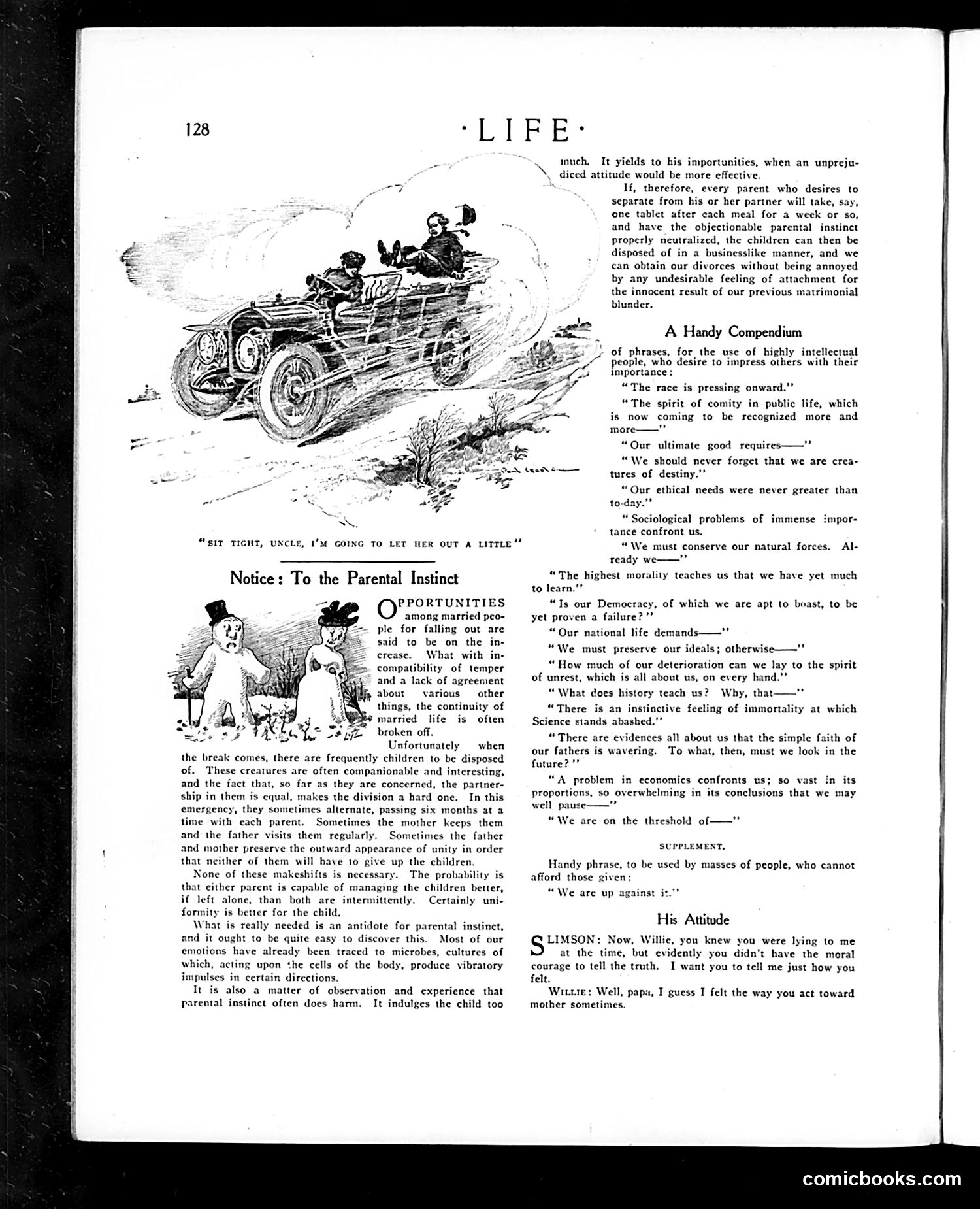
The main cartoon shows a car full of people speeding dangerously on a winding road, with the caption "SIT TIGHT, UNCLE, I'M GOING TO LET HER OUT A LITTLE." This satirizes reckless driving and youthful disregard for safety—a concern of the era when automobiles were relatively new. Below, "Notice: To the Parental Instinct" discusses marital discord and child custody arrangements. The accompanying illustration depicts a couple arguing over children. The text argues that divorce needn't harm children if parents handle separation maturely and avoid using children as weapons. It advocates for businesslike, unemotional separation agreements rather than custody battles driven by attachment or spite. The page reflects early-20th-century anxieties about modernization, driving, and changing family structures.
📄 Transcribed text from this page (OCR, searchable)
Machine-transcribed from the original scan — historical spelling and the odd misread are preserved.
“LIFE- “SIT TIGHT, UNCLE, I’M GOING TO LET HER OUT A LITTLE” Notice: To the Parental Instinct PPORTUNITIES among married peo- ple for falling out are said to be on the in- crease. What with in- compatibility of temper and a lack of agreement about various other things, the continuity of married life is often broken off. Unfortunately when the break comes, there are frequently children to be disposed of. These creatures are often companionable and interesting, and the fact that, so far as they are concerned, the partner- ship in them is equal, makes the division a hard one. In this emergency, they sometimes alternate, passing six months at a time with cach parent. Sometimes the mother keeps them and the father visits them regularly, Sometimes the father and mother preserve the outward appearance of unity in order that neither of them will have to give up the children. None of these makeshifts is necessary. The probability is that either parent is capable of managing the children better, if left alone, than both are intermittently. Certainly uni- , is better for the child. What is really needed is an antidote for parental instinct, and it ought to be quite easy to discover this. Most of our emotions have already been traced to microbes, cultures of which, acting upon the cells of the body, produce vibratory impulses in certain directions. It is also a matter of observation and experience that Parental instinct often does harm. It indulges the child too inuch, It yields to his importunities, when an unpreju- diced attitude would be more effective. . If, therefore, every parent who desires to separate from his or her partner will take, say, one tablet after cach meal for a week or so, and have the objectionable parental instinct Properly neutralized, the children can then be disposed of in a businesslike manner, and we can obtain our divorces without being annoyed by any undesirable feeling of attachment for the innocent result of our previous matrimonial blunder. A Handy Compendium of phrases, for the use of highly intellectual people, who desire to impress others with their importance; “The race is pressing onward.” “The spirit of comity in public life, which is now coming to be recognized more and more—" “Our ultimate good requires——’” “We should never forget that we are crea- tures of destiny.” “Our ethical needs were never greater than to-day.”” “ Sociological problems of immense impor- tance confront us. “We must conserve our natural forces. ready we—— “The highest morality teaches us that we have yet much to learn.” “Is our Democracy, of which we are apt to L yet proven a failure? “Our national life demands——"' Al- t, to be “We must preserve our ideals; otherwise—" “How much of our deterioration can we lay to the spirit of unrest, which is all about us, on every han “What does history teach us? Why, that— “There is an instinctive feeling of immortality at which Science stands abashed.”” “There are evidences all about us that the simple faith of our fathers is wavering. To what, then, must we look in the future?" “A problem in economics confronts us; so vast in its proportions, so overwhelming in its conclusions that we may well pai “We are on the threshold of — SUPPLEMENT, Handy phrase, to be used by masses of people, who cannot afford those given: “We are up against it, His Attitude LIMSON: Now, Willie, you knew you were lying to me at the time, but evidently you didn’t have the moral courage to tell the truth, I want you to tell me just how you felt. Witte: Well, papa, I guess I felt the way you act toward mother sometimes. comicbooks.com