
Life, 1909-01-28 · page 18 of 28
Life — January 28, 1909 — page 18: what you’re looking at
What you’re looking at
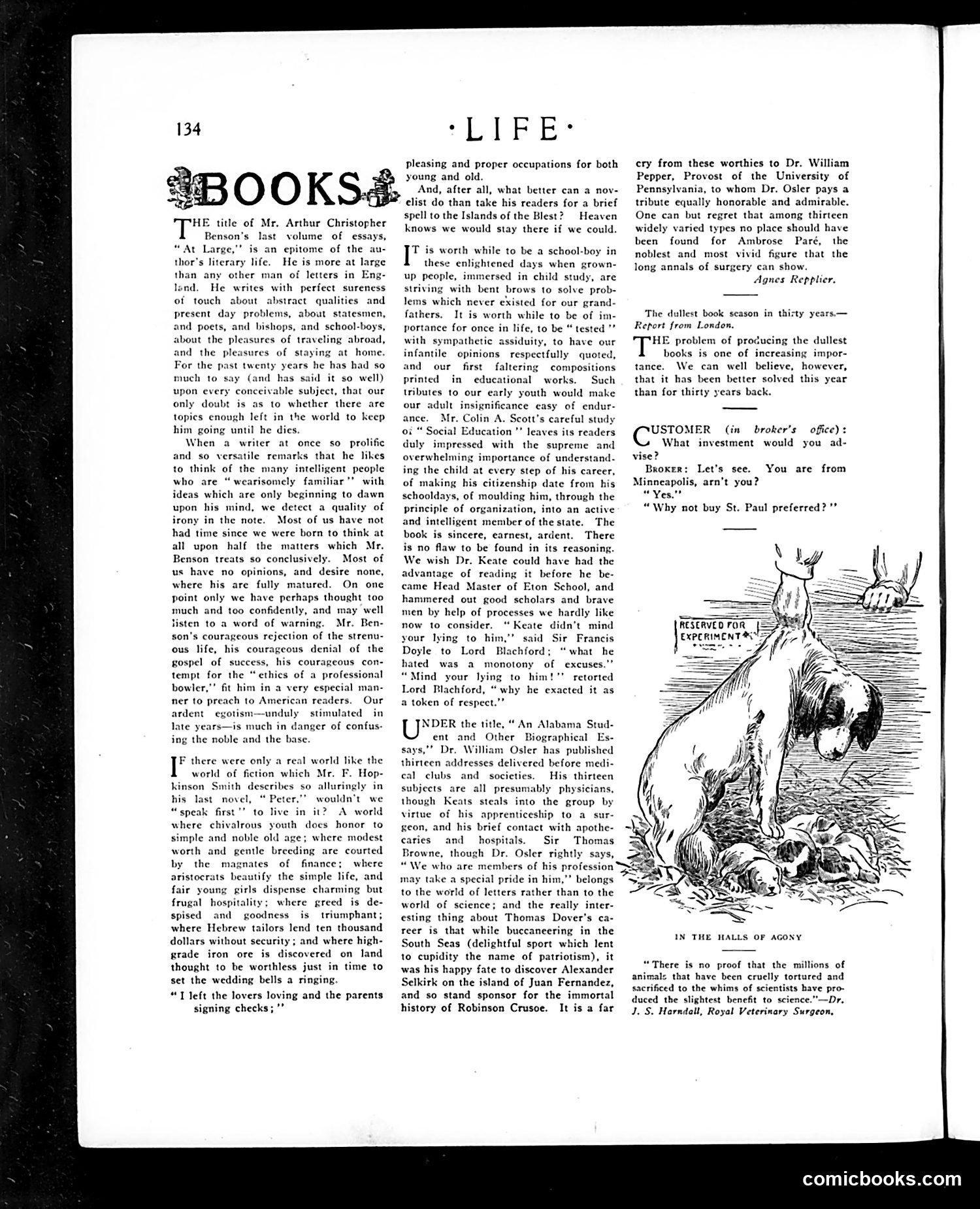
This page is primarily a **books section** reviewing recent literary works rather than political satire. The reviews discuss essays by Arthur Christopher Benson, a novel called "Peter" by F. Hopkinson Smith, and a study on "Social Education" by Colin A. Scott. The **cartoon** (titled "IN THE HALLS OF AGONY") depicts a dog and appears illustrative rather than satirical—likely accompanying a quote about animal suffering in medical research. The **satirical content** is embedded in the text itself: the reviewer gently mocks Benson's prolific output and Smith's idealized fictional world where "Hebrew tailors lend ten thousand dollars without security" and greed is despised—obvious fantasy. The irony targets both the authors' escapism and American readers' susceptibility to it. The page reflects *Life*'s role as a literary and cultural commentary magazine for educated readers.
📄 Transcribed text from this page (OCR, searchable)
Machine-transcribed from the original scan — historical spelling and the odd misread are preserved.
134 &BOOKS# HE title of Mr. Arthur Christopher Benson’s last volume of essays, At Large,"’ is an epitome of the au- thor’s literary life. He is more at large than any other man of letters in Eng- land. He writ with perfect sureness of touch about abstract qualities and present day problems, about statesmen, and poets, and bishops, and school-boys, about the pleasures of traveling abroad, and the pleasures of staying at home. For the past twenty years he has had so much to s said it so well) upon every conceivable subject, that our only doubt is as to whether there are topics cnough left in the world to keep him going until he dies. When a writer at once so prolific and so versatile remarks that he likes to think of the many intelligent people who are “wearisomely familiar’? with ideas which are only beginning to dawn upon his mind, we detect a quality of irony in the note. Most of us have not had time since we were born to think at all upon half the matters which Mr. Benson treats so conclusively. Most of us have no opinions, and desire none, where his are fully matured. On one point only we have perhaps thought too much and too confidently, and may well listen to a word of warning. Mr. Ben- son's courageous rejection of the strenu- ous life, his courageous denial of the gospel of success, his courageous con- tempt for the “ethics of a professional bowler,”’ fit him in a very especial man- ner to preach to American readers. Our ardent egotism—unduly stimulated in late years—is much in danger of confus- ing the noble and the base. F there were only a real world like the world of fiction which Mr. F. Hop- kinson Smith describes so alluringly in his last novel, “ Peter.”” wouldn't we “speak first’? to live in it? A world where chivalrous youth does honor to simple and noble old age; where modest worth and gentle breeding are courted by the magnates of finance; where aristocrats beautify the simple life, and fair young girls dispense charming but frugal hospitality; where greed is de- spised and goodness is triumphant; where Hebrew tailors lend ten thousand dollars without security ; and where high- grade iron ore is discovered on land thought to be worthless just in time to set the wedding bells a ringing. “Tleft the lovers loving and the parents signing checks; " iLIFE* pleasing and proper occupations for both young and old. And, after all, what better can a nov- list do than take his readers for a brief spell to the Islands of the Blest? Heaven knows we would stay there if we could. T is worth while to be a school-boy in these enlightened days when grown- up people, immersed in child study, are striving with bent brows to solve prob- lems which never existed for our grand- fathers. It is worth while to be of im- portance for once in life, to be “ tested "” with sympathetic assiduity, to have our infantile opinions respectfully quoted, and our first’ faltering compositions printed in educational works. Such tributes to our early youth would make our adult insignificance easy of endur- ance. Mr. Colin A. Scott's careful study 0% “ Social Education '* leaves its readers duly impressed with the supreme and overwhelming importance of understand- ing the child at every step of his career, of making his citizenship date from his schooldays, of moulding him, through the principle of organization, into an active and intelligent member of the state. The book is sincere, earnest, ardent. There is no flaw to be found in its reasoning. We wish Dr. Keate could have had the advantage of reading it before he be- came Head Master of Eton School, and hammered out good scholars and brave men by help of processes we hardly like now to consider. “Keate didn’t mind your lying to him,’ said Sir Francis Doyle to Lord Blachford; “what he hated was a monotony of excuses.” “Mind your lying to hi retorted Lord Blachford, “why he exacted it as a token of respect.”” NDER the title, “An Alabama Stud- ent and Other Biographical E: says,"’ Dr. William Osler has published thirteen addresses delivered before medi- cal clubs and His thirteen subjects are all presumably physicians, though Keats steals into the group by virtue of his apprenticeship to a sur- geon, and his brief contact with apothe- caries and hospitals. Sir Thomas Browne, though Dr. Osler rightly says, Societies. may take a special pride in him,” belongs to the world of letters rather than to the world of science; and the really inter- esting thing about Thomas Dover's ca- reer is that while buccaneering in the South Seas (delightful sport which lent to cupidity the name of patriotism), it was his happy fate to discover Alexander Selkirk on the island of Juan Fernandez, and so stand sponsor for the immortal history of Robinson Crusoe. It is a far cry from these worthies to Dr. William Pepper, Provost of the University of Pennsylvania, to whom Dr. Osler pays a tribute equally honorable and admirable. One can but regret that among thirteen widely varied types no place should have been found for Ambrose Paré, the noblest and most vivid figure that the long annals of surgery can show. Agnes Repplier. ‘The dullest book season in thirty years — Report from London. HE problem of producing the dullest books is one of increasing impor- tance. We can well believe, however, that it has been better solved this year than for thirty years back. USTOMER (in broker's office) : What investment would you ad- vise? Broxer: Minneapoli “Yes."* “Why not buy St. Paul preferred? Let's see. You are from arn't you? IN THE HALLS OF AGONY “There is no proof that the millions of animals that have been cruelly tortured and sacrificed to the whims of scientists have pro- duced the slightest benefit to science."—Dr. J. S. Horndall, Royal Veterinary Surgeon, comicbooks.com