
Life, 1909-01-28 · page 16 of 28
Life — January 28, 1909 — page 16: what you’re looking at
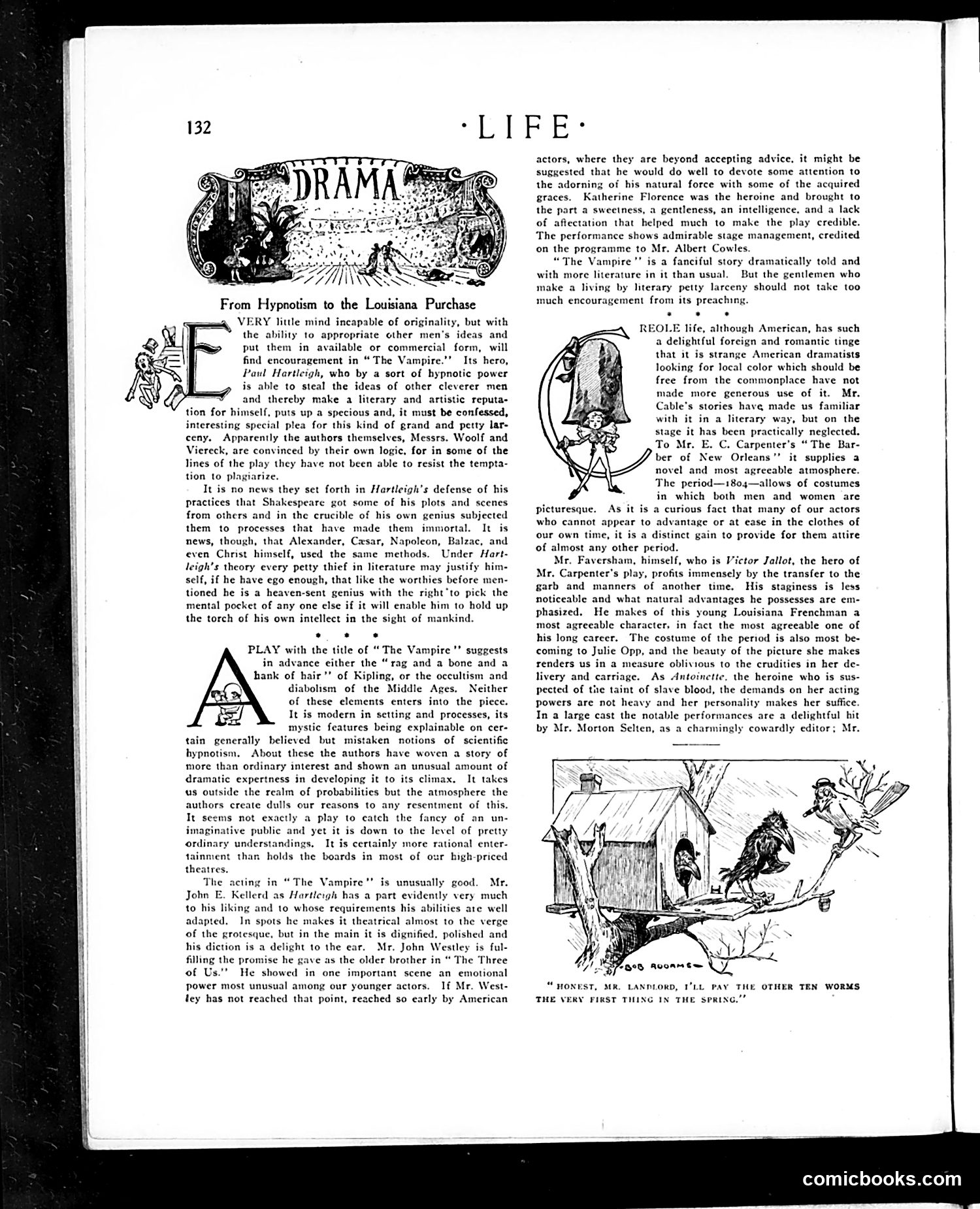
What you’re looking at
This page reviews a theatrical production of "The Vampire," a play about a man named Paul Hartleigh who uses hypnotic power to steal ideas from cleverer men and pass them off as his own creative work. The critic argues the play ironically undermines itself: it defends plagiarism and idea-theft by citing great historical figures (Shakespeare, Napoleon, Caesar) who allegedly did the same—yet the critic contends this logic dangerously justifies common theft. The authors themselves, Woolf and Viereck, apparently plagiarized *within the play*, proving the critic's point. The review then praises the acting, particularly John E. Kellerd's performance as the morally dubious Hartleigh, while offering constructive notes to younger cast members. The satire targets both the play's flawed moral argument and—implicitly—contemporary artistic practices of idea-appropriation disguised as genius.
📄 Transcribed text from this page (OCR, searchable)
Machine-transcribed from the original scan — historical spelling and the odd misread are preserved.
LT PE From Hypnotism to the Louisiana Purchase VERY little mind incapable of originality, but with the ability to appropriate other men’s ideas and put them in available or commercial form, will find encouragement in “The Vampire."’ Its hero, Paul Hartleigh, who by a sort of hypnotic power is able to steal the ideas of other cleverer men and thereby make a literary and artistic reputa- tion for himself, puts up a specious and, it must be confessed, interesting special plea for this kind of grand and petty lar- ceny, Apparently the authors themselves, Messrs. Woolf and Viereck, are convinced by their own logic, for in some of the lines of the play they have not been able to resist the tempta- tion to plagiarize. It is no news they set forth in Hartleigh’s defense of his practices that Shakespeare got some of his plots and scenes from others and in the crucible of his own genius subjected them to processes that have made them immortal. It news, though, that Alexander, Cxsar, Napoleon, Balzac, and even Christ himself, used the same methods. Under Hart- leigh’s theory every petty thief in literature may justify him- self, if he have ego enough, that like the worthies before men- tioned he is a heaven-sent genius with the right’to pick the mental pocket of any one else if it will enable him to hold up the torch of his own intellect in the sight of mankind. * 2 6 PLAY with the title of “The Vampire ’’ suggests in advance either the “rag and a bone and a hank of hair’’ of Kipling, or the occultism and diabolism of the Middle Ages. Neither of these elements enters into the piece. It is modern in setting and processes, its mystic features being explainable on cer- tain generally believed but mistaken notions of scientific hypnotism. About these the authors have woven a story of more than ordinary interest and shown an unusual amount of dramatic expertness in developing it to its climax. It takes ‘us outside the realm of probabilities but the atmosphere the authors create dulls our reasons to any resentment of this. It seems not exactly a play to catch the fancy of an un- imaginative public and yet it is down to the level of pretty ordinary understandings, It is certainly more rational enter- fainment than holds the boards in most of our high-priced theatres. The acting in “The Vampire"? is unusually good. Mr. John E. Kellerd as Hartleigh has a part evidently very much to his liking and to whose requirements his abilities are well adapted, In spots he makes it theatrical almost to the verge of the grotesque, but in the main it is dignified, polished and his diction is a delight to the ear. Mr. John Westley is ful- filling the promise he gave as the older brother in “ The Three of Us." He showed in one important scene an emotional power most unusual among our younger actors. If Mr. West- dey has not reached that point, reached so early by American actors, where they are beyond accepting advice, it might be suggested that he would do well to devote some attention to the adorning of his natural force with some of the acquired graces. Katherine Florence was the heroine and brought to the part a sweetness, a gentleness, an intelligence, and a lack of aftcctation that helped much to make the play credible. The performance shows admirable stage management, credited on the programme to Mr. Albert Cowles. The Vampire’? is a fanciful story dramatically told and with more literature in it than usual. But the gentlemen who make a living by literary petty larceny should not take too much encouragement from its preaching. * 8 6 REOLE life, although American, has such a delightful foreign and romantic tinge that it is strange American dramatists looking for local color which should be free from the commonplace have not made more generous use of it. Mr. Cable's stories have made us familiar with it in a literary way, but on the stage it has been practically neglected. To Mr. E. C. Carpenter's “The Bar- ber of New Orleans’? it supplies a novel and most agreeable atmosphere. The period—1804—allows of costumes in which both men and women are picturesque. As it is a curious fact that many of our actors who cannot appear to advantage or at ease in the clothes of our own time, it is a distinct gain to provide for them attire of almost any other period. Mr. Faversham, himself, who is Victor Jallot, the hero of Mr. Carpenter's play, profits immensely by the transfer to the garb and manners of another time, His staginess is less noticeable and what natural advantages he possesses are em- phasized, He makes of this young Louisiana Frenchman a most agreeable character, in fact the most agreeable one of his long career. The costume of the period is also most be- coming to Julie Opp, and the beauty of the picture she makes renders us in a measure oblivious to the crudities in her de- livery and carriage. As Antoinctte, the heroine who is sus- pected of the taint of slave blood, the demands on her acting powers are not heavy and her personality makes her suffice In a large cast the notable performances are a delightful bit by Mr. Morton Selten, as a charmingly cowardly editor; Mr. L PAY THE OTHER TEN WORMS THE VERY FIRST THING IN THE SPRIN comicbooks.com