
Life, 1909-01-28 · page 6 of 28
Life — January 28, 1909 — page 6: what you’re looking at
What you’re looking at
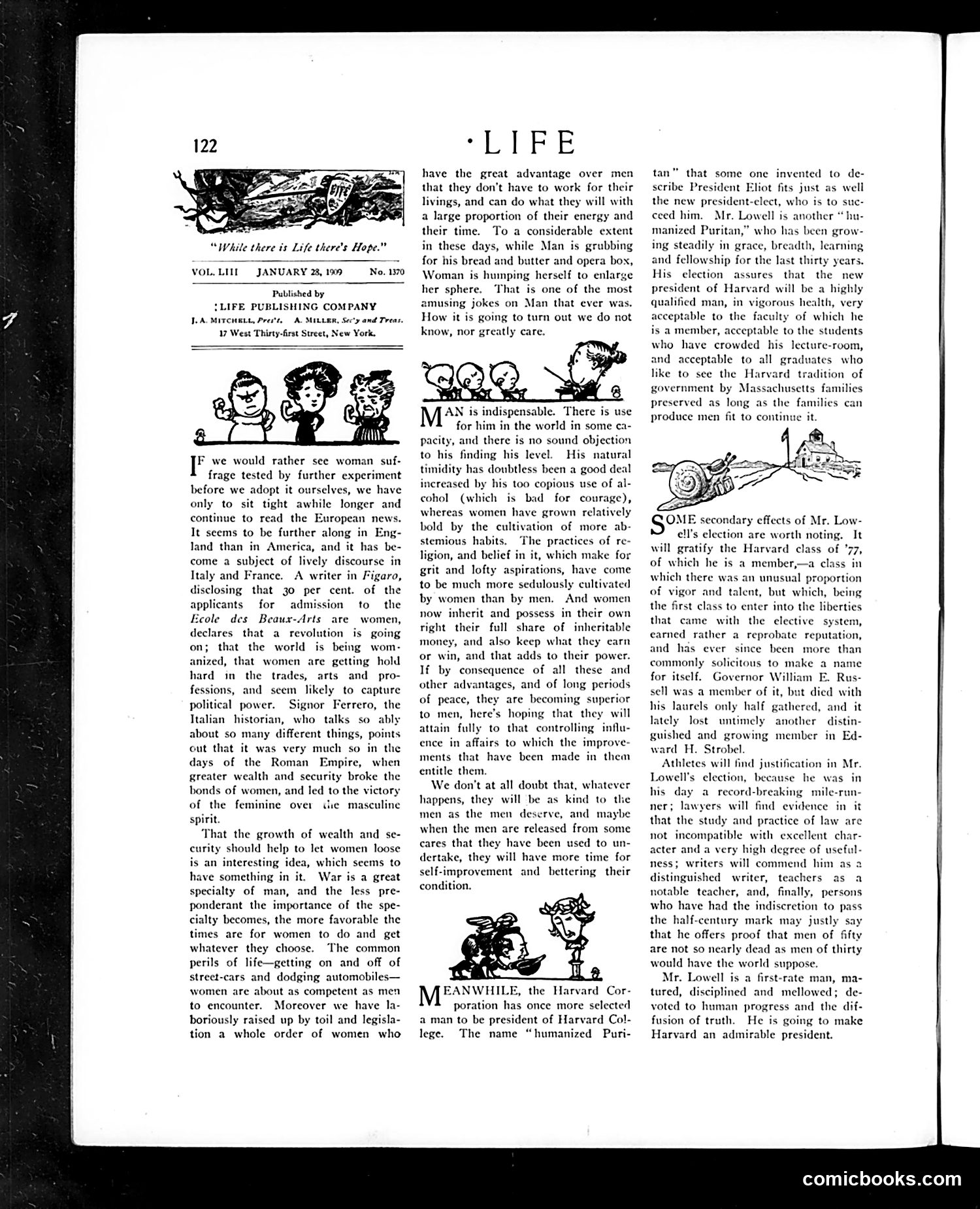
The page contains editorial commentary on women's suffrage and social progress, with accompanying satirical illustrations of women and children. The text argues that women have become indispensable to society and should have greater influence in civic affairs. It references a 30% rate of female applicants to the Ecole des Beaux-Arts in Paris, suggesting women's growing participation in professional fields. The small cartoon illustrations appear to depict women and children in domestic or social settings, likely intended to satirize contemporary debates about women's expanding roles beyond the home. The editorial also discusses Harvard College's election of a new president ("humanized Puritan"), suggesting this institutional development somehow relates to broader social progress regarding women's participation and influence in American civic and intellectual life.
📄 Transcribed text from this page (OCR, searchable)
Machine-transcribed from the original scan — historical spelling and the odd misread are preserved.
“While there is Life there's Hope.” VOL. LIL JANUARY 28, 199 No. 137% Published by {LIFE PUBLISHING COMPANY LA. MITCHELL Prestt, A. MILLER, Sec'y and Treas, ¥7 West Thirty-first Street, New York. we would rather sce woman suf- frage tested by further experiment before we adopt it ourselves, we have only to sit tight awhile longer and continue to read the European news. It seems to be further along in Eng- Jand than in America, and it has be- come a subject of lively discourse in Italy and France. A writer in Figaro, disclosing that 30 per cent. of the applicants for admission to the Ecole des Beaux-Arts are declares that a revolution is going on; that the world is being wom- anized, that women are getting hold hard in the trades, arts and pro- fessions, and scem likely to capture political power. Signor Ferrero, the Italian historian, who talks so ably about so many different things, points out that it was very much so in the days of the Roman Empire, when greater wealth and security broke the bonds of women, and led to the victory of the feminine over Gie masculine spirit. That the growth of wealth and se- curity should help to let. women loose is an interesting idea, which seems to have something in it. War is a great specialty of man, and the less pre- ponderant the importance of the spe- cialty becomes, the more favorable the times are for women to do and get whatever they choose. The common perils of life—getting on and off of street-cars and dodging automobiles— women are about as competent as men to encounter. Moreover we have la- boriously raised up by toil and legisla- tion a whole order of women who women, "LIFE have the great advantage over men that they don’t have to work for their livings, and can do what they will with a large proportion of their energy and their time. To a considerable extent in these days, while Man is grabbing for his bread and butter and opera box, Woman is humping herself to enlarge her sphere. That is one of the most amusing jokes on Man that ever was. How it is going to turn out we do not know, nor greatly care. M*s is indispensable. There is use for him in the world in some c: pacity, and there is no sound objection to his finding his level. His natural timidity has doubtless been a good deal increased by his too copious use of al- cohol (which is bad for courage), whereas women have grown relatively bold by the cultivation of more ab- stemious habits. The practices of re- ligion, and belief in it, which make for grit and lofty aspirations, have come to be much more sedulously cultivated by women than by men. And women now inherit and possess in their own right their full share of inheritable money, and also keep what they earn or win, and that adds to their power. If by consequence of all these and other advantages, and of long periods of peace, they are becoming superior to men, here’s hoping that they will attain fully to that controlling influ- ence in affairs to which the improve ments that have been made in thea entitle them. We don't at all doubt that, whatever happens, they will be as kind to the men as the men deserve, and maybe when the men are released from some cares that they have been used to un- dertake, they will have more time for self-improvement and bettering their condition. poration has once more selected a man to be president of Harvard Col- lege. The name “humanized Puri- tan” that some one invented to de- scribe President Eliot fits just as well the new president-elect, who is to suc- ceed him. Mr. Lowell is another “ hu- manized Puritan,” who has been grow- ing steadily in grace, breadth, learning and fellowship for the last thirty years. His election assures that the new president of Harvard will be a highly qualified man, in vigorous health, very acceptable to the faculty of which he is a member, acceptable to the students who have crowded his lecture-room, and acceptable to all graduates who like to see the Harvard tradition of government by Massachusetts families preserved as long as the families can produce men fit to continue it. OME secondary effects of Mr. Low- 1's election are worth noting. It will gratify the Harvard class of '77, of which he is a member,—a class in which there was an unusual proportion of vigor and talent, but which, being the first class to enter into the liberties that came with the elective system, earned rather a reprobate reputation, and has ever since been more than commonly solicitous to make a name for itself. Governor William E. Rus- sell was a member of it, but died with his laurels only half gathered, and it lately lost untimely another distin- guished and growing member in Ed- ward H. Strobel. Athletes will find justification in Mr. Lowell's election, because he was in his day a record-breaking mile-run- ner; lawyers will find evidence in it that the study and practice of law are not incompatible with excellent char- acter and a very high degree of useful- ness; writers will commend him as 2 distinguished writer, teachers as a notable teacher, and, finally, persons who have had the indiscretion to pass the half-century mark may justly say that he offers proof that men of fifty are not so nearly dead as men of thirty would have the world suppose, Mr. Lowell is a first-rate man, ma- tured, disciplined and mellowed; de- voted to human progress and the dif- fusion of truth. He is going to make Harvard an admirable president. comicbooks.com