
A complete issue · 21 pages · 1908
Life — December 31, 1908
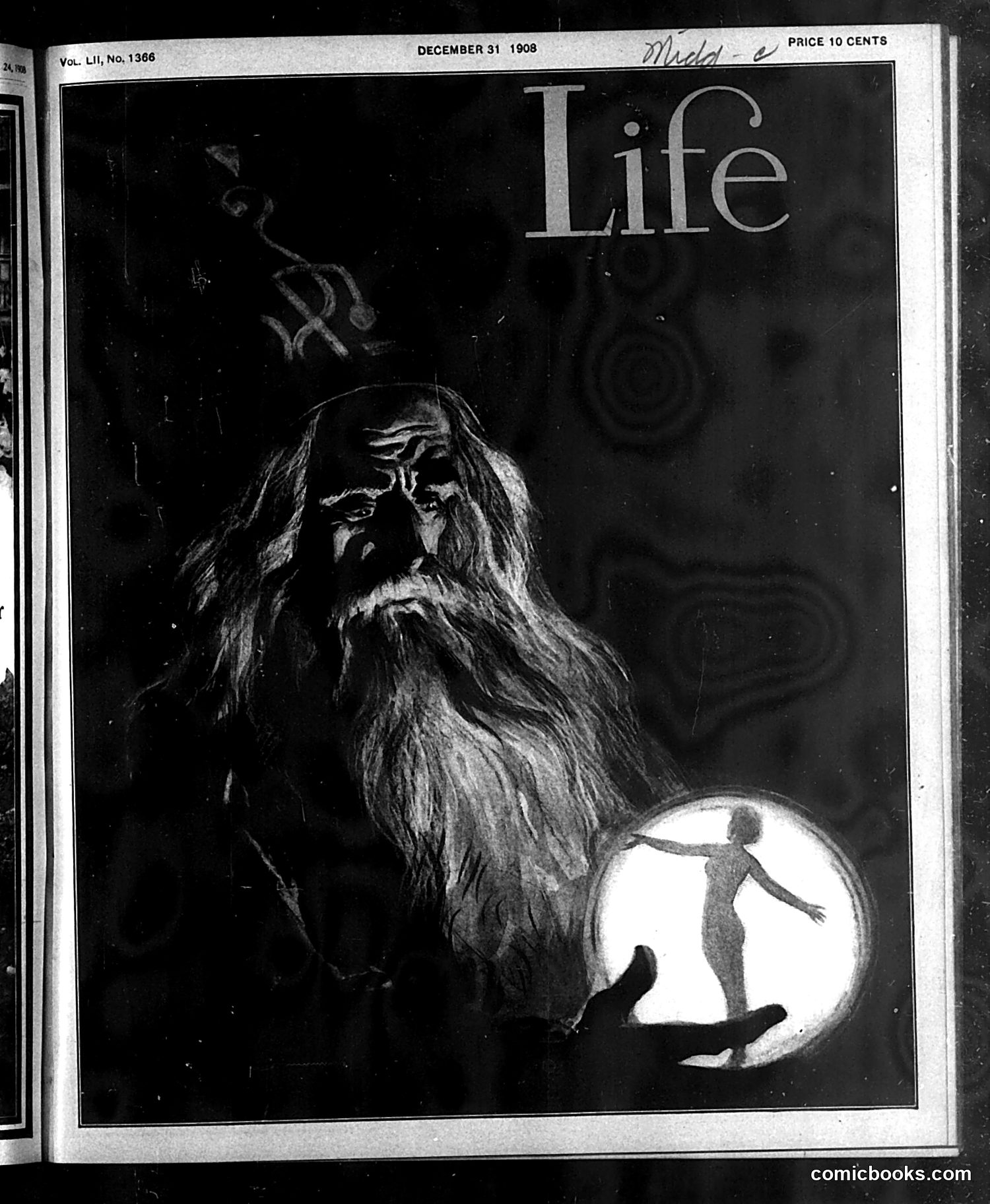
This cover depicts an elderly wizard or sorcerer with a long beard gazing into a crystal ball. The figure appears to represent someone attempting to predict the future—a common New Year's Eve theme. The mystical imagery with the glowing orb and the wizard's contemplative expression suggests the magazine is using fortune-telling as a metaphor for forecasting what 1909 will bring. Given the December 31, 1908 date, this is a Year's End issue looking ahead. The satirical tone typical of *Life* magazine suggests commentary on predictability or uncertainty about coming events, though without additional context, the specific political or social references remain unclear. The price of 10 cents is noted at top.
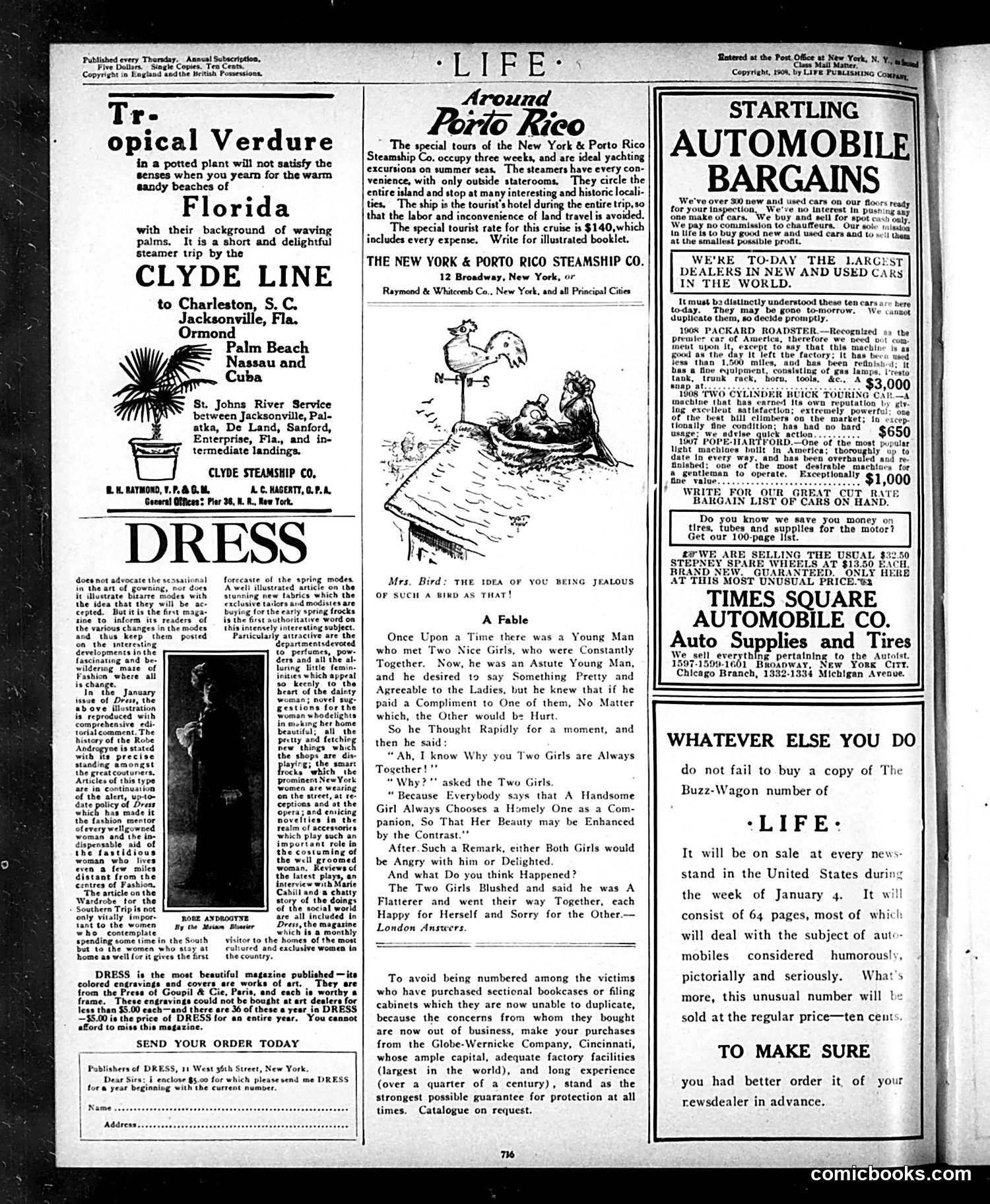
This page is **primarily advertising** with minimal editorial cartoon content. The main illustration shows a woman bird confronting a male bird, with the caption "Mrs. Bird: THE IDEA OF YOU BEING JEALOUS OF SUCH A BIRD AS THAT!" This appears to be a domestic humor cartoon playing on jealousy and infidelity themes—a male bird has apparently been caught admiring another female bird, and his wife scolds him for being jealous of a rival. It's gentle satire about relationships and vanity. The bulk of the page consists of advertisements for the **Clyde Line shipping service** (Florida cruises), automobile sales at Times Square Automobile Co., and magazine subscriptions, along with a brief fable about compliments and courtship. The cartoon humor relies on anthropomorphizing birds to comment on human romantic behavior.
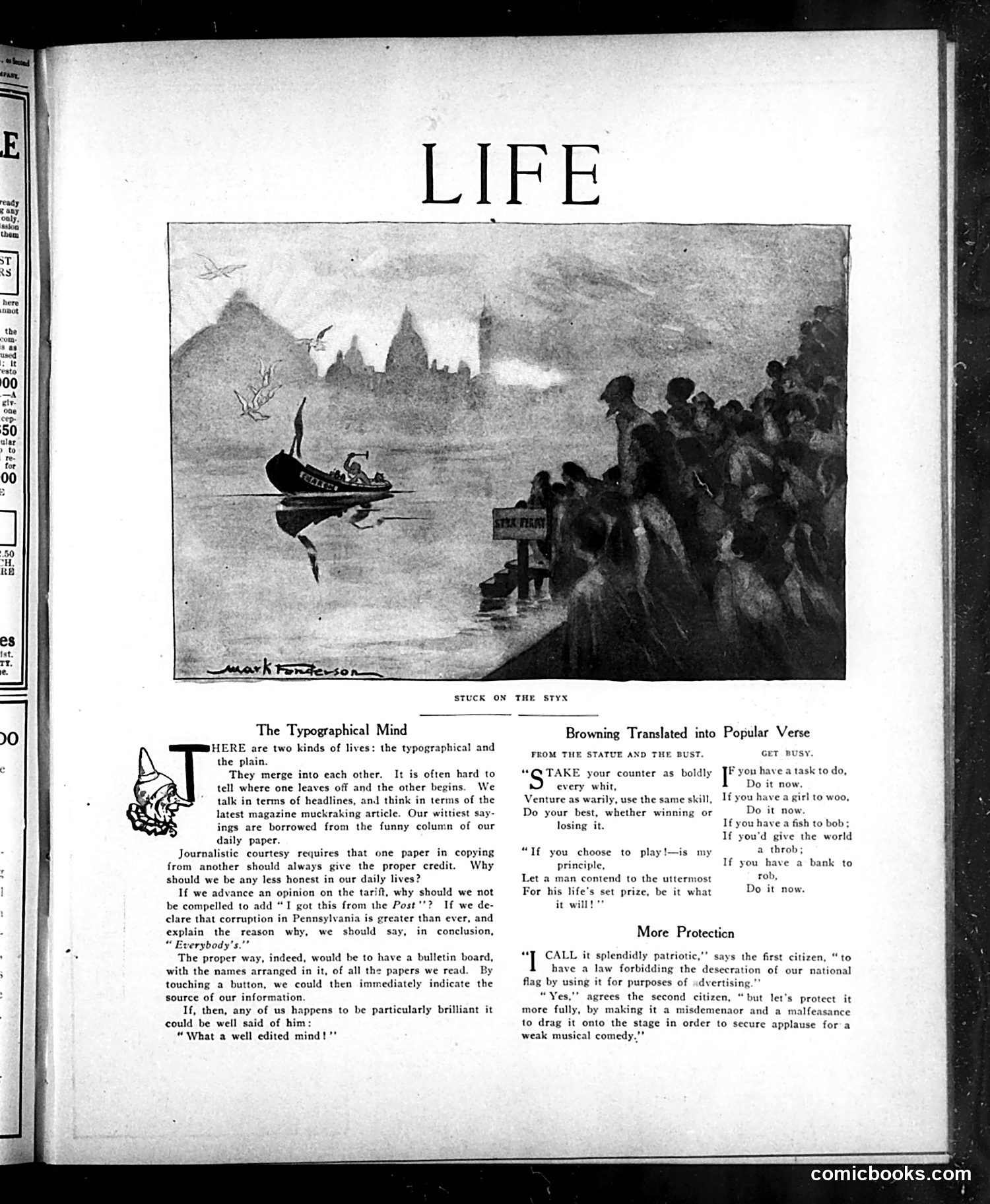
The main cartoon depicts a figure stuck on a boat in water, with a crowd gathered on shore watching. The caption "Stuck on the Styx" references the river in Greek mythology that souls cross after death, suggesting the figure is in some kind of limbo or stuck situation. However, without additional context about the specific date and political events of this Life magazine issue, I cannot definitively identify who the figure represents or what contemporary situation is being satirized. The illustration style and the mythological reference suggest social or political commentary on someone being trapped or unable to progress, but the specific target and meaning remain unclear from the image and text alone. The page also contains unrelated articles about typography and patriotic flag usage.
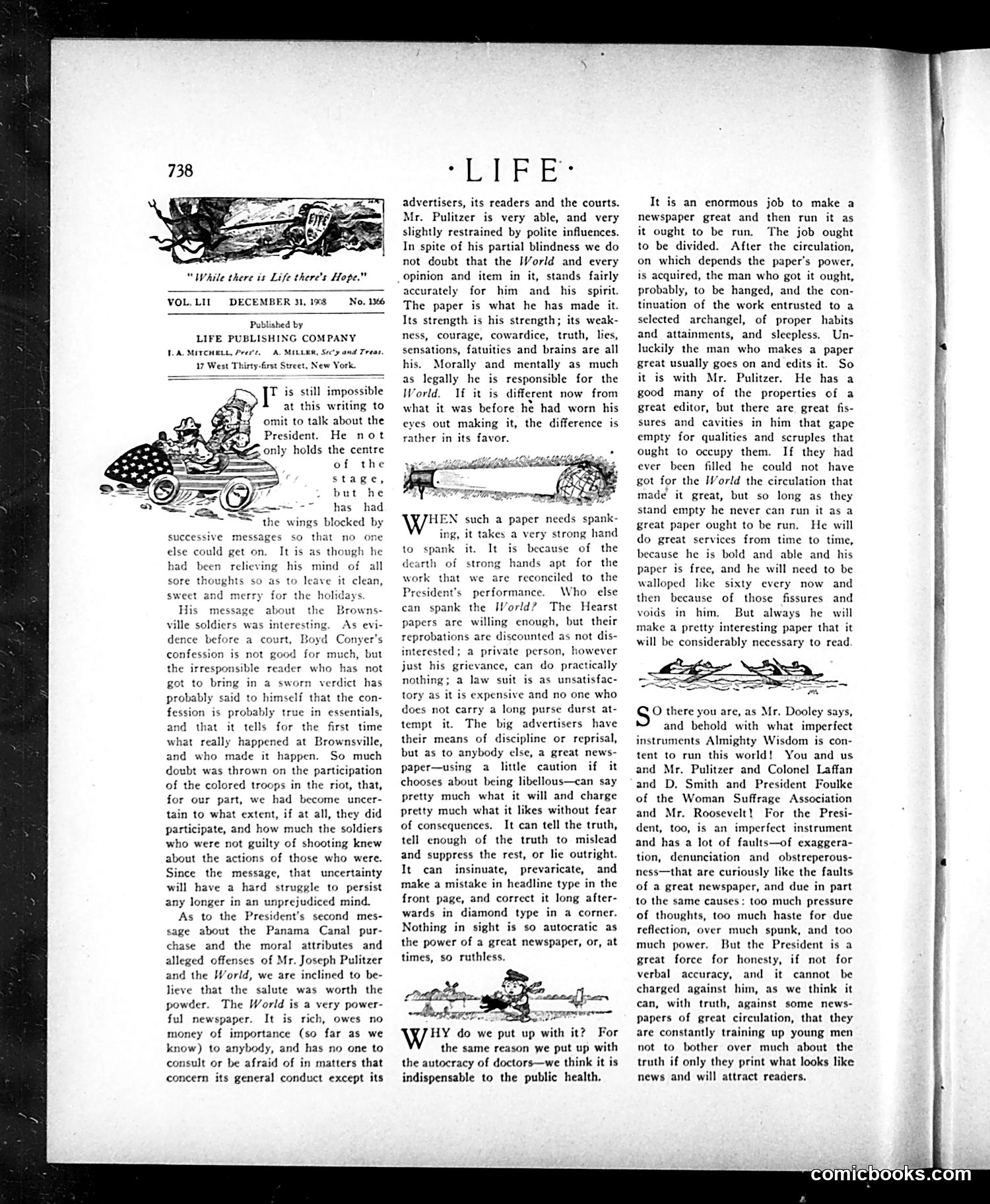
The page is primarily **text-based editorial content** rather than political cartoons. The header "While there is Life there's Hope" frames a discussion about newspaper management and editorial responsibility. The editorial defends Joseph Pulitzer and his *World* newspaper against criticism, praising Pulitzer's moral leadership despite acknowledging the paper's occasional sensationalism. It discusses how strong editorial hands are needed to manage major newspapers responsibly. The piece also references **President Roosevelt**, suggesting debates about executive power and press accountability were contemporary concerns. **Small decorative illustrations** (carriages, landscapes) appear but are ornamental rather than satirical commentary. The overall tone critiques those who attack newspapers while simultaneously acknowledging that even great papers require constant vigilance against bias and sensationalism.
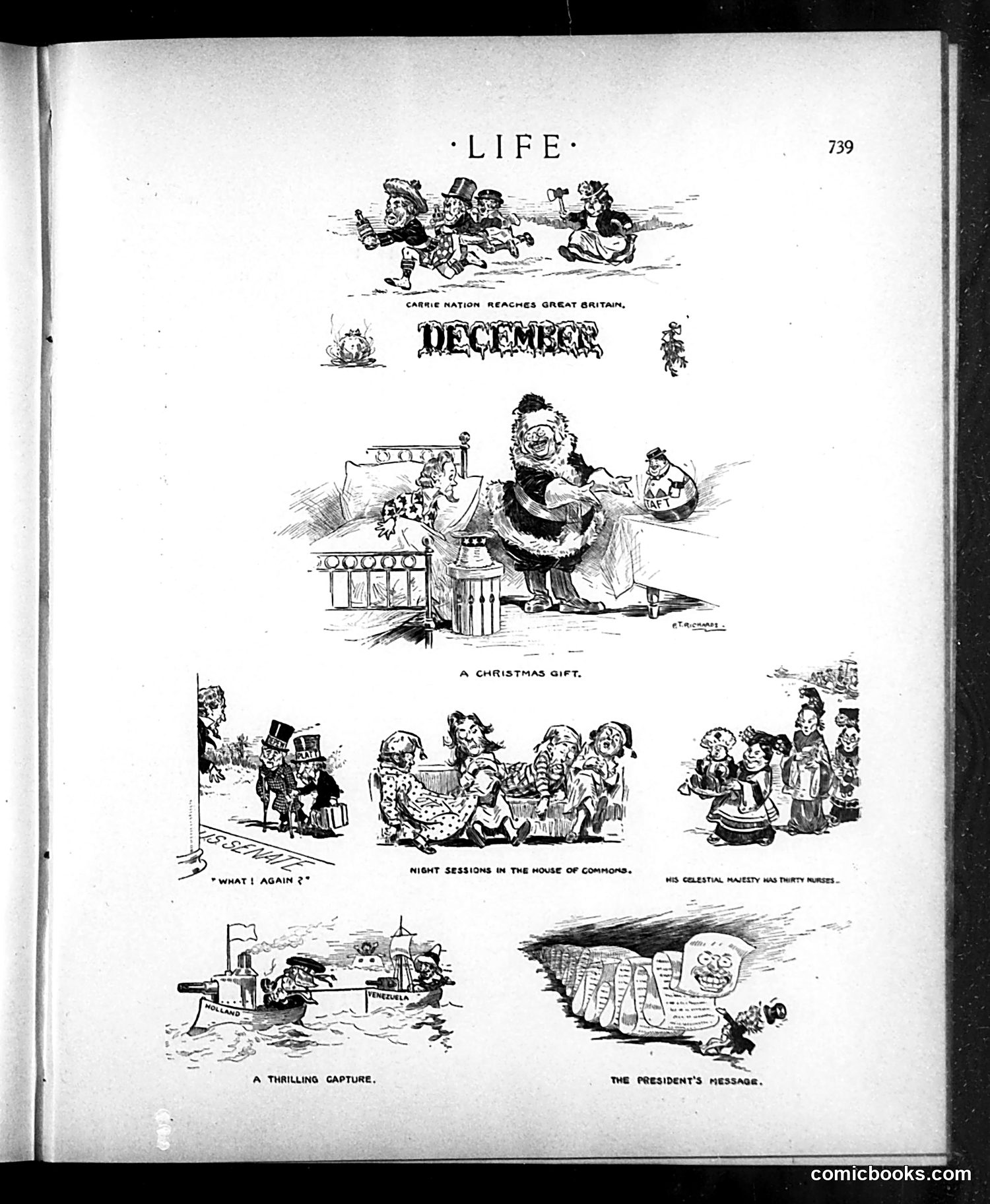
This page presents December-themed political cartoons from an early 20th-century Life magazine. The content includes: **"Carrie Nation Reaches Great Britain"** depicts the American temperance activist Carrie Nation (known for smashing saloons) arriving in Britain, likely satirizing her influence spreading internationally. **"A Christmas Gift"** shows Santa Claus, presumably referencing contemporary politics wrapped as holiday sentiment. The remaining cartoons—"What I Again?", "Night Sessions in the House of Commons," "His Celestial Majesty and Thirty Nurses," "A Thrilling Capture," and "The President's Message"—appear to reference British parliamentary politics and American presidential affairs, though specific figures and events aren't clearly identifiable from the image alone. The satirical tone suggests commentary on political controversies presented as holiday humor.
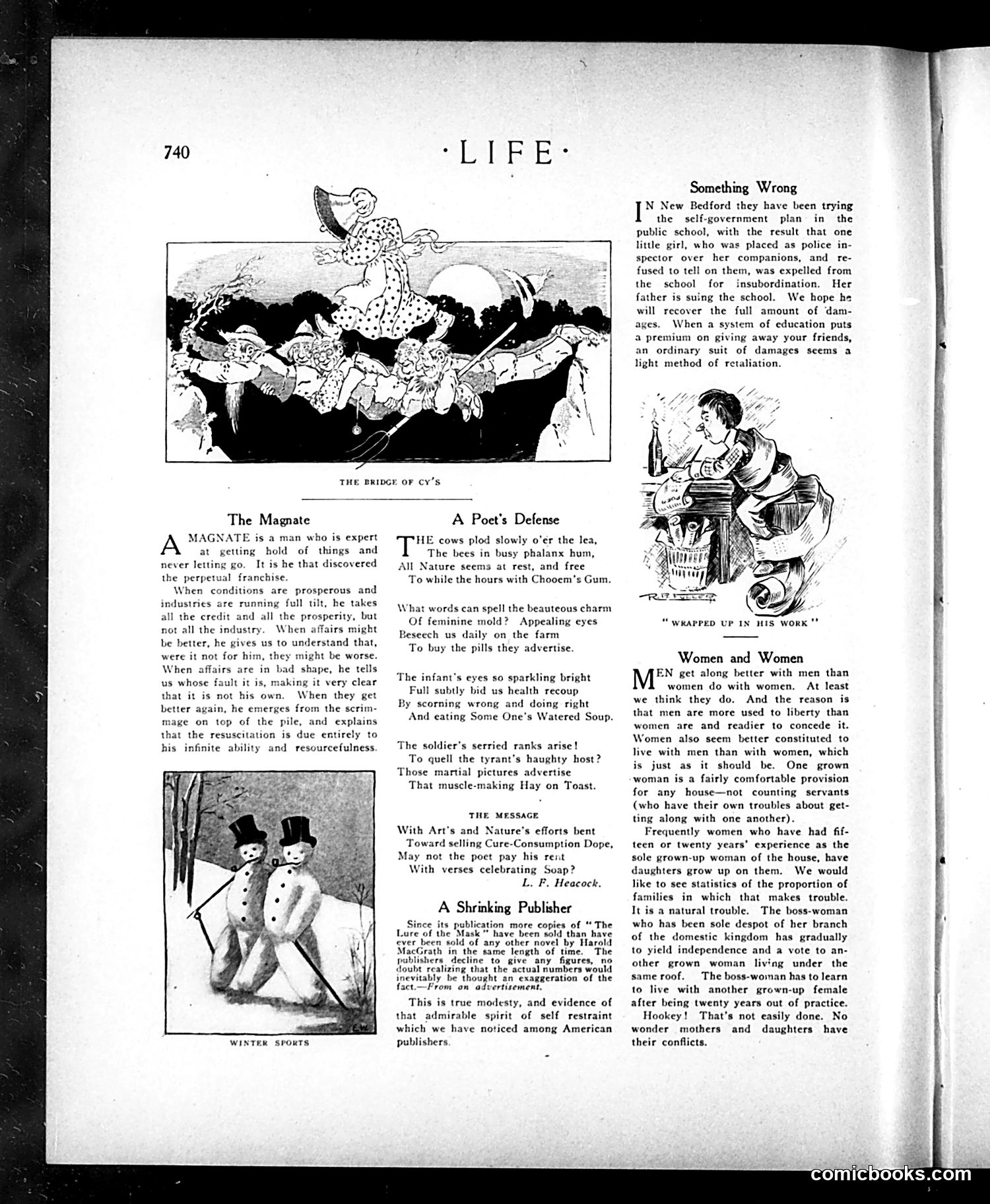
The main cartoon depicts a woman in a large hat literally bridging a gap between groups of people, labeled "The Bridge of Cy's." This appears to be advertising copy, likely promoting a commercial product or service using the metaphor of a woman "bridging" social divides. Below are several short satirical pieces: "The Magnet" mocks men who cling to prosperity; "A Poet's Defense" parodies advertising jingles for consumer products (soap, health tonics); and "A Shrinking Publisher" criticizes publishers' reluctance to disclose book sales figures, praising their "admirable spirit of self-restraint." "Women and Women" discusses domestic tensions between wives and daughters-in-law. The overall tone is light social satire targeting consumer culture, advertising practices, and household dynamics.
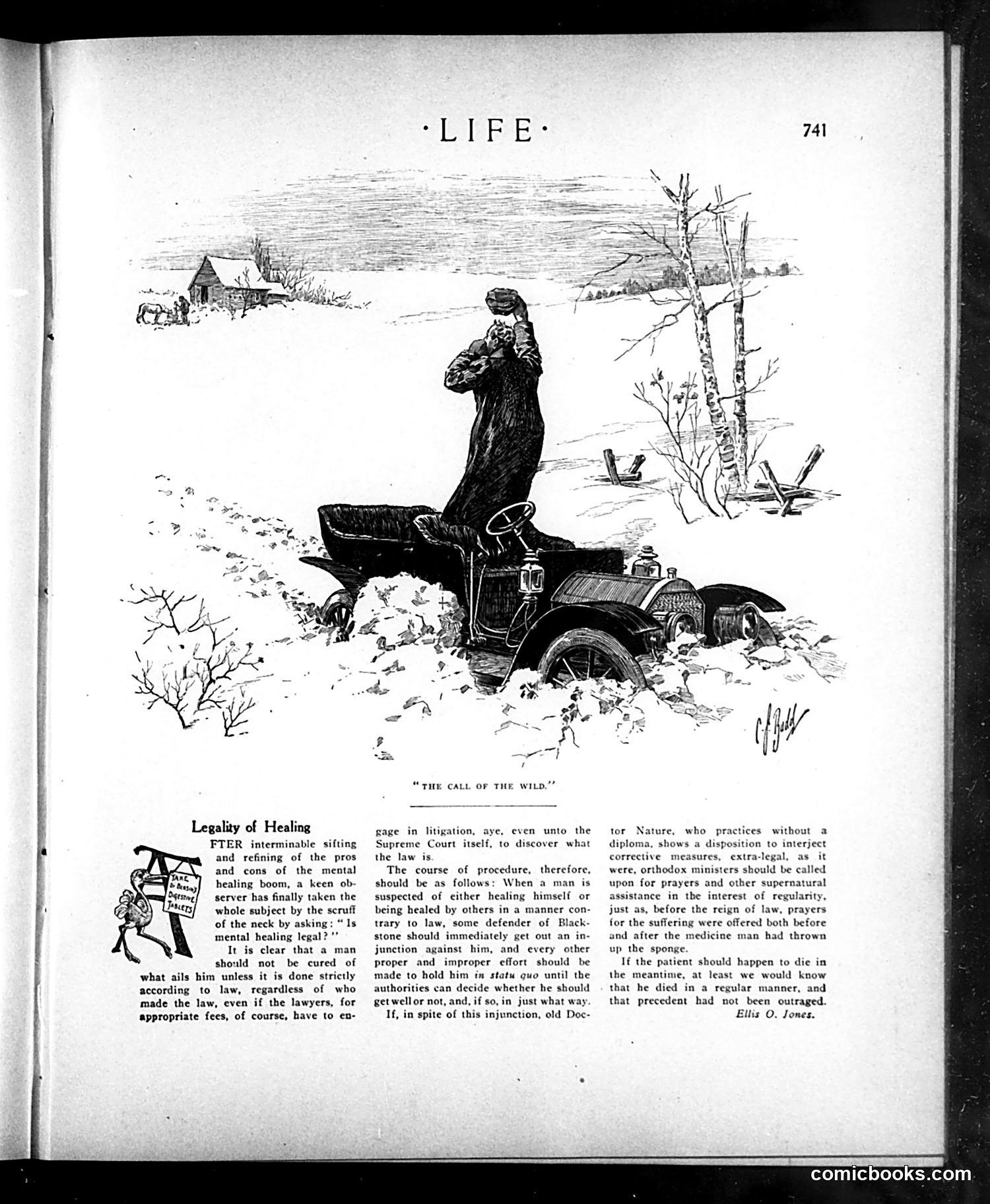
This illustration depicts a figure standing on an abandoned car in a desolate winter landscape, gazing toward a distant church and rural settlement. The cartoon's title, "The Call of the Wild," pairs urban/industrial imagery (the broken-down automobile) with pastoral wilderness, suggesting tension between civilization and nature. The accompanying article "Legality of Healing" discusses medical practitioners and legal regulation of healing practices. The cartoon appears to satirize the appeal of abandoning modern urban life—represented by the failed automobile—to return to simpler, rural existence. This likely reflects early 20th-century anxiety about industrial progress and nostalgic romanticization of agrarian life, a common satirical theme in Life magazine's social commentary.
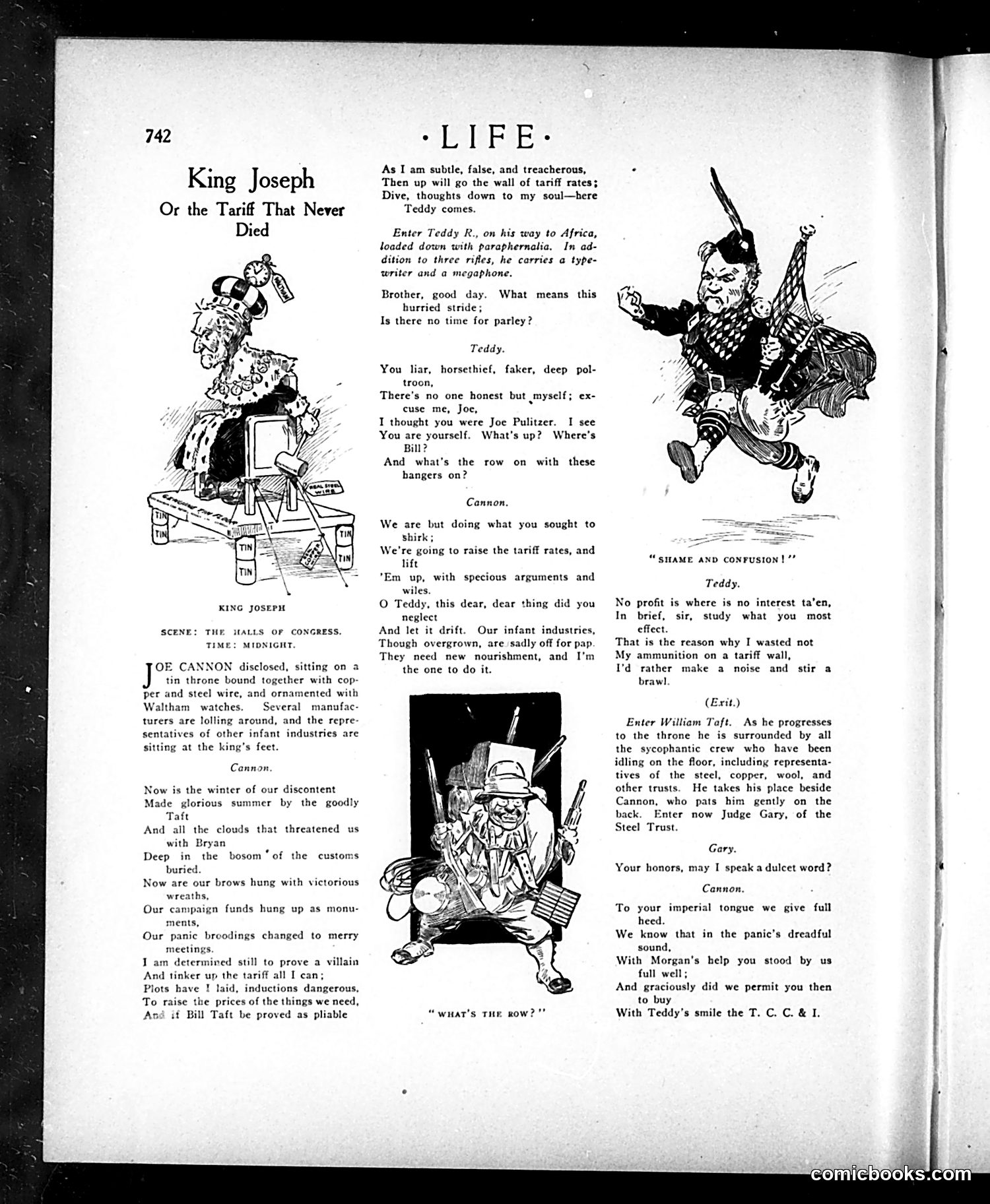
This satirical play page mocks protectionist tariff policy. "King Joseph" (likely Joseph Cannon, the House Speaker mentioned in stage directions) sits enthroned atop industrial machinery and money bags, surrounded by representatives of steel, copper, and wood trusts seeking tariff protection. The satire targets the argument that raising tariffs "nourishes" struggling industries. Characters like "Teddy" (Theodore Roosevelt) and various industrialists debate whether tariffs genuinely help infant industries or merely enrich monopolistic trusts. The central joke: tariffs become a permanent "king" that never dies—once enacted, they persist indefinitely despite claims they're temporary measures. The play critiques how special interests use economic arguments to justify protectionist policies benefiting themselves over the public.
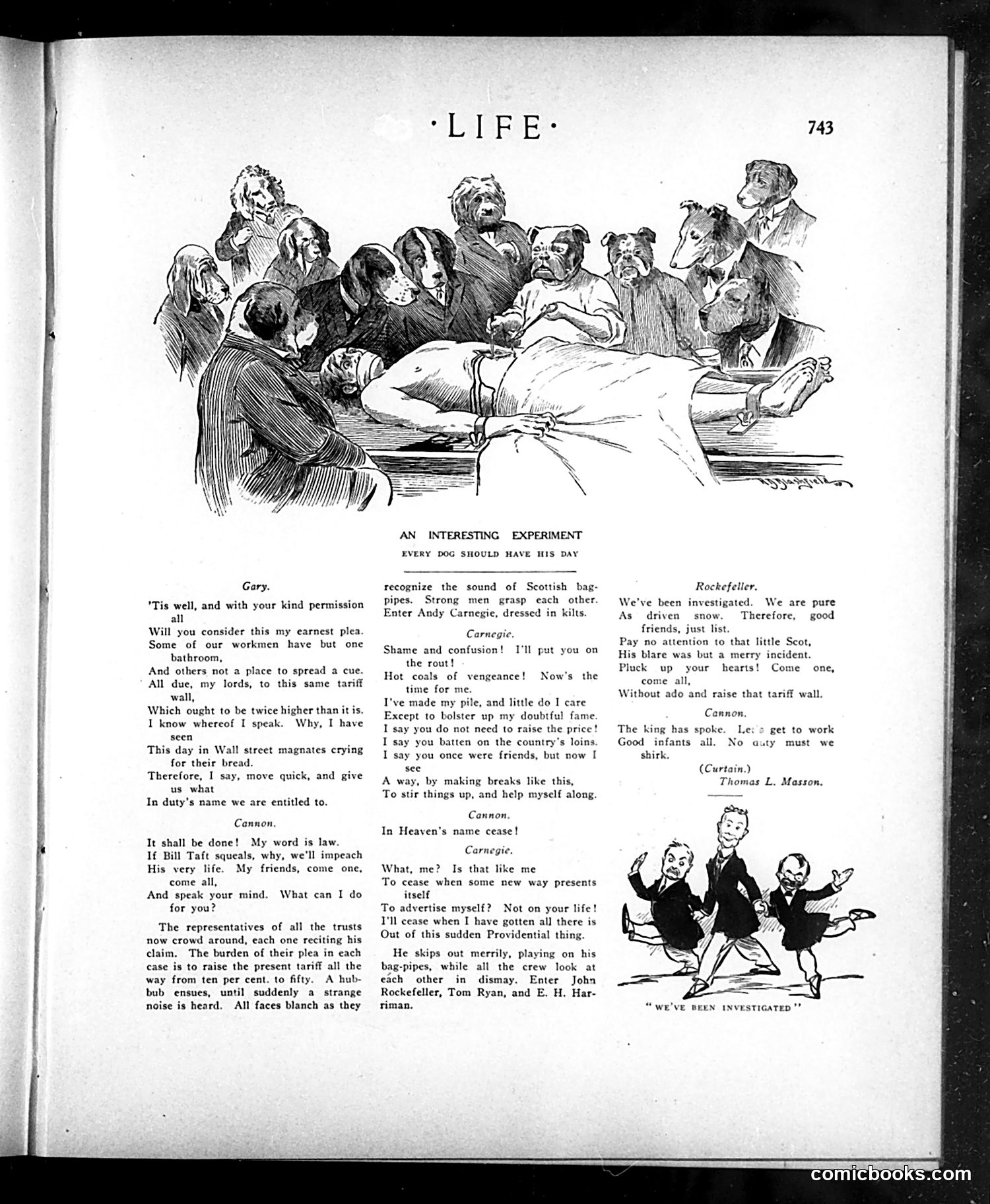
This satirical piece depicts wealthy industrialists and politicians gathered around a table like dogs, with the caption suggesting they should each "have his day." The sketch plays on the phrase "every dog has his day" — a proverb about temporary fortune. The figures appear to represent major business trusts and monopolies of the era. The dialogue references Scottish bagpipes, Andrew Carnegie (identifiable by name), and conflicts over tariffs and pricing. The satire mocks how these powerful men, though rivals, band together to maintain control and "raise the present tariff" for profit while working people suffer. The bottom cartoon shows politicians being "investigated," suggesting public scrutiny of corrupt business dealings.
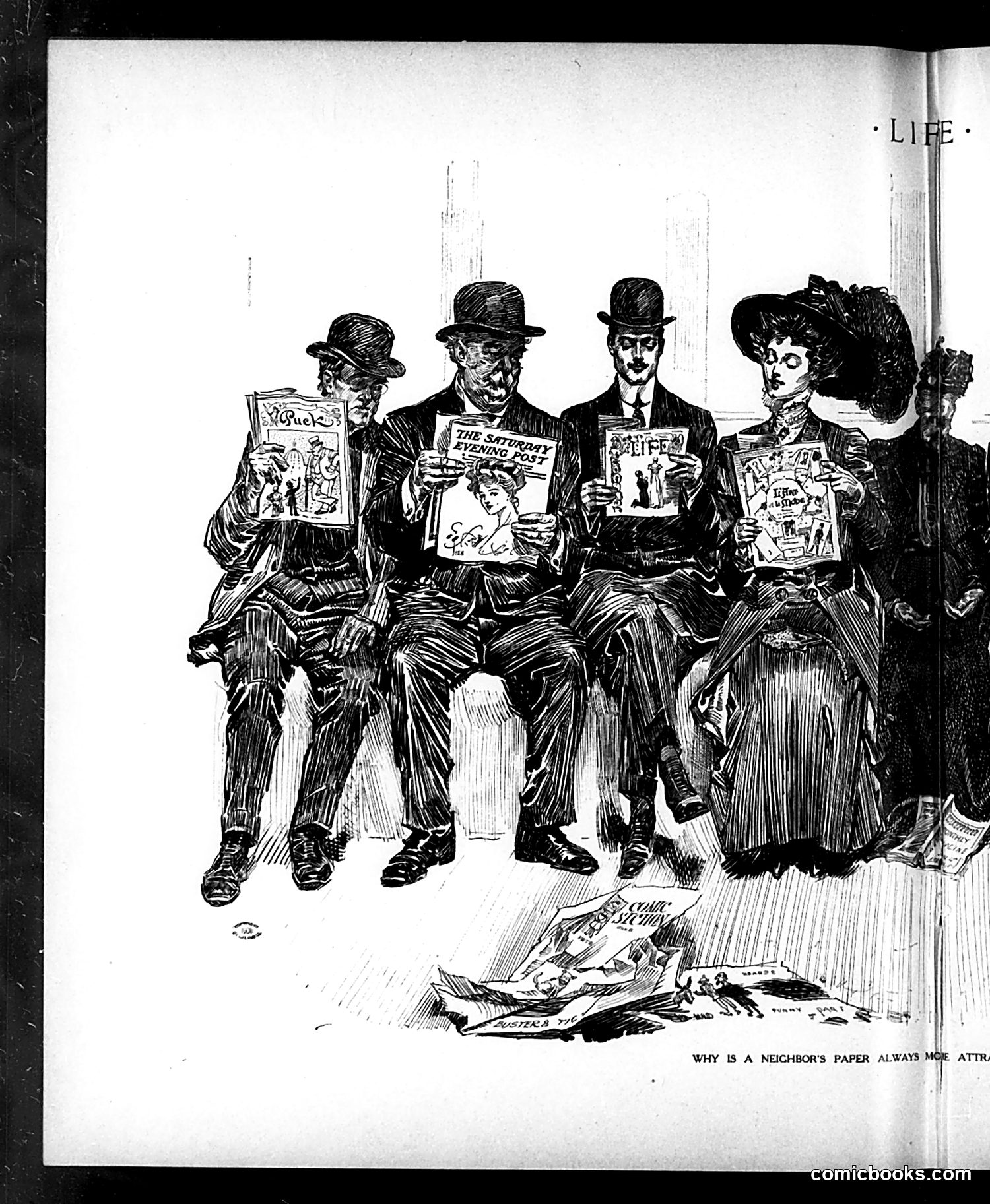
This is a satirical illustration from *Life* magazine showing five well-dressed people reading newspapers and magazines. The caption (partially visible) begins "WHY IS A NEIGHBOR'S PAPER ALWAYS MORE ATTR..." suggesting the joke concerns people's curiosity about neighbors' reading material. The figures are dressed in early 20th-century attire, with three men in suits and bowlers and a woman in an elaborate hat. They're prominently displaying publications including "The Saturday Evening Post" and what appears to be "Life" magazine itself. The satire likely mocks the common human tendency to be more interested in reading one's neighbor's newspapers than one's own—a commentary on nosiness or the perception that others' possessions or information always seem more appealing or scandalous than what we already have.
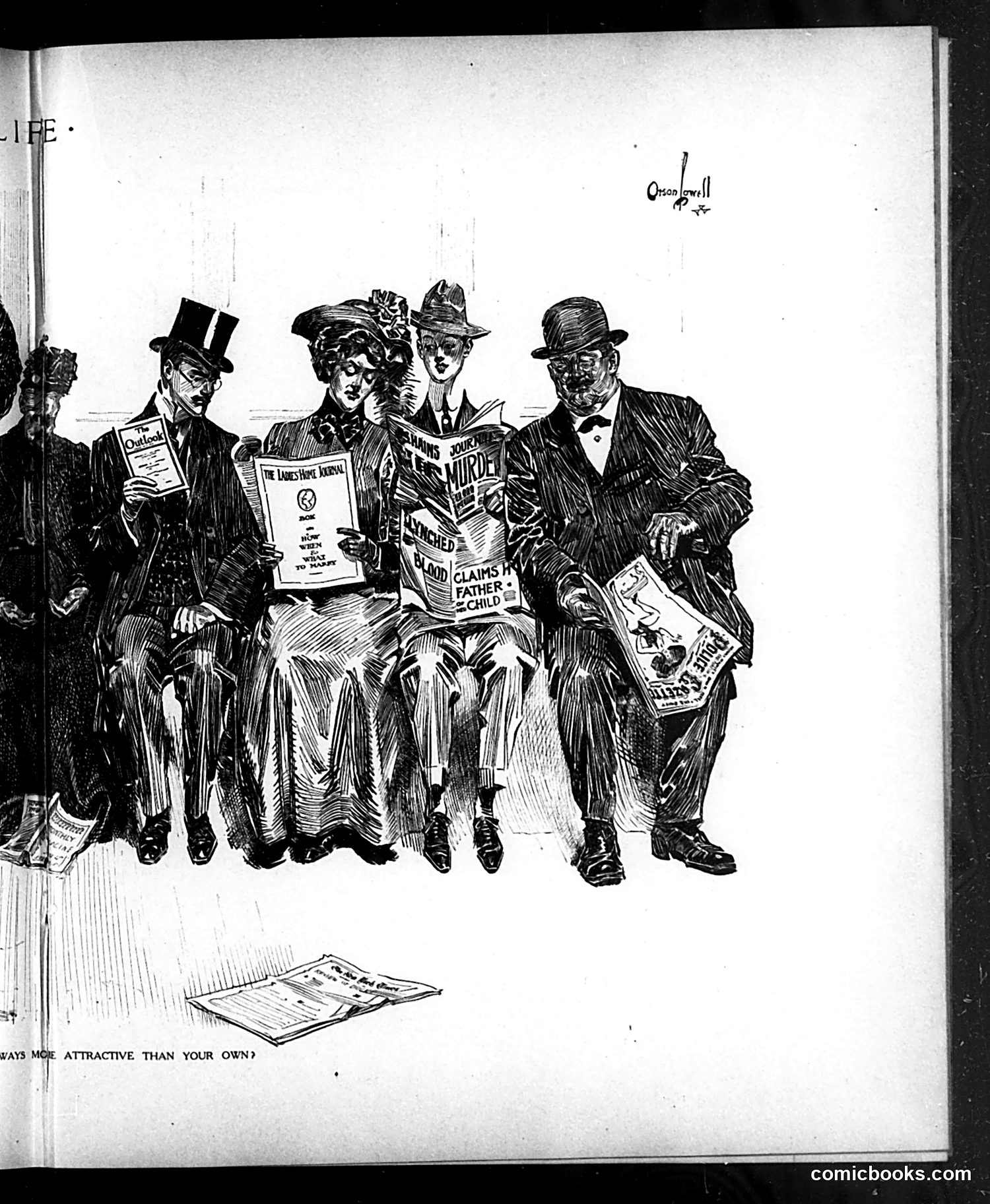
This Orson Welles cartoon satirizes sensationalist tabloid journalism and celebrity scandal-mongering. The image shows five men in formal attire reading scandalous newspapers and publications. The visible headlines include references to paternity claims ("CLAIMS HE'S THE FATHER," "CHILD") and other lurid stories ("MURDER," "BLOOD"). The satire targets how tabloids and gossip publications manufacture or sensationalize celebrity scandals, particularly involving Welles. The men appear to be various types of media figures or public consumers gleefully consuming this sensational content. The scattered newspapers suggest the proliferation of such stories across multiple publications. The cartoon critiques both the tabloid industry's creation of fake scandals and the public's appetite for celebrity gossip—a commentary relevant to Welles's own turbulent public image in that era.
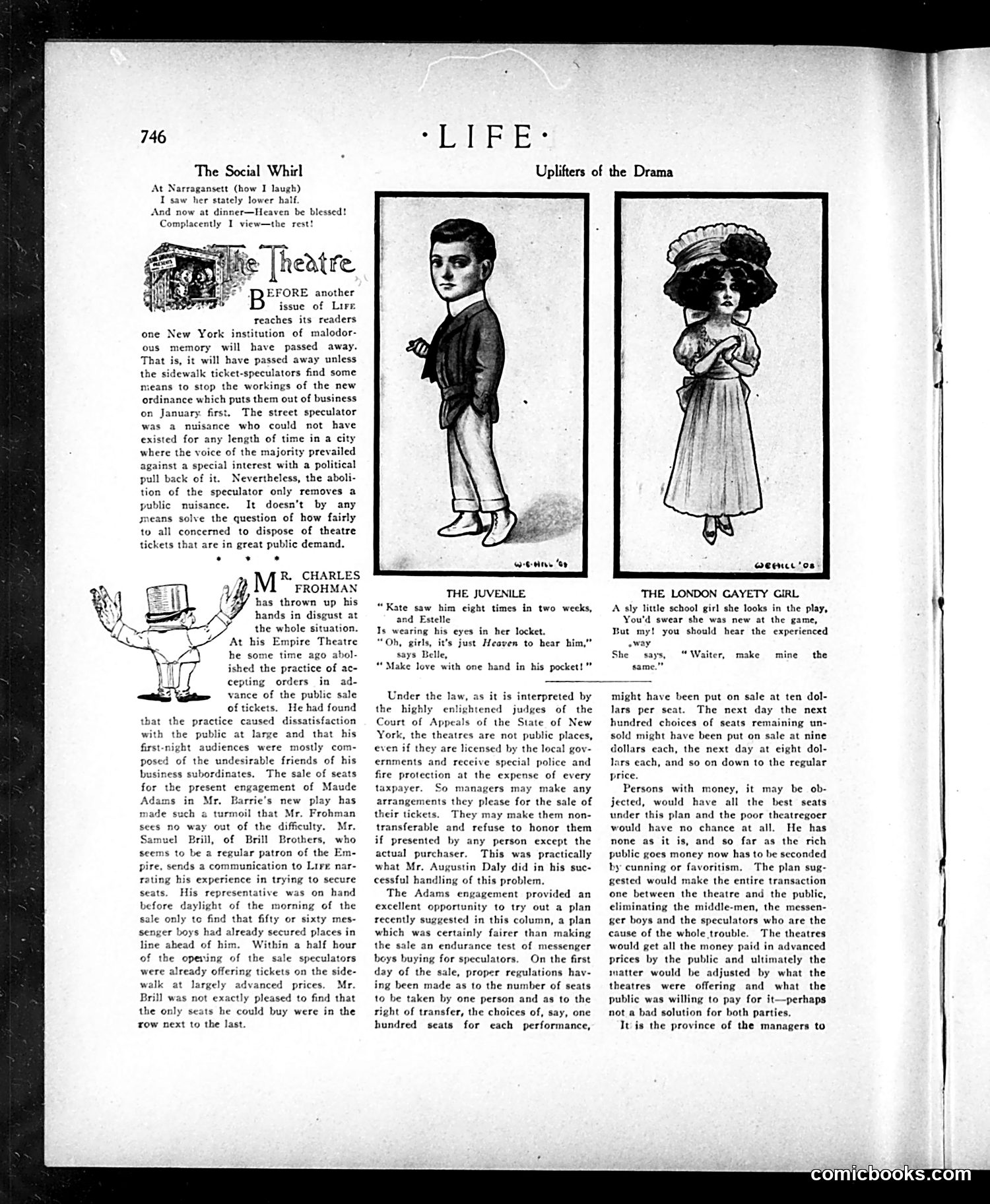
This page discusses theatre ticket speculation and scalping—a major public nuisance in early 20th-century New York. The text criticizes sidewalk ticket speculators who bought up seats and resold them at inflated prices, putting legitimate theatregoers at disadvantage. The two illustrated figures ("The Juvenile" and "The London Gaiety Girl") appear to be character types from popular plays of the era, likely referenced as examples of shows affected by speculation. The main article advocates for a regulatory solution: requiring tickets be non-transferable and limiting seat purchases per person. The text argues this would protect both theatre revenue and the public's access to affordable entertainment—a consumer protection issue rather than partisan politics.
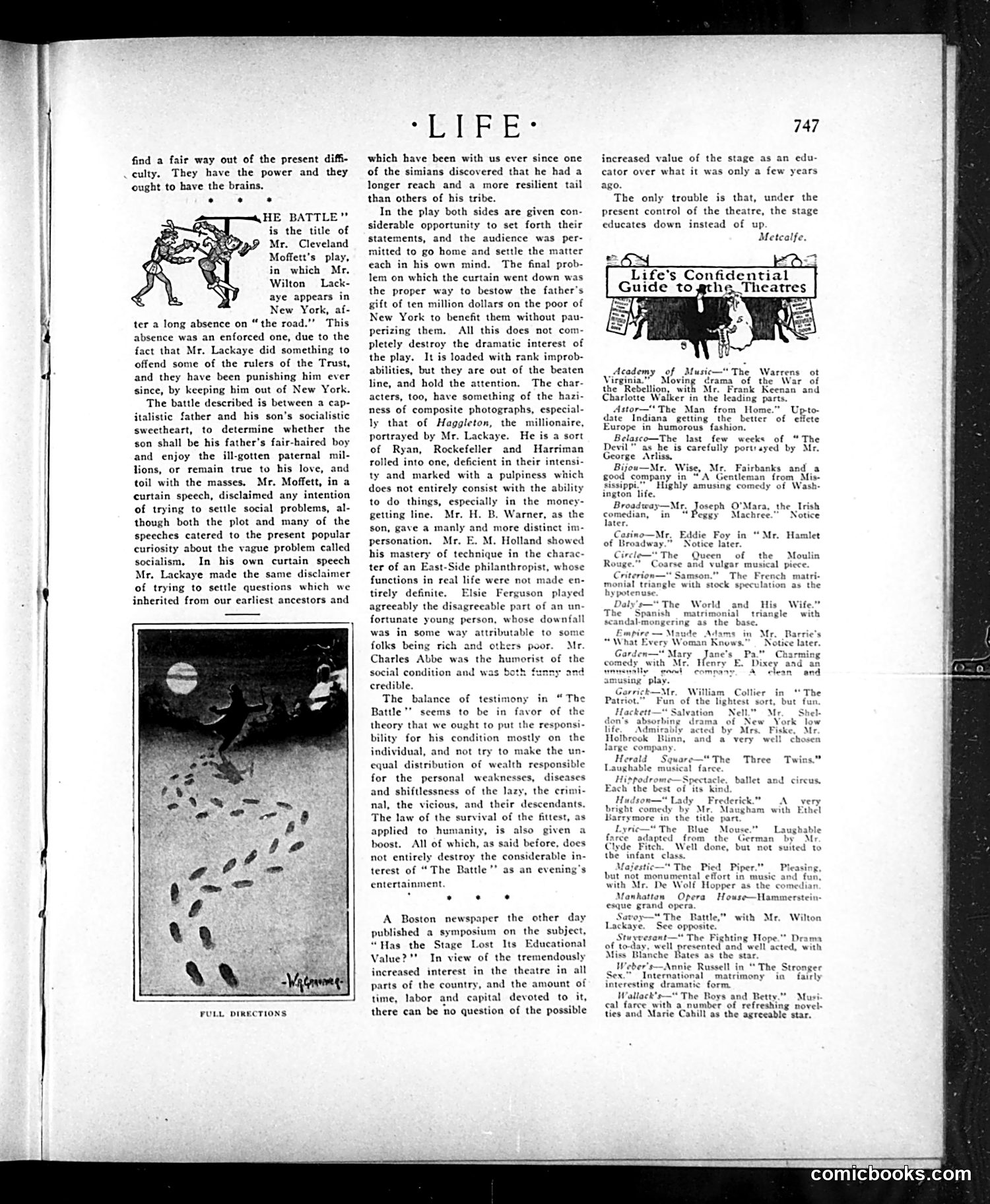
This political cartoon satirizes theatrical staging and direction. The image shows a director or authority figure appearing to orchestrate or control a scene—suggested by the gestural pose and the caption "FULL DIRECTIONS." The accompanying text discusses Mr. Cleveland Moffett's play "The Battle," which examines social problems and wealth distribution. The cartoon appears to critique how the play's message is being *directed*—suggesting that moral or social lessons are being artificially controlled or manipulated for audience consumption rather than emerging organically. The satire likely targets how theatrical productions stage social commentary in a calculated way for popular appeal, rather than presenting genuine critique. The cartoonist (signature appears to be "Cesare") questions whether such "directed" social commentary is authentic or merely theatrical performance.
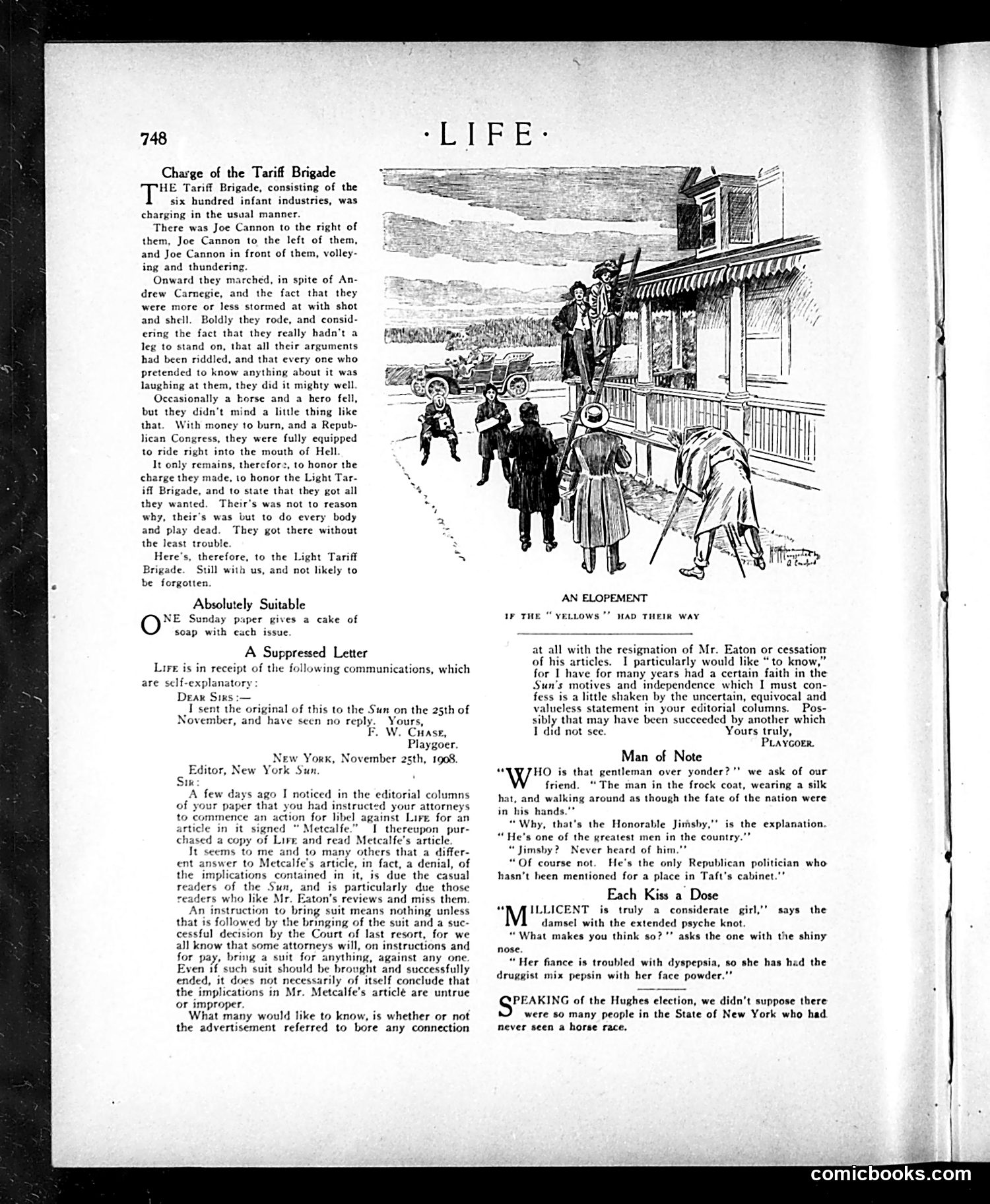
This page satirizes Republican protectionist politics circa 1908. The main cartoon parodies Tennyson's "Charge of the Light Brigade," comparing six hundred "infant industries" seeking tariff protection to a doomed military charge. **Key figures:** - **Joe Cannon** (Speaker of the House) appears three times—depicted as directing the charge - **Andrew Carnegie** represents opposition to high tariffs - The "Tariff Brigade" are industries lobbying Congress for protective duties **The satire's point:** Despite having weak arguments ("hadn't a leg to stand on"), these industries succeed through money and Republican Congressional control, riding "into the mouth of Hell" without consequence. The cartoon mocks their brazen corruption and the GOP's enabling of it. The page also includes letters criticizing the *New York Sun's* handling of a libel suit against *Life*, and brief social commentary pieces typical of the magazine's format.
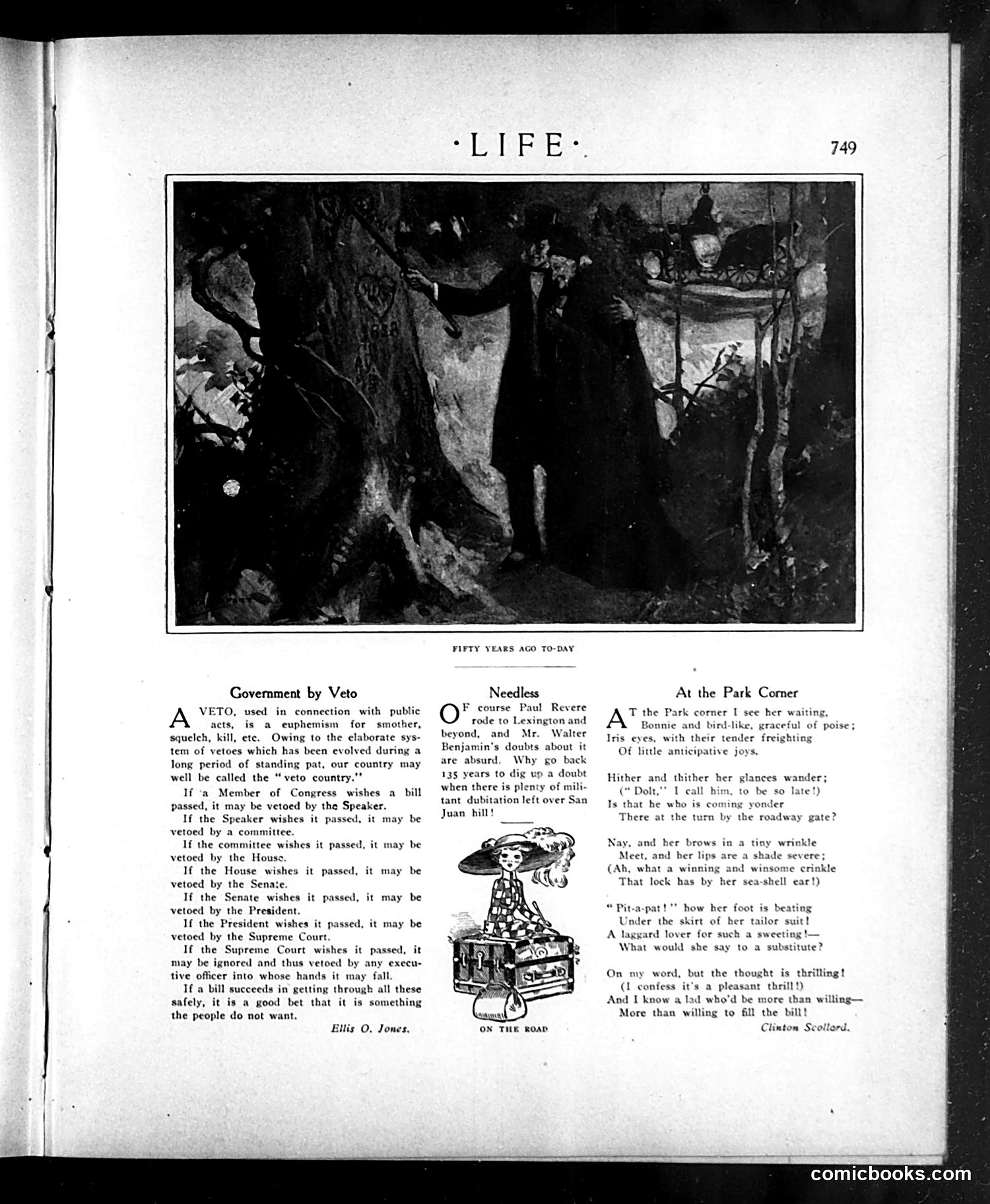
This page contains two distinct pieces of satire: **"Government by Veto"** (left) is a scathing critique of American political gridlock. The author lists the cascade of veto powers—from Congressional members through the Speaker, committees, House, Senate, President, and Supreme Court—demonstrating how legislation can be blocked at multiple levels. The satire's punchline: if a bill somehow survives all these vetoes, it's probably something the public doesn't want anyway. This reflects frustration with a legislative system so encumbered by checks and balances that meaningful action becomes nearly impossible. **"At the Park Corner"** (right) is a romantic poem accompanying a decorative illustration of a woman with an umbrella, depicting a nostalgic romantic encounter. The page's header "Fifty Years Ago To-Day" suggests these pieces commemorate or reference historical events from approximately 1859-1860, though the political critique appears timeless to Life's readership.
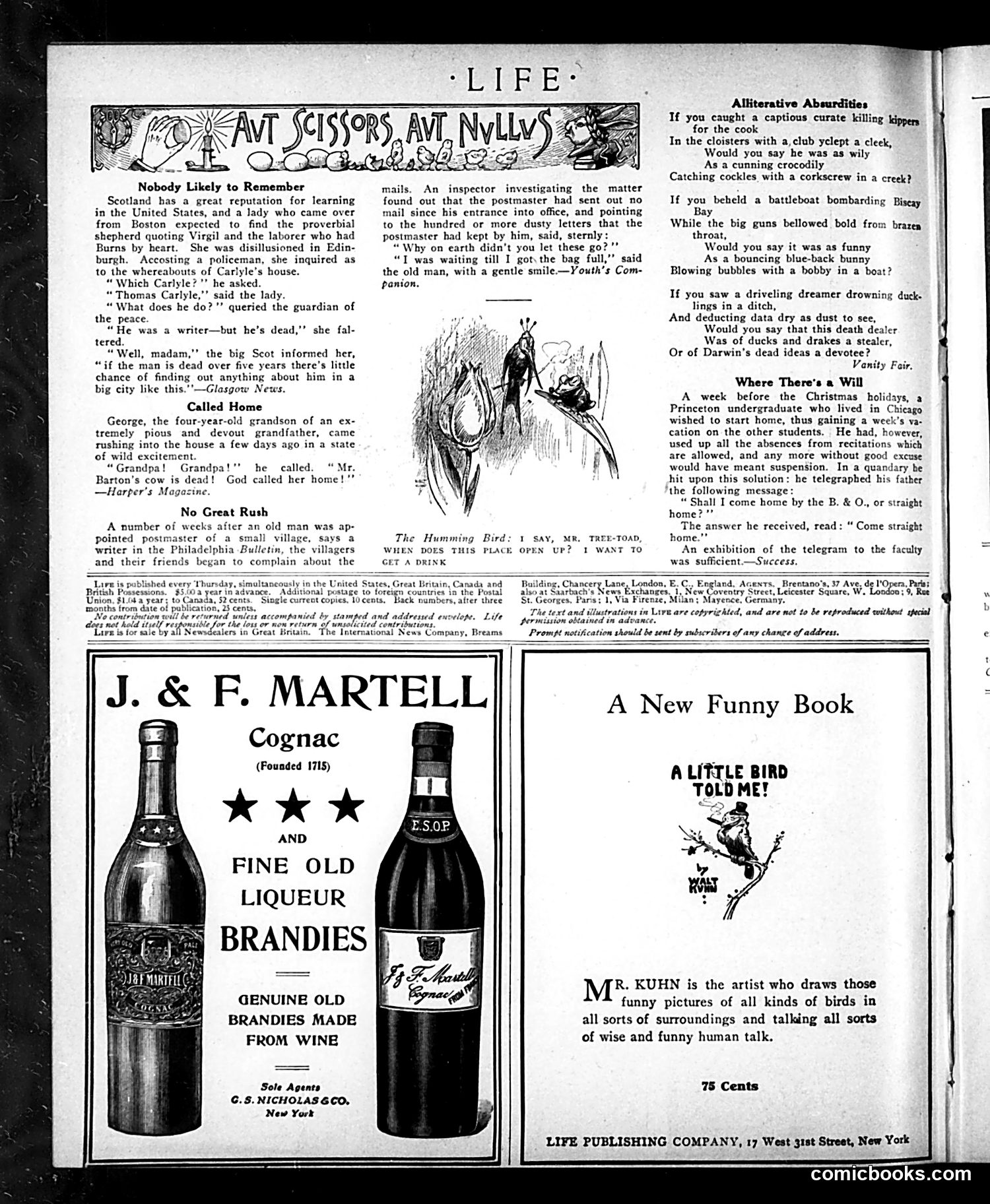
This Life magazine page (early 20th century) contains three humorous anecdotes and one satirical poem: **"Nobody Likely to Remember"**: A Boston woman visiting Edinburgh asks a Scottish policeman about Thomas Carlyle's house. The policeman, unfamiliar with the famous 19th-century writer, dismisses him—satirizing Scottish provincialism despite Scotland's reputation for learning and literary culture. **"Called Home"**: A young boy excitedly reports his grandfather's cow died, using the pious phrase "God called her home"—humor derived from the child innocently applying religious language to animal death. **"No Great Rush"**: A newly-appointed postmaster neglects delivering mail for weeks, waiting until he accumulates a full bag—poking fun at bureaucratic inefficiency and literal-minded thinking. **"Alliterative Absurdities"**: A tongue-twisting poem playing with alliteration (repeated consonant sounds) in increasingly absurd scenarios—pure wordplay humor with no political content. The page is primarily light satirical humor targeting Scottish ignorance, bureaucratic incompetence, and linguistic absurdity—typical Life magazine fare from this era.
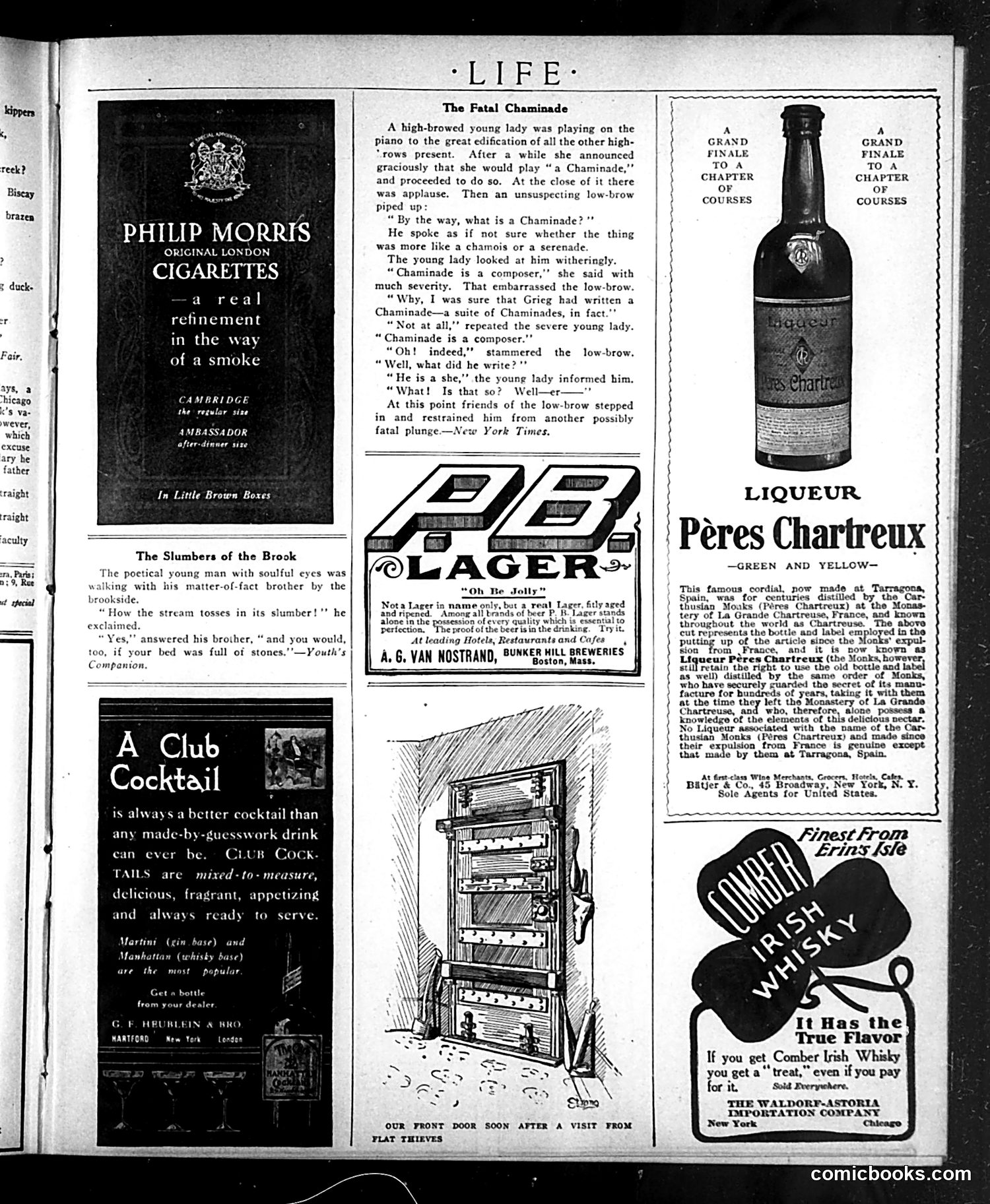
This short humor piece mocks social pretension and musical snobbery. A high-browed young woman plays a piano piece and announces it's a "Chaminade," implying sophistication. When an unsuspecting "low-brow" guest asks what a Chaminade is, she smugly corrects him that it's a composer—not a musical form. The joke escalates when the guest suggests composer Edvard Grieg wrote a "suite of Chaminades," and the woman insists otherwise. The guest then asks "what did he write?"—to which she reveals Chaminade is female ("she"). The humiliation is complete. The satire targets both the pretentious woman (who doesn't realize Grieg actually *did* compose pieces called Chaminades) and the social anxiety of lower-class guests intimidated by cultural markers they don't understand. The piece gently ridicules class-based gatekeeping of musical knowledge.
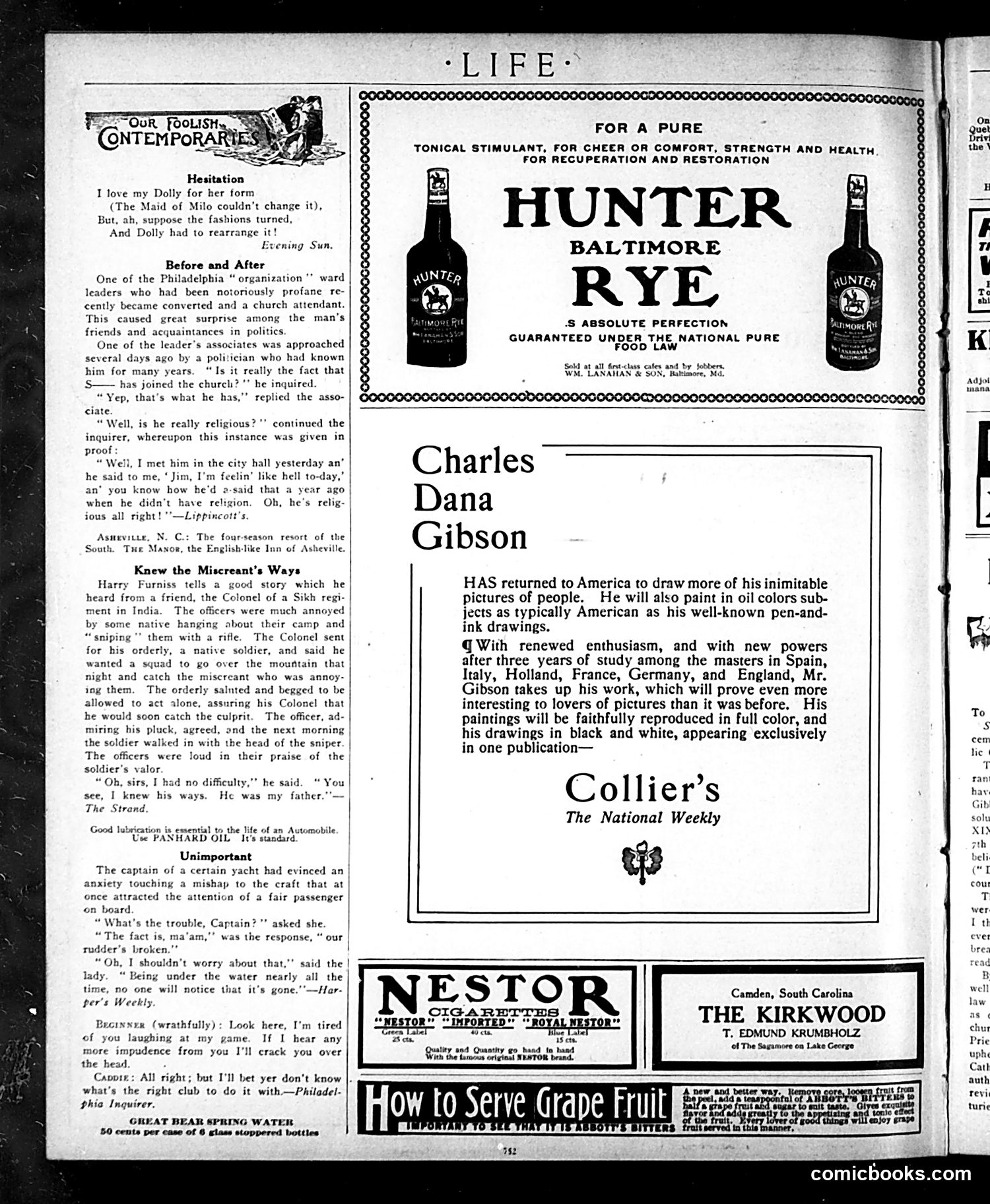
This page is primarily **advertising and announcements** rather than political satire. The main content includes: **Advertisements:** - Hunter Baltimore Rye whiskey ("absolute perfection") - Nestor Cigarettes - The Kirkwood hotel (Camden, South Carolina) - Grape fruit serving instructions **Editorial Content:** The page features several brief humorous anecdotes ("Our Foolish Contemporaries" section) on topics like fashion concerns and a Philadelphia ward leader's sudden religious conversion—presented as ironic social commentary rather than political cartoons. **Notable announcement:** Charles Dana Gibson has returned to America and will contribute drawings exclusively to *Collier's* magazine. Gibson was famous for his pen-and-ink illustrations of "typical" Americans. The satire is genteel and social rather than overtly political—poking fun at human vanity and hypocrisy. This appears to be an early 1900s issue, reflecting Life's role as a general-interest humor and society magazine before it became a photo-news publication.
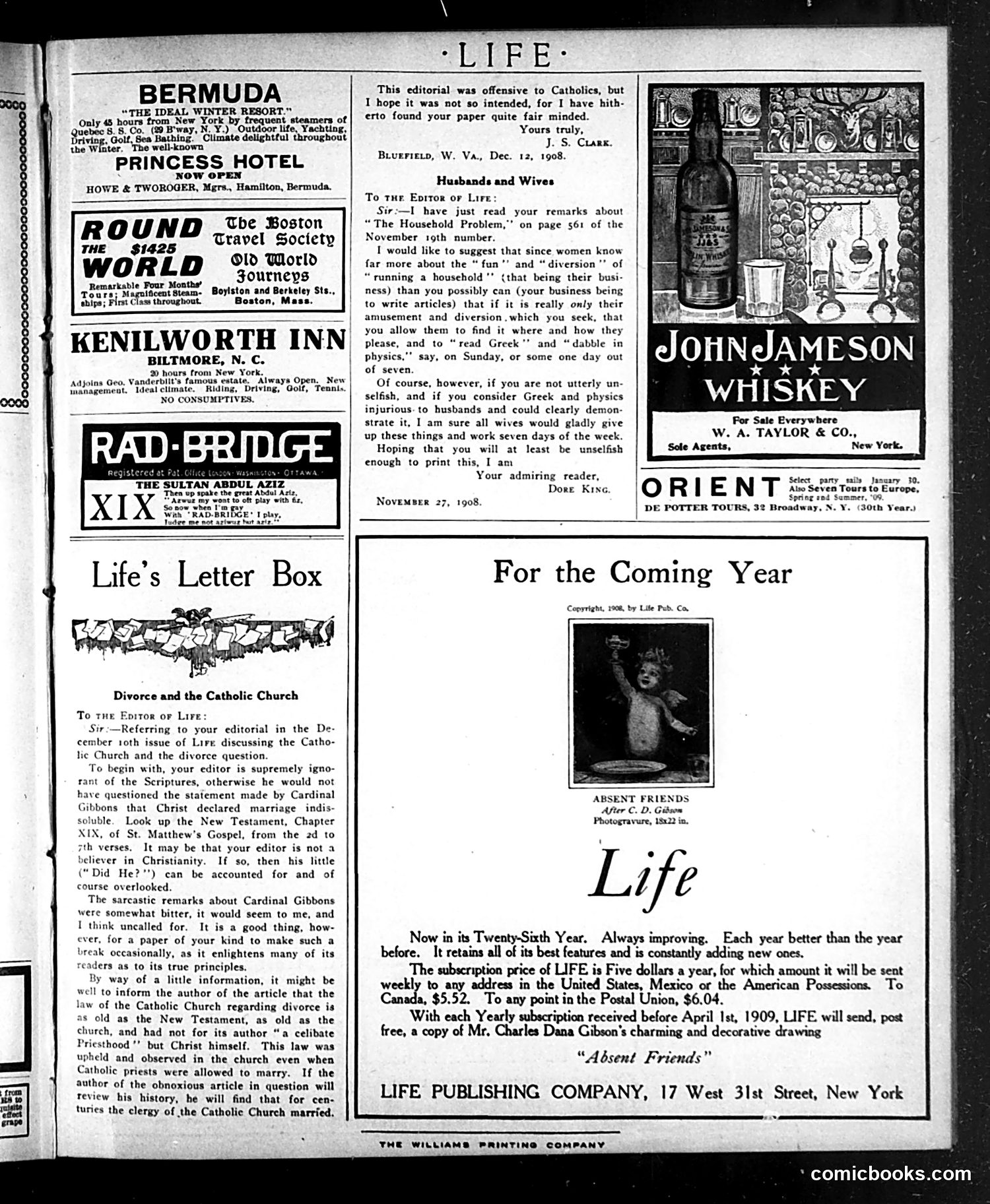
This page is primarily **advertisements and reader letters**, not political satire. The letter section ("Life's Letter Box") contains two substantive reader responses: one defending the Catholic Church's doctrine on indissoluble marriage against a Life editorial, and another—more relevant to modern readers—from "Dore King" challenging Life's patronizing article about "The Household Problem." King's letter sarcastically argues that women, being experts in household management, should be allowed intellectual pursuits (Greek, physics) without husbands' interference. The satire targets Life magazine's own paternalistic assumptions about women's roles, suggesting that if husbands truly valued women's "amusement and diversion," they'd permit such activities—or if they genuinely believed these studies harmful, they should prove it rather than simply forbid them. This reflects early-20th-century debates over women's education and autonomy. The remainder of the page consists of travel and whiskey advertisements typical of the era.
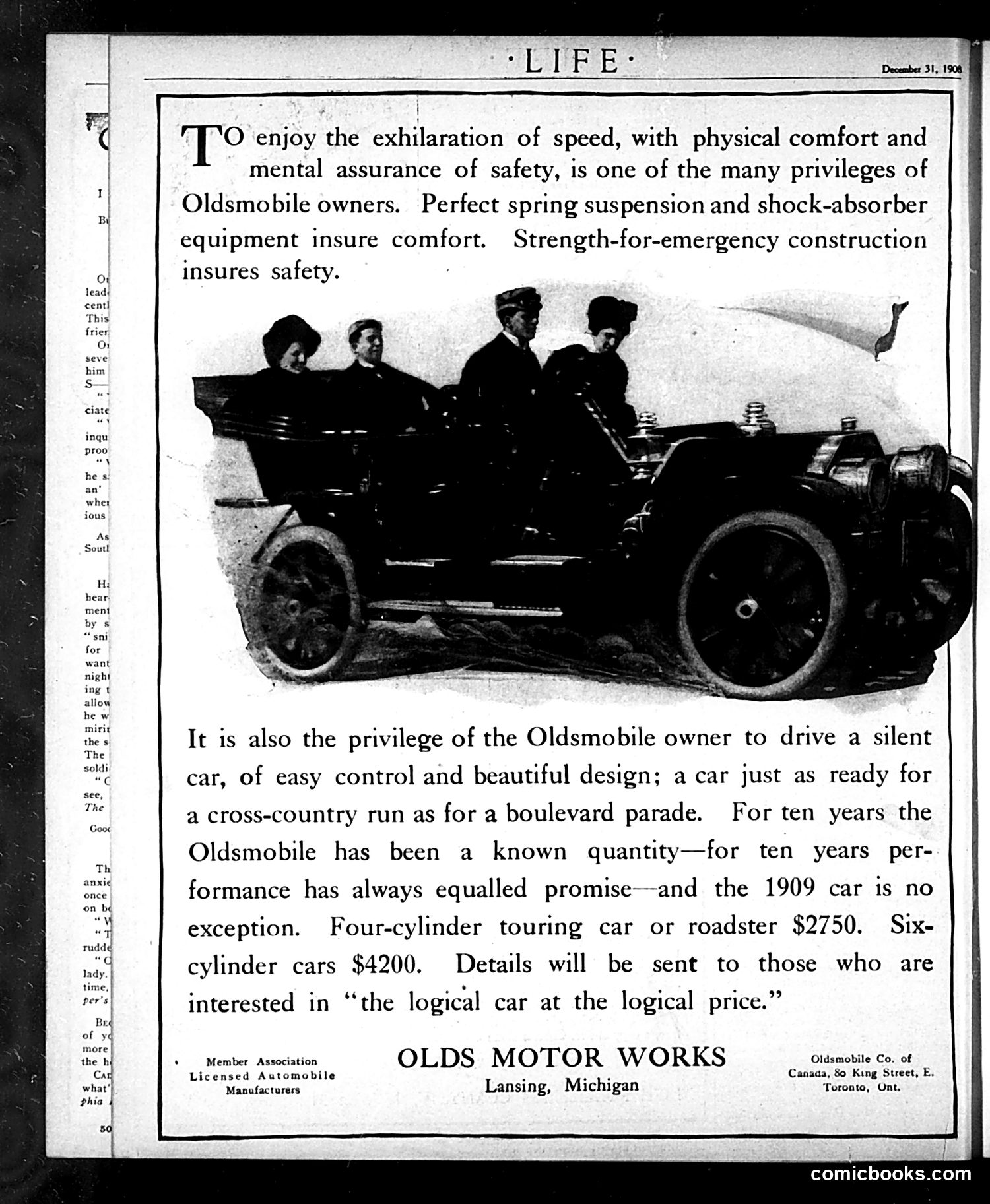
This is **not a cartoon or satire** — it's a straightforward automobile advertisement from *Life* magazine (December 31, 1908). The page promotes the 1909 Oldsmobile, emphasizing luxury features appealing to early-20th-century car buyers: speed, comfort, safety, silent operation, and elegant design. The image shows four well-dressed passengers in an open touring car, representing the aspirational lifestyle the manufacturer marketed. The ad emphasizes reliability ("for ten years performance has always equalled promise") and positions the car as versatile—suitable for both cross-country travel and formal "boulevard parade" drives. Prices ($2,750 for four-cylinder; $4,200 for six-cylinder) targeted the wealthy. This reflects the era when automobiles were luxury goods and *Life* (then a humor/general-interest magazine) carried premium advertising alongside satirical content.
I can see this is a mostly blank page from Life magazine dated December 31, 1908 (visible in top left corner). The left margin contains partial text fragments mentioning "and," "of," "ber," "ion," "ent for the," "ber-," "no," "Six-," and "are," along with what appears to be an address reference to "Street, E." The page itself is predominantly white/blank space with no visible cartoon or illustration content in the main area. This appears to be either a blank page, an advertisement page, or a dividing page between sections. Without legible content or visible imagery, I cannot identify specific figures, political references, or satirical commentary that would typically be present in Life magazine's cartoons.