
Life, 1908-12-31 · page 4 of 21
Life — December 31, 1908 — page 4: what you’re looking at
What you’re looking at
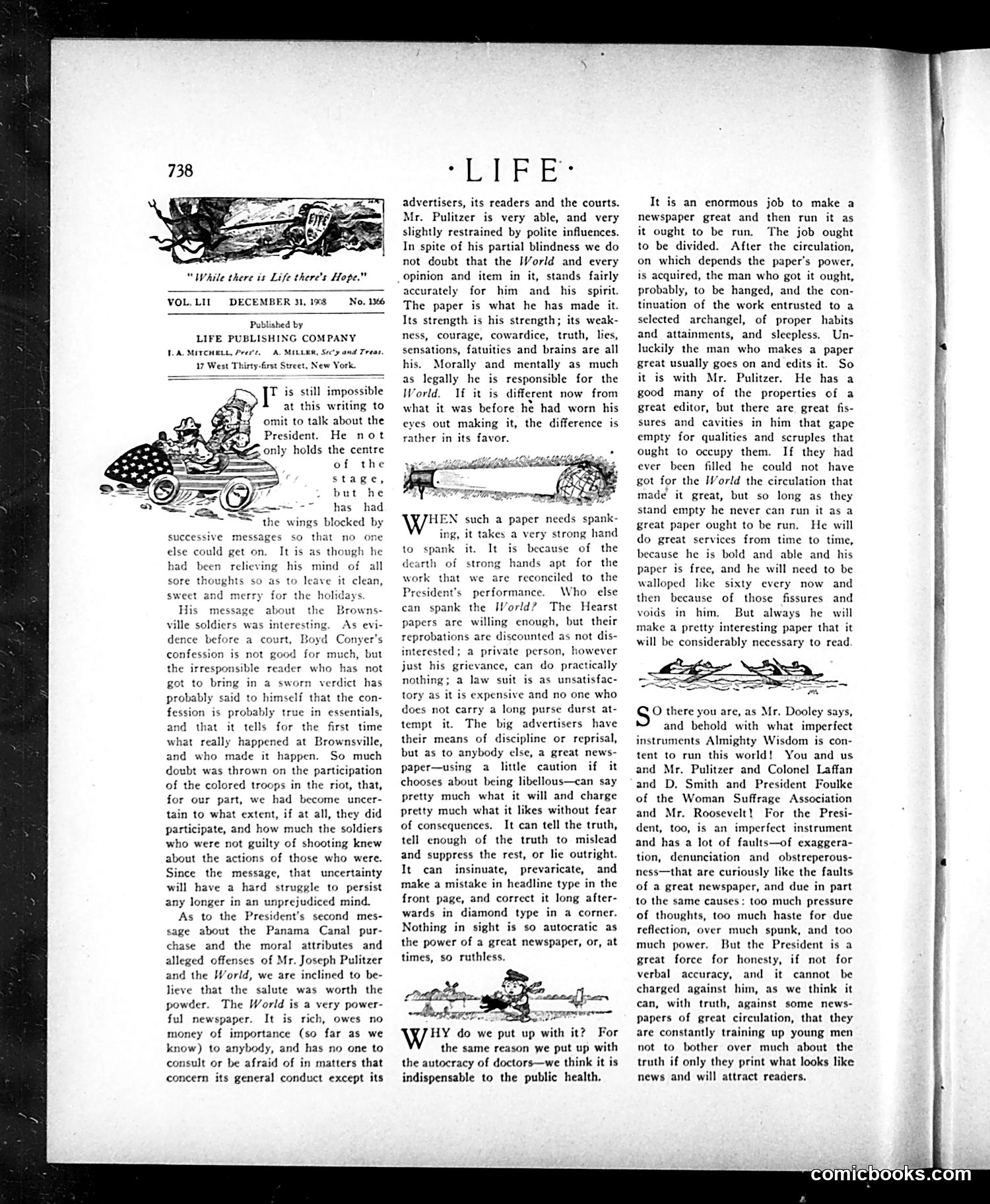
The page is primarily **text-based editorial content** rather than political cartoons. The header "While there is Life there's Hope" frames a discussion about newspaper management and editorial responsibility. The editorial defends Joseph Pulitzer and his *World* newspaper against criticism, praising Pulitzer's moral leadership despite acknowledging the paper's occasional sensationalism. It discusses how strong editorial hands are needed to manage major newspapers responsibly. The piece also references **President Roosevelt**, suggesting debates about executive power and press accountability were contemporary concerns. **Small decorative illustrations** (carriages, landscapes) appear but are ornamental rather than satirical commentary. The overall tone critiques those who attack newspapers while simultaneously acknowledging that even great papers require constant vigilance against bias and sensationalism.
📄 Transcribed text from this page (OCR, searchable)
Machine-transcribed from the original scan — historical spelling and the odd misread are preserved.
“While there is Life there's Hope.” VOL. LIL DECEMBER 31, 198 — No. 1866 Published by LIFE LISHING COMPANY La Mir A. MILLER, Secty and Treas. 17 West Thirty-first Street, New York. LL Pres'e. T is still impossible at this writing to omit to talk about the President. He not only holds the centre of the stage, but he has had the wings blocked by successive messages so that no else could get on. It is as though he had been relieving his mind of all sore thoughts so as to leave it clean, for the holidays. sweet and merry His message about the Browns- ville soldiers was interesting. As evi- dence before a court, Boyd Conyer’s confession is not good for much, but the irresponsible reader who has not got to bring in a sworn verdict has probably said to himself that the con- fession is probably true in essentials, and that it tells for the first time what really happened at Brownsville, and who made it happen. So much doubt was thrown on the participation of the colored troops in the riot, that, for our part, we had become uncer- tain to what extent, if at all, they did participate, and how much the soldiers who were not guilty of shooting knew about the actions of those who were. Since the message, that uncertainty will have a hard struggle to persist any longer in an unprejudiced mind. As to the President’s second mes- sage about the Panama Canal pur- chase and the moral attributes and alleged offenses of Mr. Joseph Pulitzer and the World, we are inclined to be- lieve that the salute was worth the powder. The World is a very power- ful newspaper. It is rich, owes no money of importance (so far as we know) to anybody, and has no one to consult or be afraid of in matters that concern its general conduct except its oa bd ba eel advertisers, its readers and the courts. Mr. Pulitzer is very able, and very slightly restrained by polite influences. In spite of his partial blindness we do not doubt that the World and every opinion and item in it, stands fairly accurately for him and his spirit. The paper is what he has made it. Its strength is his strength; its weak- ness, courage, cowardice, truth, lies, sensations, fatuities and brains are all his. Morally and mentally as much as legally he is responsible for the World. If it is different now from what it was before he had worn his eyes out making it, the difference is rather in its favor. HEN such a paper needs spank- ing, it takes a very strong hand to spank it. It is because of the dearth of strong hands apt for the work that we are reconciled to the President’s performance. Who else can spank the World? The Hearst papers are willing enough, but their reprobations are discounted as not dis- interested; a private person, however just his grievance, can do practically nothing; a law suit is as unsatisfac- tory as it is expensive and no one who does not carry a long purse durst at- tempt it. The big advertisers have their means of discipline or reprisal, but as to anybody else, a great news- paper—using a little caution if it chooses about being libellous—can say pretty much what it will and charge pretty much what it likes without fear of consequences. It can tell the truth, tell enough of the truth to mislead and suppress the rest, or lie outright. It can insinuate, prevaricate, and make a mistake in headline type in the front page, and correct it long after- wards in diamond type in a corner. Nothing in sight is so autocratic as the power of a great newspaper, or, at times, so ruthless. W the autocracy of doctors—we think it is indispensable to the public health. the same reason we put up with It is an enormous job to make a newspaper great and then run it as it ought to be run. The job ought to be divided. After the circulation, on which depends the paper’s power, is acquired, the man who got it ought, probably, to be hanged, and the con- tinuation of the work entrusted to a selected archangel, of proper habits and attainments, and sleepless. Un- luckily the man who makes a paper great usually goes on and edits it. So it is with Mr. Pulitzer. He has a good many of the properties of a great editor, but there are great fis- sures and cavities in him that gape empty for qualities and scruples that ought to occupy them. If they had ever been filled he could not have got for the World the circulation that made it great, but so long as they stand empty he never can run it as a great paper ought to be run. He will do great services from time to time, because he is bold and able and his paper is free, and he will need to be walloped like sixty every now and then because of those fissures and voids in him. But always he will make a pretty interesting paper that it will be considerably necessary to read. Se 5° there you are, as Mr. Dooley says, and behold with what imperfect instruments Almighty Wisdom is con- tent to run this world! You and us and Mr. Pulitzer and Colonel Laffan and D. Smith and President Foulke of the Woman Suffrage Association and Mr. Roosevelt! For the Pres dent, too, is an imperfect instrument and has a lot of faults—of exaggera- tion, denunciation and obstreperous- ness—that are curiously like the faults of a great newspaper, and due in part to the same causes: too much pressure of thoughts, too much haste for due reflection, over much spunk, and too much power. But the President is a great force for honesty, if not for verbal accuracy, and it cannot be charged against him, we think it can, with truth, against some news- papers of great circulation, that they are constantly training up young men not to bother over much about the truth if only they print what looks like news and will attract readers.