
Life, 1908-12-31 · page 13 of 21
Life — December 31, 1908 — page 13: what you’re looking at
What you’re looking at
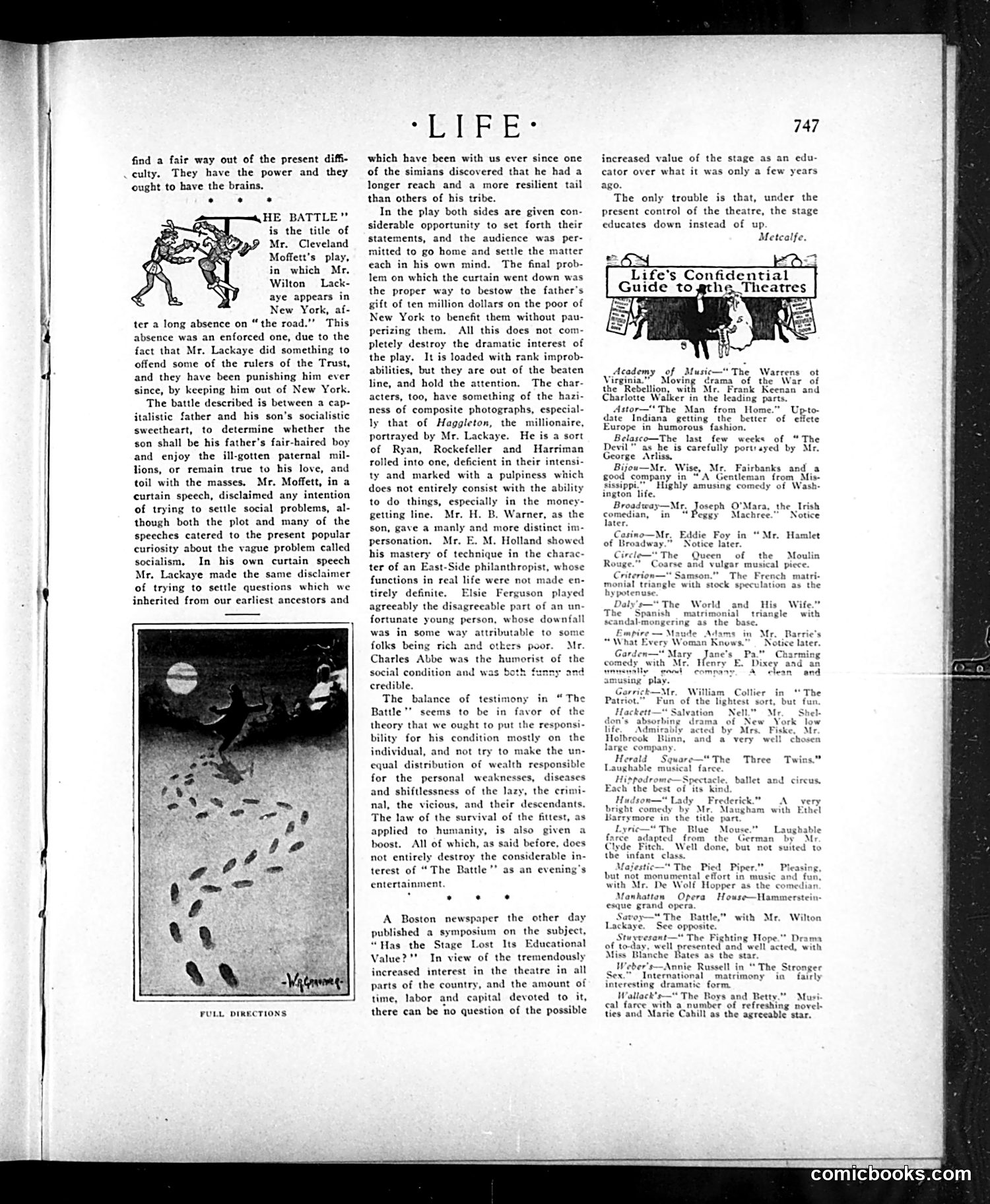
This political cartoon satirizes theatrical staging and direction. The image shows a director or authority figure appearing to orchestrate or control a scene—suggested by the gestural pose and the caption "FULL DIRECTIONS." The accompanying text discusses Mr. Cleveland Moffett's play "The Battle," which examines social problems and wealth distribution. The cartoon appears to critique how the play's message is being *directed*—suggesting that moral or social lessons are being artificially controlled or manipulated for audience consumption rather than emerging organically. The satire likely targets how theatrical productions stage social commentary in a calculated way for popular appeal, rather than presenting genuine critique. The cartoonist (signature appears to be "Cesare") questions whether such "directed" social commentary is authentic or merely theatrical performance.
📄 Transcribed text from this page (OCR, searchable)
Machine-transcribed from the original scan — historical spelling and the odd misread are preserved.
find a fair way out of the present diffi- culty. They have the power and they ought to have the brains. er pepune HE BATTLE" is the title of Mr. Cleveland Moffett's play, in which Mr. Wilton Lack- aye appears in New York, af- ter a long absence on “the road."" This absence was an enforced one, due to the fact that Mr. Lackaye did something to offend some of the rulers of the Trust, and they have been punishing him ever since, by keeping him out of New York. The battle described is between a cap- italistic father and his son's socialistic sweetheart, to determine whether the son shall be his father’s fair-haired boy and enjoy the ill-gotten paternal mil- lions, or remain true to his love, and toil with the masses. Mr. Moffett, in a curtain speech, disclaimed any intention of trying to settle social problems, al- though both the plot and many of the speeches catered to the present popular curiosity about the vague problem called socialism, In his own curtain speech Mr. Lackaye made the same disclaimer of trying to settle questions which we inherited from our earliest ancestors and FULL DIRECTIONS: |i It ei4e 2 which have been with us ever since one of the simians discovered that he had a longer reach and a more resilient tail than others of his tribe. In the play both sides are given con- siderable opportunity to set forth their statements, and the audience was per- mitted to go home and settle the matter each in his own mind. The final prob- lem on which the curtain went down was the proper way to bestow the father’s gift of ten million dollars on the poor of New York to benefit them without pau- perizing them. All this does not com- pletely destroy the dramatic interest of the play. It is loaded with rank improb- abilities, but they are out of the beaten line, and hold the attention. The char- acters, too, have something of the hazi- ness of composite photographs, especial- ly that of Haggleton, the millionaire, portrayed by Mr. Lackaye. He is a sort of Ryan, Rockefeller and Harriman rolled into one, deficient in their intensi- ty and marked with a pulpiness which does not entirely consist with the ability to do things, especially in the money- getting line. Mr. H. B. Warner, as the son, gave a manly and more distinct im personation, Mr. E. M. Holland showe his mastery of technique in the charac- ter of an East-Side philanthropist, whose functions in real life were not made en- tirely definite. Elsie Ferguson played agreeably the disagreeable part of an un- fortunate young person, whose downfall was in some way attributabl folks being rich and otkers poor. Mr. Charles Abbe was the humorist of the social condition and was both funny and credible. The balance of testimony in “The Battle’ seems to be in favor of the theory that we ought to put the responsi- bility for his condition mostly on the individual, and not try to make the un- equal distribution of wealth responsible for the personal weaknesses, diseases and shiftlessness of the lazy, the crimi- nal, the vicious, and their descendants. The law of the survival of the fittest, as applied to humanity, is also given a boost. All of which, as said before, does not entirely destroy the considerable in- terest of “The Battle’ as an evening's entertainment to some . ee 6 A Boston newspaper the other d: published a symposium on the subject, “Has the Stage Lost Its Educational Value?" In view of the tremendously increased interest in the theatre in all parts of the country, and the amount of time, labor and capital devoted to it, there can be no question of the possible 747 increased value of the stage as an edu- cator over what it was only a few years ago. The only trouble is that, under the present control of the theatre, the stage educates down instead of up Metcalfe. Life's Confidential Guide to gth atres Academy of Music—" The Warrens ot Virginia.” Moving ¢rama of the War of the Rebellion, with Mr. Frank Keenan and Charlotte Walker in the leading parts. Astor—* The Man from Home.” date Indiana getting the bette Europe in humorous fashion. Belasco—The last few weeks of “The Devil” as he is carefully portrayed by Mr. George Arliss. Bijou—Mr. Wise, Mr. Fairbanks and a sood company in “'A Gentleman from Mis- sippi.” Highly amusing comedy of Wash- ington life. Broa. is oseot O'Mara, the Trish eggy Machree.” Notice comedian, in later. no—Mr, Eadie Foy in “Mr. Hamlet Notice later. Queen of the Moulin Coarse and vulgar musical piece The Frenc s—" The World and His Wife.” Spanish © matrimonial triangle» with tcandaPmongering as the base. — Maude Adams in Mr. Barrie's ery Woman Know Notice later. y Jane's Pa.” Charming weary E Biney ond ok Sa ver! le using play. Gorrick—Mr. William Collier in “The Patriot.” Fun of the lightest sort, but fun. Hackett—“ Sal Nell.” Mr. | Shel lon’s absorbing of New York low life.” Admirably Mrs. Fiske, Mr Holbrook Blinn, a very we The Three Twins.” able musical farce Hirpodrome—Spectacle, ballet and circus, Each the best of its k Hudson—" Lady Fre A syery bright comedy by Mr 2 with Ethel Barrymore in the title part Lyri tue Mou Laughable farce the German by Mr Clyde Well done, but not suited to the infant class. Majestic—* The Pied Piper.” easing, not m Mr. De Wolf Hoppe e € Manhatten Opera House—Hamo esque grand opera Savoy—“ The Rattle," with Mr. Wilton Lackaye. See opposite. Stuvvesant—“ The Fighting Hope.” Drama of ell presented and well acted, with Miss Blanche Rates as the star _ Weder's—Annie Russell in “ The Stronger Sex.” International matrimony in fairly interesting dramatic form Wallack’s—" The Boys and Betty." Musi cal farce with a_number of refreshing novel- ties and Marie Cahill as the agreeable star. comicbooks.com