
Life, 1908-12-31 · page 12 of 21
Life — December 31, 1908 — page 12: what you’re looking at
What you’re looking at
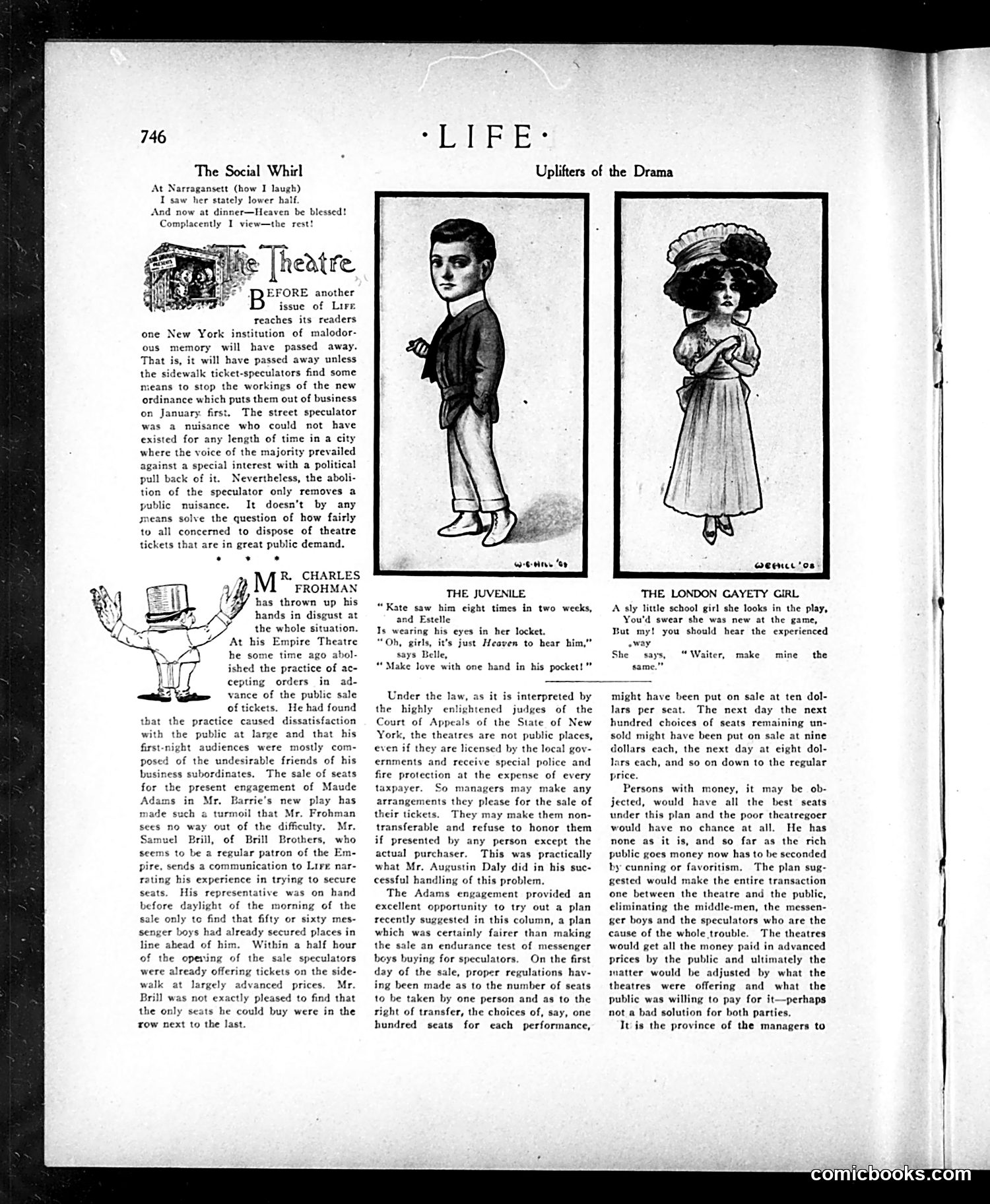
This page discusses theatre ticket speculation and scalping—a major public nuisance in early 20th-century New York. The text criticizes sidewalk ticket speculators who bought up seats and resold them at inflated prices, putting legitimate theatregoers at disadvantage. The two illustrated figures ("The Juvenile" and "The London Gaiety Girl") appear to be character types from popular plays of the era, likely referenced as examples of shows affected by speculation. The main article advocates for a regulatory solution: requiring tickets be non-transferable and limiting seat purchases per person. The text argues this would protect both theatre revenue and the public's access to affordable entertainment—a consumer protection issue rather than partisan politics.
📄 Transcribed text from this page (OCR, searchable)
Machine-transcribed from the original scan — historical spelling and the odd misread are preserved.
746 The Social Whirl At Narragansett (how I laugh) I saw her stately lower half. And now at dinner—Heaven be blessed! Complacently I view—the rest! fe [heatre ” JQEFORE another issue of Lire reaches its readers one New York institution of malodor- ous memory will have passed away. That will have passed away unless the sidewalk ticket-speculators find some nieans to stop the workings of the new ordinance which puts them out of business on January first. The street speculator was a nuisance who could not have existed for any length of time in a city where the voice of the majority prevailed against a special interest with a political pull back of it. Nevertheless, the aboli- tion of the speculator only removes a public nuisance. It doesn’t by any means solve the question of how fairly to all concerned to dispose of theatre tickets that are in great public demand. o + 8 R. CHARLES FROHMAN has thrown up his hands in disgust at the whole situation. At his Empire Theatre he some time ago abol- ished the practice of ac- cepting orders in ad- vance of the public sale of tickets. He had found that the practice caused dissatisfaction with the public at large and that his first-night audiences were mostly com- posed of the undesirable friends of his business subordinates, The sale of seats for the present engagement of Maude Adams in Mr. Barrie's new play has made such a turmoil that Mr. Frohman sees no way out of the difficulty, Mr. uel Brill, of Brill Brothers, who seems to be a regular patron of the Em- pire, sends a communication to Live nar- rating his experience in trying to secure seats. His representative was on hand before daylight of the morning of the sale only to find that fifty or sixty mes- senger boys had already secured places in line abead of him. Within a half hour of the opening of the sale speculators were already offering tickets on the side- walk at largely advanced prices. Mr. Brill was not exactly pleased to find that the only seats he could buy were in the row next to the last. OIL AES, 2 Uplifters of the Drama Oren “Oe THE JUVENILE “Kate saw him eight times in two weeks, and Estelle Is wearing his eyes in her locket. “Oh, girls, it's just Heaven to hear him,” says Belle, Make love with one hand in his pocket! Under the law, as it is interpreted by the highly enlightened judges of the Court of Appeals of the State of New York, the theatres are not public places, even if they are licensed by the local gov- ernments and receive special police and fire protection at the expense of every taxpayer. managers may make any arrangements they please for the sale of their tickets. They may make them non- transferable and refuse to honor them if presented by any person except the actual purchaser. This was practically what Mr. Augustin Daly did in his suc- cessful handling of this problem. The Adams engagement provided an excellent opportunity to try out a plan recently suggested in this column, a plan which was certainly fairer than making the sale an endurance test of messenger boys buying for speculators. On the first day of the sale, proper regulations hav- ing been made as to the number of seats to be taken by one person and as to the right of transfer, the choices of, say, one hundred seats for each performance, Seeur’os THE LONDON GAYETY GIRL A sly little school girl she looks in the play, You'd swear she was new at the game, But my! you should hear the experienced sway She says, “Waiter, make mine the same.” might have been put on sale at ten dol- lars per seat. The next day the next hundred choices of seats remaining un- sold might have been put on sale at nine dollars each, the next day at eight dol- lars each, and so on down to the regular price. Persons with money, it may be ob- jected, would have all the best seats under this plan and the poor theatregoer would have no chance at all. He has none as it is, and so far as the rich public goes money now has to be seconded by cunning or favoritism. The plan sug- gested would make the entire transaction one between the theatre and the public, climinating the middle-men, the messen- ger boys and the speculators who are the cause of the whole trouble. The theatres would get all the money paid in advanced prices by the public and ultimately the matter would be adjusted by what the theatres were offering and what the public was willing to pay for it—perhaps not a bad solution for both parties. Iv is the province of the managers to Kf