
A complete issue · 20 pages · 1908
Life — December 24, 1908
I can see this is a Life magazine page dated December 24, 1909, with the magazine's distinctive "Life" masthead visible in the upper left. However, the image quality is extremely poor—heavily darkened and degraded—making it impossible to discern specific details about any cartoon(s), figures, or caricatures that may be present. The content appears to be an illustration or artwork of some kind, but I cannot reliably identify political figures, social references, or satirical intent from this reproduction. To accurately explain the meaning and context for a modern reader would require either a clearer image or access to accompanying text that's legible in this scan. I cannot responsibly guess at specific identities or political references without clear visual evidence.
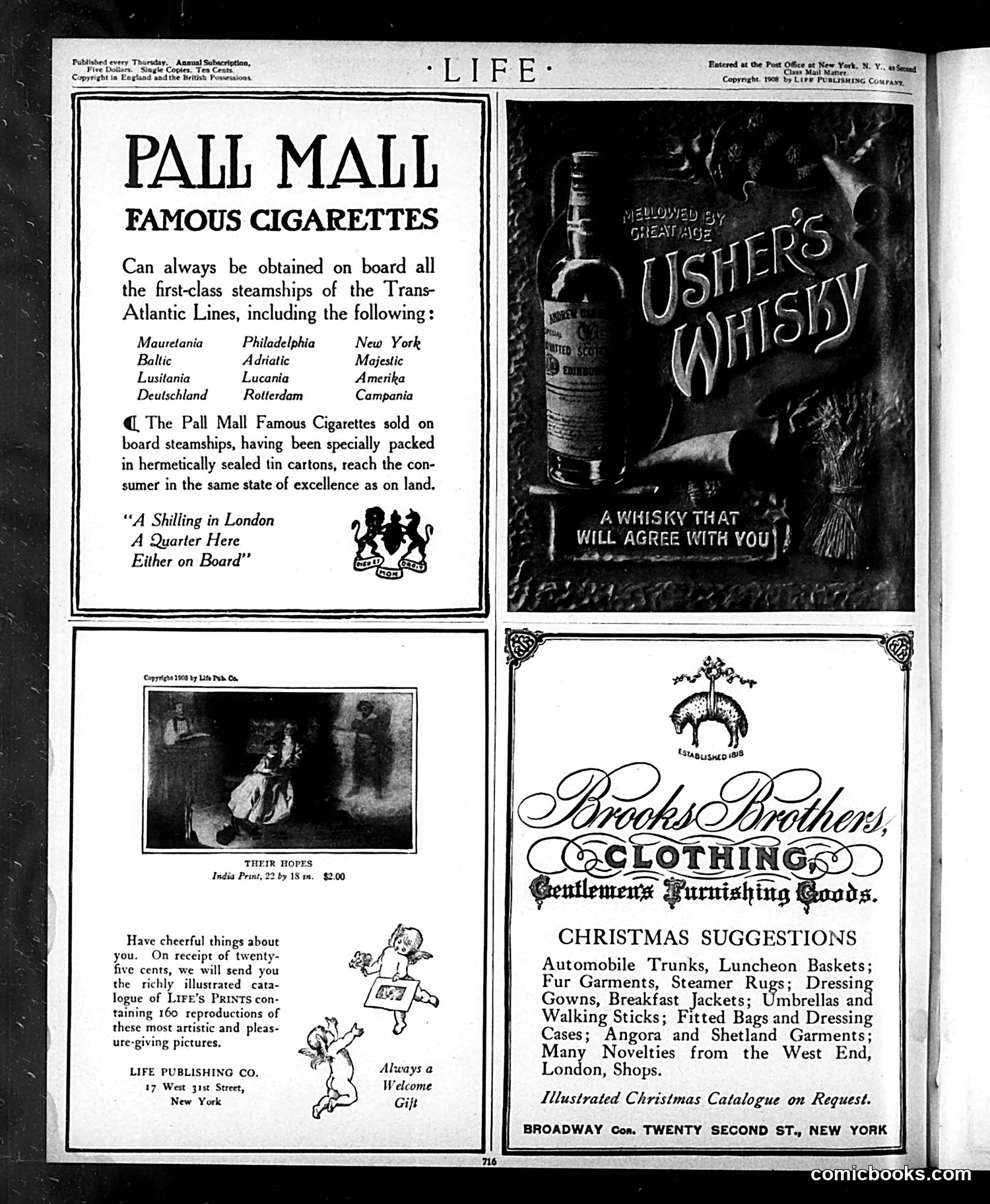
This page is primarily **advertising rather than satirical content**. It contains four commercial advertisements: 1. **Pall Mall Cigarettes** — promoting availability on Trans-Atlantic steamships 2. **Usher's Whisky** — a Scottish whisky brand advertisement 3. **Life Publishing Company** — promoting an illustrated art print catalog ("Their Hopes," priced at $2.00) 4. **Brooks Brothers** — Christmas gift suggestions for clothing and accessories There are no political cartoons or satirical commentary visible. The small illustrations accompanying the Life Publishing and Brooks Brothers ads are decorative rather than editorial. This appears to be a standard advertising page from an early 20th-century magazine, typical of how publications subsidized content through paid advertisements.
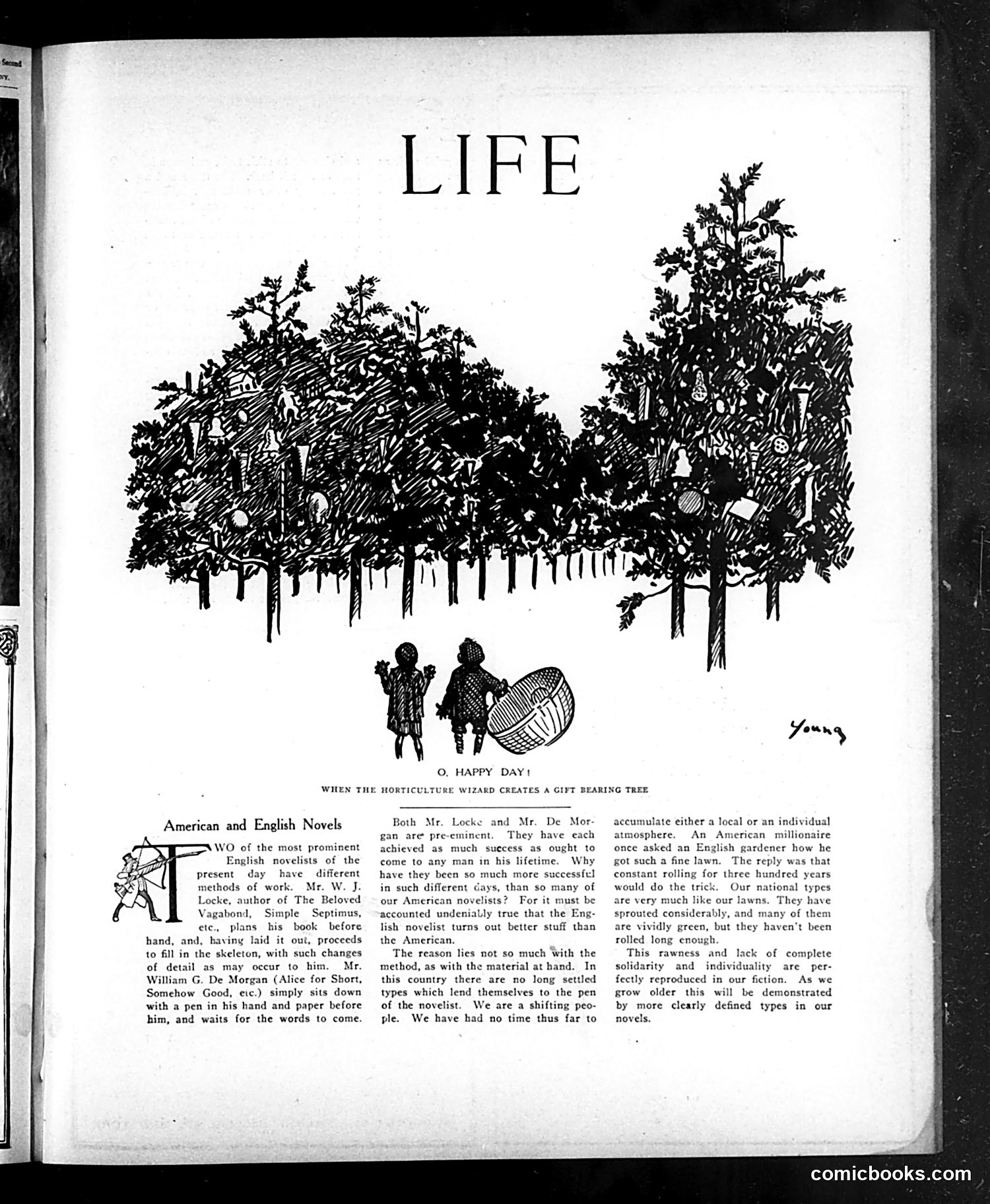
The page features an illustration titled "O Happy Day! When the Horticulture Wizard Creates a Gift Bearing Tree" showing two figures beneath a fantastical tree—likely satirizing unrealistic expectations about solving social problems through simple means. The accompanying article discusses two prominent English novelists of the present day: W.J. Locke (author of *The Beloved Vagabond*) and William De Morgan (*Alice for Short, Somehow Good*, etc.). The text compares English and American novel-writing methods, arguing that English authors produce superior work because they work from well-established literary traditions, while American writers lack this foundation. The satire appears to mock the American literary establishment's eagerness to adopt English methods as a quick fix—much like the "gift-bearing tree" fantasy above.
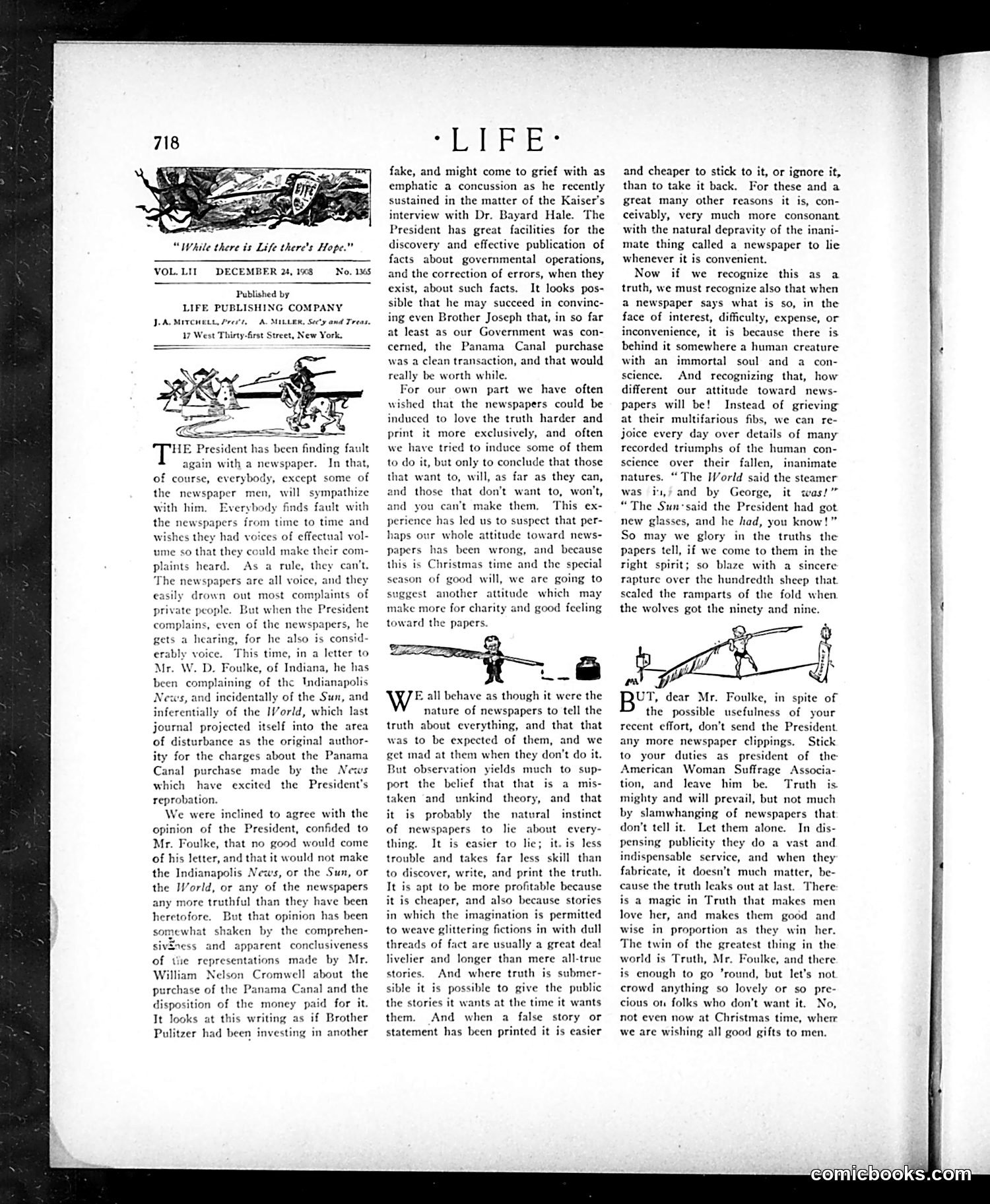
This December 24, 1908 editorial addresses tensions between President Theodore Roosevelt and American newspapers over truthfulness in reporting. The text criticizes newspapers for sometimes prioritizing sensational stories over accuracy, while defending their essential role in exposing government corruption (specifically referencing the Panama Canal controversy). The small cartoons appear to illustrate the tension humorously—figures at bottom left seem to depict the clash between press and authority. The editorial argues that despite newspapers' flaws, truth-telling remains their moral duty, especially during the Christmas season. It's a plea for journalistic integrity rather than profitable fiction, framed as a holiday moral lesson about valuing honesty in public discourse.
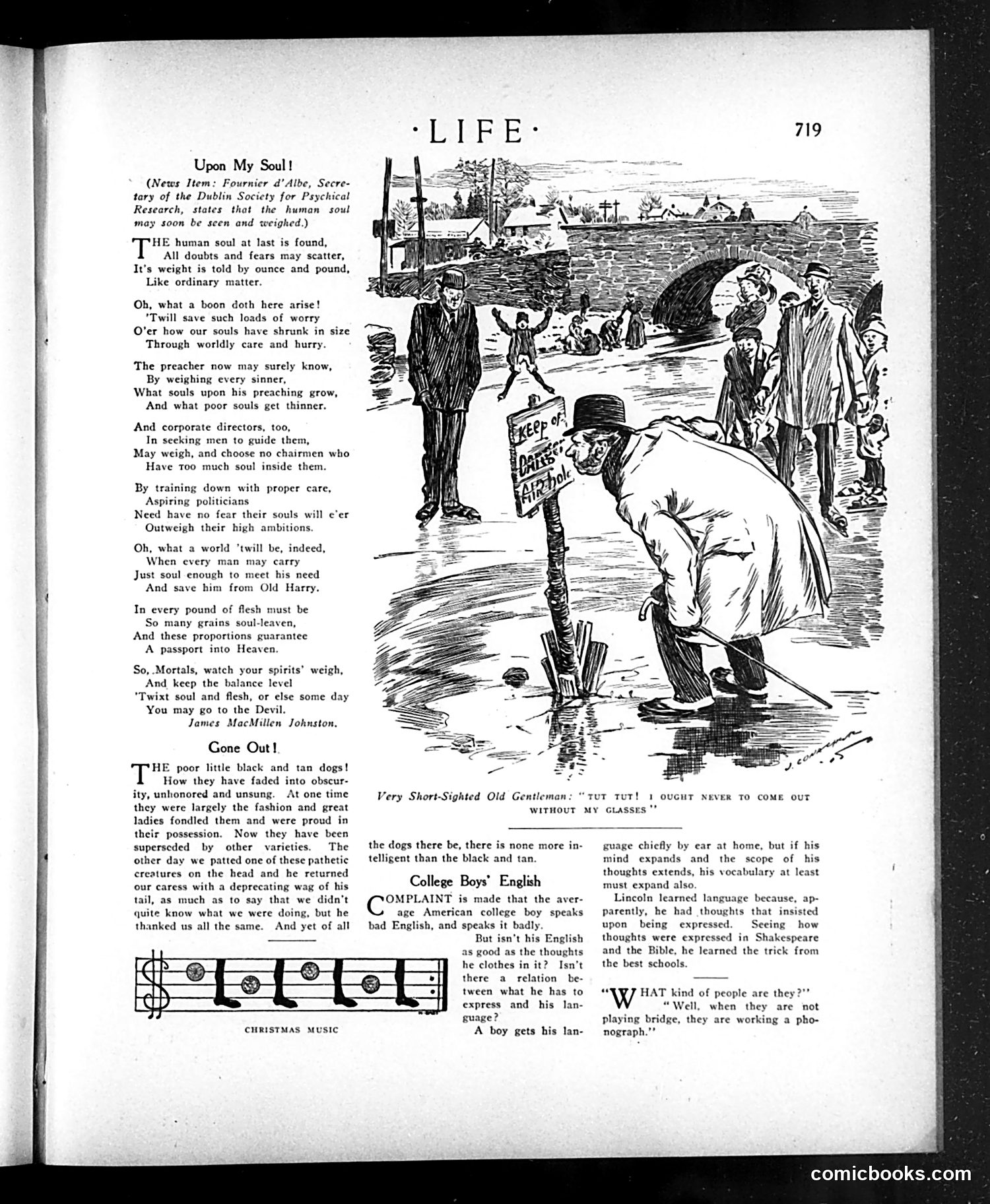
The main cartoon depicts a scene at what appears to be a beach or seaside, with a man in formal dress examining something on the ground using a magnifying glass, while other figures watch. The caption reads: "Very Short-Sighted Old Gentleman: 'TUT TUT! I OUGHT NEVER TO COME OUT WITHOUT MY GLASSES'" **The Satire:** The joke plays on the gentleman's poor eyesight—he's so nearsighted that he requires glasses to see properly, yet he's examining something extremely close to the ground, suggesting his vision problems are severe enough to be comical. The page also includes poems ("Upon My Soul" and "Gone Out!") and an article on "College Boys' English" critiquing American youth's speech patterns. The cartoon's humor relies on visual irony about human limitations rather than specific political commentary.
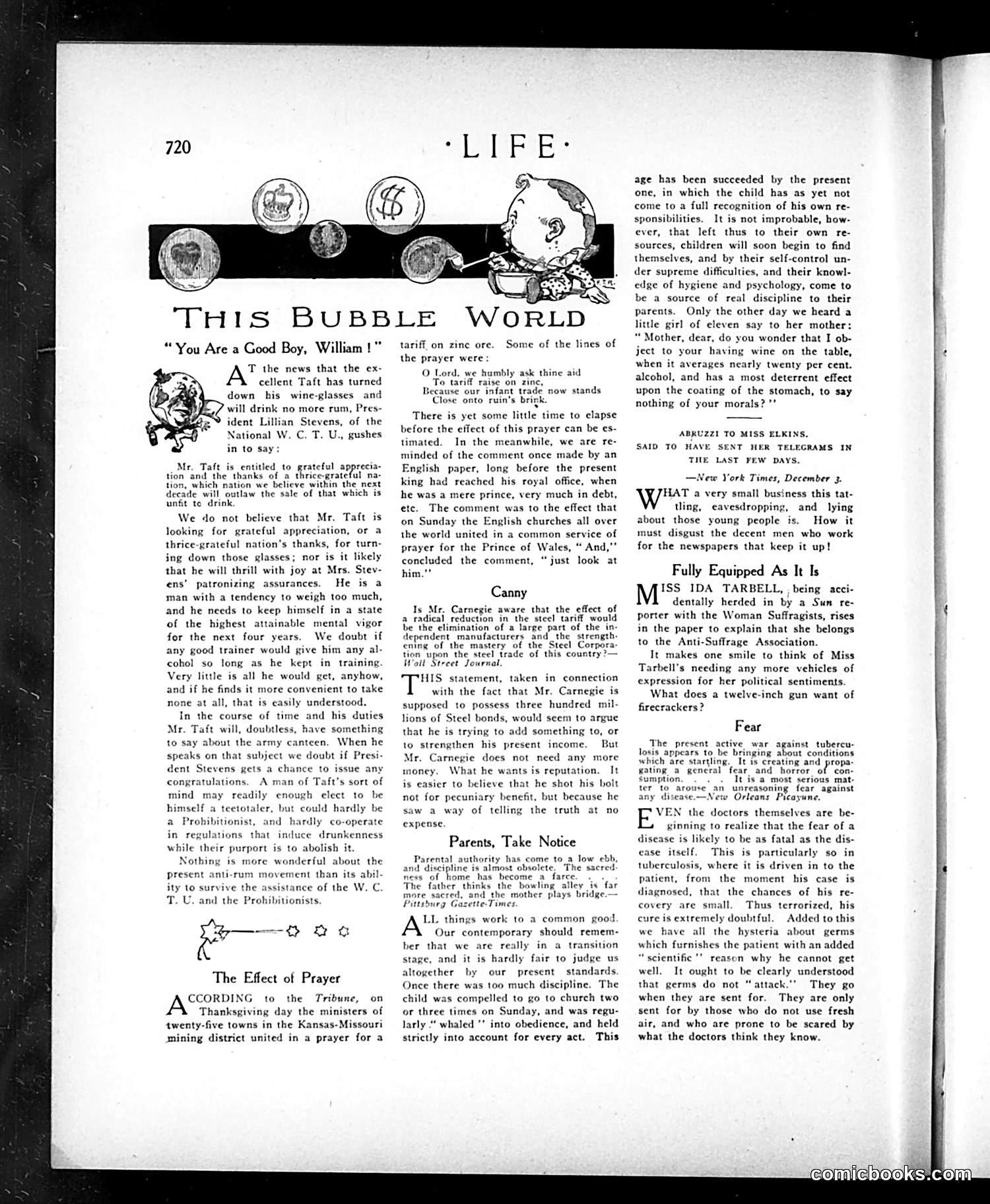
**"This Bubble World"** cartoon depicts a baby (labeled "You Are a Good Boy, William!") surrounded by soap bubbles containing various symbols—including what appear to be monetary/financial images (dollar signs, coins). The accompanying article criticizes how modern parents are raising children, suggesting they're shielded from reality and genuine discipline. The text references President Taft and debates about tariffs, steel industry consolidation (Carnegie), and the Prohibitionists' influence on American policy. The satire mocks how wealth and parental indulgence create an artificial "bubble world" disconnecting children from real consequences and responsibilities. The bubble imagery suggests fragility and inevitable bursting of such false security. The page also includes sections on prayer's effectiveness and tuberculosis fears—reflecting early 20th-century progressive social concerns.
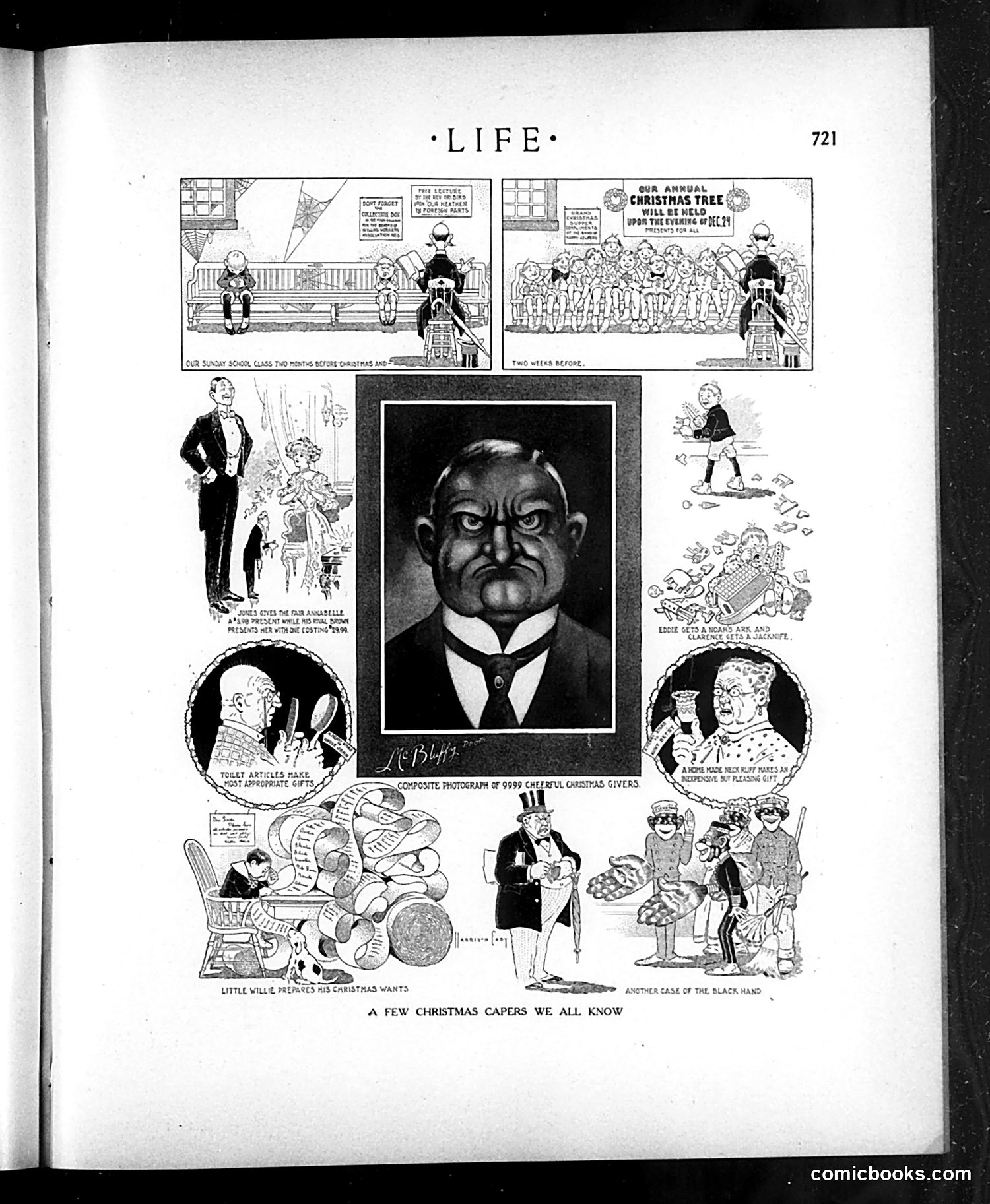
This Christmas-themed satirical page features "A Few Christmas Capers We All Know." The central portrait shows a stern-faced man labeled as a "composite photograph of 5999 careless Christmas givers" — satirizing people who give thoughtless gifts. The surrounding comic vignettes mock various Christmas stereotypes: a man receiving an unwanted gift "while his mail room shudders"; someone giving inappropriate presents; "Little Willie" receiving unwanted items; and "Another Case of the Black Hand" (possibly referencing extortion or coercion in gift-giving). The top panels show contrasting scenarios: a Sunday school class photo and a crowd viewing "our annual Christmas tree." The overall satire criticizes thoughtless, impersonal, or inappropriate Christmas gift-giving practices of the era, mocking both givers and the commercial aspects of the holiday.
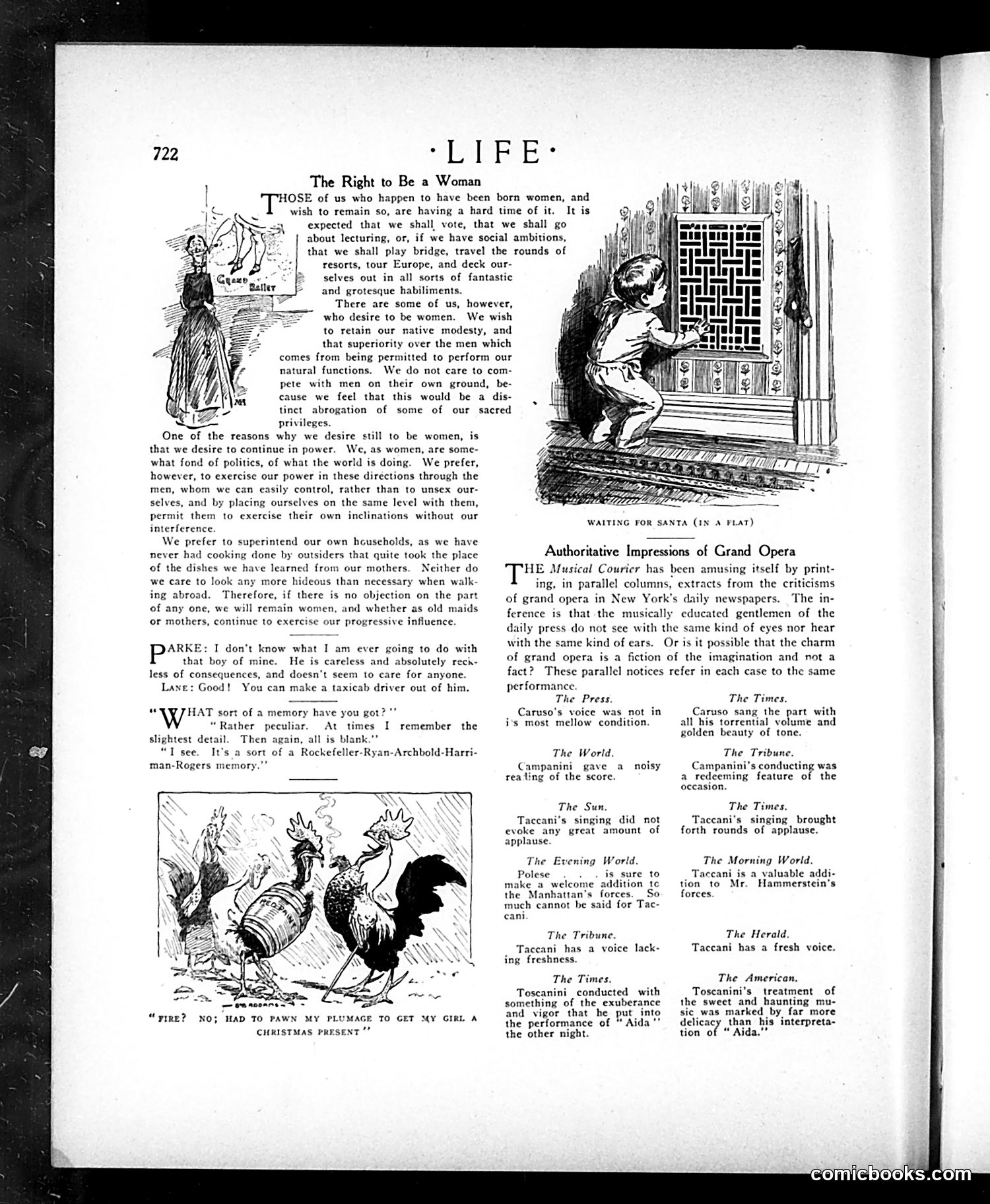
**Main Article: "The Right to Be a Woman"** This essay argues women should retain traditional domestic authority rather than pursue complete equality with men. The author contends women possess "natural functions" and "sacred privileges" that shouldn't be surrendered for unsex equality. The piece advocates women maintain power over household management and influence through men rather than compete directly. **Lower Cartoon:** A rooster and hen appear in a domestic scene. The caption reads: "FIRE? NO; HAD TO PAWN MY PLUMAGE TO GET MY GIRL A CHRISTMAS PRESENT!" This satirizes male financial burden in courting—the rooster has literally sacrificed his defining feature (plumage) to afford a gift, mocking the expectation that men bear courtship expenses while women remain economically dependent.
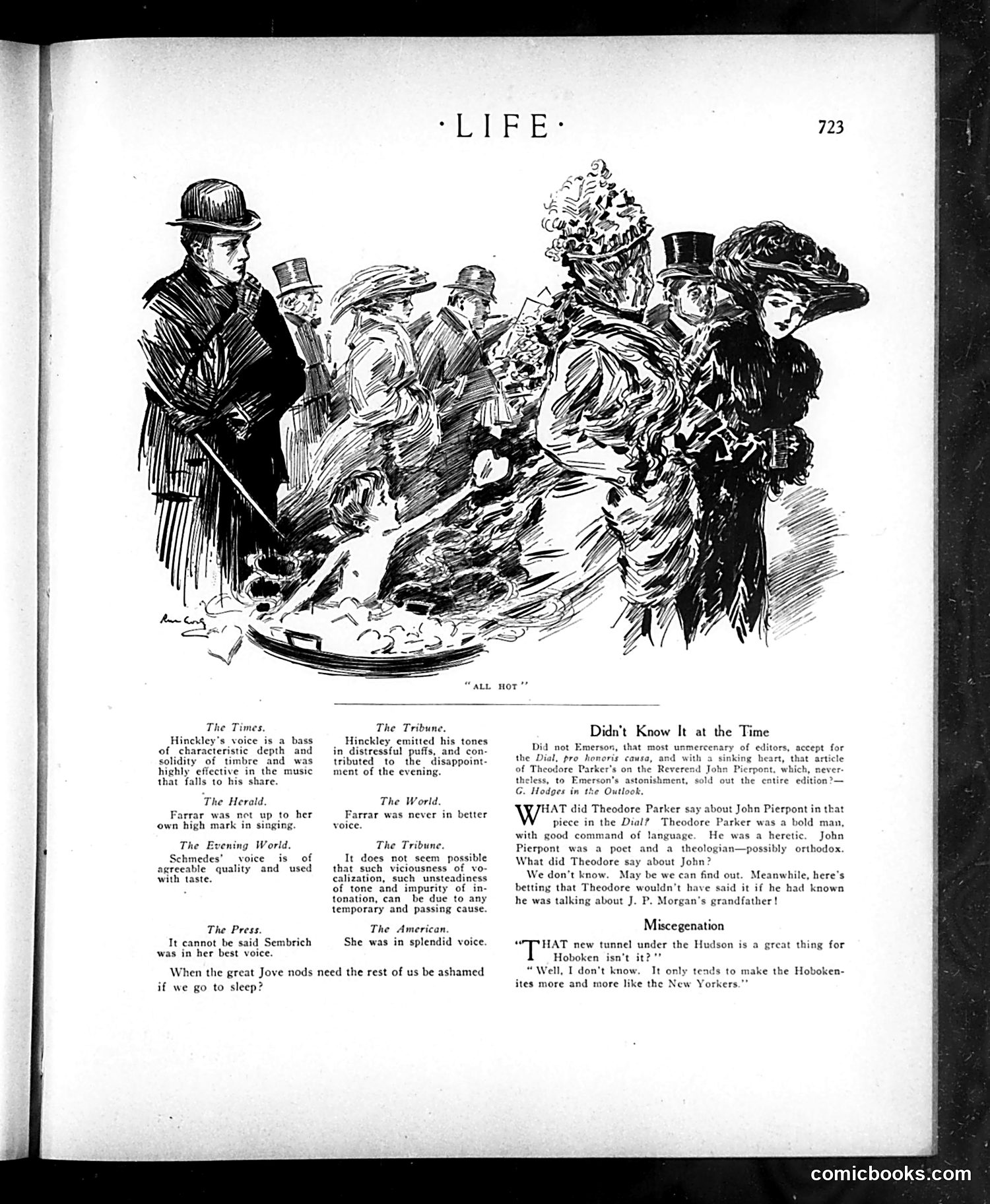
This sketch satirizes a heated public debate, likely about Theodore Parker, a 19th-century theologian and abolitionist. The cartoon's title "All Hot" suggests arguments have become overheated and emotional rather than rational. The text references competing newspaper accounts: the Times praised singer Hinckley's performance, the Tribune criticized it, and the World and American offered different takes. The "Didn't Know It at the Time" section mocks Theodore Parker's involvement in a controversy—possibly related to J.P. Morgan's grandfather, based on the text's mention. The crowded, animated figures in the sketch suggest contentious public debate. The satire appears aimed at how the same event generates wildly contradictory press coverage and public reaction, with everyone speaking passionately but nobody agreeing on facts.
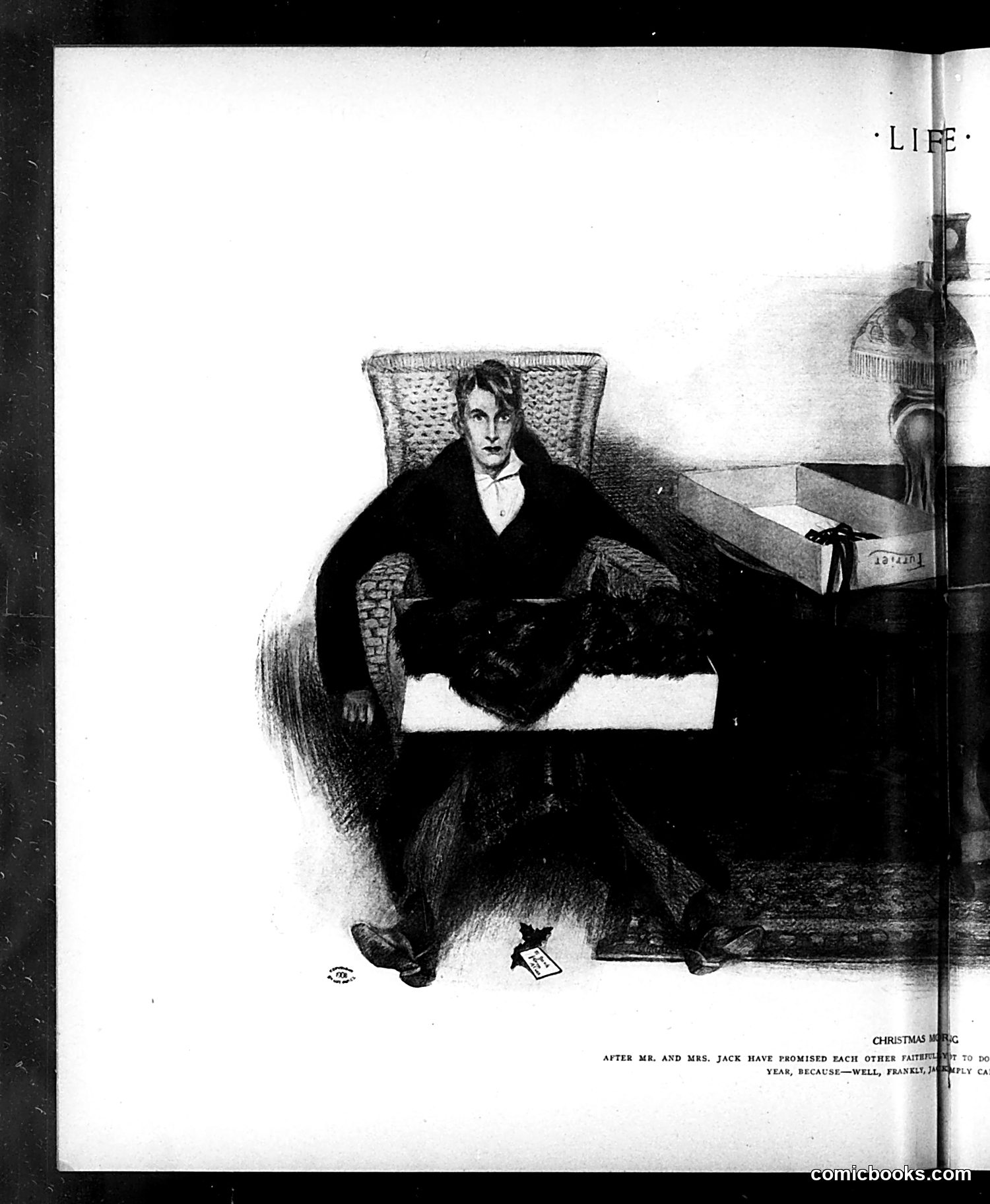
This Life magazine cartoon depicts a man slouched in a chair at a desk, looking dejected. The caption reads: "After Mr. and Mrs. Jack have promised each other faithfully not to do any year, because—well, frankly, it simply ca[nnot continue]..." The satire targets the hypocrisy of Christmas gift-giving resolutions. The cartoon suggests that couples frequently make mutual promises to abandon expensive holiday gift exchanges for financial or practical reasons, yet these pledges inevitably fail—the joke being that such "faithfully" sworn commitments are predictably broken. The figure's defeated posture emphasizes the futility and resignation surrounding this annual ritual. The cartoon mocks the cyclical nature of human weakness and the difficulty of maintaining financial discipline during the holidays, a timeless social commentary that remains relevant today.
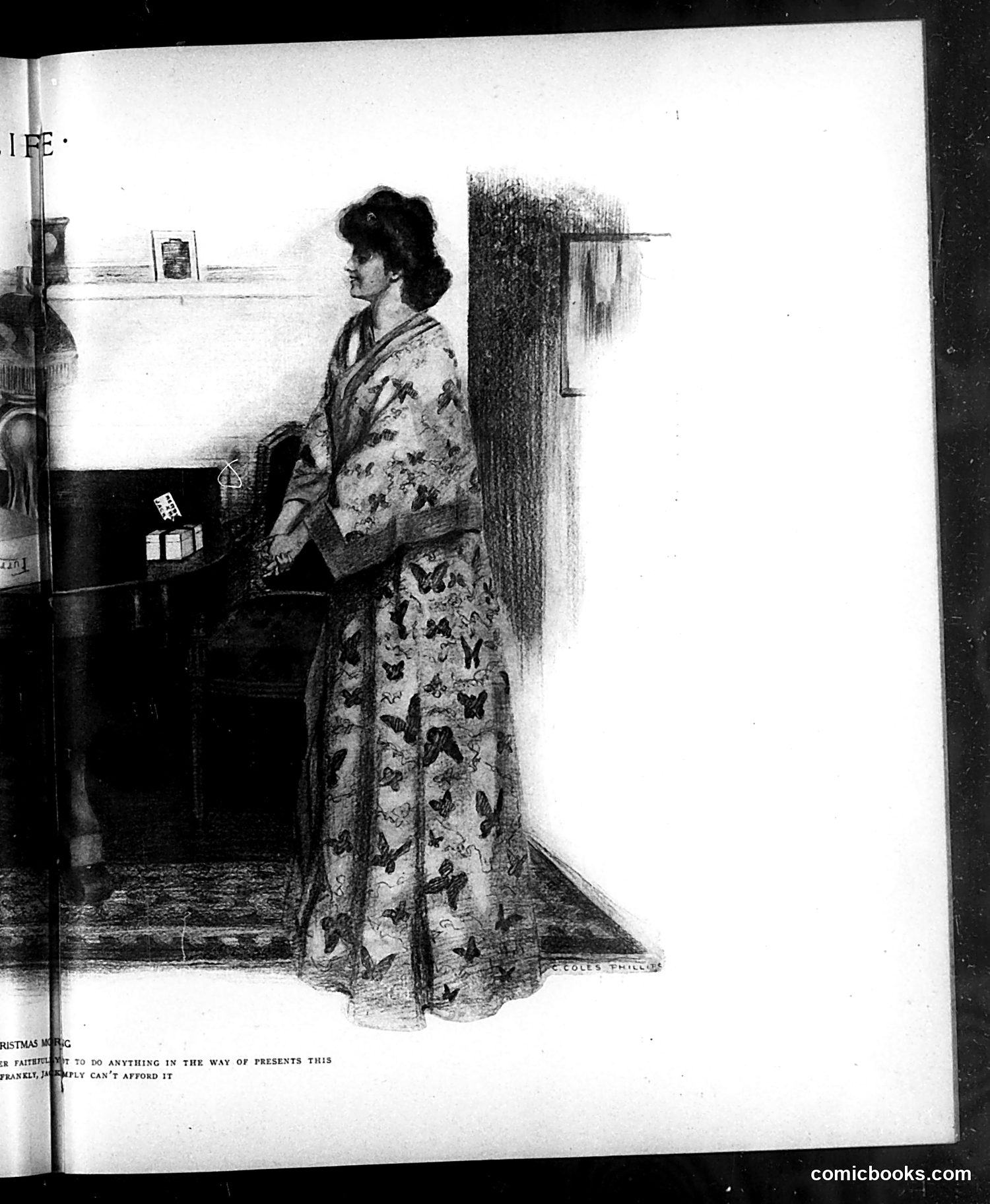
This appears to be an illustration from *Life* magazine showing a woman in an elegant, patterned robe standing in a domestic interior. The signature reads "E. Coles Phillips." The partially visible OCR text at bottom mentions "Christmas" and something about "presents" and "can't afford it," suggesting this is holiday-themed satire about financial constraints during gift-giving season. The illustration depicts a woman in fashionable dress, likely commenting on the tension between social expectations to present oneself elegantly and the economic reality of modest means—a common *Life* magazine theme. The specific joke appears to relate to maintaining appearances despite financial limitations during the expensive Christmas season. Without clearer text visibility, the precise satirical target remains somewhat unclear.
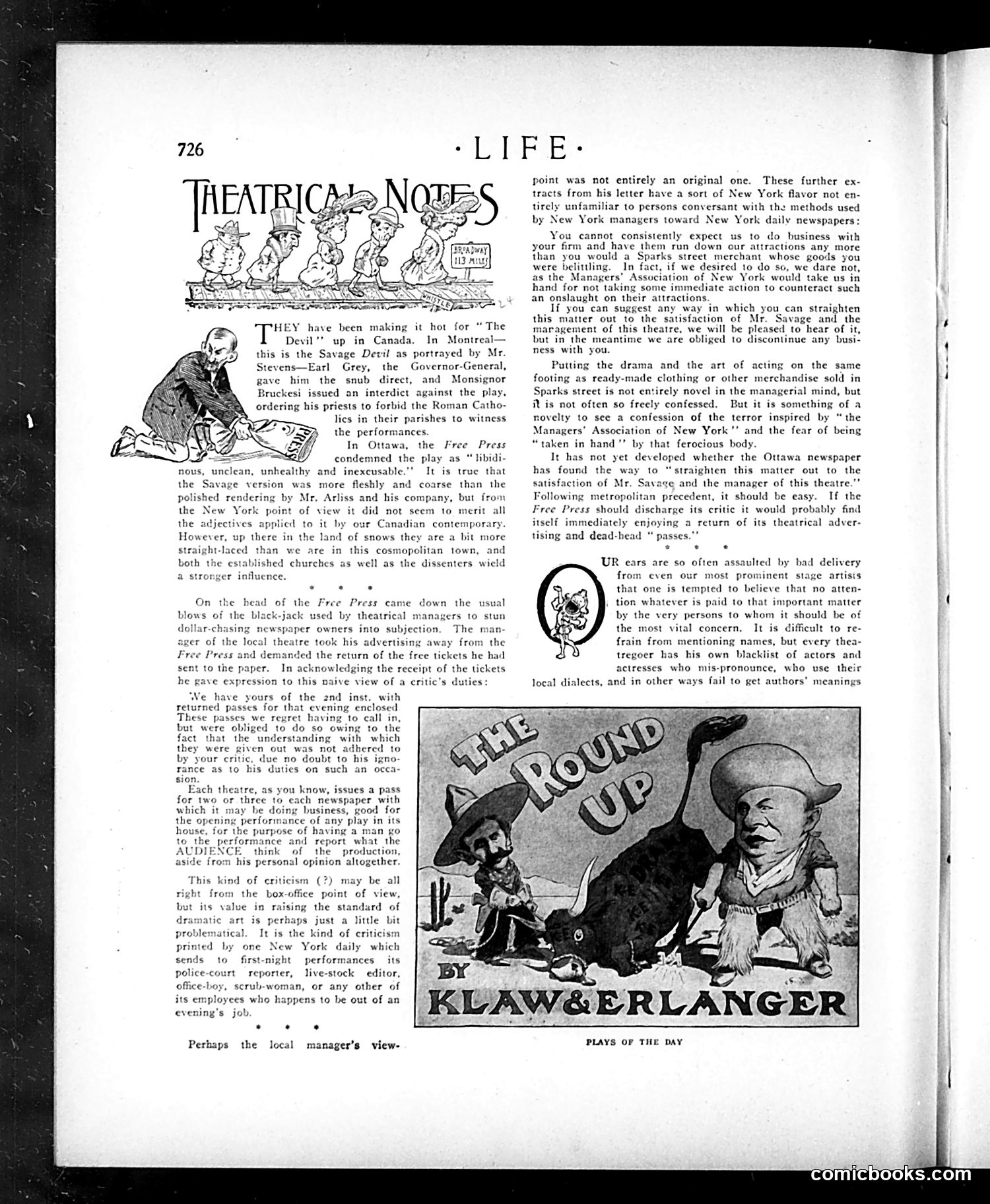
The page contains theater criticism discussing a Canadian production of "The Devil" and disputes between theatrical managers and newspaper critics over free passes. The main cartoon, titled "**The Pound**" and credited to **Klaw & Erlanger** (prominent theatrical producers), depicts what appears to be a dog pound or cage scene. The visual pun conflates theatrical management with animal control—likely satirizing Klaw & Erlanger's treatment of performers or their heavy-handed business practices. The cartoon suggests these producers "cage" or control their talent similar to how a pound confines animals. The surrounding text criticizes how theater managers attempt to silence critics through complimentary pass policies, arguing this creates conflicts of interest in theatrical journalism.
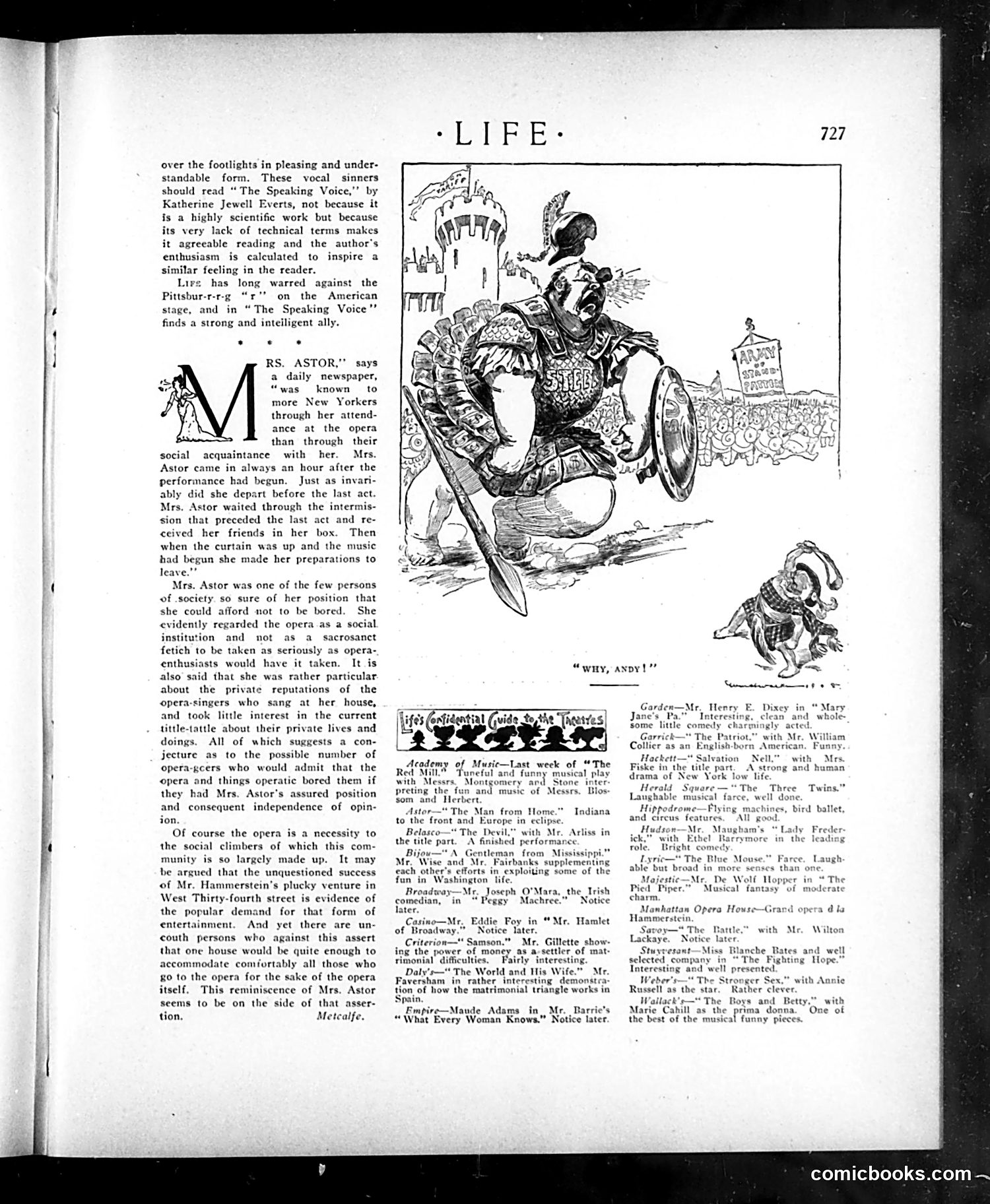
This page reviews theatrical performances, primarily opera and musical comedy productions. The main cartoon illustrates a scene titled "Why, Andy!" featuring what appears to be operatic characters in elaborate costume and armor, drawn in a exaggerated caricature style typical of Life's satirical approach. The text discusses Mrs. Astor's social prominence and her attendance at opera performances, satirizing how wealthy society figures treated the opera as a social obligation rather than genuine artistic appreciation. The magazine mocks the pretension of high society—suggesting opera-goers valued social status over actual musical merit. The reviews of various theatrical productions (listed at bottom) indicate this is entertainment criticism commentary from what appears to be the early 20th century based on the typography and illustration style.
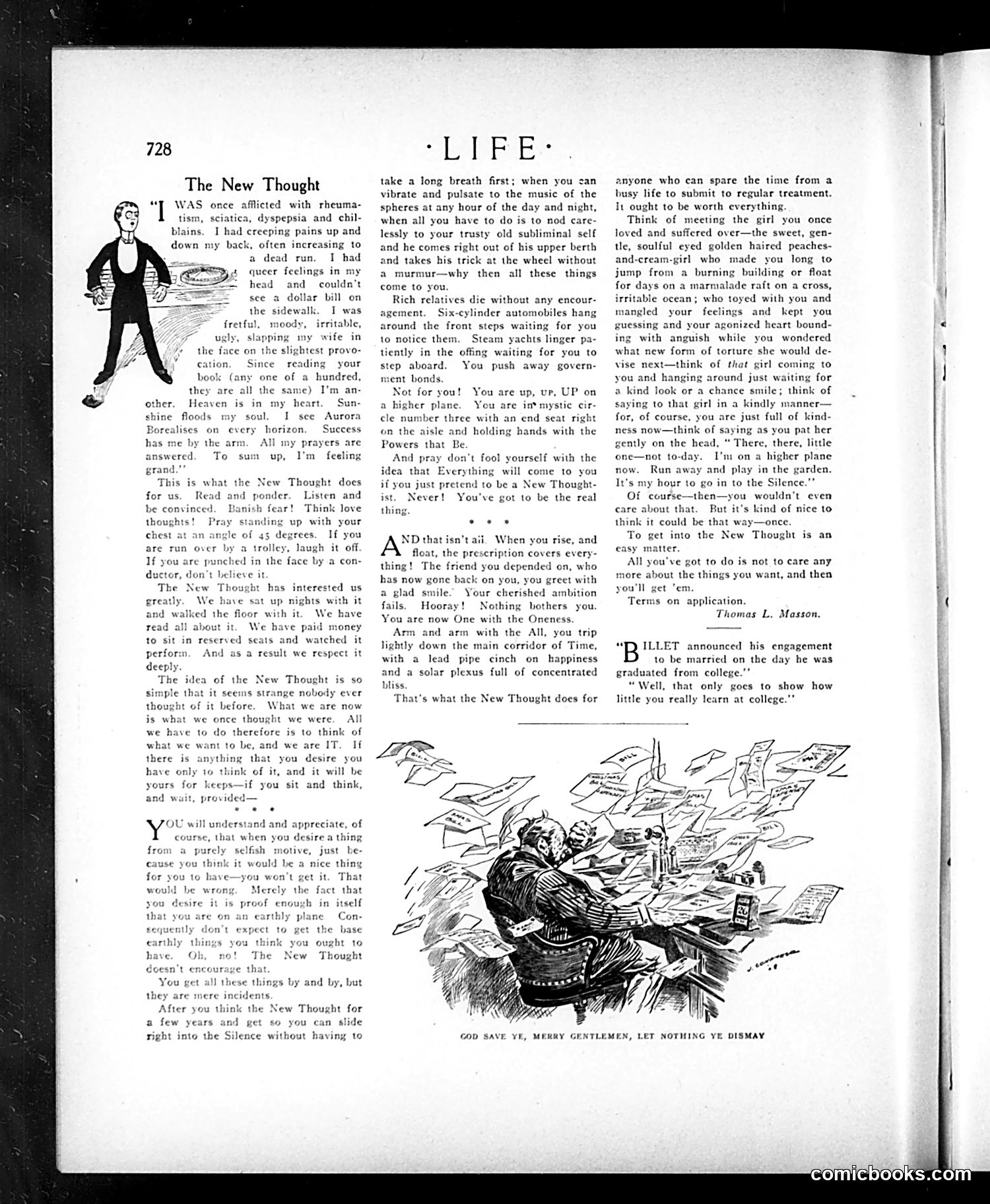
This article mocks the popular "New Thought" movement of the early 20th century—a self-help philosophy promising that positive thinking and belief in one's desires could manifest material success and happiness. The satire works through exaggeration: a man claims the philosophy cured his rheumatism and bad temper, then describes absurd consequences—rich relatives conveniently dying, luxury cars appearing on his lawn, government bonds rejecting themselves. The author ridicules the movement's core claims by showing how its logic produces ridiculous, unearned outcomes. The accompanying cartoon depicts Santa Claus buried under scattered money and gifts, labeled "God Save Ye, Merry Gentlemen, Let Nothing Ye Dismay"—suggesting that New Thought followers expect wealth to materialize like Christmas presents without effort. The piece targets both the movement's magical thinking and its appeal to selfish materialism, exposing how it promises effortless prosperity through mere belief—a con fundamentally at odds with reality and genuine morality.
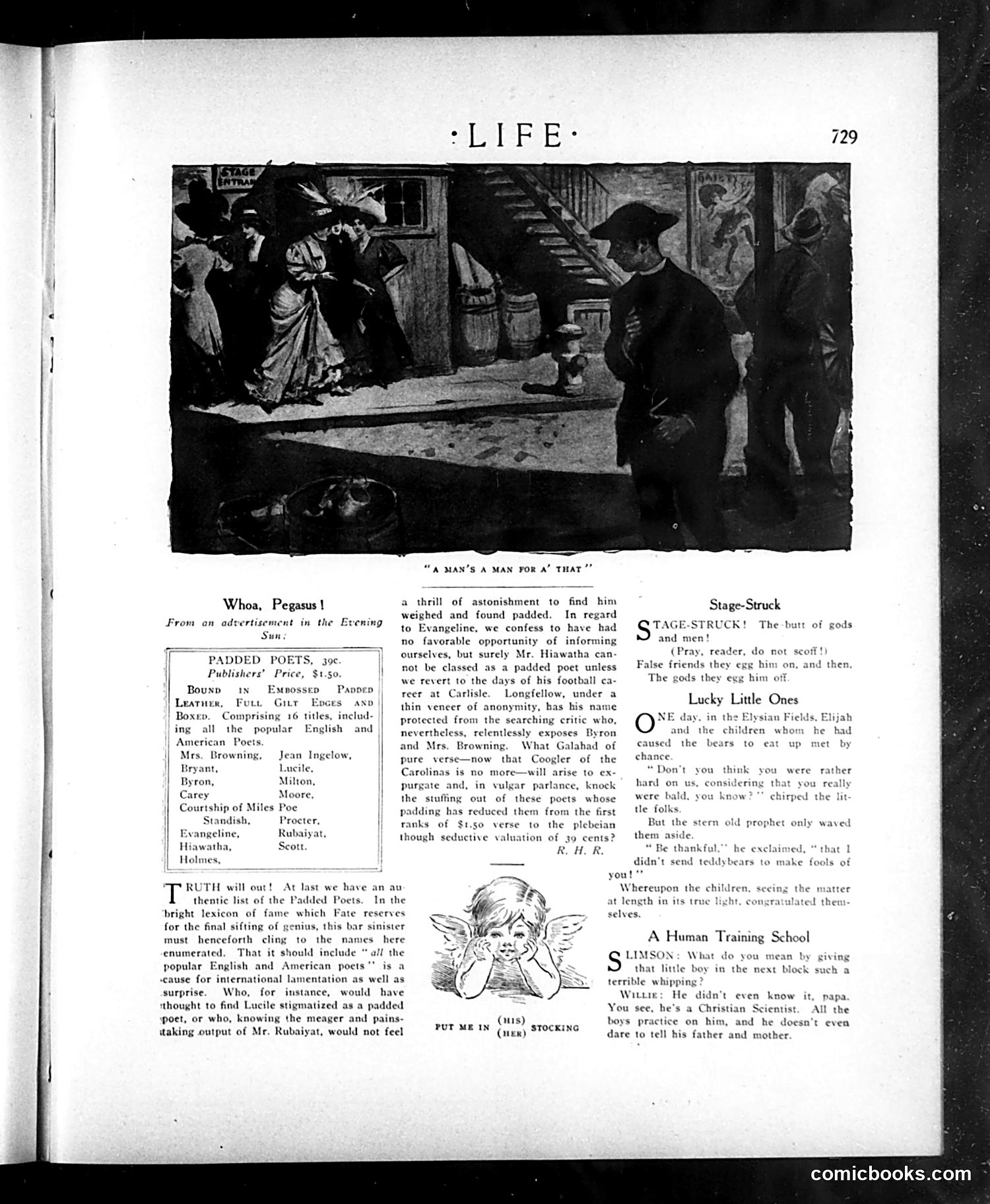
This page satirizes a book called *Padded Poets*—a collection of English and American poetry selections bound in decorative leather. The satire mocks the inclusion of certain poets deemed unworthy of "first ranks," now reduced to "39 cents" valuation. The humor targets specific poets listed as "padded" (inflated in reputation): *Evangeline* and *Hiawatha* by Longfellow receive particular ridicule. The author questions how Hiawatha—referenced oddly as having a "football career at Carlisle"—qualifies as serious verse. Byron and Mrs. Browning are also mentioned as exposed frauds. The lower sections contain unrelated comic vignettes about theater ambition and child-rearing, typical of Life magazine's miscellaneous humor format. The overall point: publishers were profiting by repackaging mediocre poetry in fancy bindings for unsuspecting readers.
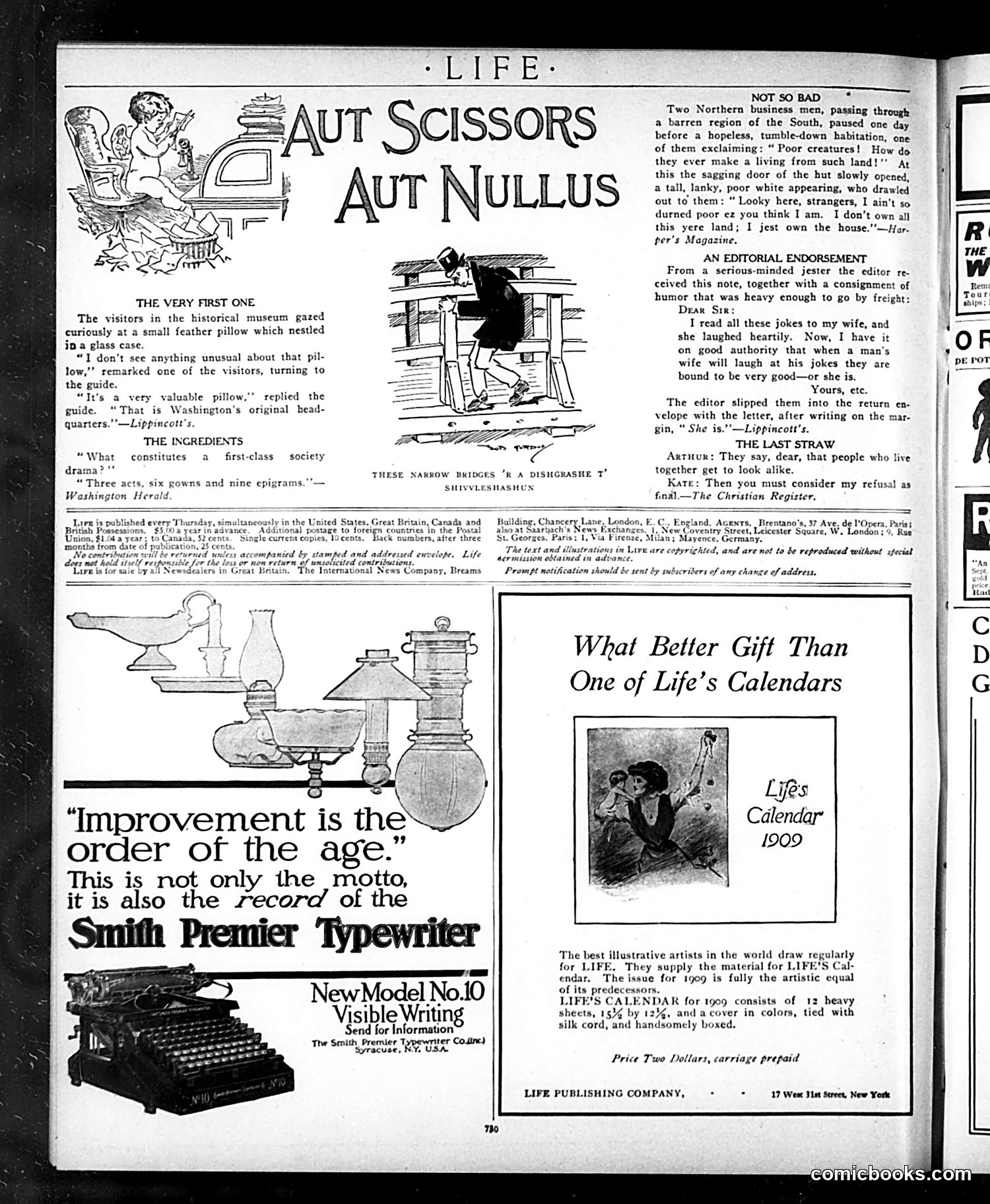
This page from Life magazine contains several brief satirical jokes and advertisements, typical of the publication's humor format. **The cartoons/jokes:** 1. **"The Very First One"** mocks museum curators' tendency to inflate historical significance—a feather pillow is presented as "Washington's original headquarters," a nonsensical claim that plays on the absurdity of relic veneration. 2. **"The Ingredients"** satirizes formulaic Broadway drama, reducing "first-class society" plays to mere superficial elements: acts, expensive gowns, and witty one-liners. 3. **"Not So Bad"** uses dialect humor (common in the era) to depict poor Southern whites defending their dignity. A destitute farmer counters Northern condescension by claiming he owns his shabby house, inverting expectations about poverty and property ownership. 4. **"The Last Straw"** is a brief marital joke about couples growing to resemble each other—Kate refuses this inevitability by rejecting marriage. The page also advertises Life's 1909 calendar and a Smith-Premier typewriter. These represent typical turn-of-century Life content: lightweight humor mixed with advertising.
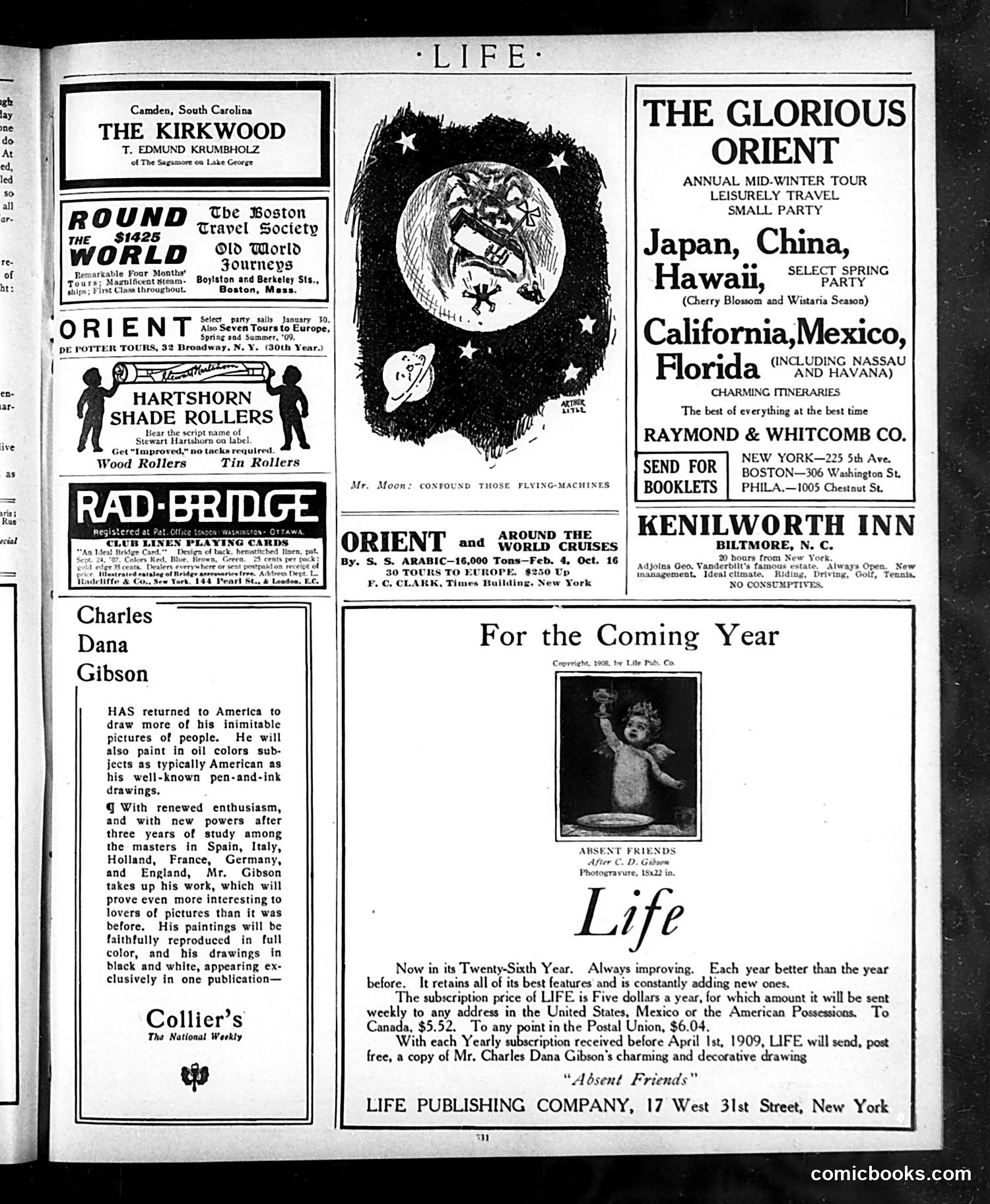
This is primarily an **advertising and promotional page** from Life magazine (circa 1908-1909), not a political cartoon page. The central cartoon shows **Mr. Moon** (a personified moon with a face) exclaiming "CONFOUND THOSE FLYING-MACHINES!" — a topical reference to the early aviation era and public anxiety about this new technology. It's a light joke about how even the moon finds airplanes bothersome. The page otherwise consists of travel advertisements (Orient cruises, European tours), product ads (shade rollers), and a notice about **Charles Dana Gibson's return to America**. Gibson was Life's famous illustrator, known for the "Gibson Girl" drawings. The notice announces he'll contribute new work exclusively to Life magazine after three years studying European masters. The page reflects 1908-1909 concerns: fascination with exotic travel, emerging aviation technology as both marvel and nuisance, and the celebrity status of prominent illustrators in the magazine industry.
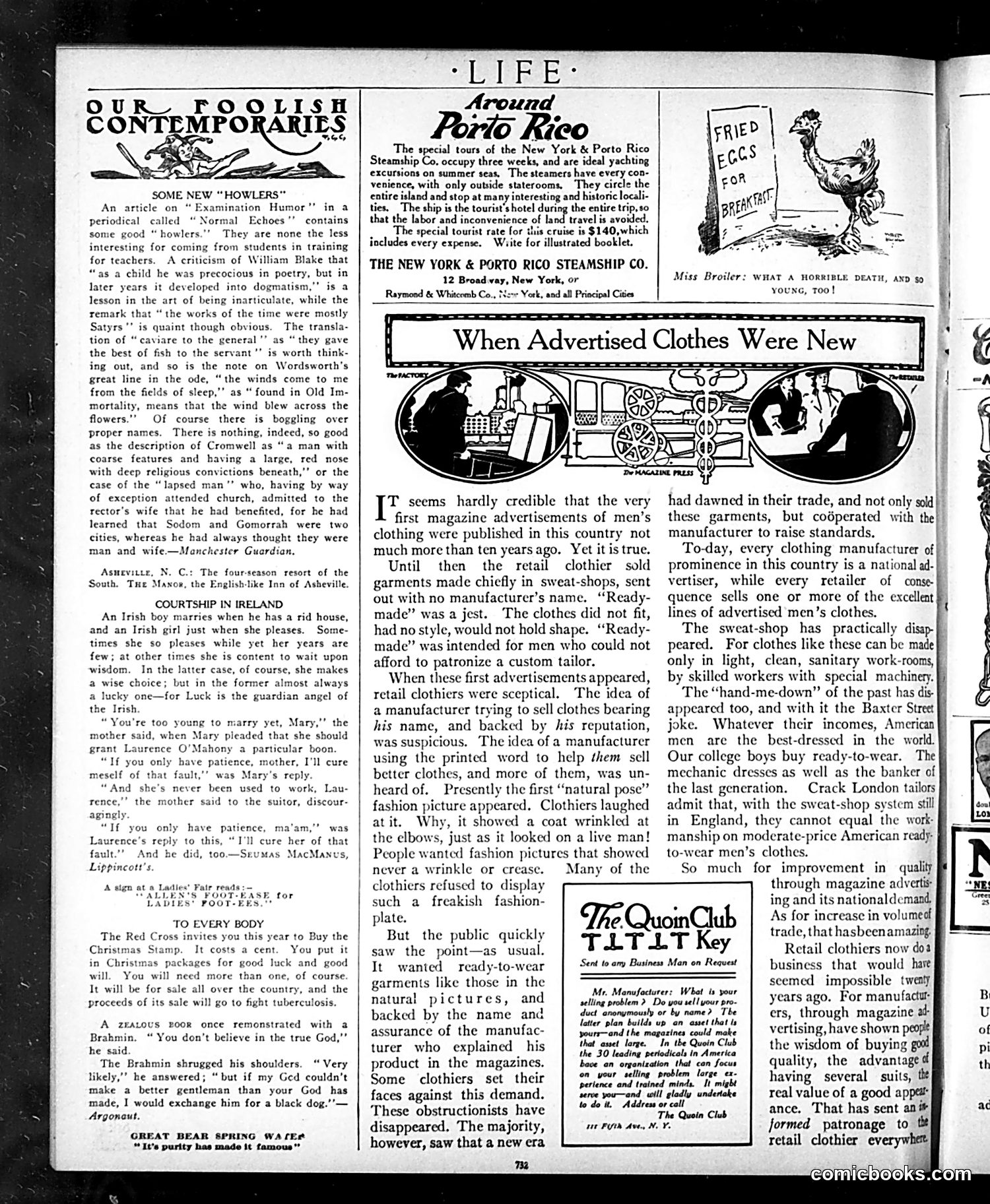
This page primarily contains **humorous anecdotes and advertisements** rather than political cartoons. The main content includes: **"Some New Howlers"** — A collection of amusing student blunders from a teacher-training publication, satirizing malapropisms and misinterpretations (e.g., describing Cromwell's "deep religious convictions" or confusing Sodom and Gomorrah as a married couple). This mocks educational pretension. **"Courtship in Ireland"** — A lighthearted sketch playing on Irish stereotypes about romance and luck. **The small chicken cartoon** (top right) labeled "Miss Broiler" is a pun about eggs for breakfast. **The main article "When Advertised Clothes Were New"** discusses how early magazine clothing advertisements didn't feature manufacturer names—companies were reluctant to advertise directly. This historical piece explains the evolution of modern advertising practices. The page is predominantly filled with **period advertisements** (steamship tours, Red Cross stamps, spring water), reflecting Life's function as both satirical magazine and advertising vehicle. There is no significant political satire on this particular page.
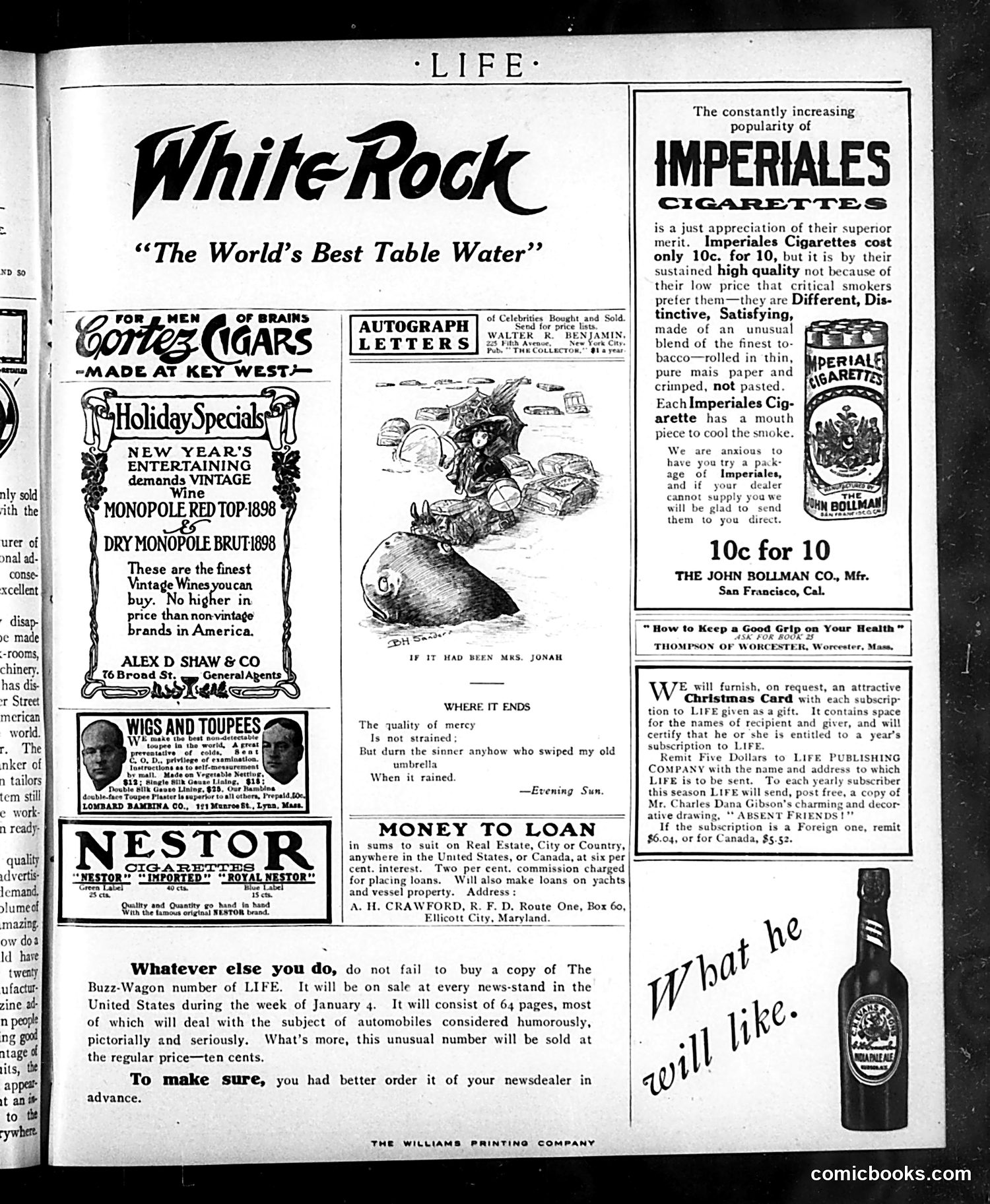
This page is primarily **advertising and promotional content** rather than political satire. The main cartoon—titled "Where It Ends"—depicts a man in the rain discovering his stolen umbrella has been returned damaged, with the caption playing on Shakespeare's "quality of mercy" speech to suggest mercy toward umbrella thieves. The page features advertisements for **White Rock water, Gorton cigars, Imperiales cigarettes, Nestor brandy**, and various services (money loans, wigs). There's also promotion for an upcoming "Buzz-Wagon" automobile-themed issue of *Life*. The cartoon's humor is gentle domestic satire: the mild frustration of a petty theft resolved with ironic acceptance. The Shakespeare reference adds literary wit typical of *Life* magazine's educated audience. No specific political figures or events are referenced. This represents typical early 1900s magazine advertising and light humor rather than pointed social commentary.
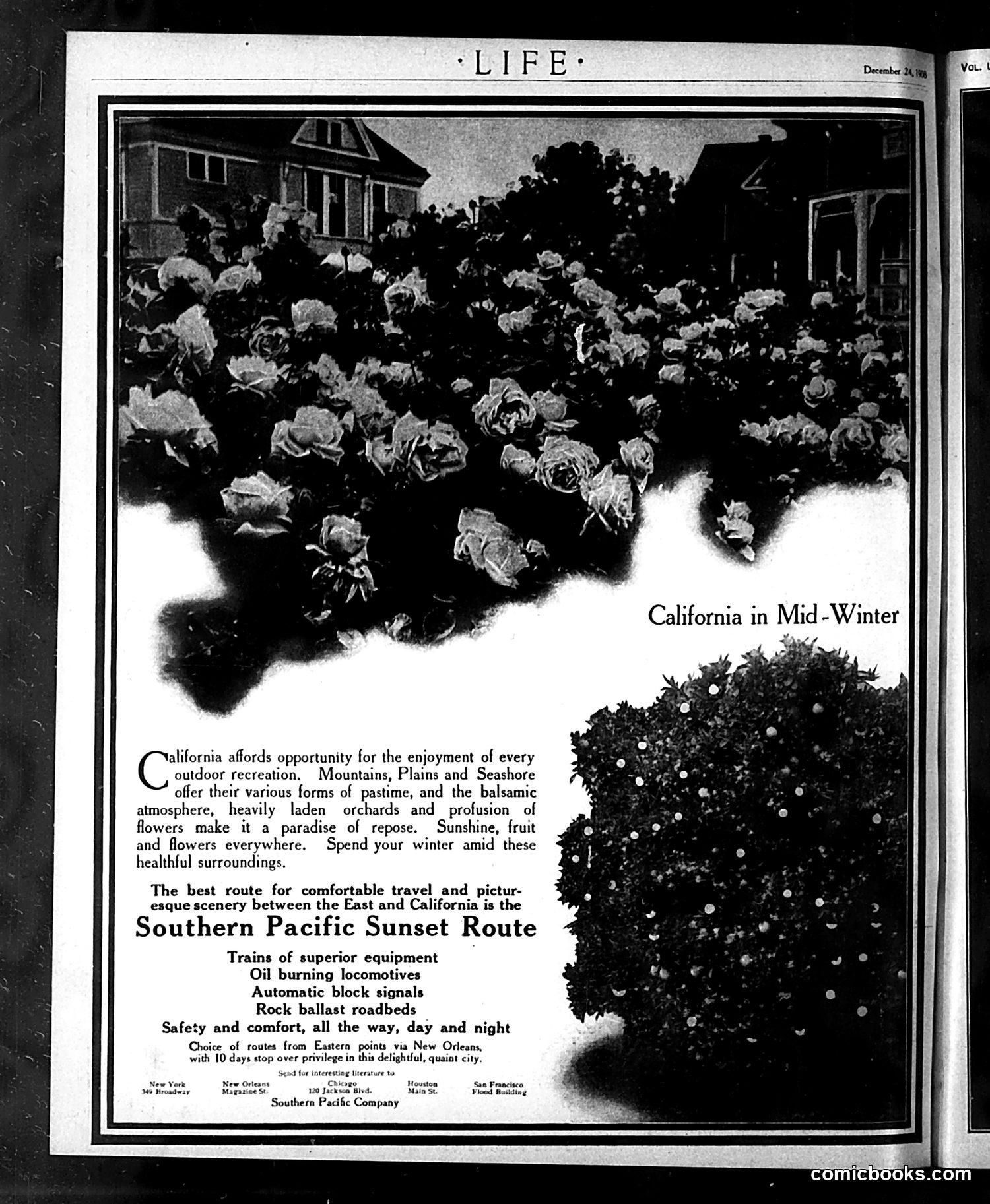
This is primarily a **travel advertisement**, not political satire. The page promotes the Southern Pacific Railroad's "Sunset Route" to California, targeting East Coast travelers. The imagery shows California's winter appeal: blooming roses in the upper photograph and flowering shrubs below, positioned against the map shape of California. The text emphasizes California as a winter destination offering outdoor recreation, orchards, and "profusion of flowers" — contrasting with harsh Eastern winters. The advertisement highlights the railroad's modern amenities (oil-burning locomotives, automatic signals, rock ballast roadbeds) and convenience (10-day New Orleans stopover). It's a straightforward commercial pitch exploiting California's climate advantage during the era when winter travel to warm destinations was a luxury pursued by affluent Americans. No cartoon or political commentary is present here — it's pure promotional content from an early-20th-century publication.