
Life, 1908-12-24 · page 4 of 20
Life — December 24, 1908 — page 4: what you’re looking at
What you’re looking at
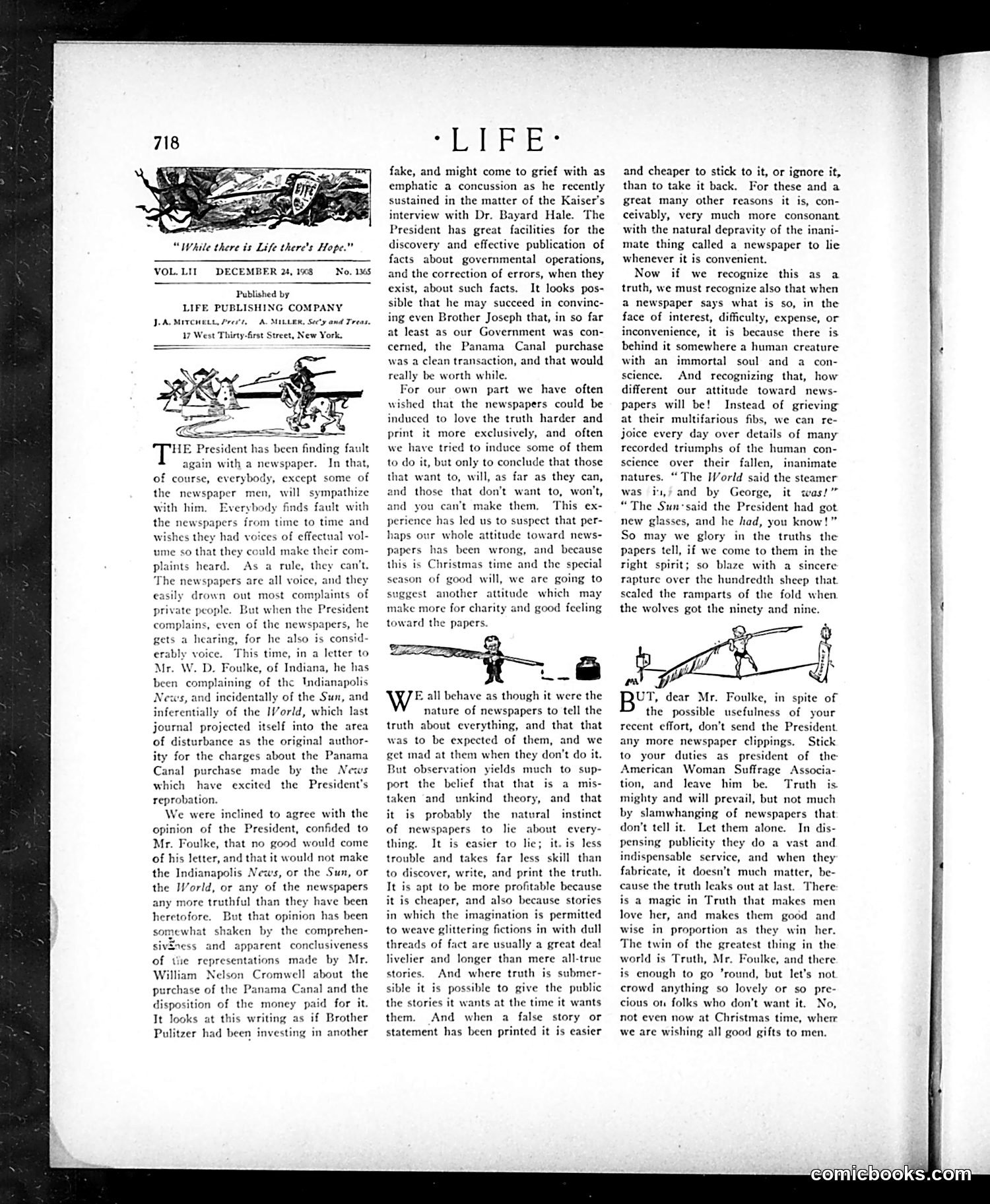
This December 24, 1908 editorial addresses tensions between President Theodore Roosevelt and American newspapers over truthfulness in reporting. The text criticizes newspapers for sometimes prioritizing sensational stories over accuracy, while defending their essential role in exposing government corruption (specifically referencing the Panama Canal controversy). The small cartoons appear to illustrate the tension humorously—figures at bottom left seem to depict the clash between press and authority. The editorial argues that despite newspapers' flaws, truth-telling remains their moral duty, especially during the Christmas season. It's a plea for journalistic integrity rather than profitable fiction, framed as a holiday moral lesson about valuing honesty in public discourse.
📄 Transcribed text from this page (OCR, searchable)
Machine-transcribed from the original scan — historical spelling and the odd misread are preserved.
VOL.LIT DECEMBER 24, 1%8 Published by LIFE PUBLISHING COMPANY JA MITCHELL, Pret, A MILLER, Secty and Tres 17 West Thirty-first Street, New York. 'HE President has been finding fault again with a newspaper. In that, everybody, except some of the newspaper men, will sympathize with him. Everybody finds fault with the newspapers from time to time and wishes they had voices of effectual vol- ume so that they could make their com- nts heard. As a rule, they can't. The newspapers are all voice, and they easily drown out most complaints of private people. But when the President complains, even of the newspapers, he gets a hearing, for he also is consid- erably voice. This time, in a letter to Mr. W. D. Foulke, of Indiana, he has been complaining of thc Indianapolis News, and incidentally of the Sun, and inferentially of the IVorld, which last journal projected itself into the area of disturbance as the original author- ity for the charges about the Panama Canal purchase made by the News which have excited the President's reprobation. We were inclined to agree with the opinion of the President, confided to Mr. Foulke, that no good would come of his letter, and that it would not make the Indianapolis News, or the Sun, or the World, or any of the newspapers any more truthful than they have been heretofore. But that opinion has been somewhat shaken by the comprehen- sivSness and apparent conclusiveness of tie representations made by Mr. William Nelson Cromwell about the purchase of the Panama Canal and the disposition of the money paid for it. It looks this writing as if Brother Pulitzer had been investing in another of cour: “SERIES fake, and might come to grief with as emphatic a concussion as he recently sustained in the matter of the Kaiser’s interview with Dr. Bayard Hale. The President has great facilities for the discovery and effective publication of facts about governmental operations, and the correction of errors, when they exist, about such facts. It looks pos- sible that he may succeed in convine- ing even Brother Joseph that, in so far at least as our Government was con- cerned, the Panama Canal purchase was a clean transaction, and that would really be worth while. For our own part we have often wished that the newspapers could be induced to love the truth harder and print it more exclusively, and often we have tried to induce some of them to do it, but only to conclude that those that want to, will, as far as they can, and those that don’t want to, won't, and you can't make them. This ex- perience has led us to suspect that pe: haps our whole attitude toward news- papers has been wrong, and because this is Christmas time and the special ason of good will, we are going to gest another attitude which may make more for charity and good feeling toward the papers. all behave as though it were the nature of newspapers to tell the truth about everything, and that that was to be expected of them, and we get mad at them when they don’t do it. But observation yields much to sup- W port the belief that that is a mis- taken and unkind theory, and that it is probably the natural instinct of newspapers to lie about ever thing. It is easier to lie; it. is less trouble and takes far less skill than to discover, write, and print the truth. It is apt to be more profitable because it is cheaper, and also because stories in which the imagination is permitted to weave glittering fictions in with dull threads of fact are usually a great deal livelier and longer than mere all-true stories. And where truth is submer- sible it is possible to give the public the stories it wants at the time it wants them. And when a false story or statement has been printed it is easier and cheaper to stick to it, or ignore it, than to take it back. For these and a great many other reasons it is, con- ceivably, very much more consonant with the natural depravity of the inani- mate thing called a newspaper to lie whenever it is convenient. Now if we recognize this as a truth, we must recognize also that when a newspaper says what is so, in the face of interest, difficulty, expense, or inconvenience, it is because there is behind it somewhere a human creature with an immortal soul and a con- science. And recognizing that, how different our attitude toward news- papers will be! Instead of grieving at their multifarious fibs, we can re- joice every day over details of many recorded triumphs of the human con- science over their fallen, inanimate natures. “ The World said the steamer was it,) and by George, it was!’ “The Sun-said the President had got new glasses, and he had, you know!” So may we glory in the truths the papers tell, if we come to them in the right spirit; so blaze with a sincere rapture over the hundredth sheep that scaled the ramparts of the fold when the wolves got the ninety and nine. UT, dear Mr. Foulke, in spite of the possible usefulness of your recent effort, don’t send the President any more newspaper clippings. Stick to your duties as president of the American Woman Suffrage Associa- tion, and leave him be. Truth is mighty and will prevail, but not much by slamwhanging of newspapers that don't tell it. Let them alone. In dis- pensing publicity they do a vast and indispensable service, and when they fabricate, it doesn't much matter, be- cause the truth leaks out at last. There is a magic in Truth that makes men love her, and makes them good and wise in proportion as they win her. The twin of the greatest thing in the world is Truth, Mr. Foulke, and there is enough to go ’round, but let’s not crowd anything so lovely or so pre- cious on folks who don’t want it. No, not even now at Christmas time, wher we are wishing all good gifts to men.